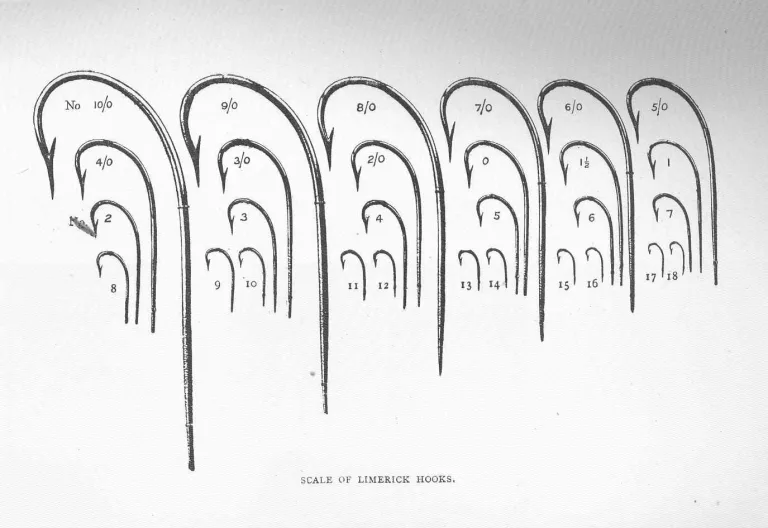
The bend is the part of a hook that carries its name. Ask a tackle dealer in 1890 for “a dozen number 6 Limericks” and he knew exactly what you meant, in the same way a dealer today knows what a Sproat or an Aberdeen is. But the names are older than the standards, and most of them started as places or people rather than shapes. This article takes the classic bend families in turn: where the name came from, what the shape actually is, and how to tell them apart on the bench, which is harder than the catalogues make it look.
A note on what a “bend” is
Strictly, the bend is the curve between the shank and the point. In practice a named bend describes a whole silhouette: how sharply the wire leaves the shank, how tight the curve is at the bottom, whether the point runs parallel to the shank or is angled in or out, and whether the point sits in the plane of the shank or is offset to one side. Eric Taverner made the point in 1942 that names like Limerick, Carlisle, Kirby and Kinsey were being used as bend names by 1867, but may originally have been the names of makers, and the evidence for several of them supports that.
Kirby
Kirby is the oldest of the named bends and the one with a person firmly attached to it. Charles Kirby was a London needle and hook maker of the mid-seventeenth century, working in the years around the Great Fire, and he is generally credited with developing the tempering methods that made an English steel hook reliable. Izaak Walton’s contemporaries mention his hooks, and by 1808 “Kirby” appears in the angling books as a pattern with a cut given by Salter.
The Kirby bend is a round bend with the point kirbed: offset sideways so that, seen from the front, the point is set off to one side of the shank. The theory was that an offset point found flesh more readily. Kirbys were the workhorse bait hook of the English coarse fishing and sea fishing trades into the twentieth century, and the “eyed Kirby” scale in Thomas’s Rod in India shows the pattern in its Victorian form. Reversed and kirbed are opposites: a kirbed point is offset to one side, a reversed point to the other, and catalogues were careful about which they meant.
Limerick
Limerick is a place, not a person, and the trade it names was a real one. Irish hook makers in Limerick and Dublin, above all the O’Shaughnessy family of Limerick (the original maker died around 1820) and later Phillips and Sell of Dublin, produced salmon hooks whose reputation in the first half of the nineteenth century was unmatched. The earliest mention Taverner could find of the Limerick as a pattern is in Taylor, around 1800.
The shape is unmistakable once you know it. The wire leaves the shank in a straight, angled line, then turns in a relatively tight curve at the bottom, with the point coming back up more or less parallel to the shank. The result is a hook with a deep throat and an angular, almost triangular profile, very strong in the bend, and it became the standard salmon hook of the classic era. The Mustad 1575 on this site is a good modern example. The “Dublin Limerick” and “O’Shaughnessy” are close relatives: the O’Shaughnessy is generally understood as a heavier, slightly rounder Limerick, and became the standard heavy saltwater bend in America.

Sproat
The Sproat is the compromise, and it was designed as one. Introduced commercially in the 1860s through the Kendal firm of Hutchinson, and named for W. H. Sproat, it softens the Limerick’s angle into a smooth parabolic curve while keeping the deep throat and the strength. Henshall, in the Book of the Black Bass, argued for it at length over the Limerick and the Kirby, and his influence in America was enormous: the Sproat became the default wet-fly and bass hook of the American trade for the next century. Mustad’s 3906 and its many relatives are Sproats.
Telling a Sproat from a Limerick is the commonest bend problem in the hobby. Look at where the wire leaves the shank. On a Limerick it goes straight, at an angle, for some distance before it starts to curve. On a Sproat it starts curving almost at once, gently, and the curve keeps tightening all the way round. If there is a definite corner at the bottom of the bend, it is a Limerick.
Round and Kendal
The round bend follows a single radius from shank to point, or near enough. It is the simplest shape to make by hand around a mandrel and probably the oldest, and it is the basis of the Kendal, Carlisle and Aberdeen patterns. Kendal hooks, from the Westmorland trade, are round bends with a relatively long shank and a point that slopes very slightly in; the site uses “Round / Kendal” for a great many trout and general-purpose hooks for that reason. The Carlisle, from the Cumberland town, is a long-shanked round bend with a slightly kirbed point, historically a bait hook. The Aberdeen, from the Scottish sea-fishing port, is a fine-wire, long-shanked round bend that has become the standard light saltwater and jig hook.
Round bends hook easily and are kind to natural baits and to fly bodies, but they have less throat than a Limerick or Sproat and open more readily under heavy load in fine wire. That is why the classic salmon hook is a Limerick and the classic trout hook is a round bend, and it is why the modern “Model Perfect” style dry-fly hook is a round bend in fine forged wire.
Sneck
The Sneck is the odd one out: a square-shouldered bend with a flat bottom and a point that comes up parallel to the shank, usually kirbed. “Sneck” is a northern English word for a door latch, and the shape does look like one. Sneck bends were common on nineteenth-century trout and bait hooks and are a strong regional clue when they appear in a packet, since they were made in quantity mainly in Redditch and Kendal and rarely copied by Mustad.

Why the names drifted
Two things happened to these names in the industrial era. First, Mustad and the Redditch houses all made every bend, so a name stopped indicating a maker or a town and became a pure shape. Second, each maker interpreted the shape a little differently and then held to its own interpretation for decades, so that a Mustad Limerick, an Allcock Limerick and a Partridge Limerick are all recognisably Limericks and all measurably different. When the site’s entries record a bend, they record the family; the photographs and the compare tool show the maker’s version of it, at true scale, which is the only honest way to do it.
Source and further reading
James A. Henshall, Book of the Black Bass (1881, rev. 1889), chapter on hooks. Eric Taverner, Fly Tying for Salmon (1942). Francis Francis, A Book on Angling (1867), for the mid-century pattern plates. Ron Reinhold, “Antique Hook Manufacturers”, on the restored Ronn Lucas Sr. site.
Image note: The illustrations are public domain reproductions from Wikimedia Commons and are credited in their captions.