

The fish hook is finished. It was finished, as a design, several thousand years ago, and every serious improvement since has been in materials and manufacture rather than in the idea. That has never stopped anyone. From the 1860s to the 1930s the patent offices of Britain and the United States granted hundreds of patents for hooks that sprang, snapped, pivoted, expanded, doubled or otherwise improved on the bent pin, and almost none of them caught a fish that a plain hook would not have caught. They are, all the same, a delightful corner of the subject, and a genuine collecting field. This article looks at what the patents tried to do, a few that were actually made, and how to tell a patent hook from a fantasy.
Why patent a hook?
The great manufacturers mostly did not. Mustad never patented Mathias Topp’s hook-making machine, preferring secrecy, and the Redditch firms protected their patterns by keeping their formers to themselves. Warner & Son of Redditch held hook patents from the 1860s, and there were British patents for eyed hooks and for particular eye forms in the 1870s and 1880s, but the pattern names that mattered, Limerick, Sproat, Pennell, were never anyone’s property. The patents that survive in quantity come instead from individuals, most of them American, who believed they had solved the problem of the fish that gets away.
The spring hook
The commonest idea is the spring hook: a hook, or pair of hooks, held open or closed by a spring and released when the fish takes the bait, so that the hook sets itself. The principle is a mousetrap’s, and the mechanisms are as various. Some have a second hook that snaps across the first to trap the fish’s jaw; some have a barb that flies out; some have a trigger in the bait. Benjamin Timmons’s “Automatic Fish-Hook” of 1909, patented in Texas, is a good example: a spring-loaded hook meant to seize the fish by the head the moment it mouths the bait.

The idea is not American or even modern. Spring hooks were used in Chinese river fisheries, set unattended on lines, and a French account of 1909 illustrates a row of them, small wire springs baited and cocked. In that context, an unattended set line, a self-setting hook makes a kind of sense, and the same logic produced the circle hook. On a rod, with an angler on the other end, it solves a problem that does not exist.

The trap hook
A step beyond the spring hook is the trap hook, which does not so much hook the fish as grab it. W. N. Greer’s “Fish Trap-Hook” of 1883, illustrated in an 1887 compilation of American fishing patents, is a lever mechanism that closes a pair of arms around the fish when it pulls on the bait. Devices of this kind were made and sold, mostly for pike and catfish, and a few survive; they are heavy, clumsy and dangerous to the fingers, and they were as often used for trapping muskrats as for fishing.

The extra hook
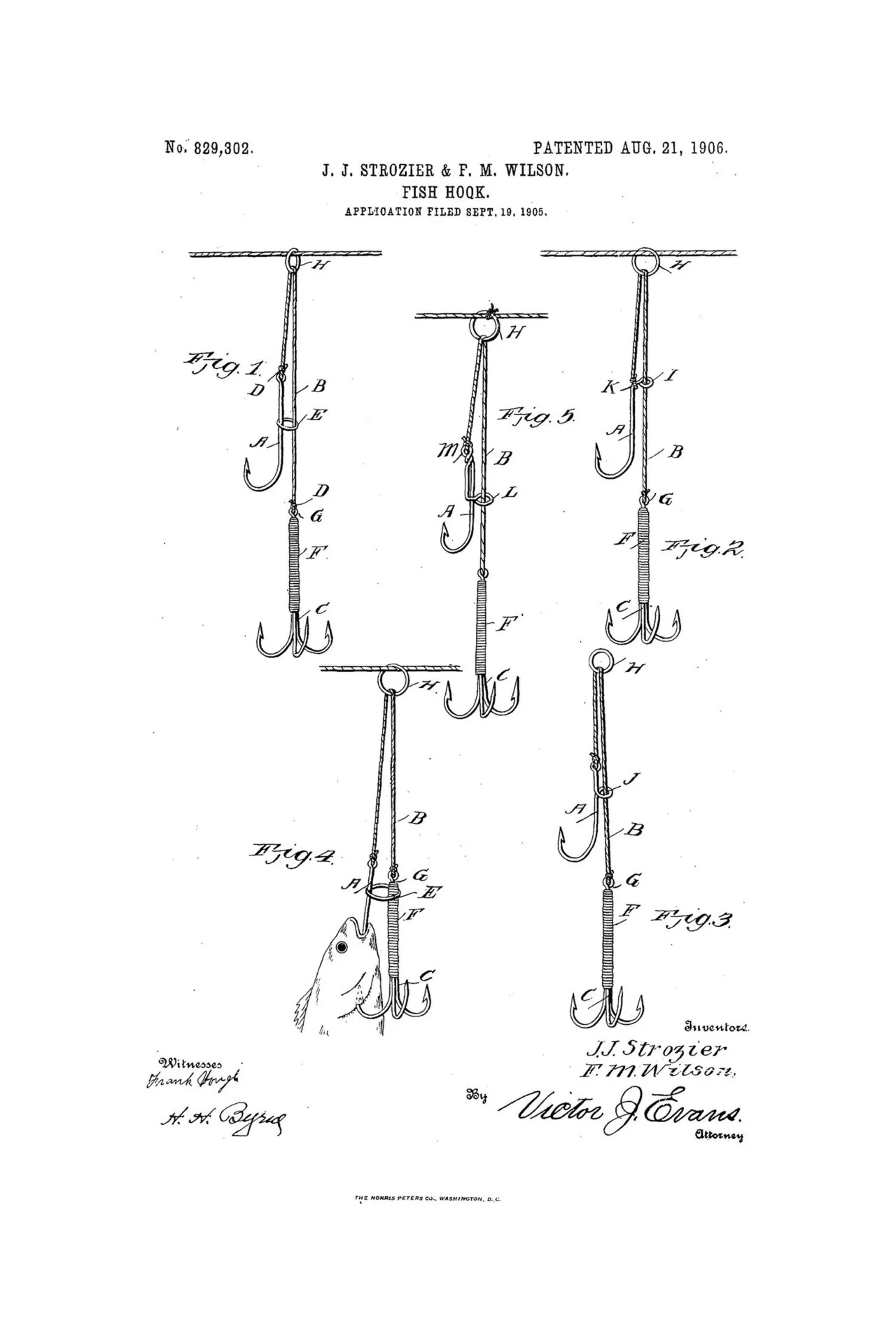
The third family adds hooks. If one hook is good, the reasoning goes, two or three on the same shank are better, and the patent record is full of hooks with auxiliary hooks, sliding hooks, hooks on hinges and hooks that open into a treble when pulled. John J. Strozier and Francis Marion Wilson’s patent of 1906 is a typical one, with additional hooks arranged along the shank to make sure a caught fish stays caught. The idea has one legitimate descendant, the treble hook, which is the subject of a separate article, and one legitimate ancestor, the gang or “flight” of hooks used with a dead bait, which is much older than any patent.
The ones that worked
Not every patent was foolish. Pflueger’s 1883 patent for luminous paint on hooks and lures built a company. Patents for weedless hooks, with a wire guard over the point, produced a design still in every bass angler’s box. Patents for bait-holder shanks, with small barbs to hold a worm, produced the ordinary bait hook of the twentieth century. Patents for keel hooks, offset shanks and weighted shanks fed directly into modern jig and fly design. The successful patents share a feature: they modified a normal hook slightly for a specific job, rather than replacing it with a machine.
Collecting patent hooks
Patent and mechanical hooks are a recognised collecting field with its own literature, and the restored Ronn Lucas site has a page devoted to them. A few points for anyone starting. The patent number or date is often stamped on the hook or printed on the card, and it can be checked against the patent record, which is free to search and includes the drawings. A hook that matches its patent drawing exactly is worth more than a variant. Original boxes and instruction slips are rare and valuable, because most of these devices were sold with instructions nobody kept. And condition matters more than with plain hooks, because springs rust solid and hinges seize; a mechanism that still works is the exception.
Be wary of reproductions. Several of the more famous spring hooks have been recast in recent decades for the decorative market, and the castings are softer, heavier and less finely finished than the originals. A genuine nineteenth-century mechanical hook was made by a small metalworking shop to a patent drawing, and it looks like a piece of Victorian hardware, not like a paperweight.
The lesson
The patent record is a century-long demonstration that the plain hook is very hard to beat. The inventors were not fools; they were anglers who had lost fish and wanted a reason other than themselves. The reference on this site documents hundreds of hooks that differ from one another by a degree of bend or a gauge of wire, and it is worth remembering, when those differences start to seem small, that the alternative to small differences was a spring-loaded jaw trap.
Source and further reading
Robert G. Cyrenforth’s 1887 compilation of American fishing patents, reproduced in the Freshwater and Marine Image Bank. University of North Texas Libraries, Portal to Texas History, for the Timmons and Strozier–Wilson patents. Ron Reinhold, “Antique Hook Manufacturers”, for Warner & Son’s patents; the “Mechanical Hooks” page on the restored Ronn Lucas Sr. site. Pol Korrigan, Causerie sur la pêche fluviale en Chine (1909).
Image note: The patent drawings and engravings are public domain reproductions from Wikimedia Commons and are credited in their captions.

