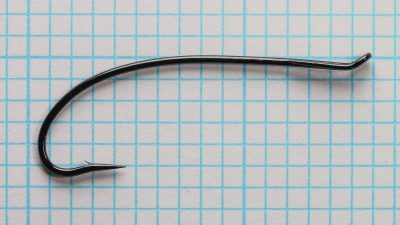
Alec Jackson was born in Yorkshire, England, where he was steeped in the “North Country” tradition of soft-hackle spiders and wet flies. This heritage emphasized slim profiles and precise proportions. After moving to the Seattle area, Jackson became a fixture of the Pacific Northwest fly-fishing community.
He was deeply influenced by legendary tiers like Syd Glasso, who revived the use of Spey-style flies for steelhead. Jackson felt that the commercial hooks available in the mid-20th century were often too clunky or lacked the “soulful” curves of antique irons. He set out to design hooks that would, in his words, “appeal aesthetically to both man and fish.”
2. The Design Philosophy: Functional Art
Jackson’s hooks are defined by three core design elements that revolutionized steelhead and salmon fly tying:
The Tapered Loop Eye: Traditional salmon hooks often had bulky eyes that made it difficult to create the slim, neat heads required for classic flies. Jackson’s tapered loop allowed the wire to thin out as it formed the eye, resulting in a perfectly proportioned head once the fly was finished.
The Modified Bartleet Sweep: While many hooks used a “Limerick” or “O’Shaughnessy” bend, Jackson popularized the Bartleet bend—a long, graceful, sweeping curve. This shape provided a larger “canvas” for the fly body and improved the hook’s ability to “swim” correctly in the current.
Finish Diversity: Jackson was one of the first to offer hooks in a wide palette of finishes (Gold, Silver/Nickel, Blue, Bronze, and Black). This wasn’t just for flash; the blue and gold finishes allowed the hook itself to act as an integral part of the fly’s color scheme.
3. Manufacturing History: From Partridge to Daiichi
The production of Alec Jackson hooks followed a path of increasing precision:
The Partridge Era: Jackson initially collaborated with the legendary Partridge of Redditch in England. These early hooks are now collector’s items, known for their hand-crafted feel but occasional inconsistencies.
The Daiichi Partnership: To achieve higher carbon steel strength and more reliable tempering, Jackson moved production to Daiichi (distributed by Anglers Sport Group) in Japan. This transition brought chemically sharpened points and superior durability to the designs, making them the industry standard for “swung fly” enthusiasts.
4. Key Hook Families & Insights
The Spey Series (2050–2059)
The flagship of the brand. These are the hooks that defined the “modern classic” steelhead fly.
Insight: These hooks use a relatively light wire for their size. This allows the fly to sink naturally and move with more life in the water than a heavy-gauge iron.
Sizes: Typically range from 1.5 to 7.
The Steelhead Irons (2061–2065)
Designed for “Winter Run” fishing where strength is paramount.
Insight: These feature a shorter shank and much heavier wire. They are the “workhorse” hooks designed to handle the brute strength of a 20-pound steelhead in heavy current without bending out.
North Country Trout Hooks
A tribute to his Yorkshire roots, these are designed for soft-hackle spiders.
Insight: Many of these feature a “Crystal” finish (a bright, iridescent silver). Jackson designed this specifically to complement Pearsall’s Gossamer Silk; when the silk gets wet, the bright hook shines through the translucent thread, creating a “glowing” effect that mimics a natural insect.
The Phantom/Covert Nymph
One of his later contributions, these hooks focused on stealth, featuring a “covert” dark finish and a shape optimized for modern nymphing techniques while maintaining his signature graceful proportions.
5. The Legacy: A Pursuit of Excellence
Alec Jackson passed away in 2020, leaving behind a legacy as a “purist” who never compromised on quality. He also produced specialized materials, such as his own line of Silk Floss, specifically designed to lay flat on his tapered loop eyes.
Deep Insight for Your Users: When someone ties on an Alec Jackson hook, they aren’t just using a piece of terminal tackle. They are participating in a tradition of “Low Water” aesthetics. The Alec Jackson hook is intended to be seen; it is the skeleton of the fly, and its curves are designed to enhance the flow of the materials, ensuring that even a sparse fly looks elegant and “fishy.”
Technical Comparison: Alec Jackson Hook Models
The following table breaks down the most prominent Alec Jackson hook series manufactured by Daiichi. These hooks are categorized by their “iron” (wire gauge) and intended application, ranging from the delicate Spey hooks to the heavy-duty Winter Irons.
Series
Model Name
Wire Gauge
Eye Style
Primary Use
Distinctive Feature
2050
Spey Hook
Light
Tapered Loop (Up)
Summer Steelhead / Spey Flies
High-carbon steel with a sweeping Bartleet bend; allows the fly to “dance.”
2060
Steelhead Iron
Heavy
Tapered Loop (Up)
Winter Steelhead / Large Salmon
Maximum strength; designed for heavy tippets and large, powerful fish.
2070
Dee Hook
Medium
Tapered Loop (Up)
Classic Dee-style Flies
Longer shank than the 2050, optimized for the long, low-wing profiles of Dee flies.
3299
Crystal Silk
Fine
Spaded / Ring
North Country Spiders
Specifically finished to “glow” through wet Pearsall’s Silk thread.
2131
Phantom Nymph
Medium/Fine
Straight
Modern Nymphing
A stealthy, dark-finished hook with a unique bend for better hook sets on trout.
2161
Covert Series
Heavy
Tapered Loop (Up)
Stealth Salmon/Steelhead
Identical to the 2061 but with a non-reflective, matte black finish.
Deep Insights for the Technical Tyer
1. The “Gape to Length” Ratio
Alec Jackson hooks are famous for having a generous gape relative to the shank length.
The Benefit: Most traditional salmon hooks have a narrow gape that can be “shrouded” by bulky wing materials (like bucktail or feathers). The Jackson design ensures the hook point remains exposed, significantly increasing your hook-up ratio when a fish “nips” at the tail of the fly.
2. Wire Tempering & Resilience
Unlike “stiff” hooks that may snap under the sudden shock of a steelhead strike, Daiichi-made Jackson hooks are known for a specific tempering balance.
The Benefit: The wire is designed to have a tiny amount of “flex” or “spring.” This act of bending slightly—but not deforming—absorbs the energy of a head-shake, preventing the hook from tearing a hole in the fish’s mouth and falling out.
3. The Anatomy of the Tapered Eye
If you look closely at a #1.5 Spey hook, the wire at the eye is significantly thinner than the wire at the bend.
The Benefit: This is critical for thread management. On standard loop-eye hooks, the “step” where the wire returns to the shank creates a bump. Jackson’s taper is so gradual that the tyer can create a “micro-head,” which is the hallmark of a master fly tyer.
The Alec Jackson Finish Guide: Matching Light & Water
In the world of classic salmon and steelhead flies, the hook is not hidden—it is showcased. Here is how to choose the right finish for your specific fishing environment.
1. Silver (Nickel) Finish
Best For: Bright, sunny days and clear “emerald” water.
The Insight: This is the most reflective finish. It mimics the natural flash of a baitfish or the silver scales of a fresh-run salmon. In clear water, it provides a “trigger” that can be seen from a distance.
Tyer’s Tip: Use this with cool-colored materials like blues, purples, and whites. It is the gold standard for the “Lady Caroline” or any “bright day” pattern.
2. Gold Finish
Best For: Overcast skies, “tannic” (tea-colored) water, or early morning/late evening.
The Insight: Gold provides a warmer, softer flash than silver. In tea-colored water, gold light waves penetrate deeper than silver ones, making the fly more visible to fish holding in the shadows.
Tyer’s Tip: Gold hooks pair perfectly with “Autumn” palettes—oranges, browns, and fiery reds. It is the preferred choice for many classic Spey patterns like the “Orange Heron.”
3. Blue Finish
Best For: Extremely clear, cold water or “deep” winter runs.
The Insight: Alec Jackson’s signature blue finish is a masterpiece of “subtle flash.” Blue light is the last color to disappear as you go deeper in the water column. In deep, cold pools, a blue hook maintains its “glow” longer than gold or silver.
Tyer’s Tip: This is a “secret weapon” for many PNW anglers. It creates a stunning, cohesive look when paired with Kingfisher Blue hackle or purple dubbing.
4. Black (Standard & Matte “Covert”)
Best For: High-pressure water, spooky fish, or very bright “glare” conditions.
The Insight: Sometimes flash is the enemy. On heavily fished rivers, a bright hook can actually spook a wary steelhead. The Black or “Covert” finish provides a clean, silhouette-heavy profile that focuses the fish’s attention on the movement of the materials rather than the flash of the steel.
Tyer’s Tip: Use black hooks for “silhouette flies” fished during the “magic hour” (dusk).
5. Bronze Finish
Best For: Traditional trout patterns and “North Country” spiders.
The Insight: The most “organic” looking finish. Bronze blends into the streambed and mimics the dark, earthy tones of aquatic insects like stoneflies or larger caddis.
Tyer’s Tip: This is the “purist’s choice” for flies that are meant to look like living creatures rather than attractors.
The Daiichi 2051 is a Japanese-manufactured Spey fly hook co-branded with the legendary Alec Jackson, designer of modern two-handed fly rods and Spey casting technique. Produced under the Daiichi brand (a division of the Japanese high-carbon steel manufacturer), the 2051 features a forged heavy-wire…
The Alec Jackson 2055 is a premium spey fly hook produced by Daiichi High Carbon Steel Hooks in Japan under license from the estate of Alec Jackson. Marketed as model 2055, size 3, it features a turned-up tapered loop eye, heavy-gauge wire, smooth sproat…