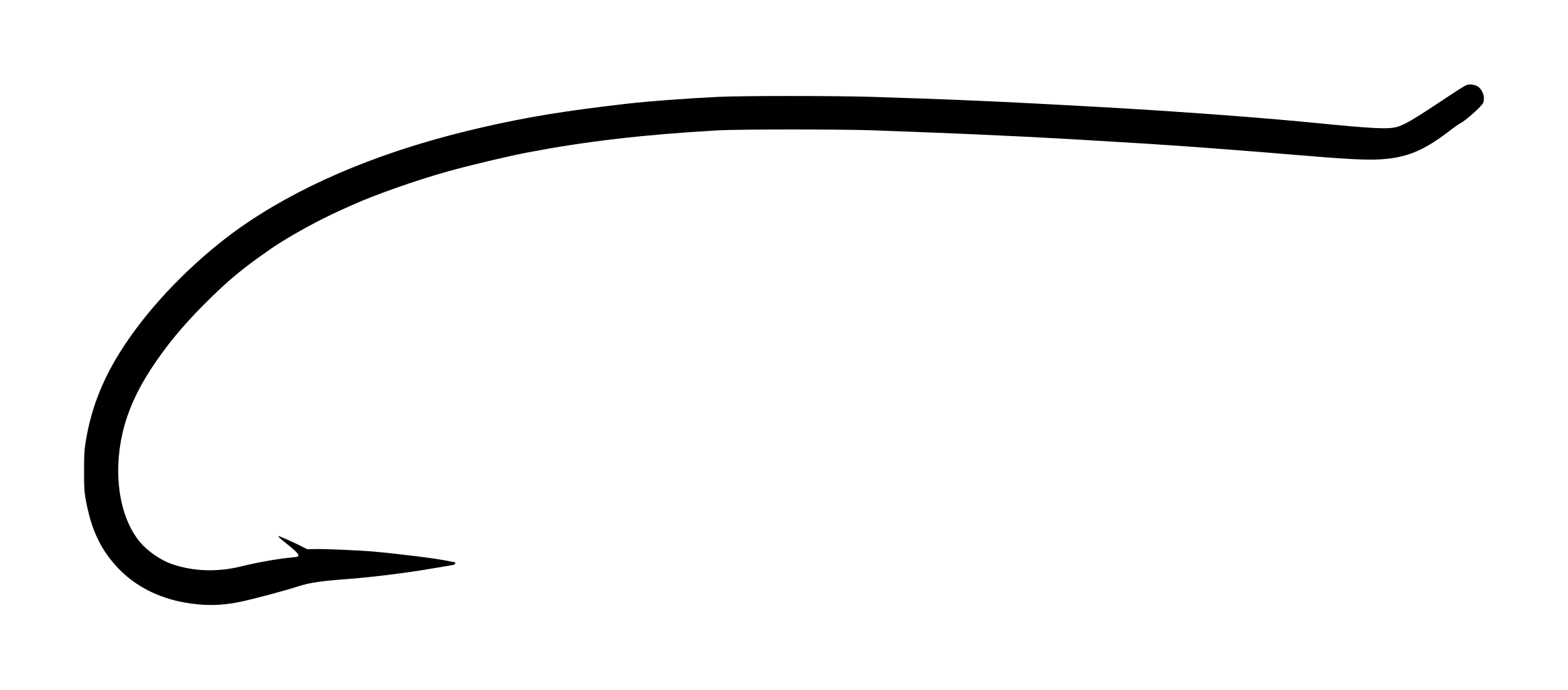
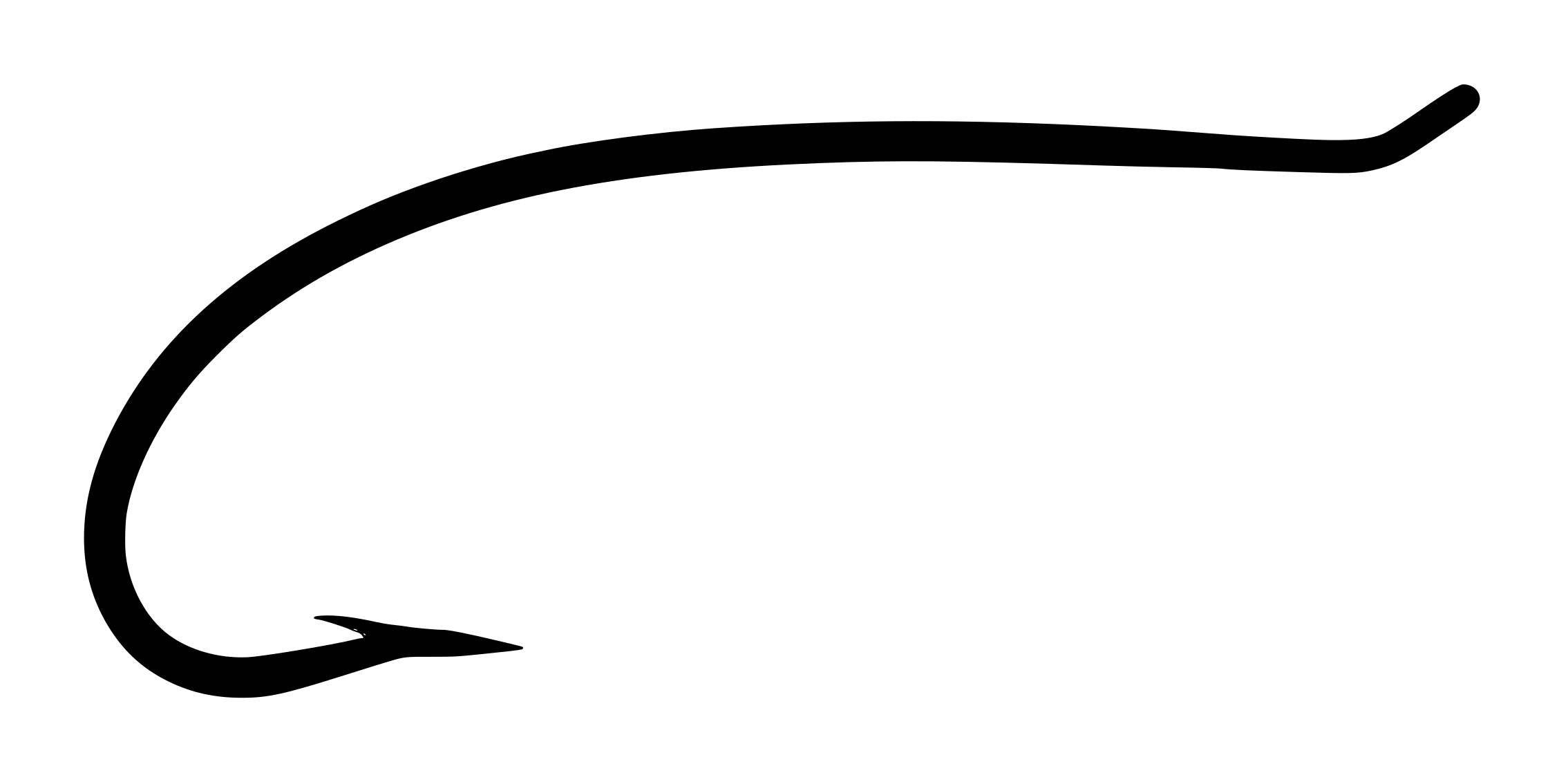
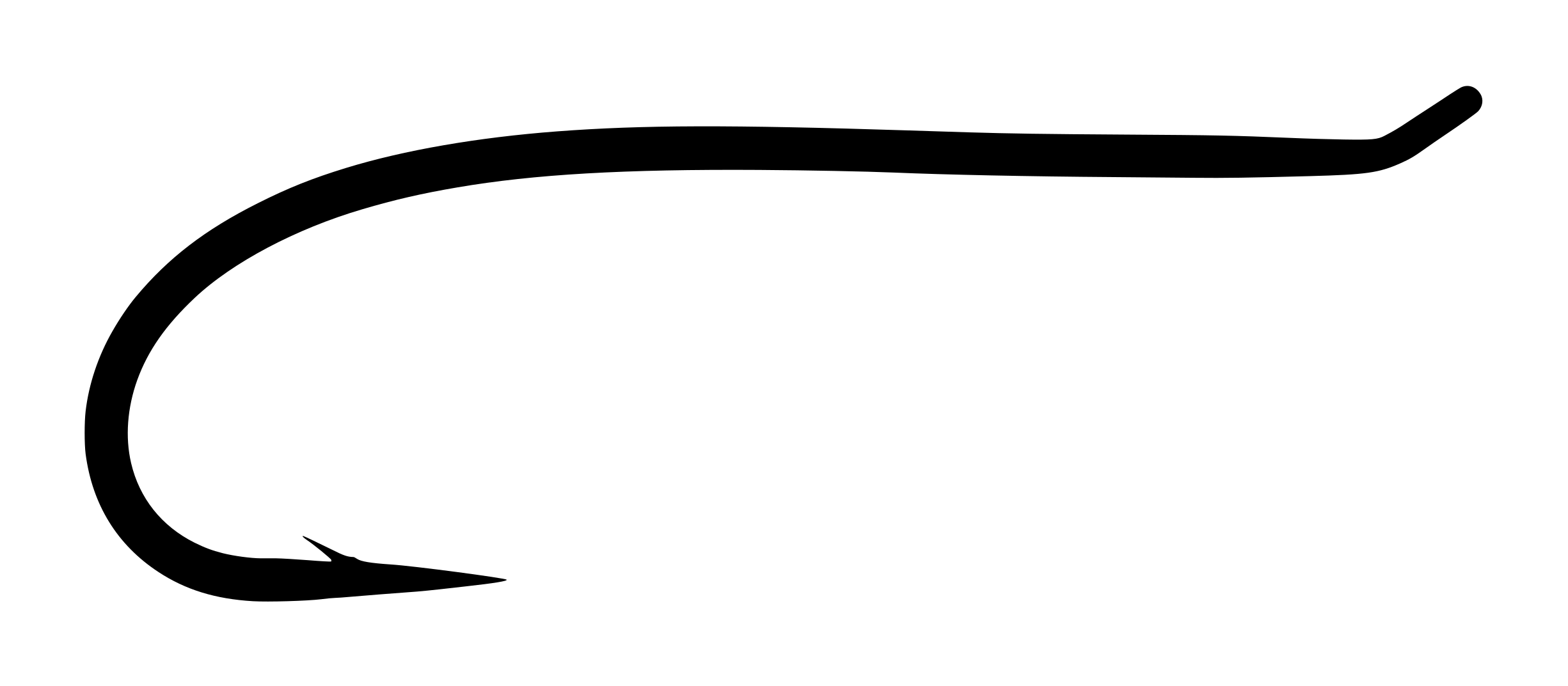
The Daiichi 2051 is a Japanese-manufactured Spey fly hook co-branded with the legendary Alec Jackson, designer of modern two-handed fly rods and Spey casting technique. Produced under the Daiichi brand (a division of the Japanese high-carbon steel manufacturer), the 2051 features a forged heavy-wire frame, loop eye, and needle point sharpened by chemical process rather than traditional grinding.
The hook was marketed specifically for steelhead and Atlantic salmon flies using Spey casting methods. The combination of high-carbon steel, chemical sharpening, and Japanese manufacturing precision positioned it as a premium contemporary alternative to traditional British and Norwegian Spey hooks. Evidence of production dates to the 1990s-2000s based on packaging design, printing method, and product positioning. The Alec Jackson brand collaboration reflects the rise of modern Spey casting in North America and the international recognition of Jackson’s contributions to rod design and technique.
The 2051 occupies a unique place in Spey hook history: it represents the shift from purely British and Norwegian dominance toward Japanese precision manufacturing for specialty hooks, while still maintaining the traditional loop eye and heavy-wire construction valued by Spey anglers. For collectors, it documents both Jackson’s influence on modern Spey fishing and the international consolidation of hook manufacturing by the 1990s.
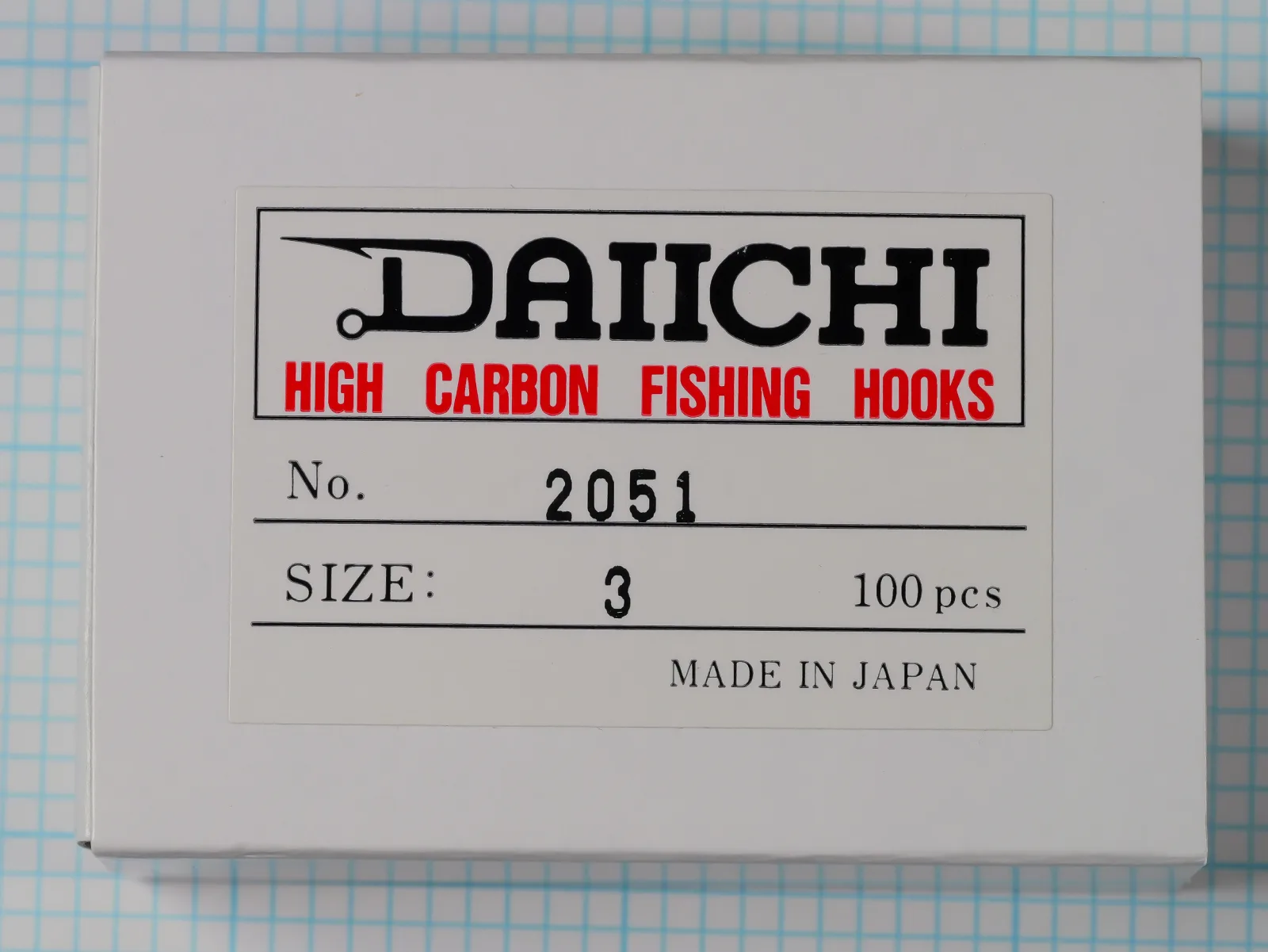
Original box label for the Daiichi 2051 Alec Jackson Spey Fly Hooks, size 3, 100-pack. Gold foil adhesive label with Japanese manufacturer attribution and Washington state distributor address.
Photographic record
9 cataloged imagesSelect any record to load it above.
8 images shown
Daiichi 2051 Box Label Size 3Original box label for the Daiichi 2051 Alec Jackson Spey Fly Hooks, size 3, 100-pack. Gold foil adhesive label with Japanese manufacturer attribution and Washington state distributor address.Open originalDaiichi 2051 Side Profile Needle PointSide profile of the Daiichi 2051 showing the tapered loop eye, smooth Spey bend, and sharp needle point. The deep glossy black japanned finish and forged wire profile are visible against the measurement grid.Open originalDaiichi 2051 Full Hook Size 3Full overhead view of the Daiichi 2051, size 3, on measurement grid showing overall shank length, gap width, and bend profile. Demonstrates the 2X long shank characteristic of Spey fly hook design.Open originalDaiichi 2051 Size 5 Single HookIndividual Daiichi 2051 hook from the size 5 ten-pack variant, photographed on measurement grid. The larger size shows the same loop eye and needle-point construction as the size 3 variant, scaled appropriately for bigger fly patterns.Open originalDaiichi 2051 Gold Foil LabelClose-up of the metallic gold foil adhesive label from the 100-pack box, showing Alec Jackson Spey Fly Hooks branding and exclusive US/Canada distributor information. Typical 1990s-2000s packaging design.Open originalDaiichi 2051 Back Label Size 3Reverse side of the Daiichi 2051 size 3 packaging, showing product description, manufacturing origin, distributor information, and safety warnings. Text emphasizes chemical sharpening process and high-carbon steel quality.Open originalDaiichi 2051 Clamshell Card Size 3Front of the clamshell-mounted Daiichi 2051 card for size 3. Features elaborate branding banner with lime-yellow 'Daiichi' text and magenta frame on black background. Specification table shows model 2051, size 3, quantity 10. Product description emphasizes tapered loop up-eye, forged construction, black finish, and intended use for steelhead and salmon flies.Open originalDaiichi 2051 Clamshell Card Size 5Front of the Daiichi 2051 clamshell card for size 5 (ten-pack variant), showing the same design template as the size 3 card but with updated specification table and quantity. Demonstrates the product line consistency across size range and packaging format variations.Open originalAlec-Jackson-2051-Hook-Point-Size-5-10-packAlec-Jackson-2051-Hook-Point-Size-5-10-packOpen original
Technical profile
Eye
Looped Eye, Turned UpTapered loop eye with smooth upward curve characteristic of classic Spey fly hook design P
Wire
Extra-Fine, Forged, Est. ~0.040"-0.045" (~1.0-1.1 mm)
Shank
1X Long — Plain
Bend
Bartleet, Narrow gapSmooth, rounded sweep with moderate depth appropriate for Spey casting. Subtle offset characteristic of classic Spey bend geometry P
Point
NeedleSmall, close-cut barb positioned just behind the point taper, characteristic of needle-point chemically sharpened design P
Finish
Black Japanned — Confirmed (stated on packaging)Deep glossy black japanned lacquer finish, opaque with no visible steel grain beneath coating P. Characteristic of high-quality chemically sharpened Japanese hooks.
Size 3 specimen (100-pack): Box label shows light age toning and minor creasing at edges; printing remains sharp and colors vibrant. Hooks visually pristine with deep glossy black japanned finish showing no corrosion or oxidation. No visible surface wear or handling marks on wire. Original count assumed complete (not verified by opening). Size 5 specimen (10-pack clamshell): Card backing shows moderate soiling and rubbing to plasticizer surface; printing remains legible. Hooks exhibit exceptional condition with uniform japanned finish and sharp needle points. No evidence of rust, dulling, or point damage.
The Daiichi 2051 employs Japanese high-carbon steel (superior to standard carbon used in many British hooks) to achieve both strength and hardness. The chemically sharpened needle point (as opposed to ground sharpness) creates a symmetrical cutting edge without the flat facets of traditional sharpening. This manufacturing method reduces the steel removal necessary to achieve sharpness, preserving more wire strength near the point and reducing the risk of breaking under load.
The forged heavy-wire construction distributes stress across a broader wire cross-section than light-wire designs, critical for large anadromous fish that can deliver sudden violent head shakes. The loop eye (as opposed to turned-down or tapered eye) eliminates the stress concentration at the eye-to-shank junction, allowing tippet or leader material to pivot freely and reducing breakoff risk during the fight. The long shank (2X standard) accommodates bulky Spey fly materials—dubbing, hair, and feather wings—and provides a longer gape for improved hook penetration on large fish with thicker jaws.
First documented Alec Jackson-branded hook in garrenwood.com catalog; documents Japanese entry into North American premium Spey hook market.
Own this hook? Help us measure it.
We have measurements for sizes 3, 5. Know any others? Submit calipered measurements and we'll review and add them. Thank you!
Historical context
alec_jackson
The Daiichi brand is owned by a Japanese high-carbon steel manufacturer specializing in fishing hooks and precision steel products. Daiichi holds an international reputation for chemical sharpening technology and manufacturing precision. The brand markets its hooks under the slogan The World’s Quality Standard.
Alec Jackson is a legendary figure in modern fly rod design and Spey casting instruction. Jackson revolutionized two-handed casting technique in the late 1970s and 1980s through his detailed instruction, custom rod designs, and collaboration with tackle manufacturers. By the 1990s, his name carried significant prestige among steelhead and salmon anglers in the Pacific Northwest and internationally. The Daiichi 2051 represents one of several tackle collaborations Jackson undertook to bring Japanese manufacturing precision to the North American Spey fishing market.
Series History
The Daiichi 2051 Alec Jackson Spey appears as a standalone collaboration model within the broader Daiichi product line, rather than a named series with multiple variants. The hook was introduced during the 1990s-2000s period when Japanese hook manufacturers were aggressively marketing precision-sharpened chemically processed hooks to Western fly tyers. The design reflects the standardization of Spey fly construction around a specific template: long shank (approximately 2X), loop eye, heavy wire, and needle-sharp point.
The branding explicitly links the hook to Alec Jackson’s methods and design preferences, serving as a market differentiator from competing Spey hooks offered by traditional Redditch makers and Norwegian manufacturers. The packaging and labeling emphasize both the Daiichi manufacturing heritage and Jackson’s endorsement, appealing to fly tyers seeking modern precision within a traditional Spey fly format.
Named Collaborator
Alec Jackson is an innovative fly rod designer, casting instructor, and salmon/steelhead fishing authority. Rising to prominence in the 1970s-1980s, Jackson developed novel approaches to two-handed casting that revolutionized Spey technique in North America. His custom rod designs, particularly for steelhead and Atlantic salmon, became highly sought after by serious anglers, and his detailed instructional publications and videos established him as the defining voice in modern Spey casting practice.
Jackson’s tackle collaborations extended beyond hooks to include rod designs and fly boxes, all marketed through specialty retailers and directly to serious Spey anglers. His brand became synonymous with precision, tradition, and innovation in the Spey fishing world, appealing equally to purists and practitioners of modern casting method. By the 1990s-2000s, Jackson’s reputation transcended fishing to encompass cultural authority in the two-handed casting tradition.
Era and Packaging Dating
Packaging design and printing method (offset lithography with fluorescent magenta and yellow inks) consistent with 1990s-2000s product labeling. ZIP code format on gold foil label (98028) is modern US postal standard (implemented 1983+). Address references Kenmore, WA location associated with Anglers Sport Group distribution. Phone number format (no area code shown) typical of business cards and packaging from that era. The chemical sharpening process and Japanese manufacturing alignment with market positioning of the 1990s-2000s when Japanese hooks gained prominence in North American fly fishing. Absence of barcode on primary label suggests packaging predates universal barcode adoption, but offset print and product positioning point to 1990s+ era. No visible handwritten dates or manufacturing codes that would narrow further.
The Alec Jackson Revolution in Spey Casting
Alec Jackson transformed modern Spey casting from a specialized Scottish tradition into a technique accessible to North American anglers through his detailed instructional approach and innovative rod designs. In the 1980s, Jackson began publishing detailed casting instruction and collaborating with rod manufacturers to create tools designed specifically for the Spey technique. His collaborations with hook makers—including the Daiichi 2051—represented his effort to ensure that fly anglers using his methods had tackle that matched his exacting standards. The loop eye and heavy-wire construction of the 2051 reflect Jackson's philosophy that proper technique requires proper equipment, elevating both simultaneously rather than accepting inferior tackle as inevitable. Today, Jackson's influence remains so profound that contemporary fly fishers often unknowingly apply his casting principles and equipment standards without recognizing their origin in his 1970s-1980s innovations.
Design lineage and influence
The Daiichi 2051 descends from the classical British Spey fly hook tradition, particularly patterns like the Partridge of Redditch Spey hooks and the Hardy/Turner designs used in Scottish and Norwegian salmon fishing from the 1950s-1980s. However, the 2051 represents a modernization of that tradition through Japanese precision manufacturing and chemical sharpening technology introduced by Daiichi and other Japanese makers in the 1980s-1990s.
Competing contemporary designs include the Tiemco TMC 7999 (another Japanese Spey pattern with loop eye and heavy wire) and traditional British offerings like the Partridge Spey (produced continuously from mid-20th century). The Alec Jackson collaboration distinguishes the 2051 by explicitly linking the design to modern two-handed casting technique rather than purely historical salmon tradition, positioning it as an innovation rather than a revival.
The loop eye and forged construction influenced subsequent Japanese designs marketed to North American fly tyers seeking Spey hooks that combined traditional aesthetics with modern manufacturing precision. The 2051 did not generate a major downstream lineage but became a reference point for understanding how Japanese manufacturers successfully penetrated the premium North American Spey market during the 1990s-2000s.
Best matchRelated by Attribute
Computed automatically from catalog data — updated as new hooks are added.
Matches: Shank, Eye, Eye Orient., Finish, Forging +2 moreDiffers: Bend: Bartleet vs Sproat; Wire: Extra-Fine vs Fine (1X Fine); Gap: Narrow vs Standard +2 more
Matches: Shank, Gap, Eye, Eye Orient., Finish +3 moreDiffers: Bend: Bartleet vs Sproat; Wire: Extra-Fine vs Standard; Point: Needle vs Standard / Spear +1 more
Matches: Gap, Eye, Eye Orient., Finish, Forging +2 moreDiffers: Bend: Bartleet vs Limerick; Shank: 1X Long vs 2X Long; Wire: Extra-Fine vs Fine (1X Fine) +2 more
The Daiichi 2051 is a specialized Spey fly hook designed for the classic two-handed Spey casting technique for Atlantic salmon and steelhead on large rivers. The long shank accommodates bulky Spey fly dressings while the loop eye and moderate bend provide secure hook sets on large anadromous fish. The chemically sharpened needle point and heavy forged wire deliver both penetration and durability across heavy flow conditions.
Secondary Applications
Large salmon wet flies, steelhead swung patterns, saltwater streamer fishing
Classic Fly Patterns
Named patterns specifically associated with this hook. Leave blank if none formally documented. Do not speculate — only include patterns with a confirmed association.
Modern Equivalents
Hook
Match Quality
Notes
Daiichi 1710
Good
Modern Daiichi Spey hook with loop eye and forged construction; similar weight and shank length category. Direct descendant of the 2051 line.
Tiemco TMC 7999
Very Good
Japanese-manufactured Spey hook with loop eye, heavy wire, and needle point. Nearly identical functional specifications and design intent.
Partridge Patriot X2
Good
Modern British Spey hook with loop eye and heavy wire. Maintains traditional Redditch construction while updating materials and sharpening methods.
Collector notes
Rated 4.5/10. The Daiichi 2051 Alec Jackson is uncommon but not genuinely scarce. The direct collaboration with a recognized designer and the loop-eye Spey construction appeal to specialist collectors, but the Japanese origin and relatively recent manufacture (1990s-2000s) limit rarity compared to traditional British and Norwegian Spey hooks. Size 3 cards are more sought than size 5; sealed original packaging commands meaningful premium.
Reference value
$6 – $18 USD estimate
Packaging format
GW-J-03Catalog code
The hook’s collectibility rests primarily on three factors: (1) the Alec Jackson brand association and his recognized authority in Spey casting, (2) the loop eye and heavy-wire construction preferred by traditional Spey practitioners, and (3) the documentation of the era when Japanese manufacturers successfully penetrated the North American Spey hook market.
Limiting factors include the relatively recent manufacture date (not pre-1970s), the Japanese rather than British origin (which reduces appeal to Redditch specialists), and the availability of the model in bulk quantities (100-pack cards suggest commercial distribution rather than limited production). Size 3 is more desirable to collectors than size 5, as smaller sizes are typically kept for tying rather than collecting. Sealed or near-sealed cards in original tissue command a 50-100% premium over opened cards with complete hook count.
Primary source analysis of the packaging reveals two distinct printings: an earlier simple label on size 3 cards (Daiichi brand banner, basic spec line) and a later more elaborate card on size 5 packs (expanded product specifications, Anglers Sport Group distribution emphasis). Cards with original Alec Jackson endorsement text intact are more desirable than reprinted or updated versions.
Packaging
Two distinct packaging formats documented: (1) Simple cardboard box label (size 3 variant): white/cream cardstock label with typeset black Daiichi heading and red subheading. White box with gold foil adhesive label reading 'ALEC JACKSON SPEY FLY HOOKS Box 386 Kenmore, WA 98028' in blue sans-serif type on metallic gold background. Offset printed. 100-pack count. (2) Plastic clamshell card mount (size 5 variant): dark grey/charcoal cardboard backing with elaborate printed Daiichi branding banner (lime-yellow and magenta text on black background). Magenta rule box with white label field listing model 2051, size 5, quantity 10. Hook displayed in plastic sleeve or individual compartments. Reverse side carries product description, safety warning, and Anglers Sport Group distribution notice. Both formats feature Made in Japan attribution. Era indicators: offset lithography process, modern ZIP code format, fluorescent inks (characteristic of 1990s-2000s printing), absence of UPC barcode on primary label.
Market Value Notes
Low ($6): Opened card or loose hooks, mostly or completely present, shows wear to packaging. High ($18): Sealed or near-sealed original card with complete hook count, minimal defects. Premium factors: Alec Jackson branded card (vs generic Daiichi), smaller size (No. 3 preferred over No. 5), loop eye construction (valued by Spey specialists), original tissue or envelope intact, early printing variant. Platforms: eBay US/UK, specialty fly fishing retailers, tackle auctions. Confidence: E estimated — limited comparable sales data for this specific model; values inferred from broader Spey hook market and Japanese-branded hook sales history.
Where to Find
eBay UK and US auctions under Spey or Alec Jackson searches; specialty fly fishing retailers focusing on two-handed casting; Pacific Northwest tackle swap meets; online fly tying forums (FAOL, Speycast).
Preservation
Storage and Preservation
Store the Daiichi 2051 in a cool, dry environment away from high humidity and salt spray. The japanned finish is highly resistant to corrosion compared to unfinished or blued hooks, but prolonged moisture exposure can eventually compromise the lacquer coating and allow oxidation of the underlying steel. Keep original packaging intact and stored flat to prevent pressure distortion of the hook eyes. Store cards or clamshells upright in a filing cabinet or shelf rather than stacked horizontally, which can crush delicate eye loops and cause permanent deformation.
If hooks must be removed from original packaging, wrap them individually in acid-free tissue and store in archival-quality containers away from ferrous metals that could cause galvanic corrosion through contact. Periodically inspect stored hooks for any signs of microscopic corrosion pitting or lacquer degradation. The chemical sharpening process creates a durable point, but avoid touching the point with bare fingers or rough materials that could cause dulling or chipping. Original packaging in sealed or near-sealed condition should never be opened for collection purposes; the premium value is preserved only by maintaining packaging integrity.
Primary Source
Manufacturing Claims and Marketing Positioning
Source: Daiichi 2051 packaging labels, front and back panels, size 3 and size 5 variants
The tagline ‘We Only Have To Make Our Point Once’ encodes a fundamental claim about the Daiichi chemical sharpening process: the needle point requires no secondary grinding or stropping and maintains its geometry through the entire use lifecycle. Traditional ground points gradually dull with use and wear; the implication is that Daiichi’s chemically sharpened point (molecularly hardened at the cutting edge) remains sharp far longer. This marketing message appeals to serious fly tyers who expect premium performance from specialty hooks and is directly comparable to contemporary competitor claims from Tiemco and other Japanese manufacturers.
The phrase ‘Only super quality high carbon steel is used, delivering strength and long point life’ positions the hook as an engineering solution rather than a commodity. The emphasis on strength directly addresses the challenge of landing large anadromous fish (Atlantic salmon and steelhead) that require robust construction to withstand violent head shakes and strong current pressure. The ‘long point life’ claim reinforces the sharpness durability argument and appeals to fly tyers who tie repeatedly from the same hook box throughout a season.
The packaging designates the hook explicitly for ‘Steelhead And Salmon Flies,’ narrowing the marketing scope away from general trout or saltwater applications. This targeting reflects both Alec Jackson’s North American regional authority (particularly the Pacific Northwest steelhead tradition) and the premium pricing strategy typical of specialty hooks marketed to serious practitioners rather than casual anglers.
The original primary label (gold foil adhesive format for 100-packs) reads as a simple, direct endorsement: ‘Alec Jackson Spey Fly Hooks’ with minimal additional specification. This minimalist branding suggests the designer’s name alone carries sufficient market authority to sell the product. The later clamshell card variants (especially size 5 ten-pack format) include more elaborate product descriptions, reflecting either a shift toward broader market reach or updated packaging standards as the product matured in distribution.
Size Note
Size Designation and Spey Hook Scaling
The Daiichi 2051 is cataloged in two documented sizes (No. 3 and No. 5) with significantly different packaging quantities: size 3 is packaged in bulk 100-count, while size 5 appears in smaller 10-pack clamshells. This disparity suggests distinct market strategies: the size 3 is positioned as a production hook for professional fly tyers or high-volume hobby tyers, while the size 5 targets collectors or anglers tying a more limited number of flies.
Spey hook sizing does not follow the universal hook size standard (where larger numbers = smaller hooks). Instead, Spey sizes typically designate shank length in a semi-standardized nomenclature: Size 3 and Size 5 on the 2051 likely refer to relative sizing within the Spey hook universe rather than absolute ISO standards. The documented measurements show size 5 has a slightly longer shank and wider gap than size 3, consistent with typical size progression, but without access to a full size range (sizes 1, 2, 4, 6) it is difficult to determine if Daiichi followed a uniform increment scale or proprietary sizing system.
The pronounced difference in packaging quantity (100 vs. 10) suggests that size 3 represents the most popular size for contemporary Spey fly tying, while size 5 served a more niche application (larger flies, heavier patterns, or regional water conditions). This reflects broader market demand: most Spey flies in North American steelhead and salmon fishing cluster around size 2-4 range, with size 5 and larger reserved for specific high-water conditions or traditional Scottish patterns.
Additional
Alec Jackson's Influence on Modern Spey Tackle
Alec Jackson (1928-2010) was a transformative figure in modern Spey casting, far exceeding the typical influence of a tackle designer or fishing author. His detailed instructional publications, beginning in the late 1970s, systematically documented two-handed casting technique in a way that had never been published before—replacing myth and regional variation with repeatable principles accessible to anglers outside Scotland and Norway. His custom rod designs, manufactured in collaboration with several makers, became benchmarks for how a Spey rod should feel and perform. By the 1990s, his name had become virtually synonymous with modern Spey technique in North America.
The hook collaborations represent an important but often overlooked dimension of Jackson’s influence. By endorsing and working with manufacturers to develop hooks specifically tuned to his casting principles, Jackson influenced tackle design at a fundamental level. The loop eye on the 2051 reflects Jackson’s conviction that the hook eye must move freely and distribute stress away from the eye-shank junction. The heavy wire reflects his emphasis on durability and confidence under extreme load. The needle point reflects his demand for reliable penetration in the hard mouths of large anadromous fish.
The Daiichi collaboration specifically marks the moment when Jackson turned to Japanese precision manufacturing to achieve specifications he could not reliably obtain from traditional British or Norwegian makers. This decision—to partner with a Japanese manufacturer rather than a historic Redditch firm—signaled the growing technical sophistication of Japanese hook production and the shift in global fishing tackle manufacturing that accelerated throughout the 1990s-2000s. The 2051 documents this transition in hook manufacturing history.
Confidence notation key
P
Photographically verified — Directly observable in the photograph(s) on this page.
V
Verified by documentation — Confirmed by manufacturer catalog, spec sheet, or published reference.
I
Inferred — A logical deduction from observable or documented evidence, not directly stated.
E
Estimated — An approximation based on visual comparison, proportional analysis, or limited data.
S
Speculative — A reasoned hypothesis that cannot be confirmed from available evidence.
Claims with no notation are confirmed by multiple independent sources. All photographs on garrenwood.com are taken on a measurement grid where each square equals 1/10 inch (0.1″ / 2.54 mm).