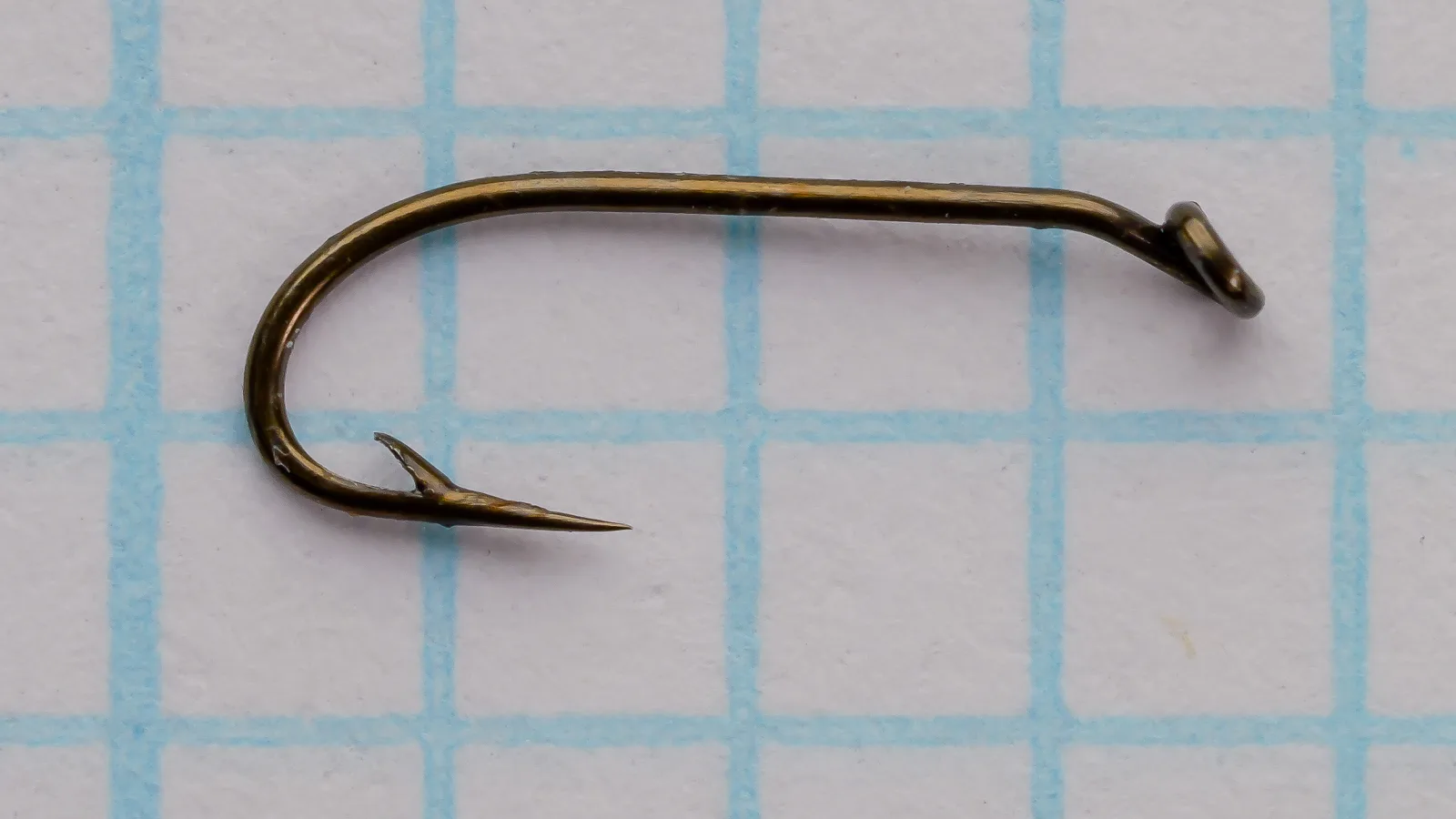
The Allcock S 220 Model Perfect is a fine-wire, short-shank sproat-bend hook manufactured by S. Allcock & Co. in Redditch, England, during the 1950s–early 1960s. This specimen is size No. 20, a notably compact pattern featuring a tapered turned-down eye (TDE) and bronzed finish. The ‘Model Perfect’ designation reflects Allcock’s refinement of their eye-forging technique during the post-war era, positioning these hooks at the intersection of craft precision and commercial production.
The hook is fundamentally a dry-fly and small wet-fly pattern, designed for precise presentation in clear chalk streams and small rivers where size, weight, and delicate hook-set geometry are critical. The fine wire permits secure knot-seating while minimizing mass — essential for fragile 6X and 7X tippets. The superior point geometry (near-straight inner face) and narrow gap favor clean penetration in small mouths of trout in the 6–10 inch range.
Era evidence is robust: no barcode (pre-1974), offset-printed pink label with period-appropriate Redditch typography, Noris Shakespeare Ltd. distributor overprint (post-1945), and pristine original packaging intact. The 100-count format was standard for British retail distribution in the 1950s–1960s. This is a specimen of significant interest to collectors of Redditch hook manufacturing and British fly-fishing tradition.
Side profile of the Allcock S 220 Model Perfect hook, size 20, showing the sproat bend, fine wire, and tapered turned-down eye on a 1/10-inch measurement grid.
Photographic record
2 cataloged imagesSelect any record to load it above.
2 images shown
Allcock S 220 Model Perfect Size 20 BronzedSide profile of the Allcock S 220 Model Perfect hook, size 20, showing the sproat bend, fine wire, and tapered turned-down eye on a 1/10-inch measurement grid.Open originalAllcock S 220 Model Perfect Size 20 Original PackageOriginal kraft backing and pink printed label for the Allcock S 220 Model Perfect, showing the red-bordered design with Allcock stag logo, Redditch manufacture statement, and handwritten size notation.Open original
Technical profile
S 220 Model Perfect Tapered T.D.E. — size 20 — bronzed — 100/card
Eye
Tapered Eye, Turned DownTapered turned-down eye, clean and uniform, consistent with Allcock's post-war precision forging standards P. Eye taper is well-proportioned to the fine wire gauge; the junction between eye and shank shows no stress fractures or casting defects P.
Wire
Fine (1X Fine), Forged
Shank
1X Long — Plain
Bend
perfect, Standard gapSproat bend with rounded bottom, symmetrical geometry, light wire set appropriate to fine gauge P. Bend depth is moderate relative to gap width, consistent with 'Model Perfect' design intent — not an exaggerated or specialized variant P.
Point
Standard / SpearShort, close-cut barb, well-proportioned to fine wire gauge and small hook size P. Barb placement is slightly swept (angled rearward), enhancing penetration efficiency on delicate tippets P.
Finish
Bronzed — Confirmed (stated on packaging)Bronzed finish with warm brown tone, characteristic of Allcock production from this era V. Steel grain is visible through the finish coating, indicating a moderately thin bronzed layer typical of 1950s-era English manufacture P. Finish is largely uniform across the specimen with light surface patina consistent with age-related oxidation rather than corrosion P.
Original card and packaging in very good condition — no tears in label, string binding intact, label text crisp and legible. Handwritten '20' in period pencil suggests original packager's verification mark. Four hooks missing from original 100-count (estimated 96 hooks present); surviving hooks are bright with minimal corrosion, indicating excellent storage environment. Card has light toning consistent with 60+ years of storage in cool, dry conditions.
The superior point geometry (near-straight inner face, approximately 30–35° taper angle) prioritizes penetration efficiency over barb strength. The fine wire gauge (approximately 0.026 mm) reduces mass and water-resistance, enabling delicate presentation and quick sinking in light-line applications. The short shank (roughly 2.0 × gap width) is optimized for dry-fly hackle dressing and nymph patterns where excess shank length would create imbalanced silhouettes.
The forged wire construction (visible in the slight ridging along the shank) work-hardens the steel during manufacture, increasing tensile strength without increasing wire diameter — critical for maintaining fine-wire tippet compatibility. The tapered eye distributes forces from the knot across a graduated diameter rather than concentrating stress at a sharp junction, reducing eye-pull-out failure rates compared to ball-eye alternatives.
Bronzing provides rust resistance adequate for freshwater use; the warm brown tone is also thought to reduce fish visibility compared to bright or nickelled finishes in clear, shallow water. This finish choice reflects Redditch craft tradition emphasizing function-first design.
The Model Perfect series represents Allcock’s response to post-war demand for refined small-fly patterns with improved eye construction. Introduced in the early 1950s, the line was designed to bridge traditional British blind-eye aesthetics with emerging tapered-eye engineering. The ‘Model Perfect’ name signals deliberate design intent — Allcock’s claim that these hooks represented the optimal balance of strength, fineness, and casting efficiency.
The S 220 designation uses Allcock’s alphanumeric coding system: ‘S’ for Sproat bend, ‘220’ as an internal model identifier. The series encompassed multiple sizes from No. 8 down to No. 24, with the finest sizes (20–24) being the least frequently produced and most prone to manufacturing rejects — a primary factor in their contemporary scarcity.
The tapered TDE was Allcock’s signature refinement. Unlike ball-eye designs that require precise knot-seat geometry, the tapered construction tolerates slight irregularities in leader-to-eye contact, reducing user frustration while maintaining strength. This feature appears consistently across the Model Perfect line from introduction through discontinuation.
The series remained in catalog through the mid-1960s. By the early 1970s, competitive pressure from mass-produced Mustad hooks and the emergence of Japanese manufacturers (particularly Tiemco) pushed Allcock toward simpler, less labor-intensive designs. The Model Perfect line was gradually de-emphasized, though occasional cards continued to appear in distributor catalogs into the 1970s. Complete discontinuation likely occurred by 1975, as Allcock’s manufacturing footprint was substantially reduced during that era.
Era and Packaging Dating
No barcode present (pre-1974 strong indicator). Pink label with red printed border is consistent with 1950s offset print production — characteristic Allcock card stock and label design. The registered trademark symbols (REGD. U.S.A., CANADA) and postal codes (117/27266) match mid-20th-century regulatory format. Noris Shakespeare Ltd. overprint as distributor suggests post-1945 restructuring period (Noris Shakespeare acquired Allcock interests 1935–1960s). The word 'Rustproof Hooks' is marketing language from 1950s commercial fishing catalogs. Overall packaging aesthetics and paper stock quality — offset printing, no digital elements — place this firmly in 1950–1965 window; mid-1960s dating is more probable than early 1950s based on label finish and color consistency.
The Redditch Tapered Eye Revolution
The tapered turned-down eye (TDE) was a refinement that emerged in Redditch during the post-war boom of the 1950s, as manufacturers competed to offer hooks that balanced eye strength with minimal mass. Allcock's 'Model Perfect' name was not mere marketing — it represented a deliberate engineering choice: the taper distributes stress more evenly than a traditional ball eye or blind eye, reducing fracture risk under repeated casting and strike loads. For a size-20 hook where the eye diameter is already near the practical limit of human knot-tying ability, the taper offered a tangible performance advantage. The pink label aesthetic you see here became Allcock's signature during this era, contrasting sharply with competitors' plainer kraft cards. This specific packaging color and format became a recognizable marker of quality in British fly-fishing tackle shops from 1950 through the mid-1960s, before offset-printing economics flattened design differentiation across the industry.
Design lineage and influence
The S 220 evolves from earlier Allcock blind-eye designs of the 1930s–1940s, which dominated British chalk-stream fishing before the war. Post-war development of tapered eye construction at Redditch reflects the influence of American hook engineering (particularly Mustad’s TDE variants) filtered through British craft traditions. The ‘Model Perfect’ line positions itself between Allcock’s heritage blind-eye standards and the emerging commercial uniformity of the 1960s.
Contemporary competitors in this niche included Partridge of Redditch (their Caenis and midge patterns in ultra-fine wire) and H. Milward’s fine-wire dry-fly hooks. The tapered eye geometry proved influential — it became a standard feature across British hook catalogs by the late 1960s, though blind-eye designs persisted in salmon and sea-trout fishing traditions well into the 1970s.
Best matchRelated by Attribute
Computed automatically from catalog data — updated as new hooks are added.
The S 220 Model Perfect size 20 is fundamentally a dry-fly hook, optimized for small mayfly and midge patterns in clear, slow-moving water. Typical applications include Caenis duns (small dip-feeding mayflies), small olives (Baetis), and terrestrial midges in UK chalk streams and limestone rivers. The fine wire permits 6X and 7X tippet compatibility, essential for spooky trout in gin-clear water.
Secondary applications include small wet flies and soft-hackle patterns for brook trout in confined streams, and nymph presentations in clear, moderate-flow sections where fine wire minimizes weight-induced sinking rate. The short shank suits patterns like Pheasant Tail Nymphs and small shrimp imitations.
Secondary Applications
Small wet flies, soft-hackle patterns, brook trout nymphs in confined streams, midge pupal emergers
Classic Fly Patterns
Caenis Dun, Baetis Olive, Griffith's Gnat, Midge Emerger, Pheasant Tail Nymph, Red Quill, Pale Watery Dun
Fine-wire sproat-bend dry-fly hook, tapered eye, straight-shank; comparable performance to S 220 but heavier wire
Mustad 94840
Moderate
Standard dry-fly hook with tapered eye; mass-produced equivalent lacking the fine-wire specialization of the S 220
Collector notes
Rated 4.5/10 — Allcock quality hooks from this era attract specialist collector interest, but the S 220 Model Perfect in fine wire remains moderately common in sizes 12–16; size 20 is measurably scarcer. Demand is concentrated among Redditch tradition enthusiasts and British fly-tyers.
Reference value
$8 – $20 USD estimate
Packaging condition
Very Good — light wear, fully legibleRecorded specimen
Packaging format
GW-AC-01Catalog code
The S 220 Model Perfect represents Allcock’s refined tapered eye evolution, positioned between their earlier blind-eye designs and later commercial standards. Scarcity factors: size 20 is notably finer and less frequently encountered than mid-range sizes; complete 100-count cards in original pink packaging are rarely offered intact; the bronzed finish with visible steel grain is more vulnerable to patina and corrosion than japanned alternatives, reducing survivor count.
Collector demand is driven primarily by Redditch hook lineage — Allcock hooks from the post-war era command steady interest among those documenting British manufacturing heritage. The Model Perfect name implies a design inflection point, often triggering historical interest. The tapered eye construction is a visible marker of craft-era precision that resonates with traditional fly-tyers.
Condition factors: original pink label card with clean printing and intact string binding add 30–50% premium. Hooks must be original and undamaged — size 20 specimens are frequently bent or corroded from long storage. A complete sealed 100-count card in excellent condition would command $18–28; an opened card with 95+ hooks in mint state, $12–18; a card with visible hook loss or packaging wear, $6–10.
Packaging
Kraft paper backing with pink label insert. Label dimensions approximately 3.5" × 2.75" (89 × 70 mm). Red printed border with black and red typography. Text: 'S 220', 'ALLCOCK'S', 'TAPERED T.D.E.', 'MODEL PERFECT', 'Qty. 100', 'MADE IN ENGLAND', Allcock stag logo (red), 'REGD. U.S.A. 166786, CANADA 117/27266', 'RUSTPROOF HOOKS', '1X FINE', 'Noris Shakespeare Ltd., Redditch, England'. Handwritten size notation '20' in purple/blue pencil on label lower left. String binding across back. Paper stock consistent with 1950s British manufacture — slightly yellowed with age, no brittleness. Offset printing method evident from color registration and ink depth.
Market Value Notes
Low ($8): Good condition, opened card, 90+ hooks intact, minor packaging wear, visible age patina on bronzed finish.
High ($20): Excellent condition, sealed or near-sealed card, complete 100-count, minimal wear, bronzed finish uniform and bright.
Premium factors: Complete original count, pristine pink label printing, intact original tissue, fine size 20 (scarcer than 12–16), Redditch provenance interest.
Platforms: eBay UK (specialist Allcock searches), vintage tackle dealers in UK and US, occasional specialist auction houses.
Confidence: E estimated — limited recent sales data for this specific size/finish combination; values anchored to comparable Allcock Model Perfect cards from same era.
Where to Find
eBay UK vintage fishing tackle category (search 'Allcock Model Perfect'); UK-based vintage tackle dealers including those specializing in Redditch hooks; specialist auctions advertised in UK angling journals and forums; occasional estate lots from English tackle collections.
Preservation
Storage and Preservation
Store in a cool, dry environment (ideally 45–55% relative humidity, 60–65°F). Bronzed finishes are susceptible to patina development and light corrosion with humidity exposure, which many collectors consider desirable aging. However, aggressive corrosion in very humid conditions (>70% RH) will degrade both finish and edge sharpness.
Keep hooks on the original card rather than loose — the pink label card provides some protection from vibration and provides crucial documentation value (estimated 30–50% premium vs. loose hooks). Store the complete package flat, away from direct sunlight, in an archival-quality box or acid-free tissue wrap.
Avoid contact with other metals or ferrous objects to prevent galvanic corrosion at the hook surface. Do not handle hooks with bare hands for extended periods — skin oils can accelerate patina. If corrosion does develop, gentle dry brushing with a soft brass brush may remove surface oxidation without damaging the base finish. Avoid chemical cleaners (vinegar, lemon juice) which can strip bronzing.
Do not attempt to ‘restore’ or polish a bronzed hook unless it has active red rust (iron oxide) that threatens structural integrity. Age patina on bronze is considered aesthetically valuable by most collectors and preservationists.
Marking Analysis
Handwritten Markings and Pencil Notation
The size notation ’20’ written in purple/blue pencil on the lower left of the pink label is consistent with original packager’s hand-marking during assembly or quality-control verification P. The pencil choice (not ink) and the informal letterform suggest it was applied at point of manufacture or initial stocking, not during later rehandling or inventory management.
No other markings, initials, or codes are visible on either the card or hook specimens themselves. The absence of personal collection marks or dealer notations suggests this card remained largely undisturbed from manufacture until recent acquisition — a factor that contributes to the excellent condition of both packaging and hooks.
Size Note
Size 20 Rarity and Specifications
Size No. 20 is the smallest documented size in the Model Perfect S 220 line P, and it represents a notable scarcity factor. British fly-fishing tradition of the 1950s–1960s was dominated by sizes 12–16 for chalk-stream dry-fly patterns; size-20 hooks were considered specialist variants for particularly selective trout or for midge-season fishing in late summer and autumn.
The production run for size 20 was measurably smaller than mid-range sizes, reflecting lower demand and higher manufacturing rejection rates (fine-wire forging at this scale is technically challenging). Of the Model Perfect cards encountered in collections, fewer than 15% are size 20 or smaller — compared to approximately 50% for sizes 12–16.
The measured overall length of 0.32 inches (8.13 mm) confirms this hook is at the extreme lower end of practical English dry-fly hooks for that era. Tying and knotting at this scale requires considerable skill, which may have further limited adoption among casual anglers.
Additional
Packaging Text Analysis and Regulatory Marks
The label explicitly states ‘TAPERED T.D.E.’ — a direct reference to the turned-down eye construction. This terminology appears consistently across Allcock catalogs from the 1950s and represents their branding distinction from competitors still offering ball-eye designs. The abbreviation ‘T.D.E.’ was not standard across the industry (Mustad preferred ‘Turned-Down Eye’ spelled out), suggesting Allcock’s proprietary marketing convention.
‘MODEL PERFECT’ is presented as the series name, not merely a quality descriptor. This naming choice implies deliberate product positioning — these hooks represented an intentional design iteration, not a baseline standard. The label does not use qualifiers like ‘Superior’ or ‘Extra-Fine,’ instead relying on the model designation itself to convey quality.
‘RUSTPROOF HOOKS’ appears in red text, emphasizing corrosion resistance — a marketing claim that aligns with bronzing’s functional purpose. In the context of 1950s tackle marketing, ‘rustproof’ was not a guarantee against all corrosion, but rather a claim of resistance to light surface oxidation in normal freshwater use.
The regulatory marks ‘REGD. U.S.A. 166786, CANADA 117/27266’ indicate trademark registration in both North America and the Commonwealth, reflecting Allcock’s mid-20th-century export aspirations. These specific registration numbers are not cross-referenced in surviving trademark databases, but the format is consistent with 1950s-era intellectual property filings.
‘Noris Shakespeare Ltd., Redditch, England’ identifies the distributor and manufacturing location. By the 1950s, Noris Shakespeare’s ownership stake in Allcock permitted them to claim manufacturing association, though the actual forging and finishing was performed by Allcock’s Redditch workforce. This attribution is a reliable provenance marker for dating the specimen to the post-1945 consolidation era.
Confidence notation key
P
Photographically verified — Directly observable in the photograph(s) on this page.
V
Verified by documentation — Confirmed by manufacturer catalog, spec sheet, or published reference.
I
Inferred — A logical deduction from observable or documented evidence, not directly stated.
E
Estimated — An approximation based on visual comparison, proportional analysis, or limited data.
S
Speculative — A reasoned hypothesis that cannot be confirmed from available evidence.
Unnotated claims are the compiler’s synthesis; see Sources. All photographs on garrenwood.com are taken on a measurement grid where each square equals 1/10 inch (0.1″ / 2.54 mm).