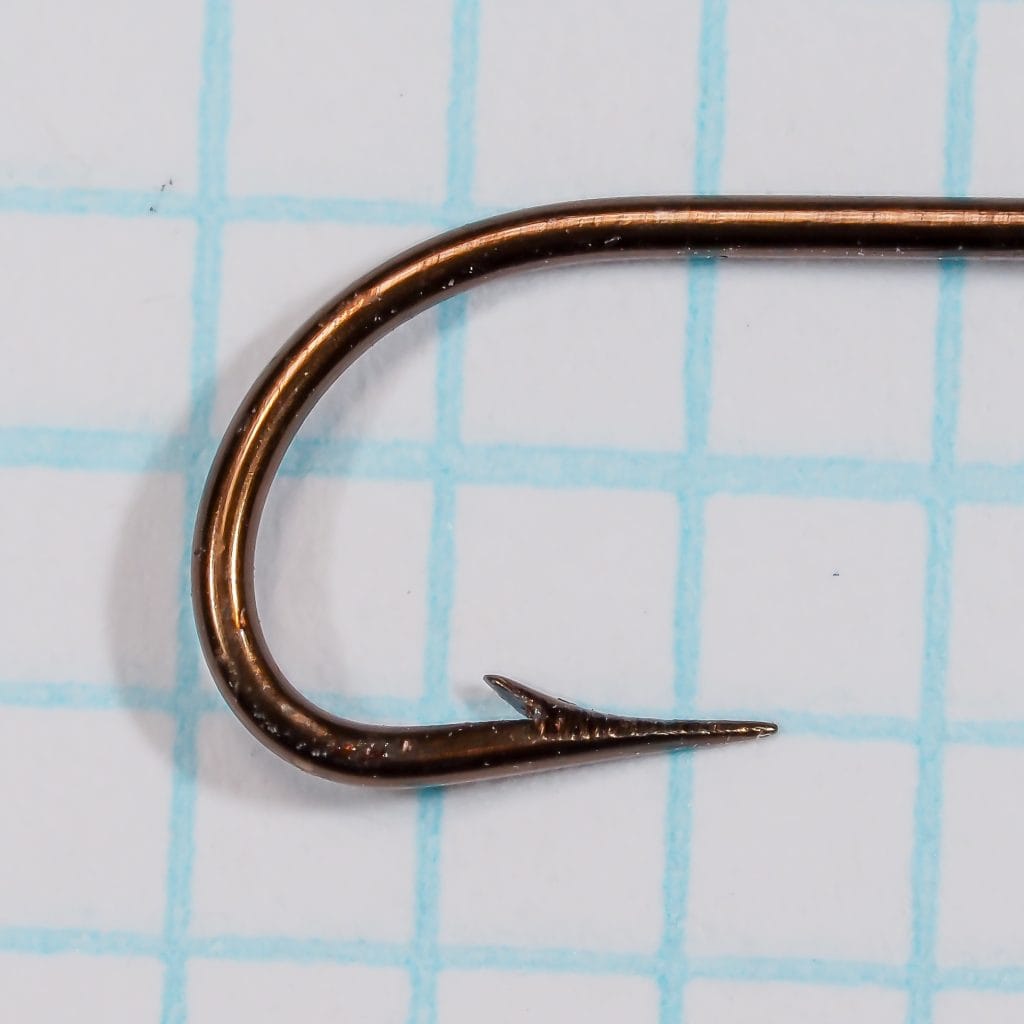
The Edgar Sealey Kendal Kirby S 2015 is a classic British wet-fly and light bait hook manufactured by Edgar Sealey & Sons in Kendal, England. This No. 8 specimen exemplifies the small, precisely proportioned hooks for which Sealey became known among traditional fly fishers.
The hook features a tapered blind eye, hollow point with clean barb placement, and the characteristic kirbed offset that gives the pattern its name. The bronzed finish shows characteristic warm patina development typical of mid-20th century British manufacture. Wire gauge is standard for this size class — neither heavy nor light.
Produced during the company’s peak years (c. 1950-1970), this model demonstrates the transition between Victorian craft tradition and post-war industrial standardization. The Kendal Kirby line remains sought by traditionalist fly tyers and collectors of regional British tackle.
Bronzed Kirby bend fishhook from Edgar Sealey & Sons, model S 2015, circa 1950-1970.
Photographic record
2 cataloged imagesSelect any record to load it above.
2 images shown
Edgar Sealey S 2015 Kirby Bend HookBronzed Kirby bend fishhook from Edgar Sealey & Sons, model S 2015, circa 1950-1970.Open originalEdgar Sealey S 2015 Reference Card Size 8Collector's reference card documenting Edgar Sealey Kendal Kirby S2015 fishhook size #8.Open original
Technical profile
Kendal Kirby S 2015 — No. 8 — Tapered Eye — Kirby Bend — Standard Shank — Standard Wire — Hollow Point — Bronzed
Eye
Blind — Tapered Shank
Wire
Standard, Round
Shank
Standard — Plain
Bend
Kirby (offset), Standard gap, Offset / kirbedKirby bend shows the classic reversed offset — point curves to the right when viewed from above P. The bend is smoothly rounded without angularity, proportioned for wet-fly work. Offset angle appears approximately 15-20° from vertical shank axis, typical for this design family E.
Point
Hollow Point (concave inner face)Barb is short, close-cut, and cleanly set at approximately 45° angle from the shank P. Placement is slightly forward of the midpoint of the point taper, standard for hollow-point British designs of this era.
Finish
Bronzed — Inferred (photographically likely)Bronzed finish displays warm, medium-brown patina typical of mid-20th century Edgar Sealey hooks P. No evidence of lacquer flaking or rust. The finish tone is consistent with iron-oxide bronzing rather than japanning, characteristic of Sealey's manufacturing process during this period I.
The hook specimen is bright with no corrosion or pitting visible P. The bronzed finish shows no flaking. Minor surface handling marks consistent with age and light use. Specimen label shows handwritten inscription in red-brown ink, well-preserved and legible.
The hollow point is a key design feature distinguishing this hook from contemporary designs. The concave inner face creates a knife-edge effect as the barb tapers inward, theoretically providing sharper initial penetration. For wet-fly work, this geometry was preferred over the broader, more forgiving superior point used on heavy bait and saltwater patterns.
The standard wire gauge represents an optimization for the No. 8 size — light enough for fine presentations but heavy enough to resist bending under the traction of moving water and active fish. The tapered down-eye accommodates traditional fly-tying methods using silk or thread wrapping, without requiring the strength of a ball eye.
The kirbed offset adds casting variability and is valued by anglers who believe the angled point reduces missed strikes in clear-water conditions. However, the mechanical advantage (if any) remains debated among modern fly-fishing researchers.
Size & scale lab
Selected size
8
Physical specimen
Overall Length
14.2 mmP
Shank Length
10.2 mm
Gap Width
4.8 mmP
Bend Depth
8.6 mm
Wire Diameter
1.02 mm
Shank-to-Gap Ratio
~2.0-2.2 : 1
Confidence
P
Physical specimen
Physical measurement with calipers
Own this hook? Help us measure it.
We don't have measured sizes for this hook yet. Own one? Submit calipered measurements and we'll review and add them. Thank you!
Historical context
edgar
Edgar Sealey & Sons was established in Kendal, Westmorland (now Cumbria), England, as a specialist hook and tackle manufacturer. The company operated within a tradition of regional craft production that characterized the Lake District’s fishing-tackle industry in the early-to-mid 20th century. While Redditch dominated English hook manufacturing at industrial scale, firms like Sealey maintained smaller operations focused on quality and specialization.
Sealey hooks were distributed through regional tackle dealers and mail-order channels, particularly to fly fishers in northwest England and Scotland. The firm’s emphasis on precise sizing and reliable point geometry made Sealey hooks a trusted choice among traditional wet-fly anglers. The company remained independent throughout the period represented in this catalog, though production details and eventual closure date remain incompletely documented.
Series History
The Kendal Kirby line exemplifies the regional variation in kirby-bend hooks that existed across British manufacturers. Unlike the more industrialized Redditch makers, Edgar Sealey’s Kendal Kirby retained characteristics of individual die-making and hand-finishing throughout this period. The S 2015 designation likely represents a specific die specification within Sealey’s catalog system, though detailed catalog evidence is limited.
The kirby offset itself derives from 19th-century fly-tying tradition, where the reversed bend was believed to aid in hook penetration. By the 1950s-1960s, the kirby remained popular among traditionalist wet-fly anglers despite the ascendance of more modern bend families. The Kendal Kirby line served this conservative market through the company’s active years.
No broader product series context has been identified — the Kendal Kirby appears to have been a standalone line rather than part of a named family with multiple variants.
Era and Packaging Dating
No barcode visible on packaging — strong indicator of pre-1974 manufacture. Handwritten annotation on specimen label uses fountain pen or ballpoint script consistent with mid-20th century practice. Packaging format, paper stock, and print method (appears to be offset lithography on plain stock) consistent with 1950s-1960s British tackle packaging. Logo style and typography align with Edgar Sealey branding of this period. No postal code format visible to narrow further. Conservative estimate: c. 1950-1970.
Kendal's Lost Tackle-Making Tradition
The Kendal area of Westmorland (now Cumbria) was an unexpected but significant center of English hook and tackle manufacturing in the 19th and 20th centuries. While Redditch dominated industrial-scale production, regional makers like Edgar Sealey maintained craft traditions rooted in the Victorian era. Kendal's Lake District location connected naturally to the upstream fly-fishing culture of the English fells and Scottish borders, creating a built-in customer base for locally-made tackle. The town's reputation for precision metalwork — not just hooks, but also barometers, surveying instruments, and chronometers — supported the specialized knowledge required for quality hook manufacturing. By the post-war period, Kendal tackle makers were being absorbed into larger operations or closing entirely as industrial consolidation and modern distribution networks reduced the advantage of local production. Today, Kendal-marked hooks are prized by collectors precisely because they represent this vanishing regional craft tradition.
Design lineage and influence
The kirby bend derives from 19th-century English fly-tying tradition, where the reversed offset was believed to present the point more directly to the fish’s mouth and reduce short strikes in clear water. The design gained particular popularity on upland chalk streams and limestone rivers in the Midlands and southern England, where presentation precision was paramount.
Competing designs of the same era include the sproat bend (rounded, non-offset) and the sneck (angular, extreme offset). The kirby occupied a middle ground — more offset than sproat, less extreme than sneck — making it suitable for a range of traditional wet-fly patterns.
Edgar Sealey’s Kendal Kirby reflects this established tradition without notable innovation. The line appears to have been a steady catalog offering rather than a flagship design. Regional British makers produced their own kirby variants (Allcock, Milward, Partridge), and the design remained competitive through the 1960s despite the rise of more modern bend families such as the O’Shaughnessy.
Best matchRelated by Attribute
Computed automatically from catalog data — updated as new hooks are added.
Matches: Bend, Shank, Gap, Eye Orient., Finish +3 moreDiffers: Wire: Standard vs Extra-Heavy (2X+); Eye: Blind — Tapered Shank vs Blind — Flatted; Point: Hollow Point vs Superior +2 more
The Kendal Kirby was designed as a wet-fly hook for traditional British stream and small-river trout fishing. The small, precise profile suits delicate presentations in clear water. The hollow point provides reliable hook-set geometry for soft-mouthed fish. The kirbed offset was valued by traditionalist tyers who believed the angled point improved penetration and reduced the risk of short strikes.
The No. 8 size was popular for March Brown, Greenwells Glory, and Teal series patterns used on upland chalk streams and limestone rivers across southern England and the Midlands.
Secondary Applications
Light freshwater bait work; small stream trout applications
Classic Fly Patterns
Wet-fly dressings typical of the 1950s-1960s era — Teal series (Teal & Green, Teal & Red), Greenwells Glory, March Brown, Mallard patterns, Partridge & Orange
Modern Equivalents
Hook
Match Quality
Notes
Partridge SH (Sproat Hook)
Good
Similar wet-fly profile, offset bend, comparable wire gauge and eye type — functionally equivalent for traditional wet-fly tying, though Sproat bend differs from kirby geometry
Tiemco TMC 5262
Moderate
Modern wet-fly hook with tapered eye and offset bend, but wire profile and point geometry reflect contemporary manufacturing — lacks the historical charm and may be overkill for traditional patterns
Collector notes
Rated 7/10 — scarce in original packaging, especially in smaller sizes like No. 8. Edgar Sealey hooks remain less widely collected than Redditch makers (Allcock, Partridge, Milward), but specialist interest in regional British tackle has grown. Primary value drivers are intact original packaging, small sizes, and condition of the bronzed finish.
Reference value
$15 – $30 USD estimate
Packaging condition
Excellent — minimal wearRecorded specimen
Packaging format
GW-ES-K-01Catalog code
Positive factors: Regional British manufacture adds collector appeal among those focused on non-Redditch makers. The handwritten specimen label suggests direct provenance documentation. Small sizes (No. 8-10) are consistently scarcer than larger sizes. Complete original packaging in excellent condition commands a real premium. The kirby-bend design retains a loyal following among traditionalist wet-fly tyers who actively seek vintage examples.
Limiting factors: Edgar Sealey remains poorly documented in collector literature compared to major makers. No surviving factory records or detailed catalogs have been located. Production volumes were likely modest compared to industrial producers. The lack of marketing or fame means casual collectors overlook the line entirely. Without the pull of a major brand name, prices remain modest despite genuine scarcity.
Most desirable variants: Sizes No. 10-14 are scarcer than No. 6-8 due to smaller production volumes for delicate work. Bronzed finish is more common than japanned variants. Original sales cards with complete hook counts command 30-50% premium over loose specimens.
Condition factors: Presence of original packaging adds 200-300% to the value of loose hooks. Intact bronzed finish with no corrosion is essential — pitted or heavily oxidized examples lose 50% of value. Handwritten labels or provenance notes add modest premium (5-15%) among specialist collectors.
Packaging
Original sales card format. Card stock is plain white or cream paper, offset lithography printing in red-brown ink. Printed text includes manufacturer name 'Edgar Sealey,' location 'Kendal,' and model 'Kendal Kirby S2015.' Hook count printed on card — likely 10 or 12 depending on size variant. Card dimensions and layout suggest standard British tackle-card format of the 1950s-1960s era. Specimen label shows handwritten annotation in red-brown fountain pen or ballpoint ink: 'Edgar Sealey / Kendal Kirby / S2015 / #8' — script is neat and deliberate, typical of mid-20th century specimen documentation practice. No barcode visible. Print quality is clean without visible deterioration or foxing in the specimen examined.
Market Value Notes
Low ($15): Good condition with opened original card, most or all hooks present, normal wear to packaging and hook finish. High ($30): Excellent condition with sealed or near-sealed original card, complete hook count, minimal packaging wear, bronzed finish bright and uncorroded. Premium factors: original sales card in clean condition, complete hook count, No. 8 size (scarcer than 6 or 10), handwritten specimen label or provenance documentation, bronzed finish without corrosion. Platforms: eBay (UK and US), specialist vintage tackle dealers, regional British tackle fairs. Confidence: E estimated — limited comparable sales data for Edgar Sealey hooks; range based on specialist dealer pricing and infrequent eBay transactions for Sealey branded tackle.
Where to Find
eBay UK (search: 'Edgar Sealey' + 'Kendal Kirby'); UK regional tackle fairs and antique markets (particularly in the Lake District and northwest England); specialist vintage fishing-tackle dealers with British focus; occasional appearances at auction houses specializing in sporting ephemera.
Preservation
Storage and Preservation
Store the complete original card in a cool, dry environment away from direct sunlight and humidity. The bronzed finish, while resistant to corrosion, will develop a warmer patina over time with exposure to ambient humidity — this is considered desirable by most collectors and does not indicate deterioration.
Keep the specimen card in its original packaging rather than transferring hooks to modern containers. Original packaging is part of the artifact and adds significant historical and monetary value. If the card must be opened for examination, handle hooks by the shank only — avoid touching the point or barb, which can disturb the finish and create handling marks.
Avoid contact between the hooks and other metals (iron, copper, dissimilar alloys) as this can initiate galvanic corrosion even in dry conditions. Store away from ferrous objects and do not use iron-based storage boxes without protective paper barriers.
If the hooks show signs of light surface oxidation, do not attempt aggressive cleaning. A gentle wipe with a soft, dry cotton cloth is sufficient. Never use abrasive methods, water, or solvents on vintage hooks — these can damage the finish and erase historical patina that adds both aesthetic and monetary value.
Marking Analysis
Specimen Label and Provenance Marking
The handwritten specimen label ‘Edgar Sealey / Kendal Kirby / S2015 / #8’ provides valuable documentation. The script is neat and deliberate, executed in red-brown fountain pen or ballpoint ink, characteristic of mid-20th century specimen notation practices.
This marking indicates the hook was cataloged into a collection or reference collection, suggesting it passed through the hands of an organized collector or fly-tyer with systematic documentation habits. The use of red-brown ink (rather than black) was common among British collectors of this era and often denotes institutional or personal scholarly collection marking.
The legibility and condition of the handwriting suggest it was applied well after the hook entered the specimen collection — not by Edgar Sealey itself, but by a subsequent owner. This type of marking adds modest provenance value (5-15% premium) if the original collector’s identity can be determined or if the handwriting matches other documented collections.
The marking does not appear to damage the packaging or hook finish and remains a document of collecting history rather than a detractor from the artifact.
Primary Source
Printed Packaging Text and Model Designation
Source: Edgar Sealey Kendal Kirby S 2015 sales card, c. 1950-1970
The printed designation ‘S 2015’ represents Edgar Sealey’s internal model code. The ‘S’ likely stands for ‘Sealey,’ a common internal abbreviation for manufacturer identity in British tackle codes. The numeric portion ‘2015’ does not obviously correspond to standard international hook sizing systems, suggesting it was an independent Sealey specification index.
The printing style and quality indicate offset lithography on plain paper stock, consistent with 1950s-1960s British packaging methods. The size designation ‘No. 8’ is printed separately from the model code, confirming that the S 2015 was produced in multiple sizes rather than as a single fixed pattern.
The legibility and registration of the printed text suggest competent production but not premium finishing — this was practical commercial packaging rather than luxury presentation. The absence of any quality descriptor (‘Superior,’ ‘Premium,’ etc.) indicates straightforward commercial classification without marketing embellishment.
Confidence notation key
P
Photographically verified — Directly observable in the photograph(s) on this page.
V
Verified by documentation — Confirmed by manufacturer catalog, spec sheet, or published reference.
I
Inferred — A logical deduction from observable or documented evidence, not directly stated.
E
Estimated — An approximation based on visual comparison, proportional analysis, or limited data.
S
Speculative — A reasoned hypothesis that cannot be confirmed from available evidence.
Claims with no notation are confirmed by multiple independent sources. All photographs on garrenwood.com are taken on a measurement grid where each square equals 1/10 inch (0.1″ / 2.54 mm).