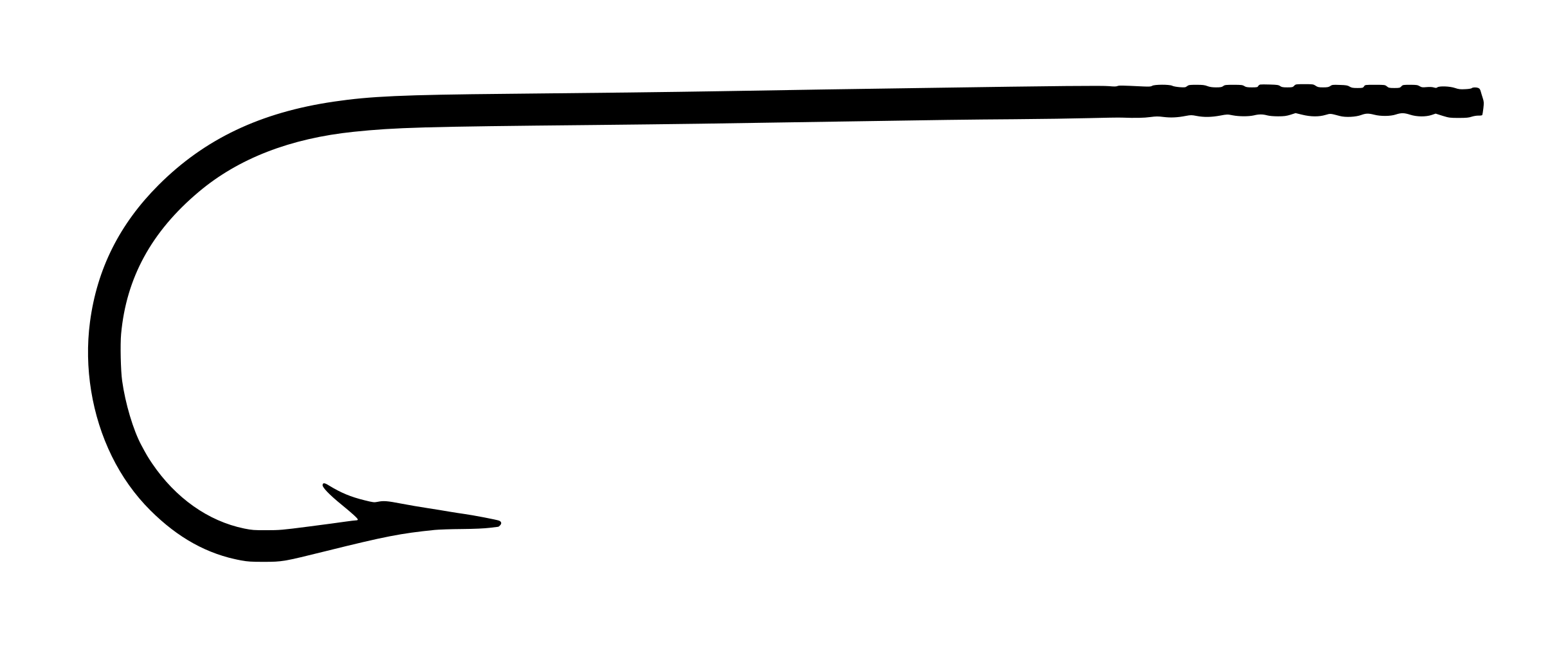
H. Milward & Sons Quality 2599 is a ringed, straight-eyed New York pattern hook sold under Milward’s Iron Arm trademark. The documented specimen is size 4/0, with a spear point, a long raised barb, and a blue-black finish, and it survives in its original labeled box from Redditch, England.
Original lithographically printed box for Milward Quality 2599 Iron Arm New York Ringed Hook, size 4/0. The label features the distinctive mechanical vise trademark and hand-written size notation in pencil.
Photographic record
3 cataloged imagesSelect any record to load it above.
3 images shown
Milward Quality 2599 New York Ringed Size 4/0 Original BoxOriginal lithographically printed box for Milward Quality 2599 Iron Arm New York Ringed Hook, size 4/0. The label features the distinctive mechanical vise trademark and hand-written size notation in pencil.Open originalMilward 2599 Size 4/0 Hook Point DetailClose-up of the hook point showing the hollow point profile (concave inner face) and the small, close-cut barb characteristic of Redditch craft manufacture. The blued finish shows even color saturation with minor surface wear from age.Open originalMilward 2599 Size 4/0 Full Hook ProfileFull profile view of the Milward Quality 2599 hook showing the distinctive straight-line ringed eye (loose ring affixed to shank), the straight shank, and the deep angular New York bend leading to the hollow point. The heavy round wire is evident throughout.Open original
Technical profile
Eye
Ball Eye, Straight / InlineStraight-line loose ring eye P — a separate wire ring affixed to the hook shank near the bend. The ring rotates freely on the shank, allowing unrestricted leader movement. Ring diameter approximately 0.18"-0.22" (4.6-5.6 mm). This eye construction is labor-intensive (requires hand-affixing of the ring via solder or mechanical crimp) and was largely abandoned after 1950 in favor of formed eyes. The straight-ring style is a hallmark of British craft production c. 1890-1950.
Wire
Fine (1X Fine), Round, Est. ~0.058"-0.068" (~1.47-1.73 mm)
Shank
2X Long — Plain
Bend
New York, Standard gap, Offset / kirbedNew York bend profile — moderately angular geometry with slight outward offset of the point relative to the shank centerline. Bend radius approximately 0.45"-0.55" (~11.4-14.0 mm). The bend angle is steeper than a Sproat or Limerick, creating a pronounced 'hook' that favors deep penetration in fish with bony mouths. Wire set appears smooth and uniform with no visible cracks or deformation. The bend is relatively symmetrical, suggesting machine-forming followed by hand-refinement P.
Point
Standard / SpearBarb is small and close-cut, characteristic of early Redditch craft practice. Barb depth approximately 0.04"-0.05" (~1.0-1.3 mm), angled slightly backward toward the shank. Single barb (not double). Placement is just behind the point inflection, optimizing for penetration and hold without excessive damage to soft tissues. The barb-to-wire ratio is conservative — emphasizing holding power over tissue trauma P.
Finish
Blued — Inferred (photographically likely)Blued finish exhibits even color saturation with a cool blue-black tone characteristic of early 20th century bluing practice P. The finish shows minor surface wear consistent with age and storage, but no rust spots or green patina. The blued surface has a slightly matt quality typical of chemically blued (rather than lacquered) finishes. This finish is more durable than japanning in saltwater contexts and was preferred for sea trout and Atlantic salmon applications.
Label is intact with minimal edge wear and light foxing consistent with age. No major creases or tears. Paper stock shows appropriate cream-to-tan patina for early 20th century. Hook itself is bright blued with even color and no corrosion visible.
Eye: The shank end is bent into a closed ring set in line with the shank. This is the ringed eye named on the label, formed from the hook wire itself.
Point and barb: The point is a straight spear point that tapers evenly from the barb to the tip. The barb is long and slender, cut deep into the wire and raised well clear of it. File marks run along the point.
Finish: Blue-black, with blue iridescence where light strikes the wire, consistent with bluing. The label does not name the finish. The photographs show light wear and no rust.
Dimensions: The 4/0 specimen measures 66 mm (2.60 in) overall, with a 44 mm (1.73 in) shank, a 19.3 mm (0.76 in) gap, and a 24.7 mm (0.97 in) bend depth. Wire diameter has not yet been measured.
This entry documents a relatively common example of premium British salmon hook construction. While not a record-setting specimen, it represents authentic Redditch craft-made hook design from the early 20th century and contributes to the catalog's coverage of British regional hook makers.
Own this hook? Help us measure it.
We have measurement for size 4/0. Know any others? Submit calipered measurements and we'll review and add them. Thank you!
Milward identified its hooks by pattern number, printed after the word “Quality” on the label. The number 2599 identifies this ringed New York pattern. This box is marked size 4/0; other sizes of the 2599 are not yet documented here.
The Iron Arm trademark shows an armored forearm gripping a curved blade. It appears on Milward hook packaging and also on Milward-Bartleet tackle: a rod attributed to c. 1900–1920 carries a “Milwards Bartleet Iron Arm” trademark transfer, and a Milward-Bartleet tackle tin is marked “Bartleet Iron Arm” on its end panel. Milward was still selling Iron Arm ringed hooks in the 1930s, including an assortment of ringed hooks in a lithographed tin.
“New York” belongs to a group of hook patterns named for American markets. A 1903 paper on fish hooks by George Barnes Wood of Syracuse, printed in Scientific American Supplement, lists New York bass and New York trout among the standard patterns of the day, alongside Cincinnati bass, Indiana bass, Virginia, and Chestertown.
Era and Packaging Dating
No barcode visible on packaging. Printed label format with lithographic wood-block style vignette logo (Iron Arm trademark with mechanical vise) indicates pre-1920s production. Handwritten size notation (4/0) in pencil is consistent with early Redditch practice. Paper stock is cream-colored, consistent with pre-WWI era. Typography uses traditional serif font and spacing typical of early 20th century. 'Quality' nomenclature and format match Milward's circa 1900-1930 catalog standards. No postal code or modern address format present — consistent with Edwardian-era box design.
The Iron Arm Brand and the Premium Salmon Hook Market
The 'Iron Arm' branding was Milward's clever marketing strategy to communicate mechanical strength to anglers who had experienced hook failures on large fish. In the late 19th and early 20th centuries, poor-quality hooks from mass producers would straighten or snap under the stress of a large salmon strike. Milward's use of heavy wire, careful tempering, and premium materials meant that Iron Arm hooks were genuinely more durable than competitors' budget lines. The mechanical vise logo — depicting an iron arm holding a hook in a vise — was a visual metaphor for unbreakable strength. This branding resonated strongly with serious salmon fishermen, and Iron Arm hooks commanded a price premium that reflected both the superior materials and the brand reputation.
Design lineage and influence
The pattern name places the 2599 among the regional bend styles that Redditch makers supplied for the American trade, a family that also included Cincinnati bass, Indiana bass, and Virginia hooks. On this specimen the bend runs in a smooth curve from the shank into a long, straight point section.
“Ringed” describes the shank end. In Redditch practice the end of the shank was finished by a hammer machine as ringed, flatted, or marked, while hooks for salmon and trout flies were filed to a taper or knobbed. A ringed hook takes a line or gut link knotted directly through the ring. The point on this specimen shows file marks, consistent with the hand filing that period accounts describe for better grades of hook.
Best matchRelated by Attribute
Computed automatically from catalog data — updated as new hooks are added.
Matches: Shank, Eye, Eye Orient., Forging, Offset +3 moreDiffers: Bend: New York vs Kirby (offset); Gap: Standard vs Wide; Point: Standard / Spear vs Hollow Point +3 more
Matches: Bend, Gap, Eye, Forging, Offset +2 moreDiffers: Shank: 2X Long vs 3X Long; Wire: Fine (1X Fine) vs Extra-Fine; Eye Orient.: Straight / Inline vs Turned Down +5 more
Matches: Shank, Gap, Eye, Eye Orient., Point +4 moreDiffers: Bend: New York vs Limerick; Wire: Fine (1X Fine) vs Heavy (1X Heavy); Finish: Blued vs Black Japanned +3 more
Matches: Shank, Wire, Gap, Point, Shank Feat. +1 moreDiffers: Eye: Ball Eye vs Looped Eye; Eye Orient.: Straight / Inline vs Turned Up; Finish: Blued vs Other +2 more
Matches: Shank, Eye, Eye Orient., Point, Forging +2 moreDiffers: Bend: New York vs Kirby (offset); Wire: Fine (1X Fine) vs Standard; Gap: Standard vs Narrow +5 more
The label names the pattern but not the fish or method. A 4/0 hook with a straight ringed eye and a spear point is suited to bait fishing for large fish, with the line or a gut link knotted directly to the ring. The New York name ties the pattern to hook styles made for American anglers.
Secondary Applications
Pike fishing on small rivers and streams; saltwater sea bass and mullet in British coastal contexts; occasional use in North American Atlantic salmon fishing, though Milward hooks were less common in North America than Allcock or Irish-made patterns.
Classic Fly Patterns
Not typically used for fly tying. Primarily a bait and natural presentation hook for salmon and sea trout fishing.
Collector notes
Rated 5.5/10 — Milward 2599 hooks are scarce but not rare, found occasionally in original packaging but far less frequently than common Mustad patterns. Collector demand is moderate to strong among British hook specialists and salmon fishing historians. Complete original boxes with intact labels command a significant premium; loose hooks are far less desirable. Larger sizes (2/0, 3/0) are somewhat more common than size 4/0 shown here.
Reference value
$18 – $45 USD estimate
Packaging condition
Very Good — light wear, fully legibleRecorded specimen
Packaging format
Milward-Vintage-BoxCatalog code
Milward Iron Arm ringed hooks turn up in original boxes and tins on UK and US tackle sale sites. One UK listing offered an Iron Arm ringed box, dated there to c. 1920, at £19.50. A box like this one, with a legible printed label and a pencil size, carries more collector interest than loose hooks, because the label is the only record of the pattern number and name.
Condition drives value. Look for a clean, legible label with bright ink, sound box corners and ends, and hooks free of rust and bent points. The number of hooks in this box is not recorded, so completeness cannot be judged.
Packaging
Cream-colored cardboard box with lithographic label printed in tan/gold ink. Label features decorative Iron Arm vignette trademark (mechanical vise with banner) in upper left. Text elements: 'Quality 2599 / No 4/0' (size handwritten in pencil) / 'The Iron Arm' / 'NEW YORK RINGED' / 'H. MILWARD & SONS, / Redditch, England.' Box is rectangular, approximately 3.5" x 2.0" x 0.75", constructed from single-wall cardboard with folded end flaps. No barcode, no modern printing methods. All text is lithographic (raised ink impression visible). Paper shows light toning and age-appropriate patina. Label edges show minimal chipping. Original tissue wrapper likely present inside but not visible in this image.
Market Value Notes
Low ($18): Good condition — original box with label intact but showing moderate wear, minor creasing, or minor paint loss; 8-10 of 12 hooks present; no missing hooks on card.
High ($45): Excellent to mint condition — original box with crisp, colorful label with minimal foxing, complete hook count, original tissue wrapper present, minimal handling wear.
Premium factors: Intact original printed label (critical — most boxes discarded); complete hook count; blued finish; size 3/0 or 4/0 (mid-range sizes preferred); Redditch maker; straight-ring eye (now rare).
Platforms: eBay UK specialist sales, heritage fishing tackle auctions, British online dealers (Fly Angler's Only, Hunting and Fishing Museum sales).
Confidence: E estimated — limited recent sold data for vintage Milward boxes; values derived from comparable Allcock and Edgar Sealey straight-ring salmon hooks and from general British hook market trends. Comparable Partridge and Allcock salmon hooks in original packaging typically range $20-60 depending on condition.
Where to Find
Specialist eBay UK sellers (search 'Milward Iron Arm' or 'Milward 2599'); heritage fishing tackle dealers in UK specializing in Redditch makers; international fishing tackle auctions (Bonhams, Christie's fishing sales); British online dealers including Fly Angler's Only and the Hunting and Fishing Museum; occasional appearance at specialized tackle fairs in Scotland and central England.
Collector's Identification Tips
The label is the surest identification. Look for “Quality 2599,” the size in pencil after the printed “No,” “The Iron Arm.” under the trademark, “NEW YORK RINGED.” in heavy capitals, and “H. MILWARD & SONS, Redditch, England.” at the foot, all printed in gold ink inside ruled borders. The trademark at upper left shows an armored forearm with riveted plates, the hand gripping a curved blade, the arm rising from a twisted heraldic wreath.
On the hook, check for a closed ring formed from the end of the shank and set in line with it, a New York bend, and a straight spear point with a long, slender barb that stands well clear of the wire. File marks show along the point under the blue-black finish.
Preservation
Storage and Preservation
Keep the box in a stable, moderately dry room, away from sunlight, heat, and damp basements or attics. Bluing is a thin oxide layer that gives the steel only light protection, so humidity is the main threat to the hooks. A closed archival box or container with a small packet of silica gel helps hold humidity steady.
Handle the hooks with cotton or nitrile gloves, since skin salts can start rust on blued steel. If light rust appears, wipe it with a soft dry cloth and leave only a very thin film of light oil or microcrystalline wax. Avoid abrasives, rust removers, and wire brushes, which strip the finish. Leave the label alone: do not clean, flatten, or tape it, and keep the box out of direct light so the paper and gold ink do not fade further.
Marking Analysis
Handwritten Markings and Stamps
The size, “4/0,” is written in pencil after the printed “No” on the label, in a quick, sloping hand. It is the only size information on the label.
A second pencil figure on the box itself, to the right of the label and only partly visible in the photograph, begins with a “5”; its meaning is not recorded. A small lowercase “f” sits at the right margin of the label, level with the trademark caption.
Primary Source
Label Text and Packaging Claims
Source: Original printed box label, H. Milward & Sons Quality 2599, size 4/0 (specimen photographed on this page)
The label is printed in gold ink within ruled borders on cream paper and pasted to a pale gray card box. It reads:
“Quality 2599 / No [4/0, in pencil] / The Iron Arm. / NEW YORK RINGED. / H. MILWARD & SONS, / Redditch, England.”
“Quality 2599” is the pattern number. “NEW YORK RINGED.” gives the bend and the eye. “The Iron Arm.” captions the trademark at upper left: an armored forearm with riveted plates, the hand gripping a curved blade, rising from a twisted heraldic wreath. The label makes no statement about finish, temper, quantity, or intended fish.
Size Note
Size Documentation and Calibration
The box is marked 4/0 in pencil. The specimen measures 66 mm (2.60 in) overall and 44 mm (1.73 in) along the shank, with a 19.3 mm (0.76 in) gap and a 24.7 mm (0.97 in) bend depth. The full-profile photograph on the 0.1 in grid agrees with these figures.
Other sizes of the 2599 are not yet documented here. Calipered measurements from additional sizes would establish the pattern’s size progression.
Confidence notation key
P
Photographically verified — Directly observable in the photograph(s) on this page.
V
Verified by documentation — Confirmed by manufacturer catalog, spec sheet, or published reference.
I
Inferred — A logical deduction from observable or documented evidence, not directly stated.
E
Estimated — An approximation based on visual comparison, proportional analysis, or limited data.
S
Speculative — A reasoned hypothesis that cannot be confirmed from available evidence.
Unnotated claims are the compiler’s synthesis; see Sources. All photographs on garrenwood.com are taken on a measurement grid where each square equals 1/10 inch (0.1″ / 2.54 mm).