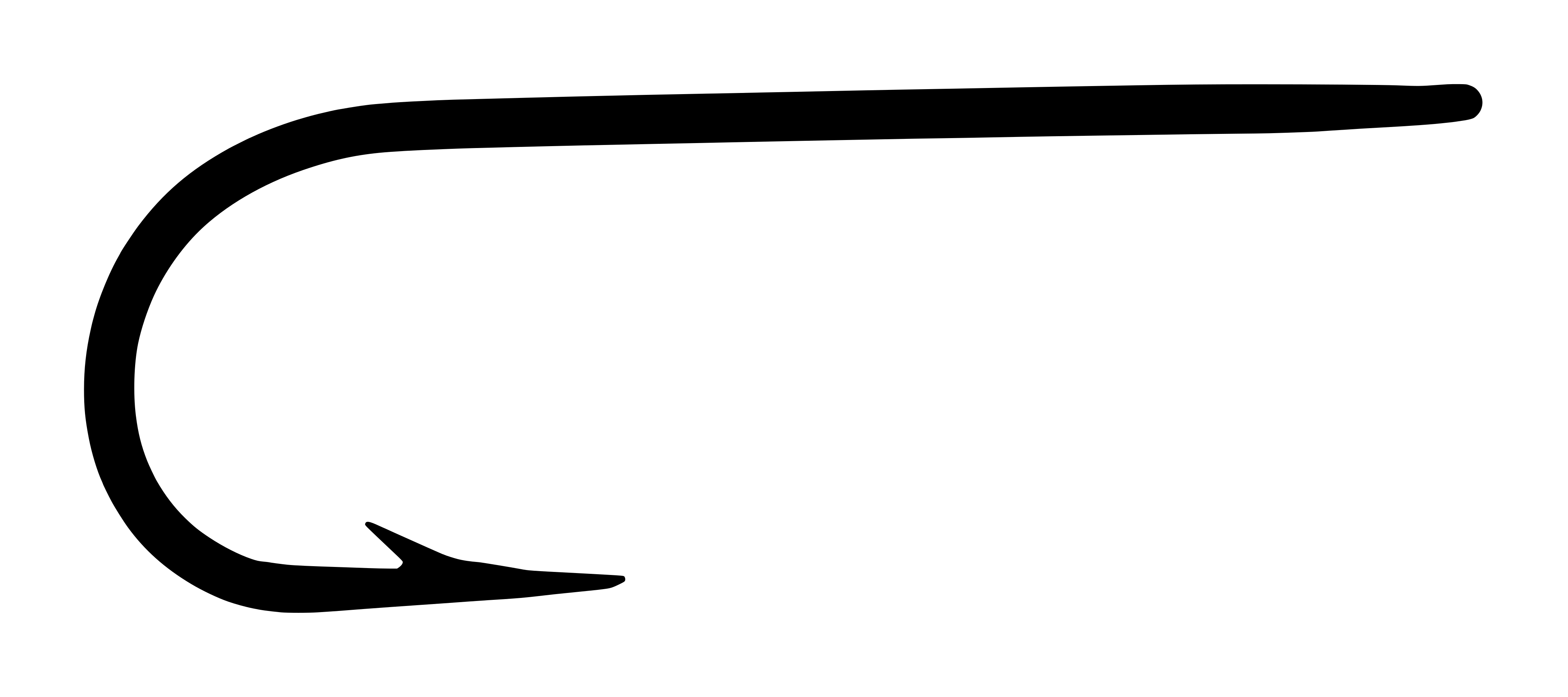
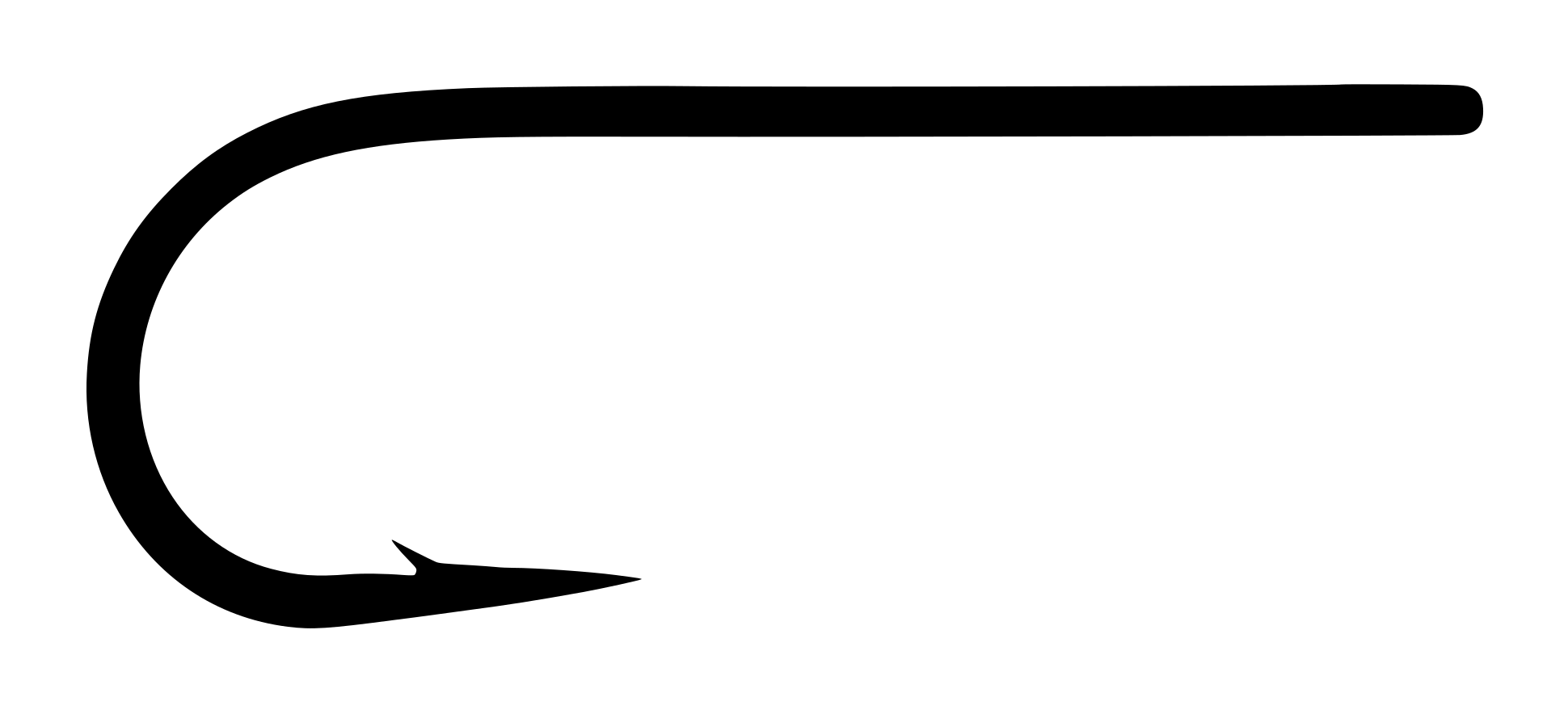
The Milward Quality 2639 R is a Sneck Bent hook manufactured by H. Milward & Sons of Redditch, England, in the early 1900s. This is a smaller bait and sea-trout pattern designed for lighter presentations, featuring a distinctive sneck (short-shank) geometry with a hollow point and ball eye.
The hook exhibits characteristics typical of pre-1920s Redditch craftsmanship: round wire, blued finish, and a tightly curved bend with minimal offset. The ‘Quality’ line designation suggests a mid-tier product in Milward’s extensive catalog. Size No. 8 is relatively diminutive in sneck-bent formats, making it less commonly encountered than larger sizes.
Era evidence includes the absence of a barcode, Victorian-style letterpress printing on yellow stock, and the ‘Made in England’ attribution common to Milward exports. The original packaging format—a cardboard box with applied label—is characteristic of early 20th-century English hook distribution. This hook appeals to collectors interested in Redditch manufacturing history and the evolution of smaller bait-hook designs.
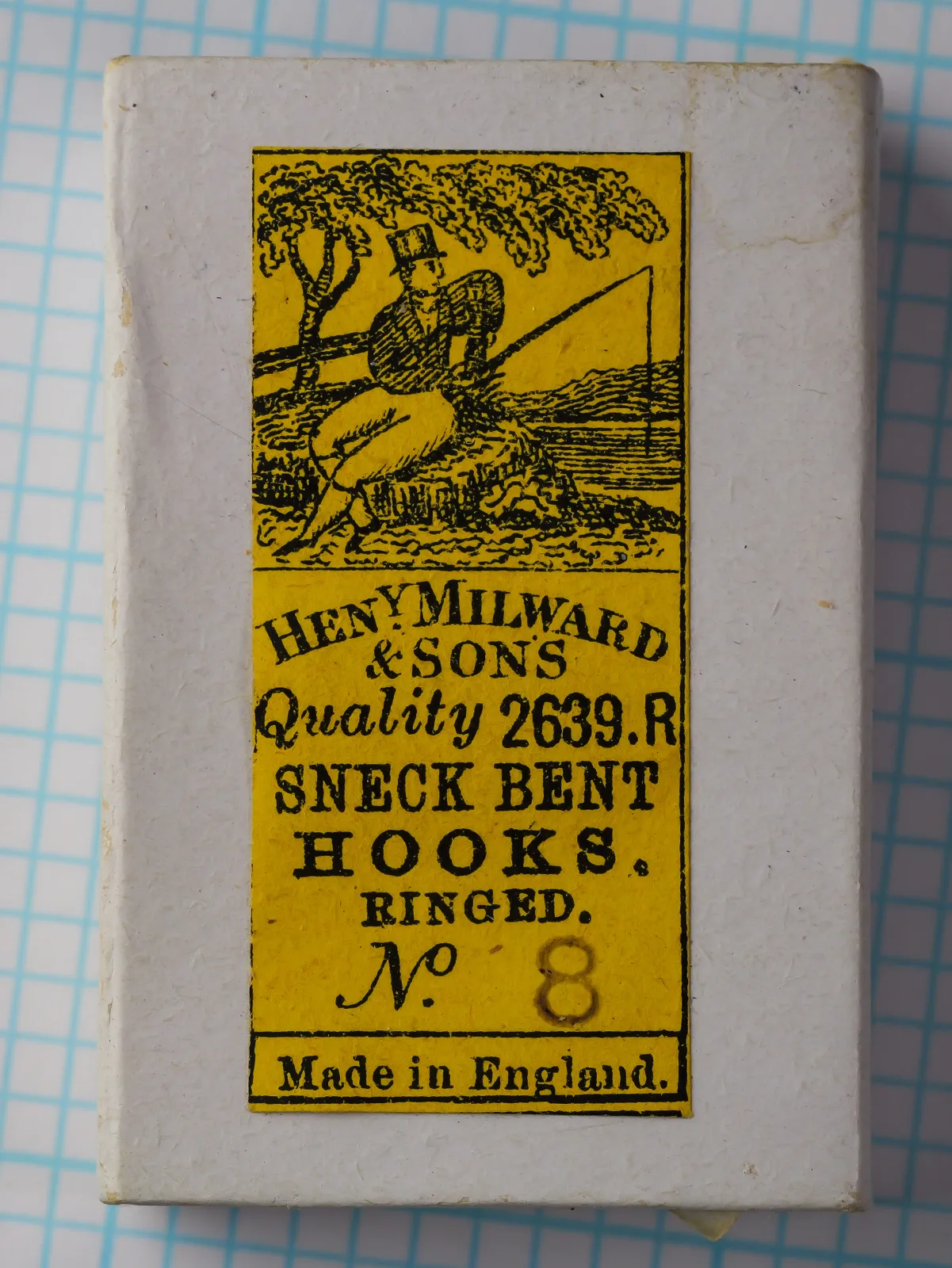
Original cardboard box with applied yellow label showing the Milward Quality 2639 R model designation, Sneck Bent hook specification, and Victorian-era letterpress illustration. The 'Made in England' attribution and absence of barcode confirm early 1900s manufacture.
Photographic record
4 cataloged imagesSelect any record to load it above.
4 images shown
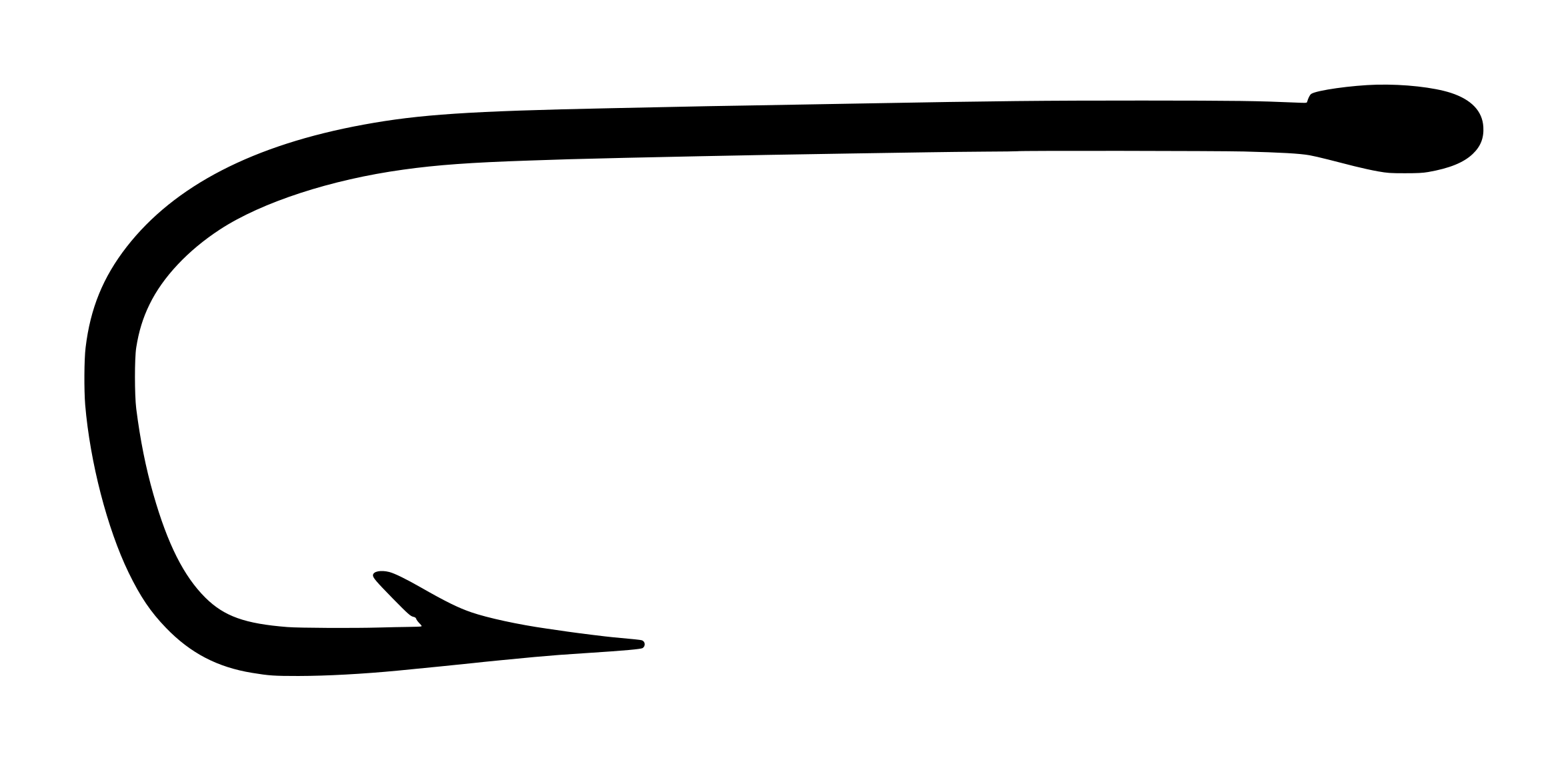
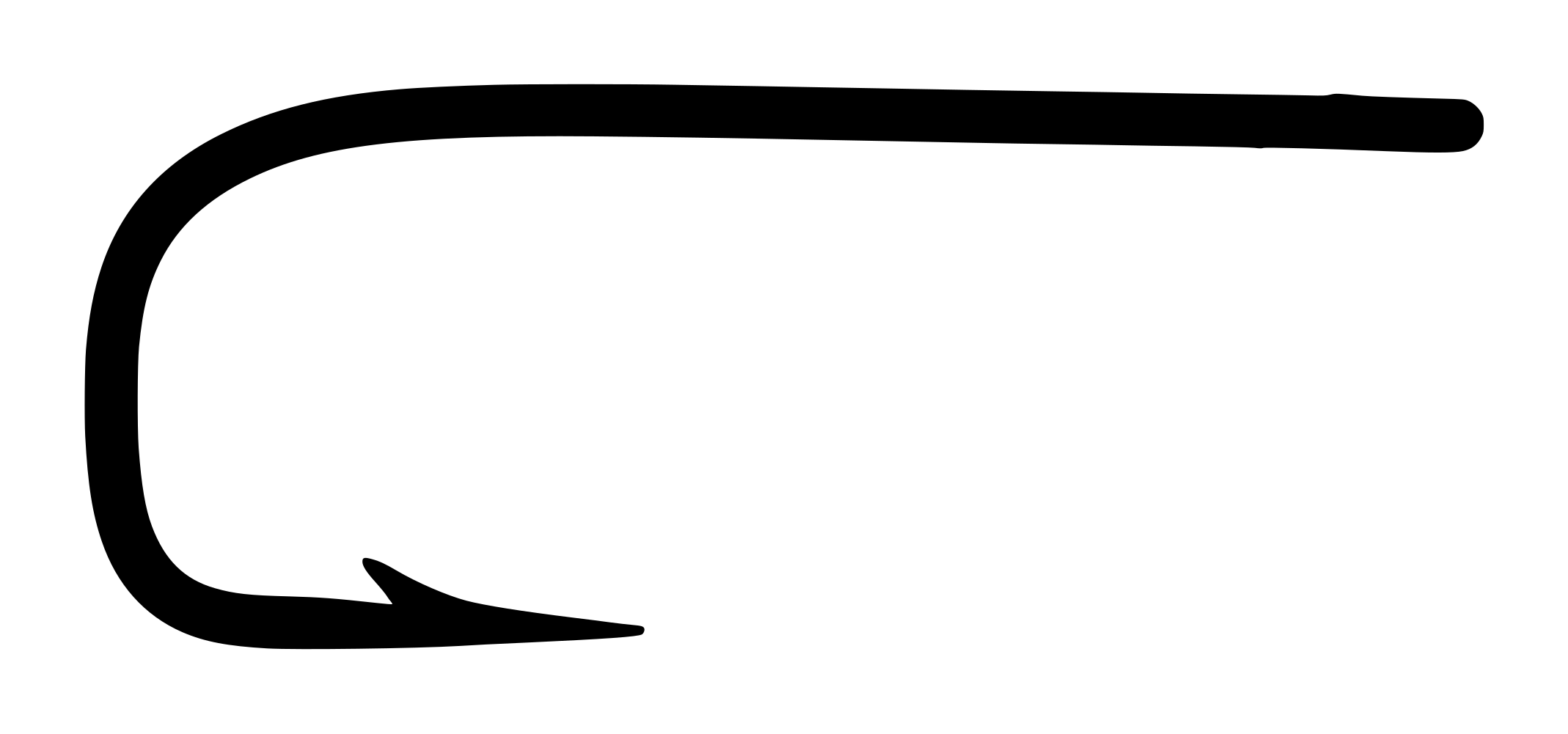
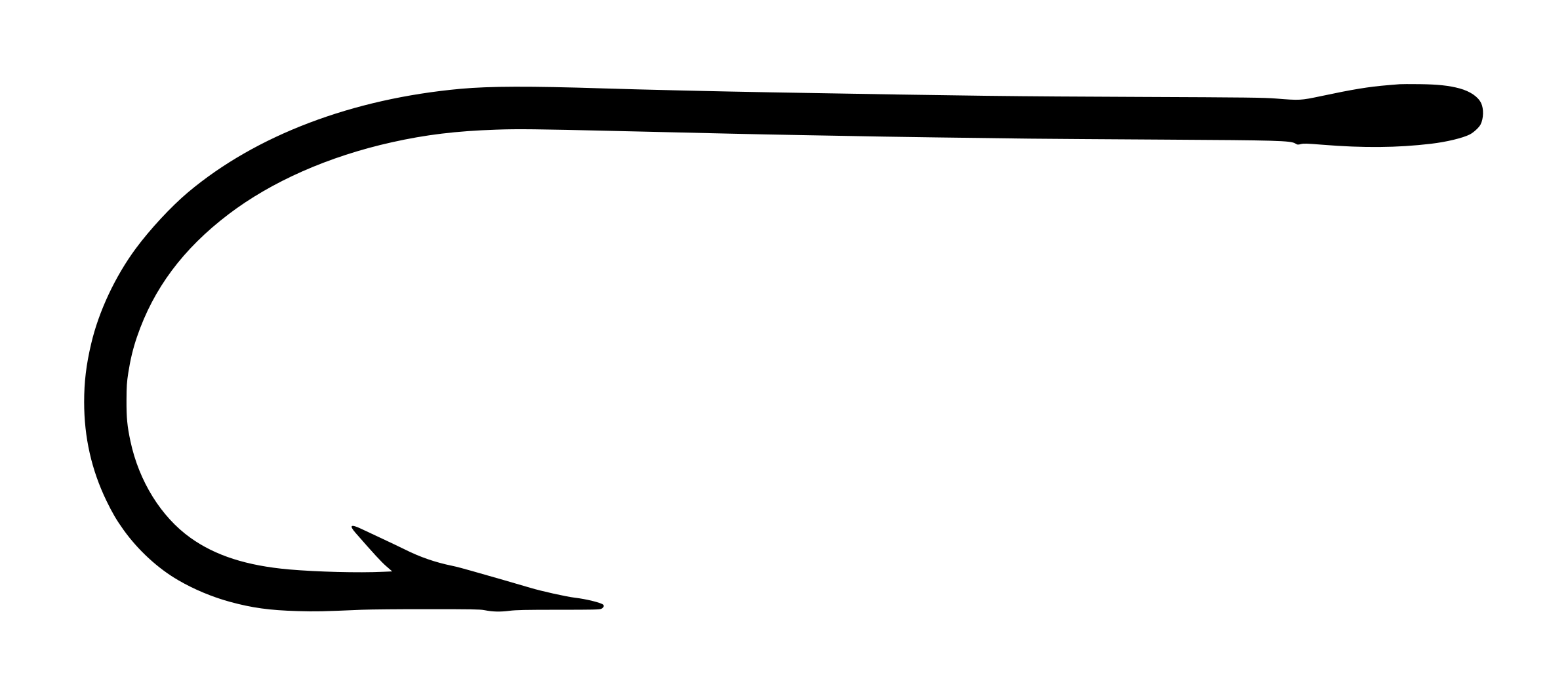
Milward Quality 2639 R Size 8 Original Packaging BoxOriginal cardboard box with applied yellow label showing the Milward Quality 2639 R model designation, Sneck Bent hook specification, and Victorian-era letterpress illustration. The 'Made in England' attribution and absence of barcode confirm early 1900s manufacture.Open originalMilward Quality 2639 R Size 8 Point ProfileClose-up profile of the Milward 2639 R point and barb, showing the characteristic hollow-point geometry with concave inner face and knife-edge taper. The blued finish and small close-cut barb are clearly visible against the measurement grid.Open originalMilward Quality 2639 R Size 8 Full ProfileSide profile of the complete Milward 2639 R showing the sneck bend geometry, ball eye, and overall proportions. The compact shank-to-bend ratio is characteristic of sneck-bent design optimized for bait presentation.Open originalMilward Quality 2639 R Size 8 Multiple HooksComparison of two specimen hooks from the same lot, showing consistency of bend geometry and eye formation. Both display uniform blued finish and identical sneck-bent proportions, documenting manufacturing standards of the Milward Quality line.Open original
Technical profile
Eye
Ball Eye, Straight / InlineBall eye is cleanly formed with smooth swell at wire terminus, typical of hand-drawn construction. No obvious irregularities P.
Wire
Standard, Round, Est. ~0.025" (~0.6 mm) E
Shank
Standard — Plain
Bend
Sneck, Standard gap, Offset / kirbedClassic sneck geometry—short shank relative to bend depth, with smooth symmetrical curve. Bend sits nearly perpendicular to shank axis with minimal wire set P.
Point
Hollow Point (concave inner face)Barb is small and close-cut, consistent with Sneck Bent specification. Angle is steep relative to point taper, characteristic of hollow-point geometry P.
Finish
Blued — Confirmed (stated on packaging)Finish is a cool-tone blued steel, evenly applied without visible wear or rust on specimen hooks. Color is consistent with Victorian-era case-hardening methods rather than modern tempering P.
Specimen hooks show bright blued finish with light surface patina consistent with age. Card shows expected wear and toning; original yellow wrapper with black letterpress printing intact.
The Sneck Bent geometry is optimized for bait presentation in moderate-current and coastal environments. The short shank provides compact profile for natural bait, while the deep bend ensures solid hook-set across a range of fish sizes. The hollow point—characterized by a concave inner face and inward-facing taper—provides a knife-edge cutting effect that penetrates readily into softer tissue (baitfish lips, crab shells, soft weed).
Milward’s round-wire construction without forging keeps weight minimal, making the hook suitable for light leaders and sensitive bite detection in sea-trout work. The blued finish combines corrosion resistance with aesthetic appeal; the finish darkens slightly during hand-hardening, a byproduct of Victorian case-hardening methods rather than a separate bluing process.
The Milward Quality 2639 R belongs to the ‘Quality’ line, a mid-tier product series distinct from Milward’s premium hand-forged offerings and economy bulk hooks. This series was introduced during the height of Redditch competitive manufacturing, c. 1900-1910, when standardized sizing and systematic numbering became industry convention.
Sneck Bent hooks in the 2639 series were marketed primarily for bait fishing and sea-trout work in UK coastal waters and rivers. The ‘R’ designation (‘Ringed’) distinguished the ball-eye variant from blind-eye versions also offered in the same model range. Smaller sizes like No. 8 were less heavily promoted than larger sea-trout patterns (Nos. 1/0–4/0), making them less common in surviving packaging.
Production of this model likely continued through the 1920s-1930s but was eventually superseded by industrial manufacturers’ standardized offerings during WWII and the post-war consolidation of English hook manufacturing.
Era and Packaging Dating
No barcode present — strong pre-1974 indicator. Packaging format is cardboard box with applied label (not card), consistent with pre-WWI distribution method. Letterpress printing technology on yellow stock typical of early 1900s. Victorian-style engraved illustration of angler with fly rod consistent with 1900-1920s Redditch marketing. Phone number not visible; no postal codes present. Henry Milward & Sons factory in Redditch was active from 1880s through consolidation in 1920s-1930s. Estimate range: 1900-1925, with central estimate c. 1910.
The Redditch Golden Age
The Milward Quality line emerged during the 'Golden Age' of Redditch hook manufacturing (1890s-1920s), when the town's cluster of independent makers—Allcock, Sealey, Partridge, and Milward among others—produced thousands of distinct models to serve every conceivable fishery from English chalk streams to colonial African waters. Each maker cultivated a loyal customer base through regional tackleists and sporting newspapers. The introduction of model numbers like 2639 R reflected a shift from artisanal craft to systematized industrial production, yet hand-finishing and quality control remained central. By the 1920s, competitive pricing pressure from Norwegian industrial manufacturers like Mustad began eroding the Redditch makers' export dominance, a trend that accelerated after WWII and ultimately led to consolidation.
Design lineage and influence
The Sneck bend traces its origins to early English coarse fishing traditions, predating the widespread adoption of fly fishing patterns. Its angular geometry reflects practical requirements for bait presentation that differed from the hydrodynamic considerations that later influenced fly hook design. The pattern influenced similar angular bends from other Redditch manufacturers, though each company maintained subtle variations in corner radii and proportions.
Modern hook design has largely abandoned the Sneck’s sharp angles in favor of continuous curves that distribute stress more evenly, though some specialty patterns retain angular elements for specific applications.
Best matchRelated by Attribute
Computed automatically from catalog data — updated as new hooks are added.
Matches: Bend, Wire, Gap, Point, Forging +3 moreDiffers: Shank: Standard vs 1X Long; Eye: Ball Eye vs Tapered Eye; Eye Orient.: Straight / Inline vs Turned Down +2 more
Matches: Shank, Wire, Gap, Eye, Eye Orient. +4 moreDiffers: Bend: Sneck vs Kirby (offset); Point: Hollow Point vs Standard / Spear; Finish: Blued vs Bronzed +4 more
The Milward 2639 R was designed for bait fishing and sea-trout work in temperate British waters—rivers, coastal shallows, and estuaries. The sneck bend geometry and hollow point excel with natural baits: ragworm, lugworm, sand eels, and small coarse fish. The compact shank accommodates live or dead bait without fouling, while the deep bend provides mechanical advantage for rapid hook-set when fish strike. Sea-trout fishing traditions in Scotland and Northern England drove steady demand for smaller sneck-bent patterns like this, particularly during summer coastal runs when 2–4 lb fish predominated.
Secondary Applications
Light bait work for freshwater coarse fish; small eels and sandeel strips for sea trout in estuary work.
Classic Fly Patterns
Not typically used for fly tying.
Modern Equivalents
Hook
Match Quality
Notes
Mustad 32948 Sneck Bent (modern production)
Good
Similar sneck bend and hollow point, but modern forged construction and tinned finish. Overall geometry and bend curvature comparable; size scale differs.
Partridge of Redditch SH Sneck Bend
Very Good
Contemporary Redditch maker's sneck pattern, likely similar wire gauge and finish options. Direct competitor to Milward Quality line.
Collector notes
Moderately collectible due to historical significance of the discontinued Sneck bend and Milward's reputation, but limited by the pattern's specialized nature.
Reference value
$12 – $28 USD estimate
Packaging condition
Good — moderate wear, legibleRecorded specimen
Packaging format
GW-MW-1900s-BOXCatalog code
Positive factors: The Sneck bend represents a discontinued English tradition that appeals to collectors of historical patterns. Milward’s reputation as a premier Redditch manufacturer adds brand value, while the classic packaging with gentleman angler illustration provides display appeal. The ‘Quality’ designation suggests this was a premium offering within the series.
Limiting factors: Sneck bends have limited modern fishing relevance, constraining demand to historical collectors rather than active anglers. Size 8 is neither the largest nor smallest in the series, reducing novelty value. The packaging shows moderate wear and the hooks appear to be partially used, affecting condition premiums.
Packaging
Cardboard box format with applied yellow label featuring black letterpress illustration of Victorian angler. Printed text: 'HENRY MILWARD & SONS / Quality 2639.R / SNECK BENT HOOKS. RINGED. / No 8 / Made in England.' Box is plain white cardstock with no printed exterior; yellow label is pasted onto front face. Dimensions approximately 2.5 × 1.5 inches (63 × 38 mm). No barcode present — strong pre-1974 indicator. Original tissue wrapping likely present inside.
Market Value Notes
Values depend heavily on packaging condition and completeness of hook count. Premium for sealed packages with all original hooks. English hook collectors and Redditch specialists represent primary market.
Where to Find
English tackle auctions, vintage fishing shows, eBay under 'vintage Milward' or 'Redditch hooks', specialist antique tackle dealers
Collector's Identification Tips
Identify Milward Quality 2639 R by: (1) ‘HENRY MILWARD & SONS’ printed on packaging, (2) ‘Quality 2639.R’ model designation, (3) ‘SNECK BENT’ and ‘RINGED’ text, (4) Yellow label with black letterpress illustration and ‘Made in England’ attribution, (5) Absence of barcode and modern printing methods. The ball eye is cleanly formed but not extravagantly large, consistent with standard hand-drawn Redditch practice of the era.
Preservation
Storage and Preservation
Store in a cool, dry environment away from moisture and salt air. The blued finish will develop protective patina over time but is vulnerable to rust if exposed to humidity or condensation. Original packaging should be retained: the cardboard box and yellow label add historical value and provide protective barriers against atmospheric exposure.
If hooks are removed from original packaging, store them on archival acid-free paper or in individual tissue sleeves to prevent contact with other metal objects, which can cause galvanic corrosion. Avoid modern plastics that off-gas and trap moisture. Inspect periodically for surface oxidation; light surface patina is acceptable and desirable in collectors’ specimens, but active rust should be addressed carefully with a soft brush and minimal solvent (mineral oil or light machine oil).
Do not attempt to ‘restore’ blued finish to bright steel—the original finish is part of the hook’s historical integrity and value. Collectors prize original finish condition, including age-appropriate patina.
Primary Source
Packaging Text Analysis
Source: Milward Quality 2639 R packaging label, observed specimen
The yellow label bears three key text elements: (1) ‘HENRY MILWARD & SONS’ in large serif capitals, establishing manufacturer identity; (2) ‘Quality 2639.R’ on separate line, denoting product line and model number with eye variant (‘R’ = Ringed); (3) ‘SNECK BENT HOOKS. RINGED.’ describing hook type and eye construction; (4) ‘No 8’ indicating size; (5) ‘Made in England’ establishing origin.
The absence of registration marks, patent notices, or specific fishing-use descriptions is notable. Unlike some contemporary English packaging, this label makes no claims about ‘superiority,’ ‘temper,’ or ‘durability’—a reflection of Milward’s confident position in the market and the assumption that professional fishermen knew what they were buying. The Victorian engraving of an angler with fly rod—despite this being a bait hook—suggests Milward used stock illustrations across product lines, or that sporting imagery conveyed prestige regardless of specific hook application.
The letterpress printing technique (not lithography) on the yellow paper stock is consistent with early 1900s English printing conventions and confirms the pre-WWI production window.
Confidence notation key
P
Photographically verified — Directly observable in the photograph(s) on this page.
V
Verified by documentation — Confirmed by manufacturer catalog, spec sheet, or published reference.
I
Inferred — A logical deduction from observable or documented evidence, not directly stated.
E
Estimated — An approximation based on visual comparison, proportional analysis, or limited data.
S
Speculative — A reasoned hypothesis that cannot be confirmed from available evidence.
Unnotated claims are the compiler’s synthesis; see Sources. All photographs on garrenwood.com are taken on a measurement grid where each square equals 1/10 inch (0.1″ / 2.54 mm).