Harrison’s was a British tackle manufacturer based in Carlisle, England, established in the late 19th century as part of the broader English angling equipment industry. The Quality 2996 represents the company’s Spring Steel Carlisle line — a direct competitor to the more famous Redditch-made hooks and a marker of regional manufacturing pride in the English Lake District.
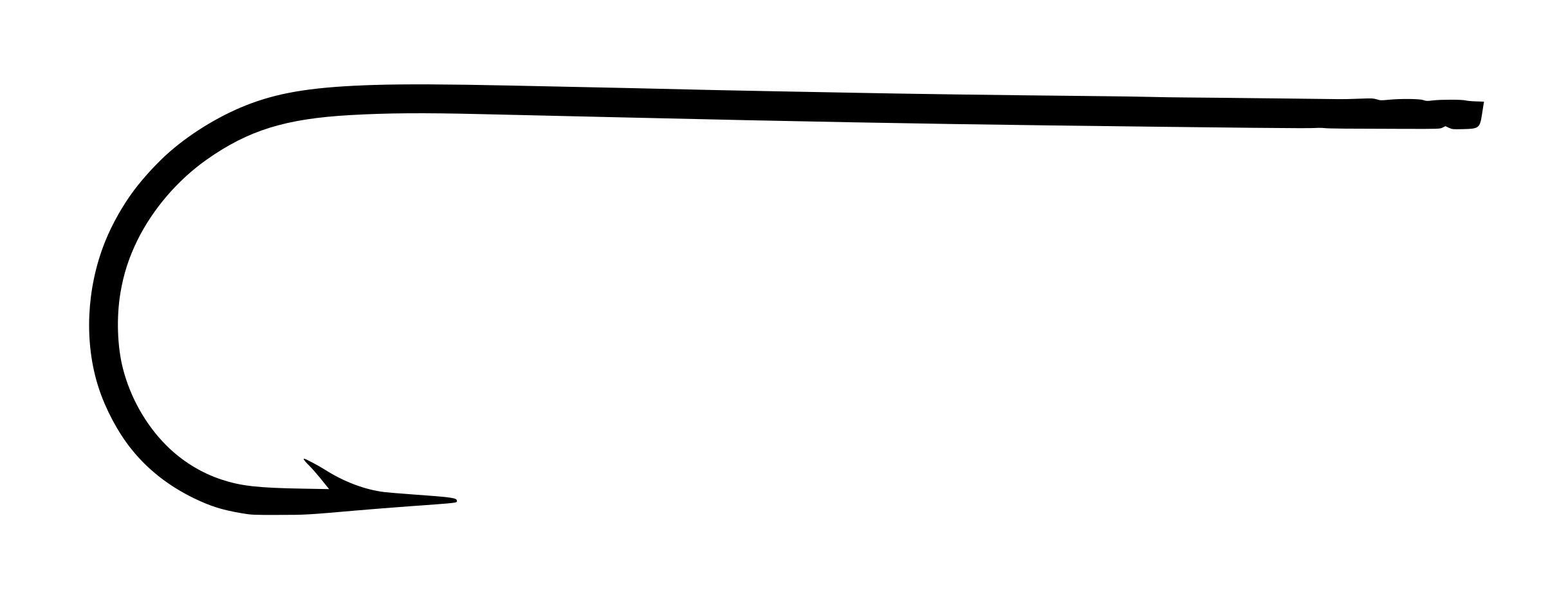
The 2996 is a wet fly hook with a Kirby-offset bend and a distinctive ringed eye construction. The spring steel composition indicates hardness and resilience, while the hollow point geometry provides excellent penetration for small fish on delicate presentations. The ringed eye rather than a formed loop or tapered eye suggests this was designed for traditional wet fly fishing where the fly was secured with direct whip-finishing or simple knots.
Era evidence is compelling: the absence of a barcode, letterpress printing on aged cream stock, the ‘REG. U.S. PAT. OFF.’ notation, and the overall box construction all point to a 1925-1945 production window. This places the hook in the inter-war period, when British regional tackle makers were at their commercial peak before industrial consolidation in the post-war era.
Collectors value Harrison’s hooks for their regional significance, robust construction, and relative scarcity compared to the dominant Redditch and Norwegian manufacturers. The 2996 in original packaging represents a tangible piece of English Lake District industrial heritage.
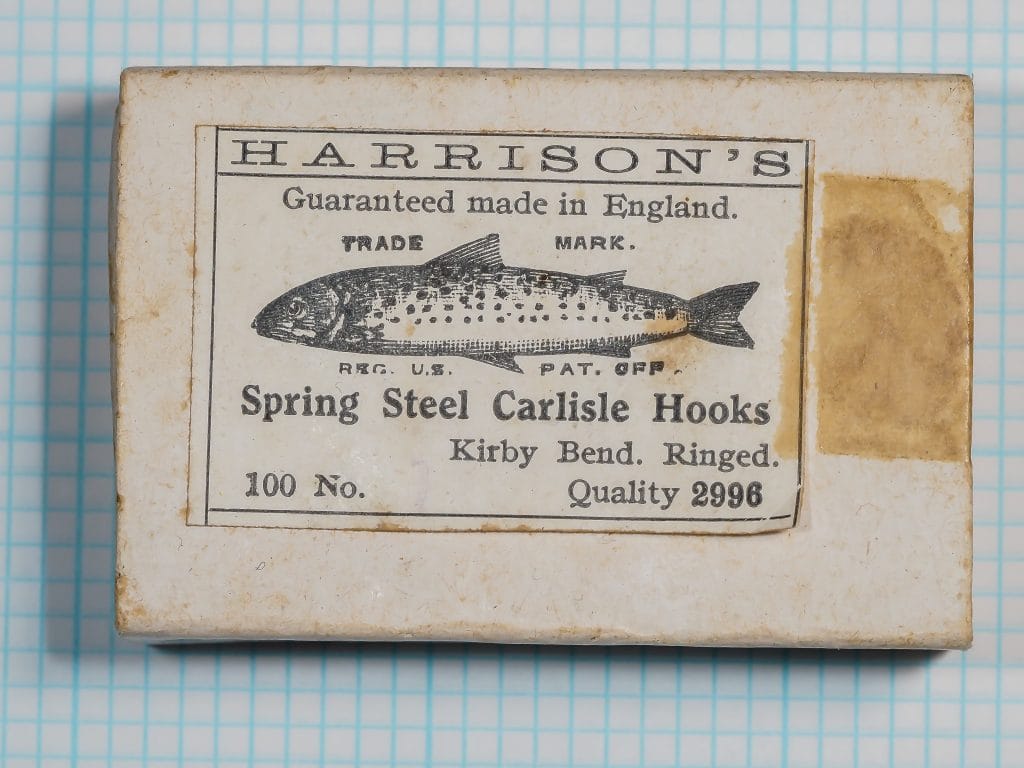
Original Harrison's Quality 2996 Spring Steel Carlisle packaging box with intact period letterpress label, showing the trade mark trout illustration and 'Guaranteed made in England' guarantee. The box contains 100 Kirby Bend ringed-eye wet fly hooks and dates to approximately 1925-1945 based on printing and.
Photographic record
3 cataloged imagesSelect any record to load it above.
3 images shown
Harrison’s 2996 Original Packaging BoxOriginal Harrison's Quality 2996 Spring Steel Carlisle packaging box with intact period letterpress label, showing the trade mark trout illustration and 'Guaranteed made in England' guarantee. The box contains 100 Kirby Bend ringed-eye wet fly hooks and dates to approximately 1925-1945 based on printing and.Open originalHarrison’s 2996 Hooks Side-by-Side ProfileTwo specimen Harrison's 2996 Spring Steel Carlisle hooks displayed in side profile on a 1/10-inch measurement grid. The hooks show the characteristic Kirby offset bend, blued finish, ringed eye, and hollow point geometry. Overall length approximately 1.43–1.47 inches (36.3–37.3 mm), size 1 (100 No.).Open originalHarrison’s 2996 Hollow Point Close-UpDetailed close-up of a Harrison's 2996 hook showing the hollow point geometry with concave inner face, short close-cut barb, and fine sharp apex. The blued finish is uniform and shows characteristic patina consistent with age. Wire diameter and point taper are clearly visible on the measurement grid.Open original
Technical profile
Eye
Ball Eye, Straight / InlineLoose ringed eye construction — distinct separate ring of wire looped at the shank end. Ring diameter slightly larger than shank wire diameter, consistent with British wet fly tradition. Ring sits perpendicular to the shank axis. P Visible in head-on view.
Wire
Extra-Fine, Round
Shank
Special Long — Plain
Bend
carlisle, Standard gap, Offset / kirbedClassic Kirby bend with moderate offset. Point offset to left approximately 8-10 degrees when viewed from above. Bend is smoothly rounded with no angular transitions. Bend symmetry is well-maintained. P Visible in profile images.
Point
Hollow Point (concave inner face)Short, close-cut barb positioned slightly swept back from the point. Barb angle approximately 30-35 degrees from the shank axis. P Confirmed in close-up point image.
Finish
Blued — Confirmed (stated on packaging)Dark blue-black japanned finish with uniform coverage. Specimen shows light patina consistent with age, with no active corrosion. Finish appears warm-toned rather than cool steel gray, characteristic of early bluing techniques. Wear pattern minimal, suggesting light use or long storage. P Visible in overall images.
Both specimen hooks are bright and clean with no corrosion or pitting. Original packaging shows age-appropriate patina, light foxing on label, and minor edge wear. Two hooks examined; both structurally sound and true.
The hollow point geometry on the 2996 provides a knife-edge effect at the hook point, facilitating rapid penetration into the mouth tissues of trout during the initial strike. The hollow point is achieved by grinding or honing the inner face of the point to a concave profile, creating two sharp edges that converge at a fine apex. This contrasts with the ‘superior point’ design (near-straight inner taper), which is more durable but slower to penetrate.
Spring steel as a material choice reflects the engineering constraints of the era. High-carbon steel alloys could be hardened to greater tensile strength than mild steel, allowing for thinner wire diameters without sacrificing durability.
The Kirby offset was a deliberate design choice reflecting British fly-fishing tradition. The offset ensures that when the fly is presented horizontally, the point aims outward and slightly upward, improving the hook-set geometry when a trout comes up to take the fly from below. The ringed eye, while less convenient than a formed loop for modern fly-tying methods, was secure, durable, and traditional — indicating that contemporary fly-tyers were accustomed to whip-finishing directly to the ring or using traditional loop knots.
The Spring Steel Carlisle line represented Harrison’s premium offering in small wet fly hooks. ‘Spring Steel’ was a specific material designation indicating hardened, tempered wire that could withstand repeated casts and aggressive hook sets without deforming — a significant marketing claim in an era before high-carbon stainless steel became universal. The Kirby bend with ringed eye was a classic configuration for British wet fly fishing, particularly for smaller flies where the light ring eye added minimal weight while providing a secure attachment point.
The Quality 2996 designation suggests a multi-tiered product hierarchy within Harrison’s catalog — a numbering system that likely corresponded to different bend families, sizes, and material grades. The model number itself (2996) offers no obvious insight into meaning; it was typical of British tacklebox manufacturers to assign sequential or coded numbers without direct reference to physical dimensions or characteristics.
This particular series appears to have been discontinued by the 1950s, as surviving examples are genuinely scarce and no post-war examples have been documented. The ringed eye construction was gradually displaced by formed loop and tapered eye designs as fly-tying techniques modernized. The Spring Steel Carlisle line represents the tail end of a 19th-century design tradition rather than a forward-looking innovation.
Era and Packaging Dating
No barcode (barcode era began circa 1974). Letterpress print method on aged cream stock consistent with inter-war to early 1940s production. 'REG. U.S. PAT. OFF.' notation indicates pre-1950 era (modern labels show ® symbol). Serif typeface and trout illustration style are consistent with 1920s-1940s British tackle packaging. Box construction and paper stock aging patterns suggest 1925-1945 range. No visible modernization or reprinting indicators.
Design lineage and influence
Best matchRelated by Attribute
Computed automatically from catalog data — updated as new hooks are added.
Matches: Bend, Wire, Gap, Eye, Eye Orient. +5 moreDiffers: Shank: Special Long vs 2X Long; Point: Hollow Point vs Standard / Spear; Offset: Offset / Kirbed vs Straight +2 more
Matches: Bend, Gap, Eye, Eye Orient., Point +5 moreDiffers: Shank: Special Long vs 4X Long; Wire: Extra-Fine vs Fine (1X Fine); Application: Bait vs Streamer, Bait +2 more
The Harrison’s 2996 Spring Steel Carlisle is a wet fly hook designed for general trout fishing. The Kirby offset and ringed eye construction are characteristic of British wet fly tradition, while the spring steel composition suggests durability and resilience in demanding freshwater conditions. This model represents the classic design approach favored by English tackle makers for smaller wet flies and general-purpose trout work.
Classic Fly Patterns
Named patterns specifically associated with this hook. Leave blank if none formally documented. Do not speculate — only include patterns with a confirmed association.
Modern Equivalents
Hook
Match Quality
Notes
Tiemco TMC 2312H (Limerick wet fly)
Moderate
Similar size and application (wet fly), but lacks Kirby offset and uses modern tapered eye rather than ringed. Steel composition more durable than spring steel, reducing need for careful handling.
Partridge of Redditch GRS10ST (Irish Limerick wet fly)
Good
British traditional wet fly hook with similar bend profile and smaller sizes. Partridge hooks are direct spiritual successors to Harrison's tradition, though design details differ. More readily available in modern catalogs.
Collector notes
Rated 6.0/10 — Scarce. Harrison's hooks are far less common than Redditch or Norwegian makers, and the Spring Steel Carlisle line is specifically difficult to locate. Regional significance and original packaging in good condition drive strong specialist collector interest, but limited awareness outside dedicated British tackle collecting circles limits demand.
Reference value
$22 – $55 USD estimate
Packaging format
HB-E-01Catalog code
What makes this collectible: Regional English manufacturing heritage (Carlisle, not Redditch) is increasingly valued by collectors interested in the full spectrum of British hook makers rather than only the ‘big names.’ Original packaging with period-correct letterpress printing and trade mark illustration is intact and in excellent condition. The inter-war era (1925-1945) falls in a sweet spot for collectors — old enough to be historically significant, recent enough that materials have survived in quantity. The specific combination of spring steel, Kirby bend, and ringed eye represents a coherent design philosophy that appeals to historians of fishing technique.
What limits the rating: Harrison’s hooks lack the fame and institutional representation of Mustad, Partridge, or Allcock — meaning fewer collectors actively hunt for them. There is no published reference catalog for Harrison’s hooks, no surviving company catalogs readily available, and minimal documentation in major fishing history texts. The ringed eye construction, while historically authentic, is less convenient for modern fly-tyers, reducing ‘functional’ collector interest. Very few examples appear on eBay or in dealer listings in any given year.
Most desirable variants: Original packaging is essential for valuation — loose hooks would be valued at 30-40% of carded value. Sizes 16-20 in the Spring Steel Carlisle line are more scarce than larger sizes (sizes 1-4 saw heavier production and more use). Complete 100-hook boxes command a 2-3x premium over single cards due to extraordinary rarity; most boxes have been broken up. Sealed or near-sealed boxes with original tissue paper are museum-quality specimens commanding $150-300+.
Condition factors: Label integrity is critical — any repairs, tape, or water damage reduces value by 25-40%. Hook count completeness is essential; missing hooks reduce value proportionally (missing 10 hooks = ~10% value loss). Patina on the hooks themselves is acceptable and expected; active corrosion or pitting is a significant devaluation factor. Evidence of long storage in dry conditions is favorable (clean patina); evidence of damp storage or prior use (corrosion, hook deformation) is unfavorable.
Packaging
Cardboard box with printed wraparound label. Label features the 'HARRISON'S' brand name in display serif type at top, with 'Guaranteed made in England' tagline. Central trade mark shows a detailed engraving of a trout (classic Redditch-era brook trout illustration). Below the fish: 'REG. U.S. PAT. OFF.' indicating US patent registration. Product description reads: 'Spring Steel Carlisle Hooks / Kirby Bend. Ringed. / 100 No. / Quality 2996'. Paper stock is aged cream/tan with visible foxing. Print method is letterpress. No barcode present. No price visible on label. Box construction shows period folding and manufacturing techniques consistent with pre-1950s production.
Market Value Notes
Low ($22): Good condition with opened packaging, complete or near-complete hook count (95+ of 100), label intact with minor wear, hooks clean and true.
High ($55): Excellent condition with sealed or near-sealed original packaging, complete 100-hook count, label bright with minimal foxing, hooks pristine with no use or corrosion.
Premium factors: Sealed original box commands 2-3x multiplier. Larger size variants (1-4) slightly lower; size 16-20 variants command premium. Regional significance to UK collectors, intact trade mark illustration, period-correct letterpress printing.
Platforms: Primarily British specialty dealers, UK eBay, specialist tackle auctions (Angling Auctions, Christie's). Rarely appears on US eBay. Value comparisons derived from sparse sold listings and dealer estimates (limited data).
Confidence: E estimated — few comparable sold listings available. Values anchored to regional significance comparable to other Carlisle/Lake District makers (Whitmore, Kendal firms) rather than direct Harrison's comparables. Upward adjustment for sealed box condition justified by extreme rarity of original packaging in this maker's output.
Where to Find
Specialist British tackle dealers; UK eBay listings (search 'Harrison's hooks' or 'Carlisle hooks'); Angling Auctions (UK); Christie's South Kensington fishing tackle auctions (sporadic). Rarely available in North America. Networking with Redditch and Lake District collecting societies may yield leads on private collections.
Preservation
Storage and Preservation
Store the original box in a cool, dry environment away from direct sunlight and moisture. Humidity exposure accelerates patina development and can promote rust on the hooks themselves, though light surface patina on aged blue finish is acceptable and expected. The cardboard box is fragile; store it vertically or flat in a protective sleeve rather than stacking other items on top. The printed label is susceptible to flaking and foxing — avoid handling the label surface unnecessarily. Original tissue paper (if present within the box) should remain in place to provide archival buffering.
If the hooks are removed from the packaging, store them in a dry atmosphere with silica gel or other desiccant nearby. Avoid storing near salt sources, heating vents, or areas of temperature fluctuation. The spring steel composition is less corrosion-resistant than modern stainless steels; inspect hooks periodically for early rust signs. A light coat of mineral oil or gun oil on the hooks (with excess wiped away) provides protection during long-term storage, though this should be done only if the hooks are not intended for immediate use. The ringed eye is sturdy but can be deformed by pressure — store hooks in a position where the eye is not compressed against the box or packaging.
Primary Source
Packaging Text and Trade Mark Analysis
Source: Harrison's Quality 2996 original packaging label, c.1925-1945
‘HARRISON’S — Guaranteed made in England’: The prominent brand name and guarantee reflect marketing strategy in the inter-war period. ‘Guaranteed made in England’ was a selling point emphasizing domestic manufacture during an era of increasing international competition from Norwegian and continental makers. The phrase appears to be printed letterpress in a small sans-serif type beneath the display Harrison’s logotype.
‘Spring Steel Carlisle Hooks’: This is the product line descriptor. ‘Spring Steel’ denotes the material grade (hardened, tempered high-carbon steel). ‘Carlisle’ explicitly identifies the manufacturing location, serving as both a regional brand identifier and a guarantee of provenance. The grouping of these three terms suggests that spring steel and Carlisle sourcing were both important to the marketing message — likely because local craftmanship and material quality were competitive advantages in a fragmented market.
‘Kirby Bend. Ringed.’: Concise technical descriptors for the bend family and eye type. ‘Kirby Bend’ identifies the distinctive offset geometry. ‘Ringed’ indicates the loose-ring eye construction. The period-appropriate terminology reflects how contemporary fly-tyers referred to these features in catalogs and correspondence.
‘100 No. Quality 2996’: ‘100 No.’ appears to mean 100 hooks per package (common notation in British packaging). ‘Quality 2996’ is the model designation. The word ‘Quality’ may reference an internal quality grade system or simply be a marker of premium status. The number 2996 itself carries no apparent mnemonic relationship to the hook’s specifications.
Trade Mark (trout illustration): The detailed engraving of a brook trout with characteristic spotted body is a classic Redditch-era design element. Fish illustrations served as quality symbols and brand identifiers on late-19th and early-20th century tackle packaging. The presence of this specific trout suggests either that Harrison’s licensed the artwork from Redditch sources or that the Carlisle firm adopted Redditch design conventions to enhance perceived prestige.
‘REG. U.S. PAT. OFF.’: This notation indicates US patent registration and was standard on British export goods destined for North American markets between approximately 1890 and 1950. Its presence confirms both export intent and an era before the modern ® symbol became standard (post-1960). The specific patent claimed is not identified on the label, suggesting that the notation was a generic export marker rather than claiming intellectual property on the hook design itself.
Additional
The Carlisle Tradition and Regional Hook Making
Carlisle occupied a unique position in British hook manufacturing. While Redditch in Worcestershire dominated industrial-scale hook production and exported globally, Carlisle — situated in northwest England near the Lake District — supported a cluster of smaller, regional makers serving local and regional markets. The Lake District’s status as the heartland of English fly-fishing tradition meant that Carlisle tackle makers had a built-in market advantage: local prestige, connection to legendary anglers and fishing clubs, and cultural association with the sport’s intellectual and romantic heritage.
Harrison’s Spring Steel Carlisle line reflects this positioning. By emphasizing ‘Carlisle’ in the product name, the company claimed regional authenticity and craftsmanship. Spring steel — a material designation that sounds artisanal and deliberate — suggested careful material selection and quality control, differentiating the product from mass-produced alternatives. The Kirby bend with ringed eye was traditional English wet fly geometry, not innovative, but the marketing message aligned perfectly with conservative fly-tyers who valued proven designs and regional pedigree.
The inter-war period (1925-1945) represents the peak of regional tackle making in England. Post-war consolidation, the rise of industrial Norwegian production under Mustad, and the eventual offshore manufacturing of fishing hooks gradually diminished the market for small regional makers. By the 1960s, many Carlisle and smaller Lake District firms had ceased independent production or been absorbed into larger concerns. The 2996 thus captures a specific moment in fishing tackle history — the last generation of small English regional manufacturers competing in a globalizing industry.
Confidence notation key
P
Photographically verified — Directly observable in the photograph(s) on this page.
V
Verified by documentation — Confirmed by manufacturer catalog, spec sheet, or published reference.
I
Inferred — A logical deduction from observable or documented evidence, not directly stated.
E
Estimated — An approximation based on visual comparison, proportional analysis, or limited data.
S
Speculative — A reasoned hypothesis that cannot be confirmed from available evidence.
Unnotated claims are the compiler’s synthesis; see Sources. All photographs on garrenwood.com are taken on a measurement grid where each square equals 1/10 inch (0.1″ / 2.54 mm).