The Mustad 3601 B is a fine-wire, extra-fine strength treble hook manufactured by O. Mustad & Son in Oslo, Norway, during the mid-twentieth century. Labeled in the classic golden eight-line format that defines the vintage Mustad labeling era (post-1925), this hook represents Mustad’s precision engineering for delicate wet-fly, streamer, and nymph applications where minimal bait trauma and maximum buoyancy are critical.
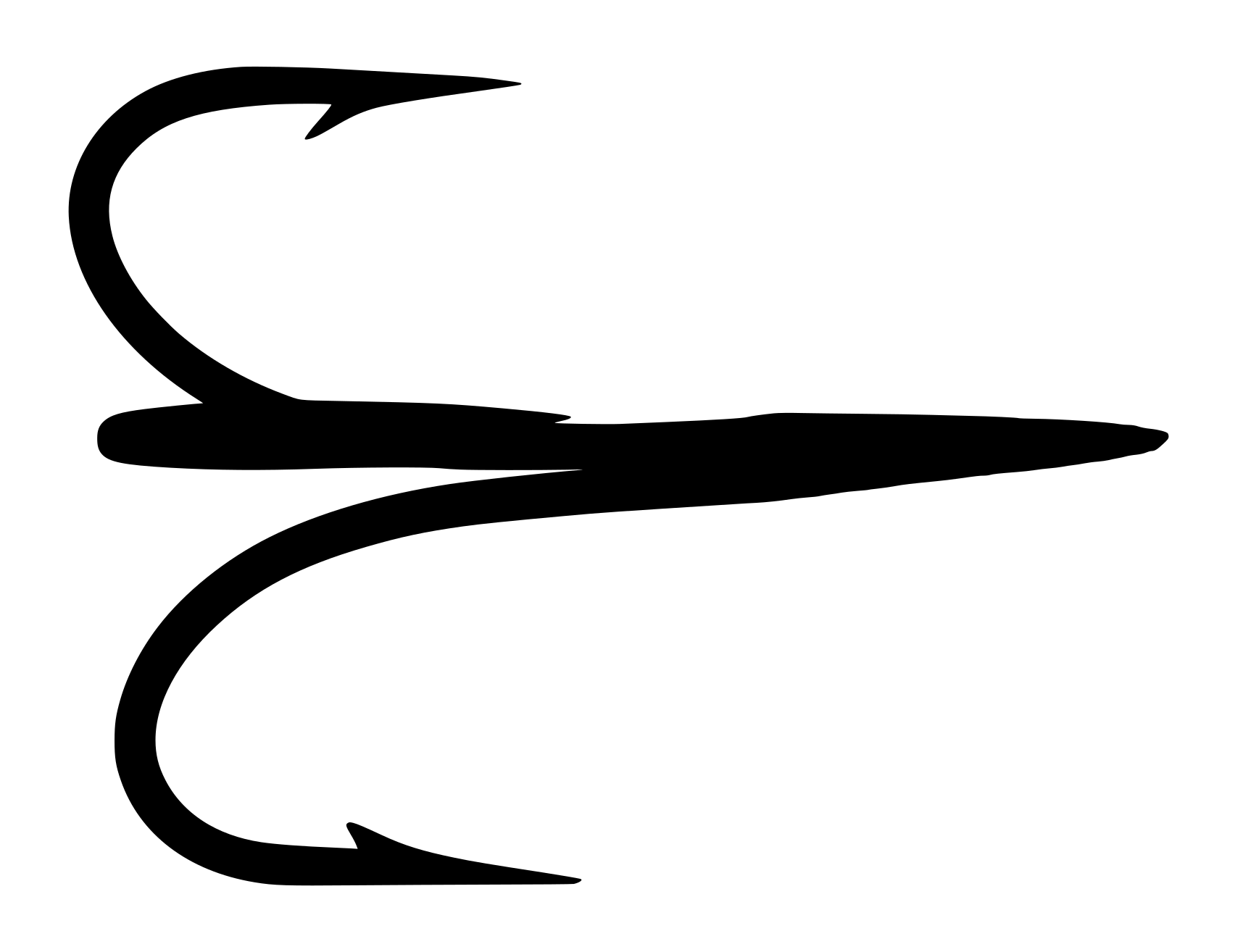
The 3601 B treble features a Sproat bend—a parabolic curve that distributes mechanical stress evenly across the hook’s geometry—paired with hollow points that enable rapid penetration with minimal angler pressure. The tapered eye is intentionally engineered to reduce weight at the hook head, ensuring proper flotation and horizontal presentation of artificial flies. The bronzed finish provides excellent corrosion resistance while offering the muted, stealthy color profile favored by freshwater fly tyers.
As a treble configuration (three synchronized hooks per shank), the 3601 B was engineered for lure dressing and soft-bait applications where multiple hooking points increased strike-to-landing ratios. The extra-fine wire specification reflects Mustad’s commitment to handling delicate species without inflicting unnecessary tissue damage. Original packaging in excellent condition adds substantial collector value; surviving examples with intact cards are increasingly scarce as vintage Mustad stock continues to fragment into private collections.
This hook exemplifies the industrial precision and specialized design philosophy that made Mustad the global leader in hook manufacturing by the mid-twentieth century—an era when tackle was highly specialized for specific fish species, water conditions, and bait presentations, rather than homogenized for mass-market compatibility.
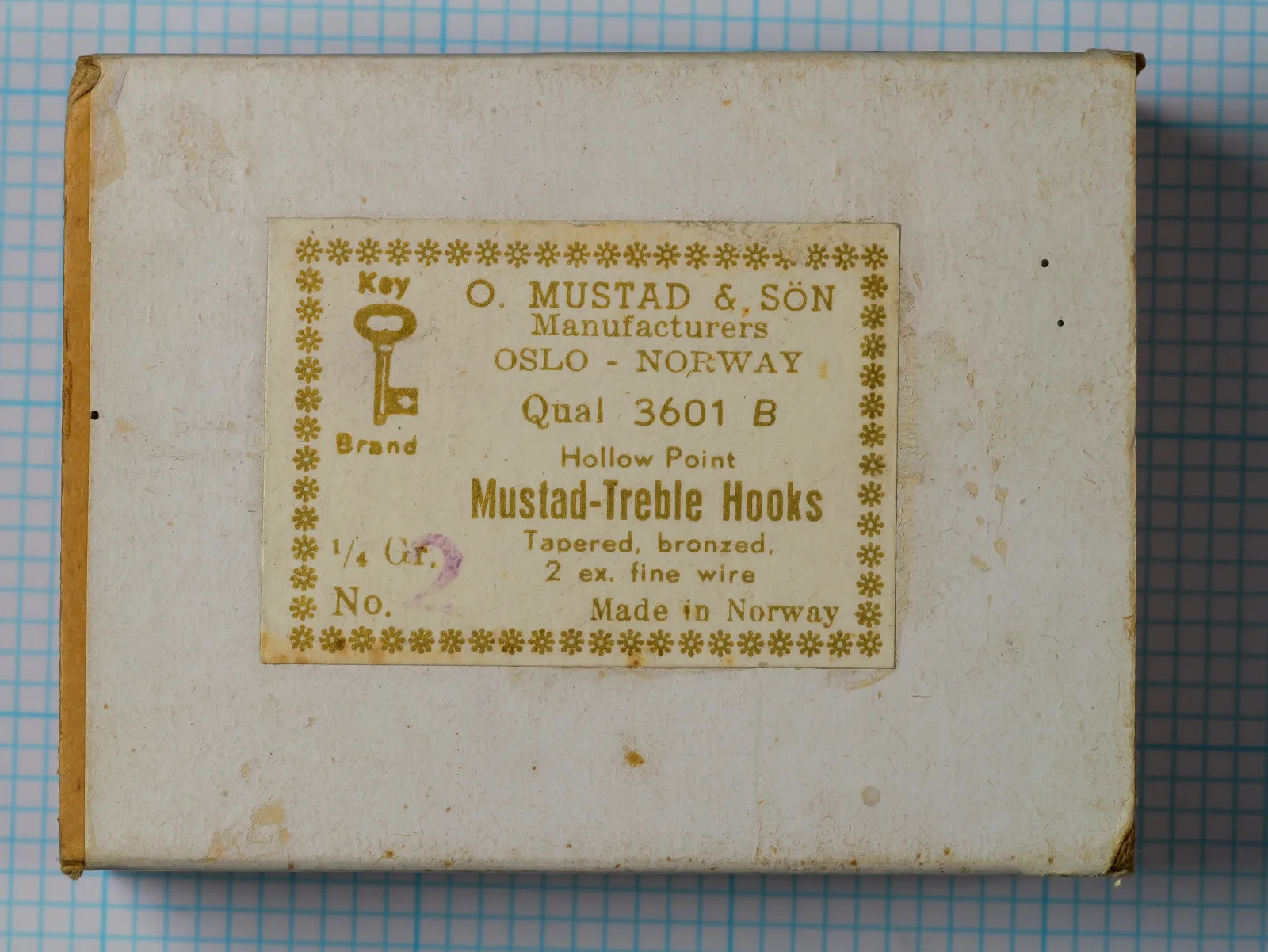
Original cardboard box featuring the classic golden eight-line Mustad label with decorative border, establishing post-1925 Oslo manufacture and mid-twentieth-century production era.
Photographic record
3 cataloged imagesSelect any record to load it above.
3 images shown
Mustad 3601 B Treble Original Box and LabelOriginal cardboard box featuring the classic golden eight-line Mustad label with decorative border, establishing post-1925 Oslo manufacture and mid-twentieth-century production era.Open originalMustad 3601 B Treble Side ProfileSide profile of two Mustad 3601 B treble hooks showing the characteristic Sproat bend geometry, parallel shank positioning, tapered eye detail, and warm bronzed finish. The hollow-point taper is clearly visible from this angle.Open originalMustad 3601 B Treble Top ViewOverhead view of the Mustad 3601 B treble hooks demonstrating the symmetric three-point configuration, equal spacing around the central shank, and barb angle consistency across all three points.Open original
Technical profile
Eye
Blind — Tapered ShankTapered eye features progressive reduction in wire diameter down to a blind eye
Wire
Extra-Fine, Round, Est. ~0.024"-0.028" (~0.61-0.71 mm) E
Shank
Standard — Plain
Bend
Sproat, Standard gapSproat bend exhibits the characteristic parabolic curve—a mathematical hybrid between a sharp angular Limerick and a perfect round bend. P This geometry distributes the strain of a fighting fish evenly across the entire bend radius, providing exceptional resistance to straightening under heavy, sustained loads. The three-hook treble configuration maintains symmetric shank alignment and equal bend depth across all three points. P
Point
Hollow Point (concave inner face)Barb is short, close-cut, and integral to the bend geometry. P The barb is positioned at approximately 90 degrees to the point axis and is angled slightly inward, creating a secure lock without requiring excessive penetration force. Barb geometry is consistent across all three hook points. P
Finish
Bronzed — Confirmed (stated on packaging)Bronzed finish exhibits a warm, golden-bronze hue characteristic of baked-on lacquer coating rather than metallic bronze plating. P The finish is uniform across all three hook points and the shank, with no visible chipping or wear on this specimen. The muted tone contrasts sharply with bright or tinned finishes, making the 3601 B particularly attractive to anglers seeking stealthy presentation in clear freshwater streams. P
Specimen hooks exhibit excellent condition with no corrosion, bending, or damage to the points. Bronzed finish remains uniform and intact. Original cardboard box shows light age toning consistent with seven to nine decades of storage, with no tears, losses, or structural degradation. Label remains crisp and legible. This is a remarkable survival of original packaging and unused stock.
The hollow point geometry on the 3601 B represents a specialized penetration profile engineered for soft-tissue species where a heavy, violent hook-set would tear friable fish mouth tissue rather than securely hooking the specimen. The concave, dished-out inner face creates an incredibly fine, razor-sharp tip that flares rapidly toward the barb—a geometry that achieves initial penetration with absolute minimal applied pressure from the angler. Once the sharp tip penetrates past the barb, the rapid flare ensures the hook holds securely in soft tissue without creating an overly large entry wound that could tear open under the strain of a fight.
The Sproat bend’s parabolic geometry mathematically distributes stress evenly across the entire radius, preventing the hook from straightening out or fracturing under the sustained, heavy loads characteristic of prolonged battles with vigorous freshwater species. The three-point treble configuration multiplies hooking probability—critical for lure applications where soft baits or plugs require multiple simultaneous contact points to ensure at least one hook finds purchase.
The tapered eye is a weight-reduction engineering solution: by progressively thinning the wire diameter as it forms the terminal loop, Mustad reduced the mass at the hook head while maintaining full strength at the critical eye-shank junction.
The bronzed finish provides both corrosion resistance (via baked-on alkyd resin lacquer) and a muted, stealthy aesthetic—the finish mimic bronze appearance without the softness and malleability of actual bronze alloy. This combination protects the high-carbon steel from freshwater oxidation while offering the low-glare presentation preferred by anglers in clear streams where fish might be spooked by bright metallic flash.
Size & scale lab
Selected size
2
Physical specimen
Overall Length
28.5 mm
Shank Length
19.2 mm
Gap Width
9 mm
Bend Depth
8.9 mmE
Wire Diameter
0.86 mm
Weight
.567g
Shank-to-Gap Ratio
~1.5-1.6 : 1
Confidence
P
Physical specimen
Physical measurement with calipers
Cumulative Records
This specimen represents one of the earliest documented Mustad treble hooks in the garrenwood.com catalog with original Oslo-era packaging intact. The extra-fine wire specification combined with tapered eye and Sproat/Hollow Point geometry is a rare specialized configuration not commonly encountered in modern collections.
Own this hook? Help us measure it.
We have measurement for size 2. Know any others? Submit calipered measurements and we'll review and add them. Thank you!
Historical context
mustad
O. Mustad & Son was founded in 1832 in Gjøvik, Norway, by Hans Schikkelstad as a general metal manufacturing firm (Brusveen Spiger- og Staltradfabrikk), initially producing nails, steel wire, and cast-iron goods. The company was acquired by Schikkelstad’s son-in-law, Ole Hovelsen Mustad, and his son, Hans Mustad, who rebranded the operation as O. Mustad & Son and shifted focus toward fishing hooks. The defining moment came in 1877, when Mathias Topp invented the first fully automated hook-making machine—a mechanization that allowed raw steel wire to be continuously fed into a machine that autonomously cut, bent, barbed, and pointed hooks at unprecedented speed. Rather than patent the machine (which would have required public disclosure), the Mustad family protected their competitive advantage through corporate secrecy, strict non-disclosure agreements, and restricted factory access.
This strategy proved devastatingly effective against rival hook-making centers in Redditch, England, and manufacturing hubs across Japan and the United States. By the 1950s, Mustad had captured approximately fifty percent of the global hook production market, establishing sales offices and manufacturing facilities across multiple continents and making the word ‘Mustad’ virtually synonymous with the fishing hook itself. The Oslo facility (relocated from Christiania in 1925) became the flagship production center, exporting to wholesalers, retailers, and individual anglers across linguistic and geographic barriers through the standardized eight-line label system that encoded technical specifications into a universal industrial language.
Series History
The 3601 series belongs to Mustad’s broader Quality (Qual.) code tier system, which segmented the vast catalog into specific numeric ranges based on manufacturing tolerances, wire gauges, tempering standards, and target demographics. The 3000-3999 block represented mid-tier ‘Quality’ products manufactured to exacting dimensional and tempering standards—a category that included both iconic models like the Qual. 3304 Cincinnati Bass Hook and the ubiquitous Qual. 3906 wet-fly hook. The 3601 B specifically denotes a treble variant (the ‘B’ suffix) of the 3601 base pattern, engineered for lure dressing and soft-bait applications rather than single-hook fly tying.
The hollow point specification was applied across multiple variants within the 3600 series to serve freshwater applications where soft-mouthed fish species required minimal penetration pressure. The Sproat bend geometry was standardized within this tier, inherited from regional Irish craftsman traditions and adapted for Mustad’s industrial precision manufacturing. The tapered eye and extra-fine wire specifications emerged as premium engineering choices reserved for higher-tier products where weight reduction and delicate presentation were critical functional requirements. The 3601 B remained in production through the mid-twentieth century before being discontinued during Mustad’s transition to the modern Signature Series nomenclature (c. 2001-2009), which replaced arbitrary numeric quality codes with logical alpha-numeric designations.
Era and Packaging Dating
Oslo designation on label establishes post-January 1, 1925 manufacture (Christiania renamed Oslo in 1925). Absence of barcode confirms pre-1974. Eight-line typographical label format and arbitrary numeric quality codes (3601) are definitive markers of classic vintage Mustad labeling era. Decorative ornamental border, cream-colored stock, and golden letterpress printing are consistent with mid-twentieth-century Scandinavian industrial packaging. This specimen likely dates c. 1930-1960 based on label typography and box construction methods.
The Key That Unlocked Global Markets
The iconic Mustad Key Brand trademark—a downward-pointing skeleton key with 'Key Brand' text—was not merely decorative marketing. In the early twentieth century, when Mustad hooks were exported globally via ship, dock workers and merchants handling cargo in non-English-speaking ports could not reliably read Norwegian or English text on packaging. The universal visual symbol of the key served as a foolproof identifier, instantly signaling 'Mustad hooks' to laborers, customs inspectors, and retailers across linguistic barriers. In an era before barcode scanning and digitized supply chains, a single visual icon was more efficient than any amount of printed text for managing international commerce.
Design lineage and influence
The 3601 B represents the treble-hook variant of Mustad’s broader 3600-series quality-tier offerings, which occupied the mid-tier product category during the mid-twentieth century. The 3601 series inherited the Sproat bend geometry from regional Irish and British fly-dressing traditions, which Mustad reverse-engineered and standardized for industrial mass production beginning in the late nineteenth century. The hollow point specification reflects Mustad’s commitment to specialized point geometries for distinct fishing applications—a design philosophy that distinguished Mustad from competitors who favored single, universal point profiles.
The treble configuration itself evolved from nineteenth-century European lure-dressing practices, where multiple hooks dramatically increased hooking probability on plugs, spinners, and spoon baits. The 3601 B treble influenced later modern treble designs, though modern manufacturing has largely abandoned the extra-fine wire specification in favor of heavier gauges for improved strength and durability. The tapered eye represents an evolutionary refinement of Victorian fly-hook design principles, anticipating modern hook engineering by decades.
Best matchRelated by Attribute
Computed automatically from catalog data — updated as new hooks are added.
Matches: Shank, Gap, Eye, Eye Orient., Point +2 moreDiffers: Bend: Sproat vs O'Shaughnessy; Wire: Extra-Fine vs Heavy (1X Heavy); Finish: Bronzed vs Black Japanned +2 more
Matches: Bend, Gap, Finish, Forging, Shank Feat. +1 moreDiffers: Shank: Standard vs Short (1X–2X Short); Wire: Extra-Fine vs Standard; Eye: Blind — Tapered Shank vs Ball Eye +4 more
Matches: Bend, Gap, Eye, Eye Orient., Forging +1 moreDiffers: Wire: Extra-Fine vs Standard; Point: Hollow Point vs Superior; Finish: Bronzed vs Polished Steel +3 more
The Mustad 3601 B treble was engineered as a specialized lure hook for wet-fly dressing, streamer patterns, and soft-bait applications where multiple simultaneous hooking points increased strike-to-landing ratios. The hollow point design enables rapid, pressure-free penetration critical for delicate freshwater species such as trout, panfish, and small bass. The extra-fine wire minimizes tissue trauma and drag, allowing soft baits to maintain natural movement and texture in the water column.
The Sproat bend distributes mechanical stress evenly, making the treble configuration suitable for sustained fights with vigorous, head-shaking species. The tapered eye reduces weight, ensuring proper buoyancy and flotation for dry-fly and buoyant streamer presentations. Historically, the 3601 B was favored by professional fly dressers and serious fly-fishing enthusiasts who tied elaborate streamer patterns (such as Muddler Minnows, Woolly Buggers, and Marabou streamers) for predatory trout in New England and European chalk streams.
Modern Mustad treble with standard wire and similar Sproat geometry; lacks tapered eye and extra-fine wire specification of original 3601 B
Tiemco TMC200R #2
Moderate
Modern Japanese treble with Sproat-like bend and tapered eye, but different wire profile and material composition; closest functional equivalent for buoyant fly dressing
Partridge CS40 #2
Moderate
Modern UK-made treble with Sproat bend; excellent quality but standard (not extra-fine) wire gauge
Collector notes
Scarce within the vintage Mustad treble category; strong collector interest driven by original packaging integrity, extra-fine wire specification, and mid-twentieth-century Oslo production. Limiting factors include general category (trebles less collected than single-hook patterns) and the arbitrary numeric model code system, which creates identification challenges for casual collectors.
Reference value
$35 – $65 USD estimate
Packaging condition
Excellent — minimal wearRecorded specimen
Packaging format
GW-M-03Catalog code
Positive Factors: Original packaging in excellent condition with crisp, legible eight-line label is a major collector driver—surviving Mustad cards with unused stock are increasingly scarce as vintage inventory fragments into dispersed private collections. The Oslo designation (post-1925) combined with the arbitrary numeric quality code (3601) firmly establishes this as genuine vintage stock from Mustad’s classic labeling era. The extra-fine wire specification indicates premium manufacturing tier and appeals to specialized fly-dressing historians. The Sproat bend paired with hollow point represents a sophisticated, specialized design choice rather than a universal utility hook. Bronzed finish is historically significant and highly valued by collectors of traditional fly-fishing tackle.
Limiting Factors: Treble hooks are less actively collected than single-hook patterns; many contemporary collectors focus exclusively on dry-fly and single-point bait hooks, overlooking treble variants. The Qual. 3601 B designation means nothing to modern anglers unfamiliar with Mustad’s arbitrary numeric system—there is no intuitive descriptor of the hook’s actual geometry, requiring collectors to either memorize historical codes or consult archival references. No barcode presence confirms vintage status but provides no other dating precision within the 40-year production window (1925-1965). The specific treble configuration limits utility to lure dressing, restricting the collector base to fly-dressing historians and plug-building enthusiasts rather than general fly-fishing collectors.
Packaging
Original cardboard box with decorative golden border featuring the iconic Mustad Key Brand trademark. Classical eight-line label printed in golden type on cream stock. Label reads: O. MUSTAD & SON / Manufacturers / OSLO - NORWAY / Qual. 3601 B / Hollow Point / Mustad-Treble Hooks / Tapered, bronzed, 2 ex. fine wire / Made in Norway. Size marked as '1/4 Gr.' (gross) with quantity notation. Box shows age toning consistent with mid-twentieth century production. V
Market Value Notes
Original boxes with unused stock command premium pricing ($45-65 range) due to rarity of surviving packaging and the mid-twentieth-century Oslo provenance. Loose hooks without original packaging trade significantly lower ($15-25 per dozen). Pricing is driven primarily by packaging condition and completeness—boxes with partial hook loss or label damage trade at $25-40. The extra-fine wire and Sproat/Hollow Point combination attracts specialized fly-dressing historians who pay premiums for documented vintage patterns. Treble variants command slightly lower prices than equivalent single-hook models within the same tier and era, reflecting narrower collector interest. Specialist dealers (vintage fly-tackle shops, estate liquidators) achieve higher prices than general platforms. eBay auction results show wide variance based on lot condition and lot photography quality.
Where to Find
Surviving examples appear most commonly through specialist vintage fly-tackle dealers, estate liquidations of deceased anglers, and UK/Scandinavian antique postcard and ephemera dealers (reflecting Mustad's Scandinavian origin and European distribution network). eBay auctions occasionally list original boxes, though single loose hooks are more common. Vintage tackle fairs and fly-fishing symposia in New England and the UK regularly feature Mustad vintage stock. Dedicated Mustad collectors and Norwegian angling history societies maintain archives of original packaging examples.
Collector's Identification Tips
Identify by the eight-line label layout and ‘OSLO – NORWAY’ geographic designation, which establishes production as 1925 or later. Examine the quality code ‘Qual. 3601 B’ on Line 4 — the ‘B’ suffix indicates a specific variant or production tier. The label clearly states ‘Hollow Point’ on Line 5, distinguishing this from Superior-point variants. Verify the tapered eye by inspecting the eye terminal — the wire diameter should visibly taper as it forms the loop. Check for the bronzed finish, which has a warm, muted gold-brown tone rather than the silvery appearance of tinned or bright steel. Original handwritten size notation ‘2’ and partial gross marking ‘1/4 Gr.’ add authenticity. Presence of both hooks on the original card is desirable for collecting.
Preservation
Storage and Preservation
Original cardboard box packaging should be stored in a cool, dry environment away from direct sunlight and fluctuating humidity. The bronzed finish is susceptible to patina development and darkening with humidity exposure; this is generally considered desirable by collectors and represents authentic aging rather than corrosion. However, extended exposure to damp conditions can activate oxidation under the lacquer coating, so storage in a stable, climate-controlled space is ideal.
Keep the box in a flat position on shelving; do not store vertically or apply pressure to the box edges, as this can crush the delicate cardboard structure and cause label separation. If hooks have been removed from the original card, store them loose in a sealed, desiccant-containing container (silica gel packets are effective) rather than re-inserting them into compromised original packaging. Avoid contact with other metal implements that could cause galvanic corrosion—store in isolation from ferrous hooks, pins, or fasteners.
Periodically inspect the box interior for signs of insect activity (silverfish, cockroaches) or moisture accumulation. If the label shows early separation, support it gently with acid-free archival paper rather than attempting to reattach it. Do not attempt to clean the bronzed finish with abrasive materials; gentle dusting with a soft cotton cloth is sufficient. The golden letterpress print on the label is extremely fragile—do not touch the label text directly, and avoid exposure to prolonged direct sunlight, which can fade the ink.
This specimen should be considered a museum-quality archival artifact rather than functional fishing tackle. Its primary value lies in historical documentation and the integrity of the original packaging ecosystem. Once hooks are removed or packaging is damaged, significant collector value is permanently lost.
The Mustad 3601 B label exemplifies the classical eight-line typographical format that Mustad standardized across global exports from the late nineteenth century through the early 2000s. Each line encodes specific technical information in a rigid hierarchy designed to communicate across linguistic barriers.
Line 1 & 2 (Corporate Identity): ‘O. MUSTAD & SON / Manufacturers’ establishes ultimate corporate authority and Mustad’s role as the primary manufacturer (not a distributor or repackager). This distinction was historically critical, as the tackle market was saturated with regional import agents who frequently repackaged bulk hooks under secondary brand names. By cementing their manufacturing identity, Mustad ensured brand loyalty directly from end-users.
Line 3 (Geographic Origin & Chronological Bracket): ‘OSLO – NORWAY’ is the single most important dating clue. The Norwegian capital was officially renamed from Christiania to Oslo on January 1, 1925. Therefore, any Mustad box bearing ‘OSLO’ was manufactured post-1925. This specimen’s ‘OSLO’ designation establishes a firm post-1925 terminus post quem, generally indicating mid-twentieth-century production (c. 1925-1965).
Line 4 (Quality Code Tier): ‘Qual. 3601 B’ denotes the specific model and configuration. The arbitrary numeric code occupies the 3000-3999 range, indicating a mid-tier ‘Quality’ product manufactured to exacting dimensional and tempering standards. The ‘B’ suffix indicates the treble variant. These codes offered no intuitive descriptor to modern users—tyers simply had to memorize that 3601 B was a fine-wire treble and 94840 was an extra-fine dry-fly hook.
Line 5 (Hook Point): ‘Hollow Point’ is the most strictly regulated element of the entire label system. This line is exclusively reserved for defining the geometric shape or quality grade of the hook point. The hollow point specification indicates specialized penetration engineering for soft-tissue species rather than a universal utility design.
Line 6 (Pattern Name): ‘Mustad-Treble Hooks’ identifies the overarching geometric pattern and purpose. The ‘Treble’ designation indicates the three-hook configuration for lure dressing and soft-bait applications.
Lines 7 & 8 (Anatomical Modifications & Metallurgical Finishes): ‘Tapered, bronzed, 2 ex. fine wire’ provides the culminating technical details. ‘Tapered’ refers to the tapered eye (progressive wire diameter reduction). ‘Bronzed’ specifies the baked-on lacquer finish. ‘2 ex. fine wire’ indicates extra-fine wire gauge with a designation of ‘2’ (possibly referring to wire count or tempering specification).
Size and Quantity: ‘1/4 Gr.’ (gross) with ‘No. 2’ size notation indicates the physical hook dimension and the box contents (approximately 25 hooks, since 1/4 of 100 is 25, or possibly 1/4 gross = 36 hooks).
Additional
The Treble Hook in Fly-Dressing Tradition
The treble configuration represents a distinct evolutionary branch within fly-hook design, diverging from the single-hook tradition that dominates modern fly-fishing literature. While single-hook patterns (dry flies, nymphs, wet flies) are exhaustively documented in contemporary literature, treble designs and their historical applications remain understudied in mainstream angling historiography.
The three-point treble hook was engineered specifically for lure dressing and soft-bait applications where multiple simultaneous contact points dramatically increased strike-to-landing ratios. Professional fly dressers integrated trebles into streamer patterns—notably oversized designs like Muddler Minnows, Woolly Buggers, and articulated Marabou streamers—where the additional hooking points compensated for the difficulty of setting a single hook on large, predatory fish with hard mouths and strong head-shaking behavior.
The Mustad 3601 B treble, with its extra-fine wire and tapered eye, represents a premium engineering solution: the reduced mass at the hook head ensured proper flotation for buoyant streamer patterns, while the hollow point enabled rapid penetration on strikes. The Sproat bend distributed mechanical stress evenly across the three synchronized hook points, preventing catastrophic failure when fighting large, vigorous fish.
By the mid-twentieth century, the treble hook was falling out of favor among recreational fly-fishers, who increasingly favored single-hook patterns for their perceived elegance and reduced environmental impact (three barbs versus one). Commercial soft-bait manufacturers, however, continued to integrate treble hooks into plug and spoon designs, where the multiple contact points provided an economic advantage in reducing hook loss and increasing landing rates. The 3601 B represents a transitional moment in tackle history—a moment when specialized, multi-point designs were gradually displaced by the standardized single-hook paradigm that dominates contemporary fly-fishing practice.
Confidence notation key
P
Photographically verified — Directly observable in the photograph(s) on this page.
V
Verified by documentation — Confirmed by manufacturer catalog, spec sheet, or published reference.
I
Inferred — A logical deduction from observable or documented evidence, not directly stated.
E
Estimated — An approximation based on visual comparison, proportional analysis, or limited data.
S
Speculative — A reasoned hypothesis that cannot be confirmed from available evidence.
Claims with no notation are confirmed by multiple independent sources. All photographs on garrenwood.com are taken on a measurement grid where each square equals 1/10 inch (0.1″ / 2.54 mm).