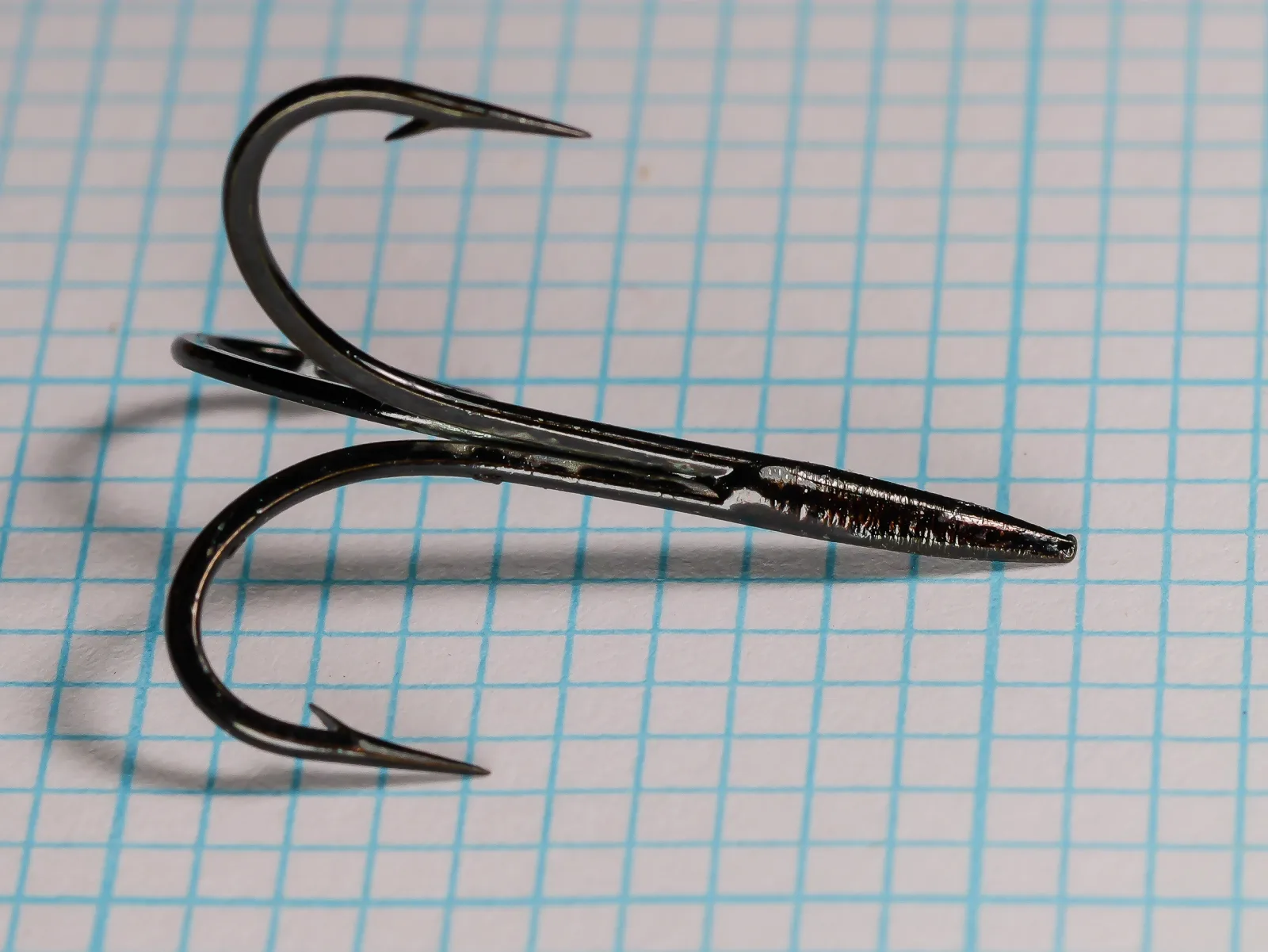
The Mustad 3621 is a vintage industrial treble hook produced by O. Mustad & Søn in Oslo, Norway, circa 1950–1965. Classified as a blind eye or tapered shank treble, it lacks the looped eye of conventional hooks; instead, the three shanks are brazed together and tapered to a fine point suitable for soldering directly into lure bodies.
The hook features a heavy, forged steel construction with an O’Shaughnessy bend profile—a classic, strong curve resistant to opening under load. The point geometry is hollow, providing excellent penetration characteristics. The finish is a durable black japanned (baked lacquer) coating, typical of industrial saltwater hooks of the era.
This model was manufactured exclusively for lure makers and tackle manufacturers, not for direct angler use. The presence of the Key Brand logo, Oslo designation (post-1925), and the eight-line Mustad label format with Qual. 3621 code are hallmarks of vintage Mustad production circa mid-twentieth century. Collectibility is strong among vintage lure restorers, who rely on these trebles to authentically restore antique spoons and plugs.
Side profile of the Mustad 3621 showing the characteristic O'Shaughnessy bend curve, heavy forged wire, and tapered termination point designed for soldering into lure bodies. Black japanned finish is uniform and well-preserved.
Photographic record
3 cataloged imagesSelect any record to load it above.
3 images shown
Mustad 3621 Size 2 Blind Eye Treble — Side ProfileSide profile of the Mustad 3621 showing the characteristic O'Shaughnessy bend curve, heavy forged wire, and tapered termination point designed for soldering into lure bodies. Black japanned finish is uniform and well-preserved.Open originalMustad 3621 Size 2 Blind Eye Treble — Top ViewTop view of the Mustad 3621 showing the three-wire brazing point and clean tapered termination designed for insertion into lure bodies or brass tubes. Hollow point geometry and barb placement are visible.Open originalMustad 3621 Original Package Label and BoxOriginal packaging for the Mustad 3621, showing the eight-line Mustad label format with Key Brand trademark, Oslo location, Qual. 3621 code, and product description. Handwritten pink '2' size notation is visible. Kraft cardstock box shows authentic age-toning.Open original
Technical profile
Eye
Blind — Tapered ShankBlind eye with three wires brazed into a single unit and tapered to a fine point P. No loop or formed eye; designed for insertion into lure body or soldering onto wire form. Taper is clean and symmetrical P.
Wire
Heavy (1X Heavy), Forged
Shank
Standard — Plain
Bend
O'Shaughnessy, Standard gapO'Shaughnessy pattern with pronounced, strong curve characteristic of heavy saltwater and lure-making applications P. Bend is deep and regular, forged for maximum strength P. No lateral offset; point aligned with shank axis P.
Point
Hollow Point (concave inner face)Barb is small, close-cut, and swept back at approximately 45-degree angle P. Barb placement is positioned midway down point taper P. Consistent with hollow point geometry design P.
Finish
Black Japanned — Confirmed (stated on packaging)Black japanned coating, uniform and well-preserved on specimen P. Finish exhibits warm black tone with slight age-darkening, typical of alkyd resin-based lacquer from mid-twentieth century E. No major corrosion or flaking visible P.
Specimen shows excellent preservation: japanned finish is uniform and intact with no significant corrosion, flaking, or rust P. Original box in good condition with minor age-toning and water-ring staining on cover P. Card label is intact and legible P.
The blind eye design represents an industrial manufacturing choice specific to lure construction prior to the widespread adoption of split rings. Rather than requiring an angler to tie the hook to a line, the hook was soldered directly into the lure body, brazed onto a wire form, or friction-fit into a tube. This construction method eliminated the need for a formed eye loop, which would have been inconvenient during the soldering process and would have wasted material.
The three wires are brazed into a single unit at the head, creating a mechanically unified structure capable of distributing stress across all three points simultaneously. The tapered termination point provides a clean soldering surface and ensures minimal excess metal at the attachment point. The heavy, forged wire and O’Shaughnessy bend were chosen for this application because lure bodies require hooks capable of withstanding the severe stresses of artificial trolling presentation, where the hook may strike bottom, rocks, or heavy fish with violent force.
The hollow point geometry provides rapid initial penetration with minimal pressure—a biomechanical advantage when the hook is embedded in a hard lure body and must cut through the buccal cavity of a fish immediately upon strike. The japanned finish provides durable corrosion resistance in the harsh saltwater environments where these lures were typically employed.
Size & scale lab
Selected size
2
Physical specimen
Overall Length
27.1 mm
Shank Length
18.1 mm
Gap Width
9.2 mm
Bend Depth
10 mm
Wire Diameter
.039
Weight
.733g
Shank-to-Gap Ratio
~1.5-1.6 : 1
Confidence
P
Physical specimen
Physical measurement with calipers
Own this hook? Help us measure it.
We have measurement for size 2. Know any others? Submit calipered measurements and we'll review and add them. Thank you!
Historical context
mustad
O. Mustad & Søn was founded in 1832 in the remote village of Gjøvik, Norway, initially as Brusveen Spiger- og Staltradfabrikk, producing nails, steel wire, and cast-iron goods. The company was rebranded as O. Mustad & Søn following the takeover by Ole Hovelsen Mustad and his son Hans Mustad. The defining moment in company history occurred in 1877 when Mathias Topp, a visionary within the firm, invented the first fully automated hook-making machine—a mechanization that allowed continuous wire feed, cutting, bending, barbing, and pointing at unprecedented speed.
Rather than filing for patents (which would have required disclosure of mechanical schematics), the Mustad family protected their competitive advantage through strict corporate secrecy, non-disclosure agreements, and restricted factory access. This strategy proved devastatingly effective against rival manufacturers in Redditch, England, Japan, and the United States. By the 1950s, Mustad had secured approximately 50% of the global hook production market, establishing sales offices and manufacturing facilities across multiple continents. The company utilized a formalized eight-line label system to communicate technical specifications to international wholesalers, regional retailers, and individual anglers across linguistic barriers.
Series History
The Mustad 3621 Blind Eye Treble belongs to the broader category of industrial treble hooks manufactured for lure makers rather than individual anglers. Within Mustad’s mid-twentieth century production, blind eye trebles were specialty products—manufactured in relatively small volumes compared to standard ringed-eye trebles—because the market was limited to professional lure manufacturers and tackle factories.
The 3621 specifically represents the company’s adaptation of the O’Shaughnessy bend pattern to treble-hook format, combining the strength and deep curve of that traditional salmon/saltwater pattern with the multi-point versatility of a treble. The quality code 3621 places it in Mustad’s mid-tier product range (3000–3999 block), indicating manufacturing to exacting dimensional and tempering standards. Production appears to have spanned the 1950s through 1960s, with the Oslo designation confirming manufacture post-1925. No broader series evolution is documented; the 3621 represents a standalone specialist product rather than a numbered progression.
Era and Packaging Dating
Oslo designation on Line 3 indicates production after January 1, 1925, when the Norwegian capital was officially renamed from Christiania V. The eight-line Mustad label format, Key Brand trademark, and formal Qual. code system were standard throughout the mid-twentieth century. Paper stock, printing method (letterpress offset), box construction, and absence of barcode all indicate pre-1974 manufacture E. The style of the Key Brand logo and label ornamental border styling are consistent with 1950s–1960s Mustad production E. The Oslo marking combined with the absence of any later modernization, combined with the specialized nature of blind-eye trebles (which fell out of favor as split-ring attachment became standard), suggests production concentrated in the 1950s–early 1960s before market shift I.
From Factory to Fishery: Industrial Lure Assembly
The blind eye treble hook represents a fascinating intersection of industrial manufacturing constraints and angling innovation. During the 1920s–1950s, lure makers faced a critical manufacturing bottleneck: how to durably attach a treble hook to a rigid spoon or plug body. The solution was to solder the hook directly into the lure, eliminating the need for the eye loop entirely. The tapered shank of the 3621 was specifically designed to be inserted into a brass tube soldered into the lure body, where it would be permanently locked by friction and solder. This method produced lures of exceptional durability—in fact, many original 1940s–1950s spoons and plugs that have survived to today still feature the original soldered trebles intact, a testament to the engineering excellence of hooks like the 3621.
Design lineage and influence
The blind eye treble hook concept originated in the late nineteenth century as a direct solution to the mechanical requirements of industrial lure manufacturing. Before the development of the split ring in the early twentieth century, lure makers faced a fundamental engineering problem: how to attach a treble hook to a rigid lure body without creating a weak point or requiring the angler to tie an additional knot.
The Mustad 3621 represents the perfected evolution of this design—combining three decades of manufacturing refinement with the company’s proprietary automated hook-making machinery. Competing manufacturers in Redditch (such as Partridge) produced similar blind-eye trebles, and Japanese manufacturers in Tokyo also manufactured blind-eye trebles for the Asian market. However, Mustad’s version became the de facto standard for North American lure makers because of the company’s dominant market position and control.
By the 1960s, the split ring had become the industry standard, making blind-eye trebles largely obsolete for new lure construction. Modern lure makers rarely produce blind-eye trebles; today’s demand for the 3621 comes almost exclusively from vintage tackle restorers attempting to authentically repair antique lures from the 1920s–1950s era.
Best matchRelated by Attribute
Computed automatically from catalog data — updated as new hooks are added.
Matches: Shank, Gap, Eye, Eye Orient., Point +3 moreDiffers: Bend: O'Shaughnessy vs Sproat; Wire: Heavy (1X Heavy) vs Standard; Finish: Black Japanned vs Bronzed +1 more
Matches: Shank, Gap, Eye, Eye Orient., Point +2 moreDiffers: Bend: O'Shaughnessy vs Sproat; Wire: Heavy (1X Heavy) vs Extra-Fine; Finish: Black Japanned vs Bronzed +2 more
Matches: Shank, Gap, Eye Orient., Forging, Shank Feat. +1 moreDiffers: Bend: O'Shaughnessy vs Other; Wire: Heavy (1X Heavy) vs Standard; Eye: Blind — Tapered Shank vs Other +4 more
Matches: Gap, Eye, Eye Orient., Application, BarbDiffers: Bend: O'Shaughnessy vs Sproat; Wire: Heavy (1X Heavy) vs Standard; Point: Hollow Point vs Superior +4 more
The Mustad 3621 was engineered exclusively for industrial lure manufacturing, not for direct angler use. Professional lure makers and tackle factories soldered or brazed these trebles directly into spoons, spinners, plugs, and spinnerbaits, creating permanent, non-rotating hook attachments. The tapered shank was designed to fit precisely into brass tubes or to be soldered directly onto the main wire form of a lure body. This construction method produced exceptionally durable lures capable of withstanding the violent strikes and sustained runs of large saltwater and freshwater game fish.
The O’Shaughnessy bend provided the structural integrity required to distribute stress across all three points simultaneously. The hollow point geometry ensured rapid penetration when the hook, embedded in a hard lure body, struck fish flesh. This application was the standard for high-end lure manufacturing from approximately 1920 until the widespread adoption of the split ring in the 1960s, which allowed hooks to rotate freely on lures and eliminated the need for soldered attachment.
Secondary Applications
Today, the 3621 is used exclusively for vintage lure restoration. Collectors and restorers soldering replacement trebles into antique spoons, plugs, and spinners seek original Mustad 3621 hooks to maintain historical authenticity. Some modern custom lure makers may also employ blind-eye trebles in specialized rigs where a fixed, non-rotating hook attachment is desired.
Classic Fly Patterns
Not applicable — this is an industrial lure component, not a fly-tying hook.
Modern Equivalents
Hook
Match Quality
Notes
VMC 9617 (modified blind eye)
Good
Standard treble used by modern lure restorers; eye must be removed by cutting to approximate blind eye function. Wire gauge and O'Shaughnessy-style bend are comparable.
Mustad 3551 (contemporary blind eye, if available)
Moderate
Modern Mustad production; geometry similar but material composition and manufacturing tolerances may differ from vintage 3621.
Collector notes
Reference value
$18 – $45 USD estimate
Packaging condition
Good — moderate wear, legibleRecorded specimen
Packaging format
Mustad-Card-Industrial-01Catalog code
Packaging
Original cardstock box, approximately 4.0" × 2.5" × 0.75", with kraft paper exterior and interior. Label is affixed to front, printed in gold ink on cream background with decorative ornamental border of asterisks. Label reads: Key Brand (with downward-pointing skeleton key graphic) | O. MUSTAD & SON MANUFACTURERS | OSLO - NORWAY | Qual. 3621 | Hollow Point | Mustad-Treble O'Shaughnessy Hooks | 1/4 Gr. 2 | Forged tapered, black | Made in Norway. Handwritten notation in pink pencil: '2' (size indicator). Box shows age-toning, light water-ring stain on front cover, minor edge wear. Interior kraft retains original hook. No barcode present (pre-1974). Box construction and printing method consistent with 1950s–1960s era.
Market Value Notes
Market value reflects strong demand among vintage lure restorers, moderate collector interest among general tackle enthusiasts. Condition of original packaging significantly influences value; hooks on vintage card with intact label command premium (30–45 USD). Loose hooks in excellent condition sell for 18–28 USD. The market is niche but stable; these trebles appear regularly on eBay and specialty tackle dealer sites. Rarity is constrained by the relatively narrow collector base (lure restorers), but scarcity within that community drives sustained interest.
Where to Find
eBay (antique tackle and lure restoration categories), specialty vintage tackle dealers (particularly those focused on lure restoration), tackle fairs and antique fishing expos, private collector networks. Original packaging boxes are rarer than loose hooks; boxed examples appear infrequently but command strong premiums.
Collector's Identification Tips
Look for the Qual. 3621 marking on the package label; this is the definitive model identifier V. Confirm the presence of three brazed wires tapering to a single point—not a flatted spade end, which would indicate a different pattern P. Verify the oslo (not Christiania) designation on Line 3, confirming mid-twentieth century production V. Examine the japanned finish for uniformity and age-appropriate patina; bright or recently refinished examples are less collectible P. Confirm the O’Shaughnessy bend profile with its characteristic deep, rounded curve P. Original packaging significantly increases value; hooks loose or on later cardstock are less desirable V.
Preservation
Storage and Preservation
Store the 3621 in a cool, dry environment away from moisture and humidity. The black japanned finish, while durable, will develop surface patina over extended periods in humid conditions—this is generally considered desirable by collectors and should not be aggressively cleaned. Original packaging is essential to long-term preservation and significantly increases value; store the hook on its original card rather than loose. Avoid contact with other metals, particularly copper-alloy materials, to prevent galvanic corrosion. If the hook shows signs of light surface oxidation, gentle dry-brushing with a soft brass brush is acceptable; do not use abrasive cleaners or wet media. The original box should be stored flat in an acid-free enclosure. Periodically inspect for moisture intrusion, particularly in coastal or high-humidity environments.
Primary Source
Mustad Eight-Line Label Decryption
Source: Mustad Label decryption methodology, 'A Comprehensive Typology and Decryption of Vintage O. Mustad & Søn Hook Labels' (garrenwood.com reference documentation)
The Mustad 3621 label exemplifies the company’s standardized eight-line typographic system, which encoded complete technical specifications for international distribution. Line 1 (O. MUSTAD & SÖN) establishes corporate authority and brand identity. Line 2 (MANUFACTURERS) distinguishes Mustad as the primary producer, not an import agent or repackager—a critical legal marker in an era when third-party distributors frequently rebranded hooks under house labels. Line 3 (OSLO – NORWAY) provides chronological bracketing: the presence of ‘Oslo’ (rather than ‘Christiania’) confirms post-1925 manufacture, as the Norwegian capital was officially renamed on January 1, 1925.
Line 4 (Qual. 3621) specifies the quality code, placing the 3621 in Mustad’s mid-tier product range (3000–3999), indicating manufacturing to exacting dimensional and tempering standards. The three-digit code system had no intuitive relationship to the hook’s actual geometry; tyers and lure makers simply memorized that a 3621 was an O’Shaughnessy blind-eye treble. Line 5 (Hollow Point) denotes point geometry exclusively—a strictly regulated element encoding the biomechanical function. The hollow point provides the rapid, delicate penetration essential for lure applications where the hook must cut through fish flesh immediately upon impact.
Line 6 (Mustad-Treble O’Shaughnessy Hooks) identifies the bend pattern, a name derived from Mustad’s practice of reverse-engineering regional hook patterns for mass export. The O’Shaughnessy was a traditional Irish/British heavy saltwater bend, adopted and manufactured at industrial scale by Mustad. Lines 7–8 (1/4 Gr. | Forged tapered, black) specify anatomical modifications and finish. ‘1/4 Gr.’ likely indicates weight in grains (approximately 0.064 grams); ‘Forged tapered’ documents the flattened wire construction and the tapered eye design; ‘black’ specifies the japanned (lacquer) finish.
Additional
Industrial Lure Manufacturing and the Soldered Treble
The Mustad 3621 occupies a unique position in hook history as an artifact of a specific industrial manufacturing era. From approximately 1920 to 1960, professional lure makers faced a fundamental engineering problem: how to durably attach multiple hook points to a rigid lure body without creating a mechanical weak point. The solution was to solder or braze the treble directly into the lure.
The manufacturing process was complex. Lure makers would machine a small brass tube to fit the diameter of the tapered shank point, then solder that tube into a hole drilled in the wooden or metal lure body at the desired attachment point. The 3621 would then be inserted into the tube and permanently locked by friction and solder. This method had several advantages: the hook could not rotate or swing freely (reducing weed fouling in shallow water), the connection was absolutely rigid and could not fail under stress, and the process was repeatable and cost-effective at scale.
The adoption of the split ring in the early 1960s rendered this soldered-attachment method largely obsolete. Split rings allowed hooks to rotate freely on lures—a feature that actually improved hook-set efficiency in many situations and simplified manufacturing. As split rings became industry standard, demand for blind-eye trebles collapsed. Mustad likely discontinued the 3621 sometime in the mid-to-late 1960s, making surviving examples increasingly rare. Today, only vintage lure restorers regularly seek these trebles, specifically to replace lost or corroded originals on antique spoons, plugs, and spinners.
Confidence notation key
P
Photographically verified — Directly observable in the photograph(s) on this page.
V
Verified by documentation — Confirmed by manufacturer catalog, spec sheet, or published reference.
I
Inferred — A logical deduction from observable or documented evidence, not directly stated.
E
Estimated — An approximation based on visual comparison, proportional analysis, or limited data.
S
Speculative — A reasoned hypothesis that cannot be confirmed from available evidence.
Claims with no notation are confirmed by multiple independent sources. All photographs on garrenwood.com are taken on a measurement grid where each square equals 1/10 inch (0.1″ / 2.54 mm).