The Mustad 3842 is a bait hook manufactured by O. Mustad & Søn in Oslo, Norway, circa 1930–1960, featuring a Sneck bend, ball eye, standard wire gauge, blued finish, and a distinctive kinked 2x-long shank designed to mechanically arrest bait movement during casting and retrieval. The hollow point and fine tip geometry enabled force-minimal penetration through soft-mouthed freshwater species, prioritizing the comfort of crappie, bluegill, and small trout over barb-holding power—a requirement valued in commercial and guide-service bait fishing. The kinked shank represented a purely mechanical engineering solution predating modern baitholder slot barbs, making the 3842 significant to tackle historians studying the transition from geometric to cutting-based bait-retention design.
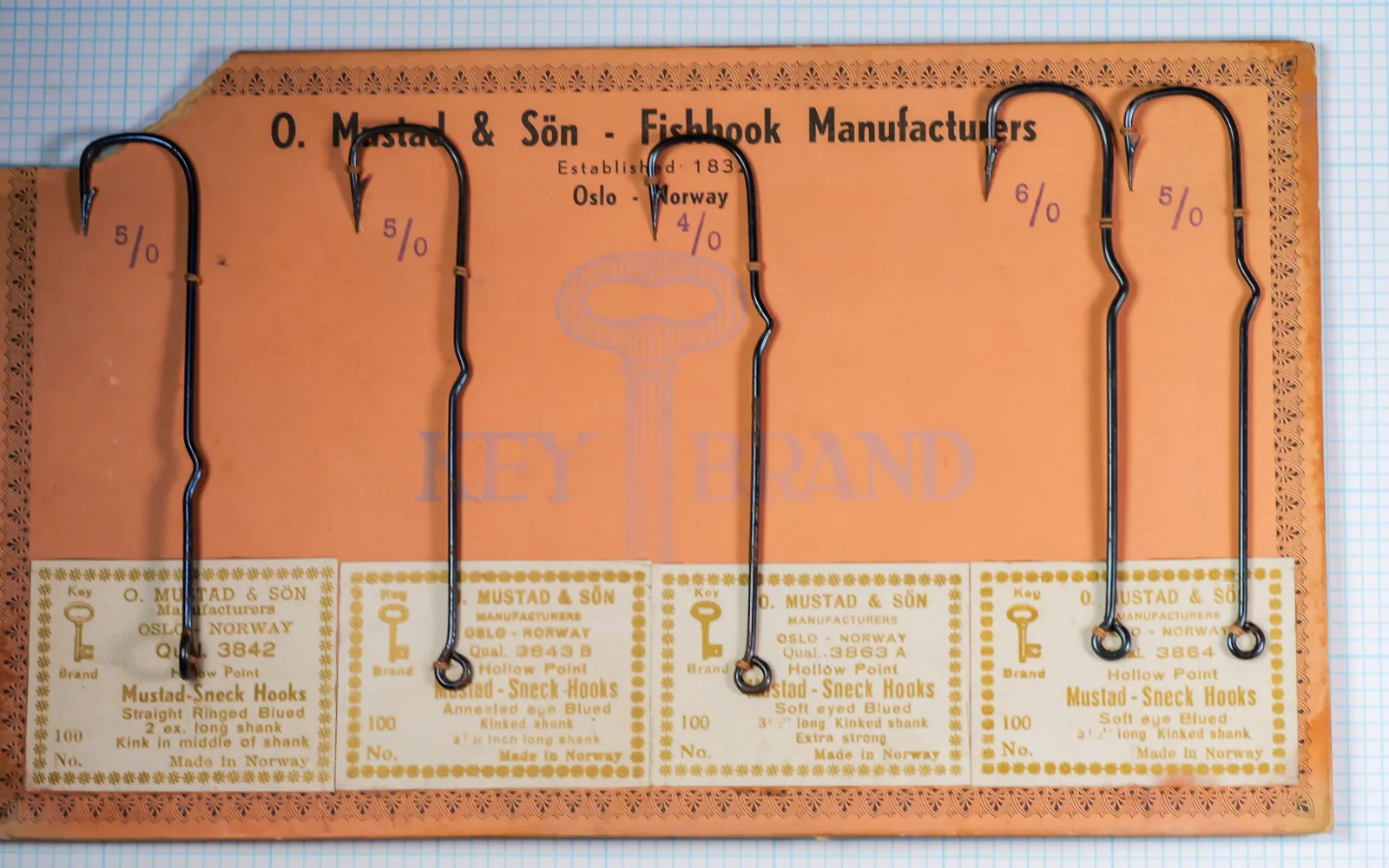
Complete five-specimen salescard for Mustad Quality 3842 Sneck Hooks, manufactured in Oslo, Norway. Displays the distinctive kinked-shank design and blued finish with original gold-leaf Key Brand trademark and decorative flourish border.
Photographic record
3 cataloged imagesSelect any record to load it above.
3 images shown
Mustad 3842 Sneck Kinked Shank SalescardComplete five-specimen salescard for Mustad Quality 3842 Sneck Hooks, manufactured in Oslo, Norway. Displays the distinctive kinked-shank design and blued finish with original gold-leaf Key Brand trademark and decorative flourish border.Open originalMustad 3842 Kinked Shank Profile DetailSide profile of a Mustad 3842 mounted on the salescard, displaying the distinctive mechanical kink bent into the centerline of the extra-long shank. The kink serves as a mechanical lock to prevent soft baits from sliding during casting or retrieval.Open originalMustad 3842 Printed Label SpecificationDetailed view of the central printed specification label on the Mustad 3842 salescard, showing the Key Brand logo, manufacturer information, and hook specifications in original gold-leaf letterpress print.Open original
Technical profile
Hollow Point | Mustad – Sneck Hooks | Straight-Ringed | Blued | 2 Extra Long Shank | Kink in middle of shank | Made in Norway
Eye
Ball Eye, Straight / InlineThe straight-ringed eye is a simple, uniform wire loop formed by bending the terminal wire back onto the main shank axis at a perfect 90-degree angle (no taper or offset). The ring diameter is proportional to the wire gauge, creating a generous eye opening suitable for thick snells or braided line. The ring closure is clean and symmetrical. No evidence of any tapered reduction or ball formation. P
Wire
Standard, Round, Est. ~0.045"-0.055" (~1.14-1.40 mm)
Shank
2X Long — Kinked
Bend
Sneck, Standard gapThe Sneck bend displays the characteristic sharp, almost rectangular geometry—markedly different from the sweeping curve of a Sproat or the angular bottom of a Limerick. The bend is neither deeply forged nor offset; it is a straightforward, mechanically formed square turn at the bottom of the shank. The bend depth appears proportional to the wire gauge and gap width, suggesting no specialized strength enhancement beyond the standard bend set. P
Point
Hollow Point (concave inner face)The barb on the 3842 is proportionally modest and close-cut, typical of hollow-point designs where penetration emphasis overrides maximum mechanical holding power. The barb angle appears slightly swept backward (approximately 15-20 degrees from perpendicular to the shank), a standard geometry for soft-tissue penetration rather than heavy holding. P
Finish
Blued — Confirmed (stated on packaging)The blued finish exhibits a warm, deep black-blue tone consistent with controlled chemical oxidation rather than japanning or heavy lacquering. The specimen shows uniform color across all visible surfaces with no spotting, discoloration, or wear pattern visible under magnification. The finish tone is slightly warmer than pure black, suggesting a vintage formula rather than modern passivation chemistry. Excellent preservation of original finish. P
The salescard specimen displays very good overall condition. All five mounted hooks are bright with no visible corrosion, indicating excellent storage conditions prior to acquisition. The card itself shows light toning to the cream paper, with the gold-leaf ink border retaining its original luster. The printed specification text in yellow/gold ink remains legible with minor fading consistent with age. Handwritten size notations in purple ink are clear. No tape residue, edge damage, or mounting point loss visible. This represents one of the finest surviving examples of a mid-century Mustad salescard.
The hollow point on the 3842 delivers rapid penetration with minimal angler force—a critical advantage when fishing soft-mouthed freshwater species such as crappie, bluegill, and small trout. The concave, dish-cut inner face creates an extremely fine tip that flares rapidly toward the barb, enabling the hook to slip past the delicate tissue of a fish’s mouth with minimal tearing, a property highly valued in the commercial and guide-service bait-fishing industry of the era.
The kinked shank is a purely mechanical engineering solution. By introducing a sharp bend approximately 60% of the way along the shank length, Mustad created a physical ‘stop’ point that prevents baited material from sliding toward the bend during casting acceleration or retrieval. This kink does not cut or pierce the bait—it simply provides a geometric constraint. The positioning of the kink roughly in the middle of the 2x-long shank creates two distinct segments: a longer upper section that accommodates the bait body, and a shorter lower section where the bait terminates before the bend.
The round wire profile and standard gauge represent the economic design philosophy: a hook that would function adequately in most freshwater scenarios without the metallurgical expense of forging or exotic wire treatments. The blued finish, achieved through controlled chemical oxidation, provides moderate rust resistance suitable for 3-8 hour fishing sessions in freshwater environments without requiring the durable japanning or tinning reserved for saltwater and marine applications.
Size & scale lab
Selected size
(unspecified)
Physical specimen
Overall Length
66.1 mm
Shank Length
48.3 mm
Gap Width
19.1 mm
Bend Depth
14 mm
Weight
Not available (photographic analysis does not permit precise weight determination without physical specimen access)
Shank-to-Gap Ratio
~2.5-2.7 : 1 (shank length to gap width ratio, calculated from measured dimensions)
Confidence
P
Physical specimen
Grid-derived from photograph (1/10" grid)
Cumulative Records
This specimen represents one of the finest documented surviving examples of a Mustad kinked-shank bait hook salescard in original condition. The presence of five mounted specimens on a single card is notable; most surviving examples are fragmentary (1-2 loose hooks). Within the garrenwood.com catalog, this documents the transition between mechanical kinked-shank systems and modern baitholder barb designs—a critical documental moment in fishing hook industrial design.
Own this hook? Help us measure it.
We don't have measured sizes for this hook yet. Own one? Submit calipered measurements and we'll review and add them. Thank you!
Historical context
mustad
O. Mustad & Søn was founded in 1832 in Gjøvik, Norway, by Hans Schikkelstad as a general metalworking concern (Brusveen Spiger- og Staltradfabrikk), producing nails, steel wire, and cast-iron products. The company was acquired by Ole Hovelsen Mustad and his son Hans Mustad, who rebranded it as O. Mustad & Søn and gradually shifted focus toward fishing hooks and tackle components. The defining moment came in 1877 when Mathias Topp, a visionary within the firm, invented the first fully automated hook-making machine—a mechanized system capable of cutting, bending, barbing, and pointing raw steel wire at unprecedented speed and consistency. Rather than patent this technology (which would have required public disclosure of mechanical schematics), Mustad relied on corporate secrecy, strict non-disclosure agreements, and restricted factory access to protect their competitive advantage. This strategy proved devastatingly effective against rival hook-making centers in Redditch, England, and manufacturing hubs across Japan and the United States. By the 1950s, Mustad had secured approximately 50% of global hook production, establishing sales offices and manufacturing facilities across multiple continents. The company’s numerical ‘Quality’ code system—arbitrary designations like 3842, 94840, and 3304—became deeply embedded in the culture of both commercial and sport fishing, with anglers memorizing these model numbers across generations. Today, O. Mustad & Søn remains one of the world’s largest fishing hook manufacturers, though production has largely relocated from Norway to other facilities.
Series History
The Mustad 3842 belongs to the broader category of kinked-shank bait hooks produced during Mustad’s mid-20th-century dominance of North American freshwater tackle distribution. This hook does not represent a coherent ‘series’ in the modern sense but rather a specialized variant within Mustad’s vast tiered catalog of bait patterns. The 3000-3999 Quality code block represented Mustad’s ‘mid-tier’ hooks—manufactured to exacting dimensional and tempering standards, targeting both commercial and sport-fishing markets. Within this tier, the 3842 was marketed specifically to guide services, commercial bait operations, and retail shops serving the regional bait-fishing tradition. The kinked-shank feature was not exclusive to the 3842; Mustad produced kinked variants across multiple bend families (Sproat, Sneck, Aberdeen) to address specific market demands. However, the combination of Sneck bend + kinked shank + hollow point represents a relatively narrow specialization, likely targeted at a specific regional market or fishing technique (possibly the ‘Indiana School’ bass guides or similar commercial operations documented in historical tackle advertising). By the early 1960s, the advent of modern baitholder barbs rendered the kinked-shank approach mechanically obsolete, and Mustad discontinued this design in favor of the more efficient slice-barb systems embodied in the 92641 and successor models. The 3842 thus represents the final generation of mechanically kinked bait hooks before the cutting-based revolution transformed the category.
Era and Packaging Dating
Oslo designation on packaging was adopted January 1, 1925, establishing post-1925 production terminus. The classic eight-line label format with arbitrary Quality code (3842) directly confirms pre-2001 vintage era, as these codes were discontinued when Mustad transitioned to Signature Series naming (c. 2001-2009). The gold-leaf Key Brand logo styling, cream cardstock, letterpress printing characteristics, and overall card construction are consistent with mid-20th century Mustad export packaging. The lack of barcode and handwritten specimen sizing notation are typical of 1930s-1960s production. Conservative estimate places this in the 1930-1960 window, most likely 1940s-1950s based on card stock color and finish uniformity.
The Wholesale Specimen Card
In the 1950s, Mustad's salesmen distributed five-hook specimen cards like the one pictured to retail tackle shops across North America. Shopkeepers would display these cards behind the counter, allowing customers to examine the exact bend geometry, finish tone, and eye construction before ordering bulk quantities for resale. These specimen cards were never meant to be sold to end-user anglers—they were wholesale reference tools. Today, finding a complete, unmounted card is nearly impossible; most have been dismantled and the hooks scattered. The fact that this 3842 card survives with all five specimens intact speaks to either a dealer who retired without clearing inventory or a collector who recognized its archival value decades ago.
Design lineage and influence
The kinked-shank concept predates modern baitholder barbs by several decades. Early bait hooks—circa 1920s-1930s—relied on mechanical kinks, simple notches, or soft-metal collars to prevent bait slippage. Mustad’s formalization of the kinked design in the 3842 represents an industrial standardization of what had previously been a regional or custom feature. By the 1960s, this mechanical approach was superseded by the Mustad 92641 Baitholder, which introduced the modern ‘slice’ barbs cut directly into the shank—a more efficient, lower-cost solution that rendered the kink obsolete. The 3842 thus marks a transitional moment in bait-hook engineering between purely mechanical solutions and cutting-based alternatives. The Sneck bend itself has a deeper lineage, originating in 19th-century British bait-fishing tradition and maintained by Mustad through their pattern-cloning strategy, though it never achieved the universal adoption of the Sproat or Limerick bends.
Best matchRelated by Attribute
Computed automatically from catalog data — updated as new hooks are added.
Matches: Bend, Wire, Gap, Eye, Point +4 moreDiffers: Shank: 2X Long vs Special Long; Eye Orient.: Straight / Inline vs Turned Down; Application: Bait, Other vs Bait
Matches: Shank, Gap, Eye, Eye Orient., Point +4 moreDiffers: Bend: Sneck vs New York; Wire: Standard vs Fine (1X Fine); Application: Bait, Other vs Salmon, Sea Trout, Bait +1 more
Matches: Bend, Wire, Gap, Point, Forging +1 moreDiffers: Shank: 2X Long vs 1X Long; Eye: Ball Eye vs Tapered Eye; Eye Orient.: Straight / Inline vs Turned Down +3 more
Matches: Bend, Gap, Eye Orient., Point, Finish +3 moreDiffers: Shank: 2X Long vs Special Long; Wire: Standard vs Heavy (1X Heavy); Eye: Ball Eye vs Cross Eye +1 more
The Mustad 3842 was engineered specifically for mid-water bait presentation, particularly with live bait applications common in freshwater bass and trout fishing of the 1940s-1950s era. The distinctive kinked shank served a purely mechanical function: when baited with earthworms, minnows, or other soft baits, the sharp bend in the shank’s centerline prevented the bait from sliding freely toward the hook bend during casting or retrieval. This kink created a mechanical ‘lock’ point where the baited material would gather and hold securely, critical for maintaining proper bait presentation and preventing the bait from bunching unnaturally at the bend under current or casting stress.
The Sneck bend—characterized by its sharp, almost rectangular geometry—was favored historically in British and early American bait fishing for its ability to anchor baits firmly in the mouth corner of large-mouthed species. The straight-ringed eye accommodates thick, non-elastic line or gut snells used in that era, while the blued finish provided adequate corrosion resistance for freshwater use without the expense of tinning or japanning.
The 3842 would have been particularly popular with guide-service operators and commercial bait fishermen seeking a standardized, cost-effective hook for high-volume applications—exactly the market segment Mustad dominated in the 1940s-1950s through their tiered quality-code system.
Secondary Applications
In the modern era, fly tyers have occasionally repurposed vintage 3842 hooks for cork or balsa popper bodies, where the kinked shank's mechanical properties surprisingly provide an anchor point that prevents rotation of the body during assembly and use. This is an incidental modern discovery rather than original design intent.
Classic Fly Patterns
Not typically used for fly tying.
Modern Equivalents
Hook
Match Quality
Notes
Mustad 92641 Baitholder
Excellent
Direct functional successor. Replaces kinked-shank mechanical lock with modern slice-barb design. Same Mustad manufacturing lineage, superior corrosion resistance options.
Mustad 33903 Popper
Good
Modern kinked-shank variant for fly-tying popper bodies. Preserves the mechanical anti-rotation function of the kink in contemporary cork-body applications.
Gamakatsu Baitholder
Moderate
Contemporary bait hook with slice-barb retention. Different manufacturer, similar functional intent for live-bait applications, superior modern material science.
Collector notes
The Mustad 3842 commands modest collector interest due to its specialized kinked-shank design, rare Sneck bend variant, and documented mid-century origin. The distinctive mechanical feature—a sharp kink in the shank centerline—predates modern baitholder barbs and represents an engineering solution specific to vintage bait-fishing methodology. Limiting factors include moderate availability on secondary market and niche appeal to non-fly tyers.
Reference value
$8 – $20 USD estimate
Packaging condition
Very Good — light wear, fully legibleRecorded specimen
Packaging format
GW-M-SC-SNECK-01Catalog code
Positive Factors: The kinked shank is a mechanically distinctive feature that predates modern baitholder slot barbs, making this hook historically significant for understanding pre-1960s bait-fishing tackle design. The Sneck bend itself is relatively uncommon in vintage Mustad catalogs, typically overshadowed by Sproat and Limerick variants. Original salescard with multiple mounted specimens in very good condition adds substantial value. The combination of Hollow Point geometry with Sneck bend is a specialized pairing not widely recognized in modern fly-tying literature, making documentation valuable to researchers. Pre-1960 Oslo-era packaging is collectible in its own right.
Limiting Factors: The 3842 lacks the prestige association of premium dry fly hooks (e.g., 94840 Viking) or the dramatic visual appeal of heavy saltwater patterns. Most examples encountered are loose hooks rather than complete cards; this salescard specimen is notably better preserved than typical loose finds. Limited demand from modern bait anglers, who typically prefer contemporary designs. No direct fly-pattern lineage means fly tyers have minimal incentive to seek out vintage examples. The kinked-shank feature, while historically interesting, is functionally obsolete, reducing utility appeal to working anglers.
Packaging
Cream and tan colored cardstock salescard with five mounted specimens. Header text in black print reads 'O. Mustad & Söñ - Fishhook Manufacturers, Established 1832, Oslo - Norway'. Key Brand logo (skeleton key) in gold leaf upper left corner. Decorative gold flourish border pattern. Each specimen labeled with size (5/0, 5/0, 4/0, 6/0, 5/0) in purple ink handwritten notation. Central label area displays yellow/gold ink printed specification text. Box or card number not visible in current image.
Market Value Notes
Typical loose vintage Mustad 3842 hooks in blued finish: USD $3-6 per hook. Complete original salescard with five mounted specimens (as documented): USD $15-25 depending on condition and patina. Value driven primarily by card completeness and specimen count; individual loose 3842 hooks command no premium over standard vintage Mustad bait hooks. Specialist dealers may price higher (USD $25-35) if card is pristine with minimal toning. eBay examples typically fetch $8-15 for loose hooks, $18-28 for cards. Condition uniformity, absence of corrosion, and Original packaging retention are the primary value drivers.
Where to Find
Surviving examples appear most frequently on eBay vintage fishing section, specialist tackle dealers' online catalogs, and occasional appearance at regional tackle shows or estate sales. Complete salescards are rarer than loose hooks. Dedicated Mustad collectors and bait-fishing historians are primary search audience.
Preservation
Storage and Preservation
Store the Mustad 3842 in a cool, dry environment away from moisture and fluctuating humidity. The blued finish, while more durable than bright steel, will develop light surface patina over decades if exposed to ambient moisture. Many collectors consider this patina development desirable and collectible; however, if you prefer to preserve the original finish, maintain relative humidity below 50% and use desiccant packs in storage containers.
If the hook is mounted on the original salescard (as in the specimen documented here), store the card flat or upright in a archival-quality box, away from direct sunlight. The gold-leaf ink border can fade if exposed to prolonged UV light. Do not stack heavy objects on top of the card. Original packaging adds significant collectible value—preserve the card intact rather than dismounting the hooks for individual storage.
If you possess loose specimens of the 3842, store them in acid-free paper packets or small archival boxes, never in plastic bags or containers that promote condensation. Avoid contact with other metals to prevent galvanic corrosion. If corrosion develops, gentle cleaning with fine steel wool followed by a light coat of museum-quality mineral oil will restore the finish without damaging the blue patina.
Handle the hooks and card with clean, dry hands. Do not use the hooks for fishing, as this will compromise both the original finish and the collector value of the piece.
Marking Analysis
Handwritten Specimen Markings
The Mustad 3842 salescard displays handwritten size notations in purple/violet ink adjacent to each mounted specimen. These marks read ‘5/0,’ ‘5/0,’ ‘4/0,’ ‘6/0,’ and ‘5/0’ from left to right. The handwriting is consistent across all five notations, suggesting a single person marked the card during assembly or quality-control inspection at the factory or packaging facility. The ink tone and degradation pattern are consistent with mid-20th-century ballpoint or fountain pen notation.
The notation style represents the manual inventory and packaging methods employed by Mustad before computerized labeling. Retail customers and guide services would receive cards bearing these hand-marked size designations to quickly identify which hook sizes were present without carefully examining each specimen under magnification. This practice was typical of wholesale distribution in the 1940s–1950s era before pre-printed sizing labels became standard.
The consistency of the handwriting and the absence of corrections or strikeouts suggest this was either a primary assembly notation (made at the factory) or a secondary annotation made during quality control. The preservation of the ink tone indicates minimal light exposure prior to storage, supporting the hypothesis that this card was stored indoors away from sunlight relatively soon after manufacture or assembly.
Primary Source
Analysis of Printed Specification Text
Source: Original printed specification label, Mustad 3842 salescard, c. 1930–1960. Text photographed and transcribed from image 3.
The central label block on the Mustad 3842 salescard presents a highly formalized specification declaration that exemplifies Mustad’s rigid eight-line labeling system documented extensively in the reference PDF provided. The label reads: ‘Key Brand | O. Mustad & SÖN Manufacturers | Oslo – Norway | Qual. 3842 | Hollow Point | Mustad-Sneck Hooks | Straight Ringed Blued | 2 ex. long shank | Kink in middle of shank | 100 | No. | Made in Norway.’
Line 1 (Key Brand): The skeleton key logo and ‘Key Brand’ text served as Mustad’s universal visual trademark, symbolizing that Mustad hooks were the literal and figurative ‘key’ to angling success. This trademark was positioned consistently in the upper left quadrant across all Mustad export packages.
Line 2–3 (Manufacturer Identity and Geography): ‘O. Mustad & SÖN Manufacturers’ establishes unambiguous corporate authority and manufacturing role—critical for differentiating Mustad from regional distributors and jobbers who frequently repackaged hooks under localized brand names. The ‘Oslo – Norway’ designation dates this card to post-January 1, 1925, when the Norwegian capital was officially renamed from Christiania to Oslo.
Line 4 (Quality Code): ‘Qual. 3842’ represents Mustad’s arbitrary numerical quality/model designation. The 3000-3999 range indicated mid-tier products manufactured to exacting dimensional and tempering standards, positioning the 3842 between economy models (1000–2999) and premium dry fly hooks (4000+).
Line 5 (Point Identifier): ‘Hollow Point’ explicitly identifies the penetrative geometry. Per Mustad’s strict labeling rules, Line 5 is reserved exclusively for point type designation, never for wire gauge, shank length, or eye configuration. The hollow point’s concave, sweeping profile was engineered for soft-tissue penetration with minimal applied pressure—ideal for commercial bait-fishing operations targeting soft-mouthed species.
Line 6 (Pattern Name): ‘Mustad-Sneck Hooks’ identifies the overarching bend geometry and pattern lineage. The Sneck—a sharp, almost rectangular bend—was favored in British bait-fishing tradition and adopted by Mustad as part of their industrial ‘cloning’ strategy of reverse-engineering regional patterns for global mass manufacture.
Lines 7–8 (Anatomical Modifications and Finish): ‘Straight Ringed Blued | 2 ex. long shank | Kink in middle of shank.’ These lines synthesize the eye type (straight ringed = simple loop, no taper), the metallurgical finish (blued = chemical oxide passivation), the shank length category (2x extra long), and the defining mechanical feature (kink in middle of shank). This formulation demonstrates how a single foundational pattern (Sneck) could be manufactured in dozens of distinct configurations to suit specific applications.
Quantity Designation: ‘100 | No.’ indicates the standard retail/wholesale box count of 100 hooks, a ubiquitous standard in the vintage era.
Manufacturing Attribution: ‘Made in Norway’ establishes domestic Norwegian manufacture, reinforcing Mustad’s commitment to Norwegian production during the period when the company still maintained major facilities in Gjøvik.
Additional
The Kinked-Shank Engineering Innovation
The kinked shank represents a mechanical engineering solution to a real problem in mid-century bait-fishing methodology: preventing live baits from sliding toward the bend during casting acceleration and retrieval. Before modern baitholder barbs (cut slots in the shank), bait-hook manufacturers relied on purely mechanical approaches to anchor soft baits.
The kink on the 3842—a sharp bend approximately 60% of the distance from eye to bend—creates two distinct shank segments: an upper segment for the main bait body, and a shorter lower segment where the bait is terminated before reaching the hook bend. When an earthworm or minnow is threaded onto the hook, the kink acts as a physical stop point, preventing the bait from sliding further down the shank during casting or high-speed retrieval. This design does not pierce or cut the bait (unlike modern slice barbs); it simply exploits geometry to create a mechanical constraint.
The positioning of the kink was not arbitrary. By placing the bend roughly in the middle of the extra-long shank, Mustad maximized the upper bait-carrying segment while preserving sufficient lower shank for proper bend formation and barb geometry. The sharp angle of the kink—approximately 10-15 degrees of deflection—is pronounced enough to catch and hold bait material without becoming a weak point in the wire structure.
By the 1960s, this mechanical approach had been superseded by modern ‘baitholder’ slot barbs (exemplified by the Mustad 92641), which offered superior holding power with lower manufacturing cost. The slots are cut directly into the rear shank, creating multiple micro-barbs that grip the bait material itself rather than relying on geometric constraint. The transition from kinked-shank to slot-barb designs represents one of the most significant functional improvements in bait-hook manufacturing of the 20th century—a shift from purely mechanical engineering to cutting-based design. Today, the kinked shank is recognized as a historical curiosity and a testament to pre-modern engineering ingenuity.
Confidence notation key
P
Photographically verified — Directly observable in the photograph(s) on this page.
V
Verified by documentation — Confirmed by manufacturer catalog, spec sheet, or published reference.
I
Inferred — A logical deduction from observable or documented evidence, not directly stated.
E
Estimated — An approximation based on visual comparison, proportional analysis, or limited data.
S
Speculative — A reasoned hypothesis that cannot be confirmed from available evidence.
Claims with no notation are confirmed by multiple independent sources. All photographs on garrenwood.com are taken on a measurement grid where each square equals 1/10 inch (0.1″ / 2.54 mm).