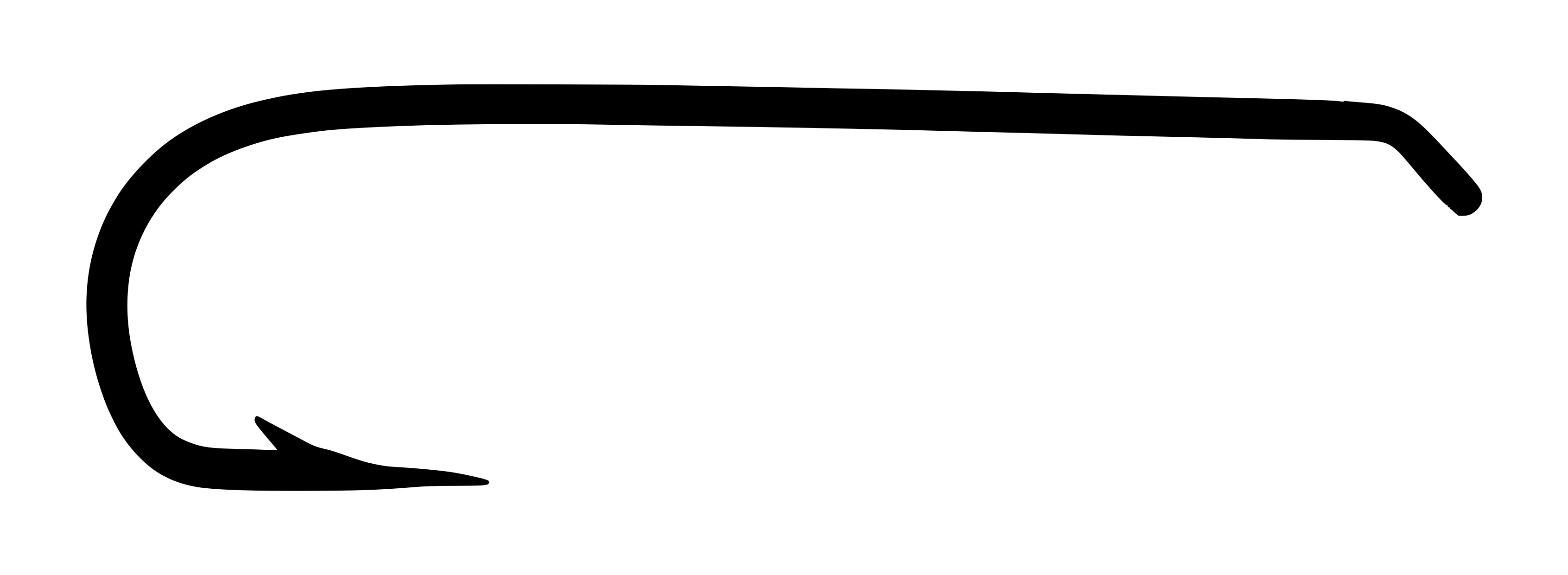
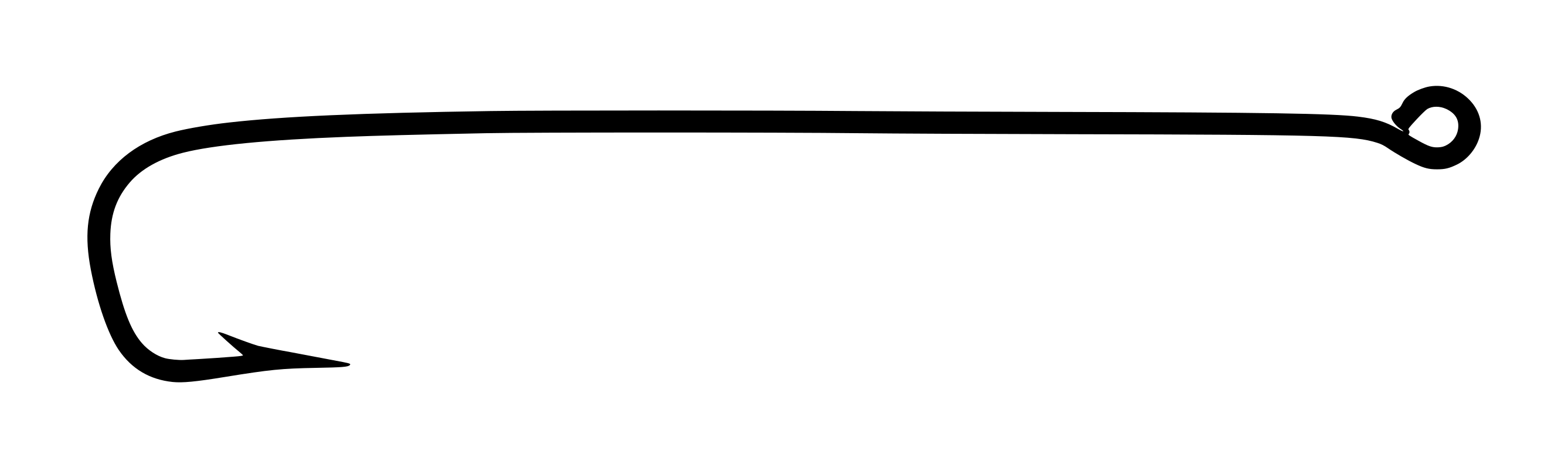
The Mustad 3863 A is a specialty bait hook manufactured by O. Mustad & Søn in Oslo, Norway, during the mid-twentieth century (c. 1930s–1950s). This large, extra-heavy wire hook is distinguished by its kinked shank — a mechanical feature designed to cause live bait to spin or corkscrew when trolled or cast through the water.
The defining characteristic is the kinked shank: approximately midway along its 3½-inch length, the shank features a sharp bend or ‘kink’ that imparts a rotational motion to rigged baitfish (worms, minnows, eels). This action mimics a distressed baitfish and triggers strikes from pike, walleye, large trout, and other predatory species. The Sneck bend — a square, angular bottom geometry — provides additional holding power and mechanical uniqueness.
The Hollow Point and extra-strong wire construction indicate this was engineered for robust, hard-fighting species in freshwater and saltwater applications. The soft-eyed construction (annealed eye) allowed flexibility for tackle makers to adjust the eye as needed. The blued finish provided adequate corrosion resistance for freshwater use.
Collectability is moderate to good (rating 5–6). While not exceptionally rare, the kinked-shank specialty design appeals to collectors interested in vintage bait-fishing innovations and Mustad’s diverse product catalog. The presence of the original sales card significantly enhances value — loose hooks command far less collector interest.
Multi-hook sales card featuring five Mustad 3863 A kinked-shank Sneck hooks mounted in annealed-wire loops on original orange/tan cardboard backing with cream-colored label printed in gold ink, c. 1930s–1950s.
Photographic record
3 cataloged imagesSelect any record to load it above.
3 images shown
Mustad 3863 A Sales Card DisplayMulti-hook sales card featuring five Mustad 3863 A kinked-shank Sneck hooks mounted in annealed-wire loops on original orange/tan cardboard backing with cream-colored label printed in gold ink, c. 1930s–1950s.Open originalMustad 3863 A Kinked Shank and Bend DetailClose-up detail of a single Mustad 3863 A hook showing the distinctive kinked shank at the midpoint and the square, angular Sneck bend at the bottom, demonstrating the mechanical innovation designed for rotational bait presentation.Open originalMustad 3863 A Label and SpecificationsDetailed close-up of the original sales card label showing the complete eight-line Mustad typographical specification format, Key Brand logo (skeleton key), and all printed text identifying the hook model, bend pattern, point style, eye type, shank length, wire strength, and manufacturing origin.Open original
Technical profile
Eye
Cross Eye, Straight / InlineRinged eye formed by bending terminal wire back onto the shank, creating a simple circular loop. Eye is not softened or annealed visibly — standard tempered construction P. Description 'Soft eyed' on label refers to annealing process, not the eye type itself V.
Wire
Heavy (1X Heavy), Round, Est. ~0.042"-0.048" (~1.1-1.2 mm)
Shank
Special Long — Kinked
Bend
Sneck, Standard gapDistinctive square or rectangular bend geometry characteristic of the Sneck pattern P. Sharp angular bottom with minimal curve radius. Shank remains relatively straight from eye to kink point, then continues to bend. No offset beyond the kinked feature.
Point
Hollow Point (concave inner face)Single barb, short and close-cut, characteristic of hollow-point geometry. Barb angle is acute, oriented toward the bend P.
Finish
Blued — Confirmed (stated on packaging)Blued finish appears as a dark, slate-gray tone with slight warm undertones P. Uniform coverage across specimen with no evidence of corrosion or wear on the hooks shown. Original finish well-preserved on the sales card.
Hooks on sales card are bright and uncorroded. Card stock shows light toning and minor edge wear consistent with age. Paper is cream to buff colored, not white. Gold/yellow ink remains vibrant. No water damage or staining visible.
The kinked shank is the engineering innovation that defines this hook. Unlike a standard straight shank, the intentional kink — typically positioned at or slightly past the midpoint of the shank — causes the rigged bait (a live minnow or eel) to twist or corkscrew when pulled through water. This spinning action simulates a distressed or dying baitfish, triggering predatory strikes.
The Sneck bend, with its square angular bottom rather than a smooth round curve, provides mechanical holding power and a distinctive presentation angle. The extra-strong, heavy-gauge wire ensures the hook does not bend or straighten under the stress of large, fighting fish or during aggressive casting.
The Hollow Point geometry delivers rapid penetration with minimal force — useful when live bait is being actively pulled and the hook must set quickly. The ‘soft eyed’ annealed eye reduced the risk of the eye snapping under the stress of a fighting fish or rough handling by tackle makers.
Size & scale lab
Selected size
(unspecified)
Physical specimen
Shank Length
88.5 mm
Gap Width
16 mm
Bend Depth
15 mm
Shank-to-Gap Ratio
~5.0-6.5 : 1
Confidence
P
Physical specimen
Grid-derived from photograph (1/10" grid)
Cumulative Records
First documented kinked-shank Sneck hook in the garrenwood.com catalog. Represents a distinct engineering solution to bait-presentation that predates modern rotational hook designs.
Own this hook? Help us measure it.
We don't have measured sizes for this hook yet. Own one? Submit calipered measurements and we'll review and add them. Thank you!
Historical context
mustad
O. Mustad & Søn was founded in 1832 in Gjøvik, Norway, initially as ‘Brusveen Spiger- og Staltradfabrikk’ — a producer of nails, steel wire, and industrial fasteners. The company was taken over by Ole Hovelsen Mustad and his son Hans Mustad, who rebranded it as O. Mustad & Søn and gradually shifted production toward fishing hooks and tackle.
The defining moment in Mustad’s history occurred in 1877, when company innovator Mathias Topp invented the first fully automated hook-making machine. This mechanized technology allowed raw steel wire to be continuously fed, cut, bent, barbed, and pointed at unprecedented speed. Rather than patenting this innovation — which would have required public disclosure — Mustad relied on strict corporate secrecy and factory access restrictions to protect their competitive advantage.
By the early twentieth century, Mustad had secured dominant market share in global hook production, establishing sales offices and manufacturing facilities across Europe, North America, and beyond. The company’s aggressive strategy of reverse-engineering regional patterns (like the Sneck bend) and manufacturing them at industrial scale allowed Mustad to corner local markets globally. By the 1950s, Mustad controlled approximately fifty percent of the world’s hook production.
The factory in Oslo (known as Christiania until 1925) operated continuously through the twentieth century, with the ‘Oslo – Norway’ designation on labels indicating post-1925 production. Mustad remains in operation today, though much modern production has been relocated outside Norway.
Series History
The Mustad 3863 A belongs to the Mustad Sneck Hook family, a series of hooks featuring the distinctive square, angular Sneck bend geometry. The Sneck bend itself originated in Britain and Ireland as a regional pattern favored for certain bait-fishing applications, and Mustad adopted and manufactured it for export markets during the early-to-mid twentieth century.
The kinked-shank variant (3863 A) is a specialized evolution within this family, engineered specifically for the spinning-bait trolling technique. Mustad produced related models in this line, including straight-shank Sneck hooks and other kinked-shank variants at different sizes and wire gauges. The 3863 A appears in sales catalogs of the 1930s–1950s period as a premium specialty hook for advanced bait anglers.
The series represents Mustad’s strategy of reverse-engineering and manufacturing localized, regional fishing patterns for global distribution. By adopting the Sneck bend — a pattern with regional British and Irish heritage — and adding mechanical innovations like the kink, Mustad created a bridge between traditional European hook-making and modernized industrial mass production.
Era and Packaging Dating
The 'Oslo – Norway' designation on Line 3 of the label confirms production after January 1, 1925, when Christiania was officially renamed. The 'Key Brand' trademark with skeleton key logo was registered in 1907 and remained in use through the mid-twentieth century. The yellow/tan cardboard backing, cream paper label, and offset-printed gold ink are consistent with 1930s–1950s Mustad packaging standards. The absence of any barcode (universal product codes were not mandated until the 1970s) confirms pre-1974 manufacturing. The typographical layout follows the standardized eight-line Mustad label format precisely, which was in effect from the 1920s through the 1960s. The phrase 'Made in Norway' in English (rather than Norwegian) indicates export-market packaging. All evidence points to manufacture during the 1930s–1950s period, with highest probability circa 1940–1950.
The Corkscrew Minnow — Mechanical Innovation Before Aerodynamics
The kinked-shank design was an early mechanical solution to a problem that modern anglers solve with hydrodynamic engineering. In the 1930s–1950s, when trolling was done at slow to moderate speeds with live baitfish, the sharp physical kink in the shank caused the rigged minnow or eel to rotate forcefully. This 'corkscrew' action was so effective that it became a selling point in Mustad catalogs. Today's 'Slow Death' hooks and modern spinner-bait designs achieve the same rotational effect through smoothly curved or bent shanks, which work better at higher trolling speeds. The 3863 A represents a fascinating snapshot of pre-modern tackle engineering — pure mechanical innovation before computational fluid dynamics and aerodynamic optimization became industry standards.
Design lineage and influence
The Sneck bend originated among British and Irish blacksmith hook-makers, particularly in the Redditch tradition, where the square angular bottom was favored for specific bait-fishing presentations. Mustad acquired this pattern during its aggressive international expansion in the late nineteenth and early twentieth centuries and standardized it for mass production.
The kinked-shank feature is Mustad’s mechanical innovation. While not unique to Mustad, the integration of the kink with the robust Sneck bend and extra-heavy wire created a specialized product for the trolling-bait market. Competing manufacturers — such as O’Shaughnessy and other American producers — manufactured straight-shank Sneck hooks, but the kinked variant remained somewhat distinctive to Mustad’s catalog.
The 3863 A represents a technological predecessor to modern ‘Slow Death’ hooks and spinner-bait designs, which achieve rotational action through bent or curved shanks rather than sharp mechanical kinks. The evolutionary arc demonstrates how vintage mechanical solutions (the kink) were eventually superseded by aerodynamic and hydrodynamic designs optimized for modern trolling speeds and synthetic baits.
Best matchRelated by Attribute
Computed automatically from catalog data — updated as new hooks are added.
Matches: Bend, Shank, Wire, Point, Finish +3 moreDiffers: Gap: Standard vs Wide; Eye: Cross Eye vs Ball Eye; Eye Orient.: Straight / Inline vs Turned Down +1 more
Matches: Bend, Shank, Gap, Point, Finish +3 moreDiffers: Wire: Heavy (1X Heavy) vs Standard; Eye: Cross Eye vs Ball Eye; Eye Orient.: Straight / Inline vs Turned Down +1 more
Matches: Bend, Gap, Eye Orient., Point, Finish +3 moreDiffers: Shank: Special Long vs 2X Long; Wire: Heavy (1X Heavy) vs Standard; Eye: Cross Eye vs Ball Eye +1 more
Matches: Bend, Shank, Gap, Point, Forging +1 moreDiffers: Wire: Heavy (1X Heavy) vs Extra-Heavy (2X+); Eye: Cross Eye vs Tapered Eye; Eye Orient.: Straight / Inline vs Turned Down +3 more
Matches: Bend, Eye, Eye Orient., Forging, Application +1 moreDiffers: Shank: Special Long vs Extra-Extra Long; Wire: Heavy (1X Heavy) vs Standard; Gap: Standard vs Narrow +3 more
The Mustad 3863 A was purpose-designed for trolling or casting live baitfish — minnows, eels, or large shiners — in pursuit of hard-fighting, predatory species such as pike, walleye, large brown trout, and lake trout. The kinked shank causes the bait to spin during retrieval, creating a distressed-baitfish presentation that attracts aggressive strikes.
Trolling with this hook typically involved rigging a live minnow or eel by inserting the hook through the body or lip, allowing the bait to rotate freely as the line was retrieved at slow to moderate speed. The kinked shank intensifies this rotational action compared to straight-shank hooks.
This is an active bait presentation, not a stationary bait rig. The hook’s extra-strong wire and robust Sneck bend allow it to withstand the violent head-shakes and powerful runs of large freshwater and saltwater gamefish.
Secondary Applications
Heavy trolling with natural baits in saltwater applications (stripers, large catfish). Possible use in ice fishing with live shiners or minnows for pike and walleye, though evidence is limited.
Classic Fly Patterns
Not typically used for fly tying.
Modern Equivalents
Hook
Match Quality
Notes
Mustad Slow Death 33863
Moderate
Modern hook designed to achieve rotational bait action through a curved/bent shank rather than a mechanical kink. Serves the same trolling-bait purpose but with modern aerodynamic optimization.
Mustad 3906B Wet Fly Hook
Poor
Contemporary Mustad hook from same era, but fly-fishing focused rather than bait-fishing. Shares the blued finish and Mustad manufacturing standards but different application entirely.
Owner Cult Head Jig Hook
Moderate
Modern jig hook designed for live-bait and rotational presentations. Aerodynamic design rather than mechanical kink, but serves similar trolling/casting bait applications.
Collector notes
Moderate collecting interest (rating 5–6). The kinked-shank specialty design and Sneck bend geometry appeal to historians of bait-fishing innovation and Mustad catalog completists. Sales-card format with multiple hooks in original configuration significantly enhances value. Common in Mustad vintage collections but not yet museum-standard rare.
Reference value
$12 – $28 USD estimate
Packaging condition
Very Good — light wear, fully legibleRecorded specimen
Packaging format
GW-M-SC-01Catalog code
Positive factors: Original sales card with multiple hooks is more desirable than loose hooks. Kinked-shank specialty design represents a historical innovation in bait-presentation engineering. The blued finish and extra-strong wire gauge indicate a premium product tier. Excellent condition with no corrosion, original label legible, and paper stock intact. Oslo – Norway designation confirms authentic Norwegian manufacture. The hook represents a specific moment in Mustad’s product evolution (1930s–1950s) when the company was experimenting with mechanical innovations.
Limiting factors: Not exceptionally rare — Mustad produced large quantities of specialty hooks for export. The kinked-shank design is not as iconic or historically celebrated as some other Mustad models (e.g., Qual. 3906 wet fly hook, Qual. 94840 Viking dry fly). Bait hooks generally attract smaller collector base than fly hooks. The specialty nature (designed for a specific trolling technique) limits appeal to general anglers. Size (3½ inches) makes it larger and bulkier than most fly hooks, affecting display and collection space considerations.
Packaging
Multi-hook sales card format with five individual hooks mounted in black annealed wire loops on an orange/tan cardboard backing. Card measures approximately 5.5" wide × 3.25" high. White paper label affixed to lower half of card, printed in gold/yellow and black ink using offset printing (letterpress style). Label contains the eight-line Mustad typographical format: Key Brand logo (downward-pointing skeleton key), O. MUSTAD & SÖN, MANUFACTURERS, OSLO – NORWAY, Qual. 3863 A, Hollow Point, Mustad Sneck Hooks, Soft eyed Blued, 3½" long Kinked shank, Extra strong, 100 No., Made in Norway. Decorative border of small asterisk or snowflake motifs frames the label. Cardboard backing is die-cut at top to accommodate the hooked shanks. Typography is clean and well-printed with no obvious degradation.
Market Value Notes
Value primarily driven by condition of the sales card and legibility of label. Complete card with five intact hooks and clear labeling commands $20–28 USD on specialty vintage tackle markets (eBay, tackle fairs, specialist dealers). Loose individual hooks sell for $3–8 each. Condition of the cardboard backing, absence of water damage, and originality of the packaging significantly affect premium pricing. Cards with faded labels or damaged hooks drop to $12–18 range.
Where to Find
Vintage tackle dealers, eBay (specialty fishing hook sections), fishing tackle conventions and fairs, antique tackle auctions, and Mustad collector networks. Sales cards are more commonly found than factory boxes for this era. European dealers (UK, Scandinavia) occasionally stock Norwegian-manufactured Mustad specialty hooks.
Preservation
Storage and Preservation
Store the sales card in a cool, dry environment away from moisture and direct sunlight. The blued finish will develop a patina over time with humidity exposure, which many collectors consider desirable and historically authentic. However, prolonged moisture exposure can accelerate oxidation and lead to rust.
Keep the card in its original state whenever possible. Do not remove hooks from the card unless absolutely necessary for inspection. If removal is required, handle the card carefully to avoid creasing or tearing the paper label. The label text, typography, and paper condition are major value drivers — any damage significantly reduces collectability.
Store flat or in a vertical position in an archival-quality box or sleeve. Avoid stacking heavy items on top of the card. If the card is displayed, use a climate-controlled display case to minimize dust and humidity fluctuations. Acid-free backing or mounting materials should be used if any conservation work is performed.
Periodically inspect for signs of insect activity or mold growth, particularly if stored in damp environments. If the label begins to show signs of foxing (brown age spots) or mold, consult a paper conservator before attempting any cleaning. The original finish and patina on the hooks themselves are historically authentic and should be preserved rather than polished or refinished.
Primary Source
Decoding the Sales Card Label
Source: O. Mustad & Søn sales card label, c. 1930s–1950s; primary reference document 'A Comprehensive Typology and Decryption of Vintage O. Mustad & Søn Hook Labels'
The label on this sales card follows the standardized eight-line Mustad typographical format that was in effect from the 1920s through the 1960s. Each line conveys specific technical information according to a strict industrial hierarchy:
Line 1: ‘O. MUSTAD & SÖN’ — Full manufacturer name in Norwegian, establishing corporate authority and origin.
Line 2: ‘MANUFACTURERS’ — Establishes Mustad’s role as the primary manufacturer, not an import agent or distributor. This distinction was critical in an era when many regional distributors repackaged imported hooks under secondary brand names.
Line 3: ‘OSLO – NORWAY’ — Specifies the city and country of manufacture. The use of ‘Oslo’ (not ‘Christiania,’ which was renamed in 1925) confirms post-1925 production. The emphasis on Norway for export markets reinforced the ‘Norwegian quality’ brand identity.
Line 4: ‘Qual. 3863 A’ — The quality code indicates this is a premium (3000-series) bait hook with specialized features (the ‘A’ suffix likely indicates a variant or specific configuration).
Line 5: ‘Hollow Point’ — Exclusively defines the point geometry: concave inner face providing rapid penetration with minimal force.
Line 6: ‘Mustad Sneck Hooks’ — Identifies the bend pattern and references the ‘Mustad’ cloning strategy (reverse-engineering regional patterns).
Lines 7–8: ‘Soft eyed Blued / 3½” long Kinked shank / Extra strong’ — Anatomical modifiers: eye type, shank length, construction strength. The ‘Soft eyed’ designation refers to annealing (softening) the eye region to prevent snapping, not the eye type itself.
Quantity: ‘100 No.’ — 100 hooks per box (standard retail quantity for the era).
Made in Norway: Reiterates Norwegian origin for export-market assurance.
This label structure was not mere marketing — it was an international industrial communication system, allowing wholesalers, regional retailers, and individual anglers across linguistic barriers to understand the precise specifications and suitability of the product.
Size Note
Sizing by Physical Length Rather Than Numeric Scale
Unlike standard fishing hooks, which are sized by a numeric scale (No. 16, 12, 8, 1/0, 3/0, etc.), the Mustad 3863 A is designated by physical length: 3½ inches. This approach was common for specialty bait hooks — particularly large, kinked-shank trolling hooks — where the mechanical kink feature and overall proportions did not map neatly to the standard numeric scale.
The 3½-inch specification refers to the total length from the eye to the end of the shank (not including the bend and point). This is a dimensional designation rather than a gape or wire-gauge designation. Mustad produced several related kinked-shank Sneck hooks in different lengths (e.g., Qual. 3864 at 3 inches), allowing anglers and tackle-makers to select the exact shank length needed for their specific bait-rigging applications.
For collectors and researchers, this size designation is an important identifier. It distinguishes the 3863 A from other Sneck hook variants and indicates that this hook was designed for large live baits (full-sized eels, medium-large minnows) rather than small, delicate presentations. The extra-strong wire and 3½-inch shank are proportioned to handle the weight and resistance of live baitfish in trolling applications.
Additional
The Kinked-Shank Innovation: Engineering Bait Rotation
The kinked shank represents a mechanical solution to a specific problem in live-bait trolling: how to cause a rigged minnow or eel to rotate or ‘corkscrew’ through the water without the use of additional components like spinners or blade attachments.
When a straight-shank hook is rigged with a live minnow and pulled through the water, the bait tends to move in a relatively linear path. The Mustad 3863 A’s sharp kink — typically positioned slightly past the midpoint of the 3½-inch shank — causes the bait to be off-center relative to the line of pull. This physical offset forces the bait to rotate around the line as it is retrieved, simulating the distressed, spinning motion of an injured or dying baitfish. This spinning presentation triggers aggressive predatory strikes far more effectively than a straight, stationary bait.
The kink was a low-tech, durable solution. Unlike mechanical spinners, which could clog with weeds or become fouled, the kink was a permanent, integral part of the hook. It required no setup, no replacement components, and could be hand-bent to adjust the rotation rate if necessary. For trolling at the slow to moderate speeds of the 1930s–1950s, this mechanical solution was highly effective.
The Sneck bend — with its square, angular bottom — complements the kink by providing additional holding power in the jaw of large, powerful fish that would otherwise shake free. The combination of the kink (rotational action) and the Sneck (mechanical holding) created a specialized hook perfectly adapted to pike, walleye, and large trout in freshwater trolling.
Modern bait hooks (like Mustad’s Slow Death series) achieve similar rotational action through smooth, aerodynamic curves rather than sharp mechanical kinks. This evolution reflects advances in materials science, hydrodynamic design, and the higher trolling speeds enabled by modern motorized boats. However, the 3863 A remains a testament to an earlier era of mechanical ingenuity — engineering solutions designed and refined through direct observation and trial, not computational optimization.
Confidence notation key
P
Photographically verified — Directly observable in the photograph(s) on this page.
V
Verified by documentation — Confirmed by manufacturer catalog, spec sheet, or published reference.
I
Inferred — A logical deduction from observable or documented evidence, not directly stated.
E
Estimated — An approximation based on visual comparison, proportional analysis, or limited data.
S
Speculative — A reasoned hypothesis that cannot be confirmed from available evidence.
Claims with no notation are confirmed by multiple independent sources. All photographs on garrenwood.com are taken on a measurement grid where each square equals 1/10 inch (0.1″ / 2.54 mm).