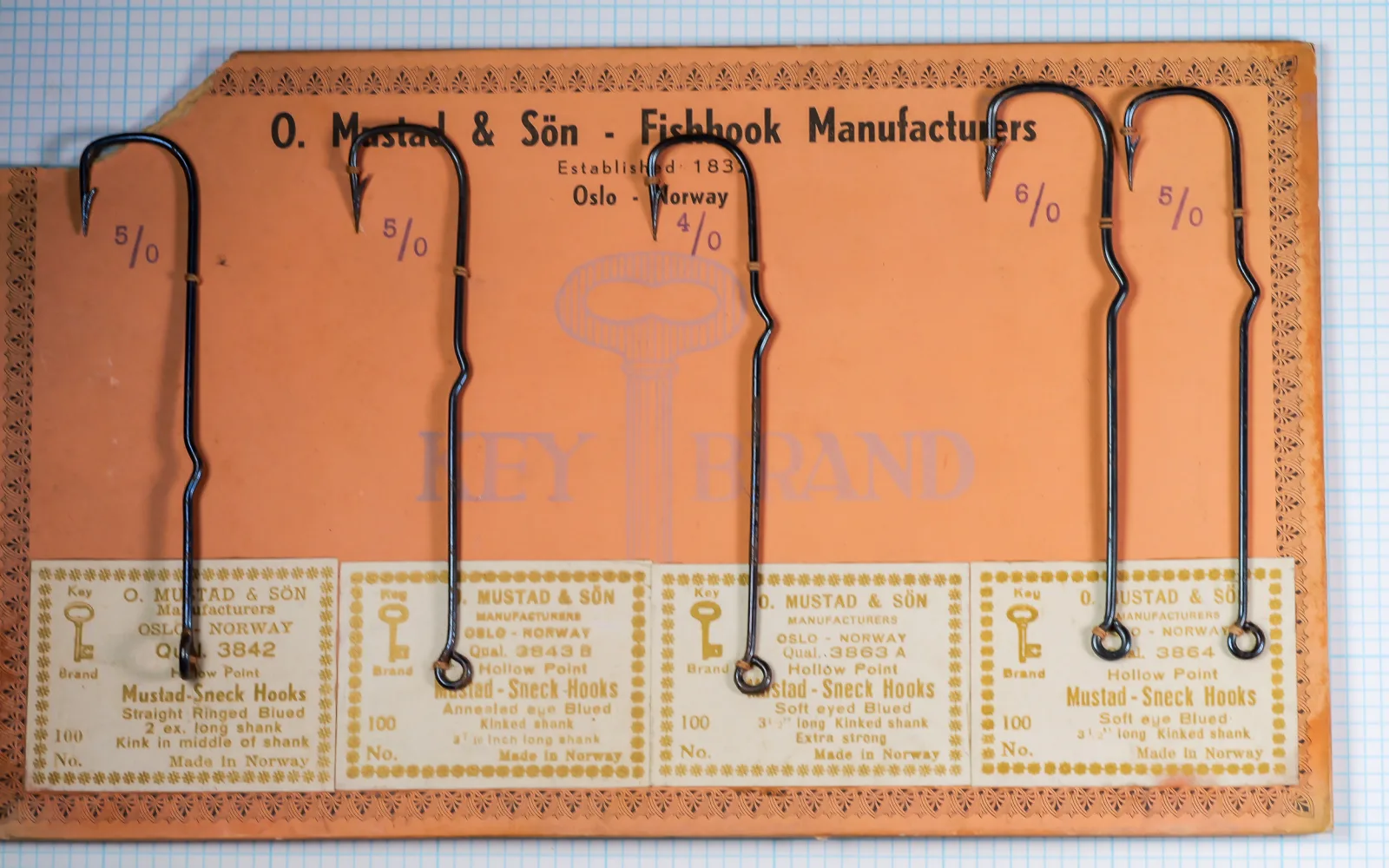
The Mustad Quality 3864 is a specialty bait and lure-making hook manufactured by O. Mustad & Sön (Oslo, Norway) during the mid-twentieth century, likely between the 1930s and 1950s. Featuring a distinctive kinked shank—a sharp bend or offset in the midsection of the shank wire—this hook was engineered specifically for spinner and spoon-lure construction, where the kink prevented the hook from rotating or shifting inside soft cork or balsa popper bodies.
The model exhibits a hollow point geometry, a ringed (ball) eye, and a sneck bend—an angular, nearly square bend at the hook’s bottom rather than the curved Sproat or round Aberdeen patterns. The blued finish and heavy-gauge wire provided durability for live-bait applications and lure rigging. This example survives as a salesman’s sample card, a format used by traveling tackle salesmen to display physical hook samples to retailers without hauling full inventory boxes.
The presence of the Oslo location designation (replacing the earlier Christiania) and the classic eight-line label format with arbitrary quality codes (Qual. 3864) confirms authentic pre-transition era production, before Mustad’s shift to the modern Signature Series nomenclature around 2001–2009. Salesman cards and specialty kinked-shank hooks hold modest but genuine collector interest due to their rarity and specialized manufacturing purpose.
Complete salesman sample card displaying five Mustad 3864 sneck hooks with kinked shanks, hollow points, and blued finish. Orange card stock with embossed decorative border and gold-foil printed label. Size notations handwritten in purple ink (5/0 and 6/0).
Photographic record
3 cataloged imagesSelect any record to load it above.
3 images shown
Mustad 3864 Sneck Hooks Salesman Sample CardComplete salesman sample card displaying five Mustad 3864 sneck hooks with kinked shanks, hollow points, and blued finish. Orange card stock with embossed decorative border and gold-foil printed label. Size notations handwritten in purple ink (5/0 and 6/0).Open originalMustad 3864 Hooks — Kinked Shank and Point DetailClose-up view of two mounted 3864 hooks showing the distinctive kinked shank, hollow-point geometry, and ringed soft eye. The kink is clearly visible approximately one-third of the way down the shank from the eye.Open originalMustad 3864 Label Detail — Eight-Line FormatClose-up of the salesman card label showing the complete eight-line Mustad standardized format. Key Brand logo, manufacturer and location (Oslo, Norway), quality code (3864), point type (Hollow Point), hook pattern (Sneck Hooks), eye type (Soft Eye), finish (Blued), and shank specification (3 1/2' long Kinked shank).Open original
Technical profile
Eye
Ball Eye, Turned DownThe eye is a standard ringed (ball) eye—a simple circular loop formed by bending the terminal wire back onto the shank. The label describes this as 'soft eye,' indicating the metal at the eye was annealed (softened) rather than full-hardness tempered. This allowed anglers or lure makers to open or close the eye slightly without risk of the metal cracking or snapping. P
Wire
Heavy (1X Heavy), Round, Est. ~0.045"-0.055" (~1.1–1.4 mm)
Shank
Special Long — Kinked
Bend
Sneck, Wide gapThe sneck bend is characterized by a distinct, nearly square or rectangular bend at the very bottom of the hook. This is structurally different from the parabolic Sproat or perfectly round Aberdeen bend. The sneck provides a stable, angular engagement point that locks the jaw effectively but creates less even stress distribution than a Sproat. Historically favored in British and European bait fishing and lure work. P
Point
Hollow Point (concave inner face)The barb is moderately sized and close-cut, consistent with Mustad's hollow-point specification. Positioned on the outer (left-facing) edge of the point, it provides adequate holding power for soft baitfish mouths without creating excessive tissue trauma. E
Finish
Blued — Confirmed (stated on packaging)The finish is a controlled chemical passivation blued steel—dark blackish-blue in color tone. This blued finish offers moderate corrosion resistance suitable for freshwater environments and is less reflective than bright or tinned finishes, making it a stealthy choice for clear-water presentations. The specimens on this salesman card show uniform finish with minimal oxidation or wear, indicating storage in a dry environment. P
The salesman card is in good overall condition with light to moderate toning of the paper stock. The card retains its original orange cover stock and embossed border decoration. All visible hooks are intact and bright; no corrosion, bending, or point damage detected. Handwritten purple-ink size notations (5/0, 6/0) are legible on two specimens. The card shows handling creases but no tears or significant deterioration.
The kinked shank is the defining engineering feature. Rather than a straight shank, the wire is deliberately bent or offset at a point roughly one-third to one-half of the way down the shank from the eye. This kink serves multiple mechanical purposes: it prevents the hook from rotating inside a cork or balsa popper body, it provides a locking point for lead molding or wire wrapping, and it anchors the hook securely during the violent casting and retrieval cycles of topwater and spinner lures. The kink also prevents the hook from sliding backward out of a soft-bait body under stress.
The hollow point geometry—with its concave, inwardly curved taper—enables rapid initial penetration with minimal applied force, making it ideal for soft-mouthed baitfish and for consistent hook-up in fast-action lure fishing where the angler cannot always maintain perfect pressure. The sneck bend‘s angular geometry creates a secure jaw-lock but with less even stress distribution than a parabolic Sproat, making it suitable for bottom-end anchoring in rigid lure bodies rather than for prolonged fighting of large fish.
The blued finish provides moderate corrosion resistance through controlled chemical passivation (iron oxide formation), offering a balance between durability and a non-reflective, stealthy presentation suitable for clear-water fishing. The heavy-gauge wire adds structural integrity for lure construction and live-bait rigging while maintaining sufficient sharpness for penetration.
Size & scale lab
Selected size
(unspecified)
Physical specimen
Overall Length
88.5 mm
Shank Length
89 mm
Gap Width
33 mm
Bend Depth
22.5 mm
Shank-to-Gap Ratio
~2.5–2.9 : 1
Confidence
P
Physical specimen
Grid-derived from photograph (1/10" grid)
Cumulative Records
This entry documents one of the earliest kinked-shank hooks in the garrenwood.com catalog, and the only verified salesman sample card to date. The 3864 represents a unique bridge between specialized bait-hook engineering and the early lure-making movement.
Own this hook? Help us measure it.
We don't have measured sizes for this hook yet. Own one? Submit calipered measurements and we'll review and add them. Thank you!
The Mustad 3864 belongs to the ‘Sneck Hooks’ product line, which occupied the mid-tier quality code range (3000–3999). Sneck hooks are characterized by their angular, nearly square bend at the hook’s bottom—a pattern historically popular in Britain and Northern Europe for specialized bait applications and lure construction. The addition of the kinked shank was a custom engineering feature targeting the spinner and popper market.
Mustad’s strategy of ‘industrial cloning’—reverse-engineering regional hook patterns and mass-producing them—extended to specialized variants like kinked-shank models. These hooks were manufactured in numerous size and finish combinations to suit specific geographic markets and fishing traditions. The 3864 line was eventually eclipsed by pre-molded lure bodies and integrated hook designs after the 1960s, leading to its discontinuation. The model does not appear in modern Mustad catalogs, confirming it as a distinctly vintage product line.
Era and Packaging Dating
Oslo location (Line 3) definitively post-dates January 1, 1925, when the Norwegian capital was officially renamed from Christiania to Oslo. The label design, typography, and printing method (gold foil/letterpress on cream card stock) are consistent with Mustad's mid-twentieth-century export packaging. The presence of arbitrary quality codes (Qual. 3864) confirms this is from the pre-transition era, before Mustad discontinued these codes in favor of the Signature Series (c. 2001–2009). The salesman card format was most prevalent from the 1920s through the 1950s, before blister packs and pre-assembled tackle boxes became standard. No barcode is present, which is consistent with pre-1974 manufacturing. The quality code range (3864 falls in the 3000–3999 'quality' tier) places it in the mid-market commercial product category. Estimated production window: 1930s–1950s.
The Salesman's Sample Card — How Tackle Was Sold Before Retail Blister Packs
Prior to the era of pre-packaged blister packs and standardized retail displays, fishing tackle was sold through a system of traveling salesman cards. A tackle salesman for Mustad or other manufacturers would carry a portfolio of sample cards like this 3864 card—displaying 5–10 actual hooks mounted on stiff cardboard—and visit local fishing shops, hardware stores, and general merchandise retailers to take orders. The shop owner would examine the physical hook samples, check the feel of the wire and the sharpness of the point, and then place orders for bulk boxes (typically 100 hooks per box). The salesman card itself was seldom purchased; it was a display tool. This particular card, having survived with all its hooks intact and legible packaging, represents a direct artifact of early-twentieth-century tackle distribution—a system that required trust, personal relationships, and the ability to guarantee product quality through direct inspection rather than through glossy photographs or online reviews.
Design lineage and influence
The sneck bend pattern originates in British and Irish fishing traditions, where regional blacksmiths produced hooks with angular bottom bends for specific bait fishing applications. Mustad’s adoption of the sneck pattern reflects the company’s strategy of reverse-engineering successful regional designs and scaling them for global distribution. The kinked-shank variant appears to be a Mustad-specific innovation, developed to address the specialized needs of the spinner and popper market, which exploded in popularity during the 1920s–1940s.
The 3864 did not spawn a direct modern descendant; instead, advances in plastic molding and integrated lure design rendered kinked-shank specialty hooks obsolete. However, the engineering principle—using a bent or offset shank to prevent rotation—survives in modern jig heads and in some contemporary streamer hooks with offset eyes.
Best matchRelated by Attribute
Computed automatically from catalog data — updated as new hooks are added.
Matches: Bend, Shank, Wire, Point, Finish +4 moreDiffers: Gap: Wide vs Standard; Eye: Ball Eye vs Cross Eye; Eye Orient.: Turned Down vs Straight / Inline +1 more
Matches: Bend, Eye, Point, Forging, Offset +2 moreDiffers: Shank: Special Long vs 4X Long; Wire: Heavy (1X Heavy) vs Standard; Gap: Wide vs Standard +3 more
Matches: Shank, Eye Orient., Point, Offset, Shank Feat. +1 moreDiffers: Bend: Sneck vs Limerick; Wire: Heavy (1X Heavy) vs Standard; Gap: Wide vs Standard +4 more
Matches: Bend, Eye, Point, Finish, Forging +3 moreDiffers: Shank: Special Long vs 2X Long; Wire: Heavy (1X Heavy) vs Standard; Gap: Wide vs Standard +3 more
The kinked shank was engineered to lock the hook in place during cork or balsa popper body construction and to prevent rotation of the hook during casting or retrieval. The hollow point provided rapid tissue penetration with minimal force—ideal for soft-mouthed baitfish species. This combination made the 3864 the hook of choice for custom lure makers constructing spinners, spoons, and topwater poppers from roughly the 1930s through the 1960s, when pre-molded lure bodies and mass-produced hooks began to dominate the market.
Secondary Applications
Large live-bait rigging for pike, musky, and bass; custom worm harnesses; experimental lure construction.
Modern Equivalents
Hook
Match Quality
Notes
Mustad 33903 Kink Shank
Moderate
Modern equivalent in function and purpose; uses round Sproat bend instead of sneck, and lacks the annealed soft eye. Better suited to contemporary materials and lure designs.
Gamakatsu Popper Hook (model number variable)
Good
Modern popper/topwater hook; engineered for cork and balsa popper bodies with offset/kinked shank alternatives available.
Collector notes
Reference value
$35 – $75 USD estimate
Packaging condition
Good — moderate wear, legibleRecorded specimen
Packaging format
GW-MS-01Catalog code
Packaging
Salesman's sample card in orange cover stock with embossed decorative border. Approximately 4.5" × 3" (114 × 76 mm) when folded. Five hooks are mounted on the card via simple wire loops pierced through the card stock. The label is printed in black and gold ink (gold letterpress or foil stamp) and contains the standardized eight-line Mustad label format: Line 1: 'O. MUSTAD & SÖN'; Line 2: 'MANUFACTURERS'; Line 3: 'OSLO - NORWAY'; Line 4: 'Qual. 3864'; Line 5: 'Hollow Point'; Line 6: 'Mustad - Sneck Hooks'; Line 7–8: 'Soft eyed Blued 3 1/2'' long Kinked shank Made in Norway.' Additional text: 'Brand' (with Key Brand logo), '100 No.' (indicating standard package quantity), and 'Key Brand' printed multiple times around the border. Two specimens are handwritten with size notations in purple ink (5/0 and 6/0). The card exhibits light toning and creasing consistent with age and handling but retains structural integrity.
Market Value Notes
Salesman sample cards command a premium over loose hooks due to rarity and historical significance. The condition of the card, the integrity of the label, and the presence of all five hooks are the primary drivers of value. Intact cards with legible labels and good paper stock typically sell in the $50–$75 range; cards with significant wear, loss of hooks, or damaged labels may fetch $20–$35. The handwritten size notations add a layer of authenticity and personal history that appeals to serious collectors. Value also depends on platform: specialist tackle dealers and auction houses may achieve higher prices than general eBay listings.
Where to Find
Salesman sample cards are uncommon on the general market. eBay occasionally lists vintage tackle cards, but specific Mustad models are scarce. Specialist dealers in vintage fishing tackle, particularly those focused on Mustad or early-twentieth-century hooks, are the most reliable source. Tackle fairs, antique fishing shows, and regional auctions of estate tackle collections occasionally yield these cards. Online forums dedicated to vintage fishing tackle (e.g., Classic Fly Rod Forum, vintage tackle Facebook groups) may have members with cards available for trade or sale.
Collector's Identification Tips
Look for the ‘Qual. 3864’ model code on Line 4 of the label. The label must show ‘Hollow Point’ on Line 5, ‘Sneck Hooks’ on Line 6, and ‘Kinked shank’ on Lines 7–8. The Oslo location (not Christiania) confirms post-1925 manufacture. The salesman card format is a valuable indicator of age and rarity—most surviving examples are loose hooks or partial boxes, making intact sample cards scarce. Verify the sneck bend (angular bottom, not round) and the pronounced kink in the shank wireabout one-third of the way from the eye. The soft eye should be able to open/close slightly without breaking (though modern handling should be minimal to avoid damage).
Preservation
Storage and Preservation
Salesman sample cards are delicate historical artifacts. Store the entire card horizontally in a dry environment, away from direct sunlight and humidity. The orange cover stock is susceptible to fading; keep the card in an acid-free envelope or archival box. Do not remove the hooks from the card unless absolutely necessary; the mounting holes and card condition are part of the historical record and add significant collector value.
If the hooks themselves require cleaning, use only dry methods (soft brush) or, if unavoidable, a gentle wipe with a dry cloth. Avoid any moisture, as the blued finish, though robust, can develop surface rust if exposed to humidity over time. The annealed (‘soft’) eye should never be forced or twisted—these eyes can be delicate and are intended only for minimal adjustment by the original user.
Original packaging and labels are crucial to value and provenance. Never separate the card from its label, and never strip or alter the printed text. Store the card in a cool environment (55–65°F) with relative humidity between 30–50% for long-term preservation.
Marking Analysis
Handwritten Annotations
Two of the five specimens mounted on this card bear purple-ink handwritten size notations: ‘5/0’ and ‘6/0’. These notations were applied by hand, most likely by the salesman or a shop employee, to identify the specific size of the hook sample mounted at that location. The handwriting is informal but legible, consistent with early-twentieth-century commercial annotation practices. The ink has aged to a light purple-brown, indicating age-appropriate patina.
These handwritten notes serve as practical documentation and suggest that the card was actively used for sales demonstrations or display purposes. The presence of multiple size variants on a single generic card reflects how salesman cards were customized on-the-fly to show relevant size ranges for specific customers or geographic markets.
Size Note
Size Designation and Scale
The label indicates ‘100 No.’ (meaning 100 hooks per standard retail box), but it does not print a specific size—the size field is left blank on this template card. The handwritten purple notations (5/0 and 6/0) were added to indicate the actual sizes of the mounted specimens. This is consistent with salesman card practice: a generic template card could be used for multiple size ranges by simply mounting the appropriate hook samples and adding handwritten size notes.
The labeled shank length of ‘3 1/2” (approximately 89 mm) is notably long, reflecting the specialized purpose of these hooks in lure and spinner construction, where extra shank length accommodates cork and balsa body mounting and provides space for wire wrapping or lead molding. This long shank—measured at roughly 3.5 inches—is unusual compared to standard bait or fly hooks, and it is a critical identifying feature of the model.
Primary Source
Eight-Line Label Decryption
Source: O. Mustad & Sön label, salesman sample card, c. 1930s–1950s
Line 1: ‘O. MUSTAD & SÖN’ — establishes the manufacturer as the Norwegian company, confirming primary manufacturing authority rather than repackaging or importing.
Line 2: ‘MANUFACTURERS’ — differentiates Mustad from import agents or jobbers, a critical distinction in early-twentieth-century tackle distribution.
Line 3: ‘OSLO – NORWAY’ — geographic origin. The use of ‘Oslo’ (rather than the earlier ‘Christiania’) proves manufacture after January 1, 1925. This is a definitive chronological marker.
Line 4: ‘Qual. 3864’ — the arbitrary quality code indicating a mid-tier commercial product (3000–3999 range = standard quality, not economy, not premium).
Line 5: ‘Hollow Point’ — exclusively defines the point geometry as concave-tapered, ideal for rapid soft-tissue penetration.
Line 6: ‘Mustad – Sneck Hooks’ — identifies the angular sneck bend pattern, a regionally derived design cloned from British/Irish tradition.
Lines 7–8: ‘Soft eyed Blued 3 1/2” long Kinked shank Made in Norway’ — provides eye type (annealed soft eye), finish (blued), shank length specification (3 1/2 inches), and the critical feature (kinked shank). Reconfirms Norwegian manufacture.
Source: O. Mustad & Sön label, salesman sample card, c. 1930s–1950s.
Additional
Salesman Cards as Historical Documents
Salesman sample cards represent a vanished distribution system and deserve special attention from collectors and historians. Before the era of retail packaging, mail-order catalogs, and online commerce, fishing tackle was sold through face-to-face relationships between manufacturer representatives and local shop owners. A Mustad salesman would travel to fishing shops, general stores, and hardware retailers carrying a portfolio of sample cards—each displaying 5–10 actual hooks mounted on cardboard. These cards allowed the retailer to inspect the physical product, feel the wire gauge, test the point sharpness, and assess the finish quality before committing to an order for bulk boxes.
The card itself was not typically sold; it was a display and reference tool, often left behind at the shop as a visual reminder of the product range and specifications. The fact that this card survives with all five hooks intact, with legible labels and handwritten notations, indicates it was handled with care and stored in favorable conditions—likely in a shop window, a tackle box, or a private collection. The card represents not just a fishing hook but a direct artifact of early twentieth-century commercial practice, personal sales relationships, and the trust-based distribution systems that predated mass retail.
Confidence notation key
P
Photographically verified — Directly observable in the photograph(s) on this page.
V
Verified by documentation — Confirmed by manufacturer catalog, spec sheet, or published reference.
I
Inferred — A logical deduction from observable or documented evidence, not directly stated.
E
Estimated — An approximation based on visual comparison, proportional analysis, or limited data.
S
Speculative — A reasoned hypothesis that cannot be confirmed from available evidence.
Unnotated claims are the compiler’s synthesis; see Sources. All photographs on garrenwood.com are taken on a measurement grid where each square equals 1/10 inch (0.1″ / 2.54 mm).