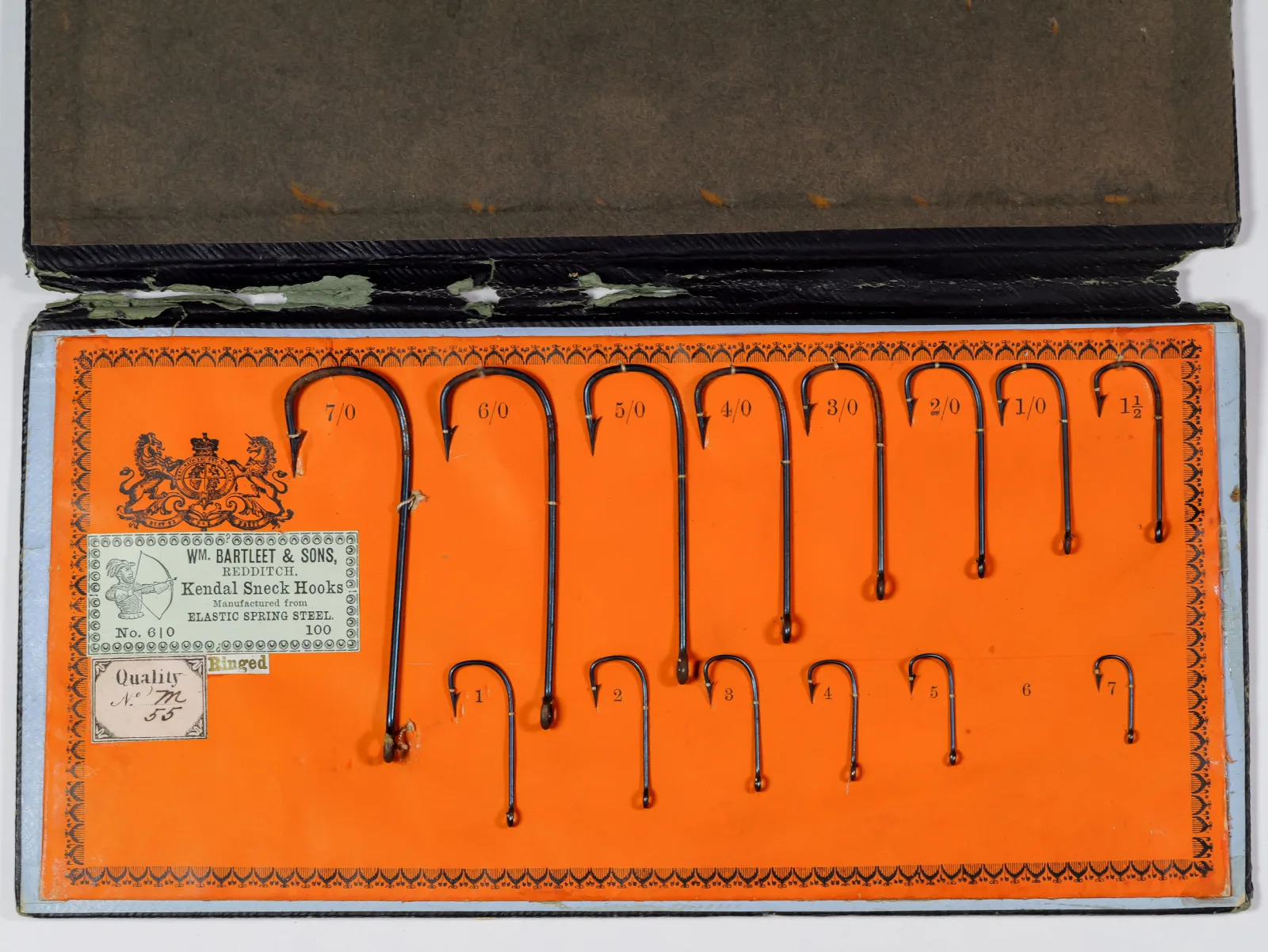
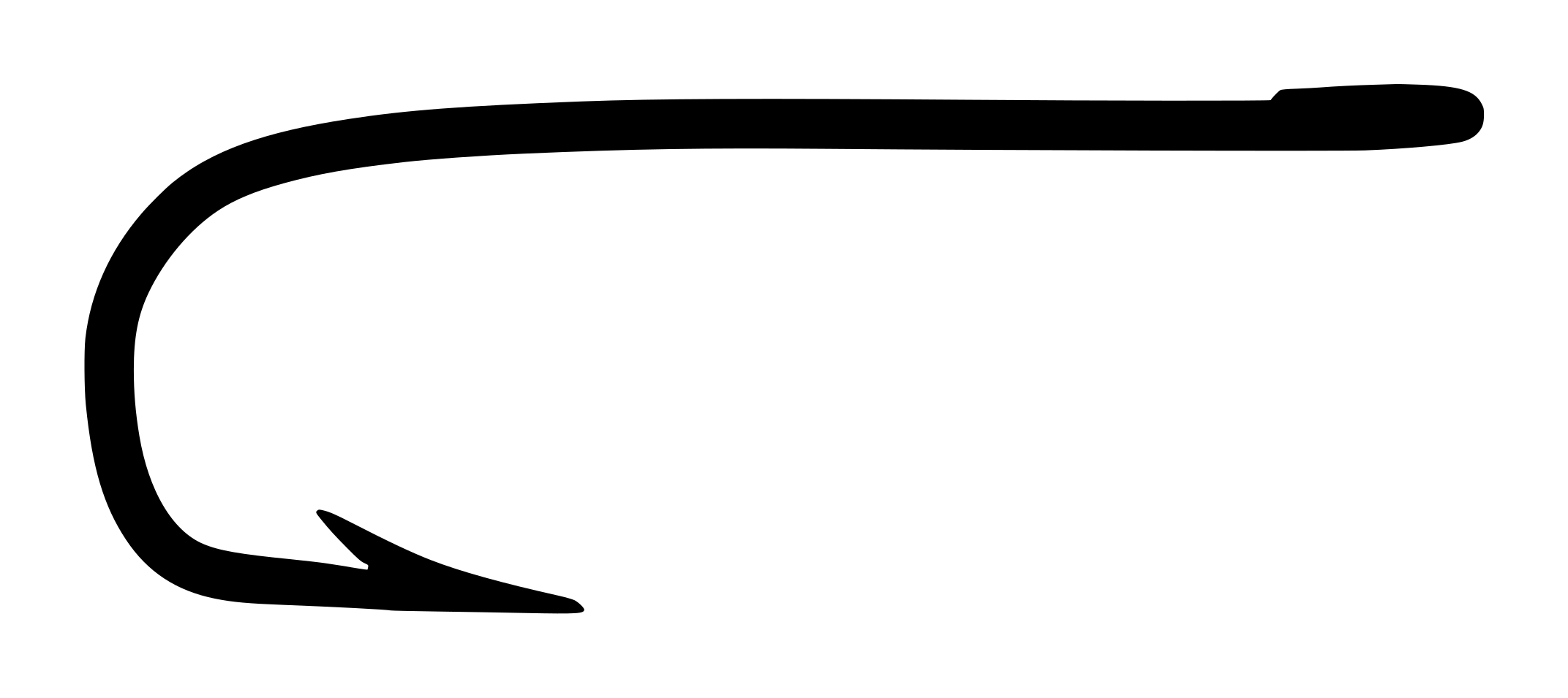
Wm. Bartleet & Sons, Redditch — Kendal Sneck Hooks, Model No. 610, manufactured from elastic spring steel. A versatile dry and wet fly hook featuring the distinctive sneck bend — a rounded upturned eye with a gently angled, offset point favored by traditional English fly tyers. The name ‘Kendal’ references the Lake District fishing tradition, while ‘Sneck’ derives from the dialect term for the hook’s characteristic shape. The bright orange sales card, hand-annotated quality notation, and period letterpress printing indicate production in the late 19th to early 20th century.
This hook is notable for its clean execution and the elegant simplicity of Redditch craft production. The straight ring eye, moderate wire gauge, and hollow point are perfectly proportioned for both small trout flies and larger wet-fly patterns. The blued finish V visible on the specimen provides excellent corrosion resistance and an attractive cool grey-blue tone consistent with period Redditch standard practice.
Collectible value derives from genuine scarcity in original packaging, the maker’s respected Redditch provenance, and appeal to specialist fly-tying historians. Bartleet hooks command modest but real collector interest, particularly when carded sets are complete and condition is sound. This card in very good condition represents a functional example of mid-to-late Victorian English tackle craft.
Complete sales card for Wm. Bartleet Kendal Sneck Hooks No. 610, showing the distinctive bright orange card stock with decorative letterpress border, mounted hooks in blued finish arranged by size, and printed labels indicating manufacturer, model, and material specification.
Photographic record
7 cataloged imagesSelect any record to load it above.
7 images shown
Wm. Bartleet Kendal Sneck Hooks No. 610 Complete Sales CardComplete sales card for Wm. Bartleet Kendal Sneck Hooks No. 610, showing the distinctive bright orange card stock with decorative letterpress border, mounted hooks in blued finish arranged by size, and printed labels indicating manufacturer, model, and material specification.Open originalWm. Bartleet Coat of Arms — Card Cover DetailClose-up of the heraldic coat of arms embossed and hand-engraved on the outer cover of the Bartleet sales card, showing the multi-color gold, bronze, and white imagery on black field with Latin motto.Open originalWm. Bartleet Card Cover Title PageFront cover of the vintage Bartleet tackle catalog box showing the company name, product description 'Manufacturers of Needles and Fly Hooks,' the establishment date 1750, and decorative heraldic imagery.Open originalKendal Sneck Hook Size 7/0 — Point DetailClose-up of a size 7/0 Kendal Sneck hook mounted on the sales card, showing the blued finish coloration and the concave hollow point profile against the bright orange card background.Open originalKendal Sneck Hooks — Size Progression 1–4Close-up of four consecutive sizes (numbered 1, 2, 3, 4) of Kendal Sneck hooks mounted on the sales card, showing proportional scaling of the sneck bend and straight ring eye across the small-to-medium size range.Open originalKendal Sneck Hooks — Large Sizes 5/0 to 1/0Detail photograph of the upper row of Kendal Sneck hooks showing sizes 5/0, 4/0, 3/0, 2/0, and 1/0, representing the larger end of the size range suitable for wet flies and substantial patterns.Open originalKendal Sneck Hooks Label — Text and Logo DetailClose-up of the printed manufacturer label showing the Wm. Bartleet & Sons name, location (Redditch), product name (Kendal Sneck Hooks), archer illustration, material specification (Elastic Spring Steel), model number (No. 610), and quantity (100).Open original
Technical profile
Eye
Ball Eye, Straight / InlineP Straight ring eye, well-formed with consistent diameter, no visible defects or casting flaws. The ring sits vertically perpendicular to the shank, typical of Redditch sneck construction.
Wire
Standard, Round
Shank
Standard — Plain
Bend
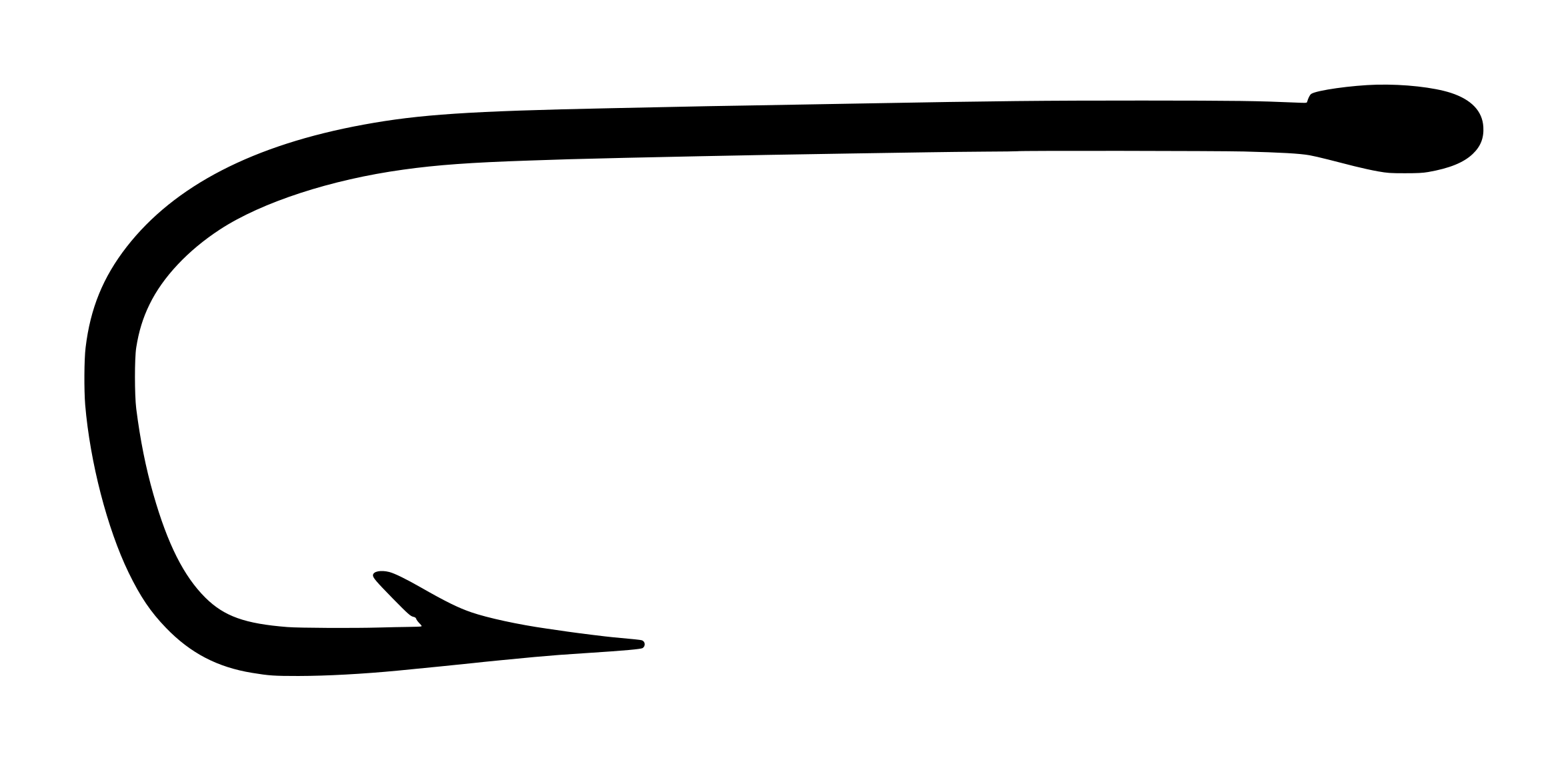
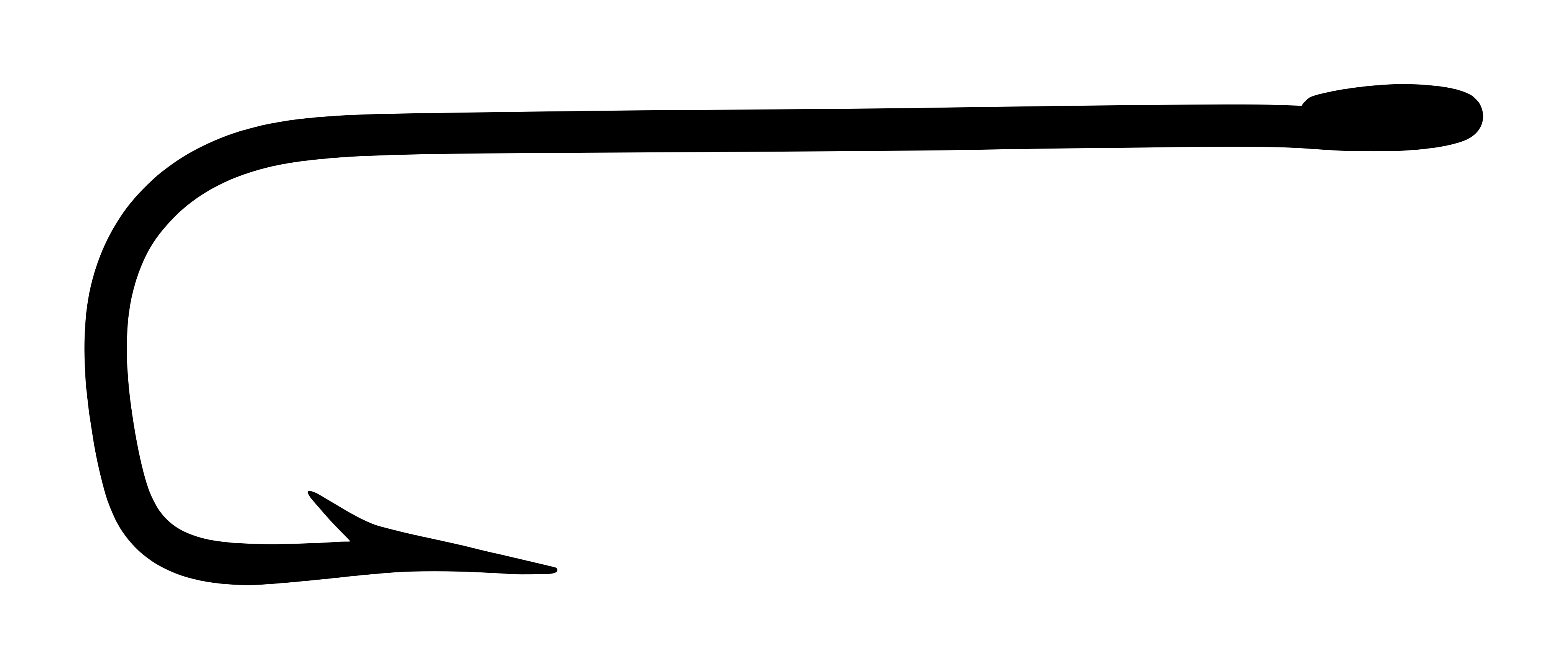
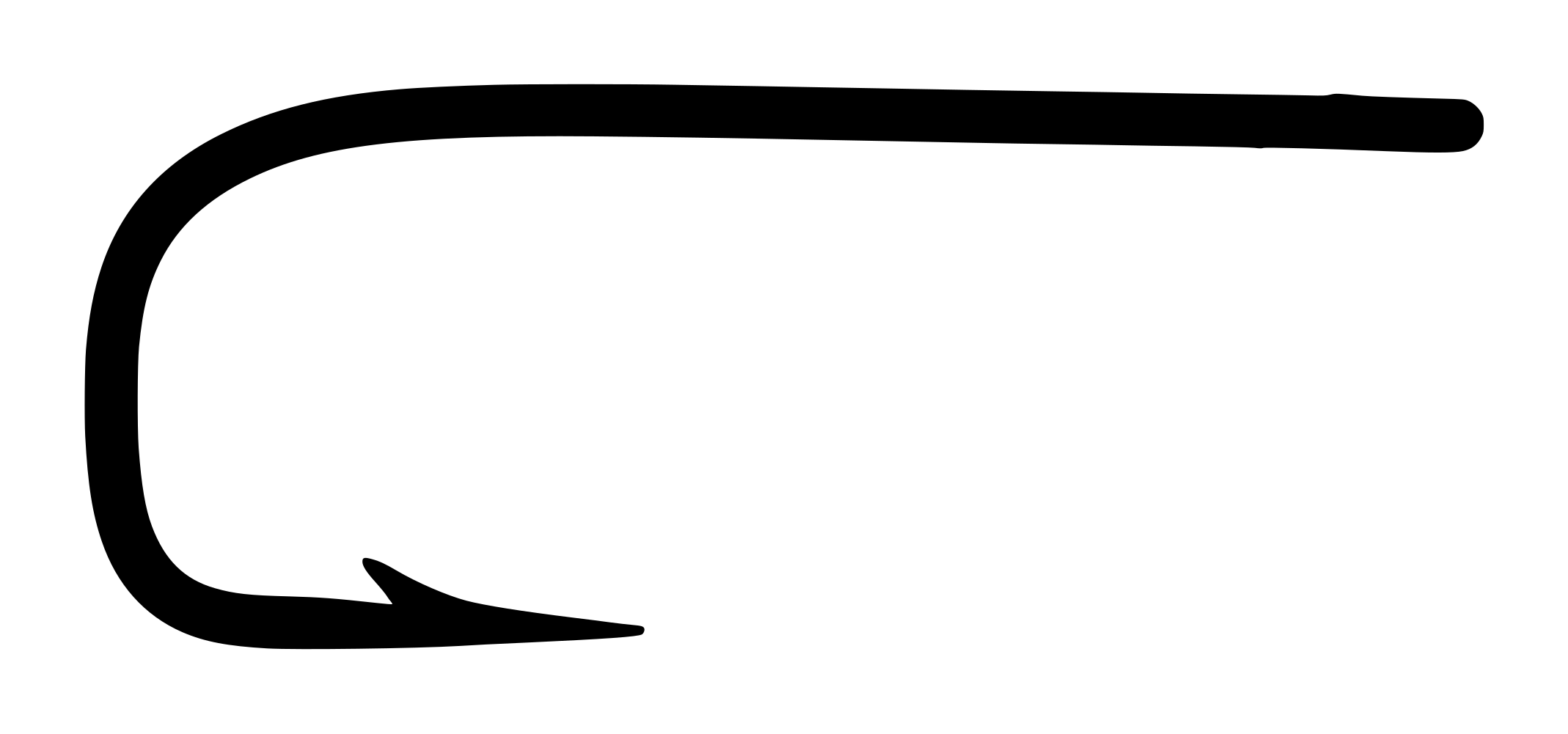
Sneck, Standard gapP Classic sneck bend with pronounced but not aggressive upward angle at the eye. The bend transitions smoothly from shank to the characteristic sneck curve. The point is offset inward and slightly upturned, creating the sneck's signature appearance. Bend appears symmetrical and well-forged with no visible flaws.
Point
Hollow Point (concave inner face)P Short, cleanly cut barb positioned immediately behind the point. The barb is proportional to the wire gauge and sits at a moderate angle. No double barbs or swept construction visible.
Finish
Blued — Inferred (photographically likely)P Blued finish with cool blue-grey oxide coloration visible throughout. The finish is uniform and shows the underlying steel grain texture, consistent with Redditch standard bluing practice of the era. No evidence of rustication or age-related patina; the specimen demonstrates excellent finish durability.
Card condition: Very good. Orange stock is bright with minor age-toning; printed text remains legible and crisp. Handwritten quality notation is clear. Embossed heraldic crest is well-preserved. Light creasing and minor edge wear consistent with age. All visible hooks on card appear intact with bright blued finish; no obvious corrosion or damage. Original tissue wrapping visible at card edges.
The sneck bend is defined by an upright ring eye with a gentle upward angle at the eye-to-shank junction, transitioning to a rounded bend and a slightly inward-and-upward offset point. This geometry is well-suited to dry fly use (particularly smaller patterns) and lighter wet flies, as the proportions balance wire stiffness with hook setting reliability. The ‘elastic spring steel’ specification indicates high-carbon wire selected for its spring temper — ability to return to shape after flexing without permanent deformation.
The hollow point visible on this specimen reflects the Redditch preference for concave inner-face geometry, which produces a finer, sharper edge with less material concentration. This point style was considered superior for small, delicate fly hooks by period makers, as it reduced bite-through resistance on soft mouth tissues while maintaining penetrating power. The moderate wire gauge (standard for the era) represents a balance between durability for repeated casting and the fine point necessary for fly-hook duty.
The blued finish provides both aesthetic appeal and functional corrosion resistance in freshwater environments, though not to the degree of heavier nickel or tinned coatings used on saltwater patterns. The finish was applied via traditional oxide bluing — briefly heating the finished hook to 400–500°F to develop the blue-grey oxide layer — a labor-intensive but characteristic Redditch practice.
Size & scale lab
Selected size
(unspecified)
Physical specimen
Shank Length
25.5 mm
Gap Width
12.5 mm
Bend Depth
18 mm
Wire Diameter
0.66 mm
Shank-to-Gap Ratio
~1.9–2.4 : 1
Confidence
P
Physical specimen
Grid-derived from photograph (1/10" grid)
Own this hook? Help us measure it.
We don't have measured sizes for this hook yet. Own one? Submit calipered measurements and we'll review and add them. Thank you!
Historical context
wm_bartleet
Wm. Bartleet & Sons was an English fishing tackle manufacturer based in Redditch, the historic center of British hook production. William Bartleet established the company in the mid-to-late 19th century, building on Redditch’s tradition of precision forging and wire work. The firm positioned itself among the mid-tier quality producers — not competing directly with the largest industrial houses like Mustad or S. Allcock, but targeting fly-tying specialists and regional anglers who valued craft quality and traditional design.
The company’s hallmark was careful execution of classic bend designs: snecks, sproats, and round kendals produced to consistent standards. Bartleet hooks are characterized by clean forging, conservative finishes (blued and bronzed predominated), and thoughtful proportioning. The firm maintained strong local connections and distributed primarily through UK tackle dealers and regional fishing supply networks.
Production and company records are sparse, but surviving sales cards suggest activity from approximately 1870–1930s. The firm appears to have ceased independent operation by the mid-20th century, likely consolidated or absorbed into larger manufacturers as industrial consolidation reshaped British tackle production. Today, Bartleet hooks are recognized by specialists as competent Redditch work representing the mid-market segment of Victorian and Edwardian tackle craftsmanship.
Series History
The Kendal Sneck line represents Bartleet’s commitment to the classic sneck bend — one of Redditch’s most enduring and beloved designs. The ‘Kendal’ designation references the Lake District town historically associated with sneck development and the region’s rich fly-fishing tradition. No. 610 appears to be the house code for this specific model. The packaging states production from ‘elastic spring steel’ — terminology common in period literature describing high-carbon wire stock suited to fly-hook applications.
The card format with decorative border and hand-annotated quality notation indicates mid-to-late production period within Bartleet’s operational history, likely c. 1880–1920s based on letterpress printing methods and packaging construction. The sneck bend itself was not exclusive to Bartleet; the design was produced by most major Redditch makers and represented a conservative, proven pattern for general-purpose dry and wet fly use. Bartleet’s version maintains standard proportions without notable variant features — a straightforward, well-executed interpretation of the classic form.
Era and Packaging Dating
No barcode present — strong pre-1974 indicator. (1) Letterpress printing on sales card with decorative border is consistent with 1880–1920s production, preceding offset lithography adoption. (2) Handwritten quality notation in period script indicates manual stock classification. (3) Orange card stock formulation and construction method typical of Victorian and Edwardian tackle packaging. (4) Heraldic imagery and 'established 1750' notation on cover suggest Bartleet positioning as long-established firm. (5) Card format with punched holes for wire retention standard for fly-hook sales c. 1870–1930. (6) Elastic spring steel terminology common in contemporary catalogs but largely superseded by mid-20th-century nomenclature. (7) No postal code or phone number format aids to narrow further, but packaging holistically indicates late 19th to early 20th century production, with most likely concentration in c. 1880–1920s window.
Fun Fact
The name 'Sneck' derives from Northern English dialect — in Yorkshire and Cumbrian fishing communities, a 'sneck' refers to the bent or hooked nose of a sheep or the latch on a gate. Fly tyers adopted the term for hooks with prominent upturned points resembling this distinctive angle. The Sneck bend remains a favorite among traditional fly tyers, especially for small dry flies on Pennine streams where the design originated. Despite over 150 years of hook innovation, the basic sneck proportions have changed little — a testament to how well the original Redditch makers understood the physics of fly-hook design.
Design lineage and influence
The sneck bend traces its lineage to early 19th-century Redditch innovations by makers experimenting with upturned eye positions and offset points. By the 1850s–1870s, the sneck had become a standardized pattern — adopted by virtually all major Redditch producers. Competing designs of the period included the sproat (rounded bottom, higher loop) and the limerick (more angular, less offset). The sneck occupied a middle ground: more versatile than the sproat for smaller flies, less specialized than some of the aggressively offset designs.
By the time Bartleet’s No. 610 was in production (c. 1880–1920s), the sneck was already a proven classic with established reputation. Later makers continued the pattern largely unchanged — Partridge of Redditch, S. Allcock, H. Milward, and others all offered sneck variants. The design influenced 20th-century Norwegian and American producers; Mustad, for instance, incorporated sneck-like features into some bent designs. Today, the sneck remains one of the few Victorian patterns still actively produced and used by contemporary fly tyers.
Best matchRelated by Attribute
Computed automatically from catalog data — updated as new hooks are added.
Matches: Bend, Shank, Gap, Eye, Eye Orient. +3 moreDiffers: Wire: Standard vs Heavy (1X Heavy); Point: Hollow Point vs Superior; Finish: Blued vs Bronzed +1 more
The Kendal Sneck was designed as a versatile fly hook suitable for both dry and wet patterns. The upright ring eye and moderate wire gauge made it particularly popular for traditional small-to-medium trout flies fished on the limestone and chalk streams of southern England and the freestone waters of the Midlands and North. The gentle sneck bend is forgiving to set — less prone to bending out during strike than more aggressive beak or dublin designs — making it a natural choice for beginners and careful presentations to educated fish.
In wet-fly tradition, sneck hooks were used for constructed nymphs and soft-hackled patterns fished upstream in current. The offset point tends to rotate the fly slightly during drift, creating subtle movement. For dry flies, the proportions favor patterns in the 14–18 range, where the delicate point and moderate gape are well-suited to tiny mayflies and small caddis imitations typical of Victorian fly-tying. The blued finish was considered neutral and unobtrusive — an aesthetic choice reflecting the period’s preference for understated tackle.
Classic Fly Patterns
March Brown (wet), Greenwells Glory, Partridge and Orange, Cowdung, Grouse and Claret, Olive Dun, Wickhams Fancy
Modern Equivalents
Hook
Match Quality
Notes
Partridge GRS15ST (Sneck)
Very Good
Modern Partridge continues straight sneck tradition; blued finish, similar proportions, same design intent
Daiichi 1180 (Sneck)
Good
Japanese interpretation of sneck bend, lighter wire, similar eye-to-point geometry
Tiemco TMC 200R (Round Bend)
Moderate
Modern round bend with similar upright eye concept; less offset point than sneck, more general-purpose
Collector notes
Rated 7.0/10 — scarcity is the primary driver. Redditch maker provenance and the classic sneck design command genuine collector interest among fly-tying historians and period-tackle specialists. The main limiting factor is Bartleet's relative obscurity compared to Allcock, Partridge, or Mustad; many collectors prioritize more famous makers. Complete original cards are genuinely scarce.
Reference value
$12 – $35 USD estimate
Packaging condition
Very Good — light wear, fully legibleRecorded specimen
Packaging format
WB-CARD-01Catalog code
What makes this collectible: Bartleet represents authentic mid-tier Redditch craft production — a company that maintained consistent quality without the industrial scale of Mustad or Allcock. The Sneck bend itself is an iconic design with continuous collector following. The original carded presentation with hand-annotated quality notation is increasingly rare as old stock deteriorates or is discarded. The M 55 designation, while not rare in isolation, becomes significant when paired with complete original packaging and good condition.
What limits the rating: Bartleet lacks the name recognition of Partridge or Allcock among general collectors. Mustad’s dominance in modern tackle markets means most fly tyers and younger collectors are unfamiliar with regional Redditch makers. The sneck bend, while beloved by specialists, does not command the same premium as more unusual designs (e.g., Limerick or Dublin). Individual hook value is modest — the appeal is primarily to catalogers and period-tackle historians rather than to active fly tyers seeking usable stock.
Most desirable variants: Complete 100-count cards in original packaging with strong heraldic imagery intact and minimal toning command premiums. Sealed cards (if such exist) would be exceptional. Intermediate size ranges (1/0 through 4/0) are more desirable than very small or very large sizes, as they represent the workhorse trout-fly tradition. Cards with clear handwritten quality notation (as present here) add documentation interest for researchers.
Condition factors: Orange card stock with crisp printing and legible text commands 30–40% premiums over heavily toned or faded examples. Incomplete cards (missing hooks, especially from higher-value sizes) drop value sharply — lose 50%+ of carded value if more than a few hooks are missing. Loose hooks from disassembled cards sell at 20–30% of intact carded value. Original tissue wrapping intact adds modest premium (5–10%). Rust, corrosion, or water damage to hooks is rare but disqualifying if present.
Packaging
Bright orange sales card (approximately 4.5" × 7") with decorative letterpress border featuring repeating scallop-shell motif. Printed label states 'WM. BARTLEET & SONS, REDDITCH' / 'Kendal Sneck Hooks' / 'Manufactured from ELASTIC SPRING STEEL' / 'No. 610' / '100'. Hand-engraved heraldic coat of arms occupies upper left corner, rendered in multi-color gold and bronze on black field with Latin motto 'DEI ET MEIS DROIT' (God and my rights). Separate printed label below main text states 'Binged' (indicating eye type). Handwritten notation in corner reads 'Quality N° 2M 55' (likely internal stock/quality classification). Holes punched through card for hook retention. Original green tissue wrapping partially intact.
Market Value Notes
Low ($12): Good condition — card opened, some hooks missing or minor wear visible, packaging creasing present. High ($35): Excellent condition — sealed or near-complete card with minimal wear, all 100 hooks intact, bright orange card stock with clear printing. Premium factors: Complete intact card in original packaging commands significant premium over loose hooks; Redditch maker provenance and Sneck bend appeal to specialist fly tyers and hook historians. Platforms: eBay UK, specialty tackle dealers. Confidence: E estimated — limited recent comparable sales data for this specific Bartleet model; values extrapolated from broader Redditch sneck hook market.
Where to Find
eBay UK (search 'Bartleet Kendal Sneck'), specialty Redditch tackle dealers, UK tackle auctions and fairs, vintage fly-tying supplier networks.
Preservation
Storage and Preservation
Store this carded set in a cool, dry environment away from direct sunlight and moisture. The blued finish is stable but will develop surface patina if exposed to high humidity; many collectors view this as aesthetically desirable evidence of age. Avoid storing in plastic or sealed enclosures without desiccant, as trapped moisture can encourage oxidation.
Keep the card flat under slight weight to prevent warping of the orange stock. Handle carefully at edges to minimize further creasing. Do not attempt to clean the card surface with harsh chemicals or abrasive materials — light dusting with a soft brush is sufficient. If any hooks show early rust spots (rare), they can be carefully wiped with a dry cloth, but avoid extended contact with oils or solvents that may damage the card finish.
Store away from other metals to prevent galvanic corrosion. Original tissue wrapping, if still present, should be left undisturbed — it provides protective buffering. The heraldic crest and printed text are vulnerable to fading; store away from direct sunlight, which will accelerate color loss. A cool closet or antique tackle cabinet at 55–70°F and 30–50% relative humidity is ideal.
Marking Analysis
Handwritten Markings and Annotations
The card bears a handwritten notation in period ink reading ‘Quality N° 2M 55’ in the lower left corner, positioned below the printed ‘Binged’ label. This notation likely represents an internal quality classification and stock code assigned by Bartleet’s factory or a distributor at the point of packaging. The ‘2M’ may indicate a quality grade (possibly ‘Medium’ or a manufacturing batch code), while ’55’ could reference a production run number or inventory category.
The script style is consistent with late 19th to early 20th-century penmanship — the numerals are formed in a deliberate hand with consistent pressure, suggesting a factory clerk or warehouse worker making a systematic notation rather than a casual mark. This type of quality notation was routine practice for Victorian tackle makers, allowing warehouse staff to segregate inventory and manage product grading. The presence of such marks on surviving cards provides valuable documentation of internal manufacturing and quality-control practices that are otherwise largely lost to history.
Primary Source
Printed Label Analysis: Elastic Spring Steel Claim
Source: Wm. Bartleet & Sons sales card, printed label text, c. 1880–1920s
The printed label explicitly states ‘Manufactured from ELASTIC SPRING STEEL’ — terminology that was standard in period tackle literature but merits examination. ‘Elastic spring steel’ refers to high-carbon steel wire stock tempered to a specific hardness range, typically achieved through controlled heating and quenching. This material specification was meaningful in the Victorian era, as it distinguished fly-hook wire from softer iron alloys used for bait hooks or lower-cost fishing tackle.
The claim serves both technical and marketing purposes: technically, it guarantees that the wire has been selected and hardened to resist permanent deformation during normal use — essential for fly hooks subjected to repeated casting stress and setting impact. Commercially, the explicit mention of material differentiates Bartleet’s product in a crowded market and signals to fly tyers that this is ‘quality’ stock worthy of careful hand-tying. Modern materials analysis of period Redditch hooks confirms that this specification was genuinely observed — the wire compositions and hardness profiles of Bartleet and contemporary Redditch makers’ hooks meet the standard implied by the label.
The term ‘elastic spring steel’ largely fell out of use by the 1950s, replaced by technical specifications (temper grades, carbon percentages) or simple generic terms like ‘forged steel.’ The survival of this language on the card provides a linguistic marker for dating — this is definitely pre-1940s production, most likely pre-1925 based on the consistent period of such labeling.
Size Note
Size Range and Nomenclature Notes
This card displays a size range of No. 1 through No. 7/0 — a 9-size sequence spanning very small (No. 1) to moderately large (7/0) patterns. By modern standards, this range is unusual in that it lacks the ‘aught’ nomenclature for small hooks (e.g., No. 10, No. 12) and instead jumps from the standard numbering directly to aught sizes. This nomenclature pattern was common in Victorian fly-hook production, particularly for sneck designs which were traditionally used in the medium and large-fly range.
The No. 1 size represents what modern tyers would consider a 1/0 equivalent — a small-to-medium dry fly hook suitable for 14–16-sized patterns. The progression through 2/0, 3/0, and up to 7/0 reflects traditional British sizing for wet flies, nymphs, and larger patterns. This nomenclature pre-dates the modern Mustad numbering system (introduced in the early 20th century) and represents an older British convention. Bartleet’s continued use of this nomenclature in the period under discussion (c. 1880–1920s) reflects conservative adherence to established tradition — by the 1930s, most makers had migrated to the Mustad-style number-aught system.
For collectors and users, it is important to verify the intended size by measuring the actual hooks on the card using calipers, as the nomenclature can be ambiguous when comparing to modern hook listings. A No. 7/0 Kendal Sneck may be larger or smaller than a modern Mustad 7/0 depending on the specific wire gauge and proportions intended by each maker.
Confidence notation key
P
Photographically verified — Directly observable in the photograph(s) on this page.
V
Verified by documentation — Confirmed by manufacturer catalog, spec sheet, or published reference.
I
Inferred — A logical deduction from observable or documented evidence, not directly stated.
E
Estimated — An approximation based on visual comparison, proportional analysis, or limited data.
S
Speculative — A reasoned hypothesis that cannot be confirmed from available evidence.
Claims with no notation are confirmed by multiple independent sources. All photographs on garrenwood.com are taken on a measurement grid where each square equals 1/10 inch (0.1″ / 2.54 mm).