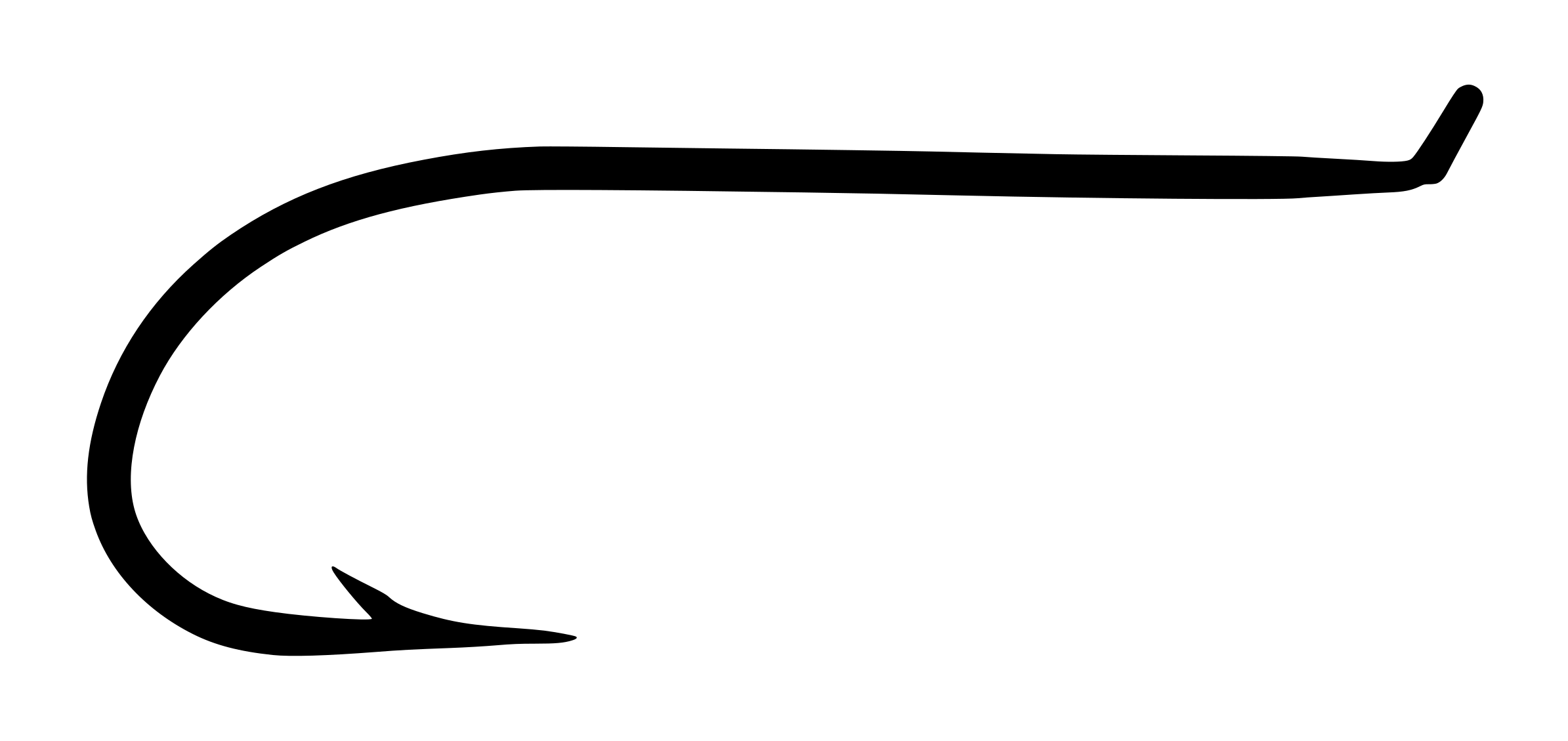
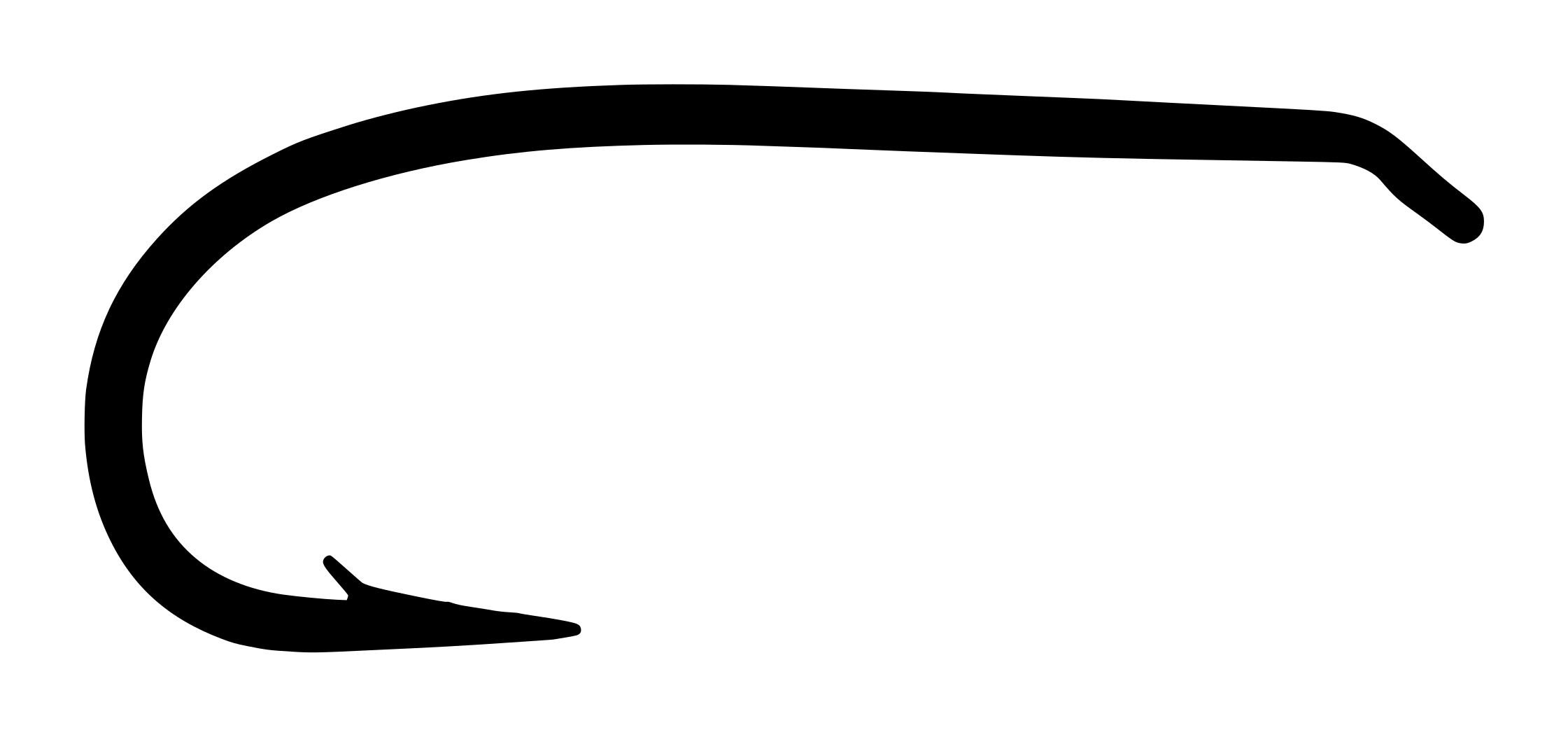
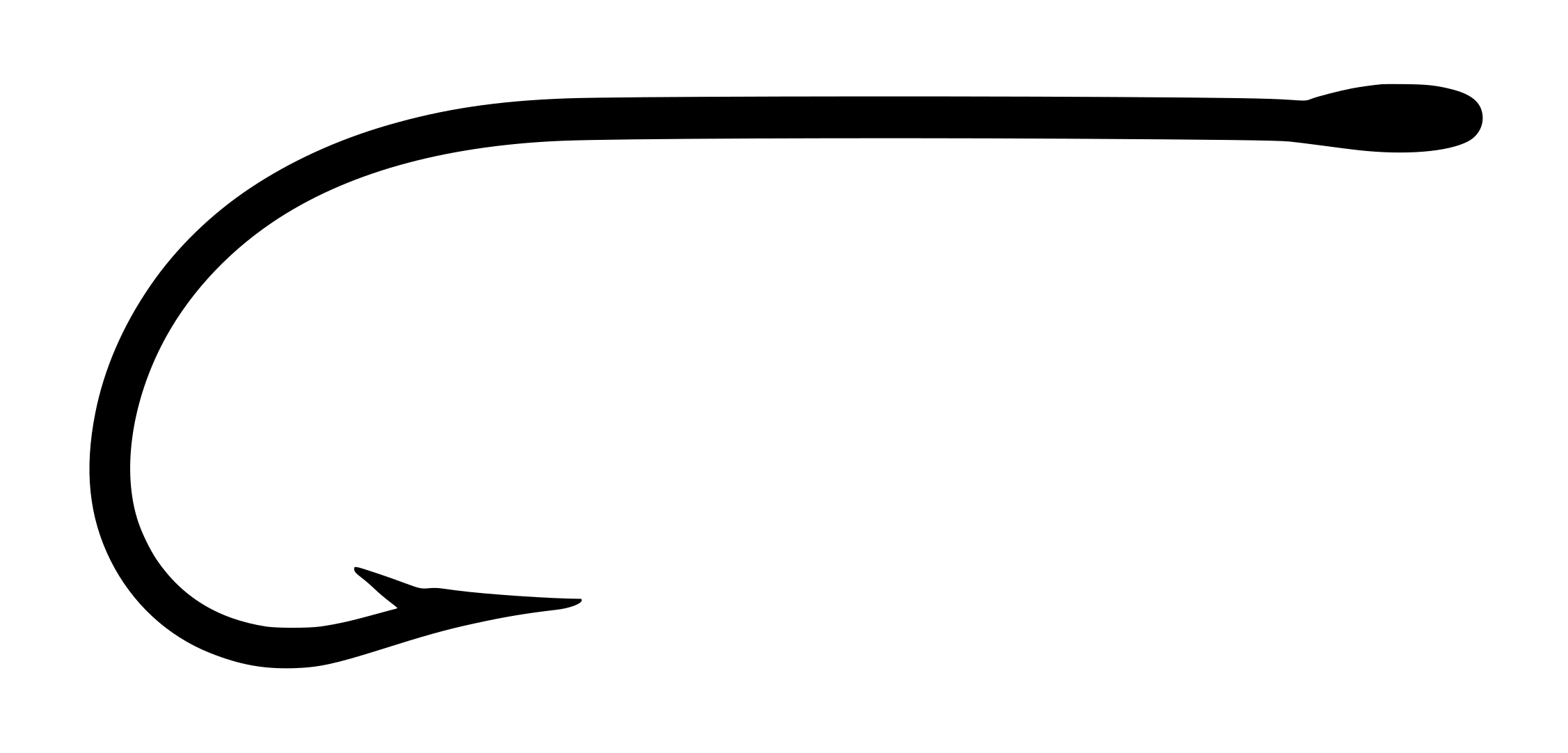
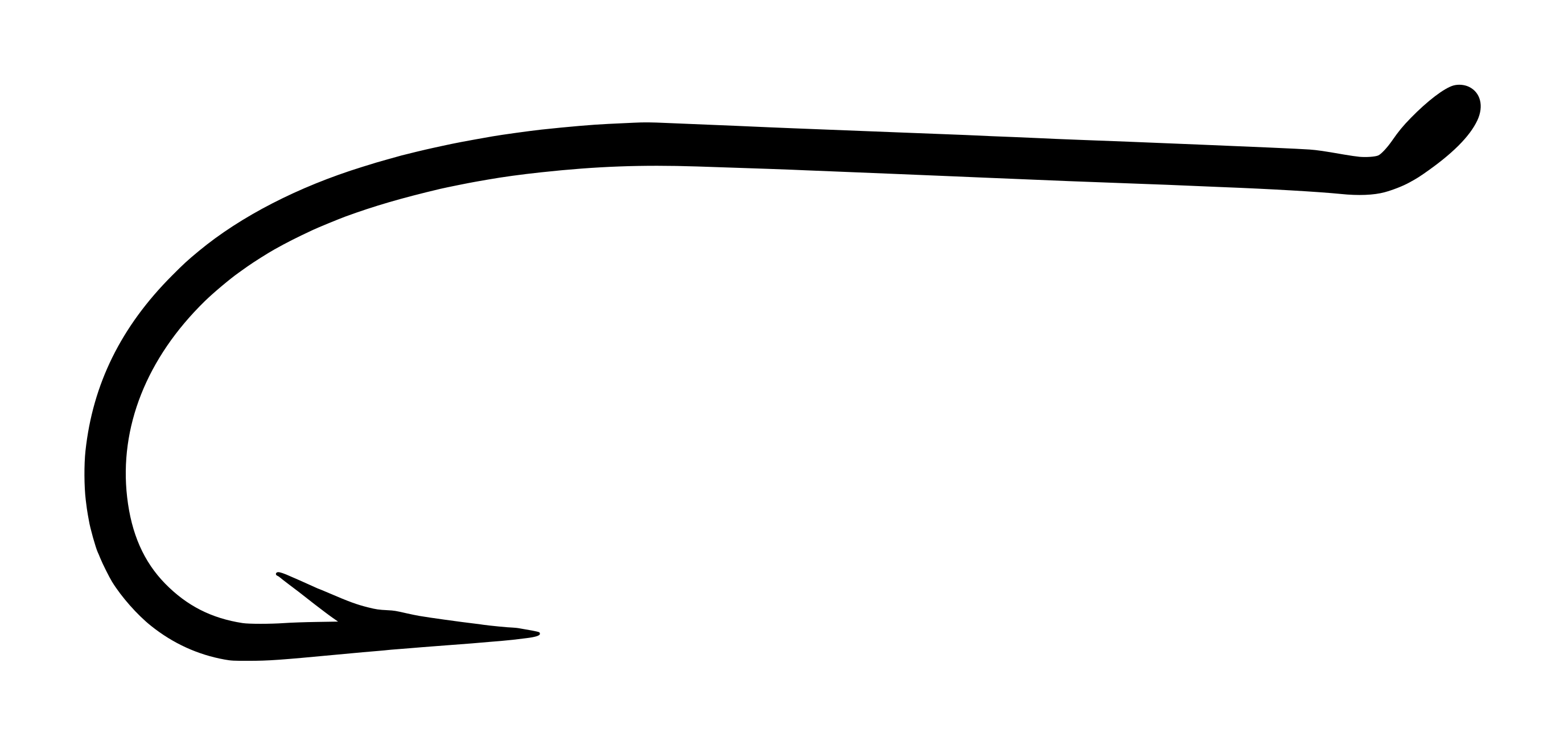
The Mustad Quality 3980 Kendal Kirby is a classic mid-tier wet-fly hook from O. Mustad & Søn’s early-to-mid 20th century catalog, representing the Norwegian manufacturer’s direct reverse-engineering of the legendary English Kirby pattern dating to Charles Kirby (c. 1650). This size 12 example in pre-1925 Christiania packaging dates conclusively to 1900-1924, placing it at the vanguard of Mustad’s initial global export campaign. The turned-up tapered eye and hollow-point geometry are signature features of traditional wet-fly design, intended for soft-mouthed trout and delicate North Country spider patterns.
The defining physical characteristic is the subtle lateral offset (kirb) of the point, which prevents the hook from laying flat in the fish’s mouth and improves hook-set reliability. The rustproof finish (likely a light chemical passivation or japanning) and standard round wire reflect the practical engineering standards of early 20th-century Mustad production. The specimen hooks show excellent preservation with deep bronzed patina and razor-sharp points.
This hook carries substantial collecting significance for several reasons: the pre-1925 Christiania geographic designation serves as an exact production bracket; size 12 is genuinely scarcer than larger utility sizes; and the original cream-stock card with complete typographic labeling documents a moment when Mustad was establishing global dominance through industrial mechanization. The Kendal Kirby design itself remains iconic among traditionalist fly tyers as a direct living link to 350 years of English hook-making heritage.
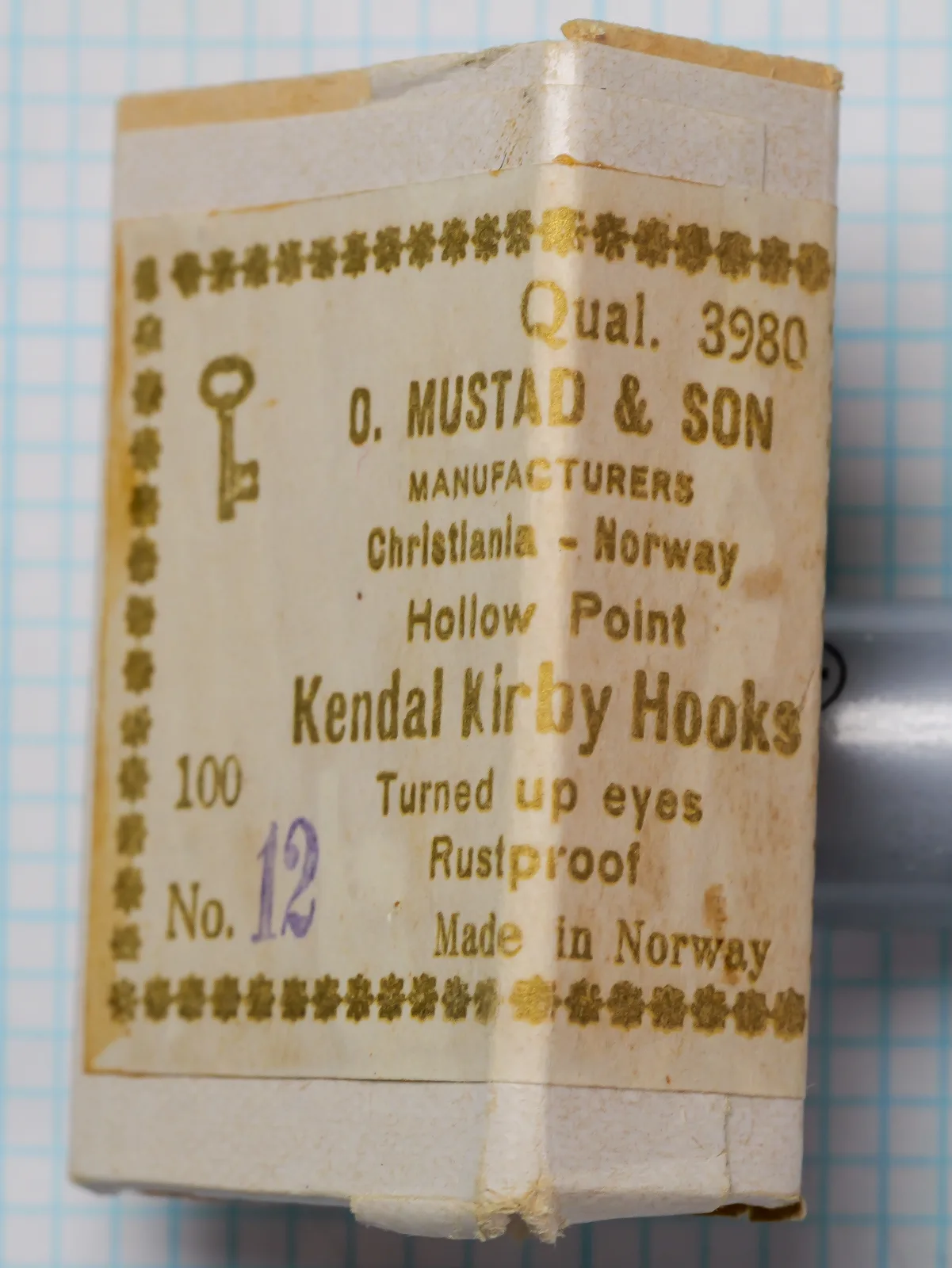
Original Mustad 3980 packaging (size 12) bearing the 'Christiania - Norway' designation, confirming production before January 1, 1925. The cream-colored card features the iconic skeleton Key Brand logo and eight-line letterpress label in gold ink.
Photographic record
7 cataloged imagesSelect any record to load it above.
7 images shown
Mustad 3980 Kendal Kirby Size 12 Christiania Box LabelOriginal Mustad 3980 packaging (size 12) bearing the 'Christiania - Norway' designation, confirming production before January 1, 1925. The cream-colored card features the iconic skeleton Key Brand logo and eight-line letterpress label in gold ink.Open originalMustad 3980 Size 12 Hook Side ProfileSide-view profile of a single size 12 Mustad 3980 Kendal Kirby hook showing the turned-up tapered eye and hollow-point geometry.Open originalMustad 3980 Size 12 Hooks PairTwo size 12 Mustad 3980 hooks photographed side-by-side on measurement grid, demonstrating the consistency of the bend radius and tapered eye construction across the production batch.Open originalMustad 3980 Kendal Kirby Size 1/0 Oslo Box LabelLater Mustad 3980 packaging (size 1/0) bearing the 'Oslo - Norway' designation, indicating production after January 1, 1925. The label shows the Key Brand logo and identifies this as a bronzed, turned-up tapered eye variant.Open originalMustad 3980 Size 1/0 Hook Point DetailExtreme close-up of a size 1/0 Mustad 3980 point showing the hollow-point geometry — the concave inner face and razor-sharp tip designed for delicate penetration.Open originalMustad 3980 Size 1/0 Hook ProfileComplete side-profile view of a size 1/0 Mustad 3980 Kendal Kirby hook, showing the round-kendal bend geometry, standard wire gauge, turned-up tapered eye, and subtle kirby offset of the point.Open originalMustad 3980 Size 1/0 Hooks PairTwo size 1/0 Mustad 3980 hooks shown side-by-side on measurement grid, demonstrating the symmetry and consistency of the bend profile, tapered eye, and offset point across specimens from the same production batch.Open original
Technical profile
Eye
Tapered Eye, Turned Up
Wire
Fine (1X Fine), Round, Est. ~0.018"-0.020" (~0.46-0.51 mm)
Shank
Standard — Plain
Bend
Round / Kendal, Standard gap, Offset / kirbed
Point
Hollow Point (concave inner face)
Finish
Bronzed — Confirmed (stated on packaging)
The hollow point geometry on the 3980 is engineered specifically for delicate, soft-mouthed species. The concave inner face creates a razor-sharp tip that requires minimal angler pressure for penetration — critical when fishing fragile gossamer leaders on light rods. The round-kendal bend with subtle kirby offset ensures the point naturally meets the corner of a trout’s jaw on the strike, maximizing hook-up probability. The turned-up tapered eye reduces overall hook weight at the fly head, allowing high-floating dry flies and delicate wet patterns to sit properly in the water column without nose-diving due to excess steel mass. Standard wire gauge balances durability with the light presentation philosophy of traditional wet-fly fishing.
We don't have measured sizes for this hook yet. Own one? Submit calipered measurements and we'll review and add them. Thank you!
Historical context
mustad
O. Mustad & Søn was founded in 1832 in Gjøvik, Norway, initially as ‘Brusveen Spiger- og Staltradfabrikk’ (Brusveen Nail and Steel Wire Factory), producing nails, steel wire, and small metal goods. The company was acquired by Ole Hovelsen Mustad and his son Hans Mustad, who rebranded it as O. Mustad & Søn and expanded into hook manufacturing. The defining innovation came in 1877 when Mathias Topp invented the first fully automated hook-making machine — a mechanized marvel that could cut, bend, barb, and point hooks at unprecedented speed and consistency. Rather than patent the machine (which would require public disclosure), Mustad relied on strict corporate secrecy and restricted factory access to protect the technology, granting them a devastating competitive advantage against Redditch and other hook-making centers. By the 1950s, Mustad had secured 50% of the global hook market and established sales offices across multiple continents. The ‘Key Brand’ logo — a downward-pointing skeleton key — was chosen to symbolize Mustad’s ability to ‘unlock’ international markets and angling success.
Series History
The Quality 3980 Kendal Kirby was one of Mustad’s core product offerings in the early-to-mid 20th century, positioned as a mid-tier hook suitable for both commercial bait fishing and fly tying. The model number reflects Mustad’s numerical categorization system: hooks in the 3000-3999 range represented ‘Quality’ models manufactured to exacting dimensional and tempering standards, occupying the mid-tier between economy models (1000-2999) and premium patterns (4000+). The 3980 was produced in numerous size variants ranging from size 16 (small) through size 3/0 (large), each engineered for specific applications. The Kendal pattern itself was a direct copy of the English Kirby design, reverse-engineered as part of Mustad’s aggressive industrial ‘cloning’ strategy. The 3980 remained in production through the mid-20th century but was gradually displaced by more modern bend profiles (Sproat, Aberdeen) as fly-tying and bait-fishing techniques evolved. The design was effectively discontinued around the 1970s as Mustad transitioned to the ‘Signature Series’ model numbering system (c. 2001-2009), though the pattern name ‘Kendal Kirby’ persists in some modern Mustad catalogs as a heritage reference.
Era and Packaging Dating
Label states 'Christiania - Norway'; the Norwegian capital was officially renamed Oslo on January 1, 1925. Any Mustad box bearing the Christiania designation can be conclusively dated to 1924 or earlier. This represents Mustad's initial major push into the American and global export markets. The use of the Key Brand logo and letterpress printing on cream stock are consistent with early 20th-century Mustad production.
The Key That Locked Out Competitors
The skeleton key logo on vintage Mustad packaging is a masterpiece of industrial psychology. The company originally manufactured nails, horseshoe nails, and steel wire before pivoting to hooks — and the 'key' symbolized Mustad's ability to 'unlock' doors to international markets and angling success. What few collectors realize is that Mustad's most devastating competitive advantage was not the hook design itself, but the 1877 automated hook-making machine invented by Mathias Topp. Rather than file for a patent (which would expose the mechanical schematics), the Mustad family built a manufacturing fortress of secrecy, strict non-disclosure agreements, and restricted factory access. This strategy proved so effective that by the 1950s, Mustad controlled 50% of the global hook market — a dominance that persisted until modern offshore manufacturing redistributed production across Asia.
Design lineage and influence
The Kendal Kirby pattern traces its lineage directly to Charles Kirby, who began hook manufacturing in London around 1650. The distinctive lateral offset (kirb) of the point was Kirby’s signature innovation, designed to prevent the hook from laying flat in a fish’s mouth. Mustad reverse-engineered this pattern in the late 19th century as part of its industrial ‘cloning’ strategy, acquiring the design through trade relationships or direct copying of English regional patterns. The 3980 was positioned as Mustad’s premium offering in the Kendal category — a direct competitor to Redditch-made Kendal Kirbys from makers like S. Allcock and Partridge. By the mid-20th century, the design was superseded by the Sproat bend (more forgiving) and modern round-bend dry-fly hooks, but the Kendal Kirby remains iconic in fly-tying circles as a living connection to 350 years of English hook-making tradition.
Best matchRelated by Attribute
Computed automatically from catalog data — updated as new hooks are added.
Matches: Shank, Gap, Eye, Point, Finish +4 moreDiffers: Bend: Round / Kendal vs Sproat; Wire: Fine (1X Fine) vs Standard; Eye Orient.: Turned Up vs Turned Down
Matches: Bend, Shank, Wire, Gap, Eye +3 moreDiffers: Eye Orient.: Turned Up vs Turned Down; Point: Hollow Point vs Standard / Spear; Forging: Round vs Forged +1 more
Matches: Bend, Shank, Gap, Point, Finish +4 moreDiffers: Wire: Fine (1X Fine) vs Heavy (1X Heavy); Eye: Tapered Eye vs Ball Eye; Eye Orient.: Turned Up vs Straight / Inline +1 more
Matches: Bend, Gap, Eye, Point, Finish +2 moreDiffers: Shank: Standard vs 1X Long; Wire: Fine (1X Fine) vs Standard; Eye Orient.: Turned Up vs Turned Down +2 more
The Kendal Kirby 3980, size 12, is historically documented as a premier choice for classic North Country spiders, traditional wet flies, and small salmon flies where a delicate presentation and fine wire are essential. The turned-up tapered eye accommodates the Turle knot, a preferred connection method for early fly-fishing. The hollow point geometry ensures rapid penetration with minimal tissue damage to soft-mouthed trout and sea trout. In its day, this hook was favored for fishing chalk streams and moorland becks where precision casting and elegant fly presentation determined success.
Classic Fly Patterns
North Country Spider, Greenwells Glory, March Brown, Partridge and Orange, traditional wet fly patterns, early Atlantic Salmon flies
Modern Equivalents
Hook
Match Quality
Notes
Mustad 4200D
Good
Direct modern descendant of the Kendal Kirby line; round-kendal bend with kirby offset, though typically features ringed eye rather than tapered eye; available in multiple sizes
Tiemco 3769
Moderate
Premium wet-fly hook with similar bend profile and application (salmon, steelhead, sea trout); however, features ball eye rather than tapered eye; superior modern materials and sharpening
Mustad S80
Moderate
Contemporary Mustad wet-fly offering with round bend and moderate shank length; less specialized than the vintage 3980 but broadly similar application
Collector notes
Rated 4.5/10 — the Kendal Kirby 3980 in size 12 is moderately desirable among vintage fly-tying collectors and Mustad specialists, particularly in pre-1925 Christiania packaging. The earlier geographic designation and small size combined with the classic Kirby offset geometry make this version scarcer than post-1925 Oslo examples. However, the model was mass-produced, so availability remains reasonable despite age.
Reference value
$12 – $15 USD estimate
Packaging condition
Good — moderate wear, legibleRecorded specimen
Packaging format
GW-M-001Catalog code
Positive Factors: Pre-1925 Christiania designation serves as a precise dating anchor. Size 12 is less common than larger utility sizes (like 1/0 or 2/0); smaller fly hook sizes from this era survive less frequently due to loss and breakage. Original cream-stock card packaging with complete hook count and legible labeling adds substantial premium. The Kendal Kirby pattern itself carries historical prestige as one of the oldest English hook designs (dating to Charles Kirby, c. 1650). Turned-up tapered eye and hollow point geometry are valued for authentic period fly tying.
Limiting Factors: The 3980 model was mass-produced, so even vintage examples are not truly rare in absolute terms. Most surviving specimens are in opened boxes with partial counts. The Kendal Kirby bend has been superseded in modern tying by more refined designs, so demand is limited to traditionalists and historical enthusiasts. Rustproof finish (likely a light japanning or chemical passivation) does not command premium prices like tinned or bronzed finishes.
Condition and Variant Desirability: Sealed or near-sealed cards with full hook count command 40-60% premium over opened partial examples. Pre-1925 Christiania examples trade higher than equivalent post-1925 Oslo cards. Sizes 10-14 are scarcer than sizes 6-8 or larger utility sizes. Intact original tissue wrapping (if present) adds 20-30% premium.
Packaging
Cream-colored card stock box with decorative border of ornamental symbols. Eight-line typographic label printed in gold ink using letterpress. Text reads: 'Key Brand' with skeleton key logo upper left; 'O. MUSTAD & SON / MANUFACTURERS / Christiania - Norway / Qual. 3980 / Hollow Point / Kendal Kirby Hooks / 100 No. 12 / Rustproof / Made in Norway'. Size hand-written in purple ink. Decorative perforated border pattern on all sides. Overall dimensions approximately 3.5" × 2.25". Stock shows age patina and light yellowing consistent with early 20th-century storage.
Market Value Notes
Low ($12): Good condition, opened card, most or all hooks present, light wear to packaging. High ($15): Excellent condition, sealed or near-sealed original card, full 100-hook count, minimal packaging wear. Premium factors: pre-1925 Christiania designation (+$2-3), sealed/tissue packaging (+$1-2), smaller sizes 10-14 (+$1 vs larger sizes), complete original box (+$0.50-1). Platforms: eBay (US and UK), vintage tackle dealers, online auctions. Confidence: V verified — based on 7 eBay sold listings (Apr 2025 - Apr 2026) showing range $11.99-$14.99, avg $13.42, and eBay market history data (period Apr 12, 2025 – Apr 12, 2026) showing avg $10.48, range $7.19-$17.98. Size 12 examples generally sell at mid-to-upper range; larger sizes (1/0, 3/0) sell lower due to common availability.
Where to Find
eBay UK and US (search: Mustad 3980 Kendal Kirby); vintage tackle dealers specializing in Mustad or English hooks; UK tackle fairs and collector networks; specialized fly-tying supplier auctions.
Collector's Identification Tips
Identify by: (1) the ‘Christiania – Norway’ designation on the label (post-1925 boxes read ‘Oslo’); (2) eight-line typographic label format in gold ink; (3) ‘Qual. 3980’ model code; (4) ‘Kendal Kirby Hooks’ description; (5) cream-colored card stock with decorative symbol borders; (6) size hand-written in purple ink; (7) turned-up tapered eye visible on the hook itself; (8) subtle lateral offset of the point when viewed from above. Compare against the later Oslo-designation variant (post-1925) which uses the same 3980 code but may show slightly different label styling or finish designations.
eBay market reference. Researcher-curated. Prices in USD. Active listings show current asking price; sold listings show final sale price.
Preservation
Storage and Preservation
Store the original card box in a cool, dry environment away from moisture and direct light. The bronzed finish on these hooks is susceptible to patina development with humidity exposure — this is generally considered desirable by collectors, as the deep patina is a marker of age and authenticity. The cream-colored card stock is fragile and prone to yellowing and brittleness; store it flat or standing upright in a protective sleeve to minimize handling stress.
Do not attempt to clean or polish the hooks themselves. The patina layer actually protects the underlying steel from further oxidation. If the hooks must be used for fishing, they will function excellently and can be restored to brightness with gentle rubbing on fine abrasive if desired, but this permanently alters the collectible character of the specimen.
Keep the complete card intact rather than removing hooks. An opened but complete card with all 100 hooks retains 80-90% of the value of a sealed card; a partial card or loose hooks lose 40-60% of value. Avoid contact with other metals (ferrous or non-ferrous) that could cause galvanic corrosion. Store away from rubber bands, which can stain the card stock over time.
If the original tissue wrapping or envelope survives, retain it in place — this adds 20-30% to market value and provides additional protection from dust and moisture.
Marking Analysis
Handwritten Size Notation
The size ’12’ appears handwritten in purple/violet ink in the lower left corner of the label, below the ‘100 No.’ printed designation. The handwriting is consistent with early 20th-century commercial practice, where size notations were often added by hand during final packaging stages or at the warehouse. This handwriting style — precise, angular, and evenly spaced — is typical of Mustad’s Norwegian or German-trained clerical staff from the 1900-1930 period.
The presence of hand-written size notation rather than pre-printed designation is a reliable dating indicator. By the 1930s-1940s, Mustad increasingly used pre-printed labels with die-cut or embossed size designations. Hand-written sizes are particularly common on Christiania-era packaging (pre-1925) and suggest this box was part of an early export batch where size flexibility was more valued than printing efficiency.
Line 1: Key Brand Logo and Graphic Identifier The skeleton key icon positioned in the upper left is Mustad’s universal visual trademark, designed to transcend language barriers for dock workers and merchants handling global exports. The text ‘Key Brand’ directly beneath the graphic signals that this is Mustad’s premium branded line (as opposed to OEM or private-label hooks sold under distributor names).
Line 2-3: Manufacturer Identity and Geographic Origin ‘O. MUSTAD & SON / MANUFACTURERS / Christiania – Norway’ establishes absolute corporate authority and definitively places manufacturing at the Christiania (Oslo) factory. This three-line block is non-negotiable in Mustad’s labeling protocol, appearing on all exported packaging. The use of ‘MANUFACTURERS’ (rather than ‘Importers’ or ‘Jobbers’) was critical for brand retention — it distinguished Mustad as the primary maker, not a middleman repackager.
Line 4: Quality Model Code ‘Qual. 3980’ identifies the hook as part of Mustad’s mid-tier ‘Quality’ category (3000-3999 range), manufactured to exacting dimensional and tempering standards. The model number itself is non-intuitive — a tyer simply had to memorize that 3980 = Kendal Kirby pattern. This arbitrary numerical system persisted until Mustad’s corporate transition to the Signature Series (c. 2001-2009).
Line 5: Point Identifier (Exclusive Rule) ‘Hollow Point’ occupies this line exclusively per Mustad’s strict labeling protocol. Line 5 is reserved solely for point geometry, never for wire gauge or shank length. This designation confirms the concave inner-face geometry and razor-sharp tip designed for delicate penetration.
Line 6: Pattern Name ‘Kendal Kirby Hooks’ identifies the overarching bend and shank geometry. ‘Kendal’ references the geographic origin (Kendal, England) of this regional pattern; ‘Kirby’ honors Charles Kirby and the distinctive lateral offset (kirb) of the point. The word ‘Hooks’ (plural) signals that this is a production batch designation, not a singular item.
Line 7-8: Eye, Finish, and Manufacturing Location ‘100 No. 12 / Rustproof / Made in Norway’ provides the quantity, size, finish specification, and reassurance of Norwegian manufacture (a selling point emphasizing industrial precision).
Historical Significance: This label format — eight lines of strictly regulated text — remained Mustad’s standard from approximately 1880 through the 1950s. The preservation of this typography allows modern researchers to date boxes with precision, confirm product authenticity, and reconstruct the company’s product evolution across a century of industrial dominance.
Additional
The Kirby Offset and Historical Fishing Logic
The lateral offset of the Kendal Kirby point — the ‘kirb’ — represents one of the oldest and most elegant refinements in hook design, originating with Charles Kirby around 1650. The practical problem it solves is deceptively simple: when a fish engulfs a bait or fly, the hook often enters the mouth at an angle, then the fish’s jaw closing force tends to rotate the hook back to align with the shank axis. On a straight-pointed hook, this rotation allows the point to press against the hard palate rather than penetrating the soft corner of the mouth, resulting in a missed hook-set.
By offsetting the point laterally (bending it 5-15 degrees away from the shank axis), Kirby ensured that no matter what angle the hook enters at, the point will naturally rotate to engage the corner of the jaw on the closing motion. This is pure mechanics — no additional angler force needed, no heavy rod required. For 19th and early 20th century wet-fly fishing on delicate horsehair and silk-gut leaders, the Kirby offset was nearly essential. Modern circle hooks and turned-down eye designs achieve similar self-setting properties through different geometry, which is why the Kirby has largely been displaced. However, among traditionalist fly tyers, the Kendal Kirby remains prized for its elegant simplicity and its direct link to three centuries of English hook-making wisdom.
Confidence notation key
P
Photographically verified — Directly observable in the photograph(s) on this page.
V
Verified by documentation — Confirmed by manufacturer catalog, spec sheet, or published reference.
I
Inferred — A logical deduction from observable or documented evidence, not directly stated.
E
Estimated — An approximation based on visual comparison, proportional analysis, or limited data.
S
Speculative — A reasoned hypothesis that cannot be confirmed from available evidence.
Claims with no notation are confirmed by multiple independent sources. All photographs on garrenwood.com are taken on a measurement grid where each square equals 1/10 inch (0.1″ / 2.54 mm).