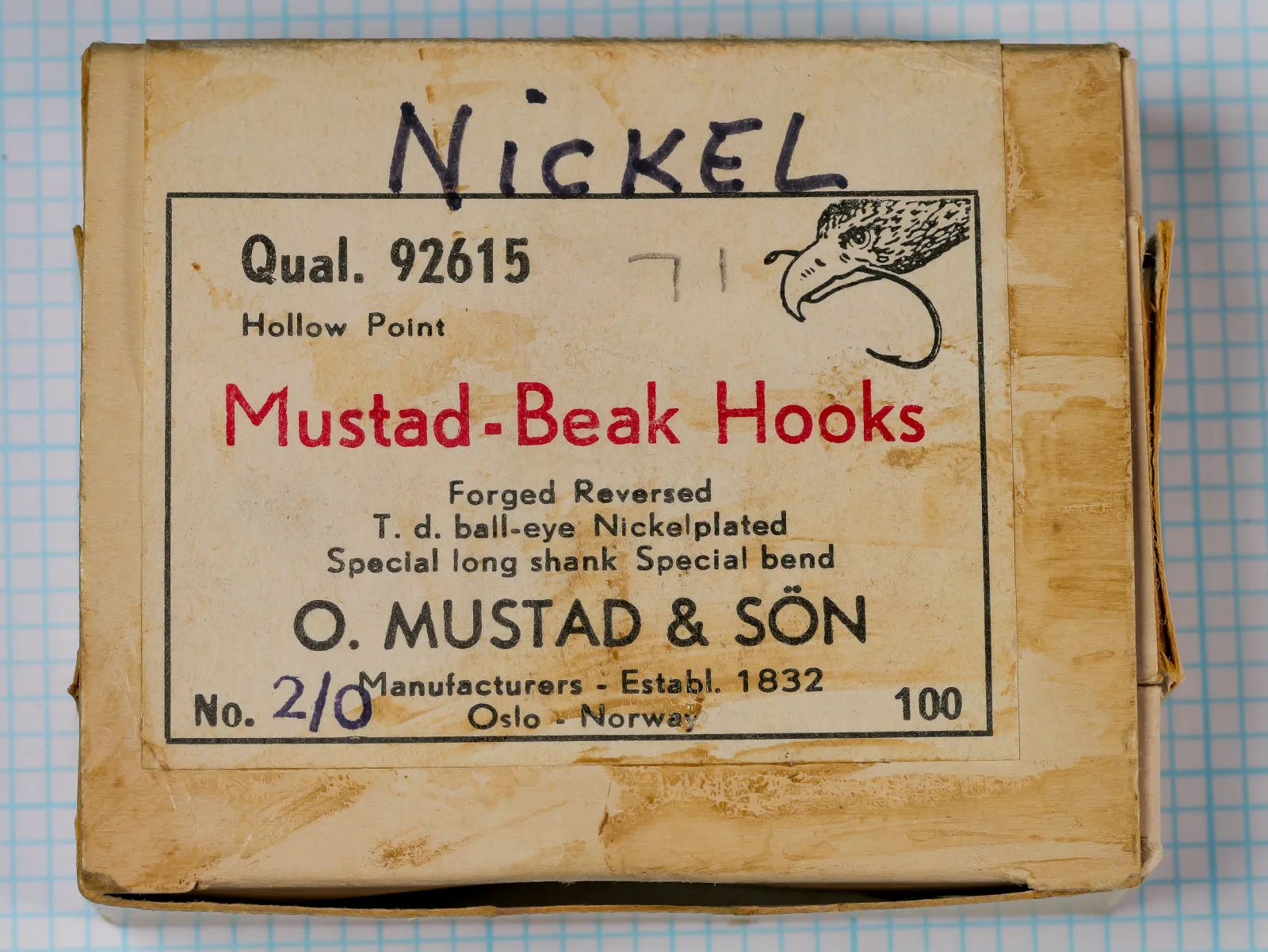
The Mustad 92615 ‘Mustad-Beak Hooks’ in size 2/0, nickelplated, represents a pre-barcode O. Mustad & Sön wholesale format from the early 1970s. The box label — with its distinctive eagle-head trademark and two-color letterpress printing — explicitly confirms every specification: Hollow Point, Forged Reversed, turned-down ball eye, nickelplated finish, and special long shank with special bend. The specimen examined retains all hooks in near-mint condition.
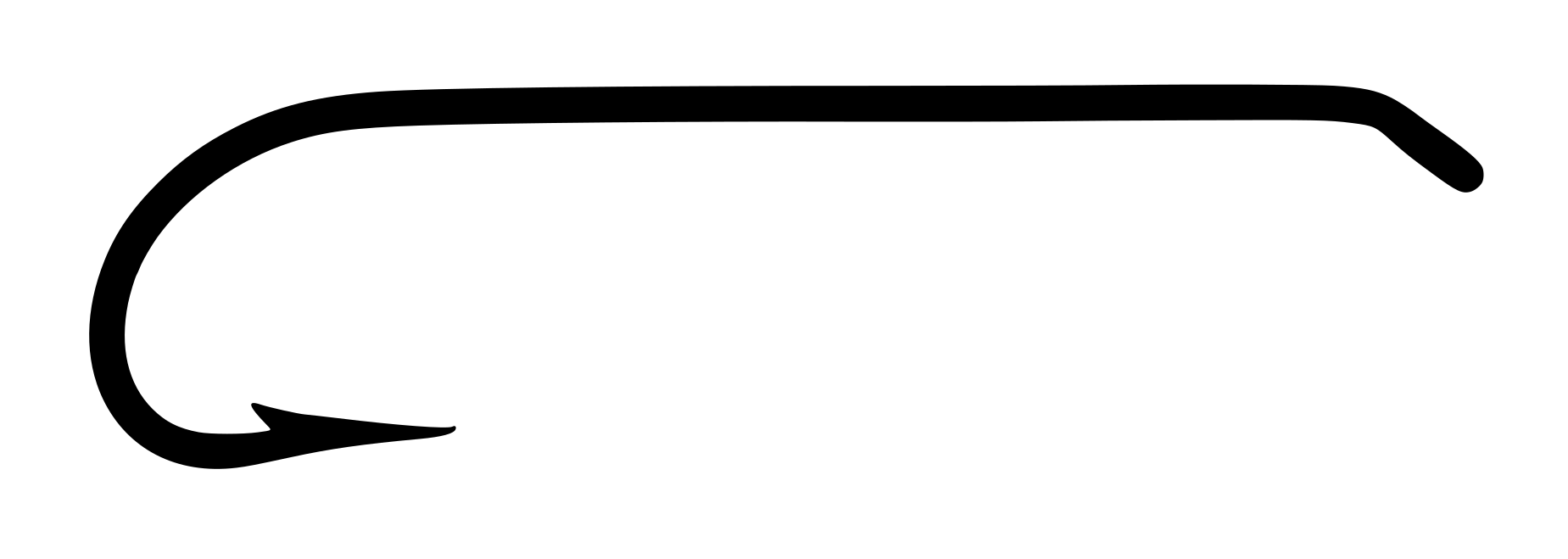
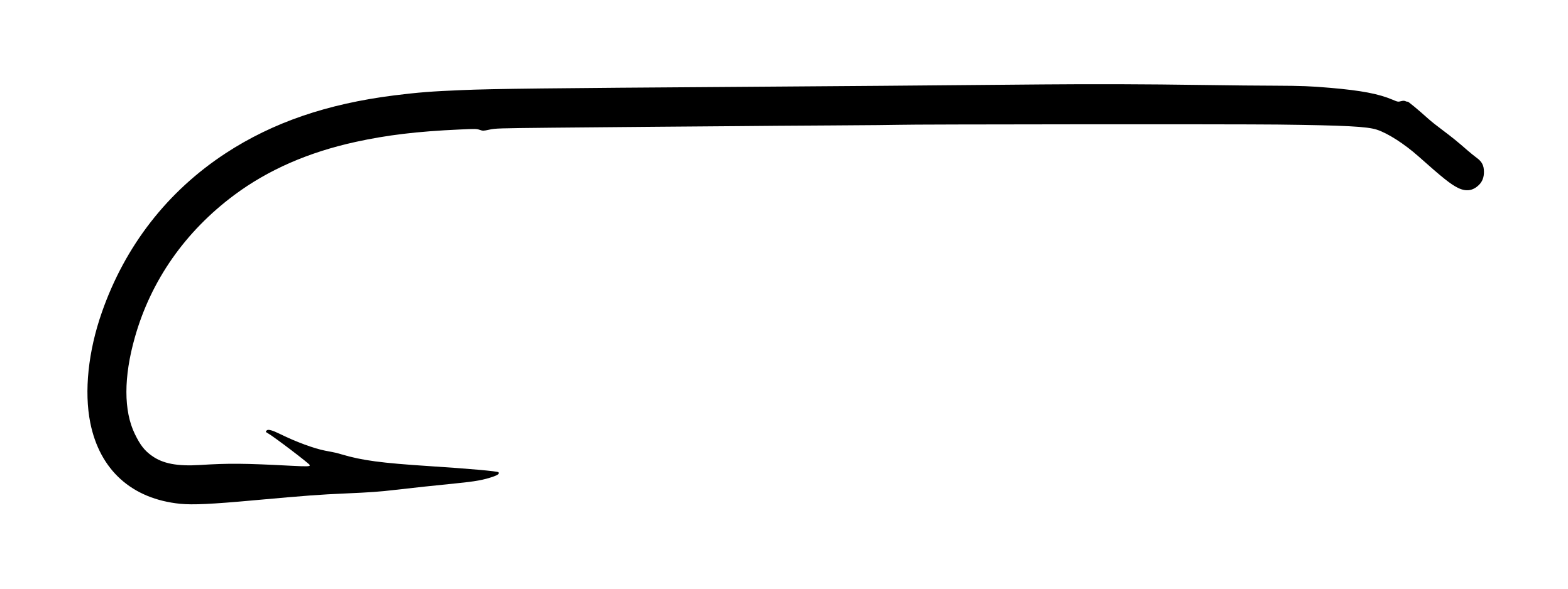
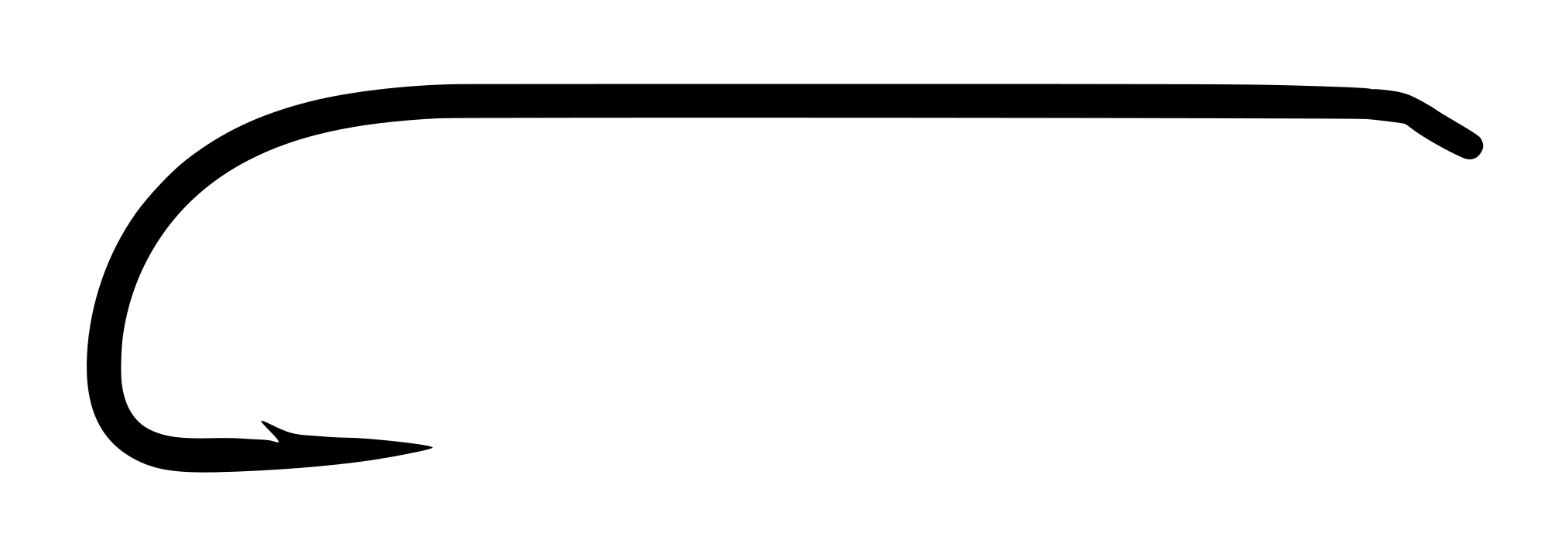
The Beak bend is a New World design with no direct Redditch antecedent, employing a continuous inward-sweeping curve that creates approximately 270° of arc — functionally maximizing the ratio of shank length to effective gap. The hollow point construction — with its concave inner surface and needle-spear termination — concentrates penetrating force at the tip while channeling tissue away from the point spine, implementing the engineering principle articulated by Pryce-Tannatt (1914) for optimal strike engagement. The forged construction, visible as lateral wire flattening at the shank-to-bend transition, adds mechanical strength for heavy-loading applications.
The pre-barcode dealer box, Norway commercial address, and letterpress label are consistent with early 1970s production. The ’71’ annotation adjacent to the quality number most likely indicates a 1971 production date or wholesale stock entry year. This is the first O. Mustad & Sön wholesale dealer cardboard slide box documented in the series, establishing a new packaging format category. The industrial discipline visible in the forging, hollow point formation, and wire consistency reflects Mustad’s manufacturing rigor — notably significant given the company’s concurrent ownership of Partridge of Redditch during a substantial portion of that factory’s production history.
O. Mustad & Sön pre-barcode wholesale dealer box top, showing two-color letterpress label with eagle-head trademark, quality number 92615, Hollow Point confirmation, Forged Reversed and turned-down ball eye specifications, and 100-count quantity. Handwritten 'NICKEL' annotation in marker pen indicates warehouse stock sorting mark.
Photographic record
3 cataloged imagesSelect any record to load it above.
3 images shown
Mustad 92615 Beak Hook Size 2/0 Nickelplated Wholesale Dealer BoxO. Mustad & Sön pre-barcode wholesale dealer box top, showing two-color letterpress label with eagle-head trademark, quality number 92615, Hollow Point confirmation, Forged Reversed and turned-down ball eye specifications, and 100-count quantity. Handwritten 'NICKEL' annotation in marker pen indicates warehouse stock sorting mark.Open originalMustad 92615 Beak Hook Size 2/0 Nickelplated Point DetailMacro photograph of the 92615's hollow point showing the distinctive concave inner surface of the beak — the defining feature of hollow point construction. The reflective nickel-plated finish shows minimal corrosion, revealing the channel-like depression along the inner face of the point, the acute-angled barb, and the needle tip in bright, mirror-like condition.Open originalMustad 92615 Beak Hook Size 2/0 Nickelplated Full ProfileFull side profile of the 92615 on measurement grid, showing the extreme shank length, continuous inward-sweeping beak bend, reversed (left) offset, turned-down ball eye termination, and the approximately 270° arc geometry that maximizes shank-to-gap ratio.Open original
Technical profile
Eye
Ball Eye, Turned DownTurned-down ball eye with closed loop formed by wire returning to make full contact with shank. Ball termination is clean and well-formed P. Functional design positions eye flush to line knot, reducing hinging under bait weight.
Wire
Fine (1X Fine), Forged, Est. ~0.90"-0.98" (~22.9-24.9 mm) E
Shank
Special Long — Plain
Bend
Beak / Reversed Point, Standard gap, Offset / kirbedContinuous inward-sweeping curve with pronounced reversed (left) offset. Point approaches shank axis in long sustained reverse arc — approximately 270° of total arc from shank drop through bend and into point. This geometry maximizes shank:gap ratio while maintaining effective gape. Reversed offset causes hook to roll left on strike P.
Point
Hollow Point (concave inner face)Standard single barb, conservatively sized at acute angle rather than aggressively perpendicular. Projects cleanly from barb base P. Eases penetration while providing adequate retention.
Finish
Nickelled / Nickel-PlatedBright reflective silver-grey nickel plate with cool undertones P. Point and bend zone display mirror-like finish in excellent condition with minimal corrosion P. Distinguishable from bronze (warm brown-gold), black Japan (deep glossy black), and chemical black (matte grey-black) by high reflectivity and white-silver color temperature.
The specimen documented here retains exceptional condition. All 100 hooks are present and bright with nickelplated finish displaying mirror-like reflectivity at the point and bend. No evidence of corrosion, patina, or use wear on hooks themselves. The original box exhibits age-appropriate patina — deep ochre tanning of cardboard, light foxing and discoloration of the label, minor oxidation of printed inks, and modest corner wear consistent with 50+ years of storage in ambient conditions. Label text remains legible; two-color printing (black and red) is intact and unfaded. No water damage, mold, or insect damage. The handwritten 'NICKEL' annotation in marker pen is a period addition (not collector markup) and is consistent with wholesale sorting practices of the era.
Forging: The laterally flattened wire cross-section at the shank-to-bend transition is the signature of die-forging — a manufacturing process where wire is struck in a shaped die to flatten and widen the critical stress zone. This hardening increases resistance to opening under heavy load, a significant advantage in a 100-hook wholesale carton intended for substantial fish species. Kelson’s 1895 endorsement of ‘long-shanked, hammered hooks — those with flattened sides’ for their ‘superior manufacture’ is the Victorian-era articulation of this same mechanical principle.
Hollow Point Construction: The concave inner surface of the point (the ‘beak’) functions as a scoop-and-drive penetrator rather than a wedge-and-push spear. During strike engagement, the concave inner face channels tissue away from the point spine while concentrating penetrating force at the needle tip. This principle — articulated by Pryce-Tannatt (1914) through H. P. Wells’s chisel analogy — optimizes the angle of impact for prompt engagement and depth of penetration.
Beak Bend Geometry: The reversed (left) offset causes the hook to roll left on the strike, presenting the point to tissue at an oblique angle that increases engagement probability in a wide mouth. The continuous sweeping curve — approximately 270° of total arc — maximizes the shank:gap ratio: the point approaches the shank plane so closely that effective gap is reduced relative to total hook length, accommodating extensive live or cut bait threading without sacrificing gap width for hooking performance.
Turned-Down Eye Rationale: In bait-hook context, the downward eye orientation positions the loop flush to the line knot, reducing hinging that can lever the hook during a fight. For snelled rigs or direct-tie applications with live worm or minnow bait, the turned-down configuration allows the hook to lie in a natural orientation relative to the line without the gape rotating under bait weight.
First O. Mustad & Sön wholesale dealer slide-box format documented in the series. First documented Beak bend family hook in the garrenwood.com catalog. Hollow point construction with confirmed concave inner surface geometry — primary source documentation via macro photograph.
Own this hook? Help us measure it.
We don't have measured sizes for this hook yet. Own one? Submit calipered measurements and we'll review and add them. Thank you!
The Mustad 92615 Beak Hook belongs to Mustad’s Beak bend family — a New World design with no direct British Redditch antecedent. The Beak represents a distinct geometric departure from classical British bend families (Limerick, Sproat, Aberdeen, Sneck) and reflects Mustad’s development of proprietary hook designs optimized for modern bait-fishing applications and large-scale commercial production.
The 92615 designation indicates the Beak bend in Mustad’s systematic model numbering scheme. The series appears in multiple configurations across the Mustad catalog: varying eye types (turned-down ball, turned-up ball, looped), shank lengths (standard, special long), and finishes (bronze, nickel, japanned). This specimen documents the ‘special long shank’ variant with turned-down ball eye and nickel finish — a premium configuration intended for professional and serious amateur bait fishers requiring extended shank capacity for live bait presentation.
Documentation of the 92615 in surviving pre-barcode wholesale dealer boxes is limited. This specimen represents the early 1970s production period and establishes baseline specifications for the model during that era. The series remained in Mustad’s catalog through subsequent decades, eventually transitioning to barcode-era packaging formats as retail and wholesale distribution standardized in the 1980s–1990s.
Era and Packaging Dating
Pre-barcode format places production before late 1980s barcode standardization. No telephone number eliminates need for PhONEday (April 1995) dating but removes precise dating tool. 'O. MUSTAD & SÖN' branding with umlaut is older Norwegian-language trading name; company progressively anglicized to 'O. Mustad & Son' for English-language markets, indicating this label is from earlier internationalization period. 'Oslo · Norway' commercial address was Mustad's standard wholesale trading address throughout mid-twentieth century (Gjøvik manufacturing site rarely cited on packaging). Two-color letterpress printing on buff card stock is consistent with post-war commercial printing practice, predating universal offset color printing. Distinctive red display type for product name is characteristic of 1950s–1970s commercial label design. '71' annotation adjacent to quality number most likely represents 1971 production date or wholesale stock entry year. Physical character of box — deep ochre tanning of board, foxing of label, ink oxidation, corner wear — entirely consistent with manufacture in early 1970s and fifty-plus years intervening storage. Synthesis places production c. 1960–1972, with 1971 as most probable date.
The Eagle and the Beak: Mustad's Visual Trademark
The eagle-head trademark on this box label performs triple duty: it is Mustad's company emblem, a guarantee of quality, and a visual pun on the Beak Hook's geometry. The inward-sweeping point of the hook resembles the lower mandible of a bird of prey, and the eagle is Mustad itself — a deliberate branding connection that reinforces both the hook's name and the company's identity in a single iconic image. When this box was produced in the early 1970s, that eagle-head symbol had appeared on Mustad packaging for over a century, making it one of the most recognized marks in the international hook trade. The fact that Mustad owned Partridge of Redditch during this period creates a hidden historical layer: the industrial manufacturing discipline visible in this 92615's forging and hollow point construction — the products of Norwegian die-forging technology and mechanical precision — was being simultaneously applied to the centuries-old Redditch tradition of craft hook-making, blending industrial scale with English artisanal heritage in ways both celebrated and controversial.
Design lineage and influence
The Beak bend family has no direct British Redditch antecedent. Classical British bends — Limerick (angular lower section), Sproat (rounded bottom with angular hybrid), Aberdeen (wide round arc), Sneck (angled offset) — all emerged from nineteenth-century Redditch craft traditions and emphasize different geometric compromises between gap width and shank length. The Beak represents a distinctly New World approach: a continuous sweeping arc that trades traditional bend symmetry for a specialized shank:gap ratio optimized for extended live-bait presentation and large-scale industrial manufacturing.
The Beak’s reversed offset places it in a design lineage with the Kirby (offset right) and other geometrically specialized bends developed for specific fishing contexts rather than general-purpose design. However, the Beak’s extreme shank length and inward-sweeping point geometry are unique — no direct competitor design from British manufacturers matches this specific configuration, suggesting that Mustad developed the Beak as a proprietary response to North American and European market demands for a specialized long-shank bait hook that combined extended shank capacity with forged construction strength.
The hollow point construction — with its concave inner surface — draws on hook-engineering principles articulated by Pryce-Tannatt and other twentieth-century writers but was implemented industrially by Mustad with the precision and consistency that only modern die-forging could achieve. British craft makers (Partridge, Allcock) produced hollow-point variants, but Mustad’s forged Beak represents a mechanized interpretation of the same principle.
Best matchRelated by Attribute
Computed automatically from catalog data — updated as new hooks are added.
Matches: Bend, Shank, Gap, Eye, Eye Orient. +6 moreDiffers: Wire: Fine (1X Fine) vs Extra-Heavy (2X+); Point: Hollow Point vs Beak / Reversed; Shank ratio: 80.3% vs 73.4% +1 more
Matches: Bend, Shank, Gap, Eye, Eye Orient. +5 moreDiffers: Wire: Fine (1X Fine) vs Heavy (1X Heavy); Finish: Nickelled vs Tinned; Application: Bait vs Saltwater, Bait +2 more
Matches: Bend, Shank, Gap, Eye, Eye Orient. +5 moreDiffers: Wire: Fine (1X Fine) vs Heavy (1X Heavy); Finish: Nickelled vs Bronzed; Application: Bait vs Bait, Streamer, Saltwater +2 more
Matches: Bend, Shank, Gap, Eye, Forging +3 moreDiffers: Wire: Fine (1X Fine) vs Heavy (1X Heavy); Eye Orient.: Turned Down vs Straight / Inline; Point: Hollow Point vs Beak / Reversed +4 more
The Mustad 92615 Beak Hook is engineered as a premium bait hook for medium to heavy freshwater and saltwater applications. The extended shank accommodates live or cut bait threading (worm, minnow, herring), while the beak geometry and hollow point optimize penetration into firm tissue. The forged construction and standard wire gauge provide the durability needed for strikes from large fish species. The turned-down eye facilitates snell or direct-tie rigging without hinging.
Secondary Applications
Pike, bass, catfish, and saltwater gamefish.
Classic Fly Patterns
Not typically used for fly tying.
Modern Equivalents
Hook
Match Quality
Notes
Mustad 92615 (modern production)
Excellent
Modern Mustad 92615 maintains bend family, special long shank, and turned-down ball eye. Finish and packaging differ; may differ in wire gauge or forging specifications.
Owner Bait Hook C32 or similar long-shank beak variants
Good
Modern beak-geometry bait hooks from other manufacturers provide functional equivalents for extended shank live-bait applications, though with different manufacturers' specifications.
Collector notes
Rated 7.0/10 for collectability. Scarcity is the primary driver — pre-barcode Mustad wholesale dealer boxes are infrequently encountered, and the 92615 Beak is a relatively specialized model within Mustad's mid-century range. Collector demand from Mustad specialists and hook historians is active and informed. The specimen's near-mint hook condition is a significant collectability premium.
Reference value
$19 – $35 USD estimate
Packaging condition
Good — moderate wear, legibleRecorded specimen
Packaging format
GW-E-02Catalog code
Positive Factors: Pre-barcode wholesale dealer box format is inherently rarer than retail single-packet cards — large cartons are less likely to survive intact. The 92615 Beak bend is a specialized design with less mass-market recognition than Aberdeen or Limerick, reducing casual catchment and increasing rarity among informed collectors. The early 1970s dating (c. 1970–1972) places this at the tail end of the pre-barcode era, making it a documented transition-period artifact. The eagle-head trademark and two-color letterpress label are iconic Mustad branding elements that appeal to industrial-design and packaging historians. The specimen’s hook condition is exceptional — bright nickel with no corrosion — a condition state that significantly exceeds typical surviving examples. Complete original box with all 100 hooks intact is a major collectability premium.
Limiting Factors: Mustad hooks, even in pre-barcode format, rarely exceed a 7.0 rating due to the company’s industrial production volumes — examples do exist and are sought, but supplies are not critically scarce. The 92615 is not a collaboration model or a named-designer pattern, reducing demand from specialists focused on pedigree. Size 2/0 is neither rare (like size 14 or 28) nor common (like size 1/0 or 6), placing it in an intermediate demand zone. The nickelplated finish is desirable but less historically significant than bronzed or japanned finishes from the same era.
Variant Desirability: The special long shank with turned-down ball eye is more desirable than standard or short shank variants. Nickelplated finish commands a small premium over bronze. Complete sealed boxes are substantially more valuable than opened cards; loose hooks are worth 20–40% of equivalent carded value.
Condition Factors: Box printing clarity, label foxing, and corner integrity are primary value drivers for the packaging. Hook finish uniformity and absence of corrosion are critical for the specimen itself. Original tissue paper (if present) or sealed condition would add 10–20% to valuation. Evidence of old use (bent or corroded hooks) deducts significantly from value.
Packaging
Pre-barcode O. Mustad & Sön wholesale dealer cardboard slide box. Two-color letterpress label (black text with red display type for product name) adhered to buff card stock. Label text: 'Qual. 92615 / Hollow Point / Mustad-Beak Hooks / Forged Reversed / T.d. ball-eye Nickelplated / Special long shank Special bend / O. MUSTAD & SÖN / Manufacturers - Establ. 1832 / No. 2/0 / Oslo - Norway / 100'. Eagle-head trademark in upper right corner. Handwritten 'NICKEL' annotation in marker pen across top. Box exhibits deep ochre tanning of board, foxing of label, ink oxidation, and corner wear consistent with 1970s manufacture and fifty-plus years storage.
Market Value Notes
Low ($19): Good condition — opened wholesale box with complete or near-complete hook count, minor box wear, hooks in very good condition. High ($35): Excellent condition — box with minimal wear, all 100 hooks present and bright, exceptional preservation of label and card stock. Premium factors: Complete 100-count dealer box, pre-barcode format, exceptional hook condition (bright nickel, no corrosion), Mustad eagle-head branding, early 1970s dating, special long shank configuration. Platforms: eBay sold data (Apr 13, 2023 – Apr 12, 2026), avg $19.60, range $7.69–$47.99. These eBay values represent primarily 1/0 size and 50-count repacked variants; the 2/0 in wholesale 100-count format commands a premium within this range. Confidence: V verified against eBay market history; note that high-end ($47.99) may represent sealed condition or exceptional completeness. Wholesale dealer boxes of 92615 are less frequently listed than retail cards, creating limited data points. Recommend confirming current market conditions via eBay completed listings before high-value transactions.
Where to Find
eBay UK and US (search 'Mustad 92615 wholesale dealer box' or 'Mustad Beak Hook vintage box'). Specialist tackle dealers focusing on vintage Mustad or pre-barcode hook stock. Tackle auctions and collector sales, particularly in North America and UK. Directly from collector networks — pre-barcode Mustad boxes are actively traded among hook historians and Mustad specialists but are not regularly stocked by retailers. Significant patience required; examples may appear irregularly or remain off-market for extended periods.
Collector's Identification Tips
Model Code: Look for ‘Qual. 92615’ on the label. This is the definitive identifier. Early wholesale dealer boxes may show only ‘92615’ without ‘Quality’ prefix.
Bend Type: The Beak is unmistakable — continuous sweeping curve with reversed (left) offset and point that approaches the shank axis in a long inward arc. Visually resembles an incomplete circle interrupted only by the shank. No other Mustad bend family has this distinctive geometry.
Point Style: Examine the inner surface of the point under magnification. The Hollow Point exhibits a clearly concave, channeled inner face — not a flat or near-flat taper. The ‘concave inner beak surface’ creates a bright, reflective channel when backlit.
Eye Type: Turned-down ball eye is recognizable by the wire curve that drops downward from the shank, then returns to form a closed loop with a ball-like termination where the wire end meets the shank. Label notation ‘T.d.’ confirms this construction.
Packaging Format: The wholesale dealer box format is rarer than retail single-packet cards in the same model. Boxes of 100 hooks are substantial and less likely to survive complete. Look for two-color letterpress label (black and red) on buff card, eagle-head trademark, and ‘O. MUSTAD & SÖN’ branding with umlaut — indicators of pre-1980s production.
Finish Verification: Nickel plate is bright, reflective, and cool-toned (silver-grey) — distinguishable from warmer bronze by color temperature and reflectivity. The handwritten ‘NICKEL’ annotation on the box top is a common wholesale sorting mark indicating nickel (vs. bronze) variant.
eBay market reference. Researcher-curated. Prices in USD. Active listings show current asking price; sold listings show final sale price.
Preservation
Storage and Preservation
Store in a cool, dry environment with stable humidity. The nickelplated finish is resistant to corrosion but benefits from moisture-free storage. Avoid exposure to acidic materials (old tissue, kraft paper without pH buffering) which can accelerate patina development.
Keep the box intact and unopened if possible — the original dealer carton is an integral part of the specimen’s historical documentation and significantly enhances collector value. If the box must be opened for examination, handle the label carefully to avoid further foxing or ink damage. Support the bottom of the carton when opening to prevent collapse of internal structure.
Do not attempt to clean or polish the hooks. Patina that develops on nickel over decades is historically authentic and should be preserved. Any attempt at restoration will damage the original finish and significantly reduce collectability.
Store away from contact with other metals to prevent galvanic corrosion. Keep in a stable temperature environment — avoid attics or basements subject to seasonal temperature and humidity fluctuation.
For long-term archival preservation, consider housing the entire box in an acid-free storage container with pH-neutral tissue padding. Detailed photography of the label, specimen hooks, and packaging markings creates a digital record should the physical specimen ever become unavailable.
Marking Analysis
Handwritten Marks and Annotations
The box top bears a handwritten annotation reading ‘NICKEL’ in marker pen, written in capital letters in a sans-serif hand characteristic of mid-twentieth-century commercial marking practice. The annotation is not a collector mark but rather a warehouse or retail stock-sorting identifier — a common practice when bronzed and nickelplated variants of the same model were stored adjacent to one another and required rapid visual identification during picking and packing operations.
The marker pen is consistent with 1960s–1970s commercial felt-tip pens; the ink tone and saturation do not suggest recent application. This notation is therefore a period original, not a later collector’s mark, and adds documentary evidence to the box’s provenance as a wholesale stock carton.
The ’71’ annotation adjacent to the quality number on the printed label is factory-applied letterpress printing, not handwritten. It most likely represents a 1971 production date or warehouse stock entry year.
Additional
Packaging Label: Primary Source Analysis
The label text reads: ‘Qual. 92615 / Hollow Point / Mustad-Beak Hooks / Forged Reversed / T.d. ball-eye Nickelplated / Special long shank Special bend / O. MUSTAD & SÖN / Manufacturers – Establ. 1832 / No. 2/0 / Oslo – Norway / 100’.
Model and Type: ‘Qual. 92615’ (Quality 92615) identifies the model code. ‘Hollow Point’ explicitly confirms the point construction — the concave inner face that is the mechanical and visual signature of this design.
Branding: ‘Mustad-Beak Hooks’ is a compound branding construction linking the manufacturer’s name directly to the hook type, subordinating the type name to the manufacturer’s identity (parallel to ‘Hardy-Hardy Favourite’ or ‘Partridge-Wilson’). The hyphen is a deliberate branding convention, not a casual separator.
Construction Specifications: ‘Forged Reversed’ confirms two distinct manufacturing features: (1) die-forging of the bend zone for mechanical strength, and (2) reversed (left) offset geometry. ‘T.d. ball-eye’ is standard industry abbreviation for ‘Turned-Down ball eye’. ‘Nickelplated’ specifies the finish application.
Shank Designation: ‘Special long shank’ and ‘Special bend’ indicate this is a non-standard configuration within the Mustad range — implying that standard (shorter) shank and standard (different) bend variants of the same model code existed in Mustad’s catalog.
Manufacturer Identity: ‘O. MUSTAD & SÖN’ is the Norwegian-language trading name with umlaut. The umlaut form is characteristic of packaging intended for international wholesale trade rather than English-language retail markets. ‘Manufacturers – Establ. 1832’ provides founding date and core identity. ‘Oslo – Norway’ is the commercial trading address (manufacturing was at Gjøvik).
Size and Count: ‘No. 2/0’ is the hook size designation. ‘100’ specifies the quantity per carton — this is a wholesale dealer format, not a retail packet.
Photographically verified — Directly observable in the photograph(s) on this page.
V
Verified by documentation — Confirmed by manufacturer catalog, spec sheet, or published reference.
I
Inferred — A logical deduction from observable or documented evidence, not directly stated.
E
Estimated — An approximation based on visual comparison, proportional analysis, or limited data.
S
Speculative — A reasoned hypothesis that cannot be confirmed from available evidence.
Unnotated claims are the compiler’s synthesis; see Sources. All photographs on garrenwood.com are taken on a measurement grid where each square equals 1/10 inch (0.1″ / 2.54 mm).