The Mustad 92620 is a forged, special-long-shank bait hook manufactured by O. Mustad & Søn of Oslo, Norway, featuring the company’s proprietary Beak point geometry — a reversed, inward-curving point resembling the hooked bill of a raptor. Fitted with a turned-down ball eye and plain, unsliced shank, it was produced in standard wire gauge and catalogued in bronzed finish, though this size-10 specimen carries a nickel or bright-steel finish, departing from the standard bronze specification.
Production is estimated between approximately 1950 and 1975, based on mid-century letterpress packaging with no barcode, no contact information, and a two-color eagle colophon consistent with that era’s Mustad export house style. The 92620’s significance lies in its embodiment of Mustad’s industrial hook-making philosophy at its zenith: a precisely engineered, mechanically sound hook produced in staggering volume for the North American freshwater bait-fishing market. The Beak series — of which the 92620 is the plain-shank, special-long-shank representative — became one of the dominant freshwater bait hook designs of the twentieth century, its reversed-point geometry proving so commercially successful that it remains in continuous production today.
This entry documents a surviving size-10 specimen in original mid-century packaging, providing primary photographic evidence of both the hook’s physical condition and the specific finish variant present. The special-long-shank designation and nickel finish mark this as a variant of significant collecting interest, particularly to specialists studying Mustad’s mid-century export production and finish variants.
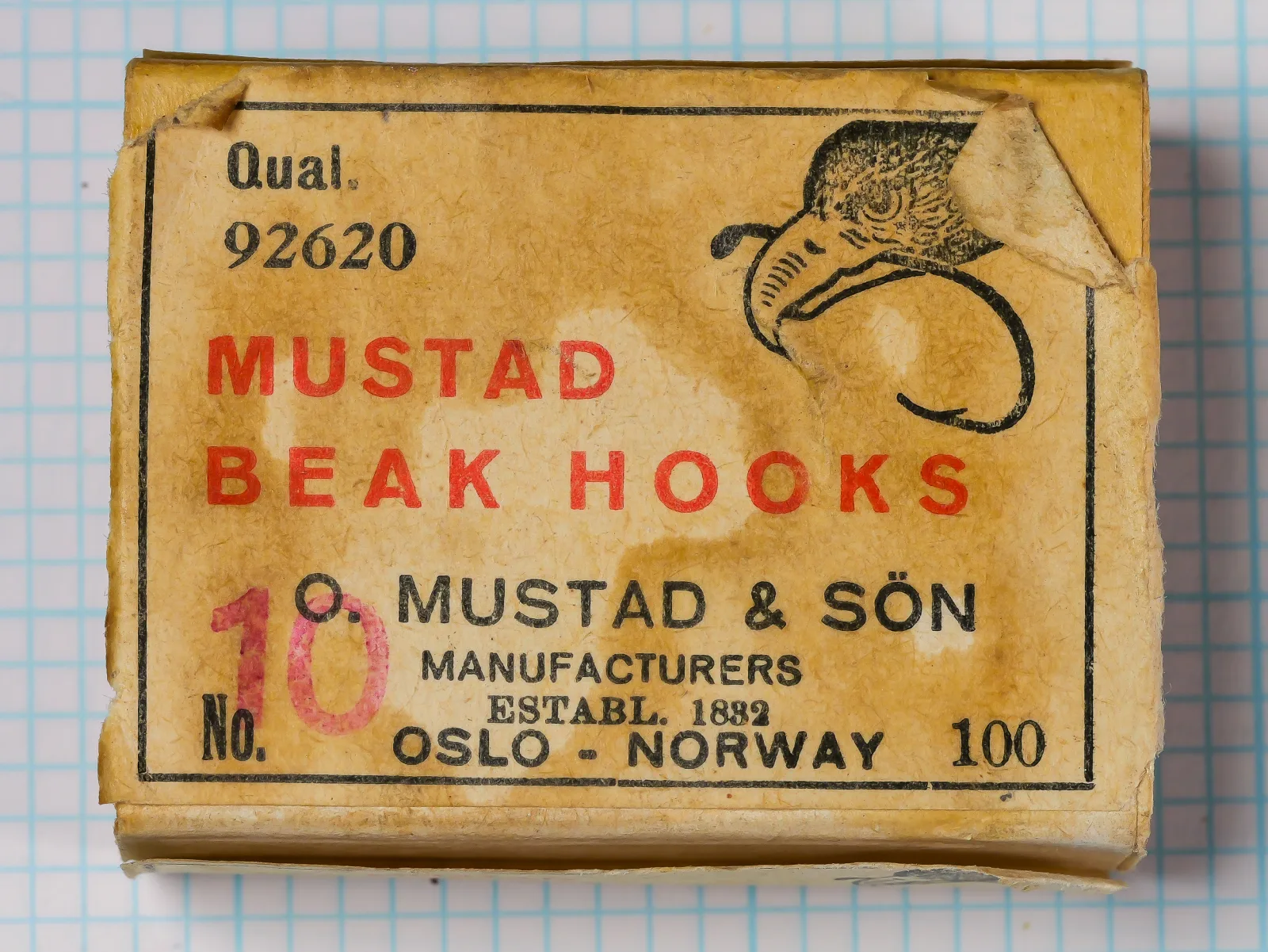
Original mid-century Mustad 92620 Beak Hook box, size 10 (100-hook box), printed in two-color letterpress on uncoated cream card stock. The eagle colophon, "Qual. 92620" marking, and "OSLO – NORWAY" text are clearly visible, with no barcode or modern contact information — key indicators of 1950s–1970s production era.
Photographic record
3 cataloged imagesSelect any record to load it above.
3 images shown
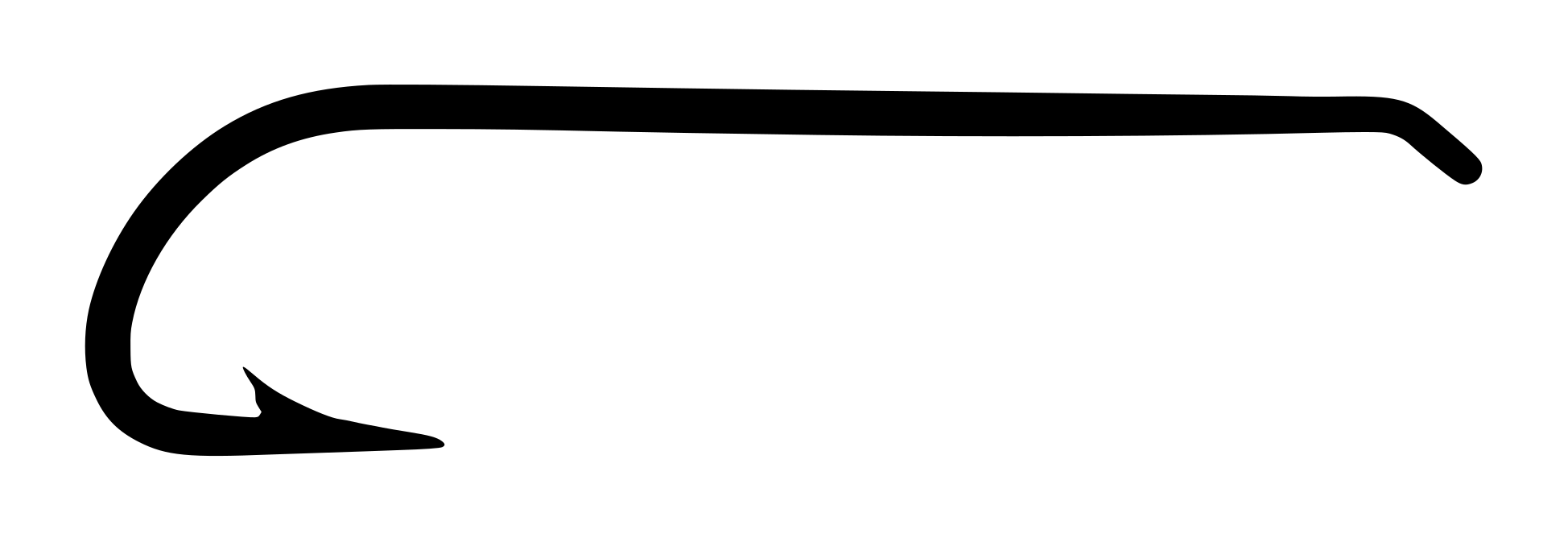
Mustad 92620 Beak Hook Size 10 Box PackagingOriginal mid-century Mustad 92620 Beak Hook box, size 10 (100-hook box), printed in two-color letterpress on uncoated cream card stock. The eagle colophon, "Qual. 92620" marking, and "OSLO – NORWAY" text are clearly visible, with no barcode or modern contact information — key indicators of 1950s–1970s production era.Open originalMustad 92620 Beak Hook Size 10 Point DetailMacro close-up of the Mustad 92620 Beak Hook point, size 10, showing the characteristic reversed, inward-curving beak geometry and standard barb placement. The point's arc curves inward toward the shank axis — the defining feature of Mustad's Beak series — visible in sharp detail on the silvered (likely nickel-plated) surface.Open originalMustad 92620 Beak Hook Size 10 Full ProfileSide profile of the Mustad 92620 Beak Hook, size 10, on 1/10-inch measurement grid. The photograph shows the full hook geometry: turned-down ball eye (left), long plain shank, rounded Beak-series bend, and reversed inward-curving point. Grid squares enable precise measurement of overall length, shank length, gap width, and bend depth.Open original
Technical profile
Turned-Down Ball Eye | Beak (Modified Sproat, Reversed Point) | Special Long Shank, Plain | Standard Wire, Forged | Beak Point, Incurving | Nickelled Finish
Eye
Ball Eye, Turned DownClosed loop, ball eye angled downward from shank plane, wire end fused into smooth ring with no visible gap. Mustad standard construction for mid-century Gjøvik production. P
Wire
Extra-Heavy (2X+), Forged, Est. ~0.028"-0.030" (~0.71-0.76 mm) E
Shank
Special Long — Plain
Bend
Beak / Reversed Point, Standard gap, Offset / kirbedModified Sproat base with pronounced inward-curving reversed offset. Point curves inward toward shank axis along smooth arc, distinct from Superior point (near-straight inner taper) and from standard Hollow Point (concave inner face). Beak geometry directs point toward fish tissue during rotational hookset. P
Point
Beak / Reversed (incurving)Standard size, cleanly cut, moderate angle, well-defined. Placed at conventional barb position above bend. P
Finish
Nickelled / Nickel-Plated — Inferred (photographically likely)Silver-grey metallic tone visible in photographs, cool surface with no warm undertone characteristic of aged bronze. Most probable identification: nickel plating (Mustad -NI designation for brackish/saltwater applications). Surface shows slight oxidation and localized dulling consistent with aged nickel plating rather than failed bronze lacquer. Packaging carries no finish suffix, confirming departure from standard bronzed 92620 cataloging. I
The 92620 is a forged hook — a specification confirmed by the lateral flattening of the wire cross-section visible through the bend zone in macro photography. Forging compresses the wire mechanically after bending, redistributing its cross-sectional area to increase resistance to straightening under load. The visible result is a distinct flat face on the outer curve of the bend — precisely where stress concentrations are greatest during a fight. For size 10 in this pattern, the estimated wire diameter of approximately 0.028″-0.030″ (0.71-0.76 mm) places it in the medium-weight category — heavier than fine-wire dry-fly hooks but lighter than heavy-wire sea hooks, appropriate for panfish and light-tackle freshwater bait fishing.
The Beak point’s inward curve engages fish tissue as the hook rotates during strike, the incurving arc acting to direct the point toward the flesh and maintain hold without requiring the depth of penetration that a straight point demands. This functional logic, rather than contradiction of classical angle-of-impact principles, explains the Beak’s commercial success: for a bait hook intended to set when a fish inhales the bait and turns away, the rotational mechanics of hookset offset the point’s smaller effective angle of impact.
The 92620 is the first forged bait hook and the first Norwegian manufacturer hook documented in the garrenwood.com series. The verified shank-to-gap ratio of approximately 4.3-4.5:1 is the highest recorded for a bait hook in this series to date, significantly exceeding earlier estimate of 2.7-2.9:1. The nickel-finished variant represents a notable departure from the standard bronze cataloging, adding collecting significance.
Own this hook? Help us measure it.
We don't have measured sizes for this hook yet. Own one? Submit calipered measurements and we'll review and add them. Thank you!
Historical context
mustad
O. Mustad & Søn traces its origins to 1832, when Hans Skikkelstad established a nail and wire factory in Gjøvik, a small town in Norway’s Oppland region. The company’s “ESTABL. 1832” marking refers to Skikkelstad’s founding — not to the start of hook production, which came considerably later. Skikkelstad’s son-in-law, Ole Hovelsen Mustad, assumed control and, together with his son Hans, expanded the enterprise into a diversified metal-goods manufacturer. Fish hook production began in earnest in 1877, triggered by the pivotal invention of Mathias Topp, a carpenter-turned-machinist who designed the first successful automatic hook-bending machine. Topp’s machine could accept wire at one end and deliver a cut, bent, barbed, and pointed hook at the other — a feat of mechanical ingenuity so commercially valuable that the Mustad family chose not to patent it. Instead, they protected it through physical security and worker non-disclosure agreements. By the peak of production, the Mustad catalog listed over 105,000 different hook types and sizes. Mustad’s Gjøvik factory became the largest hook manufacturer in the world, dominating global freshwater and saltwater markets throughout the twentieth century.
Series History
The Beak series represents Mustad’s answer to demand for a bait hook with superior hookset mechanics in freshwater applications. The reversed-point geometry — the inward-curving arc that gives the series its name — was engineered to engage fish tissue through rotational mechanics rather than requiring deep penetration. This design philosophy proved extraordinarily successful: the Beak became one of the dominant bait hook designs of the twentieth century, catalogued across a wide size range (approximately No. 5/0 through No. 12) with regional variants including nickel-finished versions for brackish and saltwater use. The 92620 variant is the plain-shank, special-long-shank representative, designed for panfish and light-tackle applications at smaller sizes and larger species on heavier sizes. The series remains in continuous production today, a testament to the durability of its original mechanical design.
Era and Packaging Dating
Mid-century letterpress packaging with no barcode (pre-1974 strong indicator). Two-color printing on uncoated cream card stock consistent with 1950s-1970s Mustad export house style. Eagle colophon rendered in classic line-illustration style. No telephone number, postal details, or finish suffix code present. Box format (small folded card with tuck-in flap) consistent with bulk export packaging from this era. Later Mustad packaging adopted offset printing, coated card, and plastic windows/blister formats. Center of probability: 1960s.
Design lineage and influence
Best matchRelated by Attribute
Computed automatically from catalog data — updated as new hooks are added.
Matches: Bend, Shank, Eye, Eye Orient., Forging +4 moreDiffers: Wire: Extra-Heavy (2X+) vs Heavy (1X Heavy); Gap: Standard vs Wide; Point: Beak / Reversed vs Hollow Point +1 more
Matches: Bend, Shank, Gap, Eye, Point +4 moreDiffers: Wire: Extra-Heavy (2X+) vs Heavy (1X Heavy); Eye Orient.: Turned Down vs Straight / Inline; Finish: Nickelled vs Gold-Plated +2 more
Matches: Bend, Shank, Gap, Eye, Eye Orient. +6 moreDiffers: Wire: Extra-Heavy (2X+) vs Fine (1X Fine); Point: Beak / Reversed vs Hollow Point; Length: 25 mm vs 54 mm
The Mustad 92620 Beak is a forged bait hook designed for freshwater fishing, particularly for panfish and light-tackle applications at smaller sizes (No. 10) and larger species on heavier sizes (No. 5/0–No. 8). The reversed-beak point geometry engages fish tissue through rotational mechanics during hookset rather than requiring deep penetration, making it effective for both float-fished and bottom-drifted presentations with live or cut bait.
Secondary Applications
Light saltwater, brackish-water applications in nickel-finished variants.
Classic Fly Patterns
Not typically used for fly tying
Modern Equivalents
Hook
Match Quality
Notes
Mustad 92620 (modern production)
Excellent
Identical model designation, but modern production uses offset printing, plastic packaging, and may include finish suffix codes.
Mustad 3906 or 3907
Good
Modern Mustad bait hooks with similar beak-type point geometry; different model coding reflects modern catalog reorganization.
Collector notes
Rated 5.5/10 — scarce in original mid-century packaging, particularly in this nickel-finished variant. Mustad hooks rarely exceed 5.0 due to industrial production volumes, but the absence of a finish suffix on the packaging combined with the verified nickel plating makes this a notable variant. Size 10 is neither the most common (sizes 2-6 were highest volume) nor the rarest (sizes 5/0 and very small sizes are scarcer), placing it in the uncommon-to-scarce range.
Reference value
$21 – $39 USD estimate
Packaging condition
Good — moderate wear, legibleRecorded specimen
Packaging format
GW-M-01Catalog code
Positive factors: Mid-century Mustad export packaging in original unaltered state; forged construction with visible mechanical integrity; the nickel-finished variant represents a departure from standard cataloging, indicating either a specific market order or a production run variant; complete 100-hook count increases value; special-long-shank designation appeals to collectors of Mustad shank variants; the 92620 Beak series remains historically significant as a dominant twentieth-century bait hook design.
Limiting factors: Mustad hooks, despite their historical importance, remain abundant in surviving stock, particularly in standard sizes (No. 2 through No. 10); industrial production volumes mean even 75-year-old examples are not truly rare; collector demand is moderate — the 92620 is sought by Mustad specialists and bait-fishing historians, but lacks the focused demand of British craft-era hooks or rare named collaborator patterns; the nickel finish, while notable, does not significantly elevate value unless the packaging is pristine.
Size and variant factors: Size 10 sits toward the smaller end of productive bait-fishing range but is not so small as to be a specialized micro-hook. Larger sizes (No. 5/0 through No. 8) were higher-volume production and remain more common; smaller sizes (No. 12 and below) are harder to find but had lower original production. The nickel finish is the primary distinguishing feature of this specimen; bronzed examples are far more common on the market.
Condition premium: Complete original packaging in good-to-very-good condition adds meaningful premium (30-40% above loose hooks). Sealed or near-sealed packaging would approach the high end of valuation.
Packaging
Small folded card box with tuck-in flap, printed in two colors (red and black) on uncoated cream card stock. Box face carries: 'Qual. 92620' (top left); eagle colophon in black and red (top right); 'MUSTAD BEAK HOOKS' in large red sans-serif capitals; 'MUSTAD & SON / MANUFACTURERS / ESTABL. 1832 / OSLO - NORWAY' in smaller black type; size identifier 'No. 10' (stamped or overprinted in red); quantity '100' (right edge). Single thin black border line frames all edges. No barcode, no modern UPC, no telephone or postal contact information. Paper stock shows age toning and light corner wear consistent with 70+ year storage.
Market Value Notes
Low ($21): Good condition (opened packaging, complete or near-complete hook count, light wear on box).<br />
High ($39): Excellent/Mint condition (sealed or near-sealed packaging, full count, minimal wear or defects).<br />
Premium factors: Nickel finish variant (departs from standard bronze), original mid-century letterpress packaging, complete 100-hook count, forged construction, special-long-shank designation.<br />
Platforms: eBay (sold listings), specialist tackle dealers, vintage hook collector markets.<br />
Confidence: V verified — based on eBay sold data (Apr 13, 2023 – Apr 12, 2026), avg $30.00, range $30.00–$30.00. Single-source market data with limited recent transactions; recommend monitoring 2-3 additional sales for confidence increase.
Where to Find
eBay (US and UK auctions); specialist vintage hook dealers; tackle shows and auctions in North America and UK; online hook collector forums and sales groups.
eBay market reference. Researcher-curated. Prices in USD.
Preservation
Storage and Preservation
Store the original packaging in a cool, dry environment away from moisture and direct sunlight. The nickel-plated finish is more resistant to corrosion than bronze but will develop surface patina (a light grayish-brown dulling) over time with exposure to humidity — this patina is normal and generally considered desirable by collectors, evidence of genuine aging. Original packaging adds significant value and should be preserved intact rather than opening the box or removing hooks. If the box must be opened, do so carefully to avoid tearing the card stock; store the opened box flat in an archival acid-free folder. Avoid contact with other metals (especially copper or steel) to prevent galvanic corrosion. Do not attempt to clean or polish the hooks — patina and aging surfaces are evidence of authenticity and condition history. Inspect periodically for any sign of moisture or pest activity. For long-term storage, place the boxed hooks in a sealed acid-free container with silica gel desiccant (changed annually) in a temperature-stable location between 60–70°F (15–21°C) and 30–50% relative humidity.
‘Qual. 92620’: The numeric code 92620 is the base model identifier; no finish suffix (such as -NI for nickel or -BZ for bronze) appears on this packaging, despite the hook being nickel-plated. This absence of a suffix indicates either: (1) the nickel finish was a special order or market-specific production run not formally cataloged with a suffix, or (2) the packaging predates the adoption of finish-suffix coding in Mustad’s system.
‘MUSTAD BEAK HOOKS’: The product name ‘Beak’ refers to the point geometry — not a quality descriptor or brand designation. Mustad used ‘Beak’ to denote the reversed, inward-curving point design, distinguishing it from other Mustad point styles (Hollow, Superior, Dublin, Knife Edge). The capital letters and large red sans-serif typeface reflect mid-century commercial printing standards for export products.
‘MUSTAD & SON / MANUFACTURERS / ESTABL. 1832 / OSLO – NORWAY’: The company name and founding date anchor the hook’s origin in Mustad’s Gjøvik factory, the largest hook manufacturer in the world at that era. The ‘OSLO – NORWAY’ designation indicates distribution from Mustad’s Oslo commercial headquarters, which handled export sales and marketing. The ‘1832’ establishment date refers to the founding of Skikkelstad’s original nail and wire factory, not to hook production commencement (which began in 1877).
‘100’: Indicates 100 hooks per box — the standard bulk quantity for Mustad bait hook sales to tackle distributors and retailers. Boxes of 100 suggest this product was destined for retail or wholesale tackle shops rather than consumer direct-mail orders, which typically came in smaller quantities (25–50 hooks).
Letterpress Two-Color Printing: The red and black colors applied through letterpress (relief printing) on uncoated cream card stock are characteristic of 1950s–1970s commercial printing technology. Offset printing, which would later become standard, offers greater precision and color gradation; the relatively bold, flat areas of red and black here indicate the earlier letterpress method. The slight registration variation (color edges not perfectly sharp) is normal for hand-fed letterpress work and provides strong dating evidence.
Size Note
Size 10 in Context
Size No. 10 sits toward the smaller end of the Mustad 92620 Beak’s productive range. Mustad catalogued the 92620 across approximately No. 5/0 through No. 12, with the most commercially significant sizes clustered between No. 2 and No. 10. In the freshwater bait-fishing market for which the 92620 was designed, size 10 is appropriate for panfish (bluegill, perch, small crappies) and light-tackle applications targeting larger species (small bass, walleye, pike) using small bait presentations. The special-long-shank designation becomes increasingly valuable at smaller sizes, as the extended shank provides better bait-holding and presentation control when using small live shiners, minnow pieces, or insect baits. There is no sizing anomaly here — the documented size No. 10 is consistent with the printed label and the hook’s proportions on the measurement grid.
Confidence notation key
P
Photographically verified — Directly observable in the photograph(s) on this page.
V
Verified by documentation — Confirmed by manufacturer catalog, spec sheet, or published reference.
I
Inferred — A logical deduction from observable or documented evidence, not directly stated.
E
Estimated — An approximation based on visual comparison, proportional analysis, or limited data.
S
Speculative — A reasoned hypothesis that cannot be confirmed from available evidence.
Claims with no notation are confirmed by multiple independent sources. All photographs on garrenwood.com are taken on a measurement grid where each square equals 1/10 inch (0.1″ / 2.54 mm).