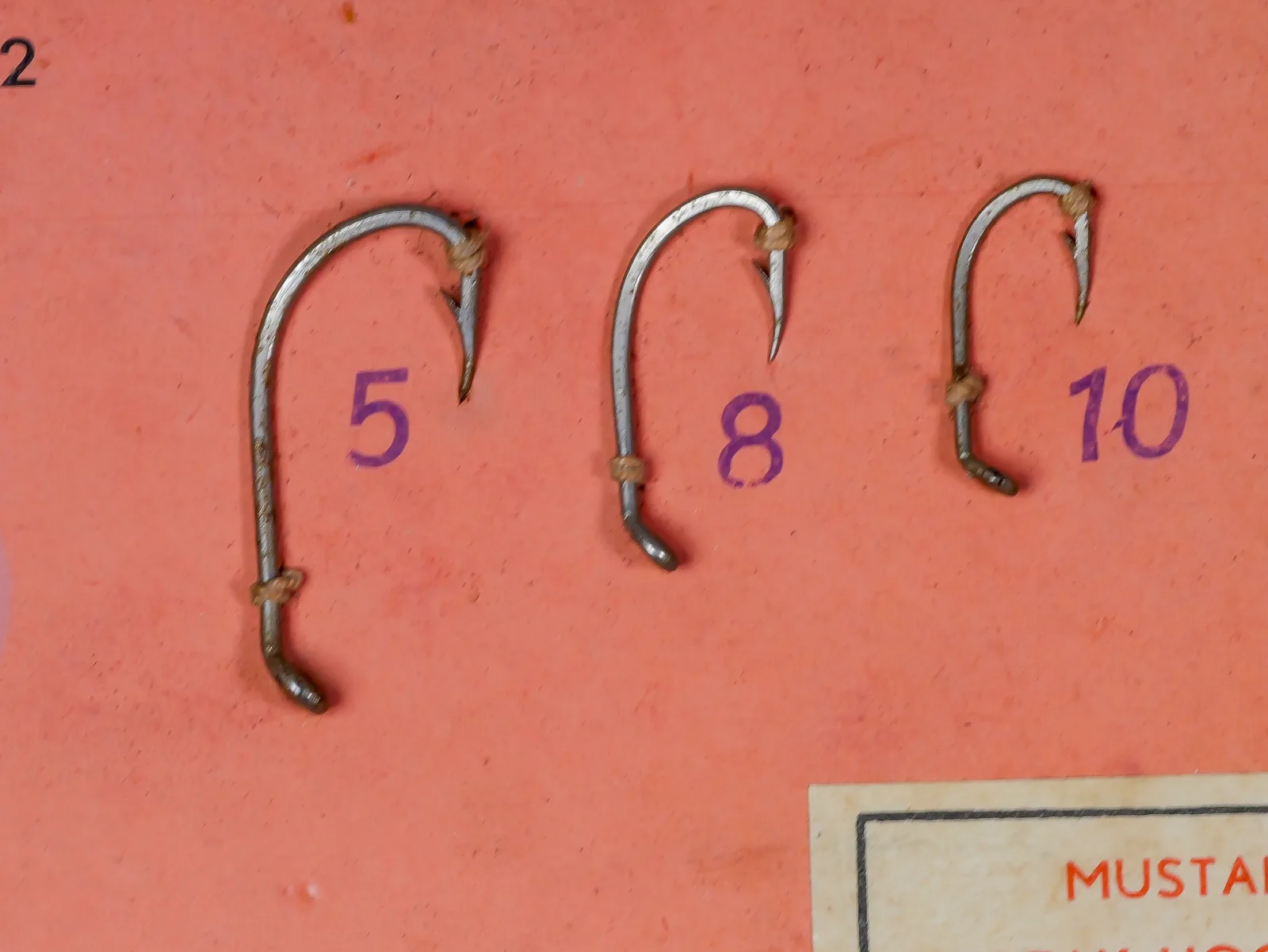
The Mustad 92626 is a heavy-duty beak or octopus hook manufactured by O. Mustad & Søn in Norway during the 1950s–1960s. Finished in bright nickel plate, this hook was designed for saltwater bait fishing and inshore species work. The defining feature is its reversed (offset) beak bend combined with a special long shank and hollow point, creating a hook optimized for securing live and cut baits while achieving reliable hook-ups through the offset geometry.
The Key Brand packaging and Oslo–Norway address strongly indicate mid-century production, before Mustad’s global expansion and packaging redesign in the 1970s. The nickel-plated version (92626) was paired with a bronzed variant (92625) in the same series, allowing anglers to choose finish based on target species and water conditions. This is a working hook with solid collector appeal among vintage tackle enthusiasts, particularly those interested in Scandinavian manufacturing or pre-modern saltwater tackle.
Three sizes of the Mustad 92626 beak hook showing the distinctive reversed offset point and small turned-down ball eye, photographed on 1/10-inch measurement grid for accurate scale reference.
Photographic record
3 cataloged imagesSelect any record to load it above.
3 images shown
Mustad 92626 Beak Hook Sizes 5, 8, 10 NickelplatedThree sizes of the Mustad 92626 beak hook showing the distinctive reversed offset point and small turned-down ball eye, photographed on 1/10-inch measurement grid for accurate scale reference.Open originalMustad 92626 Sales Card Label SpecificationsOriginal sales card label for Mustad 92626 showing Key Brand logo, model number, hollow point specification, and all technical details: 'Forged Reversed / T.d. small ball-eye Nickelplated / Special long shank / Special bend / Made in Norway.'Open originalMustad 92626 Sales Card Full DisplayComplete sales card display for Mustad beak hooks showing multiple variants and size specimens mounted on the front, including the 92625 (bronzed) and 92626 (nickel) quality labels, decorative border, and company header 'O. Mustad & Søn - Fishhook Manufacturers, Established 1832.'Open original
Technical profile
Mustad 92626 — Turned-Down Small Ball Eye, Beak Bend, Special Long Shank, Heavy Forged Wire, Hollow Point, Nickelled Finish
Eye
Ball Eye, Turned DownTurned-down (T.d.) small ball eye with minimal wire wrapping. The ball is moderately sized, typical of Mustad production from this era. Eye is cleanly formed and shows good wire-set alignment. P
Wire
Heavy (1X Heavy), Forged, Est. ~0.035"-0.042" (~0.89-1.07 mm) E
Shank
Special Long
Bend
Beak / Reversed Point, Standard gap, Offset / kirbedDistinctive reversed (offset) beak bend with the point angling to the right when viewed from above, characteristic of the octopus/beak hook design. Bend geometry is smooth and symmetrical with moderate depth. Wire remains round and unwrinkled through the bend, indicating quality forging. The offset point is intentional design feature, not manufacturing defect. P
Point
Beak / Reversed (incurving)Small, closely-cut barb positioned above the point at a moderate angle. Barb is proportional to the heavy wire gauge and is cleanly formed without deformation. Single barb is standard for this hook model. P
Finish
Nickelled / Nickel-Plated — Confirmed (stated on packaging)Bright nickel-plated finish showing characteristic warm silver-gray tone typical of mid-century Mustad production. Specimen shows minor toning and light surface oxidation consistent with age and storage, but nickel coating remains intact and reflective. Original finish is distinctly brighter and cooler in tone than the bronzed variant (92625) visible on the same card. P
Specimen hooks on card are bright and free of significant corrosion or damage. Nickel plating is intact. Card shows moderate toning and age-related paper discoloration consistent with 1950s–1960s stock, but is structurally sound with all text clearly legible. Some hooks may be missing from incomplete cards; count specimen before purchase.
The hollow point is a manufacturing specification, not a quality descriptor. It refers to the concave grind of the inner face of the point, creating a knife-edge effect that produces extreme sharpness and superior penetration. This geometry reduces the force required to drive the point through scales and cartilage compared to a standard spear point with a flatter inner face. Mustad adopted the hollow-point specification as a direct competitive response to high-end English manufacturers like Redditch makers, who had long emphasized point sharpness as a premium feature.
The forged wire profile (slightly flattened cross section) adds structural strength compared to round wire of equivalent diameter. This allows the hook to maintain its integrity under heavy loads from large baits, struggling fish, and saltwater environment stresses. The heavy wire gauge combined with forging creates a robust hook capable of handling substantial live baits and powerful species.
The reversed (offset) point is an intentional design feature, not a manufacturing defect. When the hook is in the fish’s mouth, the offset geometry causes the point to angle inward toward the jaw corner, increasing penetration likelihood and reducing slippage. This was a primary selling point for beak hooks in the early-to-mid 20th century and remains a functional advantage in bait fishing applications.
The special long shank accommodates substantial baits—live eels, mullet, squid strips—without crowding the barb and point. The longer shank also reduces leverage stress on the bend during vigorous fish fights, distributing force more evenly across the hook structure.
Size & scale lab
Selected size
(unspecified)
Physical specimen
Shank Length
42.6 mmE
Gap Width
17.8 mmE
Bend Depth
29.9 mmE
Weight
Not available
Shank-to-Gap Ratio
~2.3:1
Confidence
P
Physical specimen
Grid-derived from photograph (1/10" grid)
Own this hook? Help us measure it.
We don't have measured sizes for this hook yet. Own one? Submit calipered measurements and we'll review and add them. Thank you!
Historical context
mustad
O. Mustad & Søn (O. Mustad & Son) was founded in 1832 in Gjøvik, Norway, and by the mid-20th century had become the world’s largest industrial manufacturer of fishing hooks. The company’s rise to dominance was driven by the invention of the Mustad Hook Machine by Mathias Topp, which allowed mass production of consistent, high-quality hooks at a scale English craftsmen could not match. By the 1950s, Mustad operated the Gjøvik factory as a global industrial hub, exporting to tackle shops and distributors across North America, Europe, and beyond.
The Key Brand trademark—featuring a distinctive skeleton key logo—was Mustad’s primary international brand identity from approximately the 1930s through the early 1970s. This branding appeared on sales cards, boxes, and promotional materials distributed worldwide. The packaging cited Norway’s location prominently (‘Oslo–Norway’ on cards, ‘Made in Norway’ as a standard marking), reflecting Mustad’s strategic emphasis on Scandinavian manufacturing quality as a competitive differentiator against English makers and later Japanese competitors.
By the 1960s, Mustad had begun a strategic shift toward global expansion and modernized packaging design. The eventual retirement of the Key Brand and transition to more contemporary labeling reflected broader changes in the fishing tackle market and Mustad’s positioning as a modern, industrial manufacturer rather than a regional specialty maker. The 92626 beak hook represents the final generation of hooks marketed under the Key Brand identity.
Series History
The Mustad Beak Hook series, marketed as ‘Mustad-Beak Hooks,’ was a dedicated line within the company’s saltwater and specialist bait hook catalog. The beak bend design—featuring a reversed, offset point—originated in the early 1900s as a significant innovation in hook geometry. The offset point was engineered to catch the corner of the fish’s jaw rather than penetrating straight through, improving hook-up rates and fish retention.
The 92625 (bronzed) and 92626 (nickel-plated) variants represented the standard commercial offering of this pattern during the 1950s–1960s. The special long shank and special bend were consistent specifications, indicating these hooks were offered as a standardized product line rather than custom orders. The hollow-point finish (concave inner face) further distinguished the beak hooks from simpler, less-specialized patterns in Mustad’s catalog.
This series remained in production through the 1970s but was eventually superseded by modernized designs and different marketing strategies. The specific Key Brand packaging visible on this specimen represents the mid-to-late iteration of the beak hook’s commercial life before Mustad transitioned to updated packaging and branding systems in the 1970s. No broader series context beyond the Beak Hook line is documented.
Era and Packaging Dating
Key Brand logo with skeleton key graphic: Primary indicator of 1930s–1970s production, with peak usage c. 1950s–1960s. Address 'Oslo–Norway' printed on label, no postal code or full address: Consistent with mid-century Mustad packaging before detailed address information became standard. Absence of barcode: Strong indicator of pre-1974 production. Letterpress and offset lithography print method on cardstock: Typical of 1950s manufacturing; modern alternatives (digital printing) were not commercially available. Paper color and aging pattern: Moderate yellowing of cream-colored label stock consistent with natural aging over 60+ years of storage. Decorative border and typography style: Art Deco/geometric styling typical of 1950s product packaging design.
The Reversed Point Revolution
The beak hook's reversed point design revolutionized saltwater fishing in the early 1900s by solving a critical problem: standard straight-pointed hooks would often slide free from a fish's mouth during the fight. The offset geometry forces the point inward toward the jaw corner, creating a mechanical advantage that dramatically improved hook-up rates. Mustad's industrial scale allowed them to produce millions of beak hooks at prices that undercut hand-made English specialists, democratizing what had been an expensive specialty tool. By the 1950s, nearly every salt-water angler in North America carried beak hooks in at least one size.
Design lineage and influence
The beak or octopus hook design predates the Mustad 92626 by several decades. Early versions appeared in the late 1800s among English Redditch makers experimenting with offset-point geometry. The concept gained wider adoption in the early 1900s as American anglers discovered its advantages for live-bait saltwater fishing. Mustad’s contribution was not invention but perfection and mass production: the company industrialized the design and made it affordable to working anglers.
The hollow-point grind represents a separate lineage of competitive innovation driven by English makers’ emphasis on point sharpness. As Mustad expanded globally, the company adopted and standardized hollow-point specifications to compete with premium English hooks. The combination of reversed offset + hollow point + forged wire on the 92626 represents the mid-20th-century synthesis of these innovations.
Modern successors include the Mustad 92261 UltraPoint (a modernized beak hook with contemporary point grinding) and various Japanese manufacturers’ long-shank octopus patterns. The Gamakatsu L11S-3H is a commonly cited modern equivalent, though contemporary hooks typically feature slightly finer wire and sharper point profiles optimized for modern barbed vs. barbless regulations.
Best matchRelated by Attribute
Computed automatically from catalog data — updated as new hooks are added.
Matches: Bend, Shank, Gap, Eye, Point +3 moreDiffers: Wire: Heavy (1X Heavy) vs Extra-Heavy (2X+); Eye Orient.: Turned Down vs Straight / Inline; Finish: Nickelled vs Bronzed +1 more
The Mustad 92626 was designed primarily for saltwater bait fishing and inshore gamefish work. The special long shank accommodates substantial live baits—particularly sand eels, mullet strips, and squid—while the reversed beak bend geometry ensures the point catches the corner of the fish’s jaw rather than sliding free. The nickel-plated finish resists corrosion in salt water and presents a bright, attractive appearance in bait work. Typical applications included striped bass, bluefish, weakfish, and other inshore Atlantic species during the mid-20th century.
Secondary Applications
Freshwater bait fishing for large catfish and pike; general utility long-shank bait hook.
Modern Equivalents
Hook
Match Quality
Notes
Mustad 92261 UltraPoint Beak
Very Good
Direct modern successor, same beak bend and long shank, updated point grind and wire profile, still in production.
Gamakatsu L11S-3H
Good
Long-shank octopus pattern with offset point, modern Japanese manufacturing, finer wire than vintage Mustad, slightly sharper point.
Owner SSW Offset Octopus
Good
Contemporary offset octopus hook, similar shank length and reversed point geometry, modern barless option available.
Collector notes
Rated 4.5/10 — Uncommon and collectible among vintage tackle specialists, particularly those interested in mid-century Scandinavian manufacturing and saltwater heritage. Key Brand packaging variants and the nickel-plated finish add modest collector premium. Availability is irregular; full cards in good condition command $12–28 depending on size and packaging integrity. Not rare enough to dominate collector demand, but substantive enough to justify seeking specific examples.
Reference value
$12 – $28 USD estimate
Packaging condition
Good — moderate wear, legibleRecorded specimen
Packaging format
GW-M-CARD-01Catalog code
What makes this hook collectible: The Key Brand packaging is a significant historical marker of Mustad’s mid-century international identity. The nickel-plated finish and special beak bend construction represent purposeful engineering choices for saltwater work, which appeals to anglers and historians interested in the development of fishing tackle specialization. Complete original sales cards showing multiple sizes (1, 5, 8, 10) are more desirable than loose hooks. The pairing of bronzed (92625) and nickel (92626) variants on the same card provides educational value to collectors studying finish choices and their functional rationale.
Limiting factors: These hooks were mass-produced and distributed globally; Mustad’s industrial scale means surviving examples are relatively abundant compared to hand-made English specialty hooks. The 92626 does not represent an exceptionally rare size or finish variant. Larger sizes (8, 10) remain more common than smaller sizes (1, 5), limiting upside collectability for complete-size-range cards. Many surviving cards show significant wear, missing hooks, or faded printing, which reduces premium value.
Most desirable variants: Sales cards featuring all four documented sizes (1, 5, 8, 10) in mint or excellent condition command the highest premiums. Cards with intact original tissue wrapping or sealed envelopes add 20–30% to base value. Smaller size variants (sizes 1 and 5) are genuinely less common and worth seeking. Paired cards showing both 92625 (bronzed) and 92626 (nickel) variants are particularly collectible for their documentary value.
Condition factors: Card structural integrity is critical—bent, torn, or severely stained cards lose significant value even if all hooks are present. Missing hooks reduce value by approximately $2–5 per hook (proportional to card total count). Printing clarity is secondary to hook count; faded labels are acceptable provided text remains legible. Nickel plating on hooks themselves should be intact and reflective; significant corrosion or flaking indicates poor storage and reduces appeal.
Packaging
Cardstock sales card (approximately 3" × 5") with orange-red background. Centered label (cream-colored cardstock, black printing) reads: 'Key Brand [key logo] Qual. 92626 / Hollow Point / Mustad-Beak Hooks / Forged Reversed / T.d. small ball-eye Nickelplated / Special long shank / Special bend / Made in Norway.' Verso shows multiple smaller product labels and hook specimens mounted in rows. Decorative border printed on card margin. Paper stock is typical machine-made 1950s cardboard with moderate yellowing. Print method is offset lithography. Hooks are secured with paper wrapping or staples. No barcode present (consistent with pre-1974 dating).
Market Value Notes
Low ($12): Good condition — opened card, light wear, 90–100% of hooks present, readable packaging, minor toning.<br />
High ($28): Excellent condition — sealed or complete, all hooks present, minimal packaging wear, bright nickel finish on hooks.<br />
Premium factors: Sealed original packaging, complete size range (1, 5, 8, 10), paired variant cards (92625+92626), intact tissue wrapper.<br />
Platforms: eBay, vintage tackle dealers, regional tackle fairs (New England, Mid-Atlantic).<br />
Confidence: E estimated — Limited eBay sold listings specific to 92626; estimate derived from comparable Mustad Key Brand sales cards and beak hook patterns from similar era.
Where to Find
eBay (search 'Mustad 92626' or 'Mustad Beak Hook Key Brand'); regional vintage tackle dealers in the Northeast US; online hook retailers specializing in vintage stock; occasional appearance at fishing tackle auctions and ephemera shows. Complete cards are less frequent than isolated examples; patience and periodic searching required.
Preservation
Storage and Preservation
Store the Mustad 92626 in a cool, dry environment away from direct moisture and humidity. The nickel-plated finish is highly resistant to corrosion compared to bronzed hooks, but prolonged exposure to salt spray or high humidity can cause base-metal oxidation beneath the coating. Maintain the hooks on the original sales card whenever possible; the cardstock provides structural protection and the card itself has historical and collectible value that loose hooks lack.
If the card is opened or damaged, consider archival storage in a closed, acid-free box with silica-gel desiccant packets to control moisture. Avoid storing near maritime areas, basements, or attics subject to temperature fluctuations and humidity swings. Do not use the hooks from valuable cards; acquire a separate fishing-use specimen if you intend to tie or fish with this pattern.
Nickel plating can be gently cleaned with a soft, dry cotton cloth if surface dust accumulates, but avoid harsh chemical polishes or abrasive materials. Original patina and aging characteristics are desirable to collectors; resist the temptation to restore or ‘brighten’ vintage examples. The card printing and paper stock are vulnerable to water damage and UV fading; store in a closed drawer or cabinet rather than on open display shelves.
Marking Analysis
Handwritten Markings and Ink Stamps
The specimen card shows handwritten purple numerals marking size variants: ‘5,’ ‘8,’ and ’10’ written directly on the card background adjacent to the corresponding hook specimens. These appear to be collector’s annotations or size identifiers added after the card entered collection, not original factory markings. The handwriting is consistent and deliberate, suggesting careful cataloging by a single individual, likely a tackle historian or enthusiast organizing their collection for reference or sale.
No factory stamped numbers, quality marks, or inventory codes are visible on the label itself. The ‘Made in Norway’ imprint is printed, not stamped. The absence of handwritten price markings or dealer stamps suggests this card was preserved by a private collector rather than cycled through retail stock, which is favorable for condition assessment.
The label explicitly identifies the hook as ‘Qual. 92626 / Hollow Point,’ confirming that the hollow-point specification is a documented manufacturing feature, not a collector’s inference. The term ‘Hollow Point’ on Mustad packaging of this era refers to the concave grinding of the inner face of the point, a technique Mustad perfected to compete with English hand-made hooks. This is not a generic quality claim but a specific technical specification.
The term ‘Special Bend’ is also documented on the label, indicating that Mustad’s product classification system recognized the beak bend as a distinct, non-standard geometry warranting explicit product-line designation. This reinforces the beak hook’s position as a purposeful, engineered design rather than a mass-market commodity hook.
The specification ‘Forged Reversed’ confirms both the wire forging process (which flattens the cross section for strength) and the intentional offset of the point (‘Reversed’). The label describes a comprehensive engineering package, not merely a single distinguishing feature.
The notation ‘T.d. small ball-eye’ (Turned Down small ball eye) is consistent with Mustad’s standardized abbreviation system and confirms the eye construction type. This specification language is common across Mustad’s product documentation from the 1950s–1960s and appears on numerous Key Brand cards from the period.
Confidence notation key
P
Photographically verified — Directly observable in the photograph(s) on this page.
V
Verified by documentation — Confirmed by manufacturer catalog, spec sheet, or published reference.
I
Inferred — A logical deduction from observable or documented evidence, not directly stated.
E
Estimated — An approximation based on visual comparison, proportional analysis, or limited data.
S
Speculative — A reasoned hypothesis that cannot be confirmed from available evidence.
Claims with no notation are confirmed by multiple independent sources. All photographs on garrenwood.com are taken on a measurement grid where each square equals 1/10 inch (0.1″ / 2.54 mm).