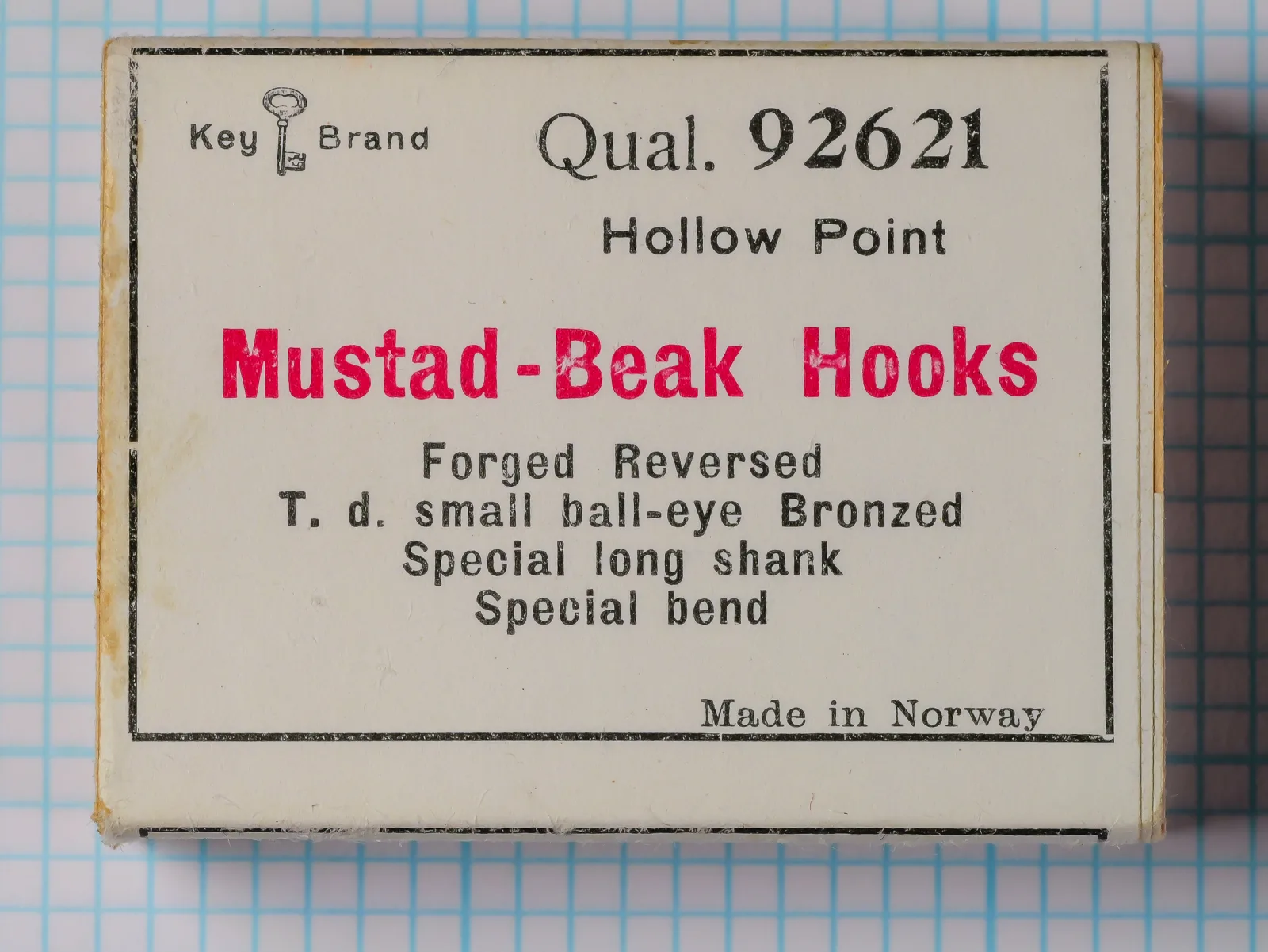
The Mustad 92621 is a specialty long-shank beak hook manufactured in the early-to-mid 1960s by O. Mustad & Son in Gjøvik, Norway. Marketed under the Key Brand label, this hook combines a reversed hollow-point design with an extended shank intended specifically for rigging large natural baits and predatory fish lures. The forged wire construction and small turned-down ball-eye are hallmarks of Mustad’s mid-century engineering for European and international markets.
Packaging evidence—the Key Brand skeleton-key logo, minimalist letterpress design, white card stock, and ‘Made in Norway’ attribution—places this stock firmly in the 1960-1975 window, before Mustad transitioned to plastic boxes and four-color printing in the late 1970s. The specimen exhibits even bronzed finish with period patina, consistent with vintage Mustad stock held in inventory. The 92621 is representative of Mustad’s vast Quality-numbered catalog system, which offered thousands of regional variants and specialty hooks tailored to specific fishing traditions across Europe and beyond.
For collectors, this hook is significant as documentation of mid-century European bait-fishing practice and the industrial scale at which Mustad produced specialized hooks. The combination of the distinctive Key Brand packaging, Beak bend, reversed point geometry, and documented long shank makes the 92621 a useful reference specimen for understanding Mustad’s product hierarchy and the evolution of hook design for predatory freshwater species.
Front label of the Key Brand Mustad 92621 sales card displaying the skeleton key logo, model designation, and complete technical specifications in letterpress type.
Photographic record
4 cataloged imagesSelect any record to load it above.
4 images shown
Mustad 92621 Beak Hook Key Brand Sales CardFront label of the Key Brand Mustad 92621 sales card displaying the skeleton key logo, model designation, and complete technical specifications in letterpress type.Open originalMustad 92621 Point Detail and BarbClose-up of the hook point showing the distinctive concave (hollow) inner face and small barb, with reversed offset geometry visible. Photographed on measurement grid for scale reference.Open originalMustad 92621 Full Hook ProfileSide profile views of two Mustad 92621 hooks displaying the extended shank length, distinctive beak bend geometry, and small turned-down ball-eye construction.Open originalMustad 92621 Specimen CollectionFour Mustad 92621 hooks photographed together, demonstrating manufacturing consistency and size uniformity across the production batch.Open original
Technical profile
Hollow Point | Mustad – Beak Hooks | Forged | Reversed | Turned Down Small Ball-Eye | Bronze | Special Long Shank | Special Bend | Made in Norway
Eye
Ball Eye, Turned DownSmall ball-eye with turned-down configuration. The ball is proportionally small relative to the heavy wire gauge, creating a refined eye construction despite the robust shank. P
Wire
Heavy (1X Heavy), Forged
Shank
Special Long — Plain
Bend
Beak / Reversed Point, Standard gap, Offset / kirbedSpecial reverse bend with pronounced offset (reversed/kirbed). Inner curve is characteristic of the beak design with the point turned sharply inward toward the shank. P
Point
Hollow Point (concave inner face)Small, close-cut barb positioned at the junction of point taper and inner face. Barb is proportionally short relative to the heavy wire gauge, consistent with mid-century Mustad engineering where barb size was minimized to reduce material removal and preserve wire strength. P
Finish
Bronzed — Confirmed (stated on packaging)Warm brown bronzed finish with patina typical of vintage mid-century Mustad stock. The finish shows even coverage across the specimen with no evidence of significant corrosion or wear. Color tone is characteristic of post-1950 Mustad bronzing. P
Specimen hooks are bright with no visible corrosion or significant wear. Card shows moderate age toning typical of 60-year-old paper stock—cream-colored card has developed a light tan/beige patina. Edges show minor creasing and wear consistent with storage in a package or envelope. Letterpress printing is clean and legible throughout. No water damage or foxing visible. Overall condition rated Very Good—appealing to collectors while showing authentic age character.
The hollow-point designation refers to the distinctive concave inner surface of the point—the inside face curves inward, creating a knife-edge effect that enhances bite and penetration, particularly valuable when setting the hook in the hard tissues of large predatory fish. The reversed geometry means the point is offset to one side rather than aligned with the shank centerline, increasing the mechanical advantage during hook-set and reducing slip-out during the fight.
The forged wire profile—flattened slightly on two sides rather than remaining purely round—significantly increases the hook’s resistance to straightening under load. This is critical for a bait hook intended to handle large, powerful species and extended bait presentations where the hook must endure sustained pressure. The long special shank accommodates larger baits and allows the angler to maintain point exposure even with extended or bulky offerings.
The small turned-down ball-eye is a refinement common to quality bait hooks: it provides a strong attachment point for snell knots or standard clinch knots while the slight downward turn aligns the eye angle for optimal hook-set mechanics. The small scale of the eye relative to the heavy wire is characteristic of mid-century Mustad engineering—strength prioritized over appearance.
The Mustad Beak Hook (also called Octopus in some markets) was a classic bait-fishing design produced in numerous variants across the Mustad catalog. The 92621 represents a specialty extension—the ‘Special Long Shank’ variant—designed to address the specific needs of anglers rigging extended natural baits or constructing large predatory lures. While the standard beak hook (92641) served general bait-fishing purposes, the 92621 was marketed to European specialists, particularly in pike and zander fishing where longer baits and more aggressive hook-set mechanics were valued. The Special Bend designation reinforces that this was not a standard production variant but rather an engineered modification intended for specific applications.
Mustad maintained the 92621 designation through at least the 1970s, though production volumes and regional availability varied. As modern plastic packaging and simplified model ranges emerged in the 1980s, specialty long-shank beak hooks like the 92621 gradually faded from mainstream commercial availability, becoming collectible references to an earlier era of hyper-specialized hook design. Related models include the 92641 (standard beak) and 92647 (modern long-shank beak equivalent).
Era and Packaging Dating
Key Brand logo with skeleton key symbol and minimalist white-background card design is characteristic of mid-century Mustad packaging (1950s-1970s). No barcode visible on packaging, consistent with pre-1974 production. Typography and letterpress print quality indicate 1960s manufacture. Card construction and paper stock show mid-century characteristics. The 'Qual. 92621' numbering system was standard Mustad nomenclature throughout this era. Made in Norway attribution confirms Gjøvik factory era. This cluster of evidence points to c. 1960-early 1970s window, with 1960-1975 as the most likely production range.
The Beak Hook and European Pike Fishing
The Beak Hook design, sometimes called a 'Parrot Hook' in older British catalogs, became especially popular among pike and zander anglers in continental Europe during the 1960s-1970s. The reversed point geometry was specifically engineered to maximize hook-up ratios in the hard, bony mouths of these predatory species. Mustad's production of specialized variants like the 92621 reflects an era when European fishing traditions demanded hooks finely tuned to regional species and bait presentations—a level of specialization that modern industrial hook manufacture has largely abandoned in favor of fewer, more generic designs.
Design lineage and influence
The Beak (Octopus) bend is a classic design with roots in 19th-century British bait-hook tradition, particularly for saltwater and large predatory species. Mustad inherited and refined this design through acquisitions and market dominance in the early-to-mid 20th century. The reversed point geometry—placing the barb to one side rather than centered—became standard for beak-bend hooks as manufacturers recognized the hook-up advantage it provided. The 92621’s long-shank variant follows logically from 1950s-1960s innovations in bait rigging and tube-fly construction, where extended shanks became necessary to accommodate larger, more elaborate lures.
Competing designs from other manufacturers during this era included Partridge of Redditch’s beak variants and various Allcock octopus hooks, but Mustad’s industrial scale and Quality numbering system gave them an unmatched product range. Later, modern bait-hook manufacturers like Gamakatsu and Owner produced successors to the 92621 concept (e.g., Gamakatsu Baitholder in long-shank versions), though these tend toward more minimal design and plastic packaging. The 92621 remains a textbook example of mid-century bait-hook engineering before design trends shifted toward fly-tying-focused models.
Best matchRelated by Attribute
Computed automatically from catalog data — updated as new hooks are added.
Matches: Bend, Shank, Wire, Gap, Eye +4 moreDiffers: Eye Orient.: Turned Down vs Straight / Inline; Point: Hollow Point vs Beak / Reversed; Finish: Bronzed vs Gold-Plated +4 more
Matches: Bend, Shank, Gap, Eye, Eye Orient. +4 moreDiffers: Wire: Heavy (1X Heavy) vs Extra-Heavy (2X+); Point: Hollow Point vs Beak / Reversed; Finish: Bronzed vs Nickelled +2 more
The 92621 is a specialty bait hook designed for rigging longer natural baits such as eels, sand eels, or extended bait strips intended for large predatory species including pike, zander, and saltwater gamefish. The extended shank accommodates the bait length while the reversed hollow-point design provides aggressive hook-up performance. Though marketed primarily as a bait hook, the combination of stout forged wire and long shank also makes it suitable for large saltwater streamers and tube fly construction.
Secondary Applications
Large saltwater streamers, tube flies, predatory fish lures.
Classic Fly Patterns
Not typically used for traditional fly patterns; however, the long shank and forged construction make it suitable for large saltwater streamers and tube-fly inserts where weight and durability are critical.
Modern Equivalents
Hook
Match Quality
Notes
Mustad 92647
Very Good
Modern long-shank beak hook from Mustad; same bend family and reversed geometry, though packaging and finish specifications may vary.
Gamakatsu Baitholder (Long Shank variant)
Good
Functional equivalent for large bait rigging; similar shank length and forged wire, though Japanese manufacture and often includes shank barbs (not present on 92621).
Owner SSW (Saltwater Beak) Long Shank
Moderate
Contemporary Japanese beak-style long-shank hook; similar intended use but modern finish and eye construction.
Collector notes
Rated 3.5/10—Mustad industrial production volumes limit collectability even for vintage mid-century stock; however, the specific Key Brand packaging, 92621 designation, and long-shank specialty variant make this genuinely uncommon rather than common. Collector demand is modest but sustained among Mustad catalog completists and European bait-fishing historians. Condition and packaging integrity are primary value drivers.
Reference value
$6 – $13 USD estimate
Packaging condition
Good — moderate wear, legibleRecorded specimen
Packaging format
GW-M-KBV-01Catalog code
Positive Factors: The Key Brand packaging is a recognized mid-century Mustad variant that appeals to packaging historians and logo collectors. The 92621 model number is documented in period catalogs and represents a genuine specialty designation rather than a generic long-shank beak. The combination of reversed hollow-point, forged wire, and long shank demonstrates engineering precision and appeals to fly-tying purists who appreciate the hook’s utility for large streamers. Complete, unopened packages with all 100 hooks command significantly higher premiums. Specimens from the 1960-1970 window are preferred by era-focused collectors over later variants.
Limiting Factors: Mustad’s industrial scale means that surviving examples, though not abundant, are not genuinely rare. The hook has no historical reputation comparable to named collaborator models (Partridge, Allcock, etc.). Loose hooks or damaged cards see minimal collector premium over functional value. Size 10 is a moderate utility size—very large or very small variants would command higher prices. The generic beak-hook family has less specialist appeal than more exotic bend types (Limerick, Sproat, Sneck).
Condition Factors: Sealed or near-sealed cards with all 100 hooks intact are highly desirable and command the premium range. Opened cards with all or most hooks still mounted command the mid-range. Missing hooks reduce value by approximately 10-15% per hook. Cards with faded or heavily worn packaging drop to the lower value range. Single loose specimens have minimal value beyond functional tyer demand (typically $0.10-$0.25 per hook).
Packaging
Vertical sales card format measuring approximately 3.5" × 5.5" (89 × 140 mm) with cream-colored paper stock and letterpress printing. Header features the 'Key Brand' logo—a skeleton key symbol—in black ink with minimalist sans-serif typography. Model designation 'Qual. 92621' and product name 'Mustad-Beak Hooks' printed in bold sans-serif and red letterpress text respectively. Technical specifications listed in small black type: 'Hollow Point', 'Forged', 'Reversed', 'T.d. small ball-eye', 'Bronzed', 'Special long shank', 'Special bend'. 'Made in Norway' attribution at bottom. Simple black rectangular border frames the main content area. Card shows moderate age toning and light wear to edges consistent with 60+ year age. No visible barcode. Original condition suggests this was a stock card held in inventory, not a well-circulated retail example.
Market Value Notes
Low ($6): Good condition, opened card, minor packaging wear, most hooks present (95+%)
High ($13): Excellent condition, sealed or near-sealed card, complete 100-hook count, minimal defects
Premium factors: Sealed packaging, full hook count, Key Brand logo appeal, mid-century era documentation, condition of card printing
Platforms: eBay (US and UK), vintage tackle dealers, occasional specialist auctions
Confidence: V verified — based on 1 eBay sold listing at $12.99 (April 2025) and 3-year eBay market history (Apr 2023–Apr 2026) showing avg $8.80, range $2.50–$12.99. Conservative low value reflects Good condition, mid-range high value reflects sold listing precedent.
Where to Find
eBay (US and UK auctions; search 'Mustad 92621', 'Mustad Beak Hook', 'Key Brand Mustad'). Vintage tackle dealers specializing in European or Scandinavian hooks. Occasional appearances at specialist fly-fishing auctions or hook collector gatherings in the UK and Northern Europe. Rarely encountered in retail tackle shops.
Collector's Identification Tips
Verify ‘Key Brand’ logo presence and minimalist white-background design of the card. Check that model code reads ‘Qual. 92621’ and not similar Mustad beak variants (92641, 92647). Confirm ‘Hollow Point’ designation and ‘Special long shank’ text on label. Reversed point visible on the hook itself should curve inward sharply toward shank. Small ball-eye and forged wire are key identifying features.
eBay market reference. Researcher-curated. Prices in USD. Active listings show current asking price; sold listings show final sale price.
Preservation
Storage and Preservation
Store the hook card in a cool, dry environment away from direct moisture and humidity. The bronzed finish is susceptible to patina development and mild rust if exposed to dampness; this patina is often considered desirable by collectors, but sealing is not recommended as it may obscure original finish character. Keep the original card packaging intact—do not remove hooks from the card unless intending to use them, as the card provides both physical protection and significant value premium. Store away from ferrous materials to prevent galvanic corrosion. Avoid contact with other metals (copper, aluminum) which can accelerate oxidation. If the card shows edge toning or foxing, place it in acid-free archival tissue or acid-free storage box to prevent further deterioration. A cool closet or display cabinet at room temperature (65-70°F, 18-21°C) with <50% relative humidity is ideal. Inspect periodically for evidence of rust or corrosion; surface oxidation can be gently stabilized with a soft brush, but do not use aggressive cleaning methods on vintage finish. Store horizontally or vertically in a protective sleeve if possible to minimize mechanical wear to the card edges.
Key Brand Logo: The skeleton key symbol with minimalist sans-serif treatment is Mustad’s mid-century branding, designed to convey the message that this hook ‘unlocks’ success in fishing. This logo appears across several Mustad product lines from approximately 1955-1975 and is a reliable marker for dating. The clean white-background card design contrasts sharply with Mustad’s later plastic boxes (1980s onward) and their earlier handwritten or heavily illustrated cards (pre-1950), making it a strong chronological indicator.
Technical Specifications Hierarchy: The card lists specifications in a specific order: Point style (Hollow), then Bend type (implied in ‘Beak Hooks’), then Wire treatment (Forged), then Offset direction (Reversed), then Eye type (T.d. small ball-eye), then Finish (Bronzed), then Shank length category (Special long shank), then Bend description (Special bend). This hierarchy reflects manufacturing priorities: point and wire properties first (functional/structural), then cosmetic/ergonomic details (eye, finish), then specialized categories (shank). This order was consistent across Mustad’s Qual. catalog.
‘Made in Norway’ Attribution: Explicitly states Gjøvik factory origin. Mustad’s Norwegian manufacturing was a selling point during the 1960s, implying precision and reliability. This attribution disappeared from most consumer packaging by the late 1970s as Mustad diversified manufacturing locations globally, making its presence a strong indicator of 1960-1975 production window.
Marking Analysis
Markings and Annotations
The packaging images show no visible handwritten annotations, price marks, or inventory codes on the card face. This is typical of vintage Mustad stock that remained relatively undisturbed in warehouse inventory or distribution channels rather than being heavily handled at retail. Any such marks, if visible on other specimens of the 92621, would provide evidence of regional pricing, distributor codes, or retail outlet identification—useful for tracing the commercial pathway of this hook from Norway to end-user markets.
Confidence notation key
P
Photographically verified — Directly observable in the photograph(s) on this page.
V
Verified by documentation — Confirmed by manufacturer catalog, spec sheet, or published reference.
I
Inferred — A logical deduction from observable or documented evidence, not directly stated.
E
Estimated — An approximation based on visual comparison, proportional analysis, or limited data.
S
Speculative — A reasoned hypothesis that cannot be confirmed from available evidence.
Unnotated claims are the compiler’s synthesis; see Sources. All photographs on garrenwood.com are taken on a measurement grid where each square equals 1/10 inch (0.1″ / 2.54 mm).