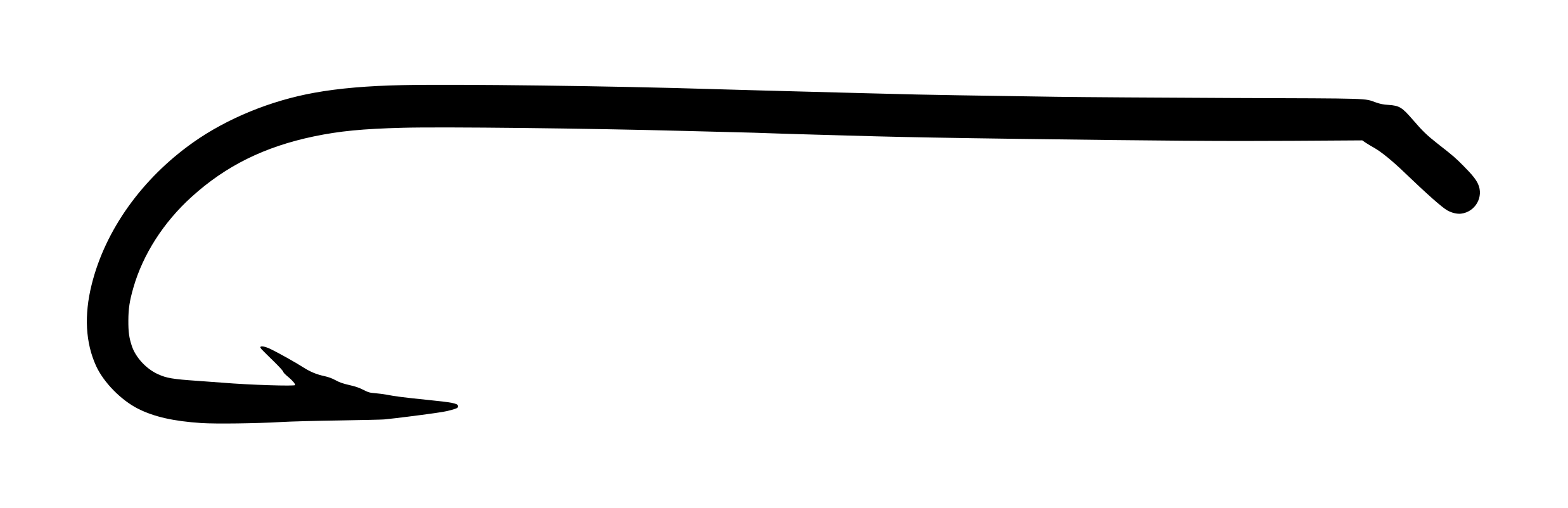
The S 1056 is Edgar Sealey & Sons’ version of the Snecky Limerick, a long-shank, turned-down-eye mayfly hook sold as ‘Long May’s Turn-down-eyes’ P. ‘Snecky Limerick’ was an established English dry-fly bend name rather than a Sealey invention — a limerick bend given squarer, sneck-like turns — and was associated with H. S. Hall’s dry-fly hooks well before Sealey began trading I. This example is bronzed P, roughly 4X long E, and was packed 100 to a folded paper trade packet marked ‘S 1056. Extra Quality’ and size No. 9 P.
Edgar Sealey & Sons began hook-making in Redditch around 1930 and was taken over by Dunlop Sports in 1960, which brackets this packet to c. 1930–1960 I. The long shank carries the full-length body of a mayfly dressing, suiting Mayfly (Ephemera danica) imitations fished dry or semi-submerged I.
From a collecting perspective, Sealey hooks sit in the middle tier of Redditch makers. The labelled packet with its Octopus trade mark is the main source of interest in this example; the packet itself is heavily worn P.
Side profile view of the Edgar Sealey & Sons S 1056 bronzed sneck hook, showing the characteristic curved bend and tapered point.
Photographic record
3 cataloged imagesSelect any record to load it above.
3 images shown
S 1056 Sneck Hook Side ProfileSide profile view of the Edgar Sealey & Sons S 1056 bronzed sneck hook, showing the characteristic curved bend and tapered point.Open originalS 1056 Sneck Hook Front ViewFront view of the S 1056 sneck hook displaying the tapered point and eye construction detail.Open originalS 1056 Original Packaging LabelOriginal vintage packaging label for Edgar Sealey & Sons S 1056 Snecky Limerick hooks, marked Extra Quality with 100 hooks per box.Open original
Technical profile
Turned-Down Eye | Snecky Limerick | 4X Long Shank | Heavy Wire | Superior Point | Bronzed
Eye
Ball Eye, Turned DownSharply turned-down eye P. Whether this is a ball eye or a tapered eye, and how cleanly the wire end closes against the shank, cannot be resolved at the current photograph resolution; an eye close-up is needed. Tapered eyes were common on English dry-fly hooks of this type I.
Wire
Heavy (1X Heavy), Round, Est. ~0.026"–0.030" (~0.66–0.76 mm) E from photographs; recorded caliper reading.032" to be reconfirmed
Shank
4X Long — Plain
Bend
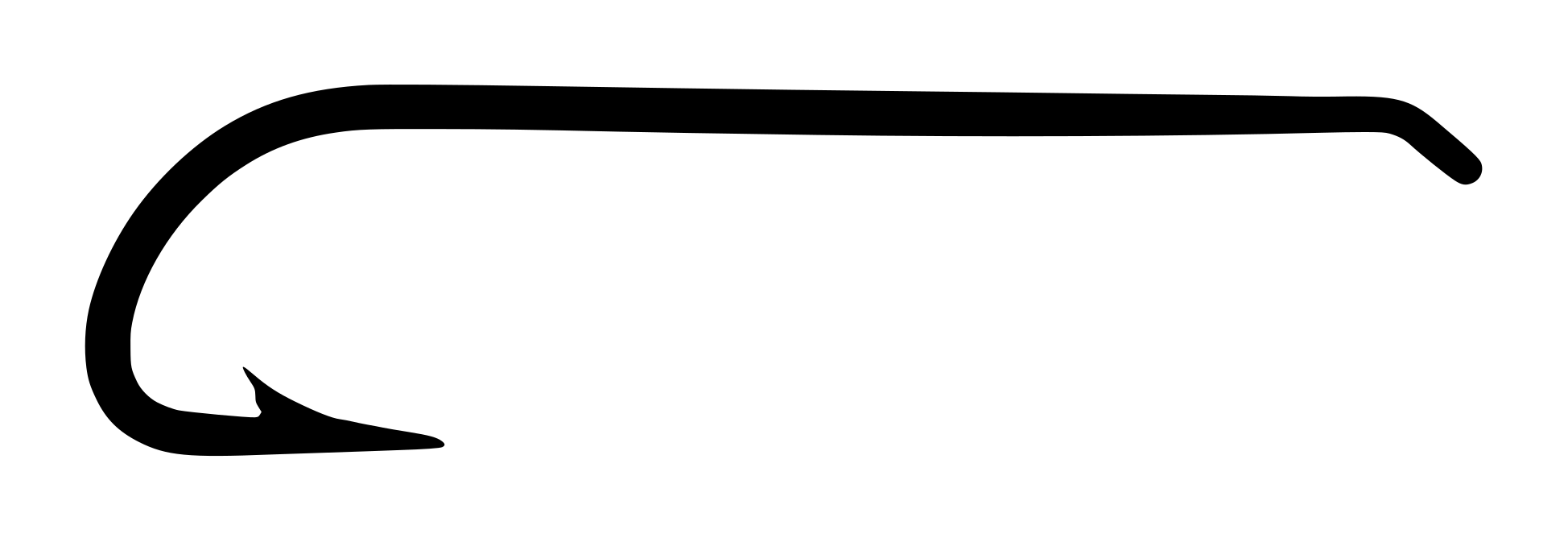
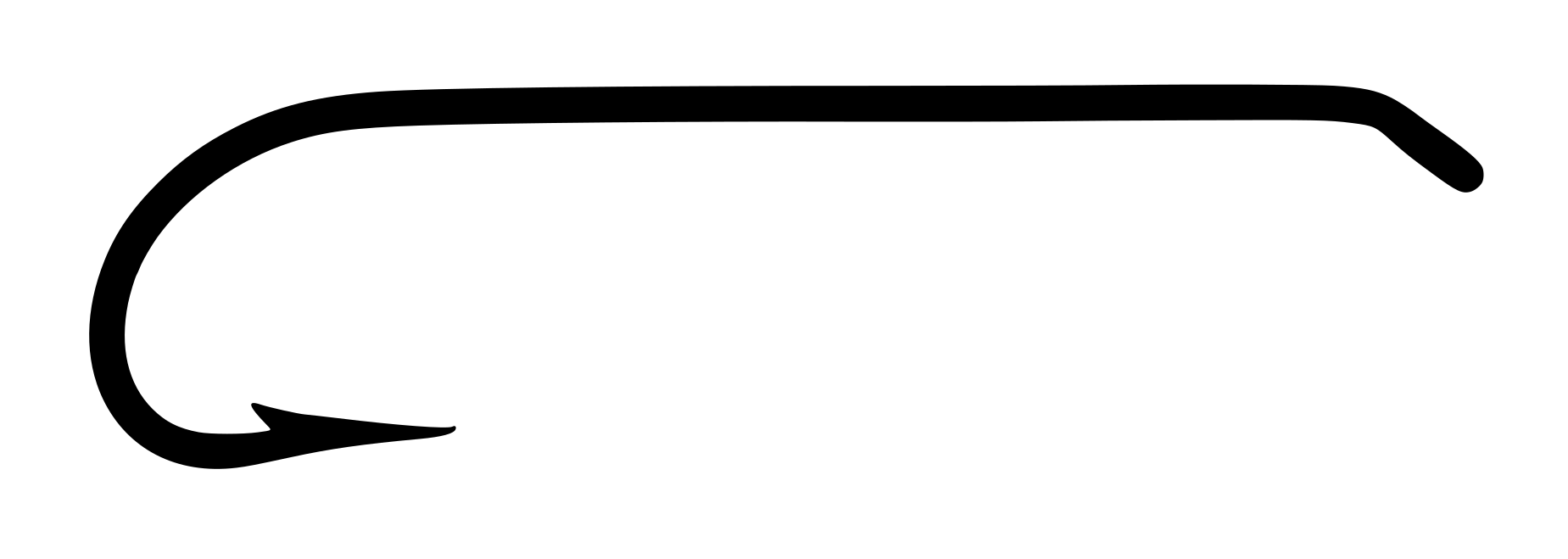
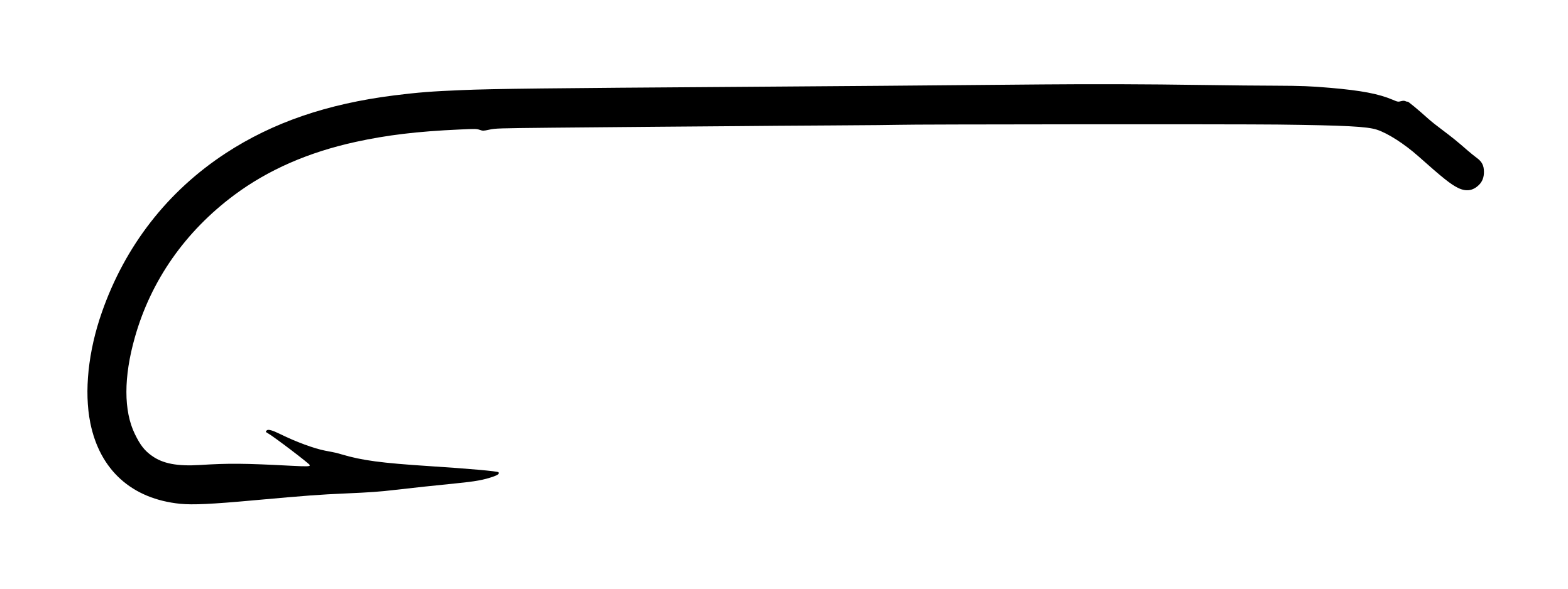
Limerick, Standard gap, Offset / kirbedLabelled 'SNECKY LIMERICK' P. Limerick-family bend with squarer, sneck-like turns: a fairly straight rear section and a tighter turn into the point P. Classified as limerick; the 'snecky' modifier describes the corners rather than an equal sneck–limerick hybrid I.
Point
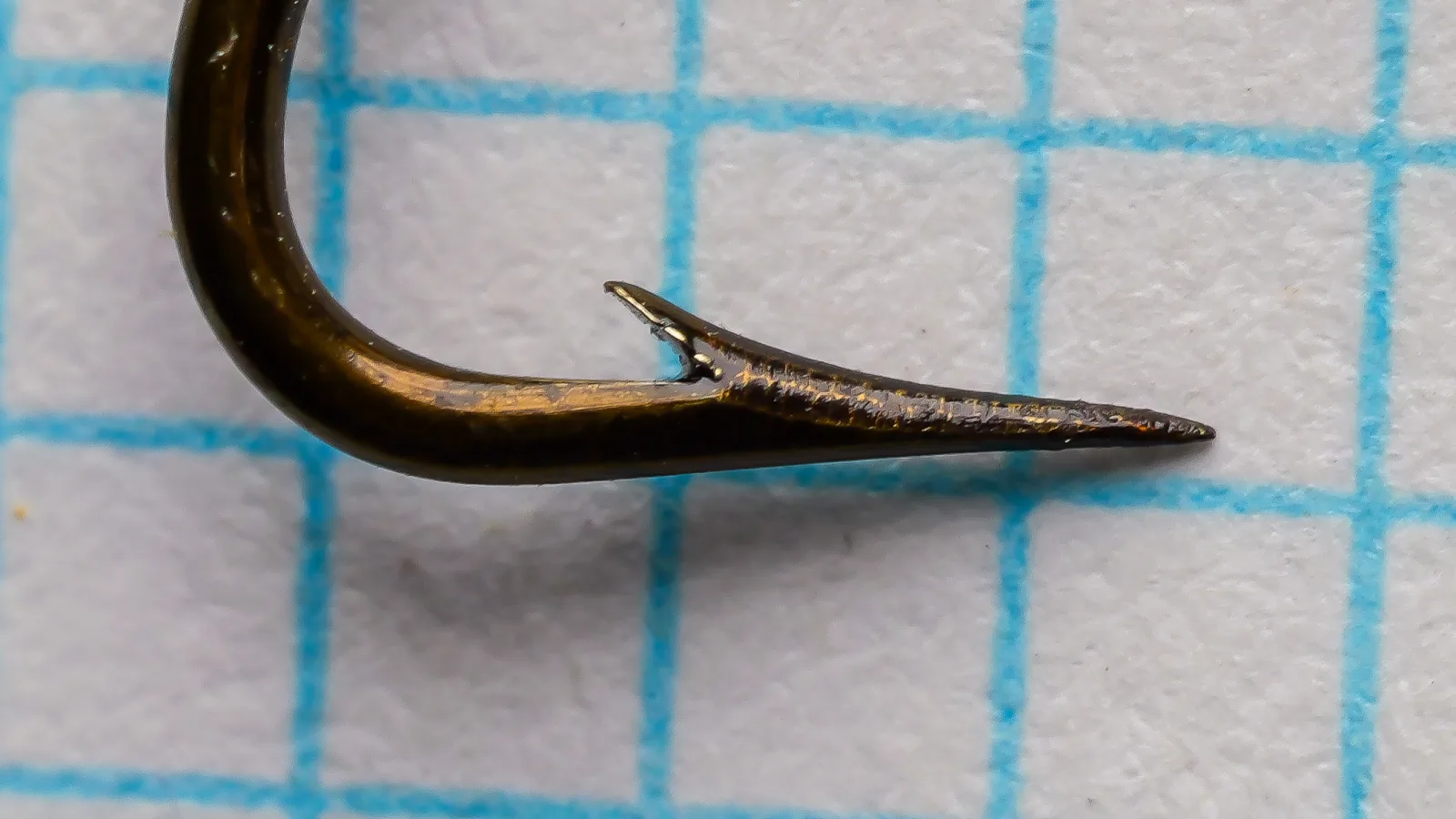
Superior (near-straight inner taper)Deep, prominent barb cut well into the wire and standing clearly off the point, with a well-defined barb tip P.
Finish
Bronzed — Confirmed (stated on packaging)Warm brown-olive bronze with golden highlights along the shank and bend; the finish appears even and intact, with no visible rust in the photographs P. The label does not state the finish.
The S 1056 is a long-shank Snecky Limerick: a limerick-family bend with squarer turns than a true limerick, giving a fairly straight rear to the bend before a tighter turn into the point P. The measured shank is about 3.8 times the gap (calculated), roughly a 4X-long proportion E, and the eye is sharply turned down P. The long shank carries the full body of a mayfly dressing, as the ‘Long May’s’ label indicates P.
The point is long, straight-tapered and parallel to the shank, with a deep, prominent barb P; the ‘superior’ point classification should be confirmed against a Sealey catalogue illustration I. The recorded wire diameter of.032″ places the wire at the heavy end for a hook of this gap and should be reconfirmed by caliper E. Whether the point is offset (kirbed) cannot be determined from the side-profile photographs; a top view is needed.
No barcode present P, consistent with pre-1974 production I. Traditional pasted paper label on folded paper stock P, consistent with pre-1960s English trade packaging I. The label reads 'Edgar Sealey & Sons' without 'Ltd.' and carries no 'England' or 'Made in England' marking P; either may prove a dating or market clue once compared with dated Sealey packets S. The firm began hook-making around 1930 and was taken over by Dunlop Sports in 1960 I, which sets the outer bounds of c. 1930–1960.
An Old Dry-Fly Name
The Snecky Limerick was not a Sealey experiment. G. E. M. Skues is reported to have favoured what he called "Hall's Snecky Limerick," after the dry-fly hook designer H. S. Hall, decades before Sealey began making hooks, and Partridge was still offering a Snecky Limerick mayfly hook in recent years I.
Design lineage and influence
Best matchRelated by Attribute
Computed automatically from catalog data — updated as new hooks are added.
Matches: Shank, Wire, Eye, Eye Orient., Point +5 moreDiffers: Bend: Limerick vs Carlisle; Gap: Standard vs Narrow; Application: Dry Fly, Wet Fly vs Bait, Saltwater +3 more
Matches: Bend, Wire, Gap, Eye Orient., Point +4 moreDiffers: Shank: 4X Long vs 3X Long; Eye: Ball Eye vs Looped Eye; Offset: Offset / Kirbed vs Straight +2 more
The label’s ‘Long May’s Turn-down-eyes’ identifies this as a long-shank mayfly hook P. The long shank carries the full-length body of a Mayfly (Ephemera danica) dressing — dun, spinner or spent gnat — and the turned-down eye follows the convention for English dry-fly hooks from the late 19th century onward I. Size No. 9, written by hand on the label P, is within the usual range for Mayfly patterns I.
Mayfly dressings on hooks of this kind were fished both dry and as semi-submerged or wet flies during the hatch I. Bronzing was the standard protective finish for English fly hooks of the period I.
Secondary Applications
Wet or semi-submerged Mayfly dressings; other long-bodied dry flies
Classic Fly Patterns
Green Drake, Grey Drake, Spent Gnat, French Partridge Mayfly, Straddlebug I
Collector notes
Original packaging with intact label and interesting hybrid bend designation elevate this above common vintage hooks, though Edgar Sealey lacks the prestige of top-tier Redditch makers.
Reference value
$15 – $40 USD estimate
Packaging condition
Poor — heavy wear or damageRecorded specimen
Packaging format
Paper packet with pasted labelCatalog code
Positive factors include the original labelled packet with legible printing, the handwritten size and Sealey’s Octopus trade mark P. The S 1056 is also a documented maker’s example of the Snecky Limerick, a dry-fly bend with a long association with English Mayfly fishing I, which gives it interest to fly-fishing historians and to tyers of period dressings.
Limiting factors include Sealey’s middle-tier standing among Redditch makers and the poor condition of the packet, which is stained, torn and heavily creased P. The hooks themselves appear sound, with even bronzing and no visible rust P. Size No. 9 is a common Mayfly size rather than a scarce extreme I.
Packaging
Folded paper packet, roughly 3.4" × 2.3" E, of buff paper stock with a single pasted label. The label is pale blue-green paper printed in black, with a repeating ring-pattern border. At left is the Octopus trade mark: an octopus above a shield bearing an interlaced 'ES' monogram, with 'OCTOPUS' on a banner and 'REGISTERED TRADE MARK' around the circle. Text reads 'EDGAR SEALEY & SONS', 'REDDITCH.', 'S 1056. Extra Quality', 'SNECKY LIMERICK', 'LONG MAY's Turn-down-eyes.', '100' and 'No. 9', with the size '9' written by hand in ink P. Heavy staining, tears, creasing and fraying at the folds, with rust-coloured spotting on the label near the trade mark. No evidence of wax coating.
Market Value Notes
Estimated values E; no sales data recorded yet. Value is driven by the labelled original packet and Sealey provenance. Examples in better packaging may bring more. Loose hooks without packaging sell for a small fraction of packet value.
Where to Find
UK auction sites, specialist tackle fairs, estate sales in England, vintage tackle dealers specializing in British items
Collector's Identification Tips
Sealey packets of this period can be recognised by the Octopus registered trade mark — an octopus above a shield bearing an interlaced ‘ES’ monogram — and by the ‘S’-prefixed pattern number P. Label style, including border pattern and paper colour, should be compared against other dated Sealey packets before it is used for dating S.
To recognise the Snecky Limerick bend, look for a limerick-type bend with squarer turns than a true limerick: a fairly straight rear section with distinct corners, rather than the continuous curve of a round bend or the pronounced right-angle corners of a true sneck I. Snecky Limerick mayfly hooks were also made by other English makers, including Partridge, so the label or a matching catalogue illustration is the most reliable way to attribute loose hooks to Sealey I.
Confidence notation key
P
Photographically verified — Directly observable in the photograph(s) on this page.
V
Verified by documentation — Confirmed by manufacturer catalog, spec sheet, or published reference.
I
Inferred — A logical deduction from observable or documented evidence, not directly stated.
E
Estimated — An approximation based on visual comparison, proportional analysis, or limited data.
S
Speculative — A reasoned hypothesis that cannot be confirmed from available evidence.
Unnotated claims are the compiler’s synthesis; see Sources. All photographs on garrenwood.com are taken on a measurement grid where each square equals 1/10 inch (0.1″ / 2.54 mm).