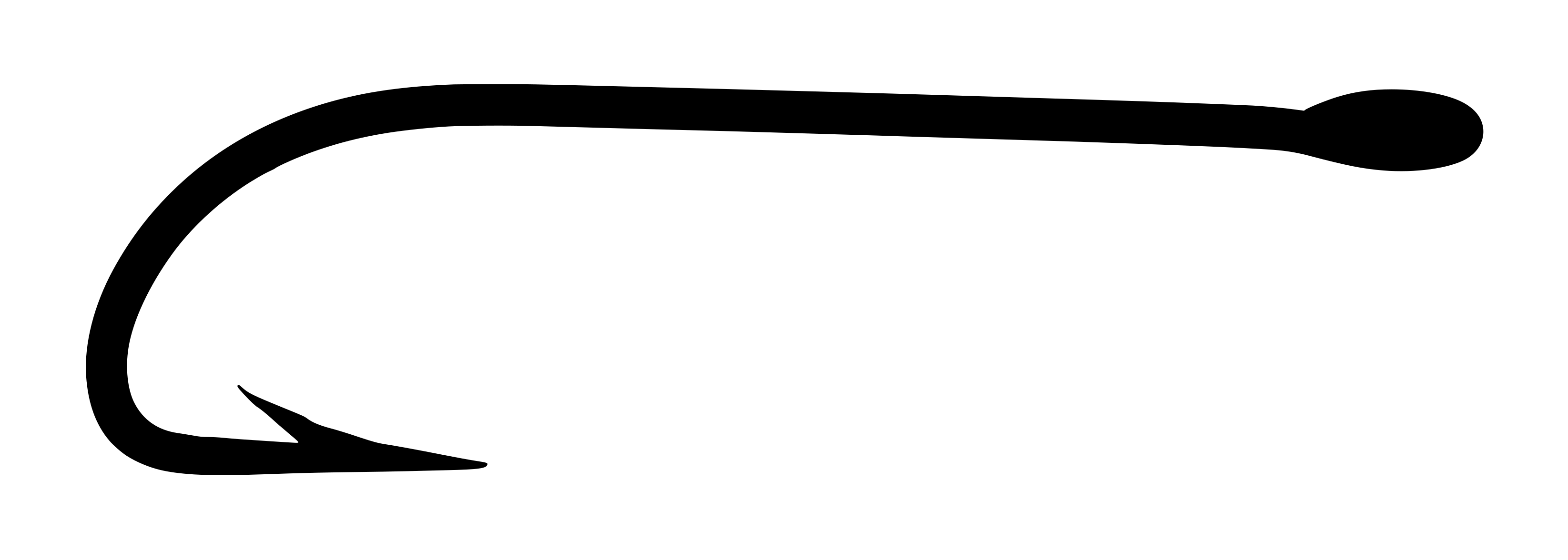
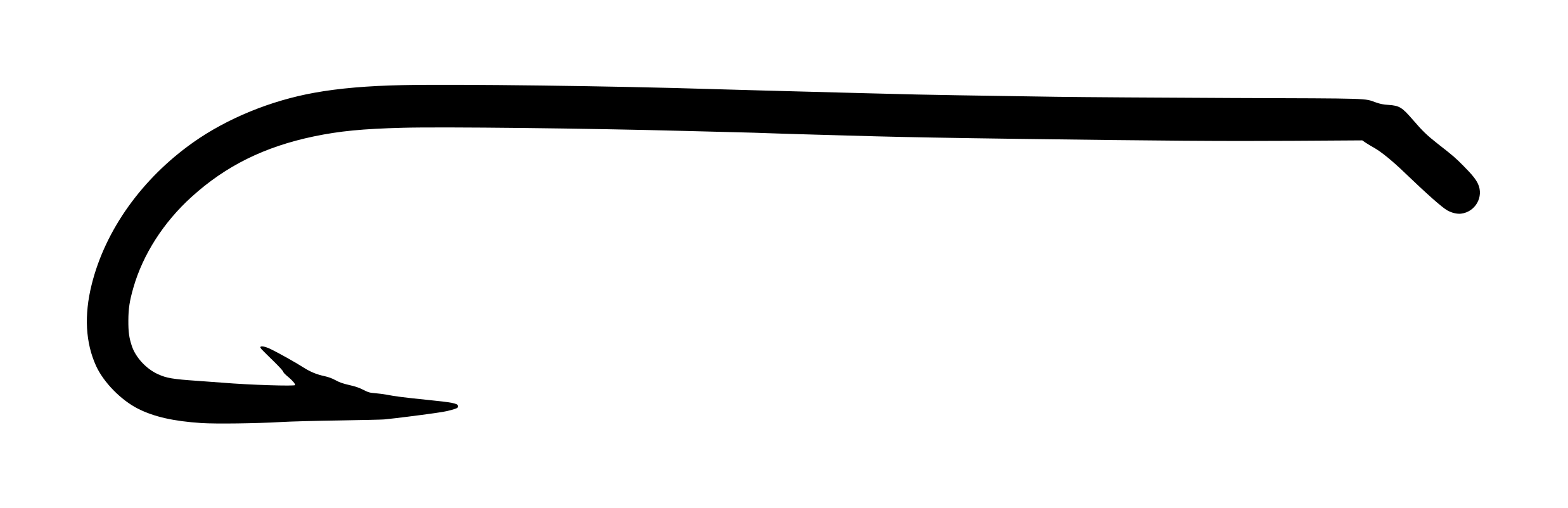
Alfred Willis & Sons Pennell Eyed Limerick Turn Down Eyes, No. 10. A late-Victorian or Edwardian Redditch fly hook, sold in boxes of 100 and labelled as made at the firm’s Limerick Works, Redditch, England. It has a Limerick bend, a long shank and a turned-down looped eye, and was probably intended for sea-trout and small salmon flies I. The finish looks bronzed in the photographs, though the label does not name it. The ‘Extra Quality’ and ‘Pennell Eyed’ wording dates it to the period when eyed hooks were replacing blind, gut-whipped hooks for British fly patterns.
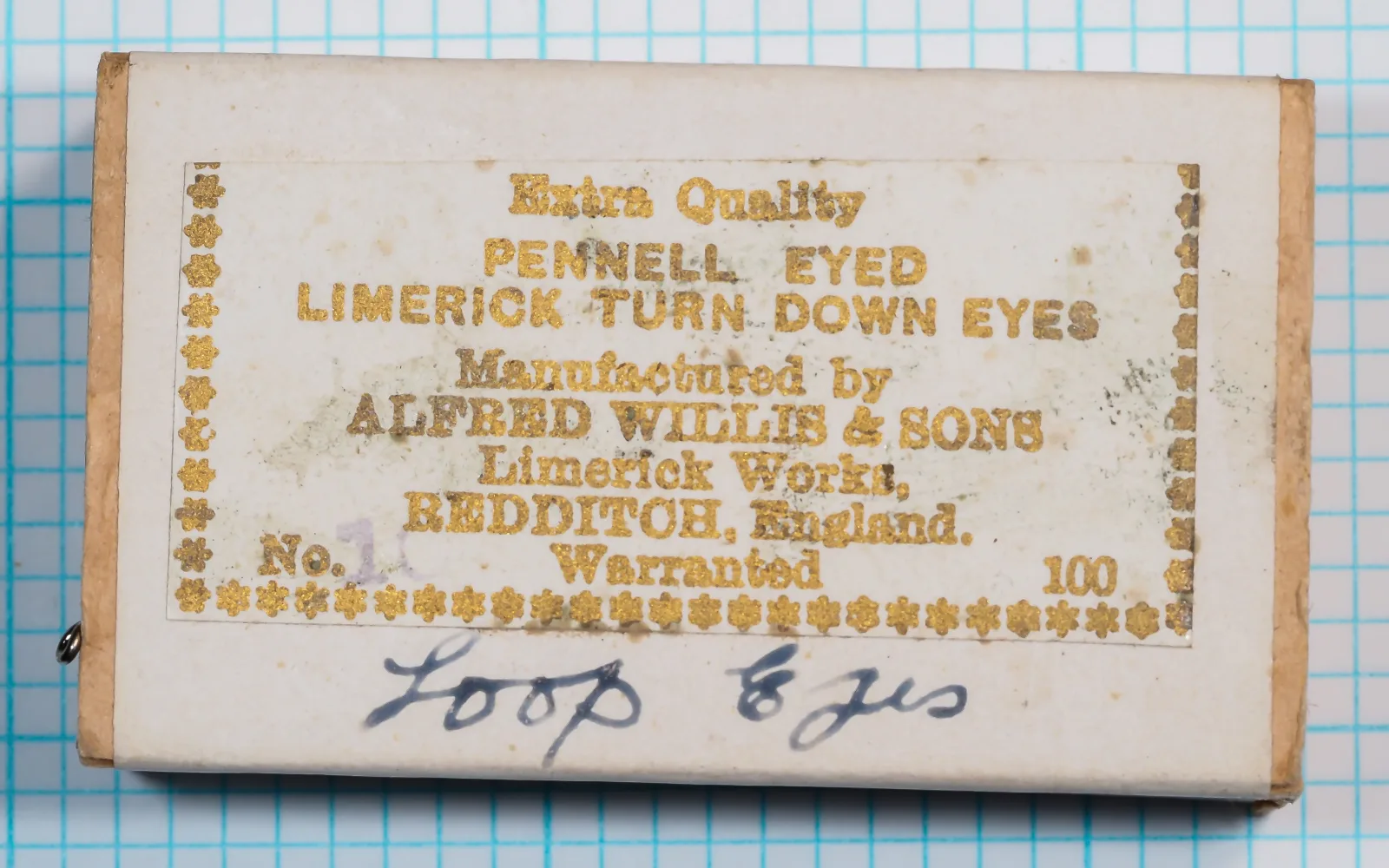
Original card packaging for Alfred Willis & Sons Pennell Eyed Limerick Turn-Down Eyes, size 10, bronzed finish. Letterpress printing in gold metallic ink with ornamental hexagon border. Card is marked 'Eudora Quality' and 'Warranted,' indicating quality assurance standard of the maker.
Photographic record
3 cataloged imagesSelect any record to load it above.
3 images shown
Alfred Willis and Sons Pennell Hook Card — Size 10 — Gold LetterpressOriginal card packaging for Alfred Willis & Sons Pennell Eyed Limerick Turn-Down Eyes, size 10, bronzed finish. Letterpress printing in gold metallic ink with ornamental hexagon border. Card is marked 'Eudora Quality' and 'Warranted,' indicating quality assurance standard of the maker.Open originalAlfred Willis and Sons Pennell Hook Size 10 — Point Detail — BronzedClose-up of the hook point and barb, showing the superior (near-straight) inner face taper and short, close-cut barb. Bronzed finish is warm brown tone with visible steel grain beneath, characteristic of traditional Redditch forging and finishing. Photographed on measurement grid for scale.Open originalAlfred Willis and Sons Pennell Hooks Size 10 — Eye and Bend ProfileTwo specimens showing the turned-down tapered eye loop and the Limerick bend profile from the side. The eye tapers inward smoothly (turned-down loop style), and the bend exhibits the characteristic rounded, open geometry of the Limerick pattern. Both hooks show bronzed finish in good condition.Open original
Technical profile
Extra Quality Pennell Eyed Limerick Turn Down Eyes, No. 10, 100
Eye
Looped Eye, Turned DownTurned-down looped eye: the tapered wire end is bent back and laid along the top of the shank, to be whipped under the dressing. The label states 'Turn Down Eyes'; the loop construction is recorded from the handwritten 'Loop Eyes' note and needs confirming in the eye-profile photograph.
Wire
Round
Shank
4X Long — Plain
Bend
Limerick, Standard gap
Point
Superior (near-straight inner taper)
Finish
Bronzed — Inferred (photographically likely)Warm brown tone in the hook photographs, consistent with bronzing (P, pending re-check). The label does not state a finish, so this identification rests on the photographs alone. Age-darkened bright steel can also read brown, so confirm under neutral light. I
Box lid shows age-appropriate toning and light foxing on white paper stock; edges lightly worn from handling. Printed lettering fully legible and ink intact. Hooks shown in the photographs are bright with no visible corrosion. Hook count has not been verified against the printed 100. No tape, water damage, or adhesive residue visible.
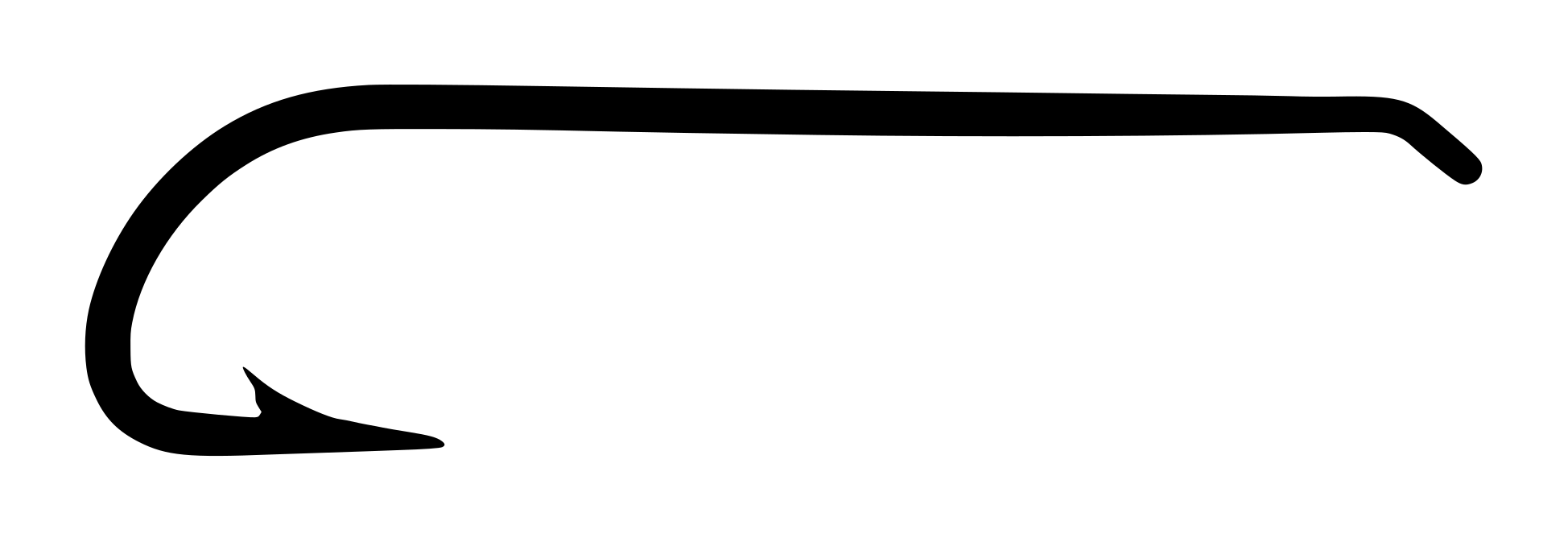
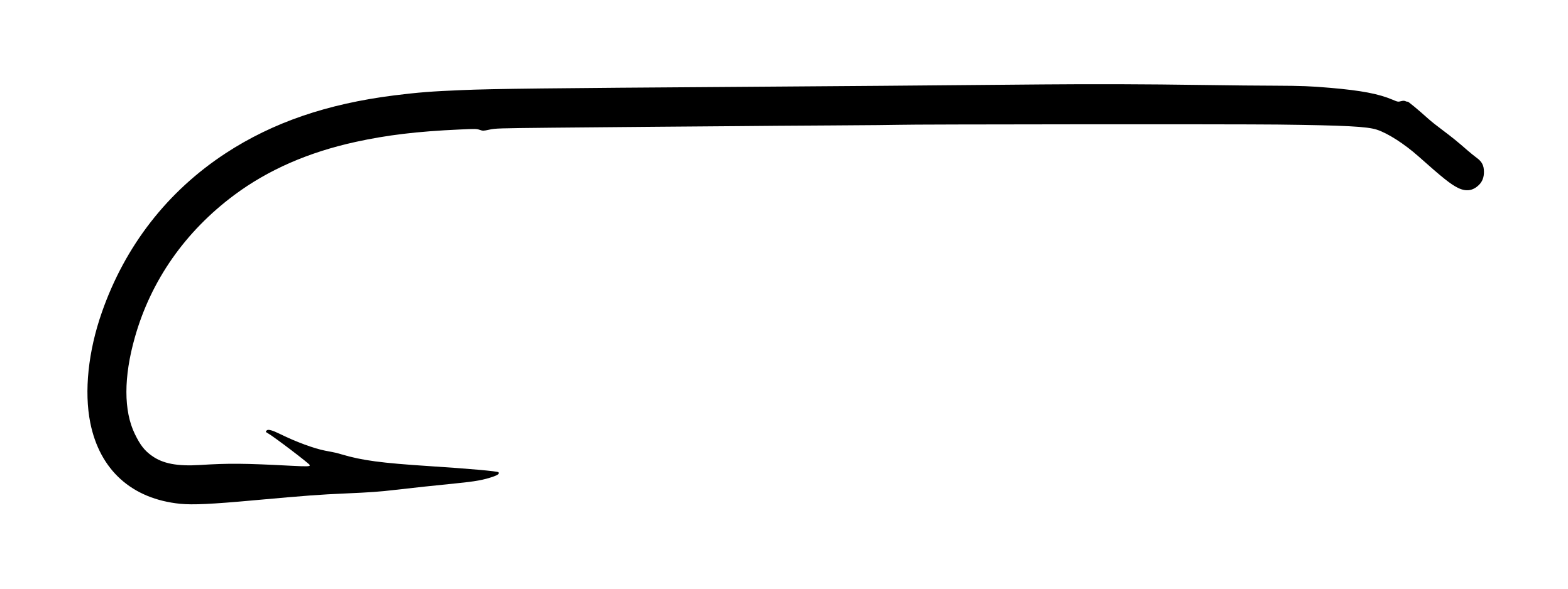
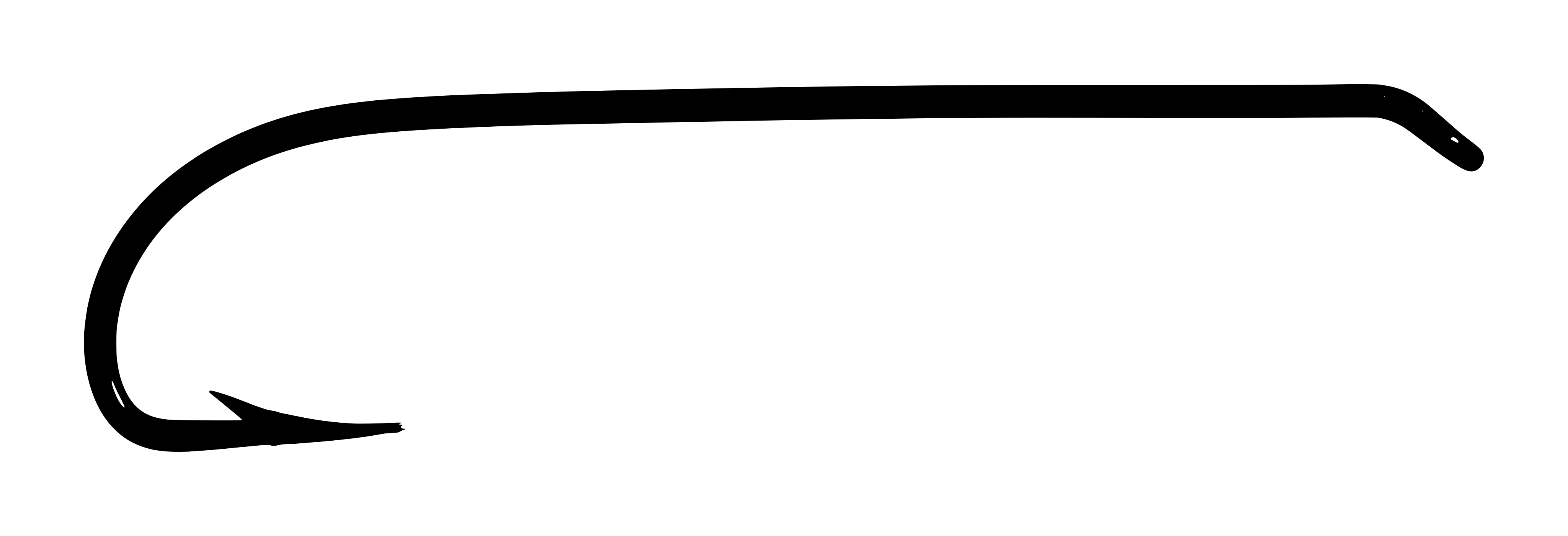
Limerick bend geometry: The Limerick is not an even curve. It runs down from the shank with a gentle sweep, then turns most sharply at the bottom of the bend just before rising to the point, which sits roughly parallel to the shank. This uneven curve separates it from the round (Kendal) bend. The Limerick was one of the standard bends for British salmon flies through the 19th and early 20th centuries.
Point: Recorded as a superior point with a nearly straight inner taper and a short barb, as described in the point close-up caption. Confirm against the photograph before treating it as verified.
Wire gauge: Not yet established. The earlier grid reading of about 0.048″–0.052″ (1.2–1.3 mm) is about a quarter of the 0.19″ gap, which is far too thick for a No. 10 hook. It was probably taken across the doubled wire of the loop eye. Re-measure with calipers at mid-shank, clear of the eye loop, before classifying.
Turned-down looped eye: The wire end is tapered, bent back into an eye and laid along the top of the shank, where the fly dresser whips it down under the body. This leaves no cut end or gap at the eye to fray the gut cast. On this hook the loop is turned down, below the line of the shank.
Forging: Recorded as forged. On a hook, forging means the bend is flattened side to side for lateral strength. It shows only when the hook is viewed from above or below, not in side profile, so a top-down photograph is needed to confirm it I.
The ‘Pennell Eyed Limerick Turn-Down Eyes’ is a standalone model within the Alfred Willis & Sons line, with no broader series designation indicated on packaging. The Limerick bend itself is a longstanding industry standard dating to the 18th century, but Willis’s version appears to be marketed under the specific ‘Pennell’ and ‘Extra Quality’ labels to appeal to progressive anglers adopting eyed hooks for salmon and sea-trout flies during the late Victorian and Edwardian periods.
Era and Packaging Dating
The printed 'England' points to manufacture after 1891, when the US McKinley Tariff began requiring country-of-origin marking on imported goods I. 'Pennell Eyed' wording fits the eyed-hook period that began in the 1880s. Letterpress printing with an ornamental border on white stock is typical of late Victorian and Edwardian trade labels. No telephone number appears. The firm name carries no 'Ltd.', which may place the box before any later incorporation of the firm S. The handwritten 'Loop Eyes' in blue ink is a dealer or owner annotation, not a factory marking. Together these support c. 1890-1910 I; a date into the 1920s cannot be ruled out without dated catalog evidence.
The Pennell Influence on Hook Design
The 'Pennell' on this label refers to Henry Cholmondeley-Pennell (1837-1915), a British angling author and one-time Inspector of Sea Fisheries who campaigned for eyed hooks in the 1880s and set out his hook designs in Modern Improvements in Fishing Tackle and Fish Hooks. A 1903 American trade article credited him with perfecting the eyed trout hook in 1885, and 'Pennell turndown eye' still appeared by name in hook-maker lists of that time.
Design lineage and influence
The Limerick bend is named for the hook makers of Limerick, Ireland, whose hooks had a high reputation in the late 18th and early 19th centuries. Redditch makers adopted the pattern and made it in quantity, and through the 19th century it became one of the standard bends for British salmon flies. This eyed version comes from the 1880s–1900s shift away from blind hooks whipped to gut, a change argued in print by Henry Cholmondeley-Pennell (1837–1915), whose name the label uses. Alfred Willis & Sons made it in competition with larger Redditch firms such as S. Allcock & Co. and H. Milward & Sons.
Looped eyes of this kind, with the wire end laid back along the shank, became the usual construction for British salmon-fly hooks because they give a smooth, gap-free eye for a gut or nylon cast. The construction is still made: the Partridge LIMK Limerick Loop Eye in this reference is a modern descendant.
Best matchRelated by Attribute
Computed automatically from catalog data — updated as new hooks are added.
Matches: Bend, Shank, Finish, Forging, Offset +2 moreDiffers: Gap: Standard vs Narrow; Eye: Looped Eye vs Ball Eye; Eye Orient.: Turned Down vs Straight / Inline +5 more
Probably intended for sea-trout and small salmon flies on British and Irish rivers I; the label names the pattern but not the fish. The Limerick bend and turned-down looped eye were the standard construction for British salmon-fly hooks of the period, and a No. 10 would suit the smaller flies used for grilse and sea trout in summer low water. The gut cast was tied directly to the eye. That was the advantage over the older blind hook, which had to be whipped to a length of gut as the fly was dressed. The label’s ‘Pennell’ wording refers to the eye style named for Henry Cholmondeley-Pennell, not to a family of fly dressers.
Secondary Applications
May be used for large sea-trout and brown-trout wet flies in sizes smaller than 10. Historical interest for museum or documentary collections illustrating Redditch fly-hook manufacturing.
Classic Fly Patterns
Not specifically tied patterns documented on packaging; historical association with Victorian salmon and sea-trout fly designs in the Pennell tradition
Modern Equivalents
Hook
Match Quality
Notes
Partridge LIMK Limerick Loop Eye
Good
Modern Partridge Limerick with a turned-down looped eye, the closest documented construction match. It is recorded as 3X long and 1X heavy, so compare shank length and wire once this specimen is re-measured.
Collector notes
Rated 7.5/10: scarce, especially as a complete original box. Collector demand is steady among Redditch specialists and vintage salmon-fly enthusiasts. Alfred Willis & Sons hooks are less sought than Allcock or Partridge.
Reference value
$20 – $40 USD estimate
Packaging condition
Very Good — light wear, fully legibleRecorded specimen
Packaging format
GW-WILLIS-01Catalog code
Positive factors: Redditch provenance is a primary driver of collectability. The packaging is well-documented (manufacturer, location, model name, and ‘Extra Quality’ branding), which appeals to both hook historians and collectors seeking documented examples. The ‘Pennell Eyed’ designation indicates a specific configuration intended for salmon and sea-trout flies, a highly collectible sub-category.
Negative factors: Alfred Willis & Sons lacks the widespread modern name recognition of Mustad, Allcock, or Partridge, which slightly depresses ceiling prices. A size 10 is on the smaller end for pure display purposes, though highly authentic for historical sea-trout applications.
Packaging
White cardboard box lid (approximately 5" × 3") with gold metallic letterpress printing. Ornamental hexagon-motif border frames the center text. Label reads: 'Extra Quality / PENNELL EYED / LIMERICK TURN DOWN EYES / Manufactured by / ALFRED WILLIS & SONS / Limerick Works, / REDDITCH, England. / Warranted / No. 10 / 100'. The number '10' is stamped in faint purple ink. Below the printed text is a handwritten annotation in blue ink: 'Loop Eyes'. Packaging exhibits light foxing and edge toning consistent with age; no barcode.
Market Value Notes
Low ($20): Good condition. Box opened, all or nearly all hooks present (95-100 count), moderate age wear and foxing, light handling creases.
High ($40): Excellent condition. Box complete with all 100 hooks, minimal creasing, light foxing only, bright finish, legible typography.
Premium factors: complete 100-hook box, Redditch provenance, Extra Quality grade, documented maker, sealed or near-sealed condition, alternate finishes (if extant).
Platforms: eBay UK (primary), specialist UK tackle dealers, UK angling auctions, occasional tackle fairs.
Confidence: E estimated. No Willis-specific sales data found; range extrapolated from comparable Redditch salmon-hook boxes (Allcock, Milward) and adjusted downward for a less-known maker.
Where to Find
eBay UK and eBay.com (search: Alfred Willis Pennell, Willis Redditch hook). UK dealers in vintage salmon tackle and Redditch hooks, UK angling auction houses, and regional fishing-memorabilia fairs. Rarely seen in North American markets; importing may add a shipping premium.
Preservation
Storage and Preservation
Store the packaging in a cool, dry environment protected from direct sunlight. The bronzed finish is stable under normal conditions but susceptible to patina development with high humidity exposure — a natural oxidation process that some collectors view as desirable character aging. Avoid storage in damp basements or unventilated plastic containers, which accelerate corrosion.
Keep the packaging in its original state; do not remove hooks unless preparing them for active use. Avoid direct contact with other metals, particularly ferrous or copper alloys, which can initiate galvanic corrosion. Store in isolation from tackle boxes or mixed vintage metal items. If the hooks show minor surface rust or patina, gentle dry brushing with a soft bristle brush is acceptable; avoid immersion or chemical cleaning, which may remove the bronzed finish entirely.
The letterpress-printed packaging is vulnerable to moisture and foxing. Avoid handling with damp hands; consider cotton gloves for frequent handling. The gold metallic ink is durable but can flake if the cardboard is flexed repeatedly.
Marking Analysis
Handwritten Markings and Annotations
The box bears a handwritten annotation in blue ink below the printed text: ‘Loop Eyes’. This notation was likely added by a dealer or early owner to rapidly identify the specific eye construction inside the box without opening it, as ‘Pennell Eyed’ could encompass both turned-up and turned-down variations. The clear script confirms the loop-eye design (where the wire tapers and returns along the shank), a popular, secure attachment method for salmon and large trout patterns in the late 19th and early 20th centuries.
Additional
Packaging Text and Manufacturing Claims
Text analysis: The printed text reads: ‘Extra Quality / PENNELL EYED / LIMERICK TURN DOWN EYES / Manufactured by / ALFRED WILLIS & SONS / Limerick Works, / REDDITCH, England. / Warranted / No. 10 / 100’
‘Extra Quality’: This branding designates a premium tier within the Willis & Sons lineup, indicating higher-grade wire or more rigorous tempering and finishing processes compared to their standard output.
‘Warranted’: The word ‘Warranted’ was common shorthand in Victorian manufacturing, implying the hooks were guaranteed against defects in material or workmanship. In the context of Redditch practice, ‘Warranted’ typically meant hooks would be replaced if they broke during normal use within the first year of purchase.
‘Limerick Works, Redditch, England’: The specificity of the factory location suggests Willis operated a dedicated facility. The name ‘Limerick’ likely reflects the bend type manufactured there, rather than a geographic reference. Naming factory buildings after product specialties was common in Redditch’s industrial structure.
Typography and printing method: The gold metallic letterpress printing on a white label is characteristic of late Victorian/Edwardian commercial printing. No barcode, no modern safety information, and no postal code format appear on the packaging — all consistent with pre-1950 manufacture and a pre-1974 date.
Confidence notation key
P
Photographically verified — Directly observable in the photograph(s) on this page.
V
Verified by documentation — Confirmed by manufacturer catalog, spec sheet, or published reference.
I
Inferred — A logical deduction from observable or documented evidence, not directly stated.
E
Estimated — An approximation based on visual comparison, proportional analysis, or limited data.
S
Speculative — A reasoned hypothesis that cannot be confirmed from available evidence.
Unnotated claims are the compiler’s synthesis; see Sources. All photographs on garrenwood.com are taken on a measurement grid where each square equals 1/10 inch (0.1″ / 2.54 mm).