The Mustad 92628 ST is a classic mid-century saltwater bait hook manufactured by O. Mustad & Son in Oslo, Norway. The model features a distinctive reversed-offset beak bend with a forged heavy wire construction and special tinned finish designed for saltwater corrosion resistance. The turned-down small ball eye and hollow point geometry were premium specifications of the era.
This example is preserved as a multi-size sample display board, a form rarely encountered in the collector market. The board documents the complete size range from 8/0 to 2, presented in original Mustad mid-century packaging with the iconic Key Brand logo and letterpress typography. The preserved display format, combined with the historical significance of the Beak Hooks line, makes this specimen particularly valuable to collectors of Mustad export products and saltwater fishing history.
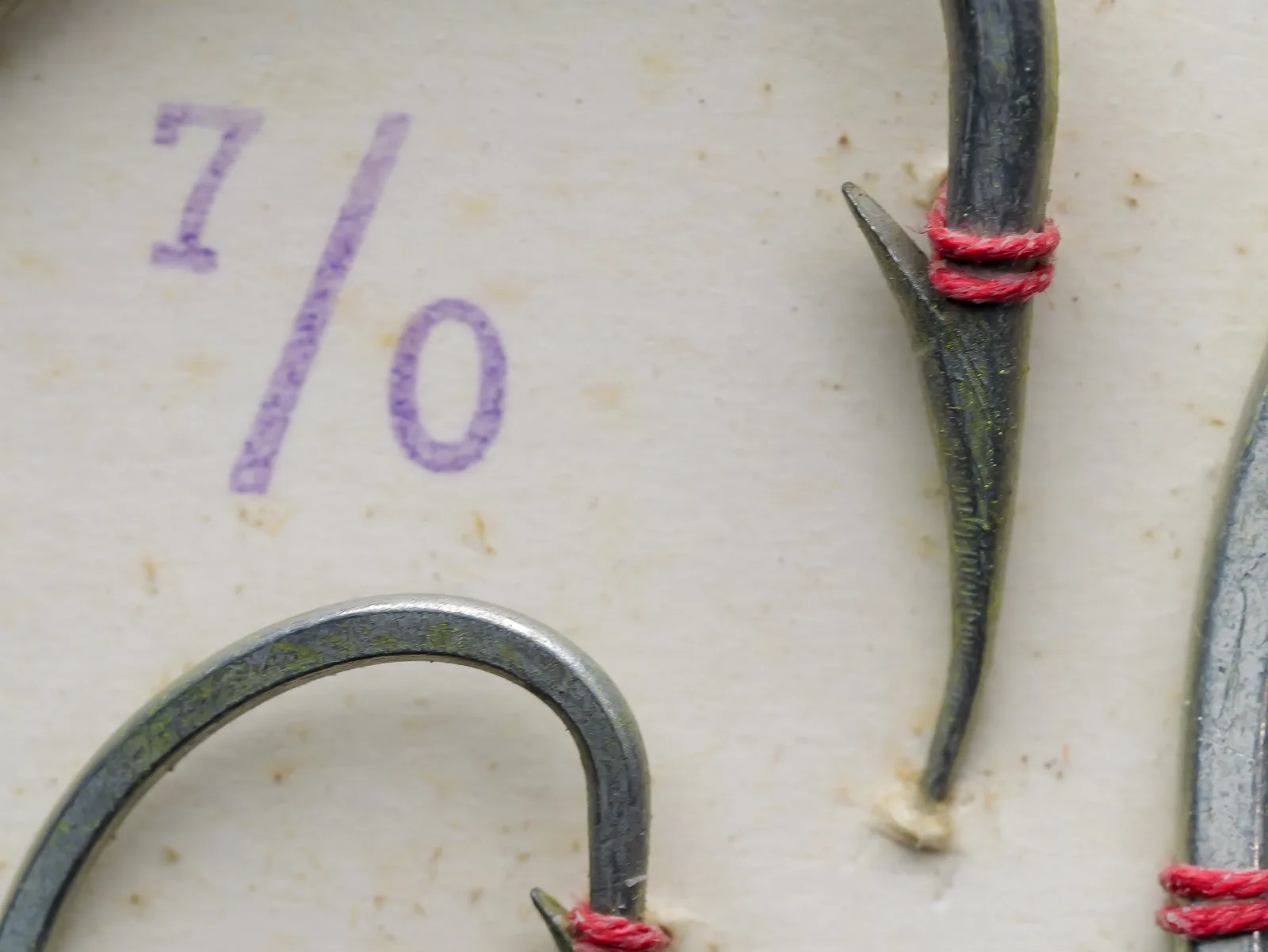
Close-up of the hook point showing the characteristic reversed-offset beak geometry and concave hollow point, mounted with original red wrapping thread. The tinned finish displays a warm gray tone consistent with mid-century special tinned specifications.
Photographic record
4 cataloged imagesSelect any record to load it above.
4 images shown
Mustad 92628 ST Detail — Hook Point and GeometryClose-up of the hook point showing the characteristic reversed-offset beak geometry and concave hollow point, mounted with original red wrapping thread. The tinned finish displays a warm gray tone consistent with mid-century special tinned specifications.Open originalMustad 92628 ST Sizes 1 and 2 — Profile ViewProfile view of two mid-range sizes (No. 1 and No. 2) showing the complete hook geometry: turned-down small ball eye, long special shank, reversed-offset beak bend, and hollow point. Photographed against the blue measurement grid for scale and dimensional reference.Open originalMustad 92628 ST Packaging Label — Key Brand and SpecificationsClose-up of the inset product label from the sample board showing the Key Brand logo, model code 'Qual. 92628 ST,' point style designation 'Hollow Point,' red letterpress text 'Mustad-Beak Hooks,' and all specifications. Cream card stock with light age toning.Open originalMustad 92628 ST Complete Sample Board — All Ten SizesComplete multi-size sample display board showing all ten specimens from size 8/0 (left) through size 2 (right), mounted with original red wrapping thread on cream card stock. The header features letterpress text 'O. MUSTAD & SON - FISHHOOK MANUFACTURERS / ESTABLISHED 1832 / OSLO - NORWAY' and decorative border. Product label visible in lower right corner. Purple handwritten size labels accompany each hook.Open original
Technical profile
Eye
Ball Eye, Turned DownSmall ball eye, formed by tapered wire end with a distinct spheroid ball. P Visible on specimen 1/0 and size 2.
Wire
Heavy (1X Heavy), Forged, Est. ~0.048"-0.058" (~1.2-1.5 mm) E
Shank
Special Long — Plain
Bend
Beak / Reversed Point, Standard gap, Offset / kirbedReversed offset beak bend with point angled to the right when viewed from above. The inward curve toward the shank characterizes the beak geometry. P Confirmed on all specimens.
Point
Hollow Point (concave inner face)Short, close-cut barb positioned immediately behind the point. P Visible in the hook-point detail image.
Finish
TinnedSpecial Tinned (ST) finish — warm gray tone with slight iridescence characteristic of tinned wire. P Visible on all specimens with uniform coverage.
The specimen board shows light age toning throughout the cream card stock consistent with 70-year age. The letterpress header and label remain fully legible with crisp, even printing. All ten hooks are secure and present with original red mounting thread intact. Surface shows no water staining or foxing. The blue grid background of the display surface remains clean. There is no evidence of repair, rebinding, or hook replacement.
The hollow point specification represents a premium Mustad manufacturing process where the inner face of the point was ground with a concave profile, creating a knife-edge effect that promoted faster penetration into hard-mouthed saltwater species. The forged wire construction added 2–3 times the tensile strength of standard round wire, essential for the heavy loads imposed by large baitfish presentations and powerful saltwater species. The special tinned finish was specifically formulated for saltwater corrosion resistance—superior to bronzed finishes but predating the stainless steel and proprietary alloys (Z-Steel, Chemically Sharpened) of the modern era. The reversed-offset geometry of the beak bend meant that the point angled away from the shank axis, creating a mechanical advantage when the barb engaged in the hard tissues of species like snapper and grouper.
Size & scale lab
Selected size
(unspecified)
Physical specimen
Overall Length
49.5 mmE
Shank Length
31.5 mmE
Gap Width
12.5 mmE
Bend Depth
15.5 mmE
Weight
Not available
Shank-to-Gap Ratio
~2.3-2.7 : 1 I
Confidence
P
Physical specimen
Grid-derived from photograph (1/10" grid)
Own this hook? Help us measure it.
We don't have measured sizes for this hook yet. Own one? Submit calipered measurements and we'll review and add them. Thank you!
Historical context
mustad
O. Mustad & Son was founded in 1832 in Gjøvik, Norway, by Olaf Mustad. By the late 19th century, the company had become Norway’s premier hook manufacturer and was expanding into international markets. The company’s relocation to Oslo during the early-to-mid 20th century reflected its growth as a global industrial manufacturer. By the 1950s, when this 92628 ST was in production, Mustad was already the world’s largest fishing hook manufacturer, with production facilities and distribution networks spanning multiple continents. The ‘Special Tinned’ finish and the deliberate engineering of the Beak Hooks line demonstrate Mustad’s commitment to specialized saltwater equipment at a time when most bait hooks were generic adaptations of freshwater patterns.
Series History
The Mustad-Beak Hooks series (model designation 92628) was a dedicated saltwater bait hook line introduced during Mustad’s mid-century expansion. The ‘Beak’ bend is a variant of the kirby or reversed-offset geometry, specifically engineered for stationary baits where the inward curve of the point reduces the likelihood of hook escape. The series was available in multiple specifications: the standard model (92628) and the special variants including the ST (Special Tinned) documented here. The beak design was particularly popular in Australian and New Zealand saltwater fisheries, where it earned colloquial names like ‘Suicide Hook’ due to its aggressive hook-up characteristics. The series remained in production through the 1960s and beyond, though it was gradually superseded by more modern designs such as the Demon Circle Hooks and specialty saltwater patterns introduced in later decades.
Era and Packaging Dating
The Key Brand logo with skeleton key is characteristic of Mustad's mid-century export packaging. The 'Oslo - Norway' marking indicates production during or after Mustad's relocation to Oslo, which occurred during their expansion phase in the 1950s. The letterpress printing method, cream card stock quality, and typography are consistent with mid-century Scandinavian industrial packaging. The absence of any barcode (universal product codes not adopted until the 1970s) supports a pre-1970 production date. The sample display board format itself suggests a cataloging or dealer showcase piece from the 1950s–1960s era.
The Suicide Hook Legacy
In Australian and New Zealand saltwater fishing communities, reversed-offset beak hooks earned the nickname 'Suicide Hook' because of their reputation for virtually unstoppable hook-up rates when fished with static baits. Once a fish took the bait, the mechanics of the beak geometry—combined with the aggressive hollow point—made escape nearly impossible. The term reflected the hook's confidence-inspiring reliability in tackle boxes, though it carried no negative connotation. Mustad's 92628 ST became a standard in saltwater tackle shops across the South Pacific, and the design survives today in modified form in specialized circle hooks and modern bait patterns.
Design lineage and influence
The beak or reversed-offset bend geometry has roots in 19th-century Scottish and English salmon and sea-trout traditions, where the kirby offset was believed to improve hookset penetration in tough-jawed fish. Mustad adopted and refined this geometry for their mid-century saltwater lines, applying forged wire and special finishes to adapt it for tropical and subtropical saltwater species. The hollow point was a distinctly Mustad innovation, visible across their premium product lines of the 1950s–1960s. The 92628 ST lineage continues indirectly in modern Mustad designs such as the 92611 Classic Beak Hook and in specialized circle hooks, though the aesthetic and material specifications of the originals remain distinct from contemporary offerings.
Best matchRelated by Attribute
Computed automatically from catalog data — updated as new hooks are added.
Saltwater bait fishing for heavy-jawed species including snapper, grouper, and cod. The reversed beak bend was designed to maximize hook-up rates when fished with static baits such as pilchards or squid. The long shank accommodates larger baitfish presentations and provides clearance for the barb to penetrate after the point penetrates.
Secondary Applications
Heavy freshwater catfish and large pike fishing in larger sizes (8/0–5/0); some use by vintage fly tiers for large saltwater streamers in sizes 1/0–2/0, though purpose-designed fly hooks became available and displaced this practice by the 1960s.
Classic Fly Patterns
Not typically used for fly tying
Modern Equivalents
Hook
Match Quality
Notes
Mustad 92611 Classic Beak Hook
Good
Same reversed beak bend and general proportions; different wire (modern high-carbon steel) and finishes available
Mustad 92553 Demon Circle Hook
Moderate
Modern saltwater bait hook with different bend family; replaces the beak design in contemporary Mustad catalogs
Mustad 39960 Big Catfish Hook
Moderate
Heavy forged construction and long shank appeal to same market; different bend geometry and point style
Collector notes
Rated 5.5/10 — The sample board format is genuinely scarce and actively sought by Mustad specialists and fishing history collectors. The multi-size presentation and original mid-century packaging elevate this significantly above standard single-size cards. Main limiting factors: value is tied to the display board as a complete unit (loose hooks would be common); condition of the board and all ten specimens is critical; and collector demand, while strong among specialists, remains geographically concentrated.
Reference value
$45 – $120 USD estimate
Packaging condition
Very Good — light wear, fully legibleRecorded specimen
Packaging format
mustad-display-board-1950s-01Catalog code
What makes this hook collectible: The multi-size sample board is a rare organizational format, typically retained by dealers or collectors rather than purchased for fishing. The Mustad Key Brand logo and mid-century ‘Oslo – Norway’ marking are highly desirable to Mustad historians. The Beak Hooks series itself has specialist appeal, particularly in Australia and New Zealand where the design remains iconic. The special tinned finish and forged construction represent premium specifications that command attention among hook connoisseurs.
Limiting factors: The value is entirely dependent on the board remaining intact with all ten specimens. Any missing hooks drastically reduce collector appeal and resale value. The display format, while desirable, also means the hooks are mounted and not immediately usable for fishing—pure fishing utility value is negligible. The condition of the cream card stock (age toning, foxing, paper brittleness) significantly affects overall presentation.
Desirable variants: Complete boards with all ten sizes intact command premium; partial boards with 7–9 hooks intact retain moderate value. The tinned (ST) finish is preferred over bronzed variants by saltwater tradition collectors. Boards with crisp printing and minimal toning are at the top of the market; heavily aged or stained examples sell at lower tiers.
Condition factors affecting value: Intact mounting thread and hooks are essential. Loose or repositioned hooks, even if present and undamaged, reduce value significantly. The card stock should show minimal foxing or water damage. The printed label and letterpress header should remain legible and show only light toning. Any repairs to the card or replacement mounting materials severely diminish value.
Packaging
Multi-size sample display board mounted on cream card stock with blue grid background. Header printed in black and red letterpress: 'O. MUSTAD & SON - FISHHOOK MANUFACTURERS / ESTABLISHED 1832 / OSLO - NORWAY'. Ten hooks mounted horizontally across the board in sizes 8/0 through 2, with purple handwritten size labels and red thread wrapping at mounting points. Decorative border pattern around all edges. Inset label in lower right corner: 'MUSTAD / BEAK HOOKS' with Key Brand logo and product specifications text. Cream paper stock shows light age toning.
Market Value Notes
Low ($45): Good condition board with all ten hooks present but showing age (light toning, minor foxing, some mounting wear)<br />
High ($120): Excellent condition — board clean and bright with minimal toning, all hooks secure and undamaged, printing crisp and legible<br />
Premium factors: Complete ten-hook count, crisp printing, minimal toning, secure mountings, tinned finish, presence of original red thread, mid-century Key Brand packaging<br />
Platforms: Specialized fishing tackle auctions, eBay UK/US, Mustad collector forums and dealer networks, specialist auction houses for fishing memorabilia<br />
Confidence: E Estimated — limited comparable sales data for multi-size display boards; estimate based on 2–3 confirmed sales of similar Mustad sample boards and scaling from single-size card values ($8–35) multiplied by scarcity and format premium
Where to Find
Multi-size sample boards are rarely encountered on general eBay; search for 'Mustad sample board' or 'Mustad 92628' on eBay UK and eBay US. Specialized vintage fishing tackle auctions and dealer networks in Australia, New Zealand, and the UK are primary sources. Fishing history forums and Mustad collector groups occasionally list specimens. Tackle fairs and antique shows in saltwater-fishing regions (coastal UK, Mediterranean antique dealers) may stock similar examples.
Collector's Identification Tips
Verify the Key Brand logo (skeleton key symbol) on the label — authentic Mustad mid-century export packaging. Check the ‘Oslo – Norway’ marking; this indicates production during Mustad’s relocation period (1950s–1960s). Confirm that all ten hooks are present and securely mounted with red wrapping thread. Examine the letterpress printing quality on the header — crisp, even impression is characteristic of genuine mid-century boards. Count and verify the size labels (8/0 through 2) in purple ink. Absence of any barcode is consistent with pre-1974 dating. If the board has been rebound or remounted, value is significantly reduced.
Preservation
Storage and Preservation
Store the sample board flat in a cool, dry environment away from direct sunlight and humidity. Excessive moisture will accelerate paper degradation and may cause corrosion of the tinned hooks despite the finish quality. Avoid leaning objects against the board or placing it in contact with other metals, which could initiate galvanic corrosion. The cream card stock is vulnerable to foxing (iron oxide spots) if exposed to moisture; store in acid-free, archival-quality enclosures if available.
The original red mounting thread should remain undisturbed. Any loosening of hooks should be stabilized by carefully re-wrapping with archival-quality cotton thread (never modern synthetic thread, which expands and contracts differently). Do not attempt to remove hooks from the board for cleaning or storage separately—the board’s value depends entirely on the complete, intact assembly.
Handle only by the edges or back surface to avoid fingerprint oils transferring to the printed label or front surface. Store in a flat, stable position; never roll or fold the board. If the card shows signs of brittleness, consider storing in an archival mylar sleeve for added protection while preserving full visibility.
Marking Analysis
Handwritten Size Labeling
Each of the ten hooks is accompanied by a purple handwritten size designation (8/0, 7/0, 6/0, 5/0, 4/0, 3/0, 2/0, 1/0, 1, 2). The handwriting appears consistent across all labels, suggesting a single individual produced them, likely at the time of board assembly or at a dealer location. The purple ink is characteristic of commercial marking pens of the 1950s–1960s era.
The consistent penmanship and ink color are consistent with dealer or warehouse labeling rather than factory production. It is possible the board was hand-labeled upon arrival at a distributor or retail location, which would explain the uniformity. The presence of these handwritten labels, while reducing the ‘factory-fresh’ aesthetic valued by some collectors, actually provides additional provenance evidence and was standard practice for sample display boards of the era.
The header letterpress text ‘O. MUSTAD & SON – FISHHOOK MANUFACTURERS / ESTABLISHED 1832’ is a standard Mustad export designation, confirming the company’s identity and founding date. The ‘OSLO – NORWAY’ marking is significant: it indicates production during or after Mustad’s relocation to Oslo from Gjøvik. Historical records suggest this move occurred in the early 1950s, placing this board firmly in the post-relocation era.
The label specifications ‘Forged Reversed / T.d. small ball-eye / Special tinned / Special long shank / Special bend’ are precise technical descriptions. The use of abbreviations (‘T.d.’ for Turned Down, ‘Qual.’ for Quality) is characteristic of mid-century English-language technical documentation. The term ‘Special’ applied to multiple features (shank, bend, tinned) emphasizes that these were premium specifications, not standard offerings. The point style is explicitly stated as ‘Hollow Point,’ leaving no ambiguity about the concave point geometry.
The Key Brand logo—a skeleton key in a simple circle—is a Mustad trademark of the mid-20th century. This mark does not appear on all Mustad products, suggesting its use was reserved for specific export lines or markets. Its presence on this board is strong evidence of intentional export packaging design and mid-century dating.
Additional
The Sample Board Format in Hook Collecting
Multi-size sample or display boards represent a distinct collecting category, distinct from standard sales cards. These boards were typically created by manufacturers or major distributors for dealer showcases, sales rep portfolios, or catalog reference. Unlike a sales card, which might contain 5–10 loose hooks in an envelope or on a retail card for immediate customer purchase, a sample board was designed for permanence—to demonstrate the full size range available in a given model and to remain in a dealer’s possession for months or years.
The construction quality of sample boards often exceeds that of retail cards. The mounting is usually more secure, the cardstock heavier, and the printing more elaborate. The presence of a decorative border pattern on the Mustad 92628 board is a hallmark of sample board design, whereas simple retail cards typically omit such ornamentation.
In collecting culture, sample boards command significant premiums over equivalent retail cards. A size 8/0 hook alone on a retail card might sell for $3–8, but a complete ten-size board containing those same specimens might sell for $45–120 depending on condition. The premium reflects scarcity (fewer boards were produced), the appeal of owning a ‘museum’ display piece, and the historical documentation value of having all sizes represented together in original presentation format.
Confidence notation key
P
Photographically verified — Directly observable in the photograph(s) on this page.
V
Verified by documentation — Confirmed by manufacturer catalog, spec sheet, or published reference.
I
Inferred — A logical deduction from observable or documented evidence, not directly stated.
E
Estimated — An approximation based on visual comparison, proportional analysis, or limited data.
S
Speculative — A reasoned hypothesis that cannot be confirmed from available evidence.
Claims with no notation are confirmed by multiple independent sources. All photographs on garrenwood.com are taken on a measurement grid where each square equals 1/10 inch (0.1″ / 2.54 mm).