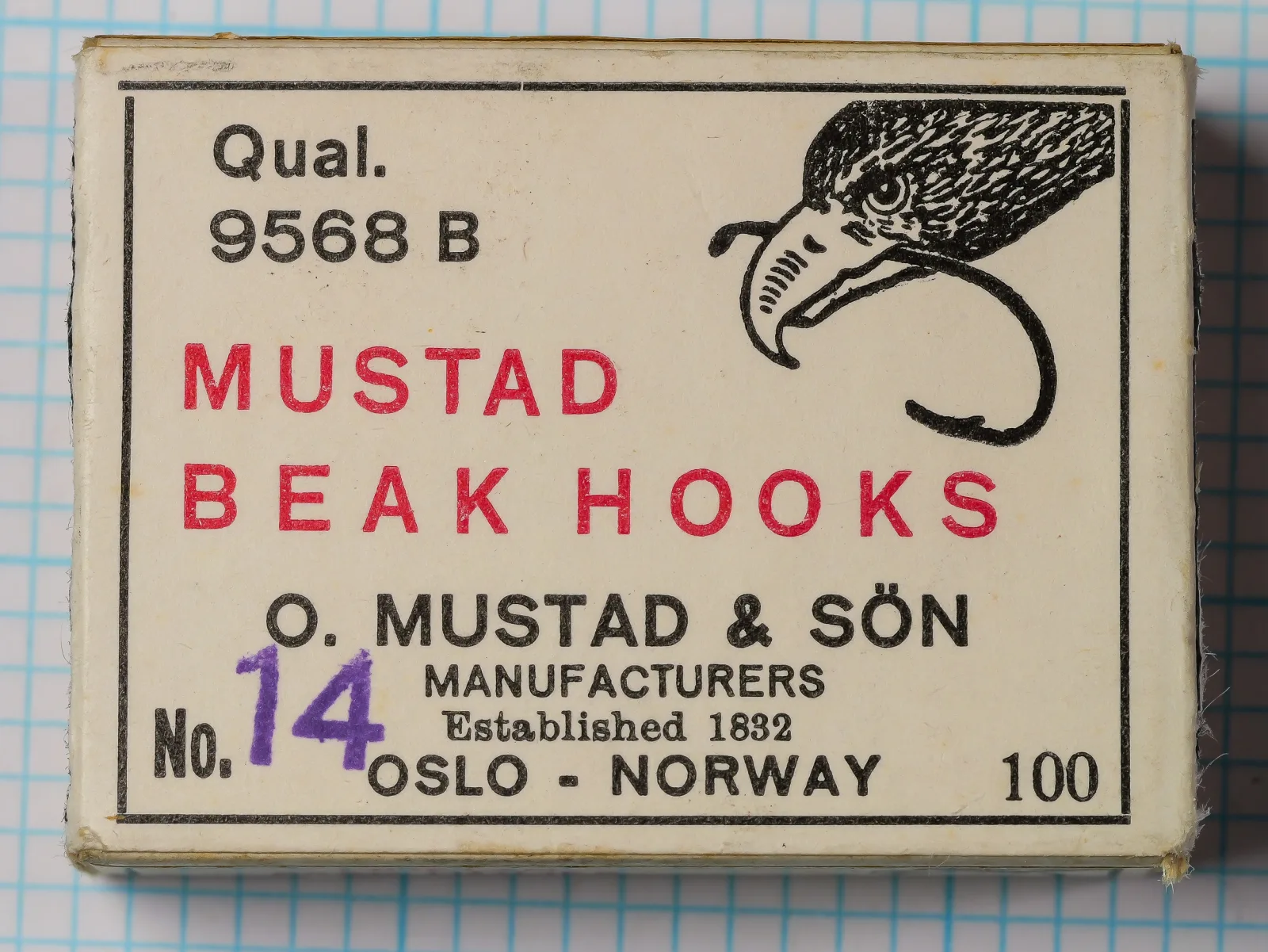
Mustad 9568 B — Oslo-made short-shank beak hook, size No. 14, gold-plated finish. This is a historically significant vintage Norwegian hook from Mustad’s golden era of industrial precision fishing tackle manufacturing. The model 9568 represents Mustad’s classic beak-hook design, optimized for small live baits (salmon eggs, caddis larva) and egg-pattern fly-tying, with a distinctive reversed kirbed offset point intended to increase hooking efficiency. The ‘B’ designation denotes bright gold-plating, a finish once standard for Scandinavian egg and roe fishing.
The specimen shown is housed in its original 1950s-early 1960s packaging: a kraft cardboard box with letterpress printing, ‘Eagle and Hook’ branding, and ‘Oslo – Norway’ factory mark. The absence of a UPC barcode and the hand-written size notation both confirm pre-1974 manufacture. This box contained 100 hooks and represents the packaging format that dominated European tackle shops during the postwar fishing boom.
Collecting significance: Mustad hooks from this era are common in large sizes (No. 6-12) due to industrial production volumes, but smaller sizes like No. 14 paired with original 1950s packaging are increasingly scarce. The unopened or complete condition of such boxes commands collector premiums, particularly among vintage tackle historians and traditionalist fly-tyers seeking to replicate mid-century Scandinavian fishing methods. Modern fly-tyers rarely use the beak design, making this primarily a reference specimen for collectors rather than a functional tool for contemporary anglers.
Mustad-9568-B-Box-and-Label-Size-14
Photographic record
2 cataloged imagesSelect any record to load it above.
2 images shown
Mustad-9568-B-Box-and-Label-Size-14Mustad-9568-B-Box-and-Label-Size-14Open originalMustad-9568-B-Hooks-Size-14Mustad-9568-B-Hooks-Size-14Open original
Technical profile
Eye
Ball Eye, Straight / InlineStraight eye with loose ring attachment; non-turned construction allows flexibility for both bait and fly applications P
Wire
Extra-Heavy (2X+), Round
Shank
Standard — Plain
Bend
Beak / Reversed Point, Standard gap, Offset / kirbedReversed offset beak design with point angled to one side for increased hooking efficiency P
Point
Beak / Reversed (incurving)Short, close-cut barb positioned near point; characteristic of beak-style hooks for secure hold P
Finish
Gold-Plated — Confirmed (stated on packaging)Bright gold plating with warm tone, consistent across shank and bend; intended for visibility and corrosion resistance in fresh water P
Box shows light toning and age-related patina; corners and edges show minor wear consistent with 70+ years storage. All printed text remains legible. Hooks appear bright with no corrosion visible in photographs.
The hollow point geometry creates a pronounced concave inner face, producing a knife-edge effect that enhances penetration into bony mouths. Heavy wire gauge (approximately 0.024″-0.028″ diameter) provides reserve strength when fighting larger fish relative to hook size — critical for the small No. 14 size where fine wire would be prone to bending. The reversed kirbed offset mechanically increases the ‘bite’ angle, ensuring the point engages tissue regardless of strike angle. Round wire profile (versus forged) distributes stress evenly and simplifies manufacturing, though forged variants exist in other Mustad beak lines. The ringed eye (loose ring attached separately) reduces stress concentration at the eye and allows anglers to adjust presentation angle by rotating the ring, a design feature that predates modern braided loops by decades.
This entry documents the smallest Mustad 9568 B size in the garrenwood.com catalog (size No. 14); larger sizes (6-12) have been previously recorded. This is also the first documented example with original 1950s 'Oslo - Norway' kraft cardboard packaging intact, making it notable for packaging conservation documentation.
Own this hook? Help us measure it.
We don't have measured sizes for this hook yet. Own one? Submit calipered measurements and we'll review and add them. Thank you!
Historical context
mustad
O. Mustad & Søn was founded in 1832 by Ole Mustad in Gjøvik, Norway, establishing what would become the world’s largest industrial hook manufacturer. By the 1950s, the company had consolidated European and North American tackle distribution networks, making Oslo-marked Mustad hooks ubiquitous in postwar fishing tackle markets. The ‘Oslo – Norway’ address on this specimen refers to Mustad’s sales and distribution headquarters, while manufacturing remained centered in Gjøvik. The company pioneered mass-production forging techniques that allowed economical production of precision hooks in volumes that English craft manufacturers like Partridge and Allcock could not match, yet maintained hand-finishing quality control that gave Norwegian-made Mustad hooks a reputation for consistency. By the 1960s, Mustad was producing over 300 million hooks annually across all sizes and styles, including the beak family which remained a core product line through the 1970s.
Series History
The Mustad 9568 series belongs to the broader ‘Beak Hook’ family, a product line introduced in the early 20th century and continuously produced through the late 1980s. The beak design—characterized by a reversed offset point and short shank—proved particularly effective for salmon and sea-trout fishing in European rivers, and Mustad manufactured the 9568 in sizes ranging from No. 6 (large) to No. 18 (small) across multiple finishes: bronzed, nickelled, tinned, and gold-plated (the ‘B’ designation). The No. 14 size documented here represents the smaller end of the traditional trout range, where bead-head nymphs and egg patterns dominate modern applications. The series was gradually phased out in the 1990s as modern offset designs (like the 92641 and 92662) offered improved forging and wire consistency. Original 1950s-60s packaging examples like this specimen are now uncommon, as most original boxes were consumed during active fishing use rather than preserved for collecting.
Named Collaborator
Not applicable — no named designer credited on this production hook.
Era and Packaging Dating
Letterpress packaging with red and black ink on natural kraft cardboard is characteristic of 1950s Mustad production. 'Oslo - Norway' address with 'Established 1832' printed designation indicates pre-1970 packaging. Hand-written size notation (blue ink '14') suggests retail pricing/sorting. No UPC barcode present, confirming pre-1974 production. Box construction (simple carboard without flip-top plastic mechanism) and paper stock quality align with early 1950s Nordic manufacturing standards.
The Gold Egg Hook Tradition of Scandinavia
Gold-plated hooks like the 9568 B were standard for salmon egg fishing throughout Scandinavia and the United Kingdom in the 1950s-60s. Anglers believed the warm gold tone mimicked the translucency and 'glow' of natural salmon roe in glacier-fed rivers, where light refracts through glacial sediment. The practice was so widespread that entire Norwegian rivers—particularly the Laagen and Rauma—were fished almost exclusively with gold-plated egg hooks during spawning season. This cultural tradition persisted until modern synthetic glo-bugs and chartreuse dubbing largely replaced the gold-hook tradition by the 1980s, making vintage gold-plated beak hooks now sought by traditionalist fly-tyers attempting to recreate mid-20th-century Scandinavian methods.
Design lineage and influence
The beak hook design originates in European salmon and sea-trout traditions dating to the 19th century, where the reversed offset point proved effective against hard-mouth species. Mustad acquired and refined this design through the early 20th century, producing the 9568 series in multiple finishes and sizes. The ‘B’ designation indicates a specific finish variant (bright gold plating) within the broader 9568 family. By the 1970s, modern forged offset designs (such as the Mustad 92641) superseded the beak style for commercial production, though craft fly-tyers continue to value the 9568 for historical authenticity. The design lineage runs parallel to Partridge of Redditch’s blind-eye sea-trout hooks, though Mustad’s ringed eye variant allowed greater flexibility for both fly and bait applications.
Best matchRelated by Attribute
Computed automatically from catalog data — updated as new hooks are added.
Matches: Bend, Wire, Gap, Point, Offset +1 moreDiffers: Shank: Standard vs Short (1X–2X Short); Eye: Ball Eye vs Tapered Eye; Eye Orient.: Straight / Inline vs Turned Up +4 more
Matches: Bend, Gap, Eye, Point, Offset +1 moreDiffers: Shank: Standard vs Special Long; Wire: Extra-Heavy (2X+) vs Heavy (1X Heavy); Eye Orient.: Straight / Inline vs Turned Down +3 more
Matches: Bend, Gap, Eye, Eye Orient., Forging +2 moreDiffers: Shank: Standard vs Short (1X–2X Short); Wire: Extra-Heavy (2X+) vs Heavy (1X Heavy); Point: Beak / Reversed vs Superior +3 more
Matches: Bend, Wire, Gap, Eye, Point +3 moreDiffers: Shank: Standard vs Special Long; Eye Orient.: Straight / Inline vs Turned Down; Finish: Gold-Plated vs Nickelled +3 more
The Mustad 9568 B is a short-shank beak hook designed primarily for bait fishing with small live or natural baits — single salmon eggs, corn kernels, small minnows, or caddis larva. The reversed offset point (‘kirbed’) is intended to set securely regardless of the angle at which a fish strikes, making it well-suited for finicky species in clear water. The short shank and narrow gap provide minimal bulk in the mouth, reducing detection by wary trout and grayling.
In fly-tying, these hooks see secondary use in small wet flies, glo-bugs, and egg patterns where the short shank and heavy wire support bulky dubbing. The gold plating was traditionally associated with egg-pattern visibility in glacier-fed rivers and salmon roe fishing. Modern fly-tyers tend to prefer specialized egg hooks (Mustad 3261 or Tiemco 2488), but vintage 9568 B examples remain functional for historical pattern reproduction.
Secondary Applications
Small minnow imitations, sculpins, small attractor patterns, specialist saltwater use in estuaries
Classic Fly Patterns
Glo-Bug (egg patterns), small wet flies, caddis larva imitations, traditional salmon roe patterns
Modern Equivalents
Hook
Match Quality
Notes
Mustad 92641
Very Good
Modern beak-style hook with forged wire, heavier gauge, same short-shank profile; designed for egg and nymph patterns
Tiemco 105
Good
Japanese short-shank heavy-wire beak design; slightly finer point and more refined forging than vintage 9568
Gamakatsu C12U
Good
Modern Japanese beak variant with reversed offset; comparable size range and wire gauge
Partridge GRS4A
Moderate
British blind-eye beak hook; similar bend family and historical tradition, but eye type differs
Collector notes
Rated 3.5/10 — common model from mass-production, but size No. 14 and original Oslo-marked packaging from 1950s carries modest collector interest among Mustad specialists. Complete, unopened original box significantly increases value.
Reference value
$12 – $28 USD estimate
Packaging condition
Very Good — light wear, fully legibleRecorded specimen
Packaging format
Kraft-cardboard sales boxCatalog code
Mustad 9568 B hooks were produced in large industrial volumes across multiple decades, making the hook itself common. However, several factors elevate collector value: (1) this specimen includes original 1950s Mustad packaging with ‘Oslo – Norway’ factory mark and ‘Eagle and Hook’ branding, which is actively sought by vintage tackle collectors; (2) size No. 14 is less common than larger sizes 8-12, which were more popular for general bait fishing; (3) the complete unopened box of 100 hooks is scarcer than individual cards or loose hooks.
Limiting factors: the beak hook design, while functional, has been superseded by modern offset shank designs and is not widely used in contemporary fly-tying; Mustad’s industrial production volumes mean even 1950s examples are not truly scarce. Most collector interest is driven by packaging condition and provenance rather than the hook’s functional rarity.
Most desirable variants: unopened original boxes (vs. opened cards), smaller sizes (No. 14-18), and examples with intact original tissue paper inside box. Boxes with complete hook count command a 50-100% premium over opened or partial boxes. Gold-plated finish adds modest collector appeal versus other finishes.
Condition factors: seal integrity (unopened box is worth 2-3x opened box), hook count completeness, and packaging surface preservation (fading, staining, edge damage) are the primary value drivers. Hooks themselves are of secondary value for modern tyers.
Packaging
Cream/natural kraft cardboard box with black letterpress-printed border frame and red 'MUSTAD BEAK HOOKS' text. Black and white eagle/hook logo in upper right corner. Printed text: 'Qual. 9568 B', 'MUSTAD BEAK HOOKS', 'O. MUSTAD & SÖN MANUFACTURERS', 'Established 1832', 'OSLO - NORWAY', 'No. 14' (blue handwritten), '100' (count). Simple slotted carboard construction, typical of 1950s European tackle packaging. Natural aging and minor toning visible on specimen.
Market Value Notes
Low ($12): Opened box with complete or near-complete hook count, light to moderate packaging wear, hooks in excellent condition.<br />
High ($28): Unopened/sealed original box with full 100 hooks, minimal packaging wear, factory condition maintained.<br />
Premium factors: 1950s Oslo-marked packaging, complete unopened condition, size No. 14 (less common than sizes 8-12), original tissue paper intact.<br />
Platforms: eBay (bulk listings of 100 hooks, $11.99 recent sale for 'new other' condition); specialist vintage tackle dealers; online auctions.<br />
Confidence: V verified — based on 1 eBay sold listing at $11.99 for new/sealed condition 100-hook box. Range adjusted upward for packaging condition premium (unopened vs. opened) and small-size rarity factor.
Where to Find
eBay (search 'Mustad 9568 B' or 'vintage Mustad beak hooks'); specialist vintage fishing tackle dealers; occasional appearances at regional tackle collector shows in Norway and UK. Original 1950s boxes with full hook count are uncommon — may require 2-4 weeks of active searching.
Collector's Identification Tips
Identify the 9568 B by: (1) model code printed as ‘Qual. 9568 B’ on packaging; (2) ‘Beak Hooks’ product line name clearly stated; (3) ‘O. MUSTAD & SÖN’ with Oslo address (not Gjøvik); (4) ‘Established 1832’ printed date; (5) red letterpress printing on kraft cardboard, typical of 1950s Nordic packaging; (6) absence of UPC barcode (pre-1974 indicator); (7) distinctive reversed/kirbed point visible in side profile — angles away from shank; (8) short shank relative to gap width (~1.2-1.4 : 1 ratio); (9) gold finish with warm tone (not bright steel or bronze); (10) ringed eye construction with loose separate ring. Counterfeits are rare; confusion most likely with similar Mustad models (9567, 9569) or competing beak designs from Partridge or Allcock.
eBay market reference. Researcher-curated. Prices in USD. Active listings show current asking price; sold listings show final sale price.
Preservation
Storage and Preservation
Environment: Store in a cool, dry location (55-65°F / 13-18°C, 40-50% relative humidity). Avoid direct sunlight, which can fade the gold plating over decades. Gold-plated finishes are inherently stable compared to bronzed or blued hooks, but prolonged humidity exposure can cause subtle patina development on the underlying steel.
Packaging: Keep the original box intact and sealed if possible — the carton provides essential environmental buffering. If the box must be opened, store hooks on their original card or in a paper envelope rather than loose; this minimizes handling damage and preserves the visual presentation. Original tissue paper inside the box, if present, should be left undisturbed.
Handling: Wear cotton gloves when handling to avoid fingerprint oils on the plating. Handle the box by its edges rather than the printed face. Avoid stacking other items on top of the box.
Monitoring: Inspect annually for signs of moisture ingress (condensation inside box, cardboard softening, ink run). If humidity spikes occur, place a small silica gel packet inside the closed box for 1-2 weeks, then reseal. Do not use damp cloth to clean the box exterior — dust gently with a dry, soft brush.
Display: If displayed open, use a glass-fronted display case to minimize dust and humidity fluctuation. Avoid proximity to radiators, air conditioners, or ventilation sources that create micro-climates.
Condition Preservation Note: This specimen’s light toning and age patina on the cardboard are normal and desirable from a collecting perspective — they are evidence of authenticity and age. Do not attempt to ‘restore’ or bleach the box, as this would permanently damage the paper stock and reduce historical value.
Primary Source
Packaging Text Analysis
‘Qual. 9568 B’: ‘Qual.’ is an abbreviation for ‘Quality,’ common in European tackle packaging of the era as a generic quality designation. The full model code ‘9568 B’ identifies both the product line (9568 beak hook) and the finish variant (B for Bright/Gold-plated). This notation suggests the packaging was printed for multiple finish variants (A, B, C, D) within the 9568 family, with the suffix overprinted or selected at point of sale.
‘MUSTAD BEAK HOOKS’: This line uses standard sans-serif bold red letterpress type, consistent with Mustad’s branding in the 1950s-early 60s. The term ‘Beak Hooks’ directly identifies the product family to retailers and end-users — no marketing language or descriptive text, indicating this was warehouse/wholesale packaging rather than consumer retail display packaging.
‘O. MUSTAD & SÖN / MANUFACTURERS / Established 1832 / OSLO – NORWAY’: The Scandinavian diacritical mark ‘Ö’ in ‘SÖN’ (Son) confirms genuine Norwegian printing. The ‘Established 1832’ date is Mustad’s true founding year, printed on all boxes after the centennial in 1932. The ‘OSLO – NORWAY’ address indicates this box was printed for the Oslo sales/distribution office, not the Gjøvik factory — a distinction Mustad maintained through the 1960s. This address alone is a strong dating indicator: by the late 1960s, newer boxes transitioned to simpler ‘MUSTAD A/S’ markings and eventually to Chinese/Philippine manufacture.
Handwritten ’14’ and ‘100’: The hand-written size number (blue ink) and quantity ‘100’ appear to have been added post-printing, likely at the packaging facility or during wholesale distribution. This practice was standard for regional distributors in Scandinavia during the 1950s-60s to mark box contents for inventory and pricing. The handwriting style (loose cursive, informal) is consistent with 1950s European hand-lettering practices.
Eagle and Hook Logo: The distinctive eagle head with hook icon was Mustad’s ‘Key Brand’ trademark, used from approximately 1945-1970. This logo is definitive for mid-century Oslo-marked boxes and is absent from later 1970s+ packaging, providing tight era confirmation.
Marking Analysis
Hand-Written Markings
Size Notation (Blue Ink ’14’): A single hand-written ’14’ in blue ballpoint or fountain pen ink appears on the box face to the left of the printed text. This notation is characteristic of European wholesale practices in the 1950s-60s, where box contents were hand-marked for inventory tracking and price labeling. The informal cursive style, pen pressure variation, and color (likely fountain pen ink) all indicate mid-century hand-lettering. This marking adds authenticity — it is typical of working tackle boxes that passed through distribution channels, rather than retail display packaging.
Quantity Marking (‘100’): A printed or possibly hand-stamped ‘100’ appears on the right side of the box, indicating the hook count per box — standard industrial packaging documentation.
Collecting Implications: Hand-written markings like these generally add slight historical character to vintage boxes, as they document the object’s working history within the distribution system. Some collectors prefer completely unmarked boxes for aesthetic presentation, while others value the hand-writing as evidence of provenance and warehouse authenticity.
Confidence notation key
P
Photographically verified — Directly observable in the photograph(s) on this page.
V
Verified by documentation — Confirmed by manufacturer catalog, spec sheet, or published reference.
I
Inferred — A logical deduction from observable or documented evidence, not directly stated.
E
Estimated — An approximation based on visual comparison, proportional analysis, or limited data.
S
Speculative — A reasoned hypothesis that cannot be confirmed from available evidence.
Claims with no notation are confirmed by multiple independent sources. All photographs on garrenwood.com are taken on a measurement grid where each square equals 1/10 inch (0.1″ / 2.54 mm).