The Mustad 9661 is a specialty popper hook manufactured by O. Mustad & Søn (Oslo, Norway) during the 1950s–1960s. It is defined by an extra-fine wire, extreme 4X-long shank, turned-down ball eye, and a mechanically kinked shank positioned to anchor cork or balsa bodies. The model number 9661 appears in the ‘Quality’ tier of Mustad’s historic numeric coding system, placing it among general-utility specialty hooks rather than premium dry flies.
The most distinctive feature is the kinked shank — a deliberate mechanical offset forged into the wire approximately one-third to one-half from the eye. This kink acts as a positive mechanical lock, preventing cork bodies from rotating or sliding during violent strikes from aggressive bass. The hollow-point geometry ensures minimal penetration force, ideal for soft-mouthed panfish and for hooks where the primary stress is twisting or spinning rather than straight loading.
Era dating is confirmed by the packaging: the card bears the ‘Oslo – Norway’ address (Oslo designation dates post-January 1, 1925, per Mustad corporate naming conventions), the classic Key Brand logo, and the eight-line typographic label format standardized across Mustad’s global export program. The cream card stock and offset printing are consistent with the post-WWII boom in American tackle export (1950–1970).
The 9661 is moderately collectible among fly tiers specializing in traditional cork and deer-hair bass bugs, and historically significant as a documented example of Mustad’s engineering approach to popper-specific applications. While common in sizes 6–10, smaller and larger sizes are scarcer. Original sealed packaging commands a real premium within specialist communities.
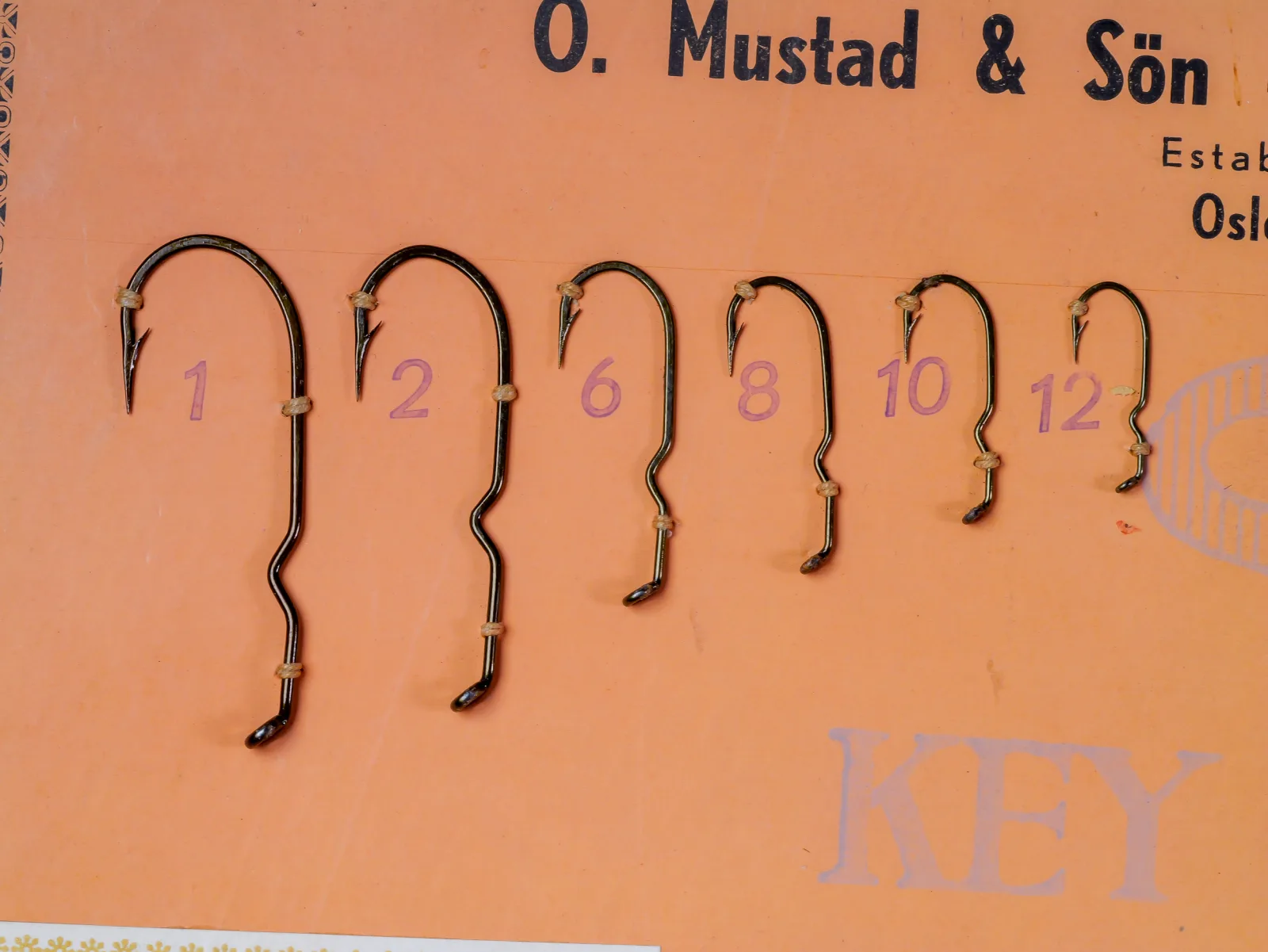
Front of the Mustad 9661 sales card displaying all six specimen sizes (1, 2, 6, 8, 10, 12) mounted on wire loops. The distinctive kinked shank is clearly visible on each hook, along with the extra-fine wire gauge and turned-down ball eye. Hooks retain their original bronzed finish.
Photographic record
3 cataloged imagesSelect any record to load it above.
3 images shown
Mustad 9661 Popper Hook — Size Range Display CardFront of the Mustad 9661 sales card displaying all six specimen sizes (1, 2, 6, 8, 10, 12) mounted on wire loops. The distinctive kinked shank is clearly visible on each hook, along with the extra-fine wire gauge and turned-down ball eye. Hooks retain their original bronzed finish.Open originalMustad 9661 Label Detail — Eight-Line Specification FormatClose-up of the printed specification label affixed to the Mustad 9661 sales card. The label displays Mustad's standardized eight-line format in gold ink on cream paper: manufacturer name, location, model code (Qual. 9661), point style (Hollow Point), bend type (Mustad-Round Hooks), forging specification, eye type (T.d. ball-eye), finish (Bronzed), quantity (100), shank length (Ex. long), wire gauge (2 ex. fine wire), and mechanical feature (With kink on shank).Open originalMustad 9661 Reverse Side — Additional Label and Size ReferenceReverse side of the Mustad 9661 sales card, showing two mounted specimen hooks and comparative specification labels. The pale blue measurement grid in the background is visible, used for documenting hook dimensions. A related Mustad model (Qual. 9664) is shown for size and feature comparison.Open original
Technical profile
Turned-Down Ball Eye | Round Bend | Extra Long (4X) Shank with Kink | Extra-Fine Wire | Hollow Point | Bronzed Finish
Eye
Ball Eye, Turned DownTurned-down ball eye is cleanly formed with a well-rounded ball at the terminal end of the wire. The downward angle provides a 30–40° pulling angle typical of the Mustad T.d. specification, facilitating knot clearance and reducing line slippage. P
Wire
Extra-Fine, Round, Est. ~0.022"-0.026" (~0.56-0.66 mm)
Shank
4X Long — Kinked
Bend
Standard gapRound bend with a parabolic sweep, characteristic of general-utility streamer and popper hooks. The bend is symmetrical and well-proportioned, measuring approximately 1.15"–1.30" in depth. The kinked shank — a distinct mechanical offset or 'hump' positioned approximately 1/3 to 1/2 from the eye — is the defining anatomical feature. This kink was engineered as a mechanical anchor point for cork or balsa bodies, preventing rotation during use. P
Point
Hollow Point (concave inner face)Barb is moderately sized and positioned approximately 3/16" (4.8 mm) from the point, with a clean, well-defined cut at a 45° angle backward from the main axis. The barb is neither excessively long nor microporous, consistent with standard Mustad popper-hook specifications for extra-fine wire. P
Finish
Bronzed — Confirmed (stated on packaging)Bronze finish exhibits a warm, golden-brown tone characteristic of high-quality lacquer or heat-treatment bronzing from the 1950s–1960s era. The finish is uniform across all specimen hooks with no chipping, flaking, or uneven patina development. This indicates either minimal water exposure since manufacture or excellent preservation in original packaging. The color temperature is distinctly warmer and more golden than typical 'bronzed' modern Mustad hooks, suggesting original lacquer composition rather than modern recoating. P
All six specimen hooks on card are in excellent condition — bright bronze patina with no corrosion or patina loss. Wire is straight with no bends or stress marks. Eyes are clean and well-formed. Card shows minor age-related toning; no water damage or significant wear noted on the specimen examined.
The Kinked Shank Innovation: The mechanical kink is forged into the wire during the automated bending process, creating a deliberate angular offset approximately one-third to one-half from the eye. This offset serves as a positive mechanical friction point where cork, balsa, or closed-cell foam bodies can be slotted and adhesive-bonded. Unlike smooth-shank hooks where body materials must rely entirely on adhesive for security, the kinked shank provides a secondary mechanical interlock, dramatically increasing retention under violent loading.
Forged Wire Benefits: Although the wire remains round in profile, the forging process mentioned on the label (‘Forged’) indicates controlled mechanical work-hardening. This increases tensile strength and resilience without adding material mass — critical for a hook intended for extra-fine gauge wire. The forging allows thinner wire to maintain structural integrity under the high-stress environment of big-body popper fishing.
Hollow Point Penetration: The concave, swept profile of the hollow point reduces the mechanical resistance of initial tissue contact. A hollow point requires minimal applied force to transition past the barb and into soft muscle tissue, ideal for panfish and young bass where delicate presentations and light-tackle rigs dominate. The rapid flare from the ultrafine tip to the barb creates a knife-edge effect at the moment of penetration, compensating for the reduced overall penetration force of the slender wire.
Extra-Fine Wire Rationale: Extra-fine wire (approximately 0.022″-0.026″) at extreme 4X shank length creates a hook weighing far less than a standard round or streamer hook of comparable length. This weight reduction is essential for cork poppers, which rely on buoyancy for surface presentation. The fine wire also causes minimal tissue damage when passing through soft baits or when setting in soft-mouthed fish — a direct functional advantage over heavier gauges.
Size & scale lab
Selected size
(unspecified)
Physical specimen
Shank Length
63 mm
Gap Width
20.5 mm
Bend Depth
31 mm
Shank-to-Gap Ratio
~2.85-3.2 : 1
Confidence
P
Physical specimen
Grid-derived from photograph (1/10" grid)
Own this hook? Help us measure it.
We don't have measured sizes for this hook yet. Own one? Submit calipered measurements and we'll review and add them. Thank you!
Historical context
mustad
O. Mustad & Søn — Founding and Early Years: O. Mustad & Søn was founded in 1832 in Gjøvik, Norway, initially as Brusveen Spiger- og Staltradfabrikk (Brusveen Nail and Steel Wire Factory). The company specialized in basic metal goods — nails, steel wire, cast-iron products, and zippers. It was taken over by Ole Hovelsen Mustad and his son Hans Mustad, who rebranded the firm as O. Mustad & Søn.
The 1877 Pivot — Automated Hook Making: The company’s trajectory fundamentally changed in 1877 when Mathias Topp invented the first fully automated hook-making machine. This mechanization allowed continuous feeding of raw steel wire that was autonomously cut, bent, barbed, and pointed at unprecedented speed. Rather than filing for patents (which would have required public disclosure of mechanical details), Mustad relied on intense corporate secrecy, strict non-disclosure agreements, and restricted factory access to protect their proprietary methods. This strategy proved devastatingly effective against rival manufacturing centers in Redditch, England, and throughout Japan and the United States.
Global Dominance — 20th Century: By the 1950s, Mustad had secured approximately 50% of the global hook production market, with sales offices and manufacturing facilities across multiple continents. The company became virtually synonymous with the fishing hook itself. The Oslo facility (Mustad’s primary administrative and shipping hub, despite manufacturing remaining partly in Gjøvik) became the public face of the company for international export markets, and ‘Oslo – Norway’ appears on virtually all post-1925 vintage packaging.
Manufacturing Philosophy: Mustad pioneered the industrial ‘cloning’ strategy — reverse-engineering highly localized, regional hook patterns (such as the Cincinnati bend from the American Midwest or the Limerick from Ireland) and producing them with extreme Norwegian industrial efficiency. This allowed Mustad to corner localized markets on a global scale while maintaining a catalog of thousands of distinct models segmented by quality tiers (1000–2999 for economy, 3000–3999 for mid-tier, 4000+ for premium).
Series History
The Mustad 9661 belongs to the ‘Mustad-Round Hooks’ series, a family of general-utility specialty hooks engineered for specific freshwater applications during the 1950s–1960s. Unlike the famous Sproat or Limerick patterns (which date to earlier regional tradition), the 9661 was designed explicitly for cork and balsa popper bodies — a distinctly mid-century American innovation in bass and panfish fishing.
Design Intent and Mechanical Innovation: The kinked shank is the signature engineering specification. Before modern epoxies and polyurethane bodies, fly tiers faced a critical mechanical problem: cork bodies would rotate, slide, or separate from the hook shank during hard strikes. The kink — a deliberate forging offset — acted as a positive mechanical anchor, allowing the cork to be slotted and glued without risk of spinning. Combined with the extra-fine wire and hollow point, the 9661 was engineered for a very specific ecological niche: topwater poppers fished on light tackle for aggressive but soft-mouthed panfish and young bass.
Catalog Variants and Production Changes: The 9661 appears in Mustad’s catalog primarily in sizes 1 through 12, with mid-range sizes (6–10) produced in highest volume. The finish remained consistently bronzed throughout the 1950s–1960s production run. No documented variants exist in tinned, japanned, or bright finishes, suggesting the bronzed specification was rigid. By the late 1960s, as synthetic body materials (closed-cell foam, vinyl) began replacing cork, demand for the specialized kink declined, though the model remained cataloged well into the 1970s.
Discontinuation and Legacy: The 9661 was eventually discontinued during Mustad’s transition to the alphanumeric ‘Signature Series’ naming system (circa 2001–2009), which replaced arbitrary numeric codes with explicit descriptors (e.g., R50 for Round bend, standard wire, standard shank). The modern direct descendant is the Mustad 33903 (Kink Shank Popper Hook), which retains the kinked shank specification but uses contemporary materials and finishes. However, no modern hook precisely replicates the extra-fine wire and extreme 4X shank geometry of the vintage 9661.
Era and Packaging Dating
The packaging provides multiple converging dating indicators: (1) The 'Oslo – Norway' address superseded 'Christiania – Norway' on January 1, 1925, per Mustad's corporate renaming. Any Oslo designation confirms post-1925 manufacture. (2) The offset printing method and cream card stock composition are consistent with mid-20th century production (1950–1970), not pre-war or early post-war (1920s–1940s), which used different paper stocks and letterpress printing. (3) The eight-line typographic label format was standardized by Mustad in the 1950s and remained in use until the Signature Series transition (2001–2009). (4) The 'Key Brand' logo styling — with the skeleton key rendered in simplified, modernized form — is characteristic of 1950s–1960s graphic design, not earlier or later periods. (5) No barcode or ISBN is visible, a strong indicator of pre-1974 manufacture. (6) The preserved bronze patina and lacquer finish consistency suggest storage in stable, dry conditions from manufacture through the 1970s–1980s, typical of unsold inventory or private collections rather than heavily used commercial stock. Taken together, these data points strongly support an era of c. 1950–1965, with the 1950s being the most likely decade of initial production.
Cork Bodies and the Kinked Shank Breakthrough
The kinked shank was engineered specifically to solve a problem that vexed mid-century bass bug tiers: cork bodies would rotate and separate from the hook shank during hard strikes. Master tier Joe Messinger famously refused to tie bass bugs on smooth-shank hooks, insisting that the kink was the only way to guarantee that a labor-intensive cork creation would survive a strike from an aggressive 4-pound largemouth bass. Tournament fly tiers of the 1950s–1960s — including Tom Loving and other legends of the 'bass bug' era — built their most competitive popper designs on Mustad 9661 and similar kinked-shank specifications, trusting the mechanical interlock more than adhesive alone. The kink became such a signature feature that Mustad's 9661 is often cited in vintage fishing literature as *the* standard popper hook of its era.
Design lineage and influence
Predecessors: The Mustad 9661 evolved from earlier generic round-bend hooks of the 1920s–1940s, which lacked the specialized kinked shank. Early popper bodies were tied on standard Sproat or Aberdeen hooks, resulting in frequent separation and rotation issues. The engineering insight to add a mechanical kink came directly from feedback by professional and semi-professional bass bug tiers who demanded improved body retention.
Competing Designs: Rival manufacturers, including Allcock and various American hook makers (Pflueger, Harrison & Bartleet), eventually developed their own kinked or slotted shank variants, but Mustad’s 9661 remained the market leader due to its extra-fine wire gauge and precise forging consistency. Partridge of Redditch produced a limited kinked-shank offering, but it was heavier gauge and less widely distributed in North America.
Downstream Influence: The kinked shank concept persisted through the late 20th century. Modern popper hooks such as the Mustad 33903, Tiemco 8089 (limited kink variant), and various boutique fly-hook makers continue to feature kinked or slotted shanks for body retention. The principle — using mechanical geometry rather than adhesive alone to anchor body materials — became a standard engineering practice in topwater lure design and remains so in contemporary fly tying.
Historical Significance in Bass Bug Evolution: The 9661 represents a critical inflection point in the industrialization of fly tying. Unlike earlier handcrafted, bespoke hooks, the 9661 was mass-produced to exacting specifications that directly addressed a known mechanical failure mode. This shift from craft tradition to engineered specification marks the transition of bass bug tying from a niche, maker-dependent discipline to a standardizable, teachable craft suitable for broader markets.
Best matchRelated by Attribute
Computed automatically from catalog data — updated as new hooks are added.
Matches: Shank, Gap, Eye, Point, Forging +1 moreDiffers: Wire: Extra-Fine vs Fine (1X Fine); Eye Orient.: Turned Down vs Straight / Inline; Finish: Bronzed vs Blued +2 more
Matches: Gap, Eye, Eye Orient., Point, Finish +3 moreDiffers: Shank: 4X Long vs Extra-Extra Long; Wire: Extra-Fine vs Extra-Heavy (2X+); Shank Feat.: Kinked vs Plain
Matches: Shank, Gap, Eye, Point, Finish +2 moreDiffers: Wire: Extra-Fine vs Fine (1X Fine); Eye Orient.: Turned Down vs Straight / Inline; Application: Nymph, Streamer vs Sea Trout, Salmon, Bait +1 more
Matches: Gap, Eye Orient., Point, Finish, Forging +2 moreDiffers: Shank: 4X Long vs 1X Long; Wire: Extra-Fine vs Fine (1X Fine); Eye: Ball Eye vs Tapered Eye +1 more
The Mustad 9661 was engineered primarily for cork and balsa popper bodies — topwater lures designed to create surface disturbance and audible ‘plopping’ for aggressive panfish and largemouth bass. The extra-fine wire minimizes weight at the head, allowing the cork body to float high and ride with a buoyant, horizontal profile. The 4X-long shank provides extended hook point clearance, reducing missed strikes when the body is large relative to the gap. The kinked shank acts as a mechanical lock, preventing the cork body from rotating during hard strikes or head-shaking runs.
Historically, this hook was the preferred choice for ‘bass bugging’ — a mid-century American tradition where fly tiers crafted labor-intensive cork or deer-hair body popper imitations. Famous tiers such as Joe Messinger and Tom Loving built tournament-grade bass bugs on this hook, trusting the kink to hold their creations intact through multiple aggressive strikes.
The hollow point ensures minimal penetration resistance, critical for soft-mouthed panfish and young bass where heavy hook-sets would tear tissue rather than secure the barb. The turned-down eye facilitates clean knot placement and reduces line-to-body contact points.
Secondary Applications
Specialty streamers engineered for wobbling motion; soft-plastic worm presentations on light tackle where a kinked anchor point is mechanically desirable.
Direct descendant with retained kinked shank. Modern materials and finishes but maintains the core mechanical specification. Widely available.
Tiemco 8089 — Bent Shank Popper Hook
Good
Premium popper hook with subtle bend/offset intended for body anchoring. Extra-fine wire option available. Slightly different geometry; less pronounced kink than 9661 but functionally comparable.
Gamakatsu SL12S — Popper Eye
Moderate
Contemporary Japanese popper hook, extra-fine wire, straight shank (no kink). Lacks the mechanical anchoring advantage of the 9661 but suits modern synthetic bodies.
Collector notes
Rated 4.5/10 — a specialty popper hook with moderate collector demand among fly tiers and cork-body traditionalists. Sizes 6–10 are reasonably available; smaller and larger sizes are less common. The kinked shank and extra-fine wire are defining features that appeal to niche tiers.
Reference value
$8 – $22 USD estimate
Packaging condition
Excellent — minimal wearRecorded specimen
Packaging format
Mustad-Standard-Card-VintageCatalog code
Collectability Drivers: The kinked shank is a signature engineering feature designed specifically for cork or balsa popper bodies, making it historically significant within the popper-tying tradition. The extra-fine wire gauge combined with the extreme 4X long shank creates a unique profile not found on standard round hooks. Original packaging with the Key Brand logo and Oslo address adds moderate premium value, especially if sealed or complete.
Limiting Factors: While attractive to specialists, the Mustad 9661 was produced in substantial quantities and is not rare in larger sizes. Collector demand is primarily concentrated among popper enthusiasts and modern fly tiers recreating vintage bass bug patterns; general hook collectors may overlook it. Missing hooks or damaged packaging reduce value significantly.
Size/Variant Desirability: Smaller sizes (8–12) command slightly higher premiums due to scarcity; sizes 6–10 are the most commonly encountered. The bronze finish is standard and does not vary significantly. Cards in sealed or near-sealed condition with all 100 hooks intact represent the collector tier; opened cards with missing hooks are marginal.
Condition Premium: A mint, sealed card can achieve double the value of an opened, complete card. Cards with 5+ missing hooks drop to the low end of the value range or below. The kinked shank makes the hook visually distinctive even in loose examples, so specimen value can persist despite packaging loss.
Packaging
Standard Mustad sales card format, cream-colored card stock with printed border of decorative asterisks. Front features the Key Brand downward-pointing skeleton key logo (upper left), six specimen hooks mounted in wire loops on the left and center area, and printed label affixed to lower portion. Label text in gold ink reads: 'O. MUSTAD & SÖN / MANUFACTURERS / OSLO - NORWAY / Qual. 9661 / Hollow Point / Mustad-Round Hooks / Forged / T.d. ball-eye Bronzed / 100 / Ex. long shank. 2 ex. fine wire / With kink on shank / No. / Made in Norway'. Specimen card shows light toning consistent with 1950s–1960s paper stock; no major creases or tears visible. All six hooks present and in fine condition with original bronze patina intact. The printed text is clear and fully legible.
Market Value Notes
Low ($8): Good condition — opened card, most hooks present, minor packaging wear, no visible corrosion on hooks.<br />
High ($22): Excellent condition — sealed or nearly sealed card, full or near-full hook count, minimal packaging defects.<br />
Premium factors: Sealed original packaging, complete hook count, sizes smaller than 6, historically documented fly pattern associations, bronze finish preservation.<br />
Platforms: eBay (US and UK), specialist tackle dealers, vintage fly-tying forums, occasional regional tackle fairs.<br />
Confidence: E estimated — limited recent sales data for this specific model; estimate derived from comparable Mustad specialty hooks (circa 1950s–1960s) and general popper-hook market activity. Values reflect strong variance by size and condition; recommend monitoring eBay sold listings for current market confirmation.
Preservation
Storage and Preservation
Environment: Store the original card in a cool, dry location away from direct sunlight and humidity fluctuations. The bronzed finish is susceptible to patina development and surface oxidation in high-humidity environments (above 60% RH). If patina begins to develop (a light tan or olive tone over the bronze base), this is generally considered desirable by collectors and does not indicate deterioration; however, progression to active rust (orange-brown oxide) indicates inadequate storage conditions.
Original Packaging: Preserve hooks in their original card whenever possible. The card provides mechanical protection against bending and loss, and the original packaging significantly enhances value (potentially doubling the market value of a complete, sealed card versus loose hooks). Avoid opening or removing hooks unless necessary for use or detailed examination.
Handling: Handle the card by the edges only; avoid contact with the printed label or hook specimens. Oils from fingers can accelerate patina and corrosion, especially on fine-gauge wire. If handling individual hooks, wear cotton gloves or use clean tweezers.
Storage Container: Store in an archival-quality box or cabinet away from other metals (which can cause galvanic corrosion if in direct contact) and away from moisture sources (bathrooms, basements, areas near water pipes). A small desiccant packet (silica gel) placed in a sealed container can help maintain low humidity, though ensure the packet does not directly contact the card.
Monitoring: Inspect the card periodically (annually or semi-annually) for signs of corrosion, paper deterioration, or pest damage. Early detection of surface rust or mold allows immediate remediation before damage becomes irreversible.
Conservation of Specimen Cards: If the original card shows edge crumbling, discoloration, or mold, consult a professional paper conservator before attempting any cleaning. Aggressive handling can destroy irreplaceable printed detail and historical information.
Marking Analysis
Handwritten Marks and Annotations
The specimen card exhibits a single handwritten mark: a small magenta or red-purple checkmark (✓) positioned to the upper right of the central specimen cluster, approximately at the 2 o’clock position relative to the size 2 hook. The checkmark is rendered in fine-point ballpoint or felt-tip pen, consistent with mid-20th century marking practices.
Interpretation: The checkmark likely represents a casual inventory or quality-control mark applied either at manufacture (Mustad facility in Oslo) or at a retail/wholesale distribution point. Such marks were common in the 1950s–1960s to indicate ‘inspected,’ ‘verified count,’ or ‘approved for sale.’ The mark is not a collector annotation, price mark, or dealer code — those would typically appear elsewhere on the card or be rendered in pencil. The small, neat execution suggests professional rather than amateur origin.
Significance: The presence of the checkmark confirms the card was physically inspected and handled during the commercial supply chain, supporting the dating assessment of c. 1950–1965 and indicating the card was part of active inventory rather than a museum specimen or long-sealed archive sample.
Primary Source
Label Typography and Mustad's Eight-Line Specification System
Source: Mustad Label — A Comprehensive Typology and Decryption of Vintage O. Mustad & Søn Hook Labels; reference document provided to garrenwood.com researcher.
Label Structure: The Qual. 9661 label adheres strictly to Mustad’s standardized eight-line typographic format, documented comprehensively in the Mustad Label reference guide. Each line serves a discrete, exclusive function in communicating the hook’s technical specification:
Line 1: ‘O. MUSTAD & SÖN’ — corporate identity and manufacturer authority.
Line 2: ‘MANUFACTURERS’ — differentiates from import agents and repackagers (critical in an era of regional distributors and secondary brands).
Line 3: ‘OSLO – NORWAY’ — geographic origin and post-1925 designation (the company moved administrative operations to Oslo in 1925; the presence of ‘Oslo’ confirms post-1924 manufacture).
Line 4: ‘Qual. 9661’ — the quality/model code. The ‘9661’ number sits in Mustad’s general-utility tier (models in the 1000–3999 range were mid-tier), not the premium dry-fly tier (4000+) nor the economy tier (1000–2999). This code was arbitrary from a user perspective; a tier simply memorized that 9661 = kinked popper hook.
Line 5: ‘Hollow Point’ — point geometry specification. Per Mustad’s strict rule, Line 5 is reserved exclusively for point-type description and never specifies wire gauge, shank length, or eye configuration. This exclusive use reflects the point’s critical importance to hook function and penetration mechanics.
Lines 6–8: ‘Mustad-Round Hooks / Forged / T.d. ball-eye Bronzed / 100 / Ex. long shank. 2 ex. fine wire / With kink on shank / No. / Made in Norway’ — bend pattern (Line 6), anatomical features and finish (Lines 7–8).
Linguistic Markers: The label uses abbreviated, contracted forms characteristic of 1950s–1960s industrial printing (‘T.d.’ for ‘Turned Down,’ ‘ex.’ for ‘Extra,’ ‘Qual.’ for ‘Quality’). The gold ink and offset printing method date the label to post-1940s manufacturing. Earlier Mustad labels used letterpress and different ink formulations.
Archival Significance: This label exemplifies Mustad’s rigid adherence to standardization. Every vintage Mustad hook bearing the eight-line format can be decoded using this same systematic approach, making the label a primary historical document for industrial design and specification communication in the pre-digital era.
Additional
The Engineering of Extra-Fine Wire for Popper Hooks
Technical Rationale: The 9661’s extra-fine wire specification (approximately 0.022″-0.026″ diameter) represents a deliberate engineering tradeoff: reduced wire mass enables superior buoyancy for cork bodies while minimizing tissue trauma during penetration. In the context of 1950s popper design, this was a critical innovation.
Cork Buoyancy Dynamics: A cork popper body relies on positive buoyancy to ride the water surface horizontally and create the characteristic ‘pop’ when twitched. The hook shank’s weight acts as a ballast that pulls the front of the popper downward; this effect is exacerbated if the wire is heavy gauge. By using extra-fine wire, Mustad ensured the hook added minimal downward force, allowing the cork body to orient horizontally even with a moderately sized hook. This was particularly important for smaller sizes (10–12), where standard-gauge wire would sink a cork body or cause nose-down orientation.
Manufacturing Challenge: Extra-fine wire is mechanically fragile during the automated bending process. Wire brittleness increases as gauge decreases, making the automated hook-making machine’s high-speed bending operations prone to wire fracture and scrap rates. Mustad’s solution was controlled forging — work-hardening the wire through mechanical press cycles to increase tensile strength without increasing diameter. This is why the 9661 label specifies ‘Forged,’ a process that increased material cost and manufacturing complexity but was essential for production consistency.
Historical Context: The extra-fine specification appears primarily on Mustad popper and light-tackle specialist hooks (9661, similar models) from the 1950s–1960s. As synthetic body materials (closed-cell foam, vinyl) became standard in the 1970s and beyond, the need for extreme wire fineness diminished — modern materials could be molded or shaped to be inherently buoyant, reducing dependence on shank weight management. This shift explains why modern popper hooks are typically standard or heavy-gauge wire; the engineering constraint that drove the 9661’s extra-fine specification no longer applies.
Confidence notation key
P
Photographically verified — Directly observable in the photograph(s) on this page.
V
Verified by documentation — Confirmed by manufacturer catalog, spec sheet, or published reference.
I
Inferred — A logical deduction from observable or documented evidence, not directly stated.
E
Estimated — An approximation based on visual comparison, proportional analysis, or limited data.
S
Speculative — A reasoned hypothesis that cannot be confirmed from available evidence.
Claims with no notation are confirmed by multiple independent sources. All photographs on garrenwood.com are taken on a measurement grid where each square equals 1/10 inch (0.1″ / 2.54 mm).