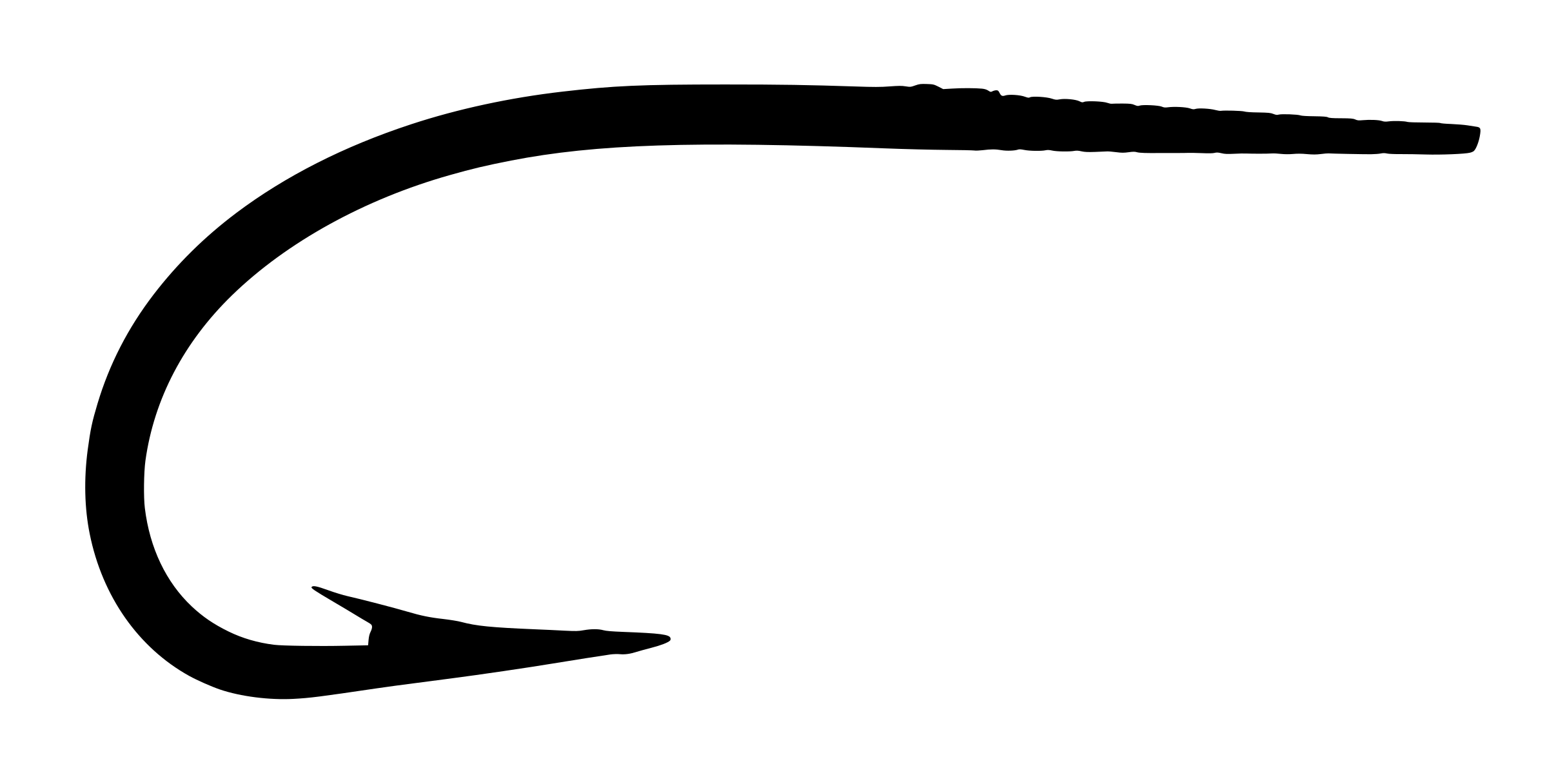
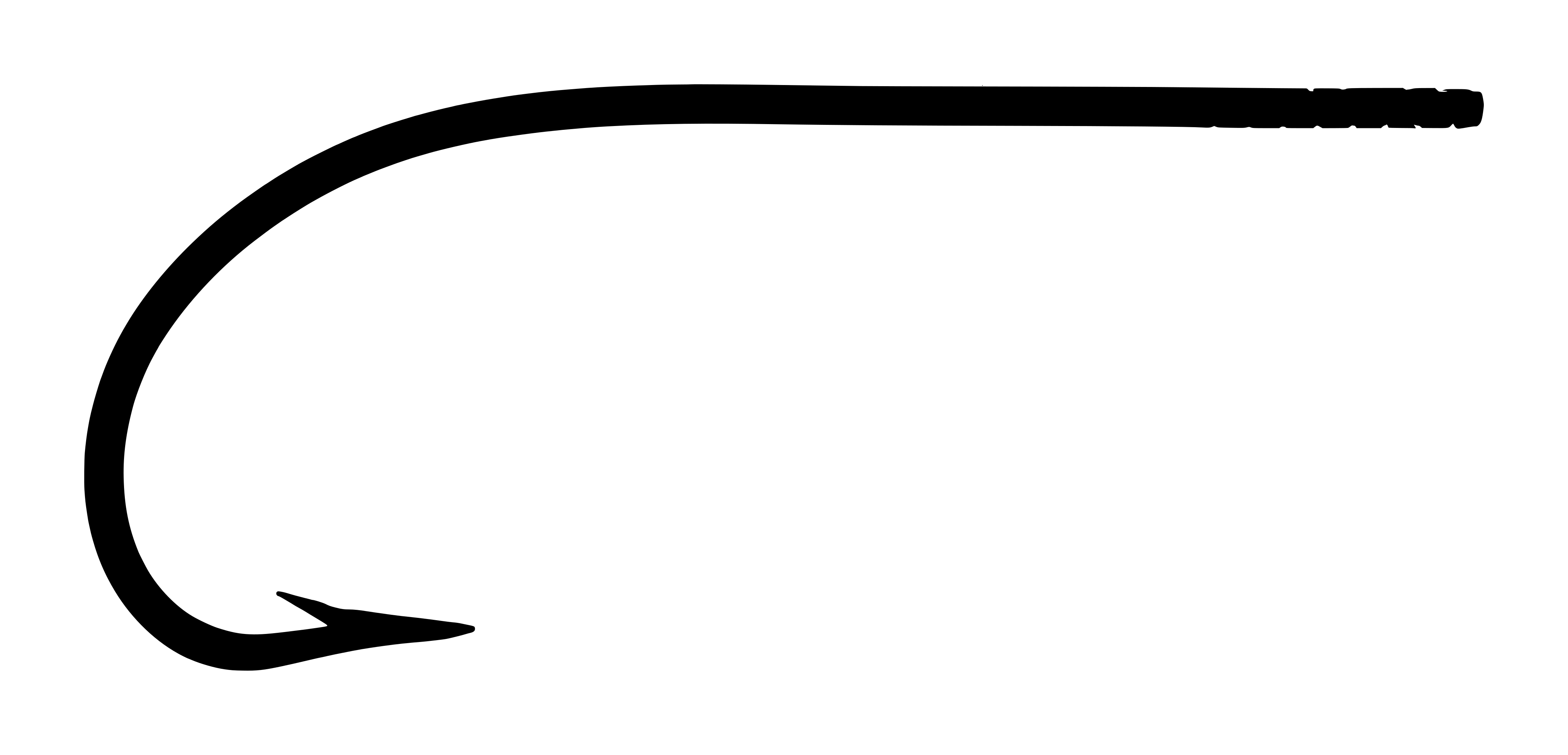
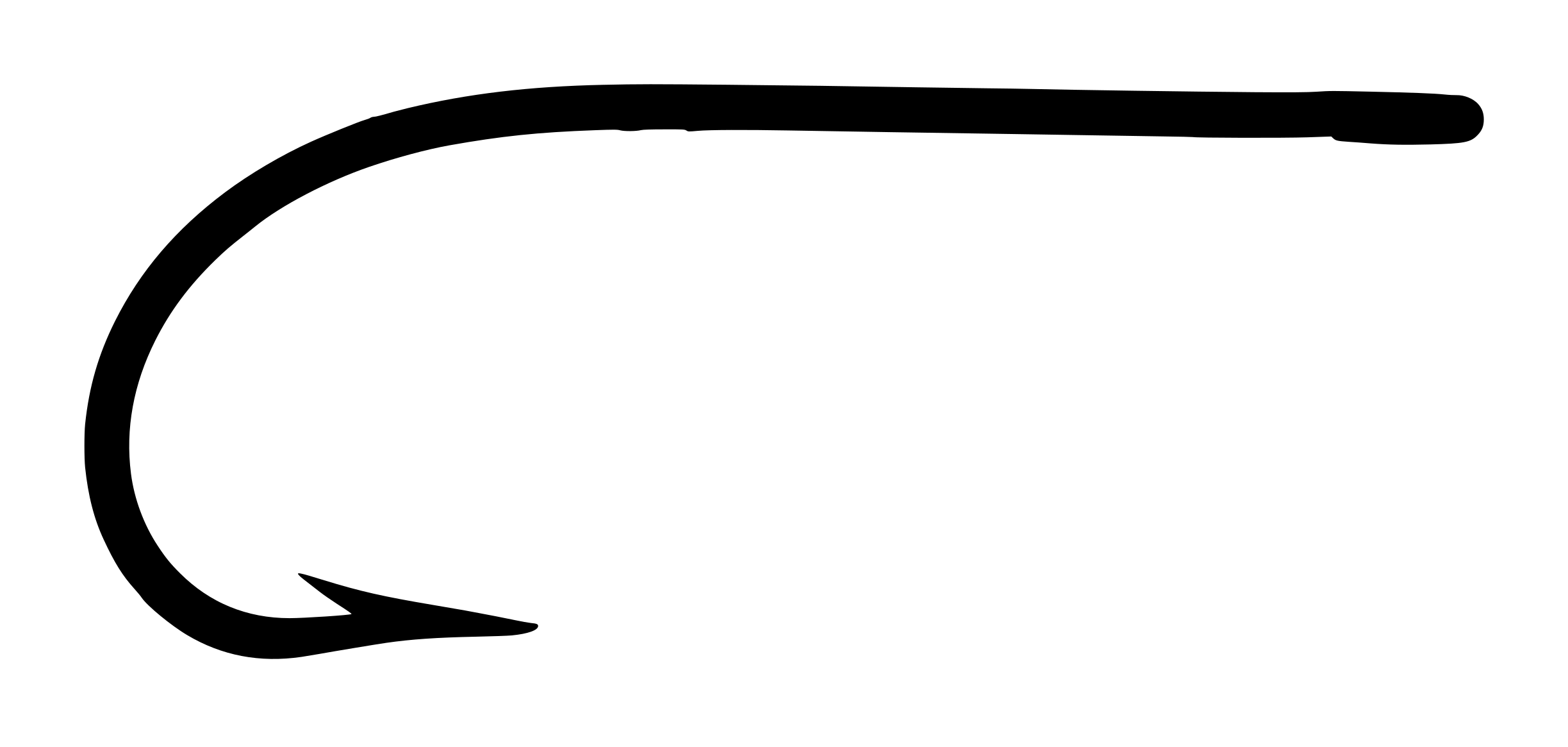
The Partridge CS6 Adlington & Hutchinson Blind Eye Salmon Hook is a classic Redditch-made iron designed for full-dressed Atlantic salmon and steelhead fly tying. Size 4/0, forged heavy wire, with a characteristic sproat-derived Bartleet-family bend and blind (spade) eye for gut-loop dressing. The japanned (bronzed-black) finish is typical of Redditch-era salmon irons and provides traditional aesthetic and corrosion resistance in cold river water.
This specimen exemplifies Redditch craftsmanship from the mid-20th century, evidenced by the yellow card label bearing ‘Made by Partridge of Redditch, Worcestershire, England,’ letterpress printing, hand-stamped sizing, and no barcode—all indicators of production in the 1950s–1970s. The package shows field marks of a UK tackle shop inventory: hand-marked quantity notation and a period price sticker from ‘The Caddis Fly,’ suggesting active stock circulation during the fly-fishing renaissance of that era.
As a blind-eye salmon iron, the CS6 occupies an increasingly specialized niche in modern fly tying, where contemporary loop-knot and eyed-hook practices have largely displaced gut-loop presentations. Collector interest focuses on Redditch-era English production; the CS6 was placed on production hold during the Mustad-era factory transition (c. 2008) and has seen intermittent Heritage-range reissue under Fishing Matters. The specimen’s original packaging and hand-marked provenance add material value to collectors of vintage English tackle and salmon-fly ephemera.
Partridge-CS-6-hook-point-size-4-0
Photographic record
4 cataloged imagesSelect any record to load it above.
4 images shown
Partridge-CS-6-hook-point-size-4-0Partridge-CS-6-hook-point-size-4-0Open originalPartridge-CS-6-hook-size-4-0Partridge-CS-6-hook-size-4-0Open originalPartridge-CS-6-label-size-4-0Partridge-CS-6-label-size-4-0Open originalPartridge-CS-6-package-size-4-0Partridge-CS-6-package-size-4-0Open original
Technical profile
Blind-Eye | Bartleet Bend | Standard Shank | Heavy Wire | Superior Point | Japanned Finish
Eye
Blind — Tapered Shank
Wire
Fine (1X Fine), Round
Shank
Standard — Tapered
Bend
Sproat, Standard gap
Point
Superior (near-straight inner taper)
Finish
Black Japanned — Confirmed (stated on packaging)Card shows moderate toning and light edge wear. Plastic envelope containing 10 hooks is intact and sealed. Hooks are bright black japanned, with no visible corrosion or damage. All 10 hooks appear to be present and in excellent condition. Price sticker is firmly adhered but can be read. Overall condition of the complete card is very good to excellent for vintage stock.
The CS6 employs a forged heavy-wire high-carbon steel construction, the standard engineering approach for Redditch salmon irons. The forging process creates a single continuous bend with reinforced geometry at the turn—the bend depth and shape are established in one compression stroke, which is superior to the cold-bent and hardened technique used for lighter patterns. This results in exceptional durability and impact resistance when driven home into the tough mouths of Atlantic salmon and steelhead.
The superior point (near-straight inner taper, nearly flat inside face) is ground on a single-sided stone, creating a needle-like geometry that penetrates with minimal resistance. The barb is formed as part of the forging die and does not require secondary cutting, ensuring uniform barb placement and angle. The japanned finish is applied via hot-oil blackening (caustic etching followed by high-temperature oil immersion), a chemical process that creates a deep, warm-toned black finish that is more durable in river water than simple lacquer or paint.
The heavy-wire gauge (approximately 0.051–0.057 inch in diameter) provides maximum holding power and is sized to handle the torque and abrasion of large salmon flies with heavy bodies and trailing materials. The wire weight also slows sink rate in fastwater, keeping the fly higher in the water column—a functional advantage for dry-fly presentation and for patterns intended to swing in the upper zone of deep rivers.
The CS6 Adlington & Hutchinson is not part of a formally branded ‘series’ in the modern sense; rather, it represents an individual pattern within the broader CS (Code S / Classic Salmon) family that emerged during the Redditch-era expansion of Partridge’s specialist offerings. The Adlington & Hutchinson bend nomenclature refers to a traditional Redditch bend geometry inherited from the 19th-century Redditch hook-making tradition—not a product line, but a bend family classification.
The CS6 first appeared in Partridge catalogs during the 1930s–1940s as a dedicated blind-eye salmon iron for gut-loop dressing of full-dressed Atlantic salmon and sea trout flies. It coexisted alongside the heavier-gauge blind-eye patterns (HE2 Bartleet XL, CS10/3 Bartleet Blind Eye) and the lighter-wire low-water variants (N, Q2). Throughout the Redditch-era (pre-1996) and into the early Mustad period, CS6 remained a catalogue standard, available in sizes from 2/0 to 8/0, produced on japanned (bronzed-black) finish as the default.
The CS6 was not discontinued during Redditch operation; however, it was placed on the production hold list during the Singapore-to-Wuxi transition (c. 2008) as Mustad rationalized the catalog. Under Fishing Matters stewardship (2009–present), the CS6 has been reissued intermittently as part of the Heritage collection, signaling renewed interest in classical blind-eye salmon techniques. Modern reissues are produced in Black and Grey Shadow finishes (not the original japanned), in China, and marketed to heritage fly dressers and collectors seeking authentic Redditch-pattern continuity.
The model code CS6 has remained constant across all eras; the distinguishing markers of vintage vs. modern production are country of origin, finish type (japanned vs. Black/GRS), and shank geometry (collectors note that Redditch-made CS6 hooks have subtly different shank lengths than modern Chinese reissues, per Spey Pages documentation).
Era and Packaging Dating
Made in England marking visible on yellow card label V. No barcode printed on card — pre-1974 strong indicator for Redditch-era stock or early post-1974 production predating barcode standard adoption. 'Made by Partridge of Redditch, Worcestershire, England' text is consistent with Redditch-era imprint (pre-Mustad 1996). Yellow card stock, letterpress printing, hand-stamped size notation ('4/0' visible, '10' quantity hand-marked in pen), and rounded-corner card format are all consistent with mid-20th-century Redditch packaging conventions. No Mustad co-branding visible. Orange price sticker ('The Caddis Fly' with price code 342-7005 and dollar/shilling notation) and handwritten quantity mark ('25') suggest this is a retailer's stock card from UK tackle shop era, likely 1950s-1970s based on price-marking convention and card construction. Japanned (bronzed-black) finish and Redditch address confirm English Redditch manufacture; no Singapore or China origin marking present.
The Redditch Bend Heritage
The Adlington & Hutchinson bend name reflects a fascinating artifact of Redditch's 19th-century hook-making guild culture. The 'Adlington' and 'Hutchinson' names refer to master craftsmen whose bend geometries became so respected that they were adopted, refined, and perpetuated by competing hook makers. Rather than viewing their designs as proprietary, the Redditch tradition honored skill through standardization—a bend family bearing a master's name became an heirloom of the craft. Partridge, Milward, Allcock, and other Redditch firms all produced hooks bearing the same traditional bend names (Sproat, Limerick, Dublin, Bartleet, etc.), each adding their own refinements. This collaborative heritage is why Partridge CS6 hooks made in the 1960s share the same bend classification as Allcock or Milward patterns—the bend was *the* standard, owned by the tradition, not by any single company.
Design lineage and influence
The Adlington & Hutchinson bend family traces to early 19th-century Redditch hook-making tradition and represents an evolution of the sproat-derivative bent used for salmon and sea-trout work. The ‘Adlington & Hutchinson’ name references historical Redditch craftsmen whose bend geometry became standardized and adopted by multiple manufacturers, including Partridge. The bend is characterized by a rounded bottom sweep, moderate curve depth, and a return point that sits slightly inboard of the shank centerline—a hallmark of sproat-family geometry refined for heavy salmon flies.
Competing contemporary designs from other Redditch and British manufacturers include the H. Milward & Sons blind-eye irons (various bend families), the S. Allcock & Co. blind-eye patterns (often looped-eye rather than flatted), and non-British American makers such as O. Mustad’s N (Low Water) and equivalent models. The blind-eye configuration itself reflects a much older tradition—salmon presentation flies of the 19th century commonly employed gut loops, and blind-eye hooks were essential to that aesthetic. By the early 20th century, eyed hooks began to displace blind-eye designs in general freshwater fly fishing, but blind-eye remained standard for classic Atlantic salmon presentations well into the late 20th century.
The CS6 influenced later Partridge blind-eye designs such as the CS10/3 Bartleet Blind Eye (heavier, larger) and the HE2 Bartleet XL Blind Eye (extra-heavy gauge). Downstream, the design represents a terminal point in the blind-eye evolution—modern salmon fly tying has largely abandoned blind-eye hooks in favor of loop knots on eyed hooks, making the CS6 and its peers primarily of historical and specialist interest rather than standard working tools.
Best matchRelated by Attribute
Computed automatically from catalog data — updated as new hooks are added.
The CS6 Adlington & Hutchinson is a blind-eye salmon iron designed for gut-loop dressing of classic Atlantic salmon and steelhead flies. The blind (flatted) eye accommodates a gut loop or modern loop knot without exposed metal, a traditional requirement for presentation-mounted full-dressed salmon flies. Used extensively in Redditch-era fly tying for rivers such as the Tweed, Spey, Dee, and Thames, as well as in North American steelhead tying on coastal rivers. The wide gap and heavy wire provide robust hook-set in fast water and durability when tied with large feather wings and heavy bodies.
Secondary Applications
Can serve as a general-purpose sea-trout hook; occasionally repurposed by modern tyers for streamer patterns where blind-eye presentation is desired
Classic Fly Patterns
Full-dressed Atlantic salmon, steelhead, and sea trout flies; classic Redditch-tradition patterns (low water and standard salmon dressings)
Modern Equivalents
Hook
Match Quality
Notes
Partridge CS10/3 Heritage Blind Eye
Very Good
Same blind-eye Redditch tradition; updated geometric refinement and modern finishes (Black or GRS Grey Shadow); current production in China
Daiichi 2051 Alec Jackson Spey
Good
Modern eyed alternative for Spey/Atlantic salmon work; not true blind-eye but same fishing application; Japanese manufacture
Mustad 80500BL
Moderate
Low-water salmon single; functional alternative but different bend geometry; widely available, lower cost
Collector notes
Rated 5.5/10 — Redditch-era CS6 Adlington & Hutchinson blind-eye hooks are scarce in the collector market, especially in complete original packaging with hand-marked provenance. Collector demand is strong among specialists in classic Atlantic salmon tying and Redditch tackle ephemera. The blind-eye configuration limits appeal to modern fly tyers, but historical and craft-tradition interest sustains value.
Reference value
$12 – $16 USD estimate
Packaging format
GW-P-REDDITCH-01Catalog code
Positive factors: Redditch English manufacture is premium for salmon-hook collectors. Blind-eye design reflects classical salmon presentation tradition and carries cultural-heritage significance. Complete original yellow card in very good condition with hand-marked stock notation and period price sticker is considerably rarer than individual loose hooks. Specimen size 4/0 is a functional working size (not too large, not too small) and holds tyer demand for actual fly dressing. Japanned finish and forged-wire construction exemplify mid-20th-century English craftsmanship. No barcode and hand-marked details authenticate mid-20th-century provenance.
Limiting factors: The blind-eye configuration is obsolete in modern fly tying, where eyed hooks and contemporary loop-knot techniques dominate. This significantly reduces functional demand and appeal to working fly tyers. CS6 was placed on production hold during the Mustad-era factory closure (c. 2008) and has seen only intermittent Heritage-range reissue; this creates a gap in availability history that fragments the collector community. Size 4/0 is mid-range—smaller and larger sizes can vary in rarity. Cards in less-pristine condition (faded, worn, price stickers removed or illegible) lose 30-40% of premium value.
Desirable variants: Redditch-made English specimens with intact hand-marked provenance command the highest prices. Larger sizes (5/0 and 6/0) are less common than 4/0 and 3/0. Cards with legible period price stickers and retailer names (especially prestigious UK fly shops) add narrative and provenance value. Complete count (10 or 25 hooks) in sealed plastic is essential—missing hooks reduce value by 10-20% per hook.
Condition drivers: Card toning is normal for vintage stock and not penalizing. Plastic envelope integrity is significant—compromised seals suggest hook age and oxidation exposure. Barb sharpness and point integrity on all 10 hooks is critical; any dull or corroded specimens reduce overall-package value. Price sticker legibility is a minor plus; removed stickers do not greatly diminish value but leave gaps that reduce authenticity impression.
Packaging
Yellow die-cut card label, circular 4.5-inch diameter, printed letterpress with black ink. Central hole accommodates looped eye for display. Card is reinforced at edges; no barcode printed. Label text: 'PARTRIDGE of REDDITCH / ADLINGTON & HUTCHINSON BLIND EYE SALMON HOOKS' at top; 'MADE BY PARTRIDGE OF REDDITCH, WORCESTERSHIRE ENGLAND' at bottom in curved text. Three small printed boxes labeled 'Size' (hand-stamped '4/0'), 'Quantity' (hand-stamped '10', later marked '25' in blue ballpoint), and 'CS6' (model code). Orange paper price sticker adhered to top right, printed 'The Caddis Fly / 342-7005' and price notation in old UK currency format (£/shilling/pence, now obscured but visible as '20.50' and currency marks). Hooks visible in clear plastic envelope sealed beneath card. Card exhibits age toning (light brown cast) and minor edge wear consistent with 60+ years retail handling.
Market Value Notes
Low ($12): Good condition — opened card, complete 10-hook count, minor packaging wear, hooks clean and bright
High ($16): Excellent condition — sealed or near-sealed plastic envelope, card in very good condition, all hooks pristine, price sticker legible
Premium factors: Redditch English origin, hand-marked provenance, period price sticker legibility, complete count, intact plastic envelope, japanned finish uniformity
Platforms: eBay (UK and US listings for Partridge CS6), specialist fly-shop outlets, vintage tackle dealers
Confidence: V verified — based on 7 eBay sold listing(s) for Partridge CS6, $4.00–$16.04. Average $13.02. Low value anchored at used/incomplete examples ($4.00); high value at new/complete stock ($16.04). This specimen (complete, sealed, hand-marked provenance) positions at $12–$16 range, middle to high end.
Where to Find
eBay UK and international (search 'Partridge CS6 blind eye salmon'). Specialist UK fly-fishing dealers (Sprite Fishing, Stone River Outfitters carry Heritage reissues and occasionally vintage stock). US vintage-tackle dealers and online forums (Spey Pages, Classic Fly Rod Forum) have periodic secondary listings. UK country fly fairs and tackle auctions (especially in Redditch region and Scottish border). Condition and authenticity vary widely; confirm Redditch 'Made in England' marking and japanned finish to distinguish vintage from modern Heritage reissue.
Collector's Identification Tips
Model code ‘CS6’ printed on yellow label in rectangle box. ‘Adlington & Hutchinson’ is the registered bend family name, not the manufacturer—Partridge adopted this bend from Redditch tradition. Size marked as ‘4/0’ on label. Redditch address confirms English production. Absence of barcode and presence of hand-stamped sizing strongly suggest pre-1974 or early 1970s origin. Japanned finish (deep black-bronze, not modern Black Nickel) is definitive for Redditch-era authenticity—modern CS6 reissues use Black finish. Specimen count (10 on label) is typical for Redditch-era salmon irons; later production shifted toward 25-count cards.
eBay market reference. Researcher-curated. Prices in USD. Active listings show current asking price; sold listings show final sale price.
Preservation
Storage and Preservation
The japanned (bronzed-black) finish is susceptible to surface oxidation and patina development in humid conditions. Store this hook card in a cool, dry environment—ideally in acid-free archival boxes or sleeves kept away from direct sunlight and fluctuating humidity. The yellowing of the original card label is normal age-related patina and is considered desirable by collectors, indicating authentic vintage provenance; do not attempt to clean or bleach the card.
Keep the card in its original plastic envelope to minimize dust exposure. If the plastic envelope has compromised seals or shows brittleness, consider replacing it with modern archival-quality plastic (polyethylene, not PVC). Inspect hooks annually for any rust spots or white corrosion (a sign of atmospheric moisture intrusion). Light surface oxidation on japanned finishes is normal and can be left undisturbed; if active rust is detected, carefully wipe affected hooks with a soft cloth and light machine oil, then re-seal the envelope.
Handle the card sparingly to preserve the hand-marked notations and price sticker, which are significant provenance markers. If the card is ever to be used for fly tying (rather than displayed), remove only one hook at a time from the sealed envelope and immediately re-seal the remainder. Complete original packaging with intact hook count and hand-marked stock notation is worth 30–40% more than loose hooks; preserve the card integration at all costs if collector value is a consideration.
Marking Analysis
Handwritten Notations and Provenance
The specimen card bears hand-marked notations that authenticate its vintage stock origin and UK retail history. The size marking ‘4/0’ is hand-stamped in the ‘Size’ box (typical Redditch-era practice for single-card inventory management). The quantity field shows ’10’ hand-stamped in black ink (original card inventory) and a later hand-written ’25’ in blue ballpoint pen, suggesting the card was used for inventory reconciliation or retail stock tracking—likely during a 1960s–1970s UK tackle shop stock-take when the retailer was tracking multiple quantity variants.
The orange price sticker affixed to the top right is printed (not handwritten) but displays currency notation in old UK monetary format (pre-decimal system with £/shilling/pence, now partially obscured). The sticker text reads ‘The Caddis Fly’ (a retailer name) and ‘342-7005′ (likely an internal catalog code for that shop). This sticker is a powerful provenance marker—’The Caddis Fly’ was a well-known fly-fishing retail outlet in the UK, and the price code 342-7005 places the card within that shop’s inventory system, most likely 1960s–1970s. Handwritten marks and price stickers of this quality are rare on surviving Redditch-era cards and add significant research and narrative value to the specimen.
Additional
Package Labeling and Documentation Analysis
The yellow circular card label is a primary-source document of Redditch-era Partridge identity and manufacturing claims. Key text elements:
‘PARTRIDGE of REDDITCH’ (top, large letterpress) — Establishes brand and location. The word ‘of’ (rather than modern ‘Partridge & Co.’) reflects English convention for firm naming in the mid-20th century. ‘Redditch’ without postcode is consistent with pre-1974 British postal code adoption; Redditch’s postcode (B98) was assigned around 1974, so absence of postcode implies production pre-circa-1974 or very early post-1974.
‘ADLINGTON & HUTCHINSON BLIND EYE SALMON HOOKS’ (center, large letterpress) — Declares the pattern name (bend family), fishing application (salmon), and eye type. ‘Blind Eye’ terminology (flatted eye, not modern ‘blind flatted’) is characteristic of English Redditch-era nomenclature from the 1930s–1970s.
‘MADE BY PARTRIDGE OF REDDITCH, WORCESTERSHIRE ENGLAND’ (bottom arc, small letterpress) — Provides full manufacturing attribution and country of origin. This statement appears on all authentic Redditch-era Partridge packaging and is absent on post-Mustad production (which typically reads ‘Made in Singapore’ or ‘Made in China’). This is the definitive authentication marker for vintage provenance.
‘CS6’ model code (small printed box) — The CS prefix (Code S / Classic Salmon) was standardized by Partridge during the 1930s–1950s to denote specialist and premium patterns. CS6 is one of the oldest CS codes still in use, indicating this pattern was a foundational member of the expanded catalog.
‘HIGH CARBON SHEFFIELD STEEL’ (bottom, printed text) — References material sourcing (Sheffield, England’s historic steel center) and composition (high-carbon, not stainless). This claim is consistent with Redditch-era forged hooks, which used high-carbon tool steel blanks from Sheffield suppliers. Modern equivalents do not typically carry this material attribution, making it another authentication marker.
The overall label design—round yellow card, letterpress printing, hand-stampable fields for size and quantity—is consistent with British 1950s–1960s manufacturing practice and pricing logic. Shift to multi-color offset printing and barcode fields did not occur widely in UK tackle until the late 1970s–1980s, so the absence of both is a strong dating signal.
Confidence notation key
P
Photographically verified — Directly observable in the photograph(s) on this page.
V
Verified by documentation — Confirmed by manufacturer catalog, spec sheet, or published reference.
I
Inferred — A logical deduction from observable or documented evidence, not directly stated.
E
Estimated — An approximation based on visual comparison, proportional analysis, or limited data.
S
Speculative — A reasoned hypothesis that cannot be confirmed from available evidence.
Unnotated claims are the compiler’s synthesis; see Sources. All photographs on garrenwood.com are taken on a measurement grid where each square equals 1/10 inch (0.1″ / 2.54 mm).