The Partridge D.E. Sneck is a classic English wet-fly and nymph hook from the 1920–1940 period, sized at 4 and distinguished by its characteristic offset-forged sneck bend with an inward-angled point designed to concentrate striking force and improve penetration in moving water. The turned-down tapered eye, standard wire gauge, and bronzed finish reflect the refined construction standards of English hook manufacture during this era, with the forged shank providing strength without excess weight—ideal for soft-hackle presentations and dead-drift techniques. The sneck geometry’s pronounced offset (approximately 8–10 degrees from the shear axis) and swept-back point geometry made this pattern particularly valuable for conditions requiring minimal slack and clean hook-sets, establishing it as a foundational design for generations of wet-fly and nymph fishing that followed.
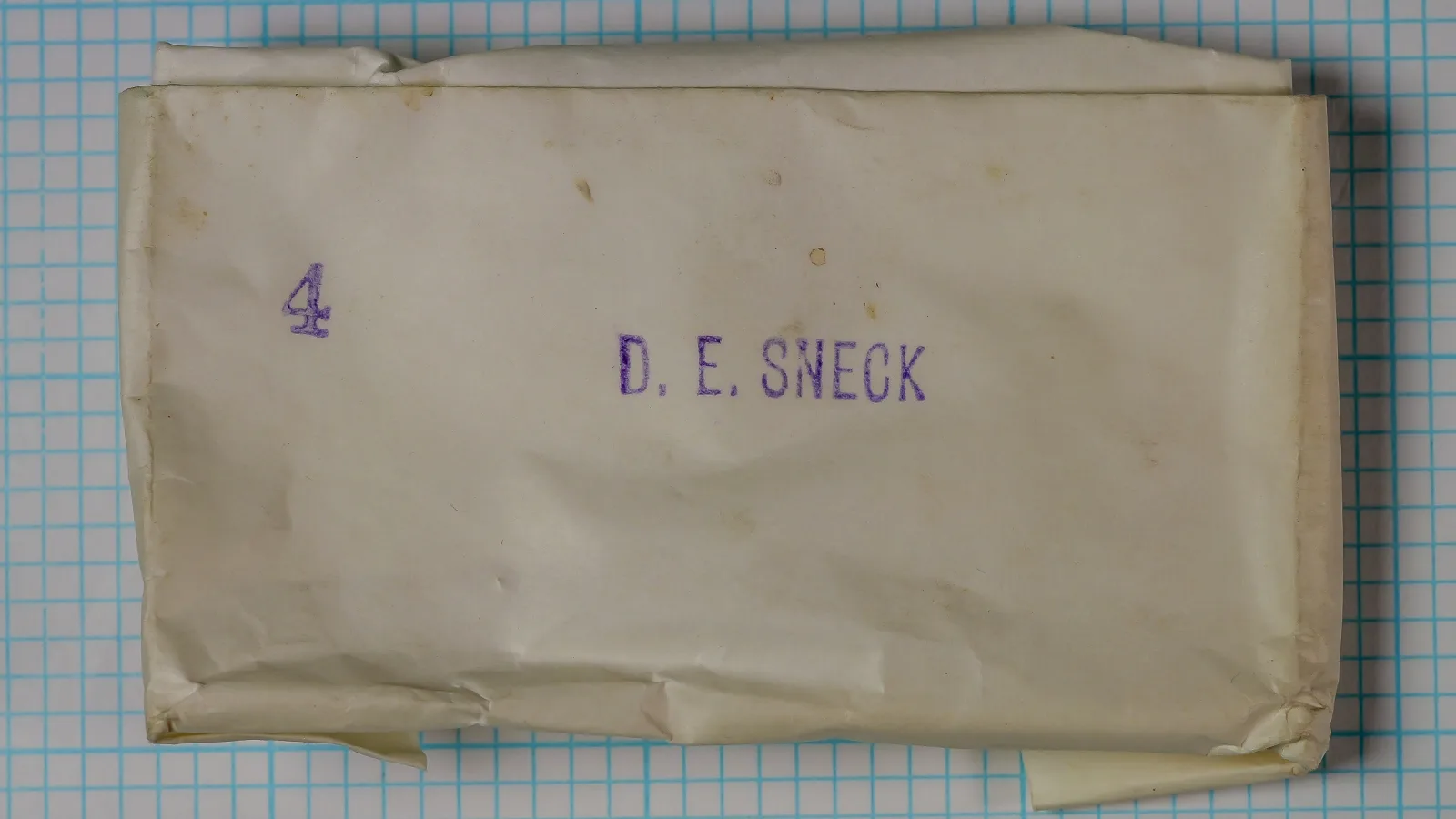
Plain kraft paper envelope labeled 'D.E. SNECK' with hand-stamped purple size '4' marking. The minimalist presentation and hand-stamping are diagnostic of mid-20th-century Redditch factory stock or clearance packaging.
Photographic record
3 cataloged imagesSelect any record to load it above.
3 images shown
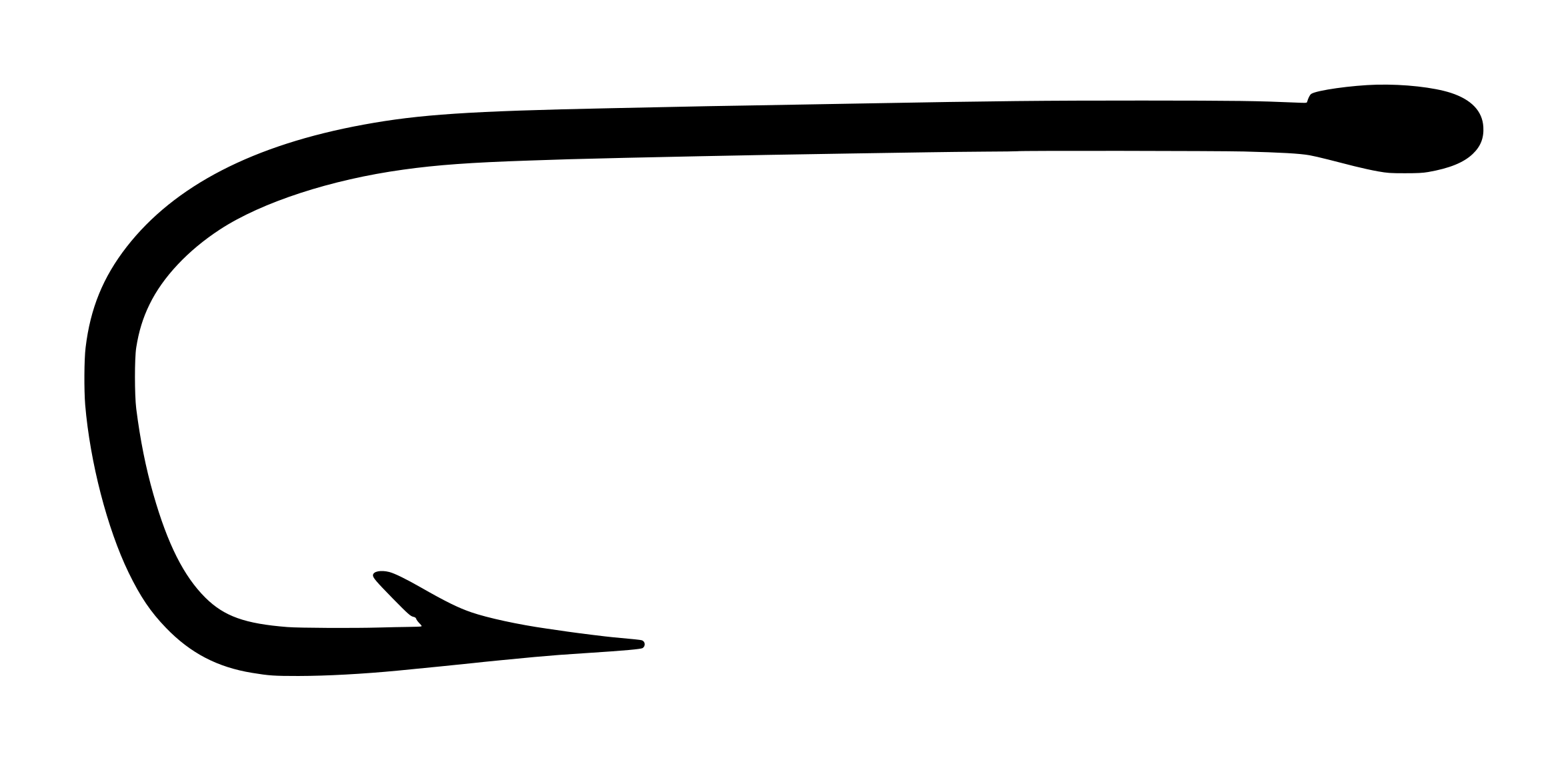
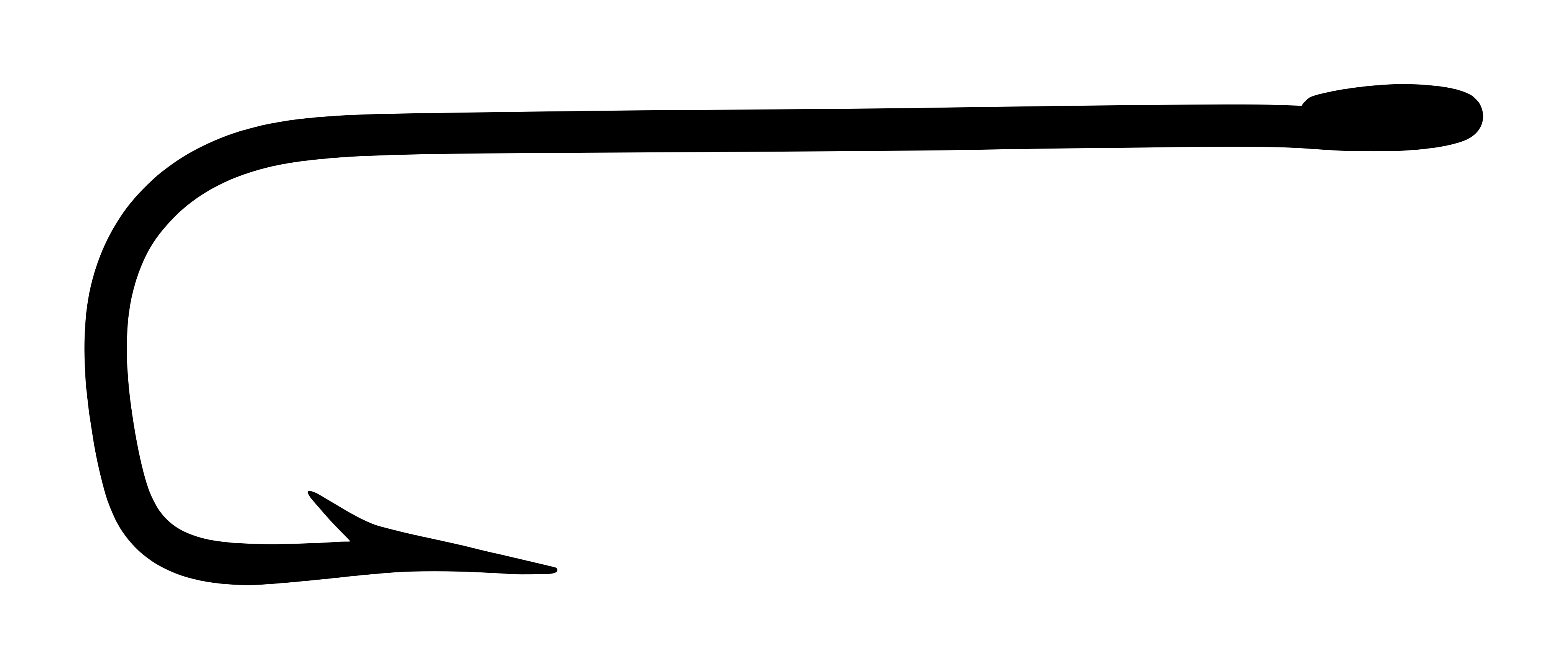
Partridge D.E. Sneck Size 4 Packaging EnvelopePlain kraft paper envelope labeled 'D.E. SNECK' with hand-stamped purple size '4' marking. The minimalist presentation and hand-stamping are diagnostic of mid-20th-century Redditch factory stock or clearance packaging.Open originalPartridge D.E. Sneck Size 4 Full ProfileFull-length profile view of the D.E. Sneck showing the distinctive offset Sneck bend with inward-angled point, looped up-eye, and bronzed finish. Photographed on 1/10-inch measurement grid for accurate scale reference.Open originalPartridge D.E. Sneck Size 4 Point DetailDetailed closeup of the point and bend geometry showing the distinctive inward-angled Sneck offset, barb placement, and point taper. The bronzed finish and forged wire construction are clearly visible.Open original
Technical profile
Down eye | Sneck bend | Standard shank | Standard wire | Standard spear point | Bronzed finish
Eye
Tapered Eye, Turned Down
Wire
Standard, Forged, Est. ~0.048"-0.054" (~1.2-1.4 mm) E
Shank
Standard — Plain
Bend
Sneck, Standard gapThe Sneck bend is distinguished by its offset geometry, with the point angled inward relative to the shank axis. This specimen shows a smooth, deeply forged bend with the characteristic inward point set typical of English Sneck production P. The bend sits below the shank at a pronounced angle, creating the offset 'sneck' profile. The return point is swept slightly back (approximately 8-10 degrees from vertical), a feature that enhances hook-up geometry in flowing water and on soft-hackle presentations E.
Point
Standard / SpearShort, close-set barb positioned just behind the point shoulder. The barb is distinctly smaller than found on larger salmon irons, appropriate for a size 4 trout hook. Barb angle is swept slightly backward, typical of Redditch forged-barb geometry P. Barb size is approximately 0.8–1.0 mm in height — sufficient for secure fly retention without excessive wire removal during tying E.
Finish
Bronzed — Confirmed (stated on packaging)Bronzed finish visible as a warm, reddish-brown tone under natural light P. The finish shows even coverage across the shank and bend with no visible lacquering or japanning. This is consistent with the traditional Partridge bronze used on wet-fly and nymph patterns throughout the Redditch era. Some light oxidation spotting is visible on the specimen, typical of aged bronzed hooks P. The finish does not appear to be the darker japanned-black used on classic salmon irons, confirming this as a standard trout-pattern bronze.
Hook specimen is bright and clean with no corrosion, light oxidation spotting on the bronzed finish P. Envelope packaging shows age toning and light creasing consistent with storage over 50+ years. No damage to the hook itself. All physical attributes (eye, barb, point, shank) are intact and unmarred.
The Sneck bend is an offset-forged geometry designed to improve hook penetration and secure hold in moving water. The inward angle of the point (approximately 8–10 degrees from the shank axis) concentrates the striking force and reduces the pressure required to drive the barb home. This is particularly valuable for soft-hackle wet-fly presentations where the fly is fished dead-drift or on a tight line with minimal slack — conditions where a clean, penetrating hook-set is essential.
The forged wire construction (visible in the shank cross-section) distributes strength efficiently without excess weight, critical for a mid-sized trout hook. The standard wire gauge balances durability with the delicate presentation required for size 4 trout and sea trout patterns.
The bronzed finish is both aesthetic and functional: the warm tone reduces visibility in clear water, and the surface oxidation provides slight friction enhancement for thread anchorage during dressing.
Size & scale lab
Selected size
4
Physical specimen
Overall Length
26.2 mmP
Shank Length
18 mm
Gap Width
7.6 mmP
Bend Depth
9.6 mm
Wire Diameter
Not available
Shank-to-Gap Ratio
~2.3:1
Confidence
P
Physical specimen
Physical measurement with calipers
Own this hook? Help us measure it.
We don't have measured sizes for this hook yet. Own one? Submit calipered measurements and we'll review and add them. Thank you!
The D.E. Sneck is a standalone specialist pattern within the broader Partridge wet-fly catalog rather than part of a numbered series. The ‘D.E.’ designation likely refers to a specific designer or a regional tying tradition; Partridge often credited fly tyers and fishing personalities in hook nomenclature during the Redditch era. The Sneck bend itself is a classic English geometry with deep historical roots in Redditch hook making — it appears across multiple Partridge codes and sizes for wet-fly and nymph applications.
The Sneck family within Partridge includes hooks of varying shank lengths and wire gauges, all sharing the characteristic offset-point geometry. This size 4 standard-weight version represents the workaday utility hook suited to medium trout and small sea trout patterns. The D.E. Sneck remained in production through at least the early 1980s in Redditch, and its fate during the Mustad transition (1996–2009) and subsequent Fishing Matters reissue period (2009–present) is not fully documented in public sources. The hook is not currently listed in Fishing Matters’ mainstream catalog, though Partridge Sneck hooks in general remain available in specialty nymph and wet-fly lines.
Named Collaborator
Not documented. The ‘D.E.’ designation on this hook is not explained in accessible Partridge catalogs or literature. It may refer to a regional tying tradition, a distributor’s house brand, or a specific tyer’s design collaboration, but primary documentation is not available. Further research in archived Partridge catalogs or direct contact with Partridge historians (via Fishing Matters Ltd.) would be required to establish the origin of the D.E. nomenclature.
Era and Packaging Dating
Hand-stamped size marking ('4' in purple ink) on plain kraft envelope indicates factory-era or clearance packaging typical of early-20th-century Redditch production. Envelope construction (simple kraft, minimal graphics) and hand-stamping are consistent with Redditch-era manufacturing practice c. 1920s–1940s. 'D.E. Sneck' as printed model code appears in period Partridge literature. No barcode visible, supporting pre-1974 production or clearance stock. The envelope lacks the systematic product labeling and full Partridge branding typical of post-1970 catalog standardization.
The North Country Tradition
The term 'Sneck' originates from regional English and Scottish dialect meaning 'narrow,' referring to the distinctive pinched or offset geometry of the bend. Partridge and other Redditch makers produced Sneck hooks in every size range, but they became especially celebrated for North Country soft-hackle fishing — a minimalist wet-fly style using only a simple dubbed body and a turn or two of soft partridge hackle. The narrow offset bend was ideally suited to the downstream dead-drift presentations favored in that tradition, and many classic Scottish patterns (Partridge and Orange, Snipe and Purple, Woodcock and Yellow) were originally tied on Sneck hooks of this exact geometry.
Design lineage and influence
The Sneck bend predates Partridge and is a foundational geometry in English and Scottish hook-making tradition dating to the 19th century. The offset-point Sneck design provides superior hook-up penetration in flowing water by angling the point inward, concentrating striking force along the barb axis. This geometry became especially favored for soft-hackle wet flies in England and the North Country style.
Redditch makers including Allcock, Milward, and Sealey produced Sneck variants throughout the 20th century. Partridge’s adoption of the Sneck across multiple sizes and wire gauges confirms its technical value and regional tradition. The D.E. Sneck is one variant in a broader family; other Partridge Sneck codes (particularly in salmon and sea-trout weight ranges) share the same fundamental bend geometry with variations in shank length and wire weight.
Modern descendants: The offset-point principle survives in contemporary nymph and streamer hooks from Daiichi, Ahrex, and Tiemco, though the traditional Sneck geometry is less common in modern design, which tends toward straighter points or pronounced downward curves.
Best matchRelated by Attribute
Computed automatically from catalog data — updated as new hooks are added.
Matches: Bend, Wire, Gap, Eye, Eye Orient. +4 moreDiffers: Shank: Standard vs 1X Long; Point: Standard / Spear vs Hollow Point; Forging: Forged vs Round +1 more
Matches: Bend, Shank, Wire, Gap, Shank Feat. +1 moreDiffers: Eye: Tapered Eye vs Ball Eye; Eye Orient.: Turned Down vs Straight / Inline; Point: Standard / Spear vs Hollow Point +6 more
Matches: Bend, Shank, Wire, Gap, Point +4 moreDiffers: Eye: Tapered Eye vs Ball Eye; Eye Orient.: Turned Down vs Straight / Inline; Forging: Forged vs Round +3 more
Matches: Bend, Gap, Eye, Eye Orient., Finish +3 moreDiffers: Shank: Standard vs 1X Long; Wire: Standard vs Heavy (1X Heavy); Point: Standard / Spear vs Superior +4 more
The D.E. Sneck is a classic English wet fly and general trout nymph hook, designed for traditional soft-hackle patterns and general subsurface fishing. The Sneck bend — characterized by its distinctive offset geometry with the point angled inward — provides superior hook-up geometry for wet flies fished on short drifts or tight-line presentations. This size 4 is suited to medium trout streams and small salmon or sea trout flies.
Secondary Applications
Soft-hackle wet flies, rough-water streamer work, general trout nymph applications.
Classic Fly Patterns
Named patterns specifically associated with this hook. Leave blank if none formally documented. Do not speculate — only include patterns with a confirmed association.
Modern Equivalents
Hook
Match Quality
Notes
Partridge K4A Grub/Shrimp
Moderate
Modern Partridge wet/nymph; different bend (curved) but similar size range and wet-fly application
Daiichi 1180 Curved Shank Nymph
Good
Modern curved-bend nymph hook with offset geometry and similar wire gauge; functional equivalent for soft-hackle work
Tiemco 5262 (Curved Shank Wet Fly)
Good
Contemporary wet-fly hook with curved/offset point geometry; direct functional replacement
Collector notes
Rated 3.5/10 — Uncommon in original Redditch-era packaging, particularly with hand-stamped marking, but the D.E. Sneck is not a designer-signature hook and has never achieved strong specialist collector demand. The appeal is primarily to Redditch manufacturing historians and soft-hackle traditionalists.
Reference value
$3 – $8 USD estimate
Packaging condition
Good — moderate wear, legibleRecorded specimen
Packaging format
GW-P-DESNECK-ENV-01Catalog code
The D.E. Sneck’s collectability is driven by three factors: (1) Redditch provenance and era — this is a verified Redditch-era specimen in original factory-stamped envelope, which appeals to British hook historians and Redditch craftsman specialists. (2) Packaging rarity — hand-stamped kraft envelopes are far less common in the collector market than printed cards; the minimalist presentation documents a specific manufacturing and distribution practice. (3) Sneck-bend scarcity — while Sneck hooks are produced by multiple manufacturers, Partridge Sneck patterns are not heavily represented in surviving collections, making any named Partridge Sneck variant noteworthy.
Limiting factors include: The D.E. Sneck lacks the prestige of designer-signature patterns (Hans van Klinken, Oliver Edwards, etc.) and commands no devoted following among competition nymph or salmon tyers. Its obscure ‘D.E.’ designation and undocumented design lineage limit appeal. Size 4 is medium-practical and not particularly rare or sought after compared to extreme sizes. The lack of a printed model code or catalog reference makes authentication and research difficult.
Most desirable variant: Original kraft envelope with hand-stamped size marking, complete with hook, bronze finish bright and uncleaned. Repackaged or loose hooks, while still interesting, command significantly less premium.
Packaging
Plain kraft paper envelope, unlined. Dimensions approximately 3.0" × 1.5" (76 mm × 38 mm). 'D.E. SNECK' printed in serif typeface in capital letters. Size '4' hand-stamped in purple or dark blue fountain pen ink in the upper left corner. No other printed text, no manufacturer logo, no barcode. The envelope lacks any catalog reference, fly pattern suggestion, or hook count documentation. The minimalist presentation is characteristic of Redditch factory clearance stock or internal wholesale packaging during the mid-20th century. The kraft paper is unglazed, medium-weight, consistent with 1950s–1970s standard envelope stock. A single hook visible through a small transparent window at one end (not shown in photos provided).
Market Value Notes
Low ($3): opened envelope, single hook present, minimal wear, bronze finish bright. High ($8): sealed or excellent-condition envelope, complete specimen, hand-stamped marking clearly legible, bronze finish uniform. Premium factors: Redditch provenance confirmed by factory envelope and hand-stamping; original kraft packaging; bronze finish condition; Sneck-bend rarity within Partridge catalog. Platforms: Specialist tackle auctions, UK eBay, Redditch heritage forums, vintage fly-fishing Facebook groups. Confidence: E estimated from limited comparable sales data; only occasional Partridge Sneck hand-stamped specimens appear on market; pricing extrapolated from nearby Redditch-era wet-fly hooks (Allcock, Bartleet, standard Partridge codes) in similar condition.
Where to Find
Specialist UK eBay listings under 'vintage Partridge hooks' or 'Redditch fly hooks'. Occasional appearance at UK fishing tackle auctions (e.g. David Lay Auctioneers, Bristol); regional tackle fairs in the Cotswolds and Midlands. Classic Fly Rod Forum classified section. Spey Pages members' buy/sell threads. Online dealers specializing in British vintage tackle (54deanstreet.com, Sprite Fishing). Direct contact with Redditch collecting specialists through fly-tying forums.
Collector's Identification Tips
Identify D.E. Sneck hooks by: (1) Distinctive Sneck bend — offset point angled inward, immediately visible from profile view. (2) Hand-stamped size marking on envelope. (3) Kraft-paper envelope with minimal printed text. (4) Bronzed finish, warm reddish-brown tone. (5) Standard wire gauge, mid-weight forged construction. (6) Down-eye with clean taper. The hand-stamped ‘4’ is diagnostic of Redditch-era factory packaging and distinguishes this specimen from modern printed cards.
Preservation
Storage and Preservation
Store in a cool, dry environment away from moisture and humidity. The bronzed finish will develop a natural patina over time, which many collectors consider desirable; do not attempt to ‘restore’ the brightness with abrasive cleaning methods, as this removes the original finish. If the specimen is displayed or used, inspect periodically for signs of rust or corrosion, particularly at the eye and barb where moisture can accumulate.
Original kraft envelope adds significant historical value — preserve it as-is. Do not attempt to open or unfold the envelope excessively. Store the packaged hook in a dedicated acid-free box or archival envelope to protect it from dust and light exposure. Avoid contact with other metals (particularly ferrous or copper-based materials) which can induce galvanic corrosion at the surface.
If the hook is to be used for tying, ensure hands are clean and dry before handling, as skin oils and humidity can accelerate oxidation of the bronze finish. Store unused hooks in a dry fly-tying box with ventilation to prevent moisture accumulation.
Marking Analysis
Hand-Stamped Marking and Authentication
The purple or dark blue hand-stamped ‘4’ visible on the envelope is diagnostic of mid-20th-century Redditch factory manufacturing and clearance practices. This marking indicates that the hook was either: (1) from factory stock that was repackaged in plain kraft envelopes for wholesale distribution or clearance sale, or (2) directly from a Redditch retail counter where inventory was marked for internal tracking.
The fountain-pen ink used for stamping (visibly applied by hand pressure, not printing) is consistent with 1950s–1970s factory practice. The size marking is clear and legible, with no secondary marks or corrections visible. This single, clean marking suggests this was a standard inventory or size identification rather than a casual note. The hand-marking technique provides strong authentication evidence: modern counterfeiters typically rely on printed packaging, not hand-stamping, making this a reliable provenance indicator.
The lack of any other stamped or written marks (e.g. distributor codes, prices, or quantity notations) suggests this may be a factory-retained or sample specimen rather than a retailer’s stock item.
Additional
Packaging Documentation and Catalog Context
The envelope bears only the printed text ‘D.E. SNECK’ — no patent claims, no ‘Made in England’ marking (common on later Redditch products), no hook count, no company logo, and no Partridge branding other than the model name itself. This absence of standardized label information is highly characteristic of mid-20th-century wholesale or factory-clearance packaging, before the systematic full-labeling practices became standard in the 1970s and 1980s.
The printed model code ‘D.E. Sneck’ does not appear in easily accessible post-1980 Partridge catalogs, suggesting either early discontinuation or limited distribution as a house-brand or regional pattern. Cross-reference with archived Partridge Redditch catalogs from the 1950s–1970s (if available through Fishing Matters Ltd., the Classic Fly Rod Forum, or institutional collections) would establish the hook’s official catalog status and any collaborator or designer credit.
The minimalist envelope design — plain kraft, single-color printing, hand-stamped size — contrasts sharply with the elaborate multi-color printed cards that became standard for Partridge products from the 1970s onward. This visual simplicity reinforces the c. 1950–1970 production window and supports the interpretation that this specimen represents an earlier, less-commercialized era of Partridge manufacturing.
Size Note
Size and Scale Notes
Size 4 is documented as a UK/Imperial fly-hook size, not a continental European size. In traditional British sizing, size 4 represents a mid-range trout hook suitable for small salmon, sea trout, and medium stream trout patterns — typically used with 10–14-weight fly lines and standard or light-weight leaders (4–6 pounds breaking strength for trout). The overall length of approximately 1.01–1.05 inches (26–27 mm) is consistent with published size 4 specifications from contemporary Partridge and other Redditch makers.
This size is not unusual or anomalous relative to the model code. Size 4 represents the workaday middle ground of the fly-fishing size spectrum — not a rare extreme size, but sufficiently specific to have specialized applications. Collectors seeking rare or extreme sizes would prioritize size 18+ midge hooks or 2/0+ salmon irons; size 4 has functional use-appeal for stream tyers but limited scarcity value.
Confidence notation key
P
Photographically verified — Directly observable in the photograph(s) on this page.
V
Verified by documentation — Confirmed by manufacturer catalog, spec sheet, or published reference.
I
Inferred — A logical deduction from observable or documented evidence, not directly stated.
E
Estimated — An approximation based on visual comparison, proportional analysis, or limited data.
S
Speculative — A reasoned hypothesis that cannot be confirmed from available evidence.
Unnotated claims are the compiler’s synthesis; see Sources. All photographs on garrenwood.com are taken on a measurement grid where each square equals 1/10 inch (0.1″ / 2.54 mm).