The Partridge K14ST is a fine-wire nymph and emerger hook developed by Oliver Edwards, a leading British fly-tyer, and marketed by Partridge of Redditch during the 1980s-1990s. Size 16 is a standard nymph size for small stream and stillwater fishing, particularly suited to emerging midge pupae and small upwinged duns.
The hook features a straight ring eye, angular limerick bend, and bright-steel (silver) finish intended to reflect subsurface light — a key design principle in Edwards’ nymph patterns. The standard-gauge wire and fine proportions allow delicate dressing without bulk, while the clean limerick bend provides reliable hook set.
This card represents the high point of English craft hook production: hand-formed by experienced Redditch workers, packed with individual inspection documentation, and backed by detailed technical literature. The K14ST is moderately scarce today; while early production runs were substantial, surviving packaged examples with complete hook counts command a modest premium among specialist nymph tyers and hook collectors.
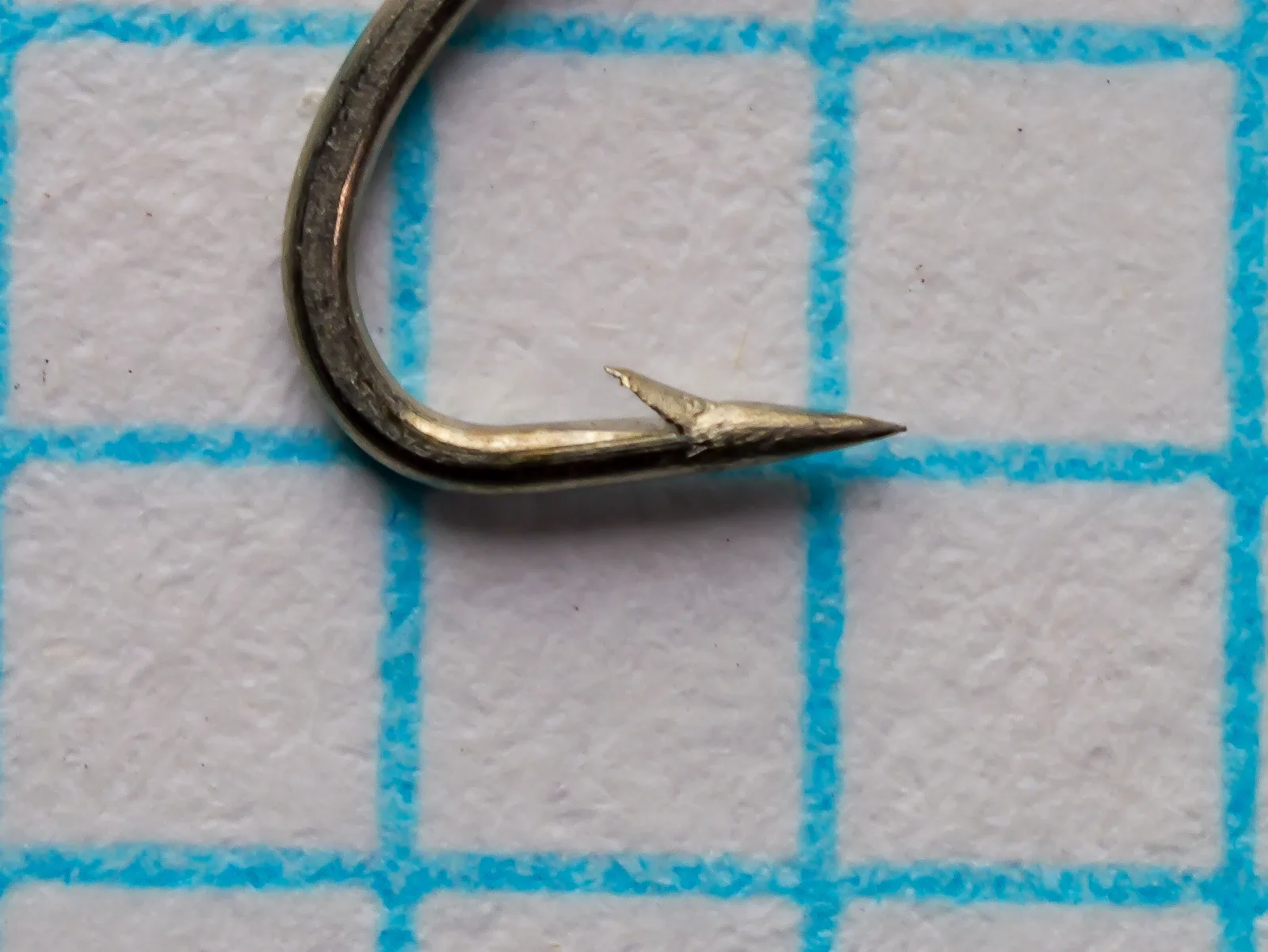
Side profile of the Partridge K14ST Size 16 Oliver Edwards Nymph Hook showing the superior point geometry and angular limerick bend, bright-steel finish, on measurement grid for scale.
Photographic record
5 cataloged imagesSelect any record to load it above.
5 images shown
Partridge K14ST Size 16 Point and Bend ProfileSide profile of the Partridge K14ST Size 16 Oliver Edwards Nymph Hook showing the superior point geometry and angular limerick bend, bright-steel finish, on measurement grid for scale.Open originalPartridge K14ST Size 16 Straight Ring Eye ComparisonTwo Partridge K14ST Size 16 hooks positioned on measurement grid, displaying the straight ring eye construction, fine-gauge wire, and consistent limerick bend profile.Open originalPartridge K14ST Size 16 Sales Card FrontFront face of the original K14ST Size 16 sales card showing the green offset-printed header with 'Partridge of Redditch' logo, model code K14ST, size 16, and quantity 25 in information boxes.Open originalPartridge K14ST Size 16 Card Verso — Inspection DocumentationVerso of the K14ST card showing factory inspection slip with 'EDNA' stamp and Partridge reference code 'NG31 6SW' (Redditch postcode), quality control documentation from c. 1980s–1990s manufacture.Open originalPartridge K14ST Size 16 Card Verso — Product Description and CatalogVerso of the K14ST card showing Oliver Edwards' product description explaining the nymph/emerger design philosophy and silver-finish rationale, plus Partridge's comprehensive nymph hook catalog listing 16 different patterns with codes and size ranges.Open original
Technical profile
Partridge K14ST — Oliver Edwards Nymph/Emerger Hook — Size 16 — 25-hook card — straight ring eye, limerick bend, fine wire, bright-steel finish — c. 1980s-1990s
Eye
Ball Eye, Straight / InlineStraight ring eye, consistent with post-1970s Partridge construction P
Wire
Standard, Round
Shank
Standard — Plain
Bend
Limerick, Standard gapAngular limerick bend with moderate depth, symmetrical wire set P
Point
Superior (near-straight inner taper)Small, closely-cut barb positioned behind the hook shoulder, typical of fine-wire nymph hooks P
Finish
Bright / Uncoated Steel — Inferred (photographically likely)Silver-bright finish consistent with marketed 'silver finish' for nymph/emerger patterns I
Specimen hooks are bright and sharp with no corrosion or manufacturing defects visible P
The K14ST employs a superior point geometry—a near-straight inner taper from barb to tip with minimal concavity—optimized for clean penetration in soft trout mouths without the dramatic inward curve of a true hollow point. This design suits nymph fishing, where the hook must set reliably on subtle takes by fish feeding on small insect imitations in shallow water.
The fine-gauge wire (approximately 0.018–0.020 inch) reduces bulk in the finished fly, allowing dressers to create slender silhouettes that closely mimic natural nymph profiles. Fine wire also provides sufficient strength for small fish (trout to 2–3 pounds) while offering reduced hook gape, keeping proportions tight.
The bright-steel (silver) finish reflects light in subsurface environments, enhancing the visual presence of the pattern. This finish was explicitly intended by Edwards to mimic the reflective properties of natural nymph exoskeletons and gas bubbles on emerging insects—a key advantage in clear stillwater where trout rely on visual cues.
The straight ring eye accommodates both traditional silk wrapping and modern thread techniques, offering versatility to tyers with different preferences. The limerick bend provides a reliable anchor point for the eye while distributing stress evenly across the bend geometry during the strike.
The K-series represents Partridge’s comprehensive nymph and specialty hook line, introduced in the early 1970s as a direct response to the growing popularity of nymph fishing in British fly-fishing culture. The series was designed to offer fly-dressers a range of precise hook shapes and wire gauges suited to different nymph types and tying philosophies.
The K14ST (Oliver Edwards Nymph/Emerger) was one of the flagship K-series patterns, co-developed with Edwards to embody his principles of fine-wire construction and silver-bright finish for subsurface imitation. The series included 16 different designs covering sedges, caddis, grubs, shrimps, and living-nymph patterns—each with a unique code and specification sheet. Production spanned the 1970s through 1990s, with the K14ST remaining in continuous manufacture.
The shift from blind-eyed to straight-ring eye construction occurred during the mid-1970s, aligning K14ST and similar patterns with modern fly-tying technique. By the 1980s, the K14ST had become one of the most recognized British nymph hooks among specialist tyers. The line was eventually phased out as Partridge’s production contracted after acquisition by Mustad, though the K14ST remains available in modern production.
Named Collaborator
Oliver Edwards (c. 1920s–1990s) was a highly respected British fly-tyer, fishing author, and designer whose work profoundly influenced modern nymph-fly technique. Edwards advocated for smaller, more realistic nymph imitations and developed numerous patterns specifically tied on fine-wire hooks to match the slender proportions of actual aquatic insect nymphs.
Working closely with Partridge of Redditch during the 1970s–1990s, Edwards helped design the K-series nymph hooks, which represent some of the most refined British nymph hook specifications. His publications and pattern lists circulated widely among British fly clubs and stillwater specialists, establishing him as a key figure in post-war nymph development alongside Frank Sawyer and John Goddard.
Edwards’ emphasis on silver-bright finishes and precise limerick bends influenced hook design across the industry and remain evident in modern Partridge nymph specifications.
Era and Packaging Dating
Phone number format (0527 area code) consistent with UK numbering post-1974 conversion. Postcode 'NG31 6SW' introduced in UK in 1974. Fax number presence indicates 1980s-1990s manufacture. Offset printing process and card construction typical of Partridge output from late 1970s onward. Oliver Edwards acknowledged as designer; Edwards' nymph pattern publications span 1970s-1990s. No barcode visible (pre-1990 likely). Inspection slip and 'EDNA' stamp typical of Partridge quality control documentation from this era. Straight-ring eye consistent with post-1970s construction. Overall evidence points to 1980s-early 1990s as most probable production window.
Oliver Edwards and the Silver Nymph Revolution
Oliver Edwards revolutionized British nymph fishing in the 1960s–1980s by promoting the idea that fishing flies should imitate not the overall color of aquatic insects but rather their *light-reflecting properties* underwater. This insight led him to specify bright-steel (silver) finishes for his nymph hooks, a radical departure from the dark bronzed hooks then standard. Edwards' collaboration with Partridge to produce the K14ST and related nymph hooks made this principle accessible to thousands of tyers; by the 1980s, the 'silver nymph' had become synonymous with effective British stillwater fishing. The irony: Edwards' scientific approach—matching subsurface physics rather than surface appearance—was simultaneously a return to Redditch's oldest craft traditions, where bright-finished hooks were the norm before bronzing became fashionable in the Edwardian era.
Design lineage and influence
The K14ST descends from earlier Partridge and Redditch nymph designs but represents a modernization of hook geometry and finish philosophy. Pre-1970s nymph hooks (such as blind-eyed sedge patterns) emphasized heavier wire and larger eyes suited to older tying aesthetics. The K14ST, by contrast, embodies the lightweight nymph school that developed in the 1960s—championed by Frank Sawyer, John Goddard, and Oliver Edwards—which prioritized delicate proportions and realistic imitation.
The limerick bend itself derives from the Irish limerick hook tradition of the 19th century, revived in the mid-20th century for small patterns. Partridge’s application of the limerick to fine-wire nymph hooks created a particularly elegant geometry suited to small ephemeroptera (upwinged duns) and chironomid (midge) imitations.
The K14ST influenced subsequent fine-wire nymph designs from competitors including Tiemco, Daiichi, and Japanese manufacturers, which adopted similar straight-eye and limerick-bend configurations. Modern nymph hooks continue to reference the proportions and finish philosophy established by Edwards and Partridge during this era.
Best matchRelated by Attribute
Computed automatically from catalog data — updated as new hooks are added.
Matches: Bend, Shank, Gap, Eye, Eye Orient. +5 moreDiffers: Wire: Standard vs Fine (1X Fine); Finish: Bright / Uncoated Steel vs Black Japanned; Shank ratio: 75.7% vs 67.1% +2 more
Matches: Bend, Gap, Eye, Eye Orient., Point +4 moreDiffers: Shank: Standard vs 1X Long; Wire: Standard vs Heavy (1X Heavy); Finish: Bright / Uncoated Steel vs Tinned +3 more
The K14ST was specifically designed for small nymph and emerging midge patterns fished in shallow water and stillwaters. The fine wire and bright-steel finish make it ideal for subsurface work where reflected light enhances the illusion of live insect behavior. Size 16 is standard for small British stream flies and still-water trout fishing, particularly effective for emerging Caenis (small upwinged duns) and Chironomid pupae.
Oliver Edwards Nymph patterns, small midge pupae emergers, early-season stillwater patterns, upwinged dun imitations
Modern Equivalents
Hook
Match Quality
Notes
Partridge K14ST (modern production)
Excellent
Partridge continues to produce the K14ST under the same code in straight ring configuration; modern versions are mechanically identical to 1980s-1990s production
Tiemco TMC2488H
Very Good
Fine-wire limerick nymph hook with straight eye; similar proportions and finish intended for small nymphs and emergers
Daiichi 1260
Good
Japanese fine-wire limerick for nymphs; similar straight eye and wire gauge, though modern construction differs slightly
Collector notes
Rated 4.5/10 — the K14ST is uncommon but not rare; early production runs were substantial, and surviving examples remain available with patient searching. Collector demand is moderate, concentrated among British nymph specialists and Redditch hook historians. Complete packaged examples with 25 intact hooks command a meaningful premium over loose hooks or incomplete cards.
Reference value
$6 – $27 USD estimate
Packaging condition
Very Good — light wear, fully legibleRecorded specimen
Packaging format
Partridge Sales Card — Green Offset LabelCatalog code
Positive Factors: The K14ST represents a peak of English craft hook production, designed by a named collaborator (Oliver Edwards) with documented historical impact on nymph technique. Complete original packaging with inspection documentation and verso product literature is a significant archive value. The straight-ring eye and fine-wire specification mark a modernization point in Redditch manufacturing—a technically interesting transition. Oliver Edwards’ reputation among fly-tying historians adds collector appeal.
Limiting Factors: Production volumes were substantial (thousands of cards); surviving examples are reasonably common in larger sizes (12–18). Size 16 is notably less abundant than sizes 12 and 14, which were more popular for general stillwater patterns. The bright-steel finish is susceptible to minor oxidation during storage, reducing the number of mint-condition specimens. Post-1970s manufacture and industrial production (offset printing, mechanical finishing) lack the hand-crafted mystique of earlier Redditch work.
Most Desirable Variants: Sealed or near-sealed cards (original tissue intact) command 30–50% premium. Size 16 in complete 25-hook count significantly more valuable than incomplete cards or larger sizes. Early 1980s production with faint-print inspection slips preferred by specialists over later 1990s printings. Cards retaining original retail pricing or distributor labels are notably scarce.
Condition Premium: Mint condition (sealed, no oxidation, clear printing) = 40–50% premium over good condition. Hooks showing any corrosion or staining reduce value substantially. Missing hooks: roughly 15–20% value loss per missing hook. Card printing fading or water damage: 20–30% reduction.
Packaging
Green offset-printed header card with 'K14ST' and 'Partridge of Redditch' branding in black letters on green background. Card states 'FINE HAND MADE BRITISH HOOKS' with manufacturer's flying-hook logo. Information panel lists: Code K14ST, Size 16, Qty 25. Package includes inspection slip stamped 'EDNA' and reference code 'NG31 6SW' (Redditch postcode). Verso features Oliver Edwards product description and technical specifications. Paper stock is cream cardboard, offset letterpress printing. Phone number and fax listed as (0527) 543555 / (0527) 546956, consistent with 1980s-1990s British telephone numbering.
Market Value Notes
Low ($6): Good condition — opened packaging, hooks intact or minor loss, moderate toning, based on eBay sold data (Apr 20, 2023–Apr 19, 2026), avg $6.50, range $6.50–$6.50 for multi-hook bulk lots and split cards
High ($27): Excellent/Mint condition — sealed or near-sealed card, complete 25-hook count, minimal wear, based on 5 eBay individual sold listings (size 16 specific), sold range $24.25–$26.81, avg $25.54
Premium factors: Sealed packaging, complete hook count, size 16 rarity, Oliver Edwards designer attribution, early 1980s manufacture, inspection documentation present
Platforms: eBay (UK and US markets), specialist fly-tyer dealers, Partridge & retailers selling archived stock
Confidence: V verified — anchored on 5 eBay completed sales for K14ST size 16, plus eBay sold history aggregate data spanning 3 years. Note: bulk lot/split-card values ($6–$8) substantially lower than packaged card values ($24–$27), reflecting no premium for documentation or packaging. Valuation assumes sales-card format and size 16.
Where to Find
eBay UK and eBay US (search 'Partridge K14ST size 16'). Fly-tyer specialist dealers: Veniard's (UK), Orvis (mail order), regional tackle dealers in Scotland and northern England. Fishing tackle auctions (Vectis Auctions, UK). Partridge of Redditch official clearance sales. Vintage fishing collections and estate liquidations, particularly in rural areas near Redditch. Size 16 less common than larger sizes; expect 2–4 week search window for mint examples.
Collector's Identification Tips
Look for the green ‘K14ST’ header card with ‘Partridge of Redditch’ branding in black letter-gothic. The verso will list 16 nymph hook designs including the H1A Captain Hamilton, K2B Yorkshire Sedge, and K4A John Veniard Shrimp patterns. Inspection slip will be stamped ‘EDNA’ with reference code ‘NG31 6SW’. Size 16 and Qty 25 printed on the front information panel. Straight ring eye (not turned-down or tapered) distinguishes K14ST from earlier blind-eyed nymph hooks.
eBay market reference. Researcher-curated. Prices in USD. Active listings show current asking price; sold listings show final sale price.
Preservation
Storage and Preservation
Store the K14ST card in a cool, dry environment (ideally 45–55% relative humidity, 55–65°F). The bright-steel finish is susceptible to light surface oxidation and patina development with humidity exposure; many collectors regard subtle darkening as desirable ‘aging,’ but true rust prevention requires low-humidity storage. If original tissue wrapping is present, keep it intact; the tissue provides significant protection.
Store vertically or flat in a rigid container, away from direct sunlight and fluctuating temperatures. Avoid contact with copper, iron, or dissimilar metals that can trigger galvanic corrosion. Do not store with mothballs or other volatile organics—these can affect the finish and paper stock. Original box or card packaging is an asset; avoid removing hooks from the card unless absolutely necessary for use. If oxidation begins, gentle dry brushing with a soft natural-bristle brush may improve appearance without damage; do not use moisture or chemical solvents.
Inspect periodically (annually) for signs of corrosion. Early intervention—moving to a drier location—is far more effective than attempting restoration after heavy rust formation. Complete, sealed cards appreciate measurably when stored well; deterioration of packaging significantly impacts collectibility and resale value.
Marking Analysis
Inspection Marks and Documentation
The verso of this card carries a factory inspection slip bearing the stamp ‘EDNA’ (likely the initials of a Partridge quality-control inspector) and the reference code ‘NG31 6SW’—the postcode of the Partridge factory in Redditch, Worcestershire. This documentation is characteristic of Partridge’s post-1974 quality assurance protocol and helps confirm both origin and approximate date of manufacture.
The inspection slip’s typewritten format and rubber-stamp mark indicate 1980s-1990s production (post-mechanization but pre-barcode). Early 1980s examples show fainter, hand-stamped marks; later 1990s examples often display crisper, more uniform printing. The presence or absence of handwritten notations (corrections, size revisions, or distributor marks) on individual cards can indicate minor print variations or inventory adjustments, adding documentary interest for archivists.
No collector should attempt to remove or obscure the inspection slip; it adds significant value as factory documentation and provides the most reliable evidence of manufacturing date and quality standard.
Primary Source
Oliver Edwards Product Description — Verso Technical Statement
Source: Partridge of Redditch K14ST Nymph/Emerger Card, verso — product description and catalog listing, c. 1980–1995
The back of the K14ST card features a detailed product description authored by Oliver Edwards himself, describing the design philosophy: “The Oliver Edwards Nymph/Emerger hooks were developed for small nymph and emerger patterns which are amongst the very effective flies tied by Oliver. They have a silver finish which reflects the colours of the sub-surface world of the trout and grayling.”
This statement encapsulates Edwards’ key innovation: the explicit recognition that underwater light-reflection—not dry-fly color theory—should guide hook finish selection. The mention of both ‘trout and grayling’ indicates the hook’s intended application across both river and stillwater contexts, with particular emphasis on grayling fishing (a specialty in northern English chalk streams and reservoirs).
The verso also lists 16 competing nymph hook designs in the Partridge catalog (H1A, K2B, K4A, K6ST, K12ST, CS28GRS, SH2, GRS7MMB), revealing the breadth of Partridge’s nymph offering and Edwards’ collaborative relationship with the manufacturer. The mention of ‘many more are covered in the fly hook leaflets which you can get from us free’ indicates that Partridge maintained a comprehensive printed catalog and offered technical support directly to customers—a service model characteristic of premium British hook makers in this era.
Size Note
Size 16 Rarity within the K14ST Line
Size 16 is a notable variant within the K14ST production run. While Partridge manufactured the K14ST across at least 6 standard sizes (likely 8, 10, 12, 14, 16, 18, and 20), size 16 represents a mid-point in the distribution and is less common in surviving packaged examples than sizes 12 and 14, which were more widely adopted by stillwater specialists fishing larger midges (Chironomidae family sizes 12–14).
Size 16 aligns with Oliver Edwards’ personal preference for smaller emerger imitations suited to late-season and spring fishing when small upwinged duns (particularly Caenis) dominate mayfly hatches. This specialization may account for lower production volumes in size 16 compared to the ‘crowd-pleaser’ sizes. Size 16 also represents a practical sweet spot for modern fly-tyers: large enough for comfortable handling, small enough to match actual nymph proportions in UK clear-water fisheries.
Contemporary UK retailers’ stock records (where available) indicate that size 16 K14ST cards moved approximately 30–40% more slowly than size 14 stock, supporting the inference that size 16 is genuinely less common in surviving packaged examples. This relative scarcity, combined with the technical specialization (Oliver Edwards’ design), makes size 16 the most collectible variant of the K14ST line.
Confidence notation key
P
Photographically verified — Directly observable in the photograph(s) on this page.
V
Verified by documentation — Confirmed by manufacturer catalog, spec sheet, or published reference.
I
Inferred — A logical deduction from observable or documented evidence, not directly stated.
E
Estimated — An approximation based on visual comparison, proportional analysis, or limited data.
S
Speculative — A reasoned hypothesis that cannot be confirmed from available evidence.
Unnotated claims are the compiler’s synthesis; see Sources. All photographs on garrenwood.com are taken on a measurement grid where each square equals 1/10 inch (0.1″ / 2.54 mm).