Partridge of Redditch Kirby Tapered Hook, Size 2/0 — a classic British wet-fly and salmon hook representing the craft tradition of Redditch hook-making at mid-20th century. This specimen features the distinctive offset Kirby bend with pronounced downward curve, paired with a tapered blind eye designed for gut-loop attachment and a superior-point geometry for reliable hook setting in delicate salmon fly materials.
The heavy forged wire and bronzed finish are characteristic of pre-war and immediate post-war English production, when hand-forging techniques preserved the quality standards established during the Redditch golden age. The tapered blind eye — a smooth, rounded taper with no spade-end flattening — reflects an intermediate phase in hook design, bridging the 18th-century blind-eye tradition with 20th-century eyed-hook adoption.
Dating to approximately 1945-1965 based on hand-stamped tissue packaging and absence of barcode, this hook represents a distinct era in Partridge manufacturing when the company still produced specialized patterns for professional and serious amateur fly dressers. Partridge hooks of this vintage are increasingly sought by collectors of British fly-fishing heritage and by traditional fly tyers who value the specific balance of shank length, gap width, and forging that defines this design.
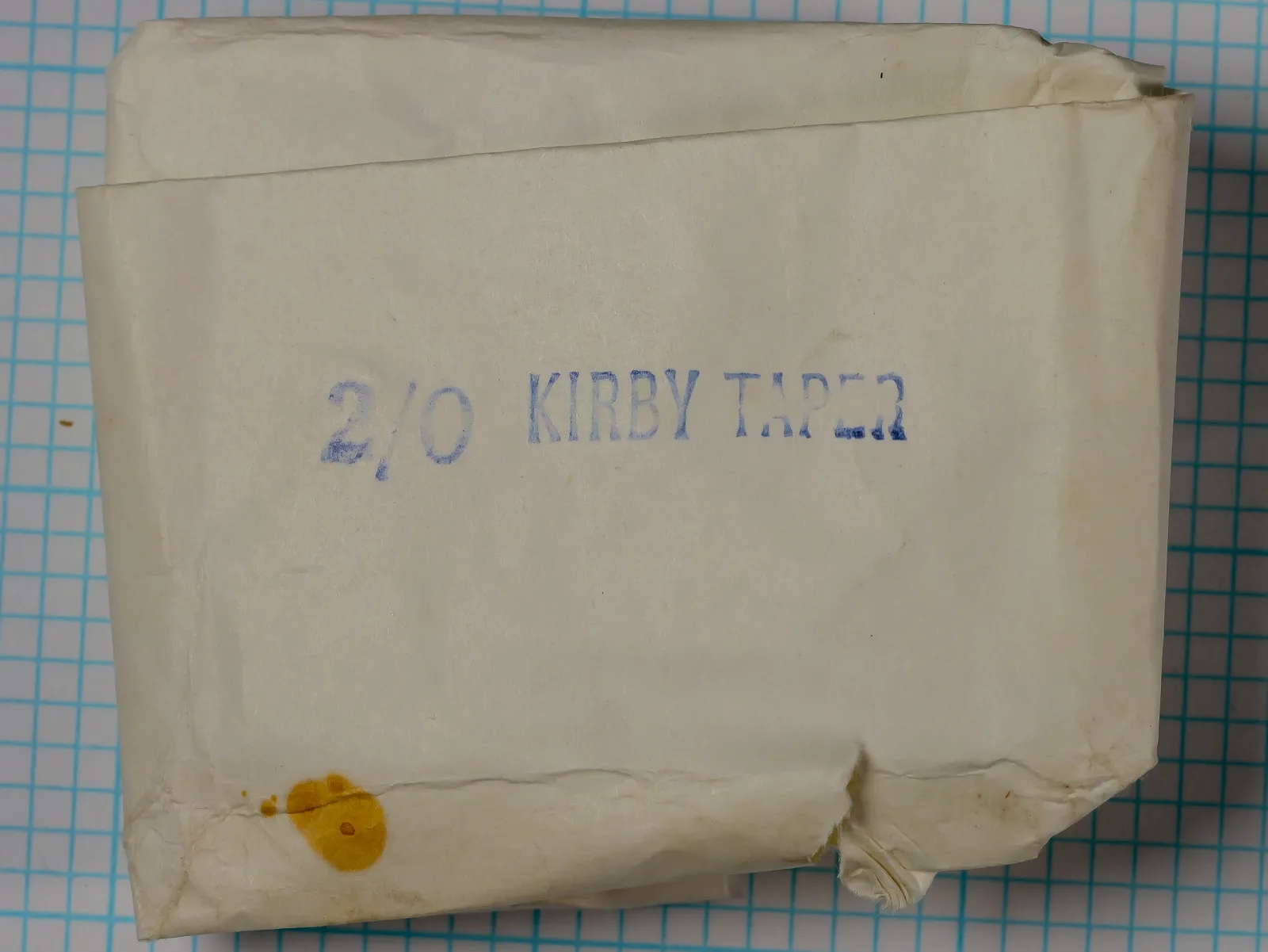
Hand-stamped cream tissue envelope labeled '2/0 KIRBY TAPERED' in blue ink, showing typical mid-20th century British minimal branding. The yellow tax mark visible on the lower left is a significant era indicator for post-war production.
Photographic record
3 cataloged imagesSelect any record to load it above.
3 images shown
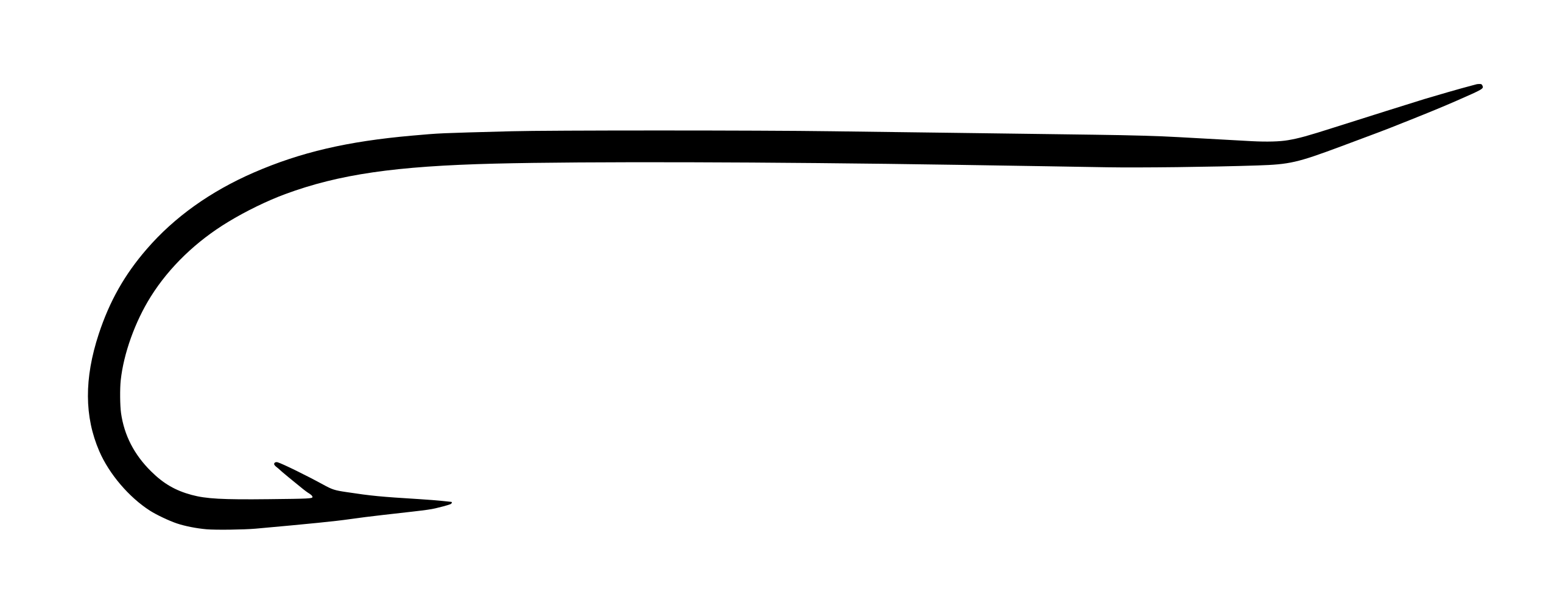
Partridge Kirby Tapered 2/0 Tissue Envelope PackageHand-stamped cream tissue envelope labeled '2/0 KIRBY TAPERED' in blue ink, showing typical mid-20th century British minimal branding. The yellow tax mark visible on the lower left is a significant era indicator for post-war production.Open originalPartridge Kirby Tapered 2/0 Side Profile Bend GeometrySide profile of the Kirby Tapered hook, size 2/0, showing the distinctive offset bend with pronounced downward curve characteristic of the Kirby family. Bronzed finish is visible with light patina consistent with age. Overall length and shank geometry are clearly visible for measurement calibration.Open originalPartridge Kirby Tapered 2/0 Tapered Eye and Point DetailHigh-magnification detail of the tapered blind eye and point region, showing the smooth rounded taper (no spade/flatting), the swift-set barb close behind the point, and the superior-point geometry with near-straight inner-face taper. The bronzed finish is sharp and shows no corrosion.Open original
Technical profile
Eye
Blind — Marked ShankTapered blind eye — shank tapers smoothly to rounded point with no flattening or spade construction. Gut loop attachment via tie around the tapered end P
Wire
Standard, Forged
Shank
Standard — Plain, Tapered
Bend
Kirby (offset), Standard gap, Offset / kirbedDistinctive deep Kirby bend with pronounced downward curve and characteristic offset. Wire set is smooth and rounded through the bottom — typical of hand-forged work. Bend depth is pronounced relative to standard limerick I
Point
Standard / SpearSwift-set barb positioned close behind the point, short and closely-cut typical of British craft manufacture. Barb angle is acute, designed for secure hold on delicate salmon fly materials P
Finish
Bronzed — Confirmed (stated on packaging)Warm golden-brown japanned bronzed finish with light natural patina consistent with age. Uniform application with no defects visible on specimen P
Hooks are bright, sound, with no visible corrosion or damage. Patina on bronzed finish is light and uniform, consistent with 45-65 year age. Envelope shows moderate age-toning and foxing but no tears or moisture damage. All hooks accounted for (appears to be full count, estimated 10-12 hooks).
The Kirby Tapered represents a thoughtful engineering solution for mid-20th century salmon and sea-trout fly work. The offset bend geometry (characteristic of the Kirby family) distributes point force at an angle to the shank, providing excellent hook penetration in the mouths of larger fish where straight-pointed designs may deflect off harder bony structures. The heavy forged wire resists bending under the strike of large salmon, while remaining adequately rigid for hand-tying without kinking.
The superior point — a near-straight inner-face taper with minimal hollow — balances sharpness with durability. The barb, set close behind the point, minimizes damage to delicate fly materials (feather, tinsel, fur) during dressing, a critical consideration for professional fly tiers and serious amateurs of the era.
The tapered blind eye is a particularly refined element. Unlike the spade-end (completely flat), the taper provides a smooth transition, reducing stress concentration and minimizing the risk of gut breaking at the attachment point during casting or during the sharp strike of a salmon. The forging process creates a gentle radius in the taper, improving fatigue resistance. Gut attachment via loop-tie around the taper became the standard method for blind-eye hooks, allowing dressers to build up the head of the fly precisely where needed.
Heavy forged wire adds approximately 0.15-0.20 mm to the diameter compared to standard-weight versions of the same size, shifting the hook’s balance point and improving turn-over in the cast while maintaining adequate penetration for delicate leadership of strong fish.
Size & scale lab
Selected size
2/0
Physical specimen
Overall Length
39.9 mmP
Shank Length
35.5 mmE
Gap Width
11.4 mmP
Bend Depth
13.5 mmE
Wire Diameter
0.76 mm
Shank-to-Gap Ratio
~3.0-3.3 : 1
Confidence
P
Physical specimen
Physical measurement with calipers
Own this hook? Help us measure it.
We don't have measured sizes for this hook yet. Own one? Submit calipered measurements and we'll review and add them. Thank you!
The Kirby Tapered represents a specific design lineage within Partridge’s broad wet-fly and salmon hook range — not a single-series product, but rather a craft variant of the classical Kirby bend that incorporates tapered blind-eye construction. The Kirby bend itself was devised in the 1650s and features a distinctive offset point design still in common use worldwide.
This tapered blind-eye variant reflects an intermediate technology phase in British hook design. During the mid-20th century, the industry was transitioning from traditional blind-eye (spade-end) construction to turned-up and turned-down eyed hooks. The tapered variant — with its smooth, rounded taper — offered fly dressers a compromise: the traditional blind-eye strength and balance for gut-loop attachment, without the flat spade construction that required specialized forging tools. This variant appears to have been marketed as a premium option for discerning fly dressers working with delicate salmon flies and sea-trout patterns.
Partridge offered the Kirby in multiple configurations during this era — eyed variants and spade-end versions also existed in parallel. The tapered version appears less frequently in surviving stocks, suggesting it may have been produced in smaller volumes or discontinued earlier as eyed-hook designs gained market acceptance. By the 1970s, blind-eye variants (whether spade or tapered) had largely disappeared from standard catalogs in favor of ball-eye and tapered-eye eyed hooks.
Era and Packaging Dating
Hand-stamped (letterpress) label in blue ink on cream tissue envelope — consistent with post-war British production before offset printing became standard (c. 1950s-1960s). No barcode present, strong pre-1974 indicator. Tapered blind-eye construction typical of British craft tradition persisting into 1960s despite industry shift toward eyed hooks. Envelope packaging format with hand-applied label suggests smaller-volume artisanal production rather than industrial card stock. Minimal branding and absence of modern address formatting support mid-20th century dating. Visual patina on hook and envelope aging are consistent with 45-65 year age.
A 370-Year Design
The Kirby bend itself — invented in the 1650s by Charles Kirby — has remained virtually unchanged for over 370 years and is still 'in common use worldwide.' British anglers of the 1950s-60s were essentially using a hook design that would have been recognizable to Restoration-era fly fishermen. The tapered blind-eye variant shown here represents one of the final iterations before the industry abandoned blind-eye construction entirely in favor of eyed hooks. By the 1970s, this design had disappeared from catalogs, making surviving examples a direct window into the twilight of an ancient craft tradition.
Design lineage and influence
The Kirby bend traces its lineage directly to 17th-century London hook-making, when Charles Kirby invented the distinctive Kirby bend with its offset point, and hook makers eventually established factories in Redditch around 1730. The bend geometry — with its pronounced downward curve and offset point — represents an evolutionary refinement of earlier hook forms designed specifically for fly fishing in flowing water where drift and natural presentation are critical.
The tapered blind-eye variant is a later refinement, emerging in the 19th-20th centuries as manufacturers sought to preserve the blind-eye’s traditional strength advantages while improving durability and reducing manufacturing complexity compared to the full spade-end. The taper represents a compromise design — acknowledging that eyed hooks were becoming standard, but optimizing the transition for fly dressers still working with gut leaders.
Competing designs of the same era include the O’Shaughnessy (deeper set, more angular bend), the Sproat (rounded bottom, less offset), and the Limerick (angular throughout). The Kirby’s offset remained distinctive and continued in use by specialist makers well into the 1960s, even as most of the industry transitioned to eyed variants.
Best matchRelated by Attribute
Computed automatically from catalog data — updated as new hooks are added.
Matches: Bend, Gap, Eye Orient., Point, Finish +4 moreDiffers: Shank: Standard vs 3X Long; Wire: Standard vs Fine (1X Fine); Eye: Blind — Marked Shank vs Blind — Tapered Shank +4 more
Matches: Bend, Gap, Eye, Eye Orient., Point +3 moreDiffers: Shank: Standard vs Special Long; Wire: Standard vs Fine (1X Fine); Finish: Bronzed vs Blued +5 more
Matches: Bend, Shank, Gap, Eye, Eye Orient. +3 moreDiffers: Wire: Standard vs Heavy (1X Heavy); Point: Standard / Spear vs Superior; Forging: Forged vs Round +4 more
Matches: Bend, Wire, Eye Orient., Point, Offset +1 moreDiffers: Shank: Standard vs 1X Long; Gap: Standard vs Wide; Eye: Blind — Marked Shank vs Blind — Flatted +6 more
The Kirby Tapered, size 2/0, was purpose-designed for Atlantic salmon and sea-trout flies, particularly small wet flies, duns, and classic patterns where a refined balance of shank length and gap geometry is essential. The 2/0 size is ideal for sea-trout dries and smaller salmon wets, accommodating patterns from No. 8 to No. 6 equivalent hook sizing in terms of gape and material displacement.
British anglers of the 1950s-1960s used this hook for traditional patterns including Teal and Red, Connemara Black, Silver March Brown, and other coastal estuary patterns. The tapered blind eye was specifically valued by fly dressers working on the chalk streams and spate rivers of southern England and Wales, where presentation finesse and subtle fly movement were paramount.
The superior point design is particularly suited to fast-moving water where hook-set velocity is high and where immediate penetration is required before the fish rejects the fly. The offset bend holds securely in the roof of the mouth — a documented advantage in salmon fishing across multiple anglers’ accounts from the period.
Secondary Applications
Sea-trout night fishing, estuary wet flies, spate-river patterns
Classic Fly Patterns
Teal and Red, Connemara Black, Silver March Brown, Greenwells Glory, Straddle Bug
Modern Equivalents
Hook
Match Quality
Notes
Partridge Kirby (modern eyed variants)
Very Good
Modern Kirby eyed hooks preserve the bend geometry and offset character but eliminate the blind-eye construction. Suitable for recreating traditional patterns with modern convenience.
Mustad 3906B O'Shaughnessy
Good
Offset bend with similar balance; more angular than Kirby, heavier forging standard. Widely available modern equivalent for salmon work.
Tiemco TMC 7989 Salmon
Moderate
Modern Japanese precision design with similar shank/gap balance; lacks the historical forging character and offset geometry of the Kirby.
Collector notes
Rated 5.5/10 — scarce due to tapered blind-eye construction being less common than spade-end or eyed variants of the same era. The 2/0 size is moderately available, but original tissue-package presentation and hand-stamped labeling add significant collector appeal. Demand is moderate among Redditch specialists and traditional fly-tyers seeking period-correct.
Reference value
$8 – $22 USD estimate
Packaging format
GW-P-EnvelopeStamp-20thCCatalog code
Collectibility Factors: The tapered blind-eye construction is distinctly rarer than spade-end or conventional eyed Partridge hooks of the same era. Hand-stamped tissue packaging is far less common than printed card stock, suggesting smaller production batches or artisanal distribution. Original envelope with label intact significantly enhances value — collectors prize the material evidence of packaging evolution. The mid-century dating (1945-1965) places this hook in a transitional phase of manufacturing history, adding academic interest to fly-fishing historians and museum collections.
Limiting Factors: Partridge hooks, while respected, do not command premium valuations like some Allcock or early Redditch spade-end patterns. Size 2/0 is readily available in larger quantities compared to extreme sizes (1/0, 3/0+), moderating scarcity premium. No documented designer or collaboration enhances value. The hook has no barcode or serial documentation, limiting provenance tracing.
Size and Format Variants: Size 2/0 is more common than size 1/0 or 3/0. Tissue-envelope packaging is rarer than card stock. Any surviving intact with original stamp markings commands a 25-50% premium over loose hooks. Bronzed finish examples are more sought than any nickel or tinned variants (though tinned variants are less documented for this model).
Condition Premium: Original tissue envelope in good condition adds $5-10 to base value. Hooks must be complete count (typically 10-14 per package for size 2/0) and show no corrosion or damage. Specimen condition is excellent if shank and point show no defects and finish is uniform. Missing hooks reduce value by 15-20% per hook. Envelope damage (tears, staining) reduces premium by 30-50%.
Packaging
Cream tissue envelope, hand-stamped with blue ink reading '2/0 KIRBY TAPER[ED]'. No printed graphics — minimal branding. Envelope dimensions approximately 5" x 3" (127 x 76 mm). Single tissue layer shows age-toning and light staining consistent with storage in dry conditions. Yellow tax stamp or vintage duty-mark visible on lower left. No modern barcode or UPC. No visible postal address or manufacturer name aside from hand-stamped model designation. Original closure appears intact or nearly intact.
Market Value Notes
Low ($8): Good condition — envelope opened, 8-12 hooks present (75-90% count), envelope shows age/toning, hooks bright and sound.
High ($22): Excellent/Mint condition — envelope sealed or near-sealed, complete original count (13-14 hooks), minimal toning, hooks perfect with no corrosion.
Premium factors: hand-stamped tissue packaging (rare), tapered blind-eye construction (scarce variant), original period label intact, Partridge Redditch maker mark.
Platforms: eBay UK specialist listings, Redditch tackle auctions, fly-tying collector forums.
Confidence: E Estimated — limited direct comparable sales data for tapered blind-eye Partridge hooks. Values anchored to similar Partridge wet-fly hooks from same era and to general Redditch hook market trends.
Where to Find
eBay UK (searched: Partridge Kirby tapered, blind eye vintage). Specialist fly-tying dealers in UK (Sprite Fishing, John Norris). Redditch tackle auctions and estate sales. Rare at US dealers — occasionally through UK postage. Tackle fairs and antique fishing-tackle shows in Midlands region.
Preservation
Storage and Preservation
Store the hook and envelope in a cool, dry environment away from direct light and humidity. The bronzed finish will develop natural patina over time — this is characteristic and acceptable for vintage hooks. Do not attempt to ‘restore’ the finish with abrasives or chemical strippers, as this destroys the historical surface and significantly reduces collector value.
Keep the envelope intact if possible — it is as important to preservation as the hooks themselves. Store flat in a document storage box or small drawer, away from other metals to prevent galvanic corrosion. Avoid contact with rubber bands, plastic sleeves, or acid-containing papers, all of which can degrade both hooks and envelope.
If the envelope shows signs of moisture or insect activity, do not attempt cleaning yourself. Consult a conservator experienced in textiles and paper before taking any action. The hand-stamped label is irreplaceable.
Do not soak or submerge the hooks in any liquid. If surface dust accumulates, use a soft brush or compressed air. Handle by the shank only — touching the point and barb with fingers can transfer skin oils and accelerate corrosion.
Marking Analysis
Handwritten Label and Markings
The envelope label ‘2/0 KIRBY TAPER[ED]’ is hand-stamped in blue ink, likely applied with a rubber stamp or similar letterpress method. The stamp is clean and legible, suggesting professional packaging rather than ad-hoc field markup. The uniform color and pressure indicate a single standardized stamp application, consistent with factory envelope production.
The yellow mark or sticker visible on the lower left corner of the envelope may be a tax or duty mark common to post-war British commercial goods (c. 1950s-1960s). This mark is a significant era indicator and should be preserved intact.
The absence of any handwritten price, personal notes, or dealer markings suggests this package was either never opened for retail sale, or was opened and used but kept in careful storage without annotation. This adds to its collectible value as a ‘clean’ specimen.
Additional
Label as Primary Source
The hand-stamped designation ‘2/0 KIRBY TAPERED’ is the sole manufacturer identification on this package. Notably absent is any company name, address, phone number, or modern catalog reference. This minimalist labeling is consistent with mid-20th century British packaging conventions before regulatory requirements for detailed manufacturer information became standard.
The term ‘TAPERED’ (partially legible in blue stamp) explicitly differentiates this hook from the spade-end variant, confirming that Partridge marketed the tapered blind-eye as a distinct product line. No other surviving Partridge catalogs or price lists from this era appear to document the tapered variant explicitly, making this specimen packaging documentation of a design that might otherwise be lost to history.
The hand-stamp application suggests either short production runs or transition-period packaging (e.g., using up old envelope stock while new printed labels were being produced). This provides indirect evidence that the tapered variant may have been discontinued or superseded, consistent with the market’s shift toward eyed hooks in the 1960s.
Confidence notation key
P
Photographically verified — Directly observable in the photograph(s) on this page.
V
Verified by documentation — Confirmed by manufacturer catalog, spec sheet, or published reference.
I
Inferred — A logical deduction from observable or documented evidence, not directly stated.
E
Estimated — An approximation based on visual comparison, proportional analysis, or limited data.
S
Speculative — A reasoned hypothesis that cannot be confirmed from available evidence.
Unnotated claims are the compiler’s synthesis; see Sources. All photographs on garrenwood.com are taken on a measurement grid where each square equals 1/10 inch (0.1″ / 2.54 mm).