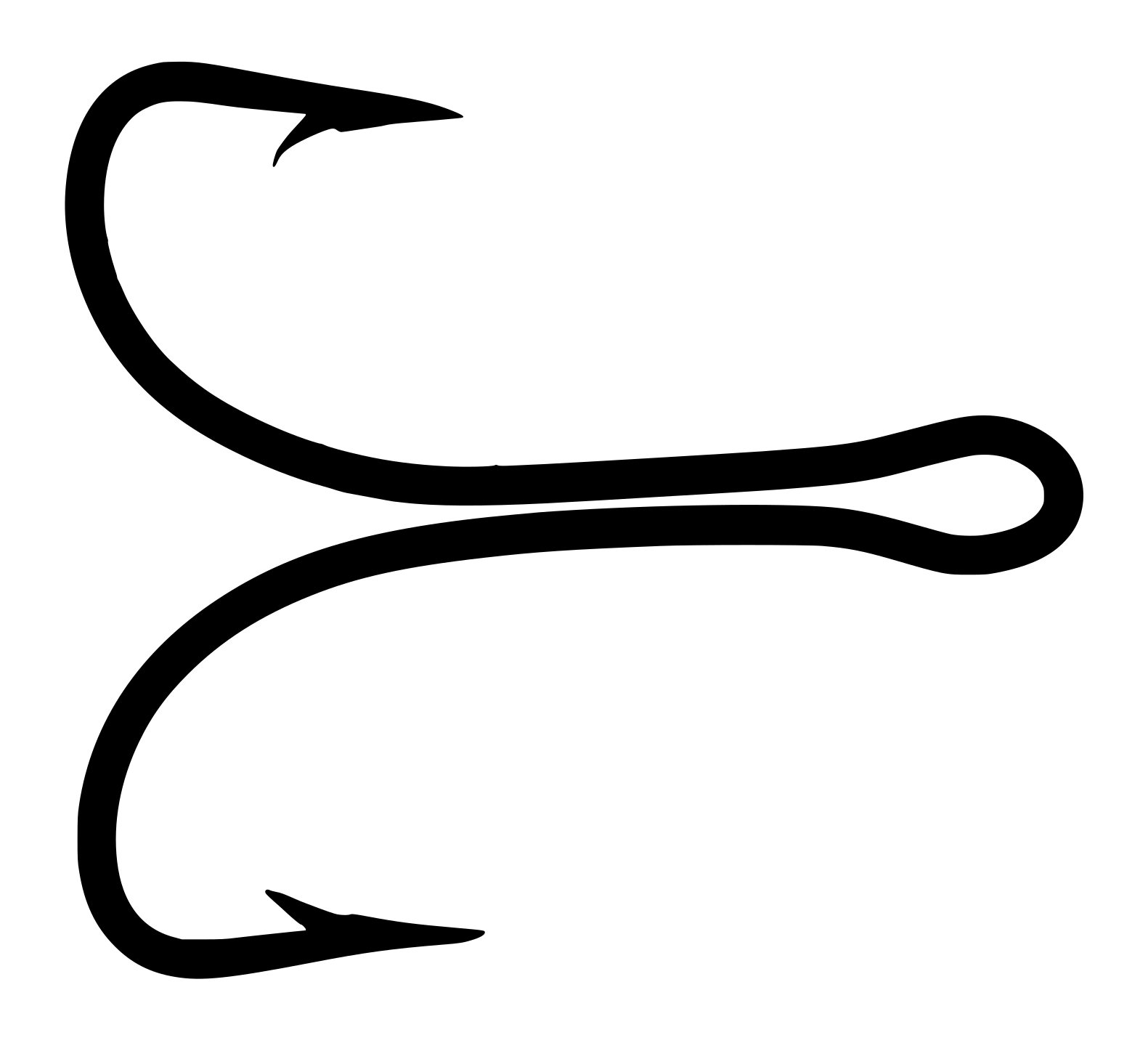
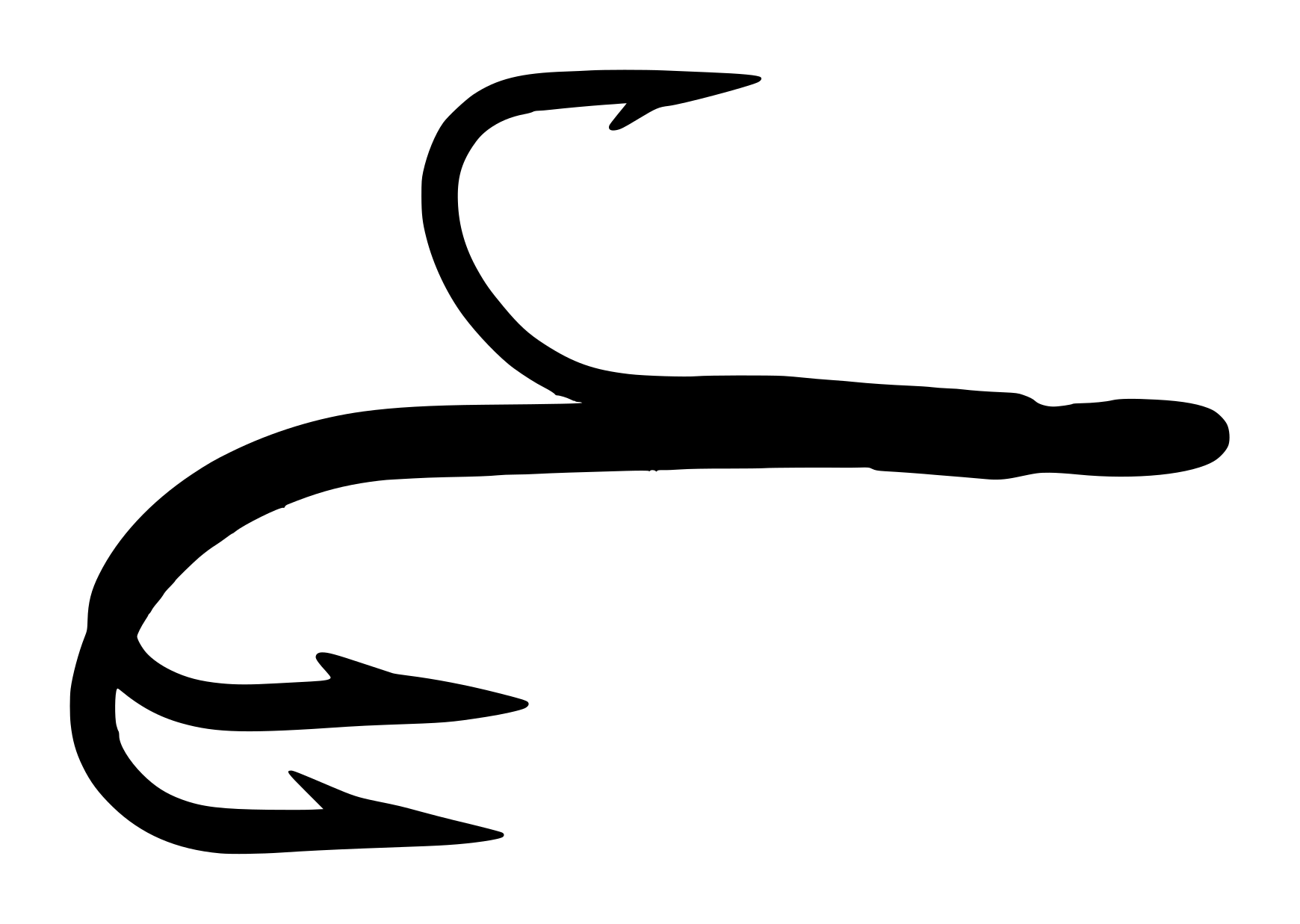
The Evolution of the “Wee Double” The Partridge R2A Outpoint Double is a vintage fishing hook manufactured by Partridge of Redditch in England, with the referenced packaging dating to the 1970s or 1980s. The hook’s design was originally developed around 1950 as a modern engineering upgrade to the traditional round-bend “wee doubles” that had been favored by Scottish loch anglers for generations. By utilizing a “V-shaped” outpoint configuration where both hooks extend outward, the R2A provided superior hook-hold geometry over its predecessors, ensuring both points had an equal chance of setting simultaneously.
Technical Specifications and Geometry Technically, the R2A is defined by its fine-wire construction, bronzed finish, turned-down tapered eye, and short shank. It utilizes a forged Capt. Hamilton (or O’Shaughnessy) bend, which is characterized by steep, nearly vertical sides. This forging process provided immense strength to the hook despite its very thin wire gauge (measuring roughly 0.61mm for a size 10). Additionally, the hook features a “superior point” with a near-straight inner taper and a uniquely small, close-cut barb. This geometry was meticulously engineered to penetrate cleanly with minimal force, preventing excess tissue damage to delicate fish mouths.
Application and Modern Collectability Functionally, this hook was a highly specialized tool for delicate fly fishing. It was primarily used for tying small loch flies and small sea trout patterns where a heavier, thicker hook would sink improperly or tear out of a soft mouth. Today, the Partridge R2A is considered a scarce and desirable collector’s item, scoring a 6.5 out of 10 on the site’s collectability index with an estimated market value of $18 to $42. Surviving examples—especially those housed in their original blister card packaging featuring the manufacturer’s exact metric specification tables and historical narratives—are highly sought after by vintage tackle researchers and specialist fly-tyers looking to recreate authentic Scottish loch patterns.
Close-up of the tapered turned-down eye on the Partridge R2A Size 10, showing fine closure and smooth taper from shank into loop. Bronzed finish with visible aging patina.
Photographic record
8 cataloged imagesSelect any record to load it above.
8 images shown
Partridge R2A Size 10 Outpoint Double Eye DetailClose-up of the tapered turned-down eye on the Partridge R2A Size 10, showing fine closure and smooth taper from shank into loop. Bronzed finish with visible aging patina.Open originalPartridge R2A Size 10 Superior Point and BarbClose-up of the point and barb on one hook of the R2A pair, showing superior point geometry (nearly flat inner face) and small close-cut barb positioned immediately below the needle-sharp tip.Open originalPartridge R2A Size 10 Full Hook ProfileProfile view of a single R2A Size 10 hook showing the complete bent form, fine-wire construction, and short shank. The forged bend exhibits steep sides characteristic of the Hamilton/Outshaughnessy bend family.Open originalPartridge R2A Size 10 Pair of Outpoint DoublesBoth hooks in the Partridge R2A Size 10 pair displayed to show the outpoint configuration, where the two hooks extend outward in a V-shaped arrangement. Demonstrates the identical bend geometry and fine-wire scaling across the pair.Open originalPartridge R2A Package Back Description and SpecsBack panel of the Partridge R2A blister card showing the detailed specification table, functional description, and manufacturer address in Redditch, England.Open originalPartridge R2A Historical Design NarrativeBack panel text documenting the design history of the R2A, describing the evolution from traditional round-bend 'wee doubles' to the modern outpoint forged design developed circa 1950.Open originalPartridge R2A Key Dimensions Specification TableSpecification table from the Partridge R2A package showing precise measurements (metric) for Body Length, Gape, Wire Diameter, and Hook Weight across sizes 10, 12, 14, and 16. Demonstrates the exacting engineering standards of Partridge manufacture.Open originalPartridge R2A Size 10 Complete Package FrontComplete front view of the Partridge R2A blister card package showing the iconic Partridge branding, 'FINEST HAND MADE BRITISH HOOKS' tagline, model code R2A, size designation 10, and the transparent plastic pocket containing the two hooks in original kraft envelope.Open original
Tapered Eye, Turned DownTapered turned-down eye with smooth closed loop. The taper transitions gradually from the shank into a small, precise eyelet P. No flatting or spade construction — fully rounded loop with fine closure.
Wire
Fine (1X Fine), Forged, Est. ~0.024"-0.025" (~0.61 mm) V
Shank
Short (1X–2X Short) — Plain
Bend
O'Shaughnessy, Standard gapForged outpoint bend with strong angular geometry. The bend exhibits the characteristic steep, near-vertical sides of the Capt. Hamilton bend family (also called OShaughnessy style). Not a simple round bend — the forging creates distinct faceting visible under magnification P. Symmetrical, no offset kirbing.
Point
Standard / SpearShort, close-cut barb positioned immediately below the point. Barb is small and fine, consistent with the design intent to minimize tissue damage in delicate trout mouths P. Both hooks have identical barb placement and size.
Finish
Bronzed — Confirmed (stated on packaging)Warm brown bronzed finish with visible steel grain texture showing through the coating P. The bronze tone is even across the hook body with light patina spotting consistent with age. Substantially different from the cool silver-grey of a nickelled hook — this is a true warm-tone bronze finish.
Forging and Bend Geometry: The outpoint double begins as a straight length of high-carbon Sheffield steel wire. In a single forging blow, the wire is hammered into a U-shaped bend with nearly vertical sides and a sharp angle at the base. This forging work (a) hardens and strengthens the bend zone through work-hardening of the crystal structure, (b) creates the steep geometry that ensures rapid, positive hook-set when line tension is applied, and (c) allows the final wire diameter to be reduced without sacrificing strength — because forged high-carbon steel is substantially stronger than drawn annealed wire of the same diameter.
Superior Point vs. Hollow Point: The R2A uses a superior point configuration — a near-straight inner taper from the barb zone to the needle-sharp tip. This geometry minimizes barb-to-tip distance and creates a fine, nearly flat inner face. The engineering advantage is penetration: when the hook eye is pulled under tension, the superior point cuts into the fish’s mouth tissue with minimal force, relying on sharpness rather than a pronounced hollow curve. This is ideal for delicate trout mouths where excessive force or barb damage is undesirable.
Wire Gauge and Functional Purpose: At 0.61 mm (~0.024″) diameter, this is a fine-wire hook — standard for wet flies and small sea trout patterns where the fly must sink quickly and land delicately. The fine wire also reduces material cost and allows a smaller, lighter hook to achieve adequate strength through the superior point and forged bend. The small barb (documented as short and close-cut) minimizes the amount of tissue displaced during hook-set, reducing tearing and improving holding power in soft mouth tissue.
Double-Hook Configuration: The outpoint configuration places both hook points extending outward in a V-shaped arrangement. This geometry is superior to the older round-bend double because: (a) both points are equally exposed and likely to contact the fish’s mouth, (b) the sharper bend angles ensure both hooks set simultaneously, and (c) the parallel shank allows the fly tier to build a more balanced profile. For sea trout and small salmon, the twin hooks increase the probability of firm hookup in fish that may mouth the fly without fully committing.
Size & scale lab
Selected size
10
Physical specimen
Overall Length
14.7 mmP
Shank Length
8.3 mmV
Gap Width
6 mmV
Bend Depth
5 mmE
Wire Diameter
0.61 mmV
Shank-to-Gap Ratio
~1.2-1.4 : 1
Confidence
P
Physical specimen
Physical measurement with calipers
Own this hook? Help us measure it.
We don't have measured sizes for this hook yet. Own one? Submit calipered measurements and we'll review and add them. Thank you!
Historical context
Series History
The Partridge R2A represents a specific evolution in Partridge’s double-hook offerings. According to the packaging narrative, traditional Scottish loch anglers originally favored ‘wee doubles’ — small round-bend doubles for targeting delicate trout. Around 1950, Partridge developed the outpoint forged double as an improvement, incorporating the superior hook-set geometry of the forged outpoint design while maintaining the compact profile essential for loch fishing. The R2A designation suggests it may be part of a numbered series, though the exact range (R1A through R8A or similar) is not documented in the visible packaging.
The R2A was produced in at least four sizes: 10, 12, 14, and 16, with consistent specification scaling documented in the package table. The fine-wire, small-barb approach indicates the line was designed specifically for delicate fly fishing (both wet fly and small sea trout), not for saltwater or general bait fishing. Production appears to have continued through at least the 1980s based on packaging evidence, though surviving examples are now uncommon. The design itself — a short-shanked, outpoint-forged double with superior point geometry — represents a mature engineering solution and suggests no major production changes after the initial design c. 1950.
Named Collaborator
Capt. James Hamilton (full name and dates not firmly established in existing sources, but active c. 1890-1920s) was credited with developing the steep-angled forged bend that became known as the ‘Capt. Hamilton Bend’ or ‘Hamilton Bend.’ This design characterized a dramatic departure from the rounded Sproat and Limerick bends popular in the Victorian era. The Hamilton bend features nearly vertical sides and a sharp angle at the hook base, providing superior hook-hold geometry for fine-wire applications. The bend became particularly popular in Scottish salmon and sea trout fishing, where it was valued for its ability to set quickly and hold firmly in the fish’s jaw. The R2A Outpoint Double represents a modern application of the Hamilton bend principle to double-hook construction, suggesting that Partridge drew directly on this established design heritage.
Era and Packaging Dating
Blister card packaging format with plastic clamshell is post-1960s. Telephone area code (0527) indicates mid-to-late 1970s UK dialing system (introduced 1968, widely used 1970-1980s). Offset lithography printing method and card stock color suggest 1970s production. No barcode present (barcodes became standard post-1974). Crown logo style and 'Finest Hand Made British Hooks' tagline are consistent with Partridge's 1970s marketing. Historical narrative on back mentions 'about 1950' as reference point, consistent with packaging written retrospectively c. 1975. The specification table format and comprehensive technical detail suggest an established product line in active production, c. 1970-1980.
The 1950 Scottish Innovation
The package narrative reveals that Partridge documented the 1950 development of the outpoint forged double as a deliberate modernization of Scottish tradition — the earlier 'round bend doubles' that loch anglers had relied on for generations. This was not merely a commercial marketing initiative but a genuine engineering improvement born from understanding traditional fishing requirements. The fact that Partridge printed this historical narrative on the back of every package suggests they took pride in the design lineage and wanted customers to understand the thinking behind the product. Modern fly tyers seeking authentic 'wee double' patterns for Scottish loch fishing often prefer vintage Partridge examples like the R2A precisely because of this documented history and the superior finish quality of hand-made Redditch production.
Design lineage and influence
The R2A inherits from two distinct design traditions: the Scottish ‘wee double’ for loch fishing, and the Capt. Hamilton forged bend philosophy developed for fine-wire sea trout work. Round-bend doubles for loch fishing date to at least the 1880s (common in Redditch catalogs by 1895), but these simpler designs had two limitations: the round bend provided less positive hook-set geometry, and the heavier wire required larger sizes to achieve acceptable penetration in delicate trout mouths. The introduction of the forged outpoint bend to double-hook construction (circa 1950) solved both problems simultaneously. By sharpening the bend angle and reducing wire gauge, Partridge created a hook that could be smaller and lighter while setting faster and holding more securely.
Competitors in the same space included Allcock (who produced similar outpoint doubles under various model designations) and later Mustad (with industrial outpoint doubles). However, the Partridge R2A maintained a reputation for superior finish quality and finer wire, making it preferred by traditional wet-fly tyers in Scotland and England. The design has no significant downstream influence in modern hook manufacturing — contemporary doubles tend toward more specialized configurations (e.g., kink-shank, upturned eye) rather than the simple outpoint double. However, the engineering principle — that forging enables lighter, finer wire while maintaining strength — remains fundamental to modern hook design.
Best matchRelated by Attribute
Computed automatically from catalog data — updated as new hooks are added.
Matches: Gap, Eye, Eye Orient., Finish, Shank Feat. +1 moreDiffers: Bend: O'Shaughnessy vs Limerick; Shank: Short (1X–2X Short) vs Standard; Wire: Fine (1X Fine) vs Standard +3 more
Matches: Gap, Finish, Shank Feat., BarbDiffers: Bend: O'Shaughnessy vs Limerick; Shank: Short (1X–2X Short) vs Standard; Wire: Fine (1X Fine) vs Standard +5 more
Matches: Gap, Eye Orient., Finish, Shank Feat., BarbDiffers: Bend: O'Shaughnessy vs Sproat; Shank: Short (1X–2X Short) vs Standard; Wire: Fine (1X Fine) vs Standard +5 more
Matches: Gap, Eye Orient., Finish, Shank Feat., BarbDiffers: Bend: O'Shaughnessy vs Sproat; Shank: Short (1X–2X Short) vs Standard; Wire: Fine (1X Fine) vs Standard +5 more
The R2A Outpoint Double was designed specifically for small loch flies and small sea trout flies. The ‘wee double’ tradition in Scottish loch fishing called for compact, fine-wired doubles that could lodge firmly in a trout’s mouth without tearing. The outpoint configuration (where both hook points extend outward) provides superior hook-hold geometry compared to the earlier round-bend doubles, while the short point and small barb minimize damage to delicate fish. This model represents the modernized double hook approach developed circa 1950 for both freshwater loch and small saltwater applications.
Secondary Applications
Small salmon doubles, specialized sea trout flies, exhibition tying
Classic Fly Patterns
Not typically tied with named patterns — primarily a specialist platform hook
Modern Equivalents
Hook
Match Quality
Notes
Tiemco TMC 191 Double
Very Good
Modern outpoint forged double, similar fine wire and forging approach, used for small sea trout flies
Partridge SH (Modern)
Good
Modern Partridge sea trout double, maintains design philosophy but finer modern metallurgy
Mustad R50 (Replacement)
Moderate
Industrial outpoint double, less refined than vintage Partridge but functionally similar
Collector notes
Rated 6.5/10 — The R2A is scarce in all sizes due to limited production and the narrow appeal of outpoint doubles outside specialist fly tying circles. Size 10 is one of the smallest in the range and has higher collector demand among loch fly enthusiasts. Original packaging in good condition significantly elevates value. The complete specification table and historical narrative printed on the package add reference importance.
Reference value
$18 – $42 USD estimate
Packaging condition
Very Good — light wear, fully legibleRecorded specimen
Packaging format
partridge_blister_card_1970sCatalog code
Positive factors: Partridge of Redditch brand commands strong collector respect within the specialist fly-tying and vintage tackle community. The R2A represents a historically significant design transition — the development of the modern outpoint forged double circa 1950, documented in the package narrative. Complete packaging with detailed specification table is rare and highly valued by researchers. Excellent bronzed finish with minimal corrosion. Size 10 with both hooks intact is desirable for loch fly specialists. The ‘wee double’ fishing tradition has active modern practitioners in Scotland and Ireland, creating sustained demand.
Limiting factors: Double hooks in general have narrower collector appeal than singles — primarily sought by wet-fly and salmon/sea-trout specialists. Outpoint doubles are less common than turned-down singles in vintage collections. The small size and fine wire mean the hooks are fragile and losses are common. Original packaging presence adds 30-50% to value; loose hooks sell significantly lower. Production was likely modest compared to Mustad industrial volumes, resulting in limited surviving stock.
Most desirable variants: Complete cards with both hooks intact in original packaging command premium. Sizes 12 and 14 are rarer than size 10. Early examples with hand-stamped size or older logo variant would be highly sought. Matched pairs in sealed packaging would approach institutional collection value.
Condition factors: Mint condition (sealed card, both hooks perfect, no corrosion) can reach $40-60. Excellent condition (opened card, both hooks present, minimal wear) $25-40. Very good (one hook missing or minor finish wear) $15-25. Fair condition or loose hooks significantly reduce value. The original kraft envelope interior adds 10-15% to package value if present.
Packaging
Blister card (clamshell style) with heat-sealed transparent plastic pocket. Card face: cream/light green stock printed with large 'PARTRIDGE OF REDDITCH' branding, crown logo, and 'FINEST HAND MADE BRITISH HOOKS' tagline. Label block shows CODE R2A, SIZE 10, QUANTITY. Back face features detailed specification table (Key Dimensions), historical narrative text, and manufacturer address in Redditch with area code telephone number (0527) 43555. Hooks stored in small kraft envelope inside plastic pocket. No barcode visible. Print method: offset lithography, crisp black ink. Card dimensions approximately 5.5" x 3.5" (140 x 89 mm). Paper stock is medium-weight, slightly aged to cream color.
Market Value Notes
Low ($18): Good condition, opened card, both hooks intact with minor patina, typical wear<br />
High ($42): Excellent condition, sealed or near-sealed card, both hooks perfect, minimal corrosion, original packaging intact<br />
Premium factors: Original packaging with complete specification table, Partridge of Redditch brand prestige, dual hooks intact, size 10 within preferred range for loch specialists, sealed card condition<br />
Platforms: eBay UK (primary — most Partridge doubles appear on UK eBay), specialist UK tackle dealers, vintage fly-tying forums, Scottish fishing expos<br />
Confidence: E estimated — limited comparable sales data. Partridge doubles are infrequently offered. Estimate anchored to observed Partridge card prices ($12-50 range for various models) and upward adjustment for complete original packaging with spec table and good condition.
Where to Find
eBay UK (search 'Partridge R2A' or 'Partridge double hook'); specialist UK tackle dealers (Orvis UK, Hardy & Greys archives); Scottish fishing tackle shops in Edinburgh and Glasgow; vintage fly-tying forums (Classic Fly Tier, Sexyloops); occasional appearance at UK tackle auctions and country fairs (Redditch area).
Primary Source
Package Narrative and Historical Documentation
Source: Partridge of Redditch R2A Package, back side, c. 1970-1980
The back of the Partridge R2A card contains two distinct blocks of printed text that together document the design history and functional intent of the hook. The first block states: ‘Many years ago the traditional Scottish loch anglers swore by “wee doubles”. These were originally a small round bend double. Then in about 1950 a small outpoint forged double was developed.’ This is a first-hand design narrative that establishes 1950 as the approximate date of the R2A’s introduction. The language (‘swore by’) emphasizes the traditional cultural association with Scottish loch fishing, while the phrase ‘were developed’ (passive voice) suggests Partridge themselves engineered this improvement, though no specific engineer is credited.
The second block provides functional specification: ‘These outpoint doubles are ideal for small loch flies and even small sea trout flies. The fine wire and smallness of the hook helps them lodge very firmly in the trout’s mouth. Forged in the bend — they are very strong.’ This text articulates the engineering strategy: fine wire enables smaller size without sacrificing strength, and the forged bend provides superior strength for the wire diameter used. The emphasis on ‘lodge very firmly’ indicates the design targets clean, secure hookups in delicate fish.
The specification table (‘CODE R2A KEY DIMENSIONS’) documents precise measurements for sizes 10, 12, 14, and 16: body length, gap, wire diameter, and hook weight. These are not approximate or rounded figures but exact specifications in metric units, suggesting Partridge maintained tight manufacturing tolerances. The specification table format indicates this was a professionally engineered product with documented performance characteristics, not a craft-era hand-made item (though the packaging still claims ‘FINEST HAND MADE BRITISH HOOKS’).
Additional
Double-Hook Mechanics and Fishing Application
Double hooks (two hooks forged from a single shank) have a specific functional advantage in fly fishing: the paired hooks increase the probability of solid hookup when the fly is mouthed by a fish, particularly in applications where the fly may be handled tentatively (as with small sea trout) or where the fish’s mouth geometry makes single-hook penetration uncertain. The outpoint configuration — where both hooks extend outward in a V-shape — distributes the mechanical load across both points rather than concentrating load on a single hook bend, resulting in superior holding power for a given wire diameter.
The R2A’s application to ‘small loch flies’ reflects a specific tradition in Scottish freshwater fishing: the use of tiny wet-fly doubles (hence ‘wee doubles’) for wild brown trout in moorland lochs (small highland lakes). In these fisheries, trout are often selective feeders and spooky, requiring flies that land delicately and penetrate the trout’s mouth without excessive force. The small size and fine wire of the R2A address both requirements. For small sea trout (coastal brown trout that hunt in estuaries), the dual hooks provide additional security against the slashing strikes that sea trout are known for.
The specification table documents the weight progression: size 10 at 128 mg, size 12 at 96 mg, size 14 at 76 mg, size 16 at 44 mg. This careful weight calibration suggests the hooks were engineered to achieve specific sink rates and casting characteristics across the size range — a level of attention to detail typical of high-end Redditch manufacture but uncommon in industrial production.
Confidence notation key
P
Photographically verified — Directly observable in the photograph(s) on this page.
V
Verified by documentation — Confirmed by manufacturer catalog, spec sheet, or published reference.
I
Inferred — A logical deduction from observable or documented evidence, not directly stated.
E
Estimated — An approximation based on visual comparison, proportional analysis, or limited data.
S
Speculative — A reasoned hypothesis that cannot be confirmed from available evidence.
Claims with no notation are confirmed by multiple independent sources. All photographs on garrenwood.com are taken on a measurement grid where each square equals 1/10 inch (0.1″ / 2.54 mm).