O. Mustad & Son
Norway · Est. 1832 · Classic, Signature & Heritage series
For the first 45 years of its existence, O. Mustad & Son didn’t make a single fish hook. Founded in 1832 by Hans Schikkelstad as a nail and steel wire factory in Gjøvik, Norway, the company took its lasting name when son-in-law Ole Hovelsen Mustad took over in 1843. His son Hans joined as co-owner in 1874, and the firm was formally named O. Mustad & Søn.
The company’s destiny changed in 1877 when a young mechanic named Mathias Topp invented an automatic hook-making machine — the first of its kind. Wire went in one end and a fully formed, barbed, and pointed hook came out the other. Mustad operated in extreme secrecy; workers were restricted from seeing the complete machine, and key blueprints were encrypted and held only by family members. This single technological leap allowed Mustad to produce consistent hooks at a fraction of the cost of their competitors in Redditch, England — at the time the hook capital of the world.
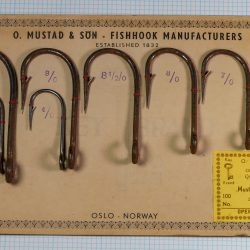
Armed with superior production technology, Hans Mustad and his five sons launched an aggressive global expansion. Between the 1890s and 1920s they acquired over 300 competing firms, effectively dismantling English dominance of the trade. Sales representatives were dispatched to the most remote corners of the world to collect local hook samples — if a tribe in the Amazon or a commercial fleet in Japan used a specific shape, Mustad would re-engineer it for their machines and sell it back cheaper and better. By mid-century, their catalog contained an estimated 60,000 to 100,000 different hook patterns and sizes.
After World War II the company lost major production capacity when several Eastern European factories were seized behind the Iron Curtain. To survive, Mustad diversified into zippers, paper clips, margarine, and ovens — at one point a world leader in paper clips — while the fish hook division remained the crown jewel. In the late 20th century the conglomerate was broken up, returning focus to fishing tackle. Hook manufacturing shifted to a state-of-the-art facility in Wuxi, China, while headquarters remained in Norway. After six generations of family ownership the company was sold in 2011 to a Norwegian investment group, and private equity firm Verdane acquired a majority stake in 2017. Mustad remains the world’s best-selling hook brand, present in over 160 countries.