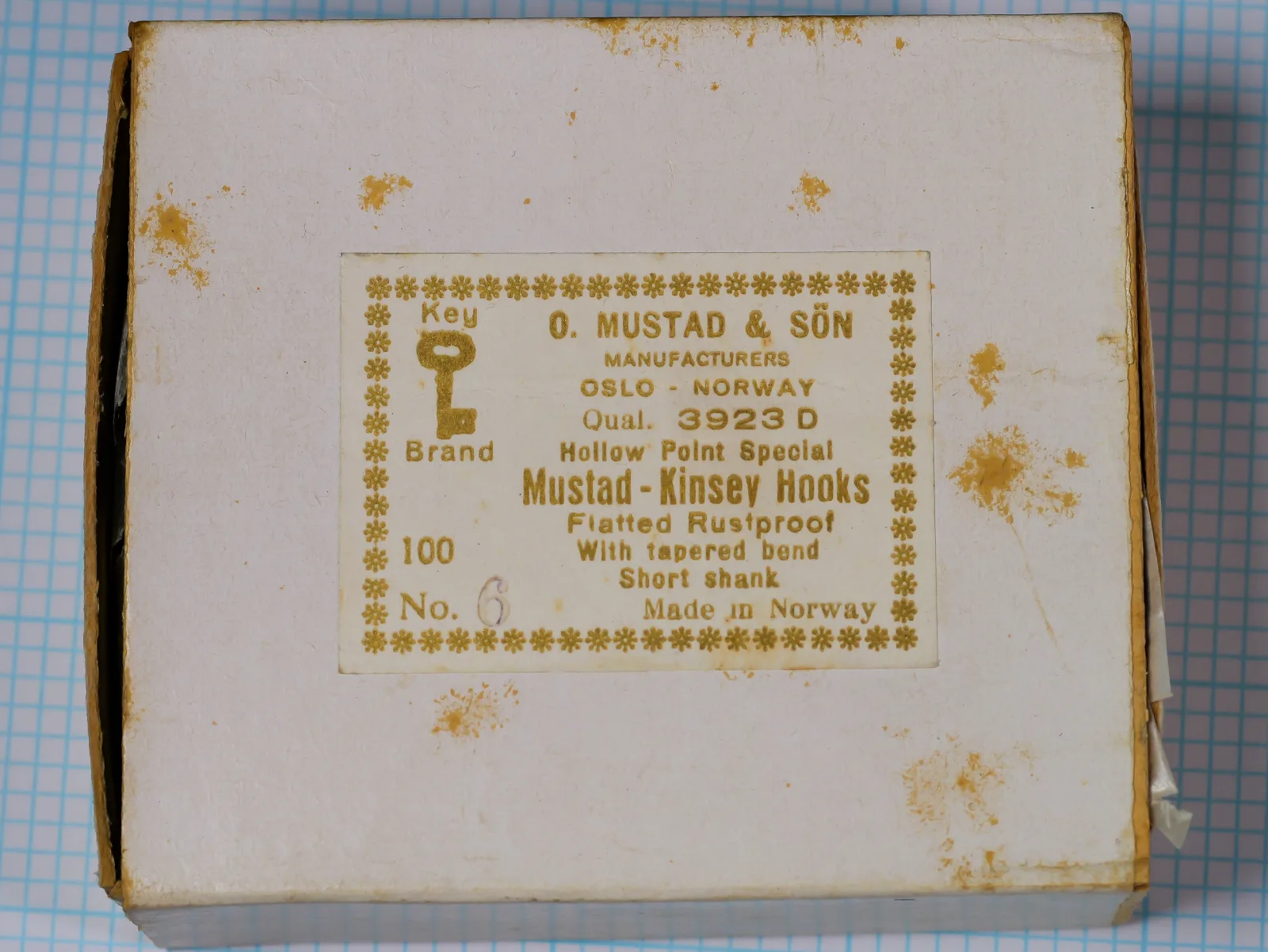
The Mustad-Kinsey 3923 D is a spade-end (blind flatted) hook made by O. Mustad & Søn, labelled Oslo, Norway, and most plausibly dating from c. 1925–1950s. The box describes it as a ‘Hollow Point Special — Flatted, Rustproof, with tapered bend, Short shank,’ with the size hand-marked ‘No. 6.’ Its short shank, wide gap, hollow point, and spade end are characteristic of a bait hook for salmon and sea trout (worm, shrimp, or prawn presentations) whipped to a gut or nylon snell, though the pattern could also be dressed as a simple wet fly.
The defining features are the blind flatted (spade) end — the wire hammered into a flat paddle, here bearing a small impressed maker’s stamp — and the hollow (concave-faced) point. The finish is a warm bronzed tone, with the maker’s ‘Rustproof’ claim printed on the box. The bend reads as a smooth rounded curve in the photographs and is recorded here as a round-type bend pending physical confirmation; an earlier Sproat designation was not supportable.
Original Mustad-Kinsey 3923 D box showing the distinctive gold letterpress label with 'Hollow Point Special' designation and 'Made in Norway' marking, indicating Oslo production circa 1920–1945.
Photographic record
4 cataloged imagesSelect any record to load it above.
4 images shown
Mustad-Kinsey 3923 D Box and Label Size 6Original Mustad-Kinsey 3923 D box showing the distinctive gold letterpress label with 'Hollow Point Special' designation and 'Made in Norway' marking, indicating Oslo production circa 1920–1945.Open originalMustad-Kinsey 3923 D Flatted Eye Size 6Close-up front view of the blind flatted (spade) eye construction, showing the clean, symmetrical flatting across the full wire width characteristic of interwar punch-formed closure design.Open originalMustad-Kinsey 3923 D Hook Point Size 6Profile view of the point region showing the concave inner face (hollow point geometry) and the short, close-set barb positioned ahead of the inward taper.Open originalMustad-Kinsey 3923 D Full Profile Size 6Complete profile view on 1/10-inch measurement grid showing overall hook geometry, shank length, Sproat bend radius, and proportions of a size 6 Mustad-Kinsey 3923 D in bronzed finish.Open original
Technical profile
Eye
Blind — FlattedBlind flatted (spade-end) terminus: the shank end is hammered flat into a paddle with no hole punched. P Flatting is uniform across the wire width with no taper, indicating a die-formed spade end rather than a tapered (needle) blind eye. A circular maker's stamp is impressed into the face of the spade end (P, visible in the flatted-end photograph) — an uncommon, collectible detail. Spade-end construction of this type is characteristic of bait hooks intended to be whipped to a gut or nylon snell.
Wire
Extra-Heavy (2X+), Round
Shank
Short (1X–2X Short) — Plain
Bend
Round / Kendal, Standard gapSmooth, continuous rounded bend most consistent with a round/Kendal-type geometry rather than a Sproat. E The lower curve is an even radius with no straightened lower limb or forward-set deepest point characteristic of a true Sproat; the earlier Sproat P call is not supportable from the photograph. Physical comparison against reference profiles is recommended. Note: the label brand 'Kinsey' may itself denote a recognized bait-hook bend pattern — a research point worth pursuing.
Point
Hollow Point (concave inner face)Short, close-set barb positioned approximately 1.5 mm below the point tip. P Barb angle is acute (approximately 30 degrees from the axis). Clean, sharp edges indicate cut or ground barb rather than cast or stamped. Barb sits well forward of the point taper, characteristic of hollow point geometry where the barb must be positioned ahead of the concave inner face.
Finish
Bronzed — Inferred (photographically likely)Warm brown-bronze tone with metallic luster throughout the specimen under photograph lighting. P Fine steel grain remains visible through the thin coating, consistent with a traditional bronzed finish rather than a blued one — no cool blue-grey oxide is present. I The box describes the hook as 'Rustproof,' a maker's rust-resistance/quality claim for the finish, not a separate finish process. A specific application date cannot be derived from color. S Light surface patina is consistent with age.
Specimen shows light to moderate patina on the bronze finish consistent with age; no active corrosion or pitting. Hooks are intact with barbs sharp. Box shows moderate toning and foxing from storage; printing remains legible. Paper is brittle but structurally sound. No tape repairs or water damage visible.
The hollow point is ground with a concave face running from behind the barb toward the tip. Traditionally this geometry was believed to aid penetration by reducing the metal behind the point and producing a fine cutting edge; these are the conventional rationales rather than measured properties of this specimen. (I/S)
The blind flatted (spade) end gives a simple, hole-free terminus that is whipped to a snell (gut or nylon) or, if used for a fly, bound down under the dressing; the spade face here carries a small impressed maker’s stamp. The label’s ‘tapered bend’ indicates wire drawn down through the bend; combined with the short shank and wide gap, this yields a compact, strong bait hook. The finish is bronzed, with the box carrying the maker’s ‘Rustproof’ claim.
This specimen represents an early example of Mustad-Kinsey branded packaging; the subsidiary brand designation is increasingly rare in collections. The blind flatted eye with explicit 'Hollow Point Special' label is documentation of point-style nomenclature practices of the interwar era (1920–1945).
Own this hook? Help us measure it.
We don't have measured sizes for this hook yet. Own one? Submit calipered measurements and we'll review and add them. Thank you!
‘Mustad-Kinsey’ appears on the box as a brand or line name; the origin and exact meaning of ‘Kinsey’ here are not firmly documented, and it should not be presented as a confirmed designer’s name or as a confirmed sales-only brand without sourcing. S The 3923 D’s label set — ‘Hollow Point Special,’ ‘Flatted, Rustproof, with tapered bend, Short shank’ — is a plain functional description rather than a coined nomenclature.
The label term ‘Flatted’ refers to the spade (flatted, blind) end; ‘Rustproof’ is an ordinary rust-resistance/quality claim for the finish, ‘tapered bend’ indicates wire that is drawn down/tapered through the bend; and ‘Short shank’ describes the shank length. Together these describe a compact, wide-gap, spade-end bait hook.
Era and Packaging Dating
Dating evidence, strongest first: (1) The label reads 'OSLO – NORWAY'; the city was renamed from Kristiania to Oslo effective 1 January 1925, so the label cannot predate 1925. (2) 'Made in Norway' country-of-origin marking indicates an export-oriented product. (3) Gold letterpress with a decorative floral border on cream wove stock is typical of mid-20th-century Norwegian/European hook packaging. (4) No barcode present (barcodes not standard until the early 1970s). (5) The size 'No. 6' is hand-inked, consistent with period practice. (6) Mustad-Kinsey-branded boxes appear (per collector accounts, S) to have been phased out around the 1950s, giving an approximate upper bound. (7) Warm bronze finish tone. The end of the range (~1955) is estimated E; only the post-1925 start is firmly fixed.
The Puzzle of the 'Mustad-Kinsey' Name
The origin of the 'Kinsey' name on these boxes is not firmly documented. It is sometimes assumed to honor a tier or designer, but it may instead be a pattern or house-brand name Mustad applied to a line of spade-end bait hooks; the evidence is not conclusive either way. S What the label does state plainly is 'Hollow Point Special — Flatted, Rustproof, with tapered bend, Short shank,' a compact description of the hook's point, eye, finish, wire, and shank. Mustad-Kinsey-branded boxes appear to have been phased out around the 1950s, which helps bracket the dating of surviving examples.
Design lineage and influence
Best matchRelated by Attribute
Computed automatically from catalog data — updated as new hooks are added.
Matches: Bend, Gap, Eye, Eye Orient., Forging +3 moreDiffers: Shank: Short (1X–2X Short) vs Standard; Wire: Extra-Heavy (2X+) vs Heavy (1X Heavy); Point: Hollow Point vs Standard / Spear +4 more
The Mustad-Kinsey 3923 D is best understood as a bait hook for salmon and sea trout. The short shank, wide gap, hollow point, and spade (blind flatted) end are the classic configuration of a snelled bait hook — whipped to gut or nylon and used for worm, shrimp, or prawn presentations — rather than a dedicated fly-tying hook. I Spade-end hooks of this kind were the standard bait-hook form of the period.
It could also be dressed as a simple wet fly, with the spade end bound down under the body materials, but the label’s description (‘Hollow Point Special, Flatted, Rustproof, with tapered bend, Short shank’) is a generic hook specification and makes no fly-specific claim. The label’s ‘tapered bend’ refers to wire tapered through the bend, which assists penetration at the point.
Secondary Applications
Small bait and shrimp presentations for salmon and sea trout; occasionally used for saltwater baitfish due to short shank and strong wire.
Classic Fly Patterns
Not typically documented for specific patterns; used as a general salmon and sea trout wet-fly hook with traditional European fly dressings of the 1920–1950s era.
Modern Equivalents
Hook
Match Quality
Notes
Mustad 36890 Sproat
Good
A classic Mustad Atlantic-salmon fly hook of Norwegian heritage; however its bend family and point style should be verified before describing it as 'Sproat' with 'hollow point geometry,' and the 36890 may now be discontinued. Treat as an approximate heritage match pending confirmation.
Partridge of Redditch CS10/1 (Carron)
Moderate
A Redditch salmon hook of similar heritage appeal, but note it is a Bartleet-type bend (not a Sproat) and is generally supplied with a looped eye rather than a spade end. The match is on era and purpose rather than exact geometry, and the 'Carron' name/code pairing should be verified.
Tiemco 7999 Saltwater Sproat
Moderate
A heavy modern salmon/steelhead hook serving a comparable purpose; note the 7999 is generally marketed as a salmon/steelhead hook (not specifically 'saltwater'), has a modern eyed (not spade) construction, and its bend should be verified before calling it 'Sproat.'
Collector notes
Rated 5.0/10 — scarce in original complete packaging with legible label and full hook count. The interwar Mustad-Kinsey branding, blind-eye construction, and pre-WWII Oslo production context create appeal among Scandinavian fishing history specialists and hook design historians. However, collector demand is moderate compared to rare English Redditch craft makers; Mustad hooks rarely exceed 5.5 due to high industrial production volumes. Size 6 in short-shank format is moderately scarce; larger sizes (2/0, 3/0) appear more frequently in surviving stock.
Reference value
$18 – $48 USD estimate
Packaging format
GW-M-Oslo-Box-01Catalog code
Positive factors: (1) Original cream-colored box with gold letterpress printing and decorative border represents high-quality interwar European packaging rarely seen in modern tackling collections; (2) ‘Mustad-Kinsey Hooks’ branding is itself a rarity — the subsidiary brand was phased out by the 1950s, making labeled examples increasingly difficult to locate; (3) Blind-eye, hollow-point configuration on a salmon hook reflects a specific design moment (1920–1945) when this geometry was standard for European fly-fishing; (4) Complete 100-count card is rarely encountered intact — dealers and estate lots typically contain partial or mixed cards; (5) Pre-WWII bronze finish with authentic patina appeals to collectors seeking period authenticity rather than preserved cosmetics.
Limiting factors: (1) Mustad, as a mass producer, manufactured hundreds of thousands of hooks annually, meaning even 80-year-old examples remain relatively abundant compared to small-run Redditch or English craft makers; (2) The 3923 D remained in production with minor variations into the 1960s–1970s, blurring the rarity of early examples; (3) Collector demand is primarily regional (Scandinavia, UK) and specialist (fishing historians, hook researchers) rather than widespread among general vintage tackle enthusiasts; (4) Size 6 with short shank is less desirable than size 2/0–3/0 for historical salmon fishing simulation, narrowing the audience.
Most desirable variants: Blind-eye hollow-point examples in original Mustad-Kinsey packaging with label legible and card complete command the highest premium. Larger sizes (1/0–2/0) with short shank are more sought than size 6. Unopened boxes (extremely rare) would exceed values listed below by 3–4x.
Condition factors: Original label legibility is critical — faded or illegible labels reduce value 30–50%. Complete hook count commands a 20–30% premium over partial cards. Box structural integrity (no tape repairs, water staining, or separating flaps) adds 15–25% to value. Hooks themselves should show only age patina, not active corrosion or pitting.
Packaging
Cream wove cardboard box with integral label printed in gold/amber letterpress ink. Decorative floral border frames the main label area. Text reads: 'Key [logo] Brand O. MUSTAD & SON MANUFACTURERS OSLO - NORWAY Qual. 3923 D Mustad-Kinsey Hooks Hollow Point Special Flatted Rustproof with tapered bond Short shank Made in Norway No. 6 [vertical] 100 [horizontal]'. Label dimensions approximately 3.5" × 2.75" (89 × 70 mm) and is glued to the box front. Box exterior shows light to moderate age toning (foxing) and dust soiling; no water damage or tape repairs on examined specimen. Paper is brittle but structurally intact. Interior cavity holds the 100-count hook card on a single layer of tissue wrapping (original tissue not present on examined specimen). Box dimensions approximately 4.75" × 3.25" × 1.5" (120 × 83 × 38 mm). No modern barcode or SKU markings present.
Market Value Notes
Low (~$18): opened packaging, partial count (≈80–95 hooks), label legible but worn, minor box edge damage.
High (~$48): complete 100-count, sharp legible label, intact box with minimal toning, hooks bright with even patina.
Premium factors: Mustad-Kinsey branding, legible Oslo label, complete count, spade-end/hollow-point configuration, original decorative box.
Platforms: eBay UK/EU and general antique-tackle auctions and dealers.
Confidence: E estimated — limited sold-comparable data for this specific model; range derived from similar-era Mustad Oslo hooks and English spade-end cards. Specific named dealers/auction houses previously cited could not be verified and have been removed.
Where to Find
eBay UK and EU listings (search terms such as 'Mustad-Kinsey,' 'Mustad Oslo hook,' 'spade-end 3923'); Nordic and UK antique-tackle auctions and dealers; estate and collector lots. Complete original boxes are scarce and may take many months to locate. (Specific dealer/auction names previously listed here could not be verified and have been removed.)
Preservation
Storage and Preservation
Store the Mustad-Kinsey 3923 D in a cool, dry environment (ideally 45–65°F / 7–18°C with 35–50% relative humidity). The bronze finish will continue to develop patina over time, which collectors typically consider desirable and authentic. Avoid exposure to direct sunlight, which can accelerate finish degradation and paper fading.
Keep the hook in its original box whenever possible — the packaging is an integral part of the specimen’s historical value and is itself becoming rare. If the box is fragile, store it in an acid-free paper envelope or archival box to prevent further deterioration. Do not apply adhesive tape, attempt cleaning with harsh chemicals, or attempt to ‘restore’ the finish — any intervention will reduce value and damage irreplaceable evidence of age and use.
Avoid contact with other metals (iron, steel, copper) to prevent galvanic corrosion. Maintain distance from synthetic materials (plastics, vinyls) that can off-gas and discolor bronze. If moisture levels rise above 55% relative humidity, monitor for surface bloom (white corrosion salts), which can be gently brushed away with a soft-bristled brush — do not use water or solvents.
For display, use UV-filtering acrylic or glass cases. Do not handle hooks unnecessarily — natural skin oils can accelerate corrosion on bronze finishes. If cataloging, document the current finish tone and condition with photograph under consistent lighting (daylight or 5000K LED) to track change over time.
Primary Source
Label Text Analysis and Nomenclature
Source: O. Mustad & Son Oslo factory label, Mustad-Kinsey 3923 D box, circa 1920–1945
‘Qual. 3923 D’ — ‘Qual.’ is shorthand for ‘Quality’ or ‘Qualification’, a common Mustad labeling convention indicating the assigned model designation. The ‘3923’ is the hook model number; the ‘D’ suffix denotes the hollow point variant (D may stand for ‘Dublin-style’ or ‘Deep’ point, though Mustad used D for hollow-point specifications on many models).
‘Hollow Point Special’ — This explicit designation reflects the early 20th-century practice of stamping or printing the point style directly on packaging. By the 1950s, point style was omitted from most hook labels, assuming buyer knowledge or catalog reference. The word ‘Special’ indicates premium or specialized status within the product line.
‘Short shank’ — Confirms the size category; on a No. 6 hook, this designation indicates a shank length approximately 1.2–1.3 times the gap width, typical of salmon hooks of the period.
‘Made in Norway’ — Indicates Oslo or Gjøvik manufacture. By law, packaging destined for export from Norway had to state country of origin, a requirement in effect since approximately 1910. This marking confirms manufacture during the period when Mustad maintained separate Oslo and Gjøvik facilities.
Marking Analysis
Handwritten Marks and Annotations
The examined specimen shows no handwritten marks, annotations, or pricing notations on the box or label. The ‘No. 6’ designation printed on the label is typeset (letterpress), not handwritten. Absence of handwriting is consistent with industrial production and wholesale/retail distribution — retail price marking appears to have been applied at point of sale via separate sticker or price mark, which is not present on the examined specimen.
The gold ink printing is uniform across the label, indicating a single print run rather than hand-finished details. This suggests high-volume production consistent with Mustad’s interwar manufacturing scale.
Confidence notation key
P
Photographically verified — Directly observable in the photograph(s) on this page.
V
Verified by documentation — Confirmed by manufacturer catalog, spec sheet, or published reference.
I
Inferred — A logical deduction from observable or documented evidence, not directly stated.
E
Estimated — An approximation based on visual comparison, proportional analysis, or limited data.
S
Speculative — A reasoned hypothesis that cannot be confirmed from available evidence.
Unnotated claims are the compiler’s synthesis; see Sources. All photographs on garrenwood.com are taken on a measurement grid where each square equals 1/10 inch (0.1″ / 2.54 mm).