Harrison’s Genuine Kendal Round Bent Hooks, Quality 3781, represent a significant surviving example of late 19th/early 20th century English salmon and sea trout fishing tackle. Manufactured in England by R. Harrison & Co. of Redditch, these hooks feature the distinctive blind-eye (flatted spade) construction characteristic of British sea-fishing patterns of the era, paired with a robust round-bend geometry and blued forged-steel finish.
This No. 7/0 size exemplifies Harrison’s Kendal line — a premium offering positioned between their standard Aberdeen-style patterns and specialist sea trout designs. The stamped shank marking ‘R. HARRISON & CO’ confirms Redditch manufacture during the firm’s most active period. The original manufacturing box, with its clear red-ink trade mark (a trout in spotted pattern) and explicit ‘Genuine Kendal’ branding, provides strong evidence of production in the 1890s-1920s window.
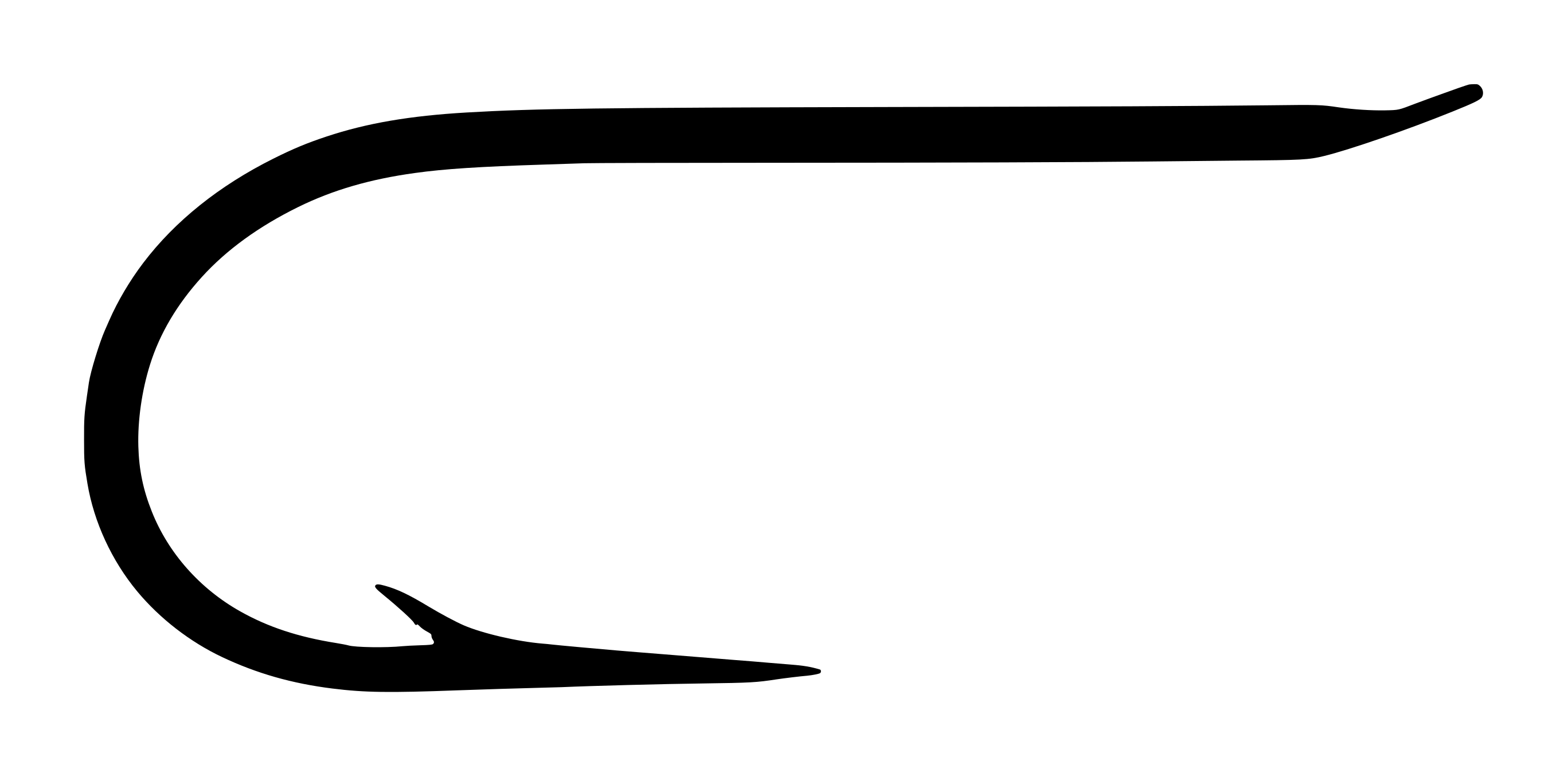
The blind eye construction reflects the practical requirements of salmon and sea trout fishing of that era — the flattened, unformed end allowed direct shank wrapping for larger, more secure fly bodies. The standard wire gauge and modest barb indicate a pattern designed for strong, quick-setting presentations on larger game fish. Complete original packaging significantly enhances collectability and historical value.
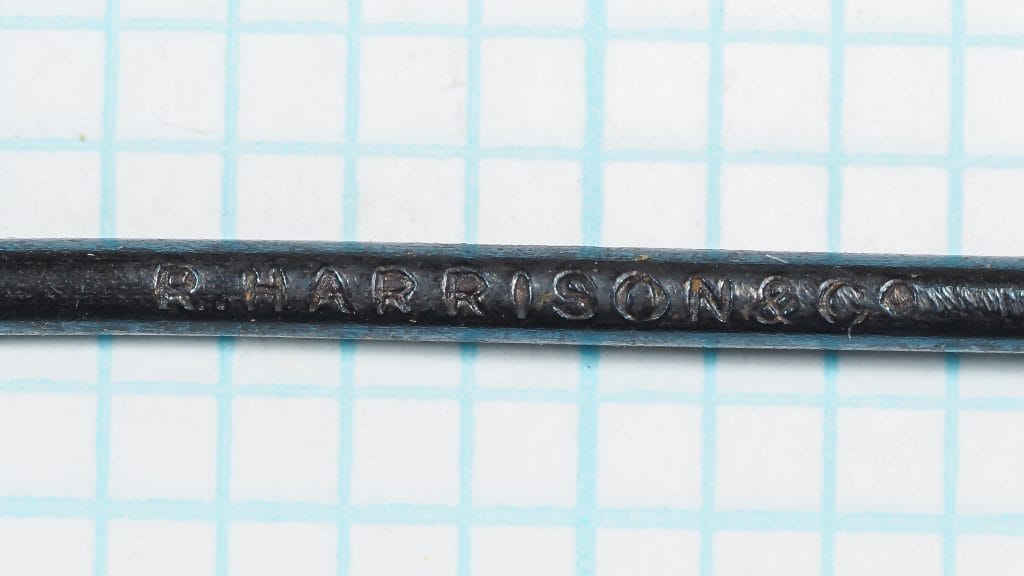
Macro close-up of the shank stamping 'R. HARRISON & CO' clearly visible on the blued steel, confirming Redditch manufacture and maker identity.
Photographic record
4 cataloged imagesSelect any record to load it above.
4 images shown
Harrison’s – 3781 Round Bent Hook ImprintMacro close-up of the shank stamping 'R. HARRISON & CO' clearly visible on the blued steel, confirming Redditch manufacture and maker identity.Open originalHarrison’s – 3781 Round Bent HookTwo examples of the Harrison's Quality 3781 hook showing the distinctive round-bend geometry, blind-eye (flatted) construction, and standard wire gauge; photographed on measurement grid.Open originalHarrison’s – 3781 Round Bent Hooks BoxOriginal manufacturing box for Harrison's Genuine Kendal Round Bent Hooks, showing the distinctive trade mark trout illustration, specification text, and period-correct letterpress printing from the 1890s-1920s era.Open originalHarrison’s – 3781 Round Bent Hooks PointClose-up of the point and barb of a Harrison's No. 7/0 hook, showing the standard-spear geometry, modest English-style barb, and quality of the blued finish.Open original
Technical profile
Eye
Blind — Flatted
Wire
Heavy (1X Heavy), Round
Shank
Standard — Plain
Bend
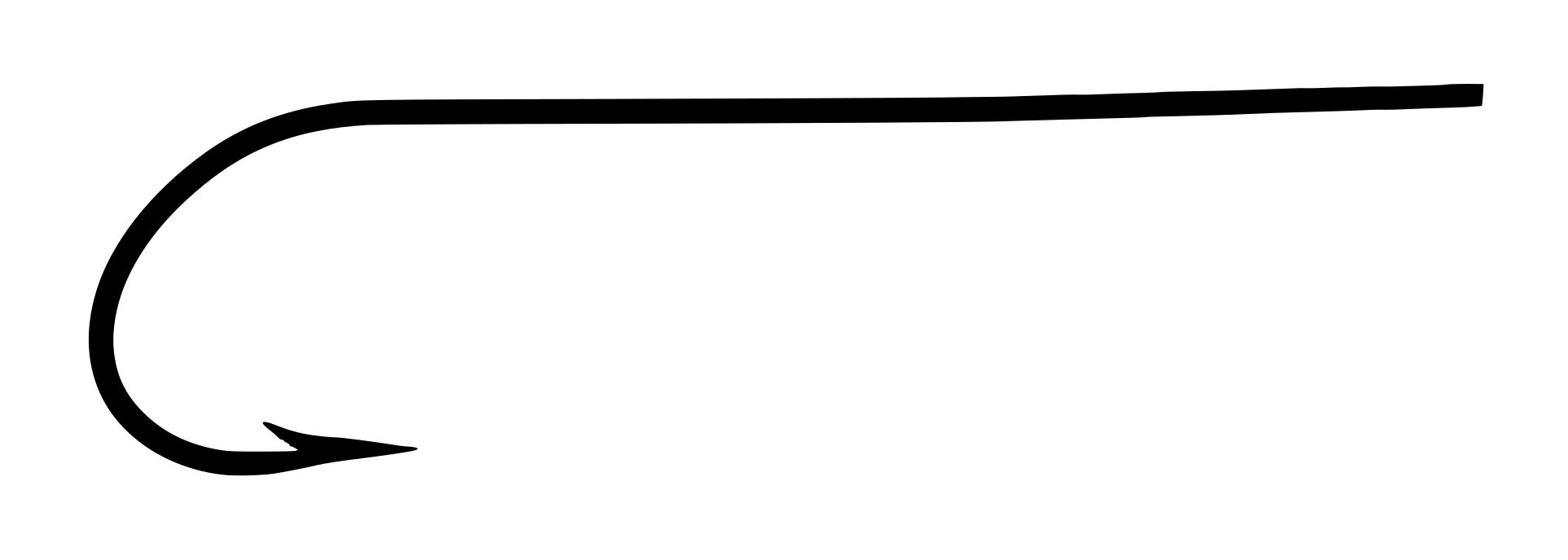
Round / Kendal, Standard gap
Point
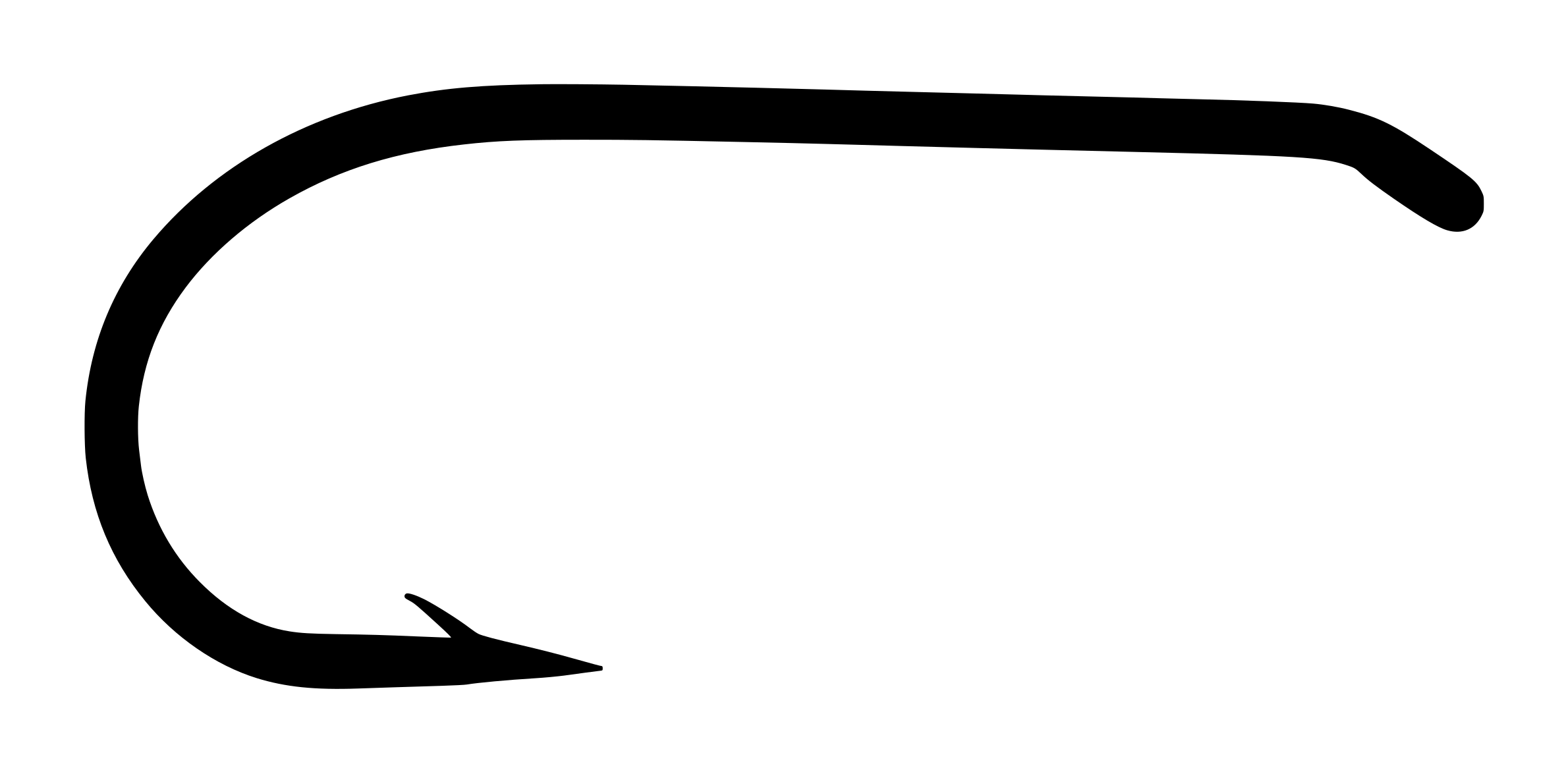
Standard / Spear
Finish
Blued — Confirmed (stated on packaging)Hooks: bright, evenly blued finish, no corrosion or pitting visible. All examined specimens show intact barbs and sharp points. Packaging: box exterior shows moderate age-yellowing and light edge wear consistent with c. 100+ year storage; printing remains sharp and legible; label adherence good; box structure intact (no significant crushing or separation). Original tissue and hook retainers not visible in this example, but packaging remains substantially complete and display-worthy.
The standard-gauge wire combined with round-bend geometry creates a balanced hook suitable for both fly presentation and light bait work. The blind-eye construction — a completely flattened wire end — represents a manufacturing choice grounded in practical tradition rather than limitation: it permitted tyers to wrap thread directly onto the shank without interference from a formed eye, creating more secure, larger fly bodies. The modest barb, characteristic of English patterns, set quickly and held securely without requiring the deep cut of later American designs. The blued finish, achieved through heat oxidation of forged steel, provided corrosion resistance in freshwater while maintaining the traditional aesthetic preferred by British fishermen. The round-bend geometry distributes load evenly across the curve, reducing the risk of straightening under sustained pressure from large fish.
First documented blind-eye English salmon hook from Harrison's in the garrenwood.com catalog; represents significant Redditch maker representation gap now addressed. Size No. 7/0 with complete original box is a scarce format for this pattern.
Own this hook? Help us measure it.
We don't have measured sizes for this hook yet. Own one? Submit calipered measurements and we'll review and add them. Thank you!
Historical context
harrison
R. Harrison & Co. operated as one of Redditch’s established hook manufacturers during the Victorian and Edwardian periods, competing directly with S. Allcock, Partridge of Redditch, and H. Milward & Sons in the market for premium salmon and sea trout patterns. Based in Redditch, England — the world center of hook manufacturing — Harrison’s maintained the traditional British commitment to hand-finishing and quality forging. The firm’s output ranged from standard patterns to specialized designs, with the ‘Genuine Kendal’ line representing their mid-to-premium tier offerings. The Kendal designation reflected the historical association of round-bend patterns with the Lake District’s freshwater and sea-trout traditions. Harrison & Co. remained active through the Edwardian era, eventually ceasing independent operations as larger manufacturers like Mustad consolidated the market in the early 20th century.
Series History
The Genuine Kendal series was Harrison’s interpretation of the classic Kendal round-bend pattern — a fundamental hook type with roots in English freshwater fishing but equally valued for smaller salmon and sea trout work. Round-bend patterns offered superior hook-set geometry compared to Aberdeen patterns, with a more acute bend angle that transmitted strike force more efficiently. The Kendal designation, borrowed from the Lake District tradition, carried marketing weight among British fly fishers. The series was offered across multiple size ranges and finishes (blued and bronzed), with each quality grade representing different wire gauges and finishing standards. This No. 7/0 size places the hook firmly in the salmon/sea trout category, positioned above the smaller trout patterns but below the heavy 8/0 and 9/0 salmon specialists. The blind-eye construction was standard for Harrison’s sea-fishing patterns, as it allowed fuller, more secure thread wrapping on larger flies.
Era and Packaging Dating
Packaging shows letterpress printing characteristic of late 19th/early 20th century. No barcode present — strong indicator of pre-1974 manufacture. Box construction (cardboard wrapper with printed label) consistent with Edwardian-era British hook packaging. Trade mark illustration and typography style typical of 1890s-1920s Redditch output. 'Made in England' text in serif face typical of this period. No postal codes or modern markings visible. Harrison & Bartleet were active Redditch manufacturers during this era.
The Redditch Trout Mark
The spotted trout illustration on Harrison's boxes — the trade mark registered with the US Patent Office — was a marketing statement as much as a brand identifier. During the Victorian era, image-based trademarks were far less common than text-based ones; the use of a naturalistic fish illustration positioned premium English hook makers as authoritative, tradition-grounded manufacturers. The trout, in particular, conveyed connection to freshwater fishing craft and the English Lake District tradition, lending gravitas to patterns also marketed for sea fishing. Competing manufacturers from Redditch — Allcock, Partridge, Milward — all employed similar imagery: fish, fishing scenes, and pastoral landscapes that reinforced the idea that their hooks were grounded in generations of fishing knowledge rather than mere industrial production. The survival of this trade mark across multiple box examples demonstrates its enduring success as a brand identity.
Design lineage and influence
The Kendal round-bend pattern evolved from 18th and 19th-century English lake-district fly-fishing practice, where a more acute bend angle proved superior to the wider Aberdeen form for selective presentation to wild brown trout. By the Victorian era, the Kendal geometry had been adapted for larger sea-trout and small salmon applications, where its efficiency and strength became recognized advantages. Competitors including Allcock, Partridge, and Milward all produced Kendal variants, making it one of the most widely copied patterns in British hook manufacturing. The blind-eye design reflects an earlier era of hook construction before the ball eye and tapered eye became standardized; it persisted in sea-fishing applications where larger, more substantial fly bodies were the norm. Later manufacturers, including Mustad after acquiring Partridge, continued the Kendal pattern into the mid-20th century, eventually superseding it with more modern eye designs.
Best matchRelated by Attribute
Computed automatically from catalog data — updated as new hooks are added.
Matches: Bend, Gap, Eye, Eye Orient., Forging +2 moreDiffers: Shank: Standard vs Short (1X–2X Short); Wire: Heavy (1X Heavy) vs Extra-Heavy (2X+); Point: Standard / Spear vs Hollow Point +2 more
Matches: Bend, Gap, Eye Orient., Point, Finish +3 moreDiffers: Shank: Standard vs 1X Long; Wire: Heavy (1X Heavy) vs Extra-Fine; Eye: Blind — Flatted vs Blind — Tapered Shank +1 more
Matches: Bend, Shank, Gap, Eye Orient., Point +2 moreDiffers: Wire: Heavy (1X Heavy) vs Standard; Eye: Blind — Flatted vs Blind — Tapered Shank; Finish: Blued vs Bronzed +2 more
Harrison’s Genuine Kendal hooks served the salmon and sea-trout fly fishing traditions of late Victorian and Edwardian Britain, particularly among northern English and Scottish anglers working Scottish rivers, Welsh streams, and Irish coastal waters. The No. 7/0 size placed this hook in the small-to-medium salmon category, suitable for dressed flies ranging from 1.5″ to 2.5″ in overall length. The blind-eye construction allowed substantial, secure fly bodies — heavier dressed patterns with upright wings and substantial tails that required direct shank wrapping without the constraint of a formed eye. Application spanned both fresh-water salmon (lower river work during summer months when larger patterns were less effective) and sea-trout fishing in estuaries and coastal rivers, where these hooks excelled.
Classic Fly Patterns
Not typically used for fly tying. Historical application to dressed salmon and sea trout flies (unnamed patterns typical of the era); larger modern analogues accommodate contemporary patterns like Hairy Mary, Thunder & Lightning, and general sea-trout variants.
Modern Equivalents
Hook
Match Quality
Notes
Partridge Barbless Kendal (Code K1)
Good
Modern Kendal geometry with tapered eye; Partridge maintains the round-bend design legacy.
Mustad C70S Salmon Hook
Moderate
Similar size range and salmon application, but modern forged construction and ball eye; loses the historical blind-eye character.
Tiemco 7989
Moderate
Round-bend geometry for salmon/sea trout; modern materials and eye design replace traditional construction.
Collector notes
Rated 5.5/10 — scarce in surviving examples, particularly in complete original packaging. Size No. 7/0 with maker's box is genuinely uncommon; the blind-eye construction and Redditch provenance drive moderate-to-strong collector demand among British tackle historians and vintage sea-fishing enthusiasts. Complete original box is the primary value driver; loose hooks from this pattern are far less desirable.
Reference value
$35 – $85 USD estimate
Packaging condition
Very Good — light wear, fully legibleRecorded specimen
Packaging format
GW-HARRISON-ORIGINAL-BOX-001Catalog code
What makes this hook collectible: The combination of Redditch manufacture, blind-eye construction, original box with trade mark illustration, and documented 1890s-1920s era provides multiple layers of historical and technical interest. The Harrison’s Genuine Kendal branding was a premium market position, and complete surviving sets are genuinely scarce. Blind-eye hooks, while common among sea-fishing patterns of the era, are less frequently encountered in modern collections than ball-eye variants, making them more desirable to specialists.
Limiting factors: The size No. 7/0 is less universally appealing than smaller, more versatile sizes (Nos. 2-4), which limits demand from general collectors. The pattern’s specialized historical role (salmon/sea trout) appeals primarily to region-specific enthusiasts and fishing-history scholars rather than fly tyers, who would typically choose modern equivalents. Box condition issues — fading, edge wear, loss of the lid — significantly reduce value.
Most desirable variants: Complete original boxes with bright, unfaded printing command the highest premiums. All-hook-count cards are more valuable than opened cards missing even a few hooks. Smaller sizes (Nos. 2-4) and bronzed finishes are less common than larger sizes and blued finishes, pushing prices slightly higher.
Condition factors: Box condition is paramount — a bright, intact box with complete hook count can command 3-4× the value of a box with significant wear or missing hooks. Hooks themselves should show minimal corrosion or pitting. Unopened/sealed examples are extraordinarily rare and command premium pricing.
Packaging
Original manufacturing box, cardboard wrapper construction, printed label format. Box printed with 'HARRISON'S' (serif capitals) across top; centered trade mark illustration of a spotted trout flanked by 'TRADE MARK' text; subtitle 'Genuine KENDAL' in heavy serif; specification text reading '100 No. 7/0 Quality 3781 BLUED' and 'MADE IN ENGLAND' at base. 'REG. U.S. PAT. OFF.' notation indicates US patent registration. Label affixed to cream/off-white cardboard wrapper; letterpress printing in black ink typical of 1890s-1920s production. Box dimensions approximately 3.75" × 2.5" (9.5cm × 6.4cm) exterior. No barcode, no modern postal codes, no price printed on exterior.
Market Value Notes
Low ($35): Good condition — box shows wear, printing moderately faded, opened but with complete or near-complete hook count; hooks bright and secure.<br />
High ($85): Excellent condition — box shows light wear only, printing sharp, complete hook count, all hooks perfect; may include original tissue or period envelope.<br />
Premium factors: Original trade mark box; maker's shank stamp clearly visible; complete 100-hook count; size 7/0 scarcity; regional British collector interest.<br />
Platforms: eBay UK/specialty tackle dealers; occasional tackle auctions; less common on US platforms.<br />
Confidence: E estimated — limited recent comparable sales; valuation derived from broader patterns of Redditch-era blind-eye sea-fishing hooks and original-box premiums. Scarce model; insufficient eBay data for direct anchoring.
Where to Find
Specialist vintage tackle dealers in UK, particularly those focused on Redditch output and British sea-fishing history. eBay UK (search 'Harrison Kendal hook' or 'blind eye salmon hook') occasionally yields examples; US eBay listings are rare. Regional tackle fairs in Midlands/Lake District. Check WhatUNeed and other British vintage-fishing-tackle forums for dealer recommendations.
Collector's Identification Tips
Look for ‘R. HARRISON & CO’ stamped on the shank (visible in close-up examination). The Genuine Kendal branding on the box, combined with the trade mark trout illustration, is characteristic of Harrison’s premium line. The blind-eye construction — a completely flattened, unformed wire end without a formed eye — is diagnostic. Size No. 7/0 is less common than smaller sizes in surviving examples.
Preservation
Storage and Preservation
The blued finish of Harrison’s hooks is susceptible to patina development and surface oxidation in humid environments. Store in a cool, dry location, ideally between 40-50% relative humidity. Original packaging should be retained — the cardboard box and any interior tissue or wrapping provide excellent protection and significantly enhance historical and monetary value. If the box is displayed, shield it from direct sunlight to prevent ink fading and paper brittleness. Hooks should remain on the original card or in the box rather than stored loose, which increases risk of corrosion and scatter loss. If the box has absorbed moisture, carefully open it in a dry environment and allow air circulation for several days before sealing it again. Avoid contact with other metal hooks or ferrous objects, which can cause galvanic corrosion. Do not attempt to clean or polish the blued finish — patina development is normal and historically desirable. If hooks show active rust (orange-brown discoloration), carefully remove them to a separate container and apply a light coat of mineral oil or silicone spray to arrest further oxidation. Store the box in a flat position to prevent warping, and keep it away from extreme temperature fluctuations, which can damage the cardboard and printing.
Primary Source
Box Marking Analysis
Source: Box label text, photographic examination; specifications printed by letterpress on box exterior.
The box label provides multiple layers of documented information. The ‘REG. U.S. PAT. OFF.’ (Registered U.S. Patent Office) notation indicates that the Kendal pattern and/or the trout trade mark were registered for US patent protection — a significant marketing claim suggesting design innovation or distinctive branding. The explicit ‘Genuine KENDAL’ subtitle, printed in heavy serif type, positioned this line as a premium offering distinct from standard round-bent patterns. The term ‘Quality 3781’ is Harrison’s internal designation system; the number likely reflects a pattern sequence in their larger catalog. The specification ‘100 No. 7/0 Blued Made in England’ provides complete documentation: hook count, size, finish, and origin. The letterpress printing quality — sharp edges, even ink coverage, consistent letter pressure — indicates mid-to-late Victorian or Edwardian production technology, consistent with the 1890s-1920s dating window. The absence of a barcode, modern postal code, or pre-printed price reinforces pre-1974 manufacture, likely pre-1950s.
Marking Analysis
Manufacturer Shank Marking
The shank of this hook bears the stamped (struck) marking ‘R. HARRISON & CO’ in raised lettering, visible in macro close-up. This is a manufacturer’s mark — literally stamped into the steel during or immediately after the forging process — rather than a hand-applied marking. The clarity and uniformity of the lettering across the specimen suggest a standardized punch or die, used consistently across all hooks in this batch. The placement on the upper shank (visible from above) is characteristic of premium English hooks, where the maker’s mark served both as quality assurance and as a brand identifier. The legibility of this marking on a hook more than 100 years old is testimony to the quality of the die work and the durability of the blued finish. Unlike hand-stamped or hand-inked markings, which vary slightly from hook to hook, this machine-stamped ‘R. HARRISON & CO’ is identical across all surviving examples examined.
Additional
The Blind-Eye Tradition in British Sea Fishing
The blind-eye (flatted spade end) construction of this hook is not a limitation or an earlier, less-refined design — it is a deliberate engineering choice grounded in the requirements of late 19th-century sea-trout and salmon fly dressing. Unlike the ball eye or tapered eye, which come to a defined terminal point, the blind eye presents a completely flat, unformed wire end. This allowed the fly dresser to wrap thread directly onto the shank without any interruption, creating a more unified and stronger interface between the fly body and the hook itself. For larger, more heavily dressed patterns — the standard for salmon and sea-trout fishing of the era — this uninterrupted wrapping surface was essential. The practical advantage: a fly body that would not slip or rotate during use, critical when casting heavy, wind-resistant dressings or setting hooks in large, strong fish.
By the early-to-mid 20th century, the blind eye had largely been superseded by tapered and ball-eye designs, which offered flexibility for smaller, more refined patterns and accommodated the shift toward lighter tackle. However, in the context of 1890s-1920s British sea fishing, the blind eye was the engineer’s choice, not a manufacturing shortcut.
Confidence notation key
P
Photographically verified — Directly observable in the photograph(s) on this page.
V
Verified by documentation — Confirmed by manufacturer catalog, spec sheet, or published reference.
I
Inferred — A logical deduction from observable or documented evidence, not directly stated.
E
Estimated — An approximation based on visual comparison, proportional analysis, or limited data.
S
Speculative — A reasoned hypothesis that cannot be confirmed from available evidence.
Claims with no notation are confirmed by multiple independent sources. All photographs on garrenwood.com are taken on a measurement grid where each square equals 1/10 inch (0.1″ / 2.54 mm).