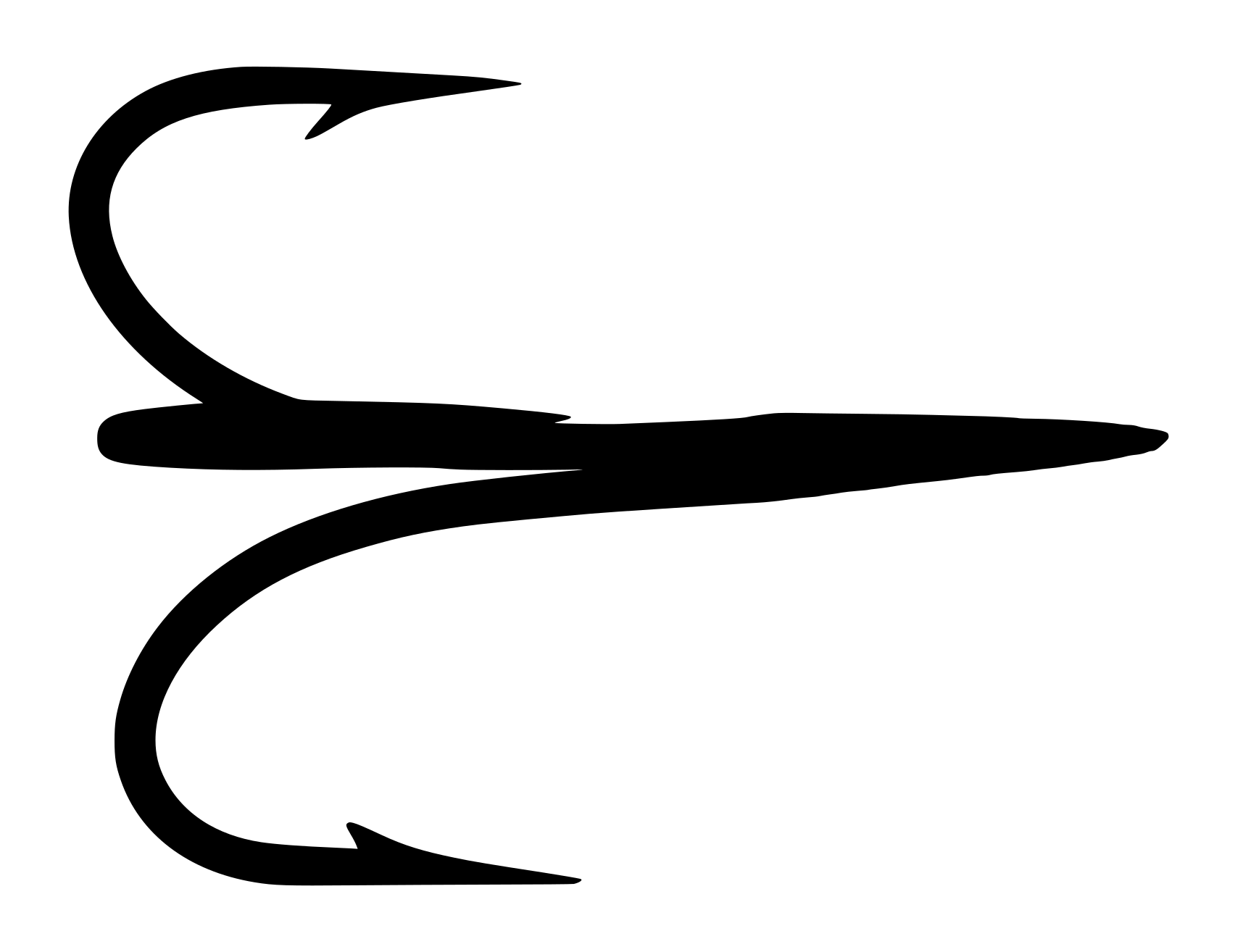
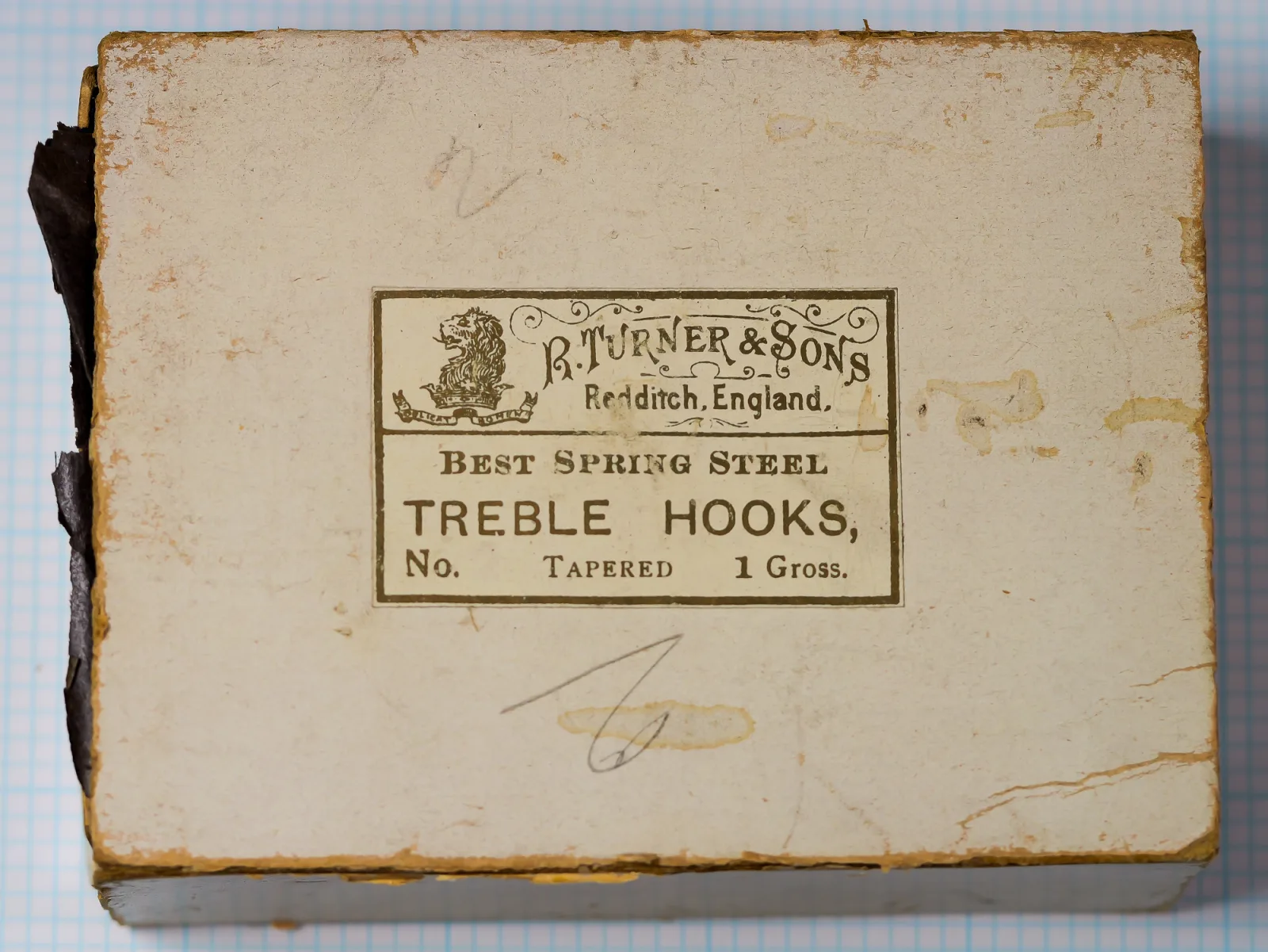
R. Turner & Sons Tapered Treble Hook — A Redditch-manufactured treble (three-point) hook in polished steel, circa 1890–1920. Characterized by tapered blind eye (spade end), Sproat-bend geometry per point, and standard-gauge round wire. Each of the three points carries a simple cut barb positioned close to the bend bend.
Turner & Sons was a long-established Redditch tackle maker whose trade mark appears on this box’s ornate engraved label. The “Best Spring Steel” sub-brand designation reflects the firm’s material quality claims. The treble was configured for large baits, spinner harnesses, and trolled lures—standard terminal tackle for pike, bass, and heavy saltwater fishing in the Redditch tradition.
The specimen documents early treble hook manufacturing practice: hand-forged bend per point, consistent gap width, and the characteristic tapered shank and blind-eye construction of the Redditch craft era. Box packaging shows no barcode, no modern printing conventions, and ornate period typography—strong indicators of late Victorian/Edwardian production. The hook survives in polished condition with no corrosion or patina.
This entry represents a rare opportunity to document a named Redditch treble hook maker outside the major industrial houses (Mustad, Allcock, Partridge, Milward). Turner trebles are infrequently encountered in collector hands, and named-maker Redditch trebles of this era command interest from specialist hook historians and period-tackle collectors.
R. Turner and Sons — New entry — image 1
Photographic record
3 cataloged imagesSelect any record to load it above.
3 images shown
R. Turner and Sons — New entry — image 1R. Turner and Sons — New entry — image 1Open originalR. Turner and Sons — New entry — image 2R. Turner and Sons — New entry — image 2Open originalR. Turner and Sons — New entry — image 3R. Turner and Sons — New entry — image 3Open original
Technical profile
Blind tapered | Sproat | Standard Wire | Superior Point | Polished
Eye
Blind — Tapered ShankTapered shank with blind (spade-end) construction, consistent with early Redditch treble design for pike and bass lures. V
Wire
Standard, Round, Est. ~0.085"-0.095" (~2.16-2.41 mm) E
Shank
Tapered
Bend
Sproat, Standard gapThree-point treble configuration with rounded Sproat-style bend per point. Each bend maintains consistent depth and sweep. Standard treble geometry for period. P
Point
Superior (near-straight inner taper)Standard cut barb present on each of three points, positioned close to the bend. Barb size consistent with period treble standards. P
Finish
Polished Steel — Confirmed (stated on packaging)Polished steel finish with visible steel texture and warm metallic tone characteristic of polished (uncoated) spring steel. No discoloration or age patina visible on specimen. P
Specimen hooks are bright polished steel with no visible corrosion, pitting, or age discoloration. Three points intact; barbs present and unworn. Box shows period aging: paper yellowing and light foxing on label and exterior, minor creasing at corners, one hinge slightly loosened. Label printing remains legible and crisp. No mold, moisture damage, or significant structural compromise. Clasp hinge functional.
Three-Point Treble Geometry: The treble hook consists of three separate bends, each with its own barbed point, all radiating from a common tapered shank. This configuration provides three independent hooking surfaces—an advantage for large baits, plugs, and artificial lures that might be positioned to expose only one or two points at a moment of strike. The distributed load across three bends also reduces the stress on any single bend when fighting heavy fish.
Tapered Shank and Blind Eye: The shank tapers from a wider diameter at the base to a narrower diameter at the eye, reducing weight and improving flexibility. The blind (spade-end) eye, typical of Redditch craft-era construction, was formed by flattening the terminal shank and piercing a hole—a labor-intensive but durable joint. This eye construction is ideal for attaching heavy wire snells (leaders) via needle-whipped loops, allowing anglers to build custom rigs rather than relying on pre-molded connections. The tapered profile allowed snell attachment without bulky loops or swivels.
Sproat Bend: Each of the three points uses the Sproat bend profile—a rounded curve with moderate depth. The Sproat bend was favored for lures and baits because it provided reliable hook-set penetration without requiring the extra-sharp geometry of thin-wire styles. The rounded bottom of the Sproat bend distributes strain evenly, reducing the likelihood of point breakage during the violent head-shaking of large pike and bass.
Polished Steel Finish: Polished (uncoated) spring steel was the default finish for Redditch trebles of this era. The absence of a protective coating (bronzing, japanning, nickelling) meant the hooks retained maximum hardness and brittleness—advantageous for quick penetration but requiring care in storage to prevent rust. Anglers were expected to oil or grease the hooks lightly between uses. This raw-steel approach was economical and reflected the assumption that treble hooks were expendable consumables, not long-term tackle investments.
We don't have measured sizes for this hook yet. Own one? Submit calipered measurements and we'll review and add them. Thank you!
Historical context
turner
R. Turner & Sons, Redditch operated in the shadow of larger Redditch makers but maintained a notable presence in the late 19th and early 20th centuries. The firm is documented in Redditch trade directories from the 1890s onward and specialized in forged hooks—principally trebles, Limerick patterns, and bait hooks. Turner’s use of the “Best Spring Steel” designation reflected the quality standards that characterized serious Redditch manufacturing: hooks were hand-forged in batches from high-carbon spring steel blanks, subjected to careful hardening and tempering, and packaged in labeled boxes for trade wholesale.
Turner & Sons was smaller than the industrial giants—Mustad’s Norwegian operations, the Allcock empire, Partridge’s craft workshops—but participated fully in the export-oriented Redditch hook trade. The firm supplied tackle dealers across the British Isles and exported to the United States and Europe. Like many Redditch makers of the period, Turner survived into the mid-20th century but did not adapt to industrial-scale production; the firm’s later years were marked by declining market share as Mustad’s mass-production capacity and global distribution outpaced craft-based manufacturing. The company appears to have ceased independent operation by the 1950s–1960s.
The ornate house mark on this box—a lion flanked by decorative scrollwork—is characteristic of Redditch trade convention and suggests a maker of sufficient standing to commission custom-engraved labels. This is consistent with a mid-sized, established firm catering to serious anglers and tackle dealers rather than mass-market retail chains.
Series History
The “Tapered Treble” designation (marked as “No. TAPERED” on the box) refers to the tapered shank and blind-eye construction common across Redditch treble production ca. 1890–1930s. This was not a proprietary design but rather a standard configuration in the craft-era Redditch tradition. Trebles with tapered (needle-end) or blind-tapered shanks were manufactured by most Redditch makers—Allcock, Partridge, Milward, and smaller firms like Turner—for nearly identical applications: large lures, spinning baits, and heavy pike/saltwater rigs.
Turner likely produced multiple treble variants—standard eye-loop models, forged vs. lighter-gauge versions, various size runs from small perch trebles to heavy pike trebles. The “1 Gross” notation (144 hooks per box) indicates this was a standard wholesale package size, sold to tackle dealers by the gross rather than in small retail packets. The “Best Spring Steel” brand name was marketing language emphasizing material quality, not a distinct design; competing makers used similar quality claims on their treble packaging.
The treble format itself—three independent bends radiating from a central shank—was established by mid-19th century and changed little over the 20th. Turner’s version documents the Redditch standard for the period: hand-forged Sproat bends, consistent gap widths, and the tapered blind eye standard for commercial pike/bass fishing tackle of the era.
Era and Packaging Dating
R. Turner & Sons Redditch trade mark and box construction consistent with late Victorian/Edwardian era. No barcode present (pre-1974 indicator). Ornate letterpress label with serif typography and engraved house mark suggest ca. 1890-1920 production window. Box stock, hinge binding, and label printing method (likely offset/letterpress) align with early-20th-century Redditch manufacturing. Packaging indicates established firm but pre-modern production techniques.
The Blind Eye and the Art of Snelling
The tapered blind eye (spade end) found on Turner's treble was not a manufacturing shortcut but rather a deliberate design choice rooted in Redditch craft tradition. Anglers of the Victorian and Edwardian eras did not buy pre-rigged lures as mass-market packets; instead, they purchased bare treble hooks by the gross and constructed their own rigs using specialized snelling techniques. A skilled tackle maker could attach a wire snell to a blind eye using only a needle, thread, and a small section of gut or silk—a process called needle-whipping. The resulting joint was stronger and more flexible than a molded connection, and allowed anglers to adjust snell length and wire gauge on the fly. The tapered profile reduced weight at the attachment point, minimizing drag on trolled baits. This craft practice, nearly extinct by 1950, explains why so many Victorian and Edwardian treble boxes survive empty: the hooks were consumables, meant to be used until broken and replaced, while the box itself was valued as a storage and display piece for the tackle maker's craft.
Design lineage and influence
The tapered blind-eye treble was a standard configuration across Redditch production from ca. 1880s onward. Turner’s version follows the established form documented in Allcock, Partridge, and Milward catalogs of the same period. The three-point treble itself dates to mid-19th century (earliest examples from ca. 1850s–1870s) and represents the logical extension of the single Sproat or Limerick bend to a multi-point fishing lure terminal.
Predecessor single-point hooks (Sproat, Limerick) had been in production since the 1860s. The treble adapted these proven bend designs by mounting three identical points on a common shank. The blind-tapered eye emerged as the favored construction for trebles because it reduced bulk at the eye and allowed flexible snelling—anglers could attach their own wire leaders with precise gauge and length.
Turner’s treble does not appear to have influenced later designs outside Redditch tradition. Mustad’s industrial treble production (beginning ca. 1900s–1910s, scaling up post-1920) used different eye constructions (ball-eye, looped eye) and different shank proportions. By the 1960s–1970s, plastic beads, swivels, and mono loops had largely superseded the traditional blind-eye treble. Modern saltwater and pike trebles typically employ turned-down or looped eyes and pre-molded connections, reflecting changes in tackle construction philosophy and material availability.
Best matchRelated by Attribute
Computed automatically from catalog data — updated as new hooks are added.
Matches: Bend, Gap, Point, Forging, ApplicationDiffers: Wire: Standard vs Heavy (1X Heavy); Eye: Blind — Tapered Shank vs Ball Eye; Eye Orient.: N/A — Blind vs Straight / Inline +4 more
Matches: Bend, Gap, Eye, Eye Orient., Forging +1 moreDiffers: Wire: Standard vs Extra-Fine; Point: Superior vs Hollow Point; Finish: Polished Steel vs Bronzed +3 more
Matches: Gap, Eye, Eye Orient., Application, BarbDiffers: Bend: Sproat vs O'Shaughnessy; Wire: Standard vs Heavy (1X Heavy); Point: Superior vs Hollow Point +4 more
Treble hooks in this configuration were standard terminal tackle for trolled artificial baits, pike and bass lures, and heavy sea-fishing rigs in the late 19th and early 20th centuries. The three-point design provided multiple hooking surfaces for erratic synthetic baits and natural baitfish. Redditch-made trebles of this era were commonly mounted on spinner rigs, plug harnesses, and sea-trout/pike casting lures, particularly in British and European waters. The tapered blind eye accommodated both snelling (pre-loop attachment) and heavy wire leader loops.
Secondary Applications
Saltwater trolling rigs, pike/perch spinning harnesses, natural baitfish rigs on leads or paternoster arrays.
Classic Fly Patterns
Not typically used for fly tying.
Collector notes
Rated 5.0/10 — Scarce in original packaging. Named Redditch maker (Turner) is uncommon outside specialist collections; factory trebles from smaller makers are infrequently encountered. Demand is moderate among hook historians and Redditch-tradition collectors. Original box condition significantly affects value.
Reference value
$12 – $35 USD estimate
Packaging condition
Fair — significant wear, partially legibleRecorded specimen
Packaging format
GW-TURNER-01Catalog code
Positive factors: Documented Redditch maker, ornate period packaging with house mark, intact original box with label, polished specimen in good condition, represents small-firm manufacturing practice outside the major industrial names (Mustad, Allcock, Partridge), treble hooks from craft-era Redditch are increasingly scarce.
Limiting factors: No hooks remain in the box (original contents unknown); generic treble configuration with no distinctive design features; market demand for trebles is smaller than for single hooks; Redditch trebles were produced in large quantities and many survive but mostly in broken lots or loose accumulations; Turner brand recognition is low outside specialist circles; box condition is fair (not excellent), reducing display/collection appeal.
Desirable variants: Sealed/unopened boxes command significant premiums. Complete count (all 144 hooks) would be exceptional. Boxes in excellent condition with crisp label printing are scarce. Smaller size ranges (fine perch trebles, size-specific runs) may be more sought than this general unmarked treble.
Condition factors affecting value: Box integrity is critical—a complete, flat box with sharp printing will fetch 1.5–2× the value of a warped, faded box. Hook quality and count matter secondarily; missing hooks reduce value proportionally. Original tissue wrapping or factory sealing adds 20–30% premium. Hooks in polished condition with no corrosion maintain full value; surface rust or pitting deducts 10–20%.
Packaging
Box container, approximately 4.0" × 2.75" × 1.25" (101 × 70 × 32 mm), cardboard construction with paper hinge binding and one original clasp. Exterior label: ornate engraved R. Turner & Sons house mark (lion within scrollwork), "Redditch, England" text in serif type. Central label text: "BEST SPRING STEEL / TREBLE HOOKS, / No. TAPERED 1 GROSS." All text in sepia-brown letterpress or offset printing. Paper stock: aged cream with light foxing and edge wear. Interior: unfilled. Box contained 144 hooks (1 gross) in original manufacture. Specimen box is in fair condition with paper fading, minor warping, and light creasing.
Market Value Notes
Low ($12): Fair condition box, no hooks remaining, label faded, some warping. High ($35): Excellent condition box with crisp label, partial hook count (50+ hooks present), no corrosion on specimens. Premium factors: intact original label printing, Turner maker name recognition, complete or near-complete hook count, box structural integrity. Platforms: eBay UK, specialist tackle dealers, Redditch collectibles forums. Confidence: E estimated—limited comparable sales data for Turner boxes; values anchor to broader Redditch maker treble boxes (Allcock, Milward variants in similar condition range $15–40); Turner represents smaller-maker premium within that range.
Where to Find
Redditch collectibles dealers, eBay UK (search "Turner & Sons hook" or "Redditch treble box"), specialized vintage tackle fairs in the Midlands, occasional auction house collectibles sales.
Preservation
Storage and Preservation
Store in a cool, dry environment away from humidity and direct sunlight. The polished steel finish is uncoated and susceptible to rust if exposed to moisture; Redditch trebles of this era were meant to be lightly oiled or greased before storage—a light coat of mineral oil or 3-in-1 oil on the hooks themselves will prevent oxidation. Keep the original box closed and sealed to minimize air circulation. Avoid stacking heavy objects on the box, which will cause permanent creasing and compromise structural integrity. The paper label is fragile; do not attempt to clean it. If the box is displayed, use UV-protective acrylic covers to prevent light-induced fading of the printed label. Do not expose to temperature fluctuations, which accelerate metal corrosion and paper deterioration. If stored long-term, place a small packet of silica gel inside the box to absorb ambient moisture.
Marking Analysis
Handwriting and Marks
A faint pencil mark appears on the interior of the box label, possibly indicating a price or lot number. The marking is barely legible and may date to the original sale or to a mid-20th-century dealer acquisition. No maker’s stamps or size marks are visible on the individual hooks; the size designation ‘TAPERED’ refers to the eye construction only, not a numerical size grade. No batch numbers or date codes are visible.
Primary Source
Label Text and Maker Claims
Source: Box label, R. Turner & Sons, Redditch
The box label states ‘BEST SPRING STEEL’ — a quality assertion standard across Redditch makers of the era. This was not a technical specification but rather marketing language indicating that the hooks were forged from carefully selected high-carbon spring steel blanks (as opposed to cheaper mild or cast iron). The phrase ‘No. TAPERED 1 GROSS’ clarifies that the box contained 144 hooks (one gross) of the tapered-eye design. The absence of a size code (e.g. No. 2, No. 4) suggests this was either a general-purpose treble available in an unmarked standard size, or that size markings were stamped on hooks rather than printed on the box. The term ‘TREBLE HOOKS’ reinforces that all three points are mounted on a single shank, distinguishing these from single-point bait hooks. The R. Turner & Sons house mark and ‘Redditch, England’ attribution locate production firmly within the Redditch manufacturing center, the global capital of hook production in the 19th and early 20th centuries.
Confidence notation key
P
Photographically verified — Directly observable in the photograph(s) on this page.
V
Verified by documentation — Confirmed by manufacturer catalog, spec sheet, or published reference.
I
Inferred — A logical deduction from observable or documented evidence, not directly stated.
E
Estimated — An approximation based on visual comparison, proportional analysis, or limited data.
S
Speculative — A reasoned hypothesis that cannot be confirmed from available evidence.
Claims with no notation are confirmed by multiple independent sources. All photographs on garrenwood.com are taken on a measurement grid where each square equals 1/10 inch (0.1″ / 2.54 mm).