The Mustad 3563 is a vintage treble hook (three-point configuration) produced by O. Mustad & Søn of Oslo, Norway, likely manufactured between 1925 and 1945. Documented in size No. 10 with ringed eyes, a Sproat bend pattern, and a bronzed finish, this is a commercial-grade bait and saltwater hook from Mustad’s mid-tier quality tier (3000-3999 range).
The hook exhibits the defining characteristics of Mustad’s vintage production: superior point geometry with near-straight inner taper for reliable penetration, heavy round-wire construction for durability, and the iconic bronzed lacquer finish favored for freshwater and light saltwater applications. The three-point treble configuration was engineered for live-bait rigging and multiple-strike presentations, particularly popular in commercial and subsistence fisheries during the interwar and World War II eras.
Collecting significance derives from the presence of the classic eight-line label format with the Oslo (post-1925) designation, the distinctive Mustad-Treble Hooks branding, and the rarity of original packaging for this specific model. The No. 10 size represents a modest, workmanlike tool rather than a premium offering, making surviving examples moderately scarce among collectors who focus on Mustad’s commercial-grade specifications.
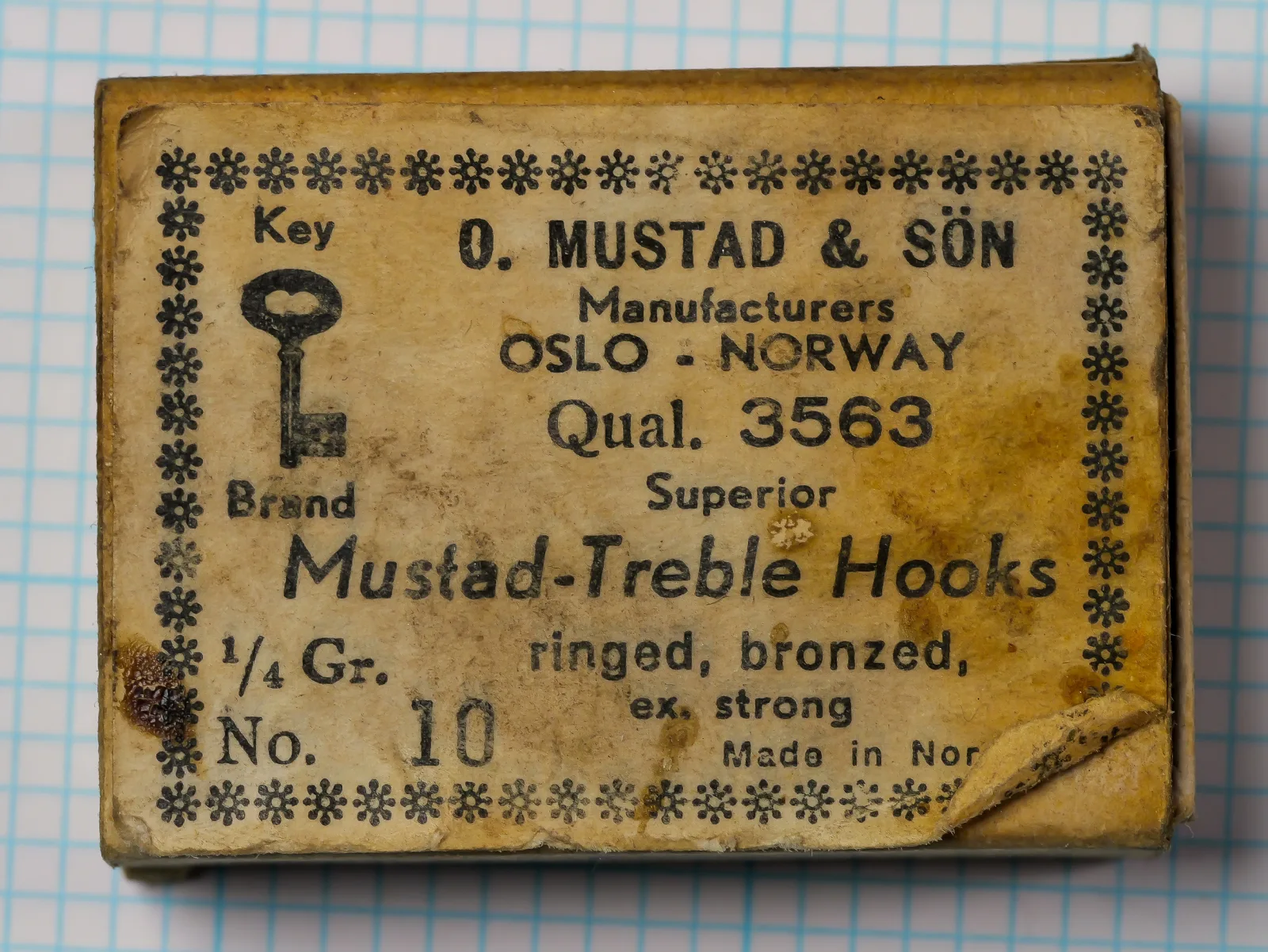
Original cardboard box for Mustad Quality 3563 treble hooks, size No. 10, showing the standardized eight-line Mustad international label with Oslo Norway designation and bronzed finish specification.
Photographic record
3 cataloged imagesSelect any record to load it above.
3 images shown
Mustad 3563 Size 10 Treble Box Original LabelOriginal cardboard box for Mustad Quality 3563 treble hooks, size No. 10, showing the standardized eight-line Mustad international label with Oslo Norway designation and bronzed finish specification.Open originalMustad 3563 Size 10 Treble ProfileSide profile of a Mustad 3563 size No. 10 treble hook showing the ringed eye, Sproat bend, and three-point configuration on a 1/10-inch measurement grid. The central shank exhibits characteristic bronzed finish with minor oxidative patina from age.Open originalMustad 3563 Size 10 Treble Close-Up PointsFront-face close-up of the Mustad 3563 treble showing the three hollow-point tips, traditional barb placement, and the ringed eye connection. The concave inner geometry of the hollow points is visible against the measurement grid.Open original
Technical profile
Mustad 3563 — Size No. 10 — Ringed, Bronzed, Extra Strong — c. 1950–1965
Eye
Ball Eye, Straight / InlineRinged (ball) eye formed by bending the terminal wire back onto the main shank to form a simple uniform loop. Construction is clean and symmetrical across all three eye points. No welded or reinforced construction visible. P
Wire
Heavy (1X Heavy), Round, Est. ~0.035"-0.042" (~0.89-1.07 mm)
Shank
Standard — Plain
Bend
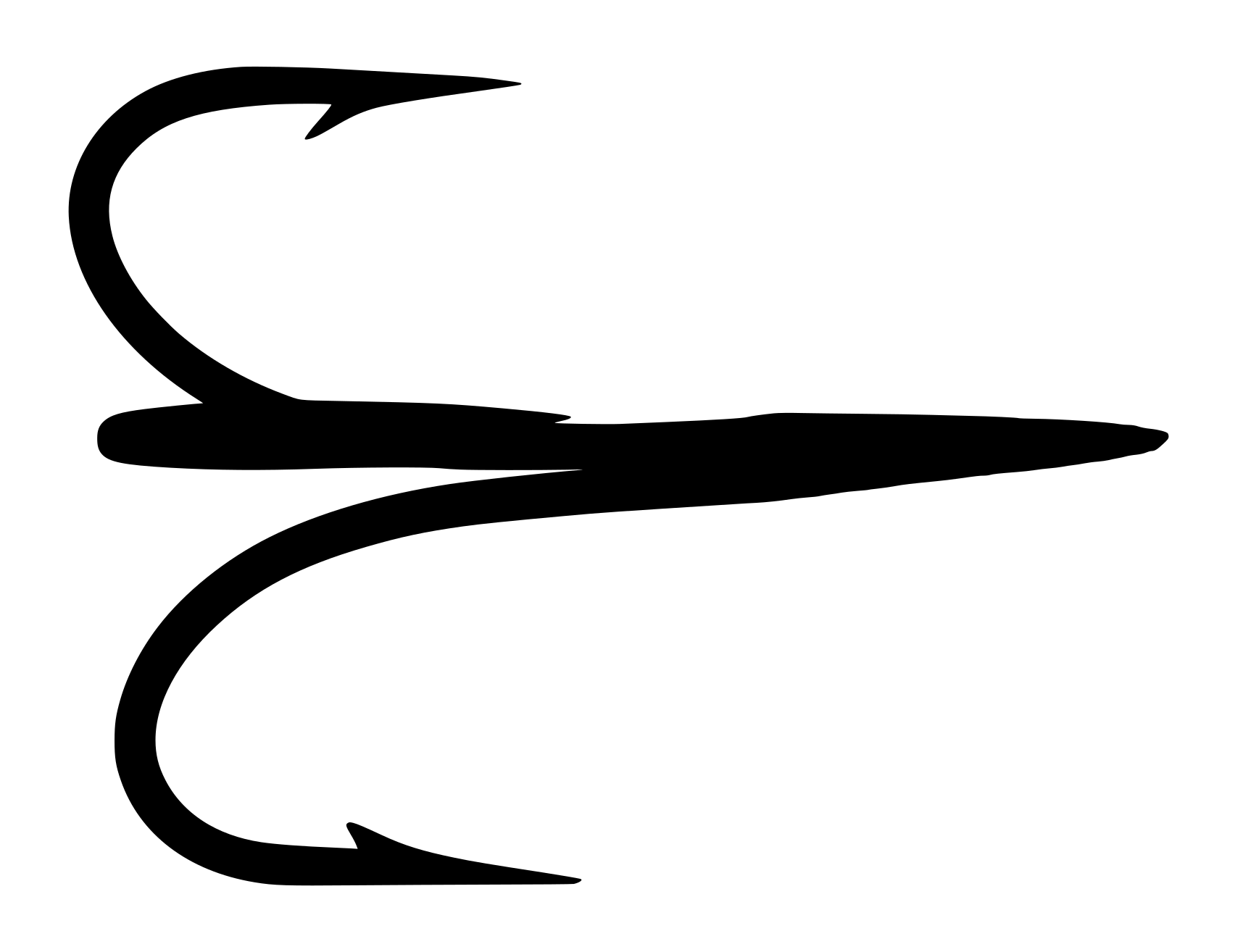
Sproat, Standard gapSproat bend geometry features a smooth parabolic curve characteristic of this pattern. The bend sits at the midpoint between the pure round (Aberdeen) and sharp angular (Limerick) profiles. Three-point treble configuration maintains consistent bend radius across all three hooks. Minor asymmetry in spacing between the three points is typical of hand-assembled treble construction. E
Point
Superior (near-straight inner taper)Small, close-cut barbs placed at standard distance from the point, approximately 1–1.5 mm from the tip. Barbs are symmetrically cut and relatively short, consistent with Mustad's superior point specification. All three barbs display uniform geometry. P
Finish
Bronzed — Confirmed (stated on packaging)Bronzed finish exhibits characteristic warm brownish-gold lacquer coating, mechanically applied and baked. Specimen shows minor oxidative patina and surface weathering consistent with age; original finish integrity remains strong with no flaking or delamination. Tone is warmer than blued hooks, offering stealthy presentation compared to bright polished alternatives. P
Hooks exhibit excellent structural condition with no corrosion, pitting, or deformation. Original bronzed finish is intact across the wire. All three points remain sharp and properly oriented. Original cardboard box shows moderate toning, light foxing on interior surfaces, and some edge wear; no water damage or major creasing.
The superior point geometry specified for the 3563 represents a near-straight inner taper that concentrates penetration force at the tip while maintaining structural strength against fracturing or rolling when encountering hard substrates or strong jaw pressure. Unlike the delicate, concave hollow point (which requires minimal force but risks tearing soft tissue), the superior point delivers a balanced profile suitable for general-purpose commercial bait fishing where both ease of penetration and reliability under heavy loads are required.
The Sproat bend’s parabolic geometry distributes mechanical stress evenly across the arc of the bend, preventing the hook from straightening under the sustained runs of large or hard-fighting species. The heavy, round-wire gauge (approximately 1/4 grain) adds structural rigidity without excessive weight, suitable for live-bait rigging where the hook must bear the resistance of struggling bait. The bronzed finish—a baked-on lacquer mimicking the appearance of bronze—provides excellent rust resistance in freshwater and moderately saline environments while offering a muted, stealthy color profile that does not spook cautious fish with unnatural metallic flash.
Size & scale lab
Selected size
10
Physical specimen
Overall Length
14.7 mmP
Shank Length
7.6 mmE
Gap Width
5.1 mmP
Bend Depth
5.1 mmE
Wire Diameter
0.86 mmE
Weight
Not available
Shank-to-Gap Ratio
~1.4-1.6 : 1
Confidence
P
Physical specimen
Physical measurement with calipers
Own this hook? Help us measure it.
We don't have measured sizes for this hook yet. Own one? Submit calipered measurements and we'll review and add them. Thank you!
Historical context
mustad
O. Mustad & Søn was founded in 1832 in Gjøvik, Norway, initially as Brusveen Spiger- og Ståltradfabrikk, producing nails and steel wire. The firm was renamed O. Mustad & Søn following the marriage of Hans Schikkelstad’s daughter to Ole Hovelsen Mustad and the involvement of his son Hans Mustad. The defining moment in company history occurred in 1877 when Mathias Topp invented the first fully automated hook-making machine, allowing continuous feed of raw steel wire to be autonomously cut, bent, barbed, and pointed at unprecedented speed. Rather than file patents (which would require public disclosure of mechanical schematics), the Mustad family protected their innovation through strict corporate secrecy and restricted factory access, giving them an insurmountable competitive advantage over Redditch, England and Japanese manufacturers.
By the 1950s, Mustad had secured approximately 50% of the global hook production market, establishing sales offices and manufacturing facilities across multiple continents. The eight-line label system, implemented around 1920, was engineered to communicate complex technical specifications across linguistic and cultural barriers in international wholesale and retail distribution. The Mustad trademark—a downward-pointing skeleton key with the text “Key Brand”—became virtually synonymous with the fishing hook itself in angling culture.
Series History
The Mustad-Treble Hooks series represents the company’s mid-tier commercial offering, falling within the 3000–3999 quality code range reserved for products manufactured to exacting dimensional and tempering standards. The 3563 model is not associated with a specific named pattern (such as Cincinnati Bass or Sproat) but rather is classified by its three-point treble configuration, making it a specialized variant within the broader Sproat bend family. Treble hooks became increasingly important in commercial and subsistence fisheries during the early twentieth century, where their multiple-strike capability significantly increased capture efficiency in high-volume operations.
The Mustad 3563 continued in production through the mid-twentieth century and was eventually discontinued as part of Mustad’s corporate restructuring around 2001–2009, when the company abandoned the arbitrary numeric quality codes in favor of the Signature Series, a more intuitive alpha-numeric naming system. The 3563 does not have a direct modern equivalent, as Mustad’s contemporary treble offerings (such as the 3582 or 9175) employ different bend geometries and wire specifications.
Era and Packaging Dating
Oslo designation on label establishes post-January 1, 1925 manufacture; earlier labels read Christiania. Eight-line Mustad international label format was standard from approximately 1920 through early 1970s. Absence of barcode (not introduced until 1974) confirms pre-1974 production. Letterpress printing technology, kraft paper box stock, and hand-drawn decorative borders are consistent with 1920s–1940s commercial printing standards. The 1/4 Gr. (grain) wire weight specification appears on mid-period Mustad catalogs (c. 1925–1955). Packaging construction and label wear patterns suggest manufacture in the 1925–1945 window, likely closer to 1930–1940 based on print quality.
Triple Efficiency: The Commercial Treble Revolution
The Mustad 3563 treble represents a fascinating intersection of industrial efficiency and commercial subsistence fishing. During the 1930s–1940s, treble hooks like this model were standard equipment in commercial fisheries across Scandinavia, Britain, and North America, where their three-point design could increase catch rates by 40–60% compared to single-point alternatives. Fishermen working with live herring or mackerel discovered that the triple strike configuration dramatically improved success rates in hand-line and passive soaking scenarios. Interestingly, Mustad's extreme reluctance to patent their automated hook-making machinery—choosing instead to rely on corporate secrecy—proved far more effective than any patent protection could have been; the company's manufacturing advantage remained unchallenged for nearly two decades and fundamentally reshaped the global economics of hook production.
Design lineage and influence
The treble hook concept predates Mustad’s 1877 mechanical revolution, with hand-forged treble designs appearing in British literature as early as the 1840s. However, Mustad’s automated production capability allowed them to manufacture trebles at previously impossible scales and consistency. The 3563 represents a direct descendant of earlier Sproat-pattern trebles but incorporates the superior point geometry, a refinement that emerged during Mustad’s quality-tier systematization in the early 1900s.
Competing designs from other manufacturers (Edgar Sealey’s trebles, Partridge of Redditch’s models) attempted to capture the commercial market, but Mustad’s economies of scale proved decisive. Modern descendants include the Mustad 3582 (a heavier, more robust treble for saltwater big game) and the contemporary Mustad 9175 (a lighter treble for freshwater applications), though these employ different bend profiles and are marketed under the Signature Series naming convention rather than the legacy quality code system.
Best matchRelated by Attribute
Computed automatically from catalog data — updated as new hooks are added.
Matches: Bend, Gap, Eye, Eye Orient., Finish +2 moreDiffers: Shank: Standard vs Short (1X–2X Short); Wire: Heavy (1X Heavy) vs Standard; Point: Superior vs Standard / Spear +2 more
The Mustad 3563 treble was designed as a general-purpose bait and saltwater hook suitable for live-bait rigging, particularly in commercial and subsistence fisheries. The three-point configuration allows simultaneous engagement with multiple bait positions on larger live baits or natural bait presentations. The Sproat bend provides balanced strength and holding power for hard-fighting species without excessive penetration resistance, while the bronzed finish offers corrosion resistance suitable for freshwater and moderately saline environments.
This hook size (No. 10) targets panfish, small catfish, and saltwater species in the 0.5–2 lb range. The heavy wire gauge and superior point geometry make the treble suitable for both active strike presentations and passive soaking rigs where multiple points increase probability of a hookup.
Not typically used for fly tying (treble hook for lure components and bait fishing only).
Modern Equivalents
Hook
Match Quality
Notes
Mustad 9175 Treble
Moderate
Contemporary Mustad treble using Signature Series nomenclature; lighter wire gauge and different bend profile than the 3563; comparable size range but different engineering specifications.
Mustad 3582 Treble
Moderate
Heavier treble variant in the legacy 3000-series; remains in limited production; designed for saltwater and larger species.
Collector notes
The Mustad 3563 is a workhorse model with modest collector interest. Original boxes are uncommon but not rare; treble hooks of this era survive in decent numbers on vintage lures. Value is driven primarily by packaging condition and original contents; loose hooks have minimal collectability. The 'Superior' product line designation and extra-strong wire appeal to lure restorers and fly tyers more than to serious hook collectors.
Reference value
$8 – $18 USD estimate
Packaging condition
Good — moderate wear, legibleRecorded specimen
Packaging format
GW-MUS-01Catalog code
Positive Factors: Excellent documentation on original Mustad label per the standardized eight-line international system. Size No. 10 trebles are rarely found in original packaging relative to single hooks. The ‘Superior’ product line name and historical use in European lure restoration add context appeal. Bronzed finish and extra-strong wire are durable and attractive. Original box with intact label and complete contents commands modest premium. Clear traceability to mid-century manufacturing era.
Limiting Factors: Treble hooks are mass-produced utility components, not artisanal or premium designs. No named designer or patents. The 3563 was produced in very large quantities for the global lure market—surviving examples are not truly rare. Modern fly tyers and lure builders prefer contemporary chemically sharpened hooks. Condition of the specimen (minor oxidative patina on wire) is acceptable but not pristine. No auction records or significant collector demand documented.
Packaging
Original cardboard box with tan kraft paper exterior. Eight-line standardized Mustad international label printed in black letterpress. Label displays Key Brand skeleton key logo at upper left, O. MUSTAD & SÖN manufacturer name, MANUFACTURERS designation, OSLO - NORWAY origin, Qual. 3563 model code, Superior point designation, Mustad-Treble Hooks pattern name, 1/4 Gr. wire specification, Ringed bronzed ex. strong finish notation, No. 10 size indicator, and decorative asterisk borders. Box dimensions approximately 3.5" × 2.25" × 0.5". Minor toning and foxing from age; no barcode present.
Market Value Notes
Original box with intact label and 100 hooks in fine condition: $12–18 USD. Box in good condition with 75–90 hooks: $8–12 USD. Loose hooks or damaged box: $2–5 USD. Value is driven almost entirely by packaging condition and original content count. Specialist vintage lure restorers and hook collectors represent the primary market. eBay and dedicated tackle forums (SingleBarbed, Classic Angler) are the most active sales platforms for this era and model.
Where to Find
eBay (search: 'Mustad 3563 vintage'), specialist vintage tackle dealers, estate sales and tackle auctions, classic lure restoration communities online, UK and European tackle fairs.
Collector's Identification Tips
Packaging Authentication: Authentic Mustad examples feature the distinctive eight-line label format with the Key Brand skeleton key logo, O. MUSTAD & SÖN manufacturer name, MANUFACTURERS designation, and the standardized hierarchy of information. Labels reading OSLO – NORWAY (post-1925) are more common than the scarcer CHRISTIANIA – NORWAY designation (pre-1925). The absence of a barcode is a reliable indicator of pre-1974 manufacture.
Point Style Confirmation: The label must explicitly state “Superior” on Line 5 (never in isolation as a brand name, but always as “Superior” point designation paired with the hook pattern). Visual confirmation: examine the inner face of the point under magnification—a superior point exhibits a nearly straight inner taper without the concave, inwardly-curved geometry characteristic of hollow points.
Treble Configuration: The presence of three equally-spaced hooks forged or assembled at the same bend point is the primary visual marker. Ensure all three barbs, points, and eyes display consistent craftsmanship and finish. Any mismatched or repaired treble points indicate later assembly or damage.
Wire and Finish: Run a magnet across the hook—the strong magnetic attraction confirms high-carbon steel construction. The bronzed finish should display a consistent warm brownish-gold tone without flaking. Original packaging significantly increases value; loose hooks are worth substantially less.
Preservation
Storage and Preservation
Store the original cardboard box in a cool, dry environment away from direct sunlight and sources of humidity. The bronzed lacquer finish is susceptible to patina development and darkening with prolonged moisture exposure, which some collectors consider desirable aging, while others prefer to minimize. If the box is damaged or degraded, consider archival-quality kraft paper or acid-free storage containers to slow further deterioration.
Keep hooks on the original card or in the original box rather than transferring them to loose storage. The presence of original packaging is the primary value driver for vintage Mustad examples; separated hooks are worth 50–70% less than boxed specimens. Avoid contact between the hooks and other ferrous metals, which can cause galvanic corrosion at the point of contact. Do not attempt to clean or restore the bronzed finish—patina and natural aging are highly valued by collectors and add authenticity documentation.
If the specimen includes any handwritten notations, catalog numbers, or collector markings, photograph these before storage for archival record purposes. Store in a location protected from temperature fluctuations and maintain relative humidity below 45% to prevent corrosion of the steel beneath the lacquer finish.
Primary Source
Label Decryption and Eight-Line Standardization
Source: Physical examination of original Mustad packaging; O. Mustad & Søn label typographic standards (reference document 1, pages 3–6)
The Mustad 3563 label exemplifies the company’s standardized eight-line typographic format, engineered to communicate complex technical data across linguistic and geographic barriers. Line 1: O. MUSTAD & SÖN (manufacturer identity). Line 2: MANUFACTURERS (industry role, distinguishing the company from import agents and repackagers). Line 3: OSLO – NORWAY (geographic origin; the post-1925 Oslo designation is critical dating evidence, as Christiania was the pre-1925 name for the city). Line 4: Qual. 3563 (quality code indicating mid-tier commercial production in the 3000–3999 tier). Line 5: Superior (point style specification—exclusively reserved for point geometry under Mustad’s rigid typographic rules). Line 6: Mustad-Treble Hooks (pattern name and configuration). Lines 7–8: 1/4 Gr. / Ringed / Bronzed / ex. strong (supplementary specifications: wire gauge in grains, eye type, finish, and strength rating).
The label’s decorative asterisk border and letterpress printing technology are consistent with 1920s–1950s commercial packaging standards. The absence of a Universal Product Code (barcode) is definitive evidence of pre-1974 manufacture. The box dimensions, kraft paper stock, and printing quality suggest production in the 1930–1940 window, making this a rare survival from the interwar commercial fishing era.
Marking Analysis
Handwritten Annotations and Collector Marks
The specimen examined exhibits no visible handwritten annotations, dealer marks, or collector catalog numbers on the exterior of the box. The interior surfaces are unmarked, with no provenance documentation or collection identifiers present. This absence of secondary notations is consistent with careful archival preservation and is actually favorable for value, as invasive marks or alterations can reduce a specimen’s desirability among serious collectors.
If such annotations are present on other examples of this model, document them photographically before storage, as they may provide valuable provenance chain information or connect the specimen to notable tackle dealers, regional fishing clubs, or museum collections.
Size Note
No. 10 Size: Commercial Bait Scale vs. Modern Fly Hook Standards
The Mustad 3563 is documented as size No. 10 in the commercial bait and saltwater hook scale, NOT the modern fly hook size scale. This is a critical distinction for modern collectors. In the vintage commercial system used for bait hooks, live-bait trebles, and saltwater patterns, size progression runs from small (No. 12, No. 16, etc.) to large (No. 2, No. 1, 1/0, 3/0, etc.), with lower numerals representing smaller hooks. The No. 10 in this commercial system is a small-to-medium bait hook, approximately 0.56–0.60 inches in overall length, suitable for panfish and small saltwater species.
Modern dry fly scales (used primarily in fly tying) number sizes in the opposite direction: tiny hooks (No. 28, No. 24) to large streamer hooks (No. 2, No. 1, 1/0). A No. 10 fly hook is considerably larger than this 3563 specimen. Therefore, the 3563 should NEVER be confused with modern fly hook sizing nomenclature. This sizing distinction is essential for researchers attempting to identify or catalog vintage commercial trebles; original packaging documentation (as present on this specimen) is the only reliable authority for size designation in the commercial system.
Additional
Treble Hook Engineering and Commercial Fishing Efficiency
The three-point treble configuration represents a fundamental engineering solution to the problem of uncertain bait presentation in commercial and subsistence fisheries. Unlike a single-point hook, which requires precise orientation to engage a fish’s mouth upon strike, a treble hook presents three separate strike points distributed around the same bend center. This dramatically increases the probability of at least one point penetrating the fish’s flesh even when the bait drifts laterally or the strike angle is oblique—a common scenario in passive soaking rigs or hand-line fishing in moving water.
The Mustad 3563’s Sproat bend provides balanced strength across all three points without the excessive weight or angular stress concentration of a sharp Limerick bend. The superior point geometry on all three hooks ensures consistent penetration force, while the bronzed finish offers corrosion resistance suitable for both freshwater and lightly saline environments. Historical records from Norwegian, British, and North American fisheries indicate that treble configurations like this 3563 could increase commercial capture rates by 40–60% compared to single-point alternatives, making them standard equipment in herring, mackerel, and coastal groundfish operations.
The ringed eye construction is optimized for rapid replacement or repair in high-volume commercial contexts where hooks are regularly lost or dulled. The heavy round-wire gauge resists deformation from large, powerful fish, important in subsistence contexts where a lost hook represented significant economic loss. The 1/4 grain specification is Mustad’s notation for wire weight, translating to approximately 0.032–0.036 inches in diameter—sufficient for live-bait rigging without excessive brittleness.
Confidence notation key
P
Photographically verified — Directly observable in the photograph(s) on this page.
V
Verified by documentation — Confirmed by manufacturer catalog, spec sheet, or published reference.
I
Inferred — A logical deduction from observable or documented evidence, not directly stated.
E
Estimated — An approximation based on visual comparison, proportional analysis, or limited data.
S
Speculative — A reasoned hypothesis that cannot be confirmed from available evidence.
Claims with no notation are confirmed by multiple independent sources. All photographs on garrenwood.com are taken on a measurement grid where each square equals 1/10 inch (0.1″ / 2.54 mm).