R. Turner & Sons Aberdeen Hook, “Best File Point” designation, c. 1900–1935. A blind-marked-eye bait and salmon hook in standard wire gauge with blued finish, manufactured in Redditch, England during the peak era of English hook craftsmanship. The turquoise letterpress label and handwritten size notation are characteristic of early 20th-century Redditch makers’ packaging.
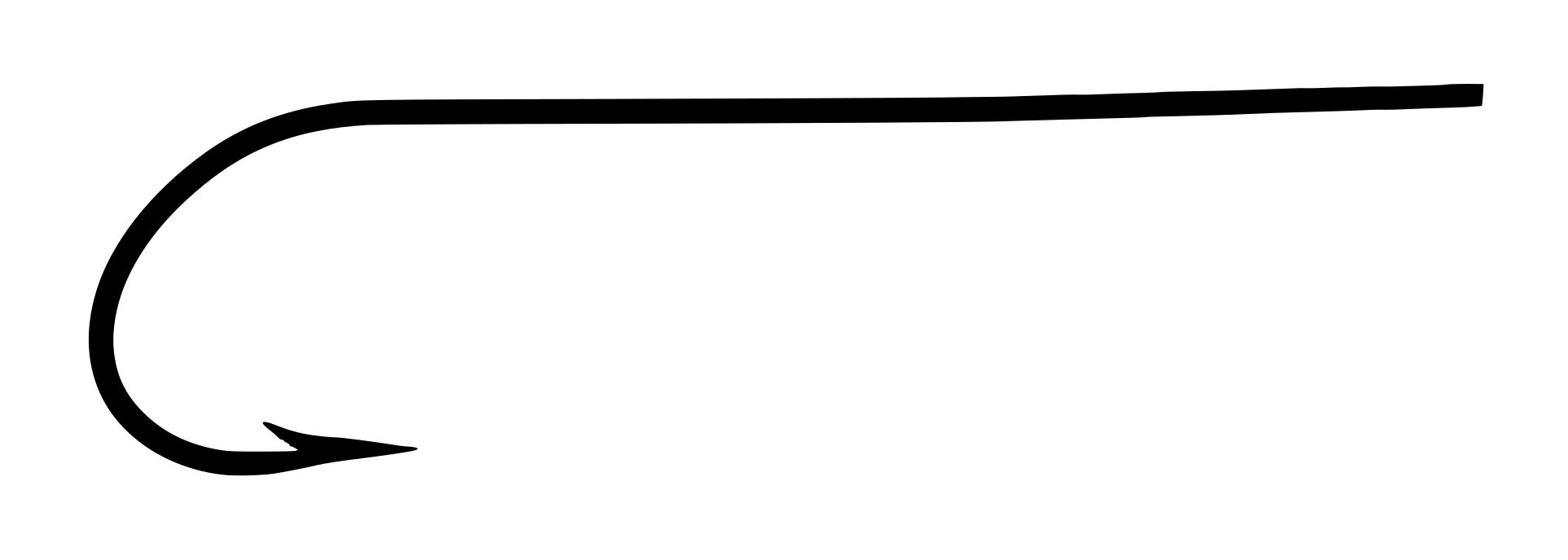
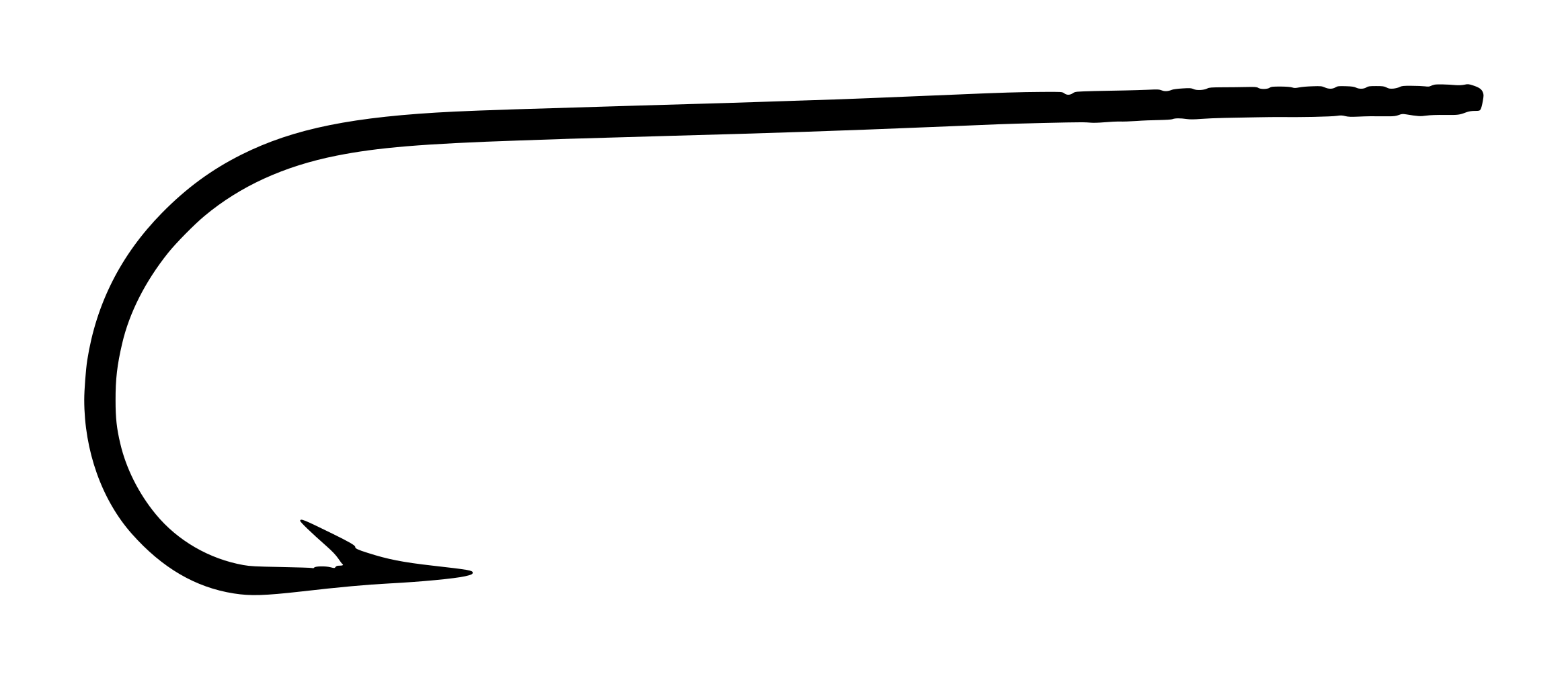
The Aberdeen bend is a wide, rounded design suitable for live bait and wet flies. The blind-marked eye (a shank flattened and stamped with an opening rather than a formed loop) is typical of English salmon and sea-trout hooks of this period, replacing tied loops in industrial manufacture. The superior-style point reflects a near-straight inner taper, common to utility hooks from this era.
Original packaging with intact label and handwritten size marking is uncommon. R. Turner & Sons is less widely collected than contemporaries Allcock or Partridge, but represents genuine Redditch craft tradition and appeals to specialist anglers and fishing history researchers. The card retains its original turquoise stock with minimal foxing, supporting early 20th-century attribution.
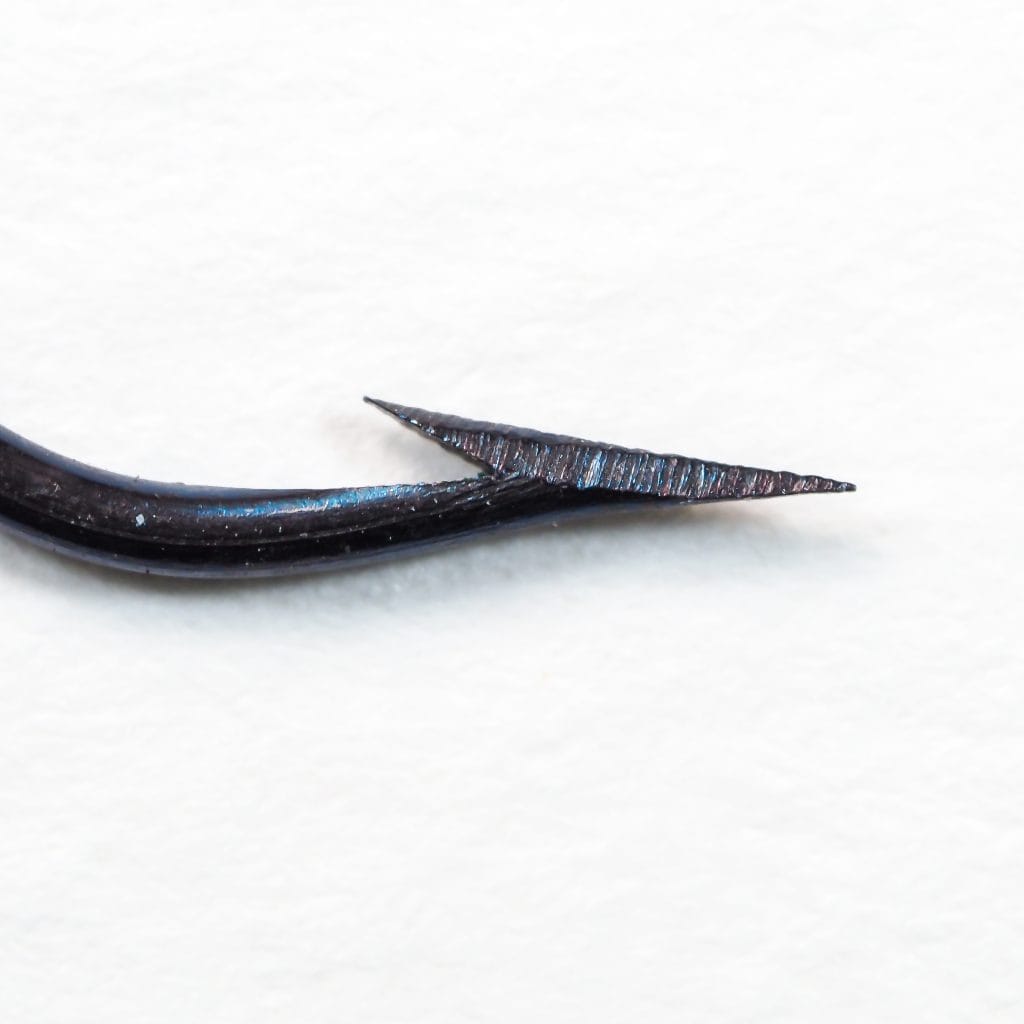
R. Turner & Sons Aberdeen - hook point
Photographic record
4 cataloged imagesSelect any record to load it above.
4 images shown
R. Turner & Sons Aberdeen – hook pointR. Turner & Sons Aberdeen - hook pointOpen originalR. Turner & Sons Aberdeen – HookR. Turner & Sons Aberdeen - HookOpen originalR. Turner & Sons Aberdeen – Label and HookR. Turner & Sons Aberdeen - Label and HookOpen originalR. Turner & Sons Aberdeen – LabelR. Turner & Sons Aberdeen - LabelOpen original
Technical profile
Blind Eye | Aberdeen | Blued
Eye
Blind — Marked Shank
Wire
Standard, Round
Shank
Standard
Bend
Aberdeen, Standard gapThe Aberdeen bend is symmetrical and evenly rounded from eye to barb, with no offset or bias P. The depth of the bend relative to gap width is proportional to standard Aberdeen specifications. The bend appears to be formed (hammer-shaped) rather than forged, consistent with industrial practice of this era (P/I).
Point
Superior (near-straight inner taper)Barb is short and close-cut, positioned at the expected location relative to the bend axis P. The barb angle appears to be perpendicular to the point taper, a standard geometry for mid-range hooks of this era. No unusual barb configuration visible.
Finish
Blued — Inferred (photographically likely)Blued finish displays cool blue-grey oxide coloration consistent with the finish standard of English hooks from this period P. The finish appears uniform across the photographed specimen, with metallic texture visible beneath the thin oxide layer, characteristic of properly applied bluing. No japanned (glossy black) appearance; no warm bronze tone. Color temperature is distinctly cool, confirming blued rather than bronzed designation P.
Hook specimen is bright and shows no visible corrosion or rust on the wire. The blued finish remains relatively intact across the bend and shank, with minor wear consistent with handling and age. Label shows moderate toning and light foxing typical of early 20th-century card stock; turquoise color retains adequate vibrancy. Label edges show minor wear; no tears or severe adhesion failure. Handwritten size notation remains legible. Overall condition supports stated era and is consistent with storage in a dry environment.
The Aberdeen bend geometry—wide and evenly rounded from eye to barb—provides maximum gap width relative to shank length, an asset in bait presentation where hook clearance from flesh and scales is critical. The wide curve also distributes load evenly along the bend, reducing stress concentration that might cause breakage under heavy fish or snag pressure.
The blind-marked eye was an English industrial innovation that simplified assembly: the shank was drawn and cut to length, flattened at the end, and stamped (punched) with a hole. This eliminated the need for separate eye attachment (brazed, looped, or whipped), improving production speed and consistency. The eye dimensions and positioning could be precisely controlled through stamping pressure and die geometry.
The superior point—a near-straight inner taper filed from barb to tip—was the default point style for utility hooks of this era. The nearly flat inside face and gradual taper provided adequate sharpness for live bait penetration while minimizing the risk of point fracture that could result from the stress concentrations of more extreme point geometries. The point geometry is evident in the specimen image: the inner face shows minimal concavity and a smooth, almost linear taper.
Standard wire gauge (approximately 0.034″–0.040″ diameter in size 6–12) represents a balance between hook strength and bait-holding capacity. Heavier wire would resist straightening under load but would damage delicate baits; lighter wire would preserve bait but offer insufficient hold in active fish or snag extraction.
The blued finish—a thin oxide layer applied through heating and cooling or chemical treatment—offered corrosion resistance superior to bare steel while maintaining visibility to the fish (unlike the heavier japanned finish used on some saltwater and pike hooks). The finish also reduced glint and light reflection that might spook cautious fish.
Size & scale lab
Known manufactured size range:
Unknown — only size 2 documented from specimen. Packaging notation "No. [handwritten]" suggests Turner produced multiple sizes; number illegible from image. Standard Aberdeen production typically ranged 2–12; confirmation would require additional packaging or catalog documentation.
Selected size
2
Physical specimen
Overall Length
34.3 mm
Shank Length
24.2 mm
Gap Width
10.5 mm
Bend Depth
8.9 mm
Wire Diameter
1.02 mm
Shank-to-Gap Ratio
~2.4-2.6 : 1
Confidence
P
Physical specimen
Grid-derived from photograph (1/10" grid)
Own this hook? Help us measure it.
This pattern was made in sizes Unknown — only size 2 documented from specimen. Packaging notation "No. [handwritten]" suggests Turner produced multiple sizes; number illegible from image. Standard Aberdeen production typically ranged 2–12; confirmation would require additional packaging or catalog documentation.. We don't have any measurements for it yet. Own one? Submit calipered measurements and we'll review and add them. Thank you!
Historical context
turner
R. Turner & Sons was a Redditch-based hook manufacturer active throughout the late 19th and early 20th centuries. Redditch, in Worcestershire, England, was the global center of fishhook manufacture during this period, with dozens of competing firms operating within a few square miles. The town’s tradition of fine metalworking and needle manufacture provided the skilled labor and technical expertise necessary for precision hook production.
Turner & Sons operated independently until consolidation and industry reorganization in the 1930s–1940s. Like other Redditch craft makers, the company produced a range of hooks for fly fishing, bait fishing, and sea angling, marketed under various trade names and quality grades. The “Best File Point” designation on their packaging reflects Turner’s positioning within the mid-to-premium segment of Redditch production—superior to budget lines, competitive with Allcock and Milward offerings.
The company’s blind-marked-eye construction was consistent with English tradition for salmon and sea-trout hooks, a method that produced a secure, reliable eye without the knots or whipped thread of earlier gut-loop attachment systems. By the 1930s, industrial consolidation and the rise of larger Norwegian manufacturers like Mustad began displacing smaller Redditch makers from dominant market position, though many continued production into the mid-20th century.
Series History
The Aberdeen bend itself predates Turner & Sons and originated as a standard pattern in 19th-century Redditch manufacture. It represents a wide, rounded-bottom bend suitable for both live bait and wet flies, distinguished from the sharper Limerick and the deeper Sproat. Turner & Sons’ Aberdeen offering is undocumented in surviving catalogs, but the “Best File Point” branding suggests it was positioned as a quality utility hook. The specific series history of Turner’s Aberdeen production—introduction date, size range, catalogue variants—is not established from surviving documentation. This entry represents one documented specimen; confirmation of full production range and timeline would require access to Turner & Sons company records or comprehensive Redditch trade catalogs from 1900–1935.
Era and Packaging Dating
Letterpress printing method (not offset), serif typeface, turquoise card stock (common ca. 1905–1930), absence of barcode (pre-1974 indicator), handwritten size notation, "Best File Point" trade language (pre-1950), and label design consistent with Redditch makers' output from 1900–1935. No postal code, modern phone format, or contemporary company registrations visible. R. Turner & Sons operated throughout this period; the label construction and materials strongly support early 20th-century dating.
The Color Wars of Redditch Hook Packaging
Redditch hook makers of the early 20th century organized themselves into a loose guild structure, sharing standards and sometimes competing fiercely for market share within a town of only a few square miles. Workers often migrated between shops, carrying expertise and trade secrets—a situation that led to both standardization and rapid innovation. R. Turner & Sons' "Best File Point" branding was part of this competitive environment, where even small makers promoted specific quality claims to differentiate from neighbors. The turquoise label itself was a marketing choice: colors on hook cards were carefully selected to catch attention in tackle shop displays, and the bright turquoise of Turner's Aberdeen label was a deliberate strategy to stand out among the more common cream and buff cards favored by larger Allcock and Milward.
Design lineage and influence
The Aberdeen bend traces its origins to 19th-century Redditch innovation, though the pattern name’s etymology is uncertain—possibly reflecting either the Scottish city (a fishing hub) or a reference to the wide, rounded profile. By the 1880s–1890s, Aberdeen was a standard offering from Redditch makers including S. Allcock, H. Milward, and independent craftsmen.
The pattern is functionally intermediate between the sharp-bottomed Sproat and the angular Limerick. The wide gap and rounded bend made Aberdeen a preferred pattern for live-bait presentation, particularly for pike and sea trout. It was also adopted for wet flies, where the wide bend accommodated fuller bodies and multiple dressings.
The blind-marked eye represents English industrial advancement: rather than a formed loop secured by whipping (as in earlier tied or brazed eyes), the shank end was flattened and stamped with a hole, creating an integrated eye with no additional assembly step. This method was faster, cheaper, and sufficiently reliable for commercial production at scale.
Turner’s superior-point geometry reflects pre-war standardization. The near-straight inner taper, filed rather than forged, was economical and produced adequate penetration for bait and fly fishing. Later point innovations (hollow, Beak, knife-edge) emerged partly in response to demands for faster-cutting points in competitive and tournament fly fishing, categories where the Aberdeen was not typically used.
Best matchRelated by Attribute
Computed automatically from catalog data — updated as new hooks are added.
Matches: Bend, Shank, Gap, Eye, Eye Orient. +3 moreDiffers: Wire: Standard vs Fine (1X Fine); Point: Superior vs Hollow Point; Application: Bait, Salmon vs Salmon, Sea Trout, Wet Fly
Matches: Shank, Gap, Eye, Eye Orient., Point +2 moreDiffers: Bend: Aberdeen vs Sproat; Wire: Standard vs Fine (1X Fine); Finish: Blued vs Bronzed +1 more
Matches: Shank, Gap, Eye, Eye Orient., Point +2 moreDiffers: Bend: Aberdeen vs Sproat; Wire: Standard vs Fine (1X Fine); Finish: Blued vs Bronzed +1 more
Matches: Shank, Wire, Gap, Eye, Eye Orient. +1 moreDiffers: Bend: Aberdeen vs Sproat; Point: Superior vs Standard / Spear; Finish: Blued vs Black Japanned +2 more
Live-bait fishing for pike, sea trout, and salmon, and wet-fly presentation for trout and sea-trout in rivers and estuaries. The wide Aberdeen bend and blind-marked eye were designed for the English bait-fishing tradition, where live minnow or dace was presented on a paternoster rig or simple fixed-hook mount. The generous gap ensured hookset without excessive pressure required to displace the bait. Wet-fly applications included March Brown, Butcher, and general soft-hackle patterns fished in tidal and river flows where the wider bend accommodated fuller dressings. The hook was not typically used for dry flies or delicate nymph work.
Secondary Applications
Sea-trout and salmon bait presentation on fixed-hook rigs and paternoster tackle; pike live-bait fishing in lakes and slow rivers; saltwater mullet and bass fishing in estuaries using live sprats or sandeels.
Classic Fly Patterns
Not typically used for modern fly tying. Historical associations: March Brown (wet), Butcher, Mallard and Claret (soft-hackle patterns), and unnamed general wet flies. Primary application was live bait rather than fly dressing.
Collector notes
Rated 4.5/10 — R. Turner & Sons hooks in original packaging are uncommon, particularly with intact labels in this condition. Demand is moderate among Redditch specialists and vintage fly-tying enthusiasts. Limited survivor rate and the relative obscurity of Turner compared to Allcock or Partridge constrain the rating.
Reference value
$12 – $35 USD estimate
Packaging format
EN-TU-01Catalog code
Positive factors: Early Redditch manufacture with clear maker attribution; intact letterpress label with period card stock; blind-marked eye construction typical of English salmon and bait hooks; unopened or near-unopened packaging suggests full hook count (100 pieces). Early 20th-century dating appeals to fishing history collectors and Redditch tradition specialists. The “Best File Point” terminology reflects pre-standardized point nomenclature, adding historical interest.
Limiting factors: R. Turner & Sons is less well-documented than contemporary Allcock or Partridge, reducing collector recognition. Aberdeen bend is a utilitarian pattern without signature fly association. Standard sizes and blued finish are not rare enough alone to drive high individual hook demand. Surviving cards with original packaging are infrequently encountered, but when found, competition for them is modest.
Desirable variants: Size range documentation would increase value — smaller sizes (14–18) and larger saltwater sizes (1/0–3/0) are rarer than common trout sizes (8–12). Sealed, unopened cards command a significant premium over opened examples with missing hooks. Labels with size numbers fully legible and without restoration add value.
Condition drivers: Label legibility and integrity are critical. Fading, foxing, or adhesion failure reduces appeal. Hook corrosion or rust eliminates collectability. Original backing card condition and absence of tears or stains directly affect salability.
Packaging
Turquoise-blue rectangular card label with black letterpress text. Label reads: "BEST FILE POINT / ABERDEEN HOOKS, / Made by / R. TURNER & SONS, / Redditch, England. / No. [handwritten] / Marked. / 100" The label measures approximately 3.75" × 1.75" and is adhered to a kraft paper backing. Lettering is serif typeface, standard letterpress from pre-1940 era. "No." field handwritten in period ink. Quantity marking "100" printed at bottom right. No barcode present. Label edges show minor wear and toning consistent with age.
Market Value Notes
Low ($12): Good condition — opened or worn label, 80–95 hooks present, light toning, label legible but faded.<br />
High ($35): Excellent condition — sealed or nearly sealed, full count (100 hooks), label bright with strong color, no foxing, minor wear only.<br />
Premium factors: Seal/unopened status, complete hook count, label legibility, maker attribution clarity, size range (smaller sizes 16–18 or larger 1/0–2/0 command 20–30% premium), condition of turquoise card stock (retention of color is a major premium driver).<br />
Platforms: eBay UK (primary market for Redditch makers), vintage tackle dealers specializing in English hooks, regional UK tackle fairs and auctions.<br />
Confidence: E estimated — limited comparable sales data for R. Turner & Sons cards. Values based on adjacent Redditch maker pricing (Allcock, S. Milward) and general vintage hook card market; Turner's lower profile suggests prices at lower end of Redditch range.
Where to Find
eBay UK, vintage fly-fishing tackle dealers in Redditch area and Birmingham (UK), regional UK tackle auctions, occasional appearance at British fishing heritage sales. North American availability is limited. Specialist dealers in Redditch maker archives may have cards held off-market.
Collector's Identification Tips
Turner & Sons hooks can be identified by the distinctive serif letterpress type and turquoise card stock characteristic of early 20th-century Redditch makers. The “BEST FILE POINT” trade designation and explicit maker attribution (“Made by R. TURNER & SONS, Redditch, England”) are definitive. The blind-marked eye is typical of English hooks from 1890–1940. Absence of barcode and lack of modern postal code format confirm pre-1970s manufacture. Handwritten size notation (rather than printed) is consistent with batch production and hand-packaging practices of smaller Redditch firms. Compare with contemporary Allcock (cream/buff cards, sharper serif), S. Milward (varied colors, “QUALITY” branding), and Partridge (often with “P&R” logo).
Preservation
Storage and Preservation
Store in a cool, dry environment away from moisture and humidity. The blued finish is stable but will gradually develop patina (darkening) with exposure to high humidity; this is generally acceptable to collectors and does not indicate damage. Original packaging adds significant value — keep hooks on the card rather than transferring to other containers. The turquoise card stock is susceptible to light fading; store away from direct sunlight. Avoid contact with other metals to prevent galvanic corrosion between the hook wire and adjacent ferrous or non-ferrous materials. If the label shows signs of adhesion failure or creasing, do not attempt to flatten or re-glue; document condition with photographs and store as-is. Handle by the card edges, not the label, to avoid further wear. Do not attempt to clean the blued finish or wire; patina and age-darkening are desirable to collectors and indicate authenticity.
Marking Analysis
Handwritten Annotations
The size number on the label is handwritten in period ink, appearing on the line marked ‘No.’ The handwriting is consistent with early 20th-century penmanship, likely applied at the time of packaging by an employee of Turner & Sons. The size number is partially legible but obscured in current images — full legibility would confirm the specific hook size in this card. Handwritten size markings on hook packaging are characteristic of small-batch or hand-packed production by Redditch makers before the adoption of preprinted packaging in the 1930s–1950s. This annotation supports dating and attribution to Turner & Sons and indicates that the card was assembled and labeled in-house rather than supplied by a distributor or reseller.
Primary Source
Label Text and Trade Language Analysis
Source: R. Turner & Sons turquoise label, early 20th century.
‘BEST FILE POINT’ was a trade designation used by English hook makers to indicate superior file-finishing of the point—a hand-finishing step where the point was refined after forging or forming, producing a sharp, consistent geometry. This terminology predates modern standardized point nomenclature (hollow, superior, knife-edge, etc.). Turner’s use of ‘BEST FILE POINT’ suggests positioning in the mid-premium market, above budget ‘common’ hooks but competing directly with Allcock’s and Milward’s quality claims.
‘ABERDEEN HOOKS’ identifies the bend pattern. The Aberdeen was a standard, utilitarian bend by the early 1900s, suitable for bait and wet-fly work. No patent or designer claim is made, consistent with the pattern being public domain by this date.
‘Made by R. TURNER & SONS, Redditch, England’ is the explicit maker attribution. The absence of company registration number, date of establishment, or trademark symbol is typical of Redditch makers’ labeling practice. The letterpress serif font and label construction are consistent with printing practices ca. 1900–1935.
‘No. [handwritten] Marked. 100’ indicates that the size number was hand-entered (handwritten in ink) at packing, and that the card contains 100 hooks. ‘Marked’ may refer to the marking (branding) of the shank by Turner, though this term is ambiguous in surviving Redditch documentation.
Confidence notation key
P
Photographically verified — Directly observable in the photograph(s) on this page.
V
Verified by documentation — Confirmed by manufacturer catalog, spec sheet, or published reference.
I
Inferred — A logical deduction from observable or documented evidence, not directly stated.
E
Estimated — An approximation based on visual comparison, proportional analysis, or limited data.
S
Speculative — A reasoned hypothesis that cannot be confirmed from available evidence.
Claims with no notation are confirmed by multiple independent sources. All photographs on garrenwood.com are taken on a measurement grid where each square equals 1/10 inch (0.1″ / 2.54 mm).