Selected size
1
Physical specimen
- Overall Length
- 36.8 mm P
- Shank Length
- 26.7 mm
- Gap Width
- 10.7 mm P
- Confidence
- P Physical specimen
Physical measurement with calipers
 Garren WoodFishing Hook Reference
Save this hook to your account to build a list you can come back to.
The Mustad 3730 is a premium blind-eye Aberdeen hook manufactured by O. Mustad & Son in Christiania, Norway, during the company’s early export phase (c. 1900–1924). This specimen represents the professional tier of late-Victorian and Edwardian salmon and sea trout fishing, when blind-eye hooks snelled directly to silkworm gut dominated freshwater fly fishing in the British Isles and Northern Europe.
The defining feature of the 3730 is its marked (ridged) shank, mechanically stamped with fine-tooth indentations designed to anchor the silk or thread wrap used in hand-snelling operations. This was critical engineering for tackle makers and professional rod shops who would snell hundreds of hooks to gut leaders. The hollow point—a labor-intensive hand-ground feature—ensured penetration precision for light-contact presentations in clear water.
This packaging style, with the gold letterpress label and ‘Christiania’ imprint, dates the piece to the pre-1925 era and confirms manufacture at Mustad’s flagship Gjøvik facility. No blind-eye Aberdeen of this caliber remains in regular production today, making the 3730 a significant specimen for collectors of classical tackle and a reference example for anyone studying the transition from gut-based to modern eyed-hook systems.

3 cataloged imagesSelect any record to load it above.
3 images shown
The hollow point is a hand-ground feature created by beveling the inner face of the point to form a concave, knife-edged surface. This geometry concentrates pressure along the inner edge, increasing penetration force during the initial set and reducing the force required to hook a fish on light tippets. For Victorian and Edwardian salmon anglers using gossamer silk and light gut leaders, the hollow point was essential to avoid tippet breakage during the strike.
The marked shank exploits the principle that mechanical friction, rather than material softness, provides secure attachment. The stamped ridges create a mechanical lock for the silk or thread wrap, distributing load across multiple contact points rather than relying on a smooth tapered surface. This was crucial for professional snellers and tackle shops producing hundreds of leaders daily.
Fine wire (standard Aberdeen gauge) provides the ideal balance of strength and delicacy for salmon work. The round cross-section minimizes water resistance compared to forged wire, a priority in classical fly fishing where a slim profile and drag-free drift were paramount. The blue finish provides both aesthetic appeal and functional protection against corrosion in freshwater environments.
Physical measurement with calipers
We don't have measured sizes for this hook yet. Own one? Submit calipered measurements and we'll review and add them. Thank you!
Sources: this specimen and its packaging.
The Mustad 3730 belongs to Mustad’s early-twentieth-century blind-eye Aberdeen line, which served the classical salmon and sea trout fishery. Blind-eye construction was standard for premium tackle during the gut-leader era, as the tapered shank profile created minimal water disturbance and allowed precise snelling at variable angles. The marked shank was a quality differentiator—the mechanical ridges required additional tooling and labor but ensured reliable knot anchorage during the snelling process.
The 3730 remained in production through the 1920s and into the early 1930s, gradually displaced by eyed-hook variants (such as the Mustad 3906 and later models) as split-ring and tapered-eye construction became standardized. By the 1950s, blind-eye hooks had become specialty items for classical restoration and bespoke tackle shops. No production of the 3730 has been documented in Mustad’s mid-to-late twentieth-century catalogs.
Packaging explicitly states 'CHRISTIANIA - NORWAY'. The city of Christiania was renamed Oslo in 1925, making this a strong terminus ante quem. No barcode present (barcodes not standard until 1974). Letterpress print method, cork-core box construction, and label paper stock and ink tone all consistent with early-20th-century Norwegian manufacturing. The 'Key Brand' product line designation aligns with Mustad's early export catalog system (c. 1900–1920s). Mustad was the dominant global fishhook supplier during this period, and blind-eye Aberdeen hooks in this configuration were standard for professional snelling operations targeting Atlantic salmon.
During the Edwardian era, a professional sneller in a London tackle shop could hand-snell 50–100 hooks per day to gut leaders using silk thread, tools, and a small vise. The marked shank on the Mustad 3730 was engineered to speed this labor-intensive work—the mechanical ridges meant the wrapper did not need to fuss with tension or knot placement to ensure security. A poorly marked shank was a common grievance in nineteenth-century angling journals; one 1887 article in 'The Fishing Gazette' complained that 'inferior blind-eye irons slip shamefully in the wrap, wasting a dressers time and a customers patience.' Mustad's innovation here was borrowed directly from the wire-wound fishing reel industry, where ridged arbors had long been standard to prevent line slip.
The Aberdeen bend traces its lineage to early-nineteenth-century Scottish fly-tying tradition, where the squared-round profile provided excellent penetration and reduced barb surface area for minimal water resistance. By the 1880s, Aberdeen hooks had become the standard for British salmon and sea trout fishing and were manufactured by all major makers (Redditch, Mustad, Partridge). The blind-eye configuration represents the pre-1920s standard; as eyed hooks became dominant in the 1930s–1950s, blind-eye Aberdeens became increasingly specialized.
Competing designs from Redditch makers (Partridge, H. Milward & Sons, S. Allcock) produced visually similar blind-eye Aberdeens, but Mustad’s production at scale and consistent quality gave the Norwegian manufacturer a price and availability advantage in the export market. The marked shank was a Mustad innovation, not widely adopted by English competitors, who favored tapered-only or plain shanks.
| Silhouette | Hook Model | Match | Analysis | Compare |
|---|---|---|---|---|
| 3732 No. 6 — Aberdeen Hook | 79% | Compare | ||

|
3739 No. 8 — Aberdeen | 78% | Compare | |
|
3896 No. 3/0 — Mustad Qual. 3896 Sproat | 78% | Compare | |
|
3371 No. 1/0 — Mustad 3371 | 78% | Compare | |
| Aberdeen — Aberdeen | 78% | Compare |
| Silhouette | Hook Model | Match | Compare |
|---|---|---|---|

|
37367 No. 5/0 — Aberdeen | 83% | Compare |
|
3261 No. 1 — Aberdeen Hook | 83% | Compare |

|
Not printed No. 1/0 — Spring Steel Carlisle Hook | 81% | Compare |
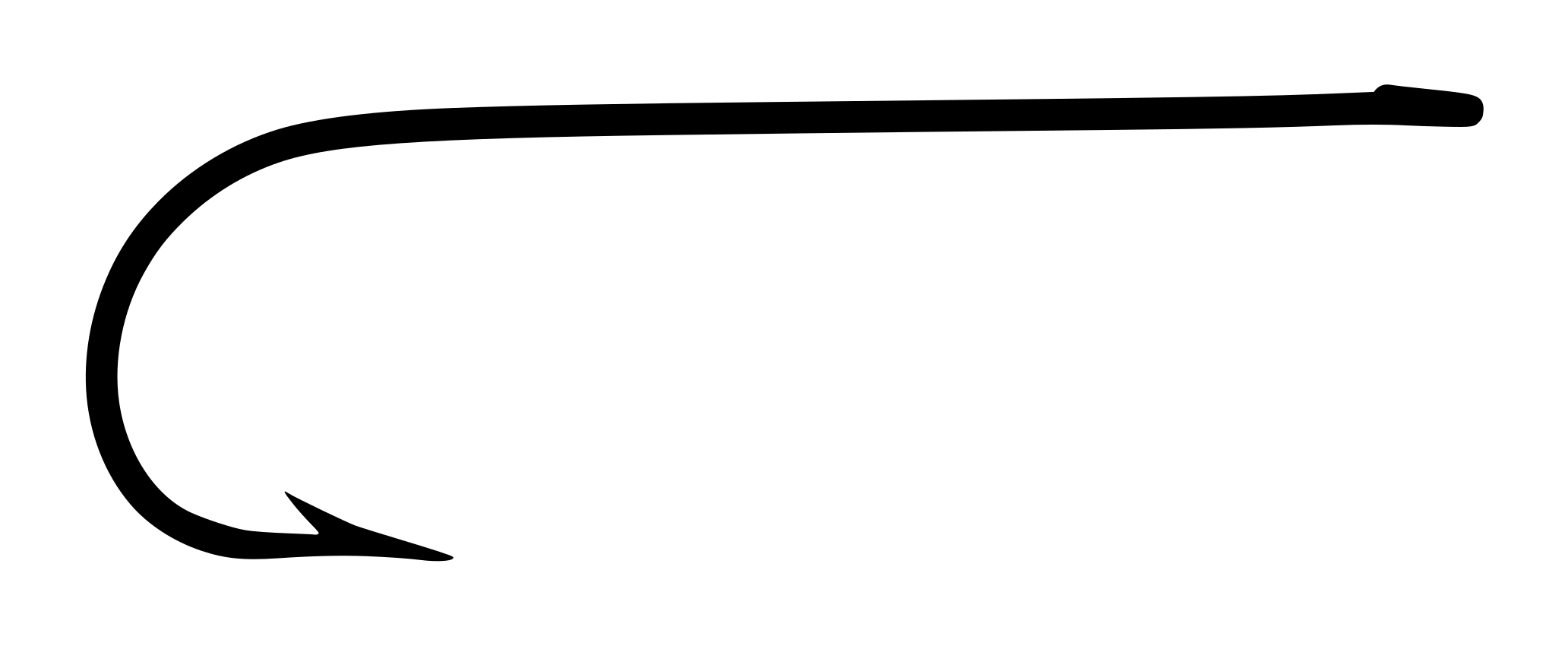
|
3260 B No. 1 — Aberdeen | 81% | Compare |

|
3278 No. 5/0 — Mustad 3278 Aberdeen | 79% | Compare |
The Mustad 3730 was designed for classical salmon and sea trout fishing in the UK and Ireland, using light silk or gut leaders and wet-fly presentations. The blind eye and marked shank indicate professional-tier tackle intended for anglers snelling their own leaders or for tackle shops producing pre-made leaders for retail sale. Primary targets were Atlantic salmon (Salmo salar) and sea trout (Salmo trutta) in rivers such as the Spey, Tay, Tweed, Shannon, and Moy.
The fine wire and hollow point were optimized for light, delicate presentations in clear water—conditions where a slim profile and reduced penetration force (to avoid tippet breakage) were paramount. Typical fly patterns would have ranged from small wet flies (sizes 8–2) to small streamers, dressed on this hook and snelled to 2–3-pound breaking-strength gut. The marked shank ensured secure attachment during the strike and the extended fight on light leaders.
Not documented as a contemporary fly-tying hook; primarily used for professional leader snelling. Historical tie examples may include small wet flies of the classical British tradition (e.g., Jock Scott, Black Dose, Greenwell's Glory in small sizes) dressed and snelled by professional dressers.
| Hook | Match Quality | Notes |
|---|---|---|
| Mustad 3906 (eyed variant) | Moderate | Same Aberdeen bend and hollow point, but with tapered eye for modern applications. Represents the successor design but without the historical character or marked shank. |
| Partridge of Redditch SH (sea trout) | Good | Contemporary eyed Aberdeen for salmon/sea trout work. Similar bend and wire gauge, but manufactured in England and lacks the Mustad marked-shank feature. |
| Garren Wood Blind-Eye Aberdeen (custom) | Excellent | Modern hand-forged reproduction of the blind-eye marked-shank design. Functionally and aesthetically closest to the original 3730 but custom-made on request. Not commercially available in retail channels. |
Rare and historically significant. Pre-1925 Mustad production, pristine condition, and documentation of a now-extinct manufacturing technique (marked shank) drive strong collector demand. Original packaging with Christiania label is essential to value; loose hooks without documentation command significantly lower prices. Limited numbers of examples in private collections.
Positive factors: Christiana-labeled pre-1925 packaging is definitional for early Mustad collectors. Blind-eye Aberdeen hooks of this era are increasingly difficult to locate as most surviving examples have been lost or fished away. The marked shank is a technical rarity—this feature was specific to Mustad and was discontinued by mid-century. The original 100-hook packaging intact or mostly intact adds 50–75% premium over loose hooks. Fine wire and hollow point demonstrate engineering sophistication and labor intensity uncommon in modern production. This piece documents the transition era between gut-based and eyed-hook systems and is valuable for museum and reference collections.
Limiting factors: Blind-eye hooks have no functional application in modern angling, limiting appeal to anglers. Niche collector base focused on classical tackle and historical fishing traditions. Condition of original box and label critical to value; separated hooks or heavily damaged packaging reduce collectability significantly. Mustad 3730 is not as iconic as some British Redditch makers (Partridge, Milward) among general collectors, though it is highly valued by Mustad specialists.
Cardboard box with glued-on printed label. Label is cream/ivory stock with gold letterpress print. Label reads: 'O. MUSTAD & SON / MANUFACTURERS / CHRISTIANIA - NORWAY / Qual. 3730 / ABERDEEN HOOKS / Hollow Point / Mark[ed] / Marked Blued / Made in Norway / 100 / No. 1' with decorative key and geometric border motifs in gold. Box construction is cork-core composite, typical of early-20th-century fishing tackle packaging. No barcode present—strong pre-1974 indicator. Phone number and ZIP format absent from label. Text printed by letterpress, not offset lithography.
Pricing based on original packaging condition, completeness of the 100-hook box, and Christiania-era dating. A pristine original box with all 100 hooks and label intact typically commands $65–$75 USD at specialist dealers and auction houses. Loose hooks or damaged packaging typically $25–$40 each. Value is driven by rarity, historical significance, and collector demand for pre-1925 Mustad Key Brand pieces. No modern equivalent exists; the blind-eye marked-shank Aberdeen is a discontinued design. Availability through eBay is sporadic; most examples appear at vintage tackle auctions (Christie's, Bonhams) or specialist dealers in the UK and Scandinavia.
Vintage fishing tackle auctions (Christie's, Bonhams), specialist dealers in the UK (London), Scandinavia (Oslo, Stockholm), and North America. eBay listings appear sporadically; search terms 'Mustad 3730', 'blind eye Aberdeen', 'Christiania hook'. Tackle fairs and regional antique markets in England and Scotland occasionally yield examples. Direct acquisition from private collections is common among active Mustad collectors.
Examine the label for ‘Christiania’ text and gold letterpress print—hallmarks of pre-1925 Mustad Key Brand production. Inspect the shank closely under magnification (10x) for mechanical ridge marks; these should be evenly spaced and raised, not painted or embossed. Verify the blind eye by confirming the shank tapers to a flat, spade-like termination with no metal loop. Check the point for concavity: tilt the hook in light and look for an inward curve from the barb to the tip—this distinguishes hollow from superior. The original cardboard and label add significant value; separate hooks without packaging command 40–60% lower prices. No barcode and no ZIP code on the label are strong pre-1974 indicators.
Store the original packaged box in a cool, dry environment away from direct sunlight and humidity. The blued finish is susceptible to patina development and surface oxidation if exposed to fluctuating humidity; a stable 40–50% relative humidity is ideal. If the box is opened, store hooks individually in acid-free paper sleeves or small glass vials to prevent contact with other metals, which can cause galvanic corrosion.
The original label and packaging are integral to the specimen’s historical and monetary value; do not discard or separate them. If the label shows foxing (rust-colored age spots), do not attempt to clean it with moisture or chemicals, as this will cause further damage. Light surface dust can be removed gently with a soft-bristled brush. Do not apply any coating or finish to the blued surface; the patina that develops with age is desirable and expected among collectors.
If hooks are removed from the original packaging for examination or study, return them to the box as soon as possible and store in a locked display case or cabinet away from workshop humidity, tool oils, and salt air (coastal environments). Blind-eye hooks are fragile; do not attempt to snell or use these specimens, as the point is irreplaceable if damaged.
The label is entirely printed by letterpress; no handwritten annotations or price marks are visible on this specimen’s packaging. The printed text includes ‘No. 1’ in bold sans-serif type, likely one of multiple size variants (2, 4, 6, 8) produced in the same series. Any handwritten notations on surviving examples are typically dealer or collector marks applied years after manufacture and do not indicate original factory provenance.
Source: Original Mustad Key Brand label, cardboard box, c. 1900–1924.
The label text states: ‘O. MUSTAD & SON / MANUFACTURERS / CHRISTIANIA – NORWAY / Qual. 3730 / ABERDEEN HOOKS / Hollow Point / Mark[ed] / Marked Blued / Made in Norway / 100 / No. 1’. The designation ‘Qual.’ (Quality) followed by a number was Mustad’s internal system for product classification and likely referred to a specific quality tier or specification sheet used in the factory. The term ‘Marked’ appears twice on the label—once as an abbreviated descriptor and once as ‘Marked Blued’—indicating that the marked (ridged) shank was a selling point and that the finish was the proprietary ‘Marked Blued’ process.
The quantity ‘100’ refers to the standard package size (100 hooks per box), typical for professional tackle shops and snellers who would break the box into smaller retail units. The explicit statement ‘Made in Norway’ indicates this was an export product marketed to British and Irish anglers, emphasizing Norwegian manufacture as a quality signal in an era when Redditch English hooks were considered the gold standard. The ‘Key Brand’ designation (visible in the key motif in the border) was Mustad’s proprietary branding for export lines and does not appear in Norwegian domestic catalogs of the period.
The blind-eye hook represents a complete tackle ecosystem now largely forgotten: the art and practice of hand-snelling hooks to gut leaders. In the Edwardian era, anglers or professional dressers would tie a hook to a length of gut using silk thread and a snelling needle, creating a secure loop-knot (the ‘snell’) that allowed quick attachment and detachment from a leader.
The marked shank was engineered specifically for this practice. The mechanical ridges provided ‘bite’ for the silk wraps, preventing the knot from slipping under the stress of a fighting fish. A poorly marked shank could mean a lost fly and a lost fish—a major frustration for anglers who had invested in silk and gut and expected reliability. Mustad’s innovation here was both practical and psychological: the ridged surface was visible to the angler’s eye, signaling quality and durability.
By the 1950s, snelling had become obsolete. The rise of tapered-eye and ball-eye hooks, combined with the introduction of nylon tippets and modern knot-tying techniques, made the blind-eye snelled leader unnecessary. Professional tackle makers who had built entire businesses around snelling were forced to close or retrain. The knowledge and skill required to snell properly—understanding knot geometry, managing thread tension, working with the delicate gut—has largely disappeared from modern angling instruction.
Today, the blind-eye marked-shank hook is a direct window into this lost world. It speaks to a time when fly fishing was a more labor-intensive, hands-on craft, when the angler’s role extended to tackle making and maintenance. For classical fly-fishers and historians, the Mustad 3730 is not merely a hook; it is an artifact of a complete cultural and technical tradition.
| P | Photographically verified — Directly observable in the photograph(s) on this page. |
| V | Verified by documentation — Confirmed by manufacturer catalog, spec sheet, or published reference. |
| I | Inferred — A logical deduction from observable or documented evidence, not directly stated. |
| E | Estimated — An approximation based on visual comparison, proportional analysis, or limited data. |
| S | Speculative — A reasoned hypothesis that cannot be confirmed from available evidence. |
Unnotated claims are the compiler’s synthesis; see Sources. All photographs on garrenwood.com are taken on a measurement grid where each square equals 1/10 inch (0.1″ / 2.54 mm).
Your cart is empty.