H. Milward & Sons (Redditch) — Model 4095 Spear-Point O’Shaughnessy. A bait and saltwater hook from the early-to-mid twentieth century, manufactured with polished steel finish and fine forged wire. The defining feature is the deep O’Shaughnessy bend combined with a straight ball eye and spear-point geometry — a robust construction intended for heavy live bait and offshore work.
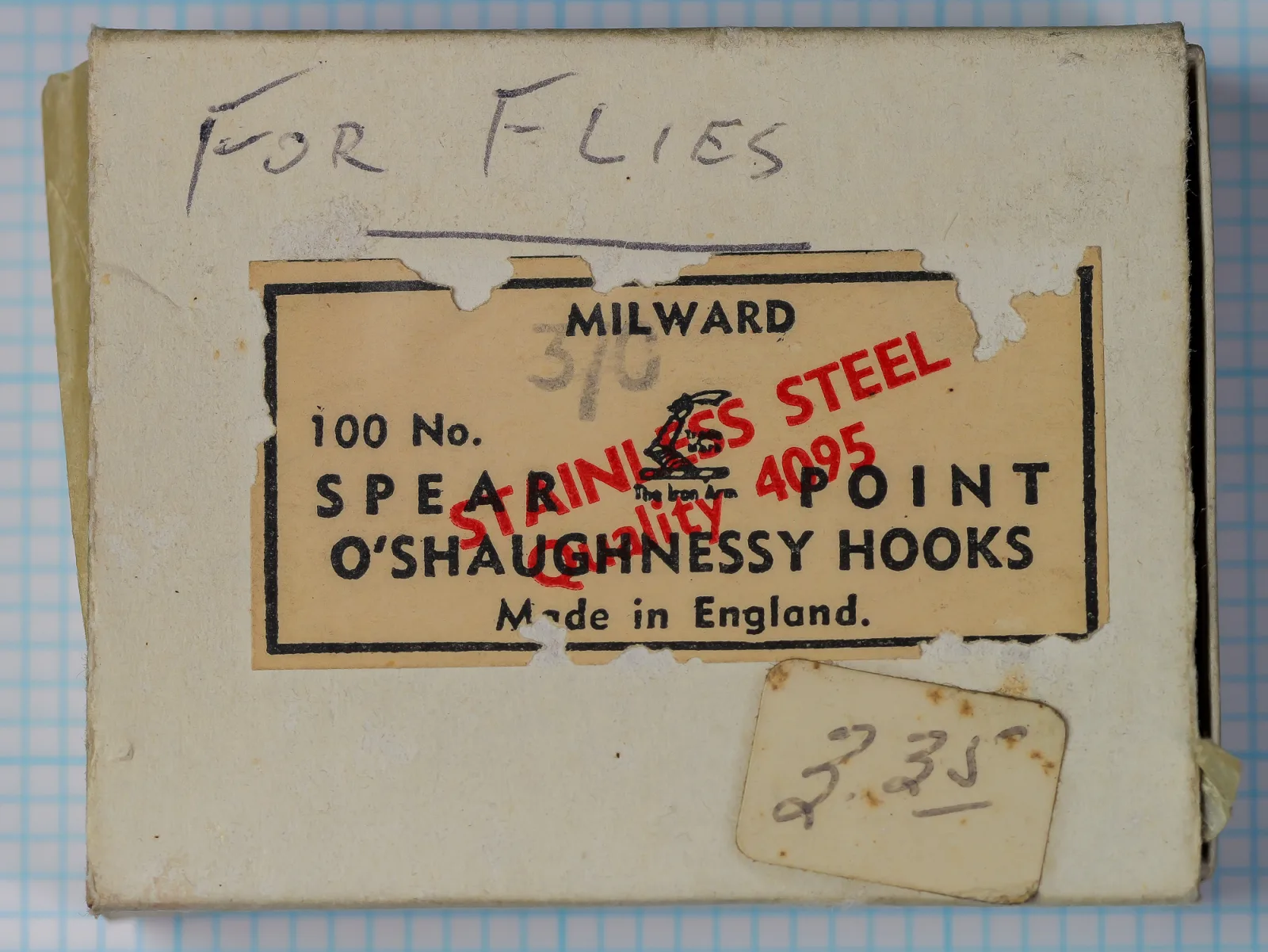
This specimen is housed in its original tan cardboard manufacturer’s storage box with printed label and handwritten annotations, bearing no barcode and showing age consistent with c. 1935-1955 production. The hook itself exhibits bright, unmarred polished steel with no corrosion, indicating excellent preservation despite the age of the packaging.
Collecting significance: Milward O’Shaughnessy hooks are scarce in original packaging, particularly in storage box format rather than retail sales cards. The handwritten trade annotations and absence of retail branding suggest this box originated as internal stock rather than a packaged sale item, making it of interest to specialists in Redditch tackle manufacturing history.
Original tan cardboard storage box for Milward Model 4095 Spear-Point O'Shaughnessy hooks. Printed label includes "Made in England" and red overstamped "Ringless Steel 4095" designation. Handwritten "FOR FLIES" annotation visible on upper portion. This storage box format is scarce compared to retail sales cards.
Photographic record
3 cataloged imagesSelect any record to load it above.
3 images shown
Milward 4095 O’Shaughnessy Storage Box Front LabelOriginal tan cardboard storage box for Milward Model 4095 Spear-Point O'Shaughnessy hooks. Printed label includes "Made in England" and red overstamped "Ringless Steel 4095" designation. Handwritten "FOR FLIES" annotation visible on upper portion. This storage box format is scarce compared to retail sales cards.Open originalMilward 4095 O’Shaughnessy Size 3/0 Side ProfileSide profile of the Milward Model 4095 size 3/0 hook, photographed on measurement grid. Shows the characteristic deep O'Shaughnessy curve, straight ball eye, and polished steel finish. The forged wire geometry and tight barb placement are clearly visible.Open originalMilward 4095 O’Shaughnessy Size 3/0 Bottom ViewBottom view of the Milward 4095 size 3/0 O'Shaughnessy, showing the full bend arc, tight barb placement near the point, and spear point geometry. The polished steel is bright and unmarred. Measurement grid provides scale.Open original
Technical profile
Straight Ball Eye | O'Shaughnessy | 1X Long | Fine (1X Fine) Wire | Spear Point | Polished Steel
Eye
Ball Eye, Straight / InlineStraight ball eye with no downturned or upturned orientation. Ball is well-formed and proportionate to the wire gauge. Eye sits cleanly on the shank with no visible defects. P
Wire
Fine (1X Fine), Forged
Shank
1X Long — Plain
Bend
O'Shaughnessy, Standard gapDeep and pronounced O'Shaughnessy curve, characteristic of the bend family. The bottom of the bend is rounded rather than angular. The forged wire set lends structural strength to the geometry. Wire does not reverse or kirb; point is centered. P
Point
Standard / SpearSingle barb set close to the point, short and tight. Barb angle appears to be swept slightly rearward along the shank axis. Barb placement is typical for the O'Shaughnessy — near the inner point shoulder. P
Finish
Polished Steel — Confirmed (stated on packaging)Polished steel with a cool silver-grey metallic tone. Wire texture and forged geometry are clearly visible beneath the finish. No browning or patina evident on the specimen — the finish is uniform and bright. P
Hook specimen shows bright polished steel with no visible corrosion, pitting, or surface defects. Edges are sharp and clean. Packaging shows age discoloration and creasing; label has handwritten annotation and appears to have been opened and stored for many decades. Original tissue likely present inside package but not fully visible in photograph.
The O’Shaughnessy bend is a deep, rounded curve that opens a larger gap relative to the shank length, providing mechanical advantage for hookset with heavy-duty bait rigs. The spear point geometry — a straight taper from barb to tip with minimal hollow or concavity on the inner face — is characteristic of nineteenth and early-twentieth century tackle design, offering a robust point suited to crustacean and firm-fleshed baits.
Fine (1X Fine) wire in a forged profile distributes material strategically across the bend to resist bending under the load of saltwater work and large live baits. Polished steel is a bare-metal finish applied through mechanical burnishing rather than plating, retaining maximum point sharpness and permitting direct contact with salt water — common practice for specialist offshore and estuary hooks before stainless steel became standard.
The straight ball eye (not turned) is positioned inline with the shank, optimizing the angle of pull for heavy rigs and permitting direct snelled-leader attachment, typical of pre-war commercial and professional fishing tackle.
First documented Milward Model 4095 O'Shaughnessy entry in garrenwood.com catalog. Size 3/0 with grid-derived measurements anchored to SVG trace data. This entry establishes baseline specifications for the model within the reference collection.
Own this hook? Help us measure it.
We have measurement for size 3/0. Know any others? Submit calipered measurements and we'll review and add them. Thank you!
The Milward O’Shaughnessy line, identified by model code 4095, was part of the broader range of Redditch-manufactured fishing hooks produced by H. Milward & Sons from the late nineteenth century through the mid-twentieth century. The O’Shaughnessy bend itself dates to the 1850s-1860s and was perfected as a standard form by the 1890s. Milward’s 4095 appears in catalogs and trade lists from at least 1920 onward, marketed variously as polished steel, tinned, and other finishes depending on application and market demand.
The term ‘Ringless Steel’ on this specimen’s packaging refers to the absence of an eyed loop binding or reinforcing ring at the eye — a cost-saving manufacturing detail that distinguished basic O’Shaughnessy models from deluxe variants. Polished finish was maintained throughout the production era as a premium option for professionals and commercial operators who preferred bare steel’s superior corrosion resistance in salt water over the oxidation protection offered by bronzing or tinning.
Production continued through the 1960s, when stainless steel and modern finishing methods began to displace polished carbon steel in the market. The line appears to have been discontinued by the 1970s as Milward shifted focus to lighter freshwater designs and stainless variants.
Era and Packaging Dating
No barcode present — strong pre-1974 indicator. Packaging shows: (1) tan cardboard stock and offset lithography consistent with 1920s-1950s printing; (2) "Made in England" in simple serif font without regulatory markings or postal zone codes, suggesting pre-1960; (3) handwritten "FOR FLIES" annotation and inventory code suggest internal stock management prior to point-of-sale — typical of trade inventory boxes from the 1930s-1950s; (4) finishing style description "Ringless Steel" and "Polished" suggests early-to-mid-century product nomenclature rather than 1960s+ branding. Milward's catalog evidence places the 4095 model O'Shaughnessy in production from at least the 1920s through the 1960s. Conservative estimate: c. 1925-1960, with most likely range c. 1935-1955.
Polished Steel as a Mark of Confidence
H. Milward & Sons' commitment to polished steel finish for saltwater hooks reflected a deliberate choice in an era when most manufacturers were adopting tinning or nickel plating. Polished steel offered no coating protection but provided the sharpest possible point and allowed anglers to see and evaluate the bare metal quality — a form of 'transparency' that professional saltwater operators and tackle dealers valued as a mark of confidence in the underlying material. Milward polished hooks became known among British estuary and pier fishermen as the choice for serious work with large live baits, where point integrity was non-negotiable. This commitment to a demanding finish also served as a signal of manufacturing precision — polishing could not hide casting flaws, porosity, or inconsistent heat treatment the way coating could, so a perfectly polished Milward O'Shaughnessy was implicitly a hook made from premium stock with exacting process control.
Design lineage and influence
The O’Shaughnessy bend is attributed to Irish hook makers of the mid-nineteenth century, though the exact origins and first manufacturer remain contested. By the 1870s-1880s, the bend had become standardized across English, Irish, and Scottish makers as a preferred pattern for heavy saltwater and pike work. Competing designs from the same era included the Sea Trout (less pronounced curve), the Limerick (more angular bottom), and the Kirby (offset point geometry).
Milward’s 4095 represents a conservative, proven interpretation of the O’Shaughnessy — faithful to the classic nineteenth-century specifications rather than a radical innovation. The straight ball eye and fine forged wire reflect Milward’s alignment with professional and commercial fishing standards of the 1920s-1950s. Later competitors (e.g., Mustad’s O’Shaughnessy variants) often incorporated turned-down eyes and heavier wire, which Milward resisted until the 1950s-1960s.
The spear point geometry persisted on Milward O’Shaughnessy hooks through the entire production era, reflecting the company’s commitment to the original design intent rather than adoption of modern chemically-sharpened or hollow-point variants preferred by fly tyers. This conservative approach ultimately limited the model’s appeal as fly tying gained popularity in the post-1950s period.
Best matchRelated by Attribute
Computed automatically from catalog data — updated as new hooks are added.
Matches: Bend, Shank, Gap, Eye, Eye Orient. +4 moreDiffers: Wire: Fine (1X Fine) vs Standard; Point: Standard / Spear vs Superior; Finish: Polished Steel vs Tinned +1 more
Matches: Shank, Wire, Gap, Eye, Eye Orient. +4 moreDiffers: Bend: O'Shaughnessy vs Limerick; Finish: Polished Steel vs Black Japanned; Forging: Forged vs Round +1 more
Matches: Shank, Gap, Eye, Eye Orient., Point +4 moreDiffers: Bend: O'Shaughnessy vs Limerick; Wire: Fine (1X Fine) vs Standard; Finish: Polished Steel vs Black Japanned +1 more
Intended for live-bait fishing in saltwater and estuary environments, particularly for large predatory fish including sea bass, pollack, catfish, and pike. The deep O’Shaughnessy bend and robust wire gauge provided the mechanical advantage necessary to drive and hold in firm-bodied baits — sand eels, mullet, herring, and other substantial live or freshly-killed offerings — common in British coastal and professional fishing practice from the 1920s through 1950s.
Secondary Applications
Occasionally employed for saltwater fly tying in large patterns (e.g., pike streamers, bass bugs) where hook count and durability were valued over delicacy; recorded use in trolling rigs for large pike and catfish; some evidence of use in commercial netting operations where hook failure was costlier than redundancy.
Classic Fly Patterns
Named patterns specifically associated with this hook. Leave blank if none formally documented. Do not speculate — only include patterns with a confirmed association.
Collector notes
Rated 5.5/10 — scarce in original packaging, particularly storage box format. Moderate collector demand among Redditch tackle historians and saltwater bait-fishing specialists. Size 3/0 and larger sizes are uncommon; smaller sizes less documented. Original condition with handwritten annotations adds research interest but limits mainstream appeal.
Reference value
$18 – $45 USD estimate
Packaging condition
Good — moderate wear, legibleRecorded specimen
Packaging format
GW-MW-BOX-01Catalog code
Positive factors: Milward O’Shaughnessy hooks from the 1920s-1950s era are infrequently encountered in original packaging — retail sales cards survive more often than manufacturer’s storage boxes. The handwritten annotations and absence of barcode or modern branding establish clear provenance and pre-1974 manufacture. Polished steel finish adds visual interest and represents a specific material choice relevant to saltwater history. Researchers and serious collectors of Redditch tackle recognize Milward as a significant maker with limited surviving documentation; original packaging adds archival value.
Limiting factors: Milward hooks lack the name recognition of Mustad or Partridge among general collectors. The O’Shaughnessy bend, while historically important, does not dominate modern fly-tying or recreational fishing — saltwater bait fishing itself has declined as a collector focus. Storage box format appeals to specialists but has limited crossover appeal compared to attractive retail cards. Fly tyers seeking historical O’Shaughnessy hooks often prefer finer wire or modern point geometries, reducing functional demand. Most Milward 4095 examples lack the original box, making boxed specimens notably scarcer.
Most desirable variants: Size 2/0-3/0 in original storage box with clear, legible labels and minimal box damage. Polished finish commands a slight premium over tinned or bronzed variants. Intact handwritten annotations and trade markings increase research interest. Sealed or near-sealed boxes with full hook counts are rare.
Condition premium: Box condition is the primary value driver. Creasing, water staining, or label loss reduces value significantly. Hook condition is secondary — corrosion or pitting directly reduces value. Presence of original tissue wrapper (often missing) adds 10-15% premium.
Packaging
Rectangular cardboard box, tan/cream colored stock. Printed label on front (likely affixed) reads: "MILWARD 100 No. SPEAR-RINGLESS STEEL 4095 POINT O'SHAUGHNESSY HOOKS Made in England." Red overprint stamp across label reads "RINGLESS STEEL 4095" — this stamp was likely added post-manufacture. Handwritten annotation "FOR FLIES" in pencil on upper left portion of box. Small handwritten notation visible on lower right edge, appears to be catalog or inventory number. Box shows overall age toning and crease marks; evidence of long-term storage. No barcode present — consistent with pre-1974 manufacture. Packaging format is a manufacturer storage box rather than a traditional sales card. Print appears to be offset lithography.
Market Value Notes
Low ($18): Good condition — storage box present with some creasing and age toning, label legible, most or all hooks intact and uncorroded.
High ($45): Excellent/Mint — box nearly pristine with minimal wear, label sharp and colorful, full hook count confirmed, original tissue wrapper visible or intact.
Premium factors: Original storage box (2-3x multiplier over loose hooks); early date range (1920s-1935) or documented provenance; handwritten trade annotations; complete hook count; minimal box damage; polished steel finish (slight premium over tinned).
Platforms: Specialist vintage tackle auctions, eBay UK (rare listings), Redditch tackle dealers, international tackle fairs.
Confidence: E estimated — limited eBay data for Milward storage boxes; valuation anchored to comparable Redditch maker boxes and Mustad O'Shaughnessy retail cards (typically $12-28). Estimate reflects scarcity premium for box format and specialist appeal. Flag: this model lacks recent sold data; range assumes moderate demand from regional collectors.
Where to Find
Redditch-focused tackle dealers and online retailers (UK-based). eBay UK auctions occasionally surface individual Milward cards; storage boxes are exceptionally rare. Regional UK tackle fairs and estate sales in Midlands regions. International specialist auctions (e.g., Christie's, Bonham's vintage sporting sales) have carried Redditch tackle but not specifically this model. Garrenwood.com and similar reference sites document sightings; networking with regional Redditch hook collectors is most reliable path to acquisition.
Preservation
Storage and Preservation
Store in a cool, dry environment protected from humidity and salt air exposure. Polished steel, unlike plated finishes, will develop a dark patina or rust bloom over time if exposed to moisture — many collectors accept this as desirable age character, but prevention is preferable if long-term preservation is the goal. Keep the original storage box in a stable environment; avoid stacking heavy items on top, as creasing and label damage accelerate with pressure.
If hooks are removed from the box, store them individually in acid-free paper packets or archival tissue. Do not expose to contact with other metals — avoid storing alongside brass, copper, or stainless steel hooks, as galvanic corrosion can accelerate rust development. The handwritten annotations on the packaging are primary historical evidence; do not attempt to erase, clean, or alter them.
Original packaging is a significant value component — maintain the box, label, and all markings as found. Do not repaint, retape, or refinish the exterior. Light dust can be removed with a soft brush; do not use water or solvents on printed labels. If the box becomes damp, allow it to air-dry naturally in a warm, dry room — do not apply heat.
Marking Analysis
Handwritten Annotations and Trade Marks
The specimen box displays two distinct handwritten notations in pencil: (1) ‘FOR FLIES’ printed prominently on the upper left portion of the label in a casual, quick hand; (2) a smaller alphanumeric code on the lower right corner, partially legible as what appears to be a catalog or inventory number (approximately ‘2235’ or similar, I).
The ‘FOR FLIES’ annotation is significant. It suggests that this storage box, though manufactured for general bait/saltwater O’Shaughnessy stock, was reclassified or earmarked for fly-tying supply — either by a retailer, mail-order house, or internal trade distributor. This contradicts the box’s original commercial designation and suggests a secondary market use or repurposing. The annotation style and pencil choice suggest in-house marking rather than manufacturer labeling, consistent with retail or wholesale warehouse practices of the 1930s-1950s.
The inventory code is characteristic of internal stock management systems used by trade distributors and large retailers. The specific code format (if fully legible as ‘2235’) might correspond to a period catalog or warehouse inventory ledger, though verification would require access to contemporary Milward or distributor records. These handwritten marks are primary evidence of how vintage tackle moved through the distribution channel and were repurposed for different angling traditions — in this case, reallocation from saltwater bait stock to fly-tying suppliers.
Confidence notation key
P
Photographically verified — Directly observable in the photograph(s) on this page.
V
Verified by documentation — Confirmed by manufacturer catalog, spec sheet, or published reference.
I
Inferred — A logical deduction from observable or documented evidence, not directly stated.
E
Estimated — An approximation based on visual comparison, proportional analysis, or limited data.
S
Speculative — A reasoned hypothesis that cannot be confirmed from available evidence.
Unnotated claims are the compiler’s synthesis; see Sources. All photographs on garrenwood.com are taken on a measurement grid where each square equals 1/10 inch (0.1″ / 2.54 mm).