
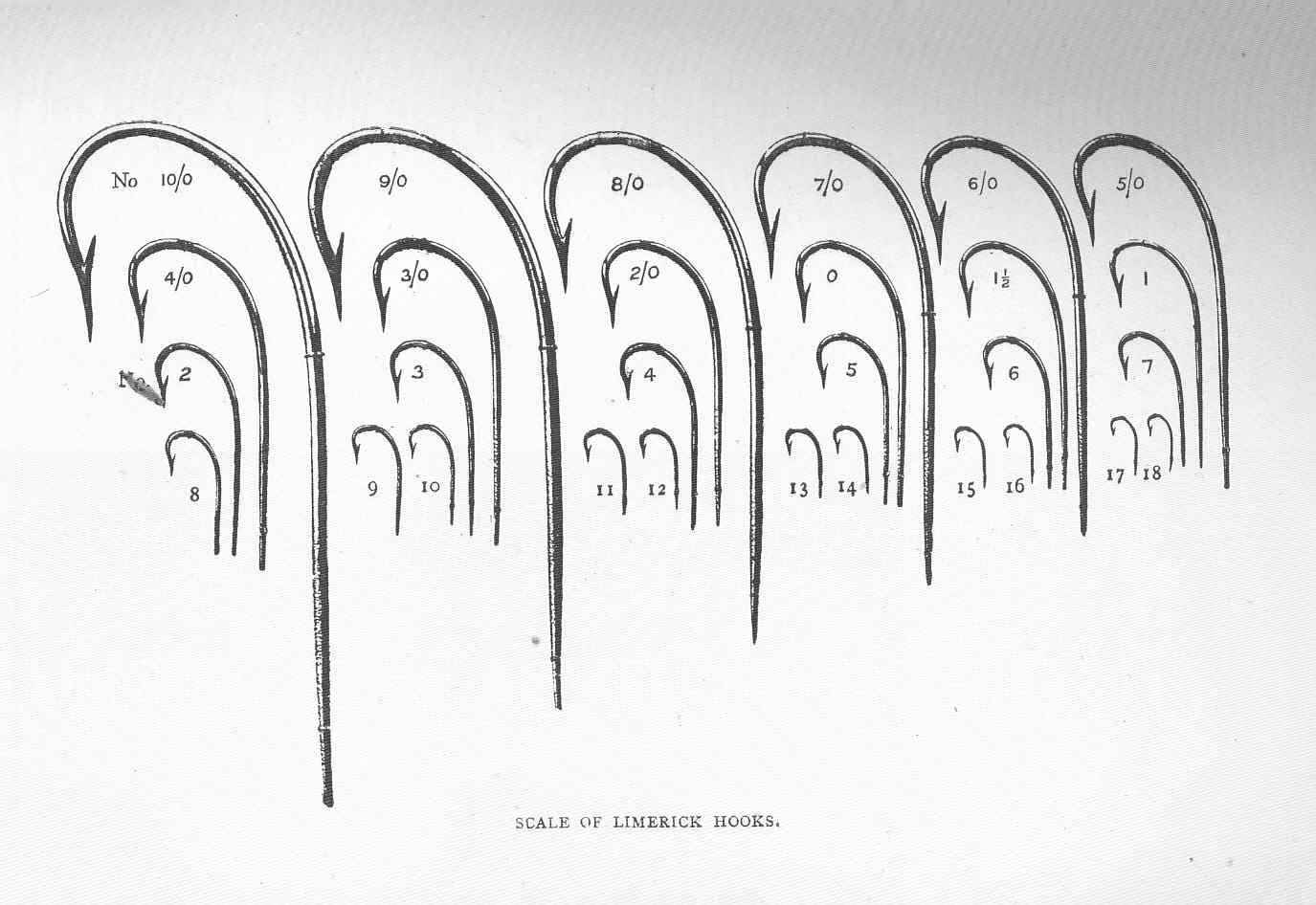
Hook sizing is the first thing every angler learns and the last thing anyone fully understands. A size 20 is tiny and a size 2 is large; then the numbers stop, turn into 1/0, 2/0, 3/0, and start getting bigger again. A size 10 from one maker is not the same as a size 10 from another. And a Victorian packet marked “No. 5” might be a big salmon hook or a small trout hook depending on which town it came from. This article explains where the system came from, why it runs backwards, and what a collector can and cannot infer from a number on a packet.
Numbers that count down
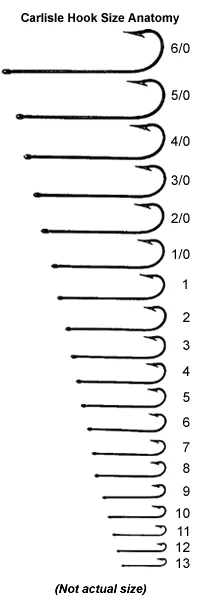
The modern convention is the Redditch scale, also called the old scale. Hooks are numbered from 1 upward, and the number goes up as the hook gets smaller: a 4 is smaller than a 2, a 12 is smaller than an 8, and the trout and grayling sizes run down through 16, 18, 20 and beyond to a 26 or 28 that is barely visible. For hooks larger than a size 1, the scale switches to “aughts”: 1/0 (one-aught), 2/0, 3/0 and so on, with the number now increasing with size. A 9/0 or 10/0 is a big-game or shark hook.
The reason the sequence runs this way is that it started life as a wire gauge rather than a hook size. Needle and wire gauges in the English trades numbered from a coarse “0” upward, with each step meaning a finer wire, and the Redditch hook makers, who were needle makers first, simply carried the habit across. A size 1 hook was the largest made from ordinary wire; anything bigger was an “0”, and then a double-0 and a triple-0, which were later written 1/0, 2/0 and 3/0. Nobody designed it; it accreted.
The rival scales
For most of the nineteenth century the Redditch scale was only one of several, and this is where the collector has to pay attention. Ron Reinhold counted at least five in use at once: Redditch, Kendal, Carlisle, the O’Shaughnessy Limerick scale, the Dublin (or Phillips) Limerick scale, and Sell of Dublin’s, and there were house variants on top.
The Kendal scale
Kendal ran the opposite way. In the Kendal scale a 00 was the smallest hook and the numbers rose with size, up to a 20 that was a large salmon hook; Henshall described it in 1889 as “the reverse of the one heretofore universally used, the Redditch scale”. Kendal hooks were highly regarded and widely sold, and the makers there, Hutchinson especially, kept their scale into the twentieth century. A Kendal-scale packet marked No. 12 is a big hook, not a small one.
Pennell’s new scale
H. Cholmondeley-Pennell, who did more than anyone to popularise the eyed trout hook in the 1880s, proposed his own “new scale” to go with it, running from 000 at the small end to 19 at the large. Redditch makers produced Pennell-scale hooks alongside old-scale hooks for decades, and packets from the 1890s through the 1930s often carry both numbers, one in brackets. Catalogues of the period print conversion tables, and a collector working with British fly hooks of that era needs one.
The Irish scales
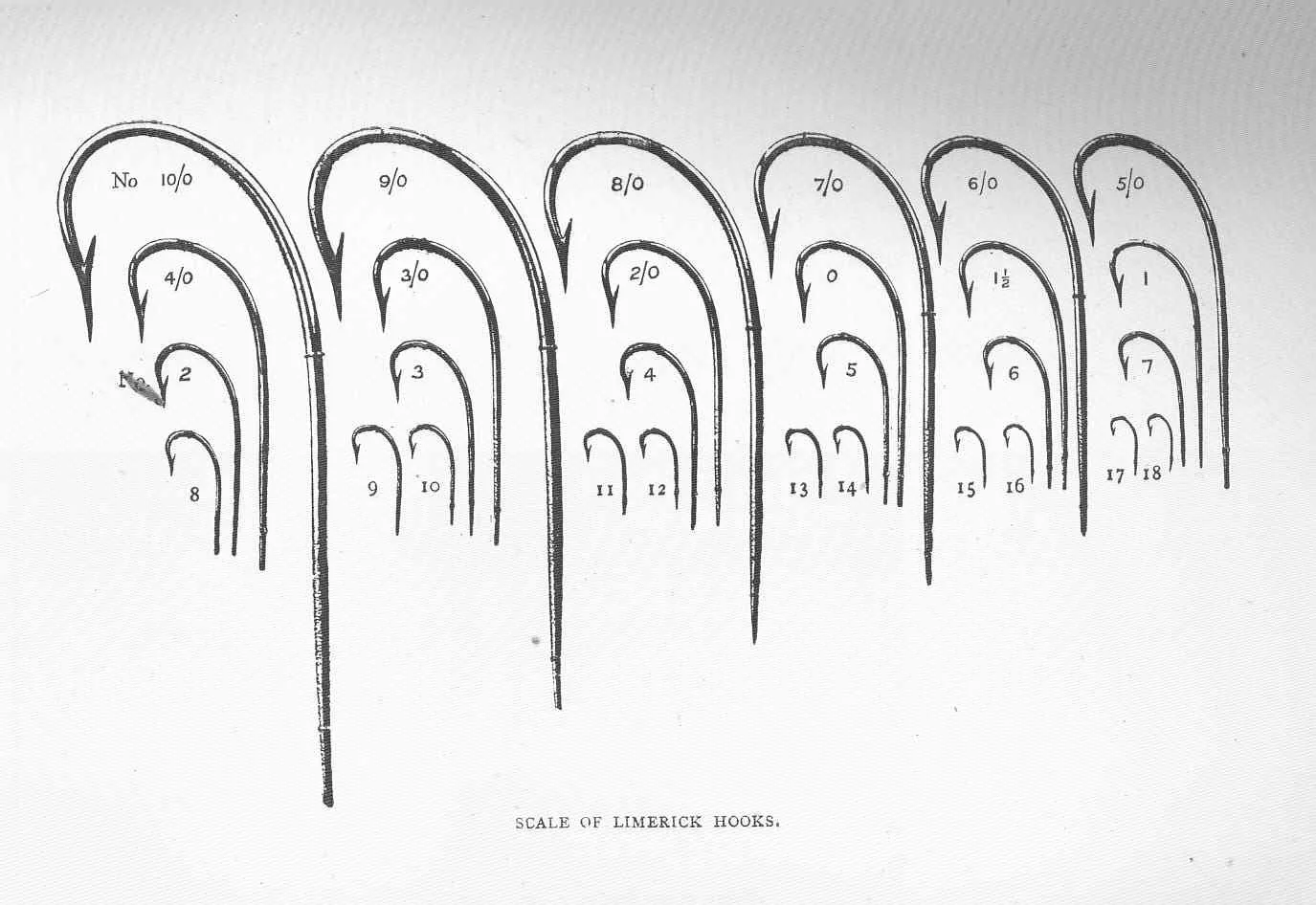
The Limerick makers were a law unto themselves. Phillips of Dublin sized their celebrated light-wire Limericks with the largest as No. 1 and the numbers rising as the hooks got smaller, like Redditch, but the heavy-wire Phillips pattern illustrated in Jones’s Guide to Norway (1848) is numbered the other way round. Two hooks by the same maker, both marked No. 3, could be at opposite ends of the salmon range.
What the number actually measures
Even within a single scale, a size is not a dimension. Originally a hook size described the gape, the distance from point to shank, and it still does, loosely. But shank length is described separately in the X system (2X long, 1X short), wire weight in the same way (2X fine, 3X stout), and neither of those changes the size number. So a size 10 4X long streamer hook and a size 10 1X short spider hook share a nominal gape and nothing else.
Worse, the nominal gape was never standardised between makers. Mustad’s size 10 is not Partridge’s size 10, and neither is Tiemco’s. The differences are small in the middle of the range and become large at the ends; a size 2/0 salmon hook from one house can be a full size bigger than another’s. Hutchinson of Kendal tried to fix this with a “Rational scale” before 1899, in which each hook rose by a fixed fraction of an inch in overall length, and Pryce-Tannatt’s “rational” salmon hook groups of 1914 follow the same idea. Neither caught on generally.
How this site handles it
Because of all this, the reference records the size as printed on the packet, records which scale it appears to be using where that is not the modern one, and then measures the hook: overall length, gape, throat and wire diameter. The compare tool works from those measurements and shows two hooks at true scale, which sidesteps the number entirely. The Print Lab will produce a true-scale size chart for any maker in the catalogue, which is the nineteenth-century book plate brought up to date.
Practical rules for reading an old packet
A few habits save a lot of confusion. If the packet is from Redditch or from Mustad, assume the modern scale unless there is a bracketed second number, in which case one of them is Pennell’s. If it is from Kendal, or from a dealer who bought from Kendal, assume the reverse. If it is an Irish salmon hook, do not assume anything: measure the gape and compare it with a plate. And if the hook is loose, with no packet, the number on a dealer’s card is only a guess, and the measurements are the only facts you have.
Source and further reading
James A. Henshall, Book of the Black Bass (1889), on the Kendal and Redditch scales. Ron Reinhold, “Facts and Folklore About Hooks”, on the restored Ronn Lucas Sr. site, for the Phillips and Rational-scale anomalies. Sir Herbert Maxwell, Salmon and Sea Trout (1898), for Hutchinson’s Rational scale.
Image note: The illustrations are public domain reproductions from Wikimedia Commons and are credited in their captions.
