A hook is a piece of high-carbon steel, and high-carbon steel rusts. Everything a maker did to the surface of a hook after hardening it was an attempt to delay that, and the choices they made, black japan, brown bronze, bright tin, blue, nickel, gold, tell you what the hook was for and often when it was made. Finish is the last field on every entry in the reference, and it is one of the most useful. This is a field guide to the common finishes, what they actually are, how to tell them apart, and how to tell an original finish from a later one.
Before finishes: mutton fat and talc
The earliest protection was grease. Hand-made hooks were heated and dipped in hot mutton fat, and the coating built up with repeated dips. Later, hooks were blued, by controlled heating or a chemical bath that left a thin blue-black oxide on the surface, and packed in paper with a dusting of talc to keep moisture off. Ron Reinhold, who has spent decades making and studying blind-eye hooks, notes that blueing was the ordinary finish before japanning and lacquering took over, and a nineteenth-century salmon hook with a soft blue-grey surface and no coating is very probably in its original state.
Japanned
Japanning is a baked varnish, originally developed in Europe in imitation of Asian lacquerwork, and on hooks it produces the deep, glossy black of the classic salmon iron. The hook is coated with a resin-and-oil varnish and stoved at a temperature high enough to harden the film without drawing the temper of the steel. A good japan finish is thin, hard, slightly translucent at the edges, and very durable. The Mustad 1575 and the whole family of black salmon hooks from Redditch and Norway are japanned.
Reinhold’s acetone test is the simplest way to tell a true japan from a modern paint or lacquer: wipe the hook with a swab soaked in acetone. Paint comes off; japan does not. It is a useful check on any “antique” salmon hook offered loose, since reproduction blind-eye hooks are often finished with a black lacquer that looks right and wipes off.
Bronzed
Bronzed is the commonest finish on twentieth-century fly and bait hooks and the most misunderstood. A bronzed hook contains no bronze. It is a steel hook with a thin brown coating, and in the classic period that coating was a japan varnish, the same compounds as the black japan mixed in a different ratio. The ratios could be adjusted to give a brown or a bronze tone, and some makers achieved the colour instead by heat-tinting the wire and sealing it with a clear lacquer. Modern bronzed hooks generally use a baked lacquer. The finish is thin, and it is the first to go: a bronzed hook that has been in a damp fly box shows rust freckles along the bend within a season.
Tinned
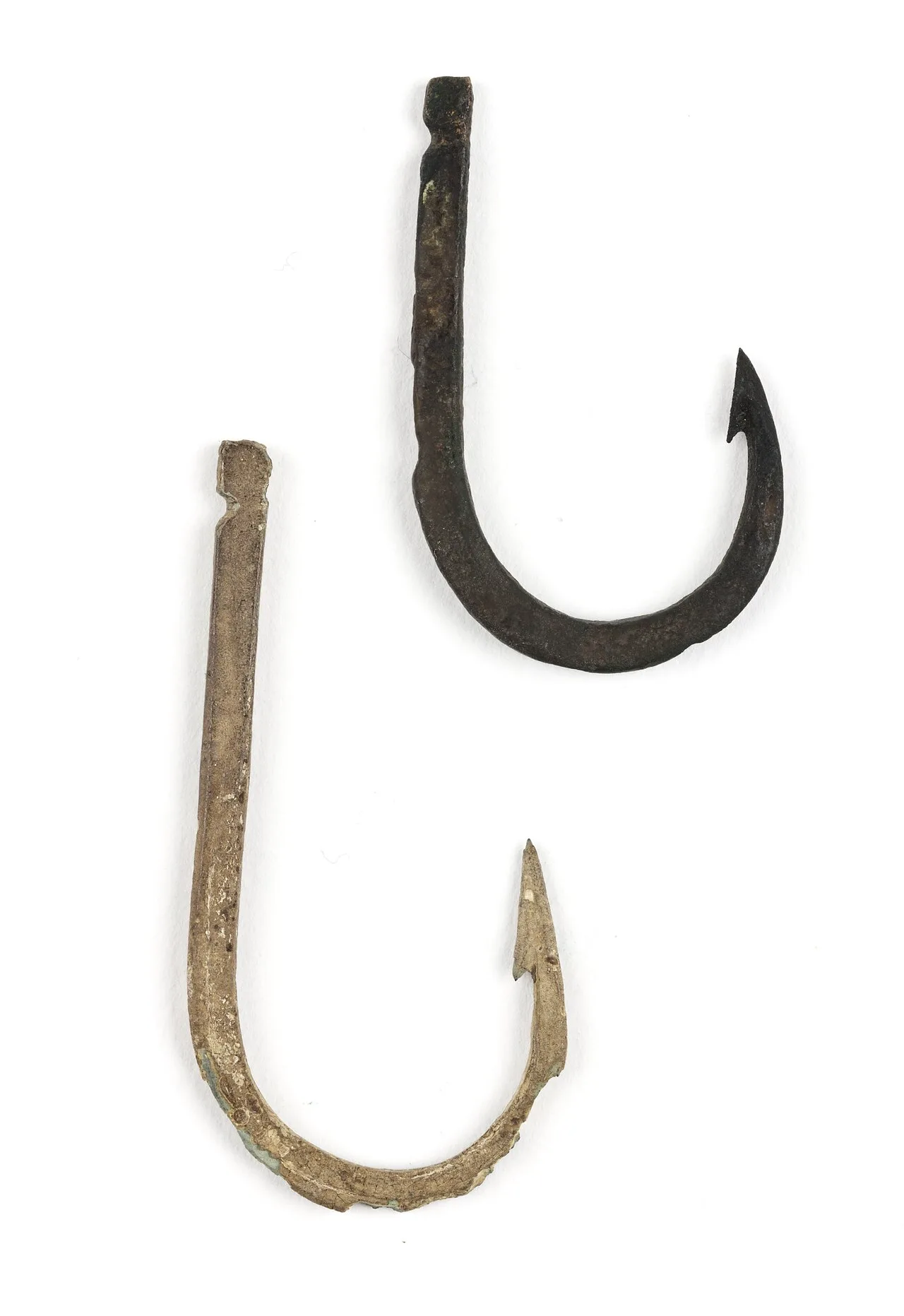
Tinning is a hot-dip or electroplated coating of tin, bright silver-white when new, dulling to a soft grey with age. It is the standard finish for hooks that will meet salt water: cod and haddock hooks, long-line hooks, mackerel feathers, sea-angling bait hooks. Mustad’s enormous commercial-fishing range is very largely tinned, and a tinned finish on a hook of otherwise unknown origin is a strong hint toward Norway or one of the American sea-hook makers. Tin does not stop corrosion so much as slow it; an old tinned hook shows a characteristic white bloom before the rust comes through.
Nickelled and cadmium
Nickel plating gives a harder, brighter, slightly warmer silver than tin and wears better. It appears on better-quality sea and bait hooks from the late nineteenth century onward, and on some fly hooks where a bright hook was wanted under a sparse dressing. The Edgar Sealey S 4304 in the reference is a nickelled example. Cadmium plating, dull grey and very corrosion-resistant, came in for saltwater hooks in the mid-twentieth century and went out again when its toxicity became a concern; a dull, matt, slightly greasy-looking grey plate on a post-war sea hook is probably cadmium, and worth handling with washed hands.
Gold and coloured finishes
Gold-plated and gold-lacquered hooks were sold for particular fisheries, where a flash of gold under the bait or the fly was thought to help, and for display. They are common in the Continental European market and on some Japanese hooks, and they photograph beautifully, which is why they turn up on so many dealer cards. Coloured enamel hooks are older than you might expect: Francis Francis records Mr Court of Redditch inventing red, green, blue and yellow enamelled hooks that Allcock’s manufactured in the 1860s. Painted red hooks for salmon flies and lures have been around ever since.
Black nickel and the modern finishes
From the 1980s the finishes change character. Black nickel, a dark plated finish with a faint sheen, replaces japan on most fly hooks; Teflon-type and PTFE coatings appear on carp and sea hooks; “chemically sharpened” points come with their own coatings. These are good finishes, but they are not what a hook made before about 1975 will carry, and a black-nickel hook in a packet printed in the 1950s has been repacked.
Reading a finish on the bench
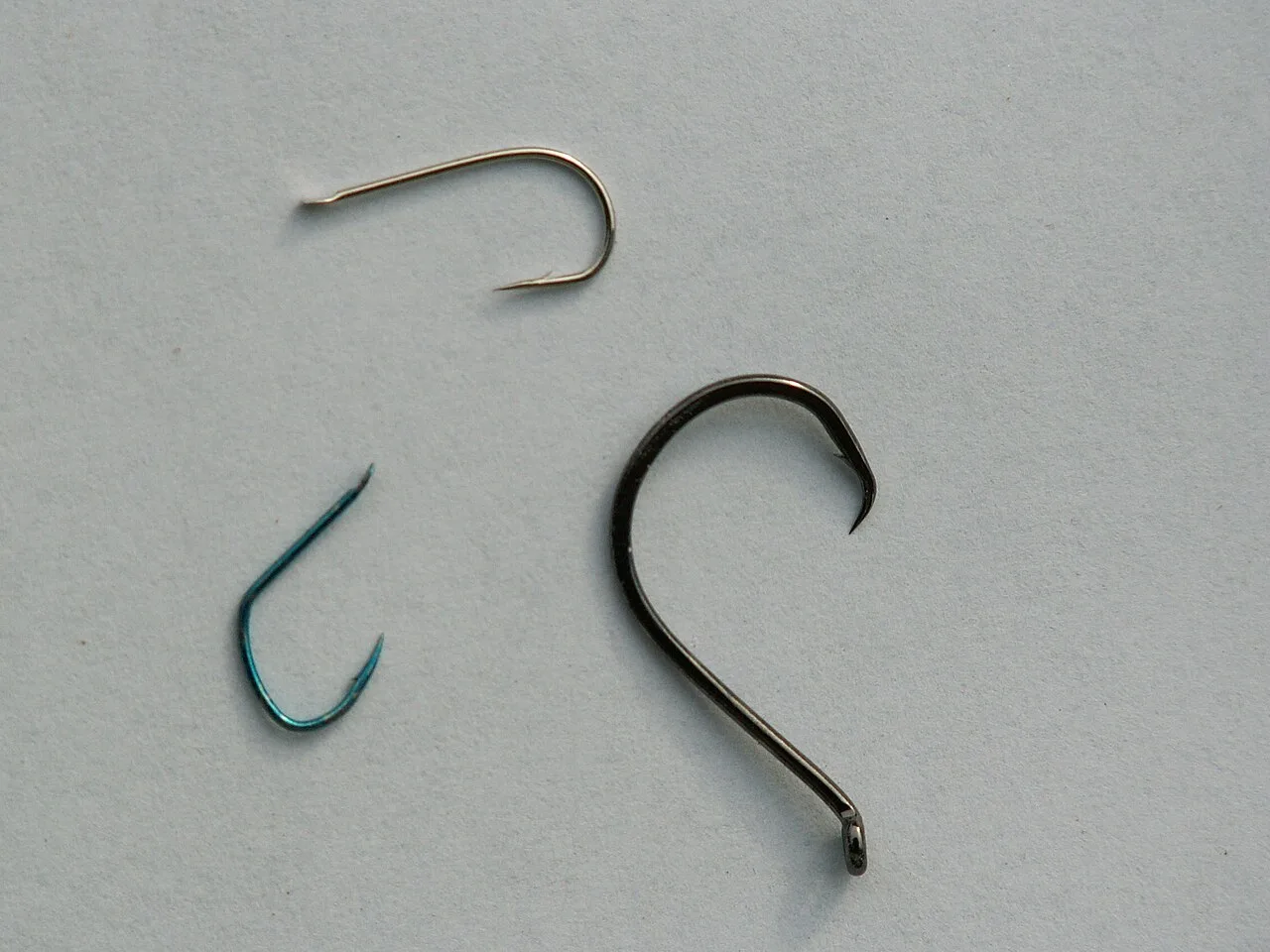
Under a loupe, the finishes separate quickly. Japan shows as a smooth film with a rounded edge where it meets the point, which was usually left bare or wiped. Bronze japan is thinner and often shows the grinding marks of the point through it. Tin has a slightly crystalline surface and a soft grey bloom when old. Nickel is smooth, hard and bright, and chips rather than wears. Blueing has no film at all; it is the steel itself. Gold lacquer is soft and scratches with a fingernail; gold plate does not.
Rust is not the enemy of identification that it seems. A hook rusts from the bare point back, and from the eye where the wire was cut, and an evenly rusted hook was usually stored loose. Uneven rust, worst on one side, means the packet got wet. Neither affects the bend, the eye form, or the wire diameter, which are what the compare tool works from, so a rusty hook can still be identified. Just do not try to clean it back to bright: you will take the finish, and the evidence, with the rust.
Source and further reading
Ron Reinhold, “Facts and Folklore About Hooks”, on the restored Ronn Lucas Sr. site, for the japan, bronze and blueing notes and the acetone test. Francis Francis, A Book on Angling (1867), for Court’s enamelled hooks.
Image note: The photographs are public domain or CC0 reproductions from Wikimedia Commons and are credited in their captions.