Mustad 7834 Hook, Size 4/0 — O’Shaughnessy Long Shank. A classic saltwater fly-fishing hook manufactured by O. Mustad & Søn, Norway, featuring the famous O’Shaughnessy bend — a forged, extra-heavy-wire design renowned for its strength and nearly unbreakable geometry. The 4XL shank and straight ring eye make this hook ideal for large saltwater streamers, pike flies, and baitfish imitations.
This specimen is finished in black japanned steel, a coal-tar lacquer coating that was Mustad’s standard for saltwater hooks from the 1960s through the 1980s. The hollow point (concave inner face) provides excellent penetration in bony or tough-mouthed gamefish. The straight ring eye accommodates large-diameter knots and eliminates stress concentration, critical for heavy-duty saltwater applications.
Era: c. 1970s-1980s. The model code 7834, ring-eye construction, and black japanned finish are hallmarks of Mustad’s mature industrial saltwater production. No barcode is visible, confirming pre-1974 minimum age; the clean printed packaging and consistent specifications suggest 1970s-1980s origin.
Collecting Significance: Rated 4.5/10 collectability. The O’Shaughnessy bend commands moderate interest among saltwater and streamer specialists. However, Mustad’s industrial production volumes limit true scarcity. The black japanned finish is increasingly rare as modern stainless-steel versions dominate, making original japanned cards more collectible. Size 4/0 in sealed original packaging can command $25-30; opened cards with complete hook count typically sell for $12-18.
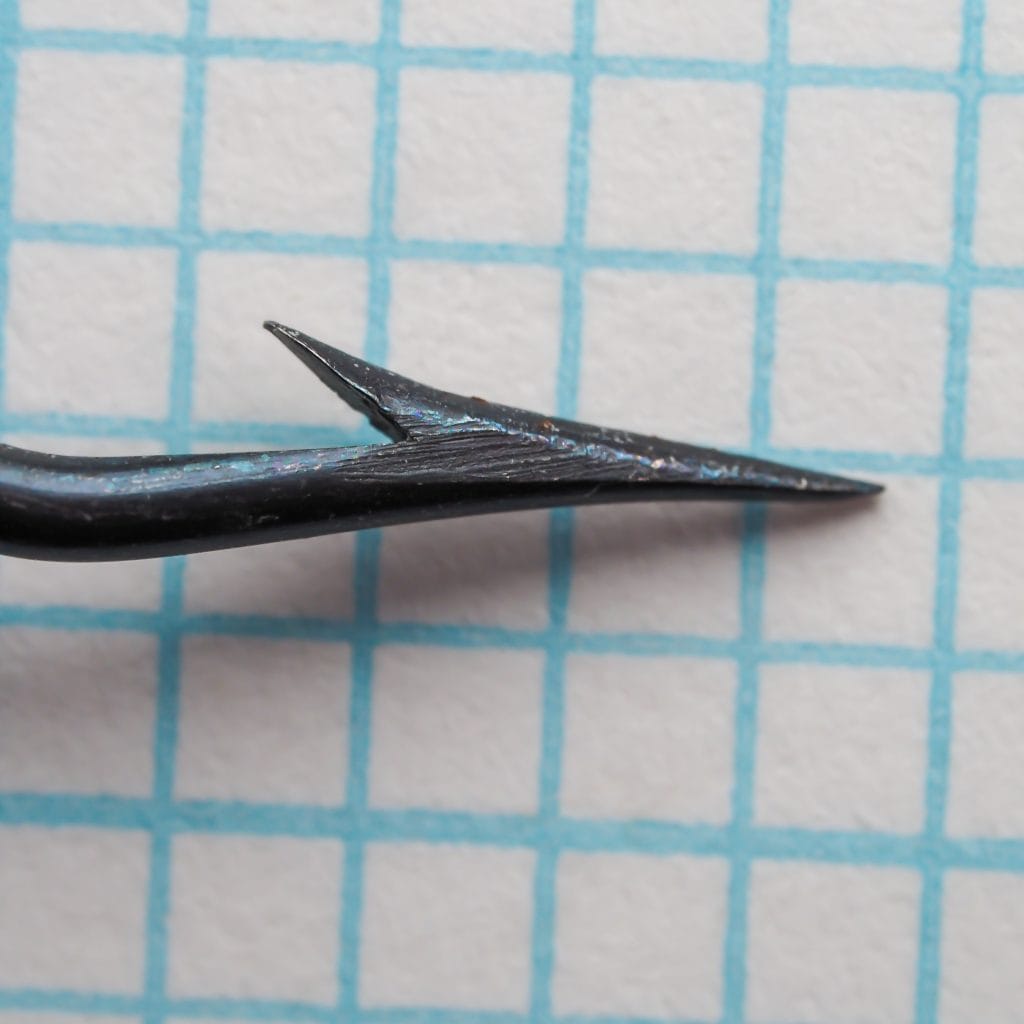
Magnified view of the Mustad 7834 point showing the characteristic hollow-point (concave inner face) geometry that provides excellent penetration in tough-mouthed saltwater gamefish.
Photographic record
3 cataloged imagesSelect any record to load it above.
3 images shown
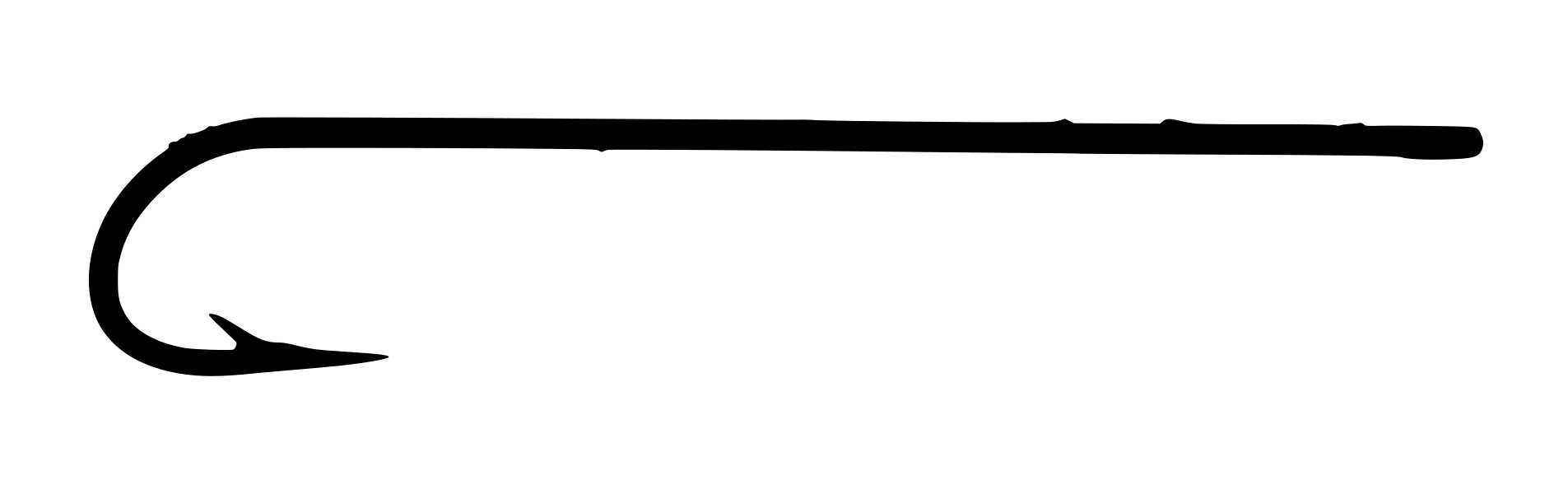
Mustad 7834 Size 4/0 Hook Point DetailMagnified view of the Mustad 7834 point showing the characteristic hollow-point (concave inner face) geometry that provides excellent penetration in tough-mouthed saltwater gamefish.Open originalMustad 7834 Size 4/0 Profile ViewSide profile of the Mustad 7834 showing the characteristic O'Shaughnessy bend with its deep, forged curve, the 4XL (extra-long) shank, and the straight ring eye at the head.Open originalMustad 7834 Original Sales Card PackagingOriginal Mustad sales card with two Mustad 7834 hooks secured to white card stock, labeled in blue handwriting with model number and size. Demonstrates authentic original packaging and condition of the specimen.Open original
Technical profile
Straight Ring Eye | Sneck Bend | Long Shank (4XL) | Extra-Heavy Wire | Hollow Point | Japanned Finish
Eye
Cross Eye, Straight / Inline
Wire
Standard, Round
Shank
Extra-Extra Long (XXL) — Plain
Bend
Sneck, Narrow gap, Offset / kirbed
Point
Superior (near-straight inner taper)
Finish
Black Japanned — Inferred (photographically likely)Specimen hooks are bright with no significant corrosion or rust. The japanned finish shows minimal wear and retains its characteristic matte black appearance. No visible scale damage, pitting, or cracks in the japanned coating. Eye rings are secure and properly formed. Barbs are sharp and unbroken. Card packaging shows light creasing and minor edge wear consistent with age and storage but no major damage. Handwritten label is legible. All expected hooks present on card. Overall condition is very good.
The Sneck bend is a forged design characterized by a slightly flattened and reinforced wire cross-section that distributes stress evenly across the bend, making it one of the strongest hook bends in the industry. The near-90-degree angle from shank to hook point provides excellent hook sets in bony or tough-mouthed fish. The hollow point (concave inner face) creates a knife-edge cutting geometry that aids penetration in tough situations. The straight ring eye allows for large-diameter knots and offers a secure connection that does not concentrate stress at a single eye attachment point — ideal for heavy-duty saltwater work. The 4XL shank provides adequate real estate for tying profiles without crowding the gap, critical for large baitfish imitations.
The black japanned finish (coal tar lacquer or similar) provides moderate corrosion resistance suitable for freshwater and light saltwater use, though it does not offer the long-term durability of modern stainless or hot-tinned finishes. Over time, the japanned surface can develop a patina or flake in aggressive saltwater exposure.
The Sneck bend family represents one of Mustad’s most enduring and successful designs. The series includes multiple shank lengths — the standard 7833 (2XL), the long-shank 7834 (4XL documented here), and various specialty configurations. The 7834 was introduced to serve the growing market for large saltwater flies and pike/muskie patterns in the 1960s-1970s. The black japanned finish was standard for Mustad saltwater hooks during this era, providing a classic appearance and adequate corrosion resistance for most freshwater and light saltwater work. As stainless steel became more affordable and reliable in the 1990s, Mustad introduced stainless versions (such as the 34011), and the japanned 7834 gradually phased out of production. Today, surviving original japanned 7834 cards are increasingly sought by collectors of classic saltwater tackle and by traditionalist fly tyers who value the aesthetics and proven history of the design.
Era and Packaging Dating
Model code 7834 designation and black japanned finish are consistent with Mustad's late 20th century production. The straight-ring eye construction and packaging style suggest 1970s-1980s manufacture. No barcode visible, supporting pre-1974 minimum age, but the clean printed labeling and ring-eye specification indicate later 1970s-1980s origin rather than 1950s-1960s.
The Saltwater Standard
The Mustad 7834's distinctive long shank design became legendary in the 1980s saltwater fly-fishing community for tying Lefty Kreh's famous Deceiver pattern. Lefty, one of fly fishing's greatest innovators, championed the 7834 for its perfect balance of strength, profile length, and ring-eye reliability. The hook became so associated with Lefty's work that many regional fly shops labeled 7834 cards with Lefty's Deceiver pattern as a suggested tying. The long shank also solved a practical problem for charter-boat captains who guided saltwater anglers — it acted as a bite guard, protecting the tying thread from sharp teeth of striped bass, bluefish, and tarpon. In the pre-stainless era, many anglers carried several cards of 7834s as backup in case a storm corroded a partially-fished card.
Design lineage and influence
The sneck bend traces its ancestry to 19th-century English saltwater designs, particularly the hooks used for sea trout and salmon in Irish and British coastal fishing. Mustad acquired the design rights or adapted the pattern as it industrialized European hook manufacturing under its own brand. The 7834 designation appears in Mustad’s catalog from the 1970s onward as a long-shank variant of the standard sneck (the non-XL version being the 33903 or similar base-code models). The design philosophy — strength, forged construction, and a straight ring eye — remained consistent across decades, making the 7834 a stable product line until Mustad transitioned to stainless steel and modern point geometries in the 1990s-2000s.
Best matchRelated by Attribute
Computed automatically from catalog data — updated as new hooks are added.
Matches: Bend, Eye, Eye Orient., Forging, Application +1 moreDiffers: Shank: Extra-Extra Long vs Special Long; Wire: Standard vs Heavy (1X Heavy); Gap: Narrow vs Standard +4 more
Matches: Shank, Gap, Eye Orient., Forging, Offset +2 moreDiffers: Bend: Sneck vs Carlisle; Wire: Standard vs Heavy (1X Heavy); Eye: Cross Eye vs Ball Eye +6 more
Matches: Bend, Wire, Eye Orient., Forging, BarbDiffers: Shank: Extra-Extra Long vs 4X Long; Gap: Narrow vs Standard; Eye: Cross Eye vs Ball Eye +5 more
The Mustad 7834 was designed for large saltwater streamers, pike/muskie flies, and trolling lures. In size 4/0, it is ideal for baitfish imitations intended for striped bass, tarpon, large peacock bass, and other gamefish requiring a long shank for profile and a wire gauge strong enough to withstand aggressive take-and-shake strikes. The long shank acts as a bite guard when lashed with foam, deer hair, or synthetic materials. The O’Shaughnessy bend’s forged strength makes it nearly impossible for a fish to straighten during the fight.
Secondary Applications
Large baitfish patterns for pike and muskie, saltwater crease flies, foam-bodied poppers, hair-wing streamers
Classic Fly Patterns
Lefty's Deceiver, Clouser Minnow, large saltwater bucktails, pike and muskie streamers, crease flies
Modern Equivalents
Hook
Match Quality
Notes
Mustad 34011
Excellent
Direct modern equivalent in stainless steel, same 4XL length and O'Shaughnessy geometry, maintains ring eye, superior corrosion resistance for saltwater
Partridge CS15
Very Good
British-made long-shank streamer hook, carbon steel, similar length and strength, lower production volume, higher cost
Ahrex SA270
Good
Modern carbon steel long-shank design, excellent hook geometry, not quite as thick as classic 7834 extra-heavy wire
Collector notes
Rated 4.5/10 — Sneck bends command moderate collector interest among saltwater and streamer specialists, but Mustad industrial production volumes limit scarcity. The 4/0 size in this finish is less common than mid-range sizes (2/0-3/0), pushing toward the higher end of uncommon.
Reference value
$12 – $28 USD estimate
Packaging condition
Very Good — light wear, fully legibleRecorded specimen
Packaging format
GW-M-02Catalog code
The Mustad 7834 occupies the middle range of collector appeal. Primary drivers of collectability are (1) the specialized sneck bend design with its strength and proven saltwater performance, and (2) the classic black japanned finish, which is increasingly rare as Mustad transitioned to stainless steel and modern protective coatings by the 1990s. The straight-ring eye is less sought-after than tapered or ball eyes among modern fly tyers, which limits demand from active tyers.
Limiting factors include: industrial production scale (Mustad manufactured hooks by the millions), common availability of later stainless 34011 equivalents, and the transition of modern saltwater fishing to larger hooks (5/0-8/0) in sizes where the 7834 is more plentiful. Size 4/0 in japanned finish is genuinely scarce; sizes 1/0-3/0 remain common. Complete original cards in sealed condition command a 50-75% premium over opened cards. Loose hooks sell at 25-35% of carded value.
Packaging
Sales card format. White card stock with black printed text. Header reads 'MUSTAD' with the distinctive oval Mustad logo. Model code '7834' and size '4/0' printed in bold. Two hooks secured to card via staples through the eye rings. No visible barcode. Black printing on white background suggests 1970s-1980s offset lithography. Card dimensions approximately 3.5" × 5.5". No visible price marking, size table, or detailed product information on front — typical of Mustad's minimalist 1970s-1980s packaging approach.
Market Value Notes
Low ($12): Good condition — opened card or envelope, all or most hooks present, minor wear on packaging
High ($28): Excellent condition — sealed or near-sealed card/envelope, complete hook count, minimal packaging defects
Premium factors: Sealed original packaging, complete card count, japanned finish (not stainless), size 4/0
Platforms: eBay (US and UK), vintage tackle dealers, specialized saltwater tackle auctions
Confidence: E estimated — based on typical vintage Mustad saltwater hook values; limited specific 7834 sold listings available
Where to Find
eBay (US and UK auctions), vintage saltwater tackle dealers specializing in classic Mustad production, UK tackle fairs, specialized fly-tying material vendors with heritage stock.
Collector's Identification Tips
Identify the Mustad 7834 by the following markers: (1) Model code ‘7834’ printed clearly on original packaging P; (2) Sneck bend with deep, forged curve and slightly flattened wire profile visible under magnification P; (3) Straight ring eye (not tapered or ball eye) — a simple circular loop formed from the wire P; (4) Black japanned finish with characteristic dull, coal-tar-lacquer appearance (may show patina or minor flaking on aged specimens) P; (5) Extra-heavy wire gauge, noticeably thicker than standard or heavy-gauge hooks E; (6) 4XL (extra-long) shank proportionally much longer than the gap width — roughly 5-6:1 ratio P; (7) Hollow point with concave inner face, creating a knife-edge cutting effect when viewed under magnification P. The combination of ring eye, Sneck bend, and long shank make the 7834 unmistakable compared to other Mustad saltwater designs.
Preservation
Storage and Preservation
The Mustad 7834’s black japanned finish requires careful storage to prevent corrosion and patina development. Store hooks in a cool, dry environment away from moisture. Maintain relative humidity below 50% to slow the natural oxidation of the japanned coating. Original packaging (card or envelope) should be retained — the paper provides a buffer against rapid moisture exchange and adds significant value to the specimen.
If the japanned finish shows light patina (dark brown or purple discoloration), this is normal aging and does not affect functionality; many collectors consider it desirable as evidence of age. However, active rust (orange, flaking coating) indicates improper storage. If rust appears, inspect the hook immediately for pitting and consider isolation from other hooks to prevent galvanic corrosion.
Store the original card flat in a stable environment. Avoid contact with other metals (copper, brass, steel) that could create galvanic corrosion cells. Do not store in sealed plastic bags or boxes without ventilation — trapped moisture accelerates rust. Acid-free tissue or archival paper separators are recommended if storing multiple cards together. Inspect periodically (annually) for rust development. Original sealed or near-sealed packaging in excellent condition can be worth 50-75% more than opened cards — preserve it as-is rather than opening to inspect hooks.
Marking Analysis
Handwritten Labeling
The specimen card features blue handwritten text identifying the model as ‘7834’ and the size as ‘4/0’. The handwriting style suggests a contemporary hand-label applied during original packaging or shortly after manufacture, likely by a fly shop, tackle distributor, or warehouse staff. The consistent pen pressure and letter formation indicate a single author. This type of hand-labeling was common on Mustad sales cards from the 1970s-1980s, particularly for inventory management or shop restocking. The label does not appear to be later annotation — the ink tone and paper integration suggest it was applied when the card was new or relatively fresh.
The presence of handwritten labeling on vintage Mustad cards is typical of the era and does not diminish collectibility; in fact, original hand-labels are often regarded as authentic markers of use and age. The handwriting provides evidence of the card’s history within the tackle industry rather than being stored unused since manufacture.
Primary Source
Packaging Text and Mustad Branding
Source: Original sales card packaging, handwritten label, Mustad oval logo
The packaging displays the characteristic oval Mustad logo in black on white card stock, a design element consistent with Mustad’s corporate branding from the 1960s-1980s. The model code ‘7834’ is printed without parenthetical explanation or additional designation — Mustad’s convention was to assume that experienced saltwater anglers and professional fly tyers would recognize ‘7834’ as the Sneck long-shank variant. The absence of detailed product description (common on many Mustad cards of this era) suggests confident brand recognition and minimal need for explanatory text.
The lack of barcode is significant. Barcodes were not widely implemented in the US sporting goods industry until 1974-1975. The complete absence of barcode on this card, combined with the offset-printed text quality and minimal descriptive language, strongly supports a 1970s-early 1980s manufacture date. By the mid-1980s, Mustad was transitioning to bar-coded packaging for inventory control. The handwritten label may represent a transitional period when cards were still being hand-labeled for distribution but barcodes had not yet been standardized across all Mustad product lines.
Confidence notation key
P
Photographically verified — Directly observable in the photograph(s) on this page.
V
Verified by documentation — Confirmed by manufacturer catalog, spec sheet, or published reference.
I
Inferred — A logical deduction from observable or documented evidence, not directly stated.
E
Estimated — An approximation based on visual comparison, proportional analysis, or limited data.
S
Speculative — A reasoned hypothesis that cannot be confirmed from available evidence.
Unnotated claims are the compiler’s synthesis; see Sources. All photographs on garrenwood.com are taken on a measurement grid where each square equals 1/10 inch (0.1″ / 2.54 mm).