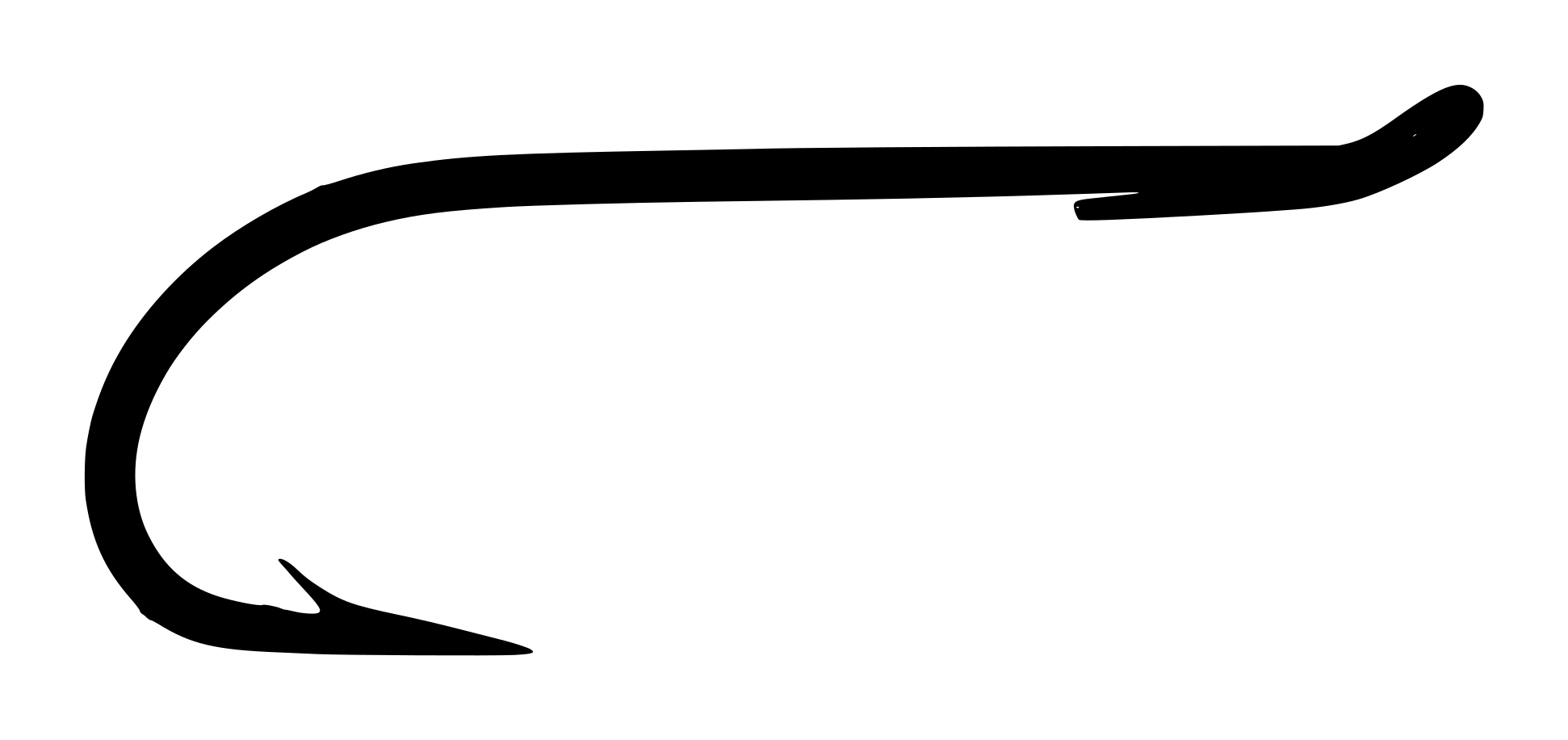
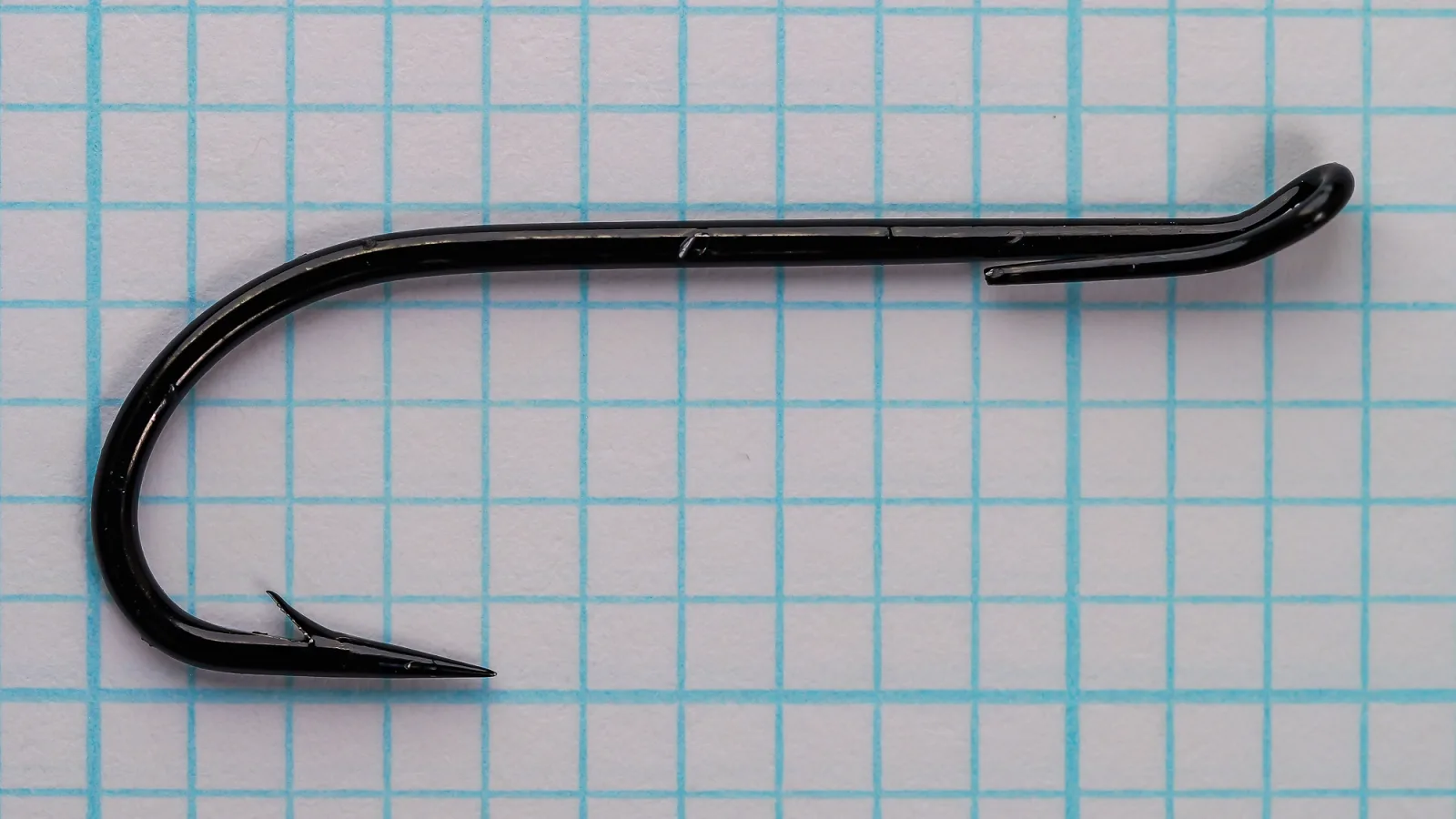
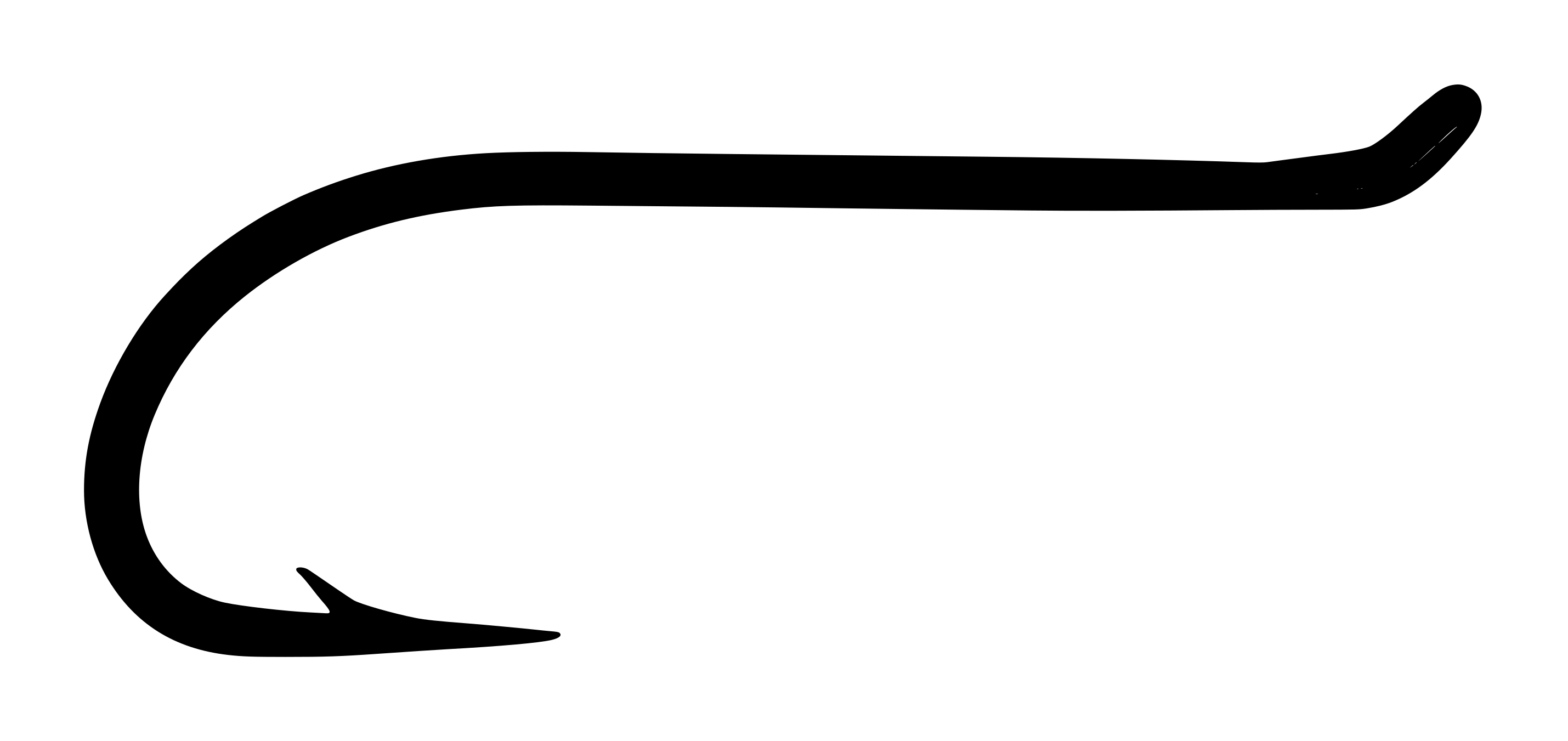
Edgar Sealey model 1736.J, size 2: a turned-up looped-eye salmon hook sold under Sealey’s “Octopus” brand. Limerick bend, long spear point with a prominent barb, glossy black japanned finish. Wire gauge not yet confirmed by caliper.
Likely produced after Sealey’s 1960 takeover by Dunlop Sports; the label livery differs from the company’s classic octopus-and-shield packaging S. Packed 100 to a box; the packaging on record is a photocopy of the original box label.
Collectability is modest. Sealey trade boxes of 100 appear regularly on the vintage market, and demand comes mainly from tyers of classic salmon flies and collectors documenting Redditch makers.
Round Kendal bend octopus hook with japanned finish. Straight eye, barbed point, moderate wire gauge.
Photographic record
2 cataloged imagesSelect any record to load it above.
2 images shown
Edgar Sealey 1736.J Octopus Hook Size 2Round Kendal bend octopus hook with japanned finish. Straight eye, barbed point, moderate wire gauge.Open originalEdgar Sealey 1736.J Package LabelOriginal Edgar Sealey package label marking Model 1736.J, Size 2, quantity 100. Octopus motif visible on envelope.Open original
Technical profile
Turned Up Looped Eye | Limerick | Standard | Wire Gauge Unconfirmed | Standard / Spear Point | Black Japanned
Eye
Looped Eye, Turned UpFormed loop, turned up roughly 30 degrees from the shank line E. The returned wire runs about 0.37" back along the underside of the shank before ending E. Whether the loop is brazed cannot be determined from the photograph.
Wire
Forged
Shank
Standard — Plain
Bend
Limerick, Standard gapLimerick profile: the wire leaves the shank in a long, gradual shoulder, runs nearly vertical down the back of the bend, makes its tightest turn at the lower rear, then runs into a straight point section rising slightly toward the tip P. Not a constant-radius curve, so not round/Kendal. Compare against Sealey S 1937 (limerick) for confirmation.
Point
Standard / SpearLong, prominent barb, sharply raked and standing well clear of the wire P. Barb root roughly 0.18"-0.20" behind the point tip E. Point is a long, straight-sided spear taper P.
Finish
Black Japanned — Inferred (photographically likely)Glossy black, opaque finish with no metallic sheen, consistent with japanning P. A few small specks on the shank and point section; dust versus coating loss is not determinable at this resolution. Japanned attribution also supported by the.J suffix I.
Specimen hook shows no visible rust; finish largely intact apart from a few small specks P. Box condition and hook count cannot be assessed: the packaging on record is a photocopy of the box label. QTY. 100 is the labelled quantity, not a verified count.
The bend is a limerick: the wire leaves the shank in a long, gradual shoulder, runs nearly vertical down the back of the bend, and makes its tightest turn at the lower rear before running into a straight, slightly upswept point section P. The point is a long, straight-sided spear taper with a prominent, sharply raked barb set roughly 0.2″ back from the tip E. Wire diameter estimated from the photograph is about 0.03″ (~0.8 mm) E, which does not support a heavy-wire classification; a caliper reading is needed.
Forging, the flattening of the sides of the bend after forming to stiffen it, cannot be confirmed or ruled out from a side-profile photograph; a top view is required. The turned-up looped eye is the traditional British salmon-hook eye, giving a smooth doubled eye for the leader and a firm base for the head of the fly. On this specimen the returned wire runs about 0.37″ back along the underside of the shank E.
Size & scale lab
Known manufactured size range:
Size 2 documented; full range unknown S
This pattern was made in sizes Size 2 documented; full range unknown (S). We have measurement for size 2. Know the others? Submit calipered measurements and we'll review and add them. Thank you!
The label identifies this box only as model 1736.J under the Octopus brand; no pattern name appears P. “Octopus” was Sealey’s house trademark, used across hooks and rods, not a hook pattern, and this hook is unrelated to the modern short-shank octopus bait hook. The specimen is a turned-up looped-eye salmon hook with a limerick bend P. No catalog documentation for the 1736 number has been located, so the sizes, wire options and finishes offered are unknown.
The unprefixed four-digit number with a letter suffix differs from the S-prefixed pattern numbers (S 1034, S 3008, S 4324) seen on many Sealey boxes, and matches other unprefixed Sealey numbers such as 1762B. This may indicate a different numbering period or product line S. The “.J” suffix most plausibly denotes a japanned finish, consistent with the specimen I.
Era and Packaging Dating
The label (recorded from a photocopy) shows no barcode, but this is weak evidence: EAN barcodes were introduced in Britain from 1977 and were rarely applied to 100-count trade boxes even later. Printing method and box colours cannot be judged from a photocopy. The livery (a two-fish 'S' roundel, 'Edgar Sealey' in bold sans-serif, 'OCTOPUS' reversed out in light geometric capitals) differs from Sealey's classic octopus-and-shield packaging, suggesting production after the 1960 Dunlop Sports takeover S. Sealey hook manufacture at Redditch ended with the factory closure in 1981. Range c. 1960-1981 pending examination of the full box for Dunlop or Gladding imprints.
Octopus Was the Brand
Despite the word on the box, this is not an octopus hook. Octopus was Edgar Sealey's house trademark, and a 1959 advert told anglers to 'Say Octopus for hooks and Rods', covering everything from salmon hooks to the Octofloat split-cane float rod. The hook inside is a traditional looped-eye salmon limerick. When Sealey's Redditch factory closed in 1981, some of its hook machinery was reportedly bought by Vince Green and put to work making Sprite hooks.
Design lineage and influence
The limerick is one of the oldest British bend forms and became the standard profile for classic British salmon fly hooks, typically paired, as here, with a japanned finish and a turned-up looped eye. The 1736.J belongs to that salmon-hook tradition rather than to any bait-hook lineage. Sealey’s c. 1950 “Octopus Brand” sample cards include Pennell’s Limerick patterns alongside Sproat and Sneck forms V.
The “Octopus” name on the box is Sealey’s brand, not a pattern name, and has no connection to the later octopus bait-hook style. The 1736.J designation is Sealey’s model number; the “.J” suffix most likely denotes the japanned finish variant I.
Best matchRelated by Attribute
Computed automatically from catalog data — updated as new hooks are added.
Matches: Bend, Shank, Gap, Eye, Eye Orient. +5 moreDiffers: Point: Standard / Spear vs Hollow Point; Forging: Forged vs Round; Gap ratio: 32.0% vs 26.8%
Matches: Bend, Shank, Gap, Eye, Eye Orient. +4 moreDiffers: Point: Standard / Spear vs Hollow Point; Finish: Black Japanned vs Other; Shank ratio: 73.4% vs 72.6% +2 more
Salmon and sea trout fly hook for traditional wet salmon patterns. The turned-up looped eye and limerick bend are the classic British salmon-hook combination P; the intended use is inferred from that configuration, as the label states no application I.
Collector notes
Rated 4.0/10 — uncommon but not rare. Sealey trade boxes of 100 appear regularly on the vintage market; demand is moderate and centred on classic salmon fly tyers and collectors of Redditch makers. Value is driven by original packaging, count and condition E.
Reference value
$8 – $18 USD estimate
Packaging condition
Good — moderate wear, legibleRecorded specimen
Packaging format
GW-ES-01Catalog code
Positive factors: A documented Sealey model number with its label (recorded here from a photocopy). Looped-eye japanned salmon hooks in size 2 are useful to tyers of classic salmon flies, and Sealey is one of the better-documented mid-century Redditch makers.
Limiting factors: Sealey trade boxes of 100 turn up regularly on the vintage market, so boxed stock is not scarce. Sealey is less widely collected than Allcock or Partridge. The 1736 number has not been found in a catalog, so its size range and production period remain uncertain.
Size and condition premium: Value depends on the original box and label, the hook count, and freedom from rust. Price multiples for boxed versus loose examples have not been established from comparable sales E.
Packaging
Recorded from a photocopy of the box label; original colours, board and printing method cannot be determined. An upper white panel carries the variable data '1736.J', 'SIZE 2' and 'QTY. 100' in a typeface distinct from the brand text P. Below it, at left, a roundel containing two stylised fish forming an 'S' on a diamond P. 'Edgar Sealey' in bold black sans-serif and 'OCTOPUS' reversed out in light geometric capitals P. No barcode or price visible within the photocopied area P.
Market Value Notes
Low ($8): Good condition — box present but worn, near-complete count
High ($18): Excellent condition — box intact with crisp label, all 100 hooks present, no rust
Premium factors: Original box with label, complete count, sound japanned finish
Platforms: eBay UK, specialist vintage tackle dealers, UK tackle fairs and auctions
Confidence: E estimated — limited comparable sales data; recheck against sold listings for boxed Sealey hooks
Where to Find
Edgar Sealey hooks appear regularly on eBay UK and with specialist vintage tackle dealers, both loose and in original boxes of 50 or 100. UK tackle fairs and auctions are another source.
Collector's Identification Tips
On Sealey packaging, “Octopus” is the brand, not a hook pattern, so identify the hook by its number and shape. Sealey’s classic packaging carried an octopus-and-shield trademark; later boxes include blue-and-white stock marked for the Dunlop Sports Group, and 1970s goods may carry “Gladding Sealey” I. This label’s two-fish roundel is probably a post-1960 livery S. Check box ends and bases for Dunlop or Gladding imprints, which narrow the date.
Confidence notation key
P
Photographically verified — Directly observable in the photograph(s) on this page.
V
Verified by documentation — Confirmed by manufacturer catalog, spec sheet, or published reference.
I
Inferred — A logical deduction from observable or documented evidence, not directly stated.
E
Estimated — An approximation based on visual comparison, proportional analysis, or limited data.
S
Speculative — A reasoned hypothesis that cannot be confirmed from available evidence.
Unnotated claims are the compiler’s synthesis; see Sources. All photographs on garrenwood.com are taken on a measurement grid where each square equals 1/10 inch (0.1″ / 2.54 mm).