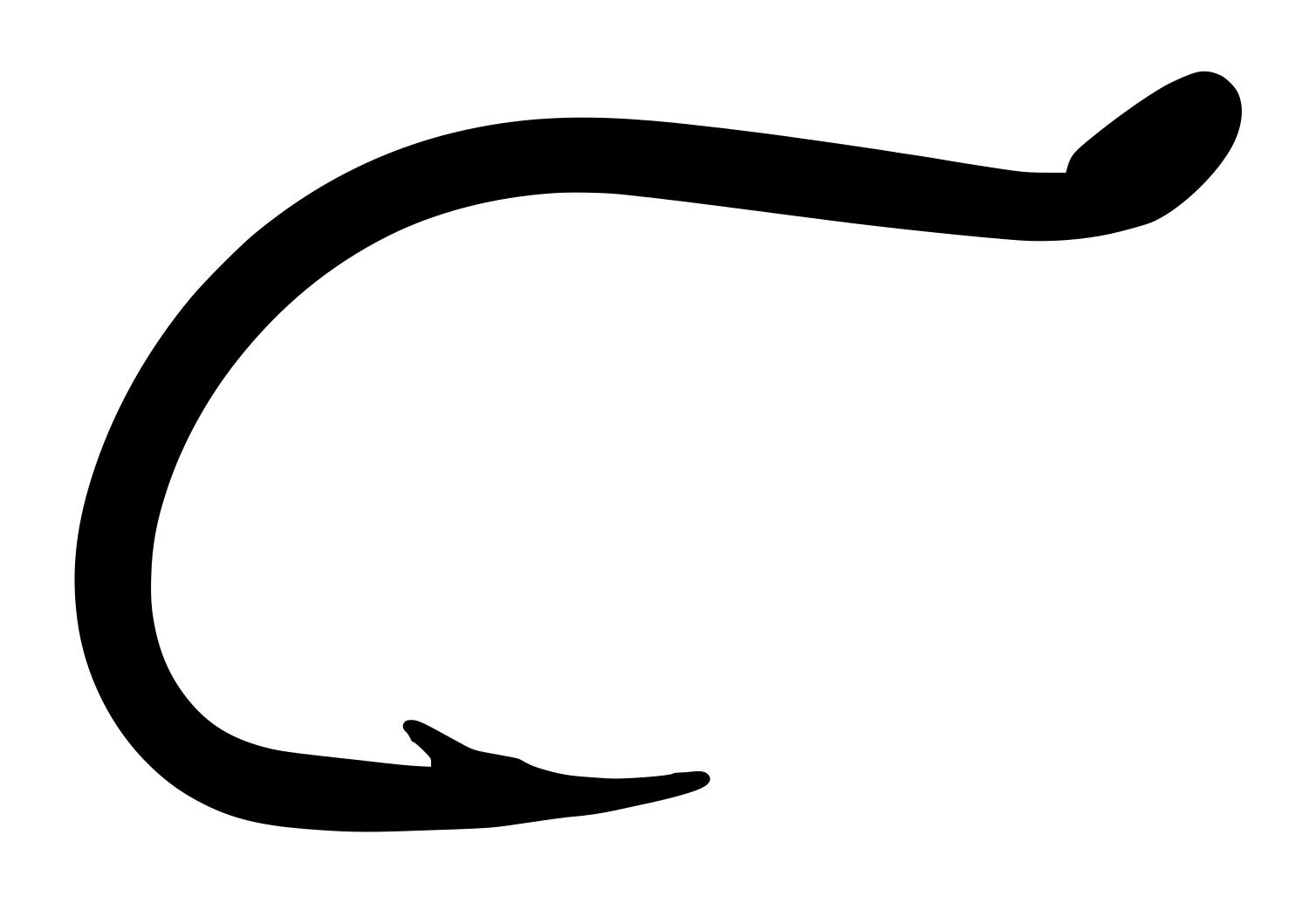
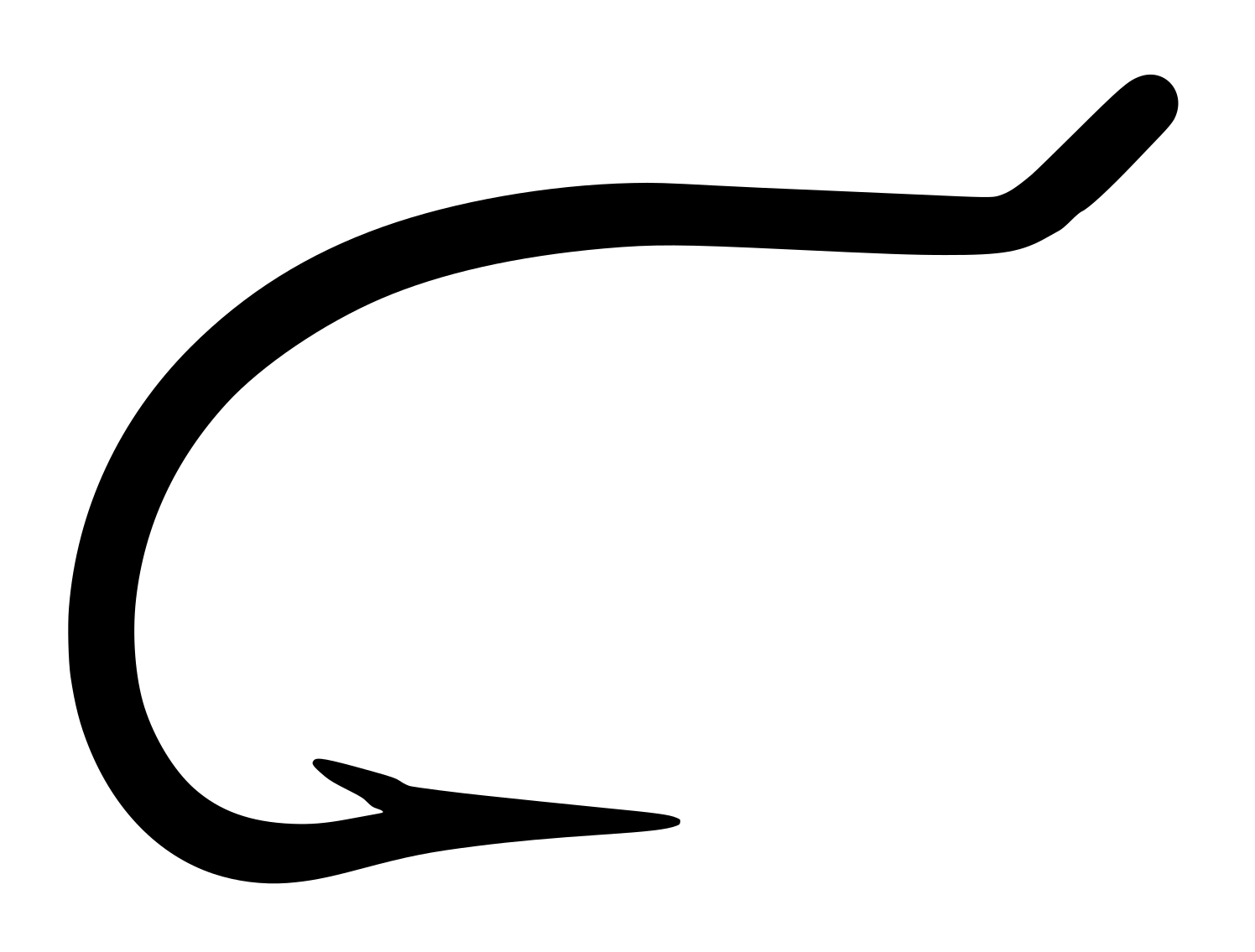
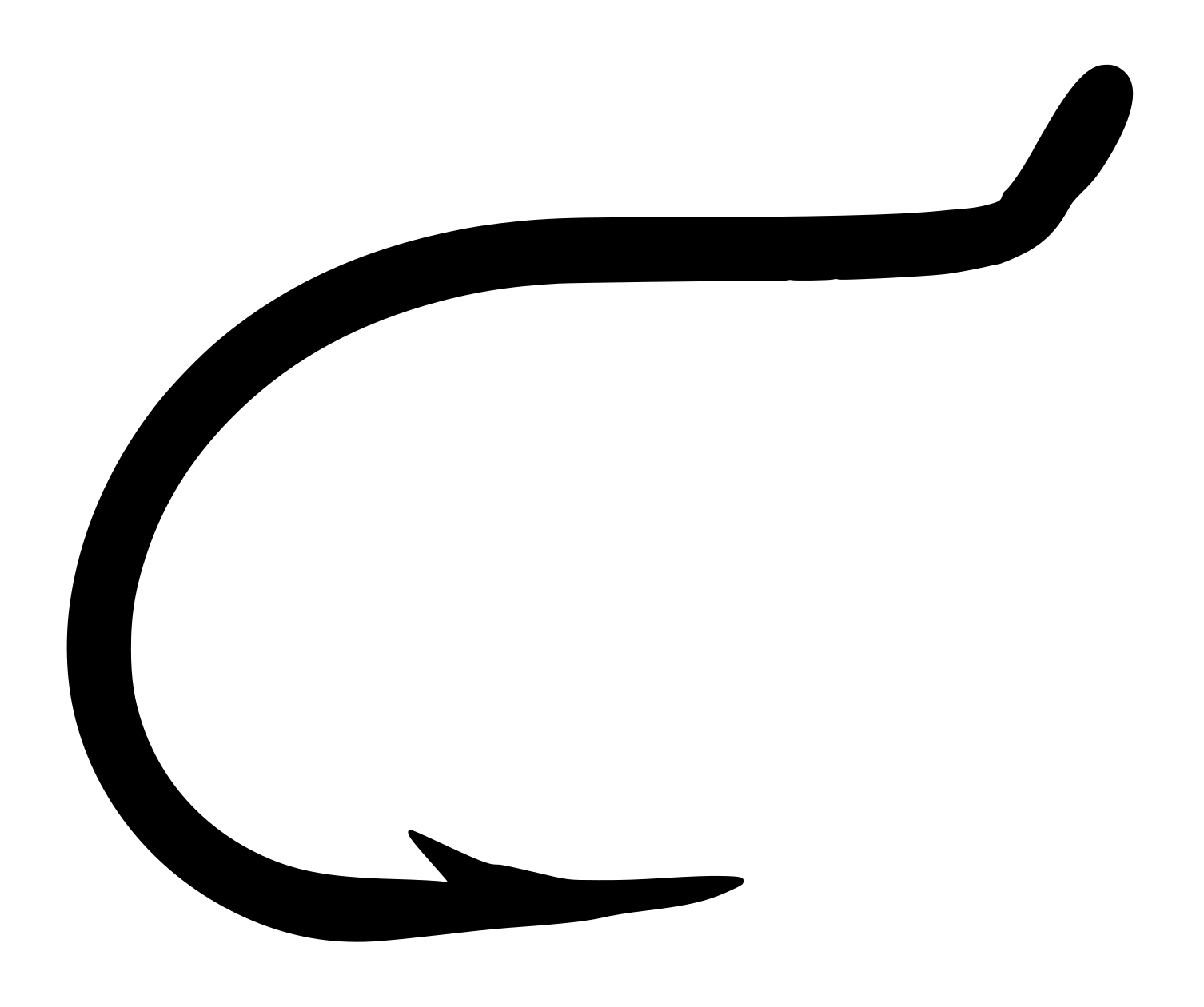
Edgar Sealey & Sons S 4304 — a forged, offset-point (“Forgé Renversé”) hook with a turned-up ball eye, documented here in size 6 from a labelled Octopus-brand box of 100. The bend is wide and rounded, with a short shank relative to the gap, a long straight point and a pronounced barb P. The offset point, forged bend and robust barb point to bait use rather than fly tying I. The finish appears nickel-plated E, with scattered rust spots on the specimen hook P. Dated c. 1950–1970 E.
“Forgé Renversé” was one of Sealey’s own series names, listed in the firm’s 1950 sample book V. The label’s French descriptors — “Qualité Extra Supérieure” and “Forgé Renversé” — sit alongside English text (“Sole Makers,” “Up Eyed,” “No.”), so they may reflect trade nomenclature as much as export positioning S. Forged construction is stated on the box V and visible as the flattened, broadened bend in the profile photograph P.
The box has been opened and at least one hook removed for photography; the hook count has not been verified. The label is clear and legible, with a hand-applied size numeral, making the box a useful reference for Sealey S-series labelling. Whether the S 4304 survives in public or institutional catalog collections has not been established.
Front lid of the Edgar Sealey S 4304 box showing the distinctive bright grass-green letterpress label with Octopus maker logo, French-language quality descriptor 'Qualité Extra Supérieure,' and specifications.
Photographic record
2 cataloged imagesSelect any record to load it above.
2 images shown
Edgar Sealey S 4304 Box Lid LabelFront lid of the Edgar Sealey S 4304 box showing the distinctive bright grass-green letterpress label with Octopus maker logo, French-language quality descriptor 'Qualité Extra Supérieure,' and specifications.Open originalEdgar Sealey S 4304 Size 6 Hook ProfileProfile view of a single Edgar Sealey S 4304 hook, size 6, nickelled finish, photographed on 1/10-inch measurement grid. Shows the forged Round Kendal bend, heavy wire gauge, turned-up ball eye, short shank, and kirbed point offset to the left of center.Open original
Technical profile
Turned Up Ball Eye | Round / Kendal | Short (1X–2X Short) | Heavy (1X Heavy) Wire | Standard / Spear Point | Nickelled / Nickel-plated
Eye
Ball Eye, Turned UpBall eye, turned up, with regular round formation P; orientation confirmed by the label's 'Up Eyed' V. Eye opening appears proportionate for a size 6 E.
Wire
Heavy (1X Heavy), Forged
Shank
Short (1X–2X Short) — Plain
Bend
Round / Kendal, Wide gap, Offset / kirbedWide, rounded bend with a short shank relative to the gap P. The curve is not constant-radius: the shank sweeps gradually into a nearly straight back, and curvature tightens in the lower quarter toward the point P. The point runs roughly parallel to the shank P. The bend is broadened and flat-faced in profile, showing the forging P. Round/Kendal is the closest classification E, pending comparison with the Forgé Renversé card in Sealey's 1950 sample book. A point offset is documented by 'Renversé' on the label V; its direction and degree are not visible in the side-profile photograph and require an edge-on view.
Point
Standard / SpearBarb is pronounced and fairly long, set well back from the tip (roughly 0.15" behind it) on a long, straight point P. Barb angle roughly 40–45 degrees E.
Finish
Nickelled / Nickel-Plated — Inferred (photographically likely)Finish reads as a cool-to-neutral silver-grey plating consistent with nickel E; tinning cannot be fully excluded from a single photograph. Polishing and forging striations are visible through the plating on the flat face of the bend P. Scattered reddish-brown rust spots are visible on the shank behind the eye, inside the eye, at the top of the bend and near the base of the point P.
Box shows moderate toning, corner wear, a damaged corner flap at one end, and a torn puncture at one corner that breaks the edge of the label P. Label print is clear and legible with color well preserved P. The box has been opened and at least one hook removed for photography; hook count not verified. The specimen hook shows scattered rust spots on the shank, inside the eye and around the bend P.
The forged bend is the defining construction feature. In hook-making, “forged” means the bend is pressed or hammered flat on its sides after the wire is bent, making it wider in the plane of the bend and narrower edge-on; this stiffens the bend against opening under load. The broadened, flat-faced bend is visible in the profile photograph P. The point is long and straight, running roughly parallel to the shank, with a pronounced barb set well back from the tip P. Measured from the photograph, gap (~0.27″) and shank (~0.28″) are nearly equal, a shank-to-gap ratio of roughly 1 : 1 E — short in the shank for the gap, consistent with the short-shank classification. The label’s “Renversé” establishes a point offset V; offset points are generally a bait-hook feature, since they tend to make a dressed fly track off-true I. The turned-up ball eye is confirmed by label and photograph (V, P). Shank wire appears roughly 0.018″–0.020″ (~0.45–0.5 mm) in the photograph E; the wider ~0.03″ figure is the forged face of the bend and should not be used to classify wire gauge. A caliper reading of the shank is needed to confirm the heavy-wire classification.
This pattern was made in sizes Not documented (S). We have measurement for size 6. Know the others? Submit calipered measurements and we'll review and add them. Thank you!
The label names this pattern “Forgé Renversé Up Eyed,” and “Forgé Renversé” was one of Edgar Sealey’s own series names: the firm’s 1950 sample book includes a sample card under that title, along with a “Forgé Renversé Sliced” variant V. “Forgé” means forged — in hook-making, the bend is flattened on its sides after bending so that it is wider in the plane of the bend, stiffening it against opening; the broadened, flat-faced bend is visible in the profile photograph P. “Renversé” (reversed) denotes a point offset out of the plane of the shank V. In English trade usage “reversed” and “kirbed” are both offsets but conventionally run in opposite directions; the direction on this specimen has not been photographed. “Up Eyed” confirms the turned-up ball eye (V, P). The same “Qualité Extra Supérieure” descriptor and “Renversé” modifier appear on the S 4320 (Italians Renversé Down Eyed), suggesting Sealey offered offset variants across more than one S 43-series pattern I. The bend is not named on the label; its classification here as round/Kendal rests on the photograph and should be checked against the Forgé Renversé card in the 1950 sample book E. The range of sizes made and the production span of the S 4304 are not documented S.
Era and Packaging Dating
Series documented: 'Forgé Renversé' appears as a sample-card title in Edgar Sealey's 1950 hook sample book V, so the series was in production by 1950. Company name printed without 'Ltd.' P; later Sealey rod labels read 'Edgar Sealey & Sons, Ltd.', so the date of incorporation, if established, may narrow the range S. No Dunlop or Gladding branding P; the manufacturer record dates the Dunlop acquisition to 1960 and the Gladding merger to the 1970s, so the absence of later group branding is consistent with, but does not prove, a pre-1970s date I. No barcode P, consistent with pre-1980s packaging but weak evidence alone I. Address given only as 'REDDITCH. Eng.', with no works name, street or postcode P; not diagnostic of date I. Label printing appears letterpress E; letterpress remained in use for small labels after 1960 and does not narrow the date I. A sibling Sealey label with the same 'Qualité Extra Supérieure' descriptor (S 4320) is dated c. 1930–1955 on this site, so an earlier start date cannot be excluded S.
The Octopus Mark
Edgar Sealey & Sons sold its hooks under the 'Octopus' trademark. On this label the mark shows an octopus above a shield carrying an 'OCTOPUS' banner and an interlaced monogram, set within a roundel. The brand was not limited to hooks: by the late 1950s Sealey was advertising Octopus hooks and rods together, and Octopus-branded rods such as the Octofloat and the 'Old Gold' fly rods still turn up at tackle auctions. Because the same mark was carried across Sealey's hook boxes and cards, it is a useful first check when attributing loose Sealey packaging.
Design lineage and influence
The Kendal bend takes its name from Kendal in Westmorland I, and garrenwood.com groups it with round bends under the round/Kendal classification. No cited source supports a specific origin story for the pattern. The S 4304 profile shows a wide, rounded bend whose curve tightens toward the point P; its exact family should be confirmed against Sealey’s 1950 sample book.
Offset (“reversed” or “kirbed”) points were a long-standing option among Redditch makers for bait patterns I. Within Sealey’s own range, the “Renversé” designation appears on at least two S-series hooks — this S 4304 and the S 4320 Italians Renversé Down Eyed — both carrying the “Qualité Extra Supérieure” descriptor P. The 1950 sample book also lists a “Forgé Renversé Sliced” variant, likely a sliced-shank bait version of the same series S.
The S 4304’s historical interest lies in documenting Sealey’s forged, offset series and its labelling conventions. Its later production history and any successor patterns are not documented.
Best matchRelated by Attribute
Computed automatically from catalog data — updated as new hooks are added.
Matches: Bend, Shank, Gap, Forging, Offset +3 moreDiffers: Wire: Heavy (1X Heavy) vs Standard; Eye: Ball Eye vs Tapered Eye; Eye Orient.: Turned Up vs Turned Down +2 more
Matches: Bend, Shank, Gap, Eye, Eye Orient. +5 moreDiffers: Wire: Heavy (1X Heavy) vs Fine (1X Fine); Point: Standard / Spear vs Superior; Application: Bait vs Bait, Sea Trout
Matches: Bend, Shank, Gap, Eye Orient., Offset +3 moreDiffers: Wire: Heavy (1X Heavy) vs Standard; Eye: Ball Eye vs Tapered Eye; Point: Standard / Spear vs Hollow Point +5 more
The S 4304 is best understood as a bait hook. Its forged bend, offset (“Renversé”) point, long straight point with a pronounced barb, and short shank relative to a wide gap match general-purpose bait patterns of the period I. The existence of a “Forgé Renversé Sliced” card in Sealey’s 1950 sample book — sliced shanks being a bait-holding feature — supports a bait orientation for the series I. Offset points are generally avoided for dressed flies, so fly-tying use, including weighted nymphs, is possible but undocumented S. No specific fisheries, species or regional traditions are documented for this model.
Classic Fly Patterns
No named fly patterns documented. The offset point, pronounced barb and bait-oriented series (a sliced-shank variant exists) suggest the S 4304 was primarily a bait hook I; any fly-tying use is undocumented S.
Collector notes
Rated 4.5/10 — Edgar Sealey boxes are encountered infrequently and this label is clear and legible, but the box has been opened and the hook count is unverified. Collector demand is moderate among Redditch specialists and English tackle historians. Limiting factors: a round-bend bait pattern, a standard working size (6), rust on the specimen hook, and a narrow market for vintage hooks compared with other collectible tackle.
Reference value
$12 – $35 USD estimate
Packaging condition
Good — moderate wear, legibleRecorded specimen
Packaging format
GW-ESO-01Catalog code
Positive factors: Labelled original manufacturer box with a clear, legible Octopus-brand label naming the model code, series and count. Boxes survive less often than loose hooks E. Forged construction is stated on the label and visible on the hook. The “Forgé Renversé” series is documented in Sealey’s 1950 sample book, which supports attribution. Edgar Sealey is a recognized Redditch maker with a collector following among English tackle historians. The mixed French-and-English label is a distinctive feature of Sealey’s S-series packaging.
Limiting factors: The box has been opened and at least one hook removed; the hook count is not verified. The specimen hook shows scattered rust spots. A round-bend bait pattern is less visually distinctive to collectors than salmon, dry-fly or unusual-bend patterns. Size 6 is a standard working size. The box has a torn puncture at one corner that breaks the label edge, and a damaged corner flap.
Most desirable variants: Complete, unopened boxes with a verified count and bright labels. Other sizes of the S 4304 would help establish the series range, which is not yet documented. The “Sliced” variant of the Forgé Renversé series, if found boxed, would be a useful companion piece. Original interior wrapping, if present, adds interest.
Condition factors affecting value: Label clarity and box integrity are the primary drivers. Hook count should be verified and recorded; missing hooks reduce value. Toning of the cardboard is expected; tears, crushing and water damage deduct value. Rust on the hooks themselves reduces value for buyers who want to use or display the contents.
Packaging
Manufacturer box in kraft card, toned cream-buff; lid construction not visible in the single top view I. Dimensions approximately 4.5" × 2.75" × 0.75" (E — to be verified by measurement). Label on top: green paper label with a single border of black blocks, printed in black, apparently letterpress E. Octopus trademark roundel at left: an octopus above a shield bearing an 'OCTOPUS' banner and interlaced monogram, with small lettering around the roundel P. Text reads: Sole Makers: | EDGAR SEALEY & SONS, | REDDITCH. Eng. | S 4304 | Qualité Extra Supérieure | Forgé Renversé Up Eyed | 100 | No. 6 — the size numeral appears applied in a different ink from the printed text P. Condition: torn puncture at one lower corner breaking the label edge; damaged corner flap at the opposite end; moderate toning P. Interior and wrapper not photographed.
Market Value Notes
Low ($12): Good condition — opened box, all or most hooks present, label legible but toned, minor wear to cardboard acceptable.
High ($35): Excellent condition — box sealed or near-sealed appearance, complete 100-hook count verified, label clear and bright, minimal cardboard wear.
Premium factors: Complete original manufacturer box (vs. loose or carded), intact hook count, label clarity and color preservation, Edgar Sealey maker attribution, forged construction documentation, mid-20th-century dating confidence.
Confidence: E estimated — limited comparable sales data for Edgar Sealey boxes; values extrapolated from general Redditch maker market and box-format premium relative to card packaging.
Where to Find
eBay UK (search "Edgar Sealey hook box" or "Sealey S 4304"); British vintage tackle dealers specializing in Redditch makers; specialist fishing-tackle auctions in England and Scotland; Redditch heritage/antiques fairs (periodic regional events). Complete boxes are slower-moving than loose hooks or cards; expect irregular availability.
Collector's Identification Tips
Look for the Octopus trademark — an octopus above a shield bearing an “OCTOPUS” banner and interlaced monogram, within a roundel — and the printed maker’s name “EDGAR SEALEY & SONS, REDDITCH. Eng.” P. The green label with a black block border is characteristic of this Sealey S-series packaging P, but colour alone is not diagnostic I. The model code S 4304 and the series name “Forgé Renversé Up Eyed” are printed on the label P. The size numeral after “No.” appears applied in a different ink from the printed text, suggesting labels were printed generically and sized at packing I. Forged hooks are identified by the flattened sides of the bend: in profile the bend looks broader than the shank, and edge-on it is visibly narrower (P for the profile on this specimen). The absence of a barcode is consistent with older packaging but is weak dating evidence on its own I. Verify the hook count by opening the box carefully.
Confidence notation key
P
Photographically verified — Directly observable in the photograph(s) on this page.
V
Verified by documentation — Confirmed by manufacturer catalog, spec sheet, or published reference.
I
Inferred — A logical deduction from observable or documented evidence, not directly stated.
E
Estimated — An approximation based on visual comparison, proportional analysis, or limited data.
S
Speculative — A reasoned hypothesis that cannot be confirmed from available evidence.
Unnotated claims are the compiler’s synthesis; see Sources. All photographs on garrenwood.com are taken on a measurement grid where each square equals 1/10 inch (0.1″ / 2.54 mm).