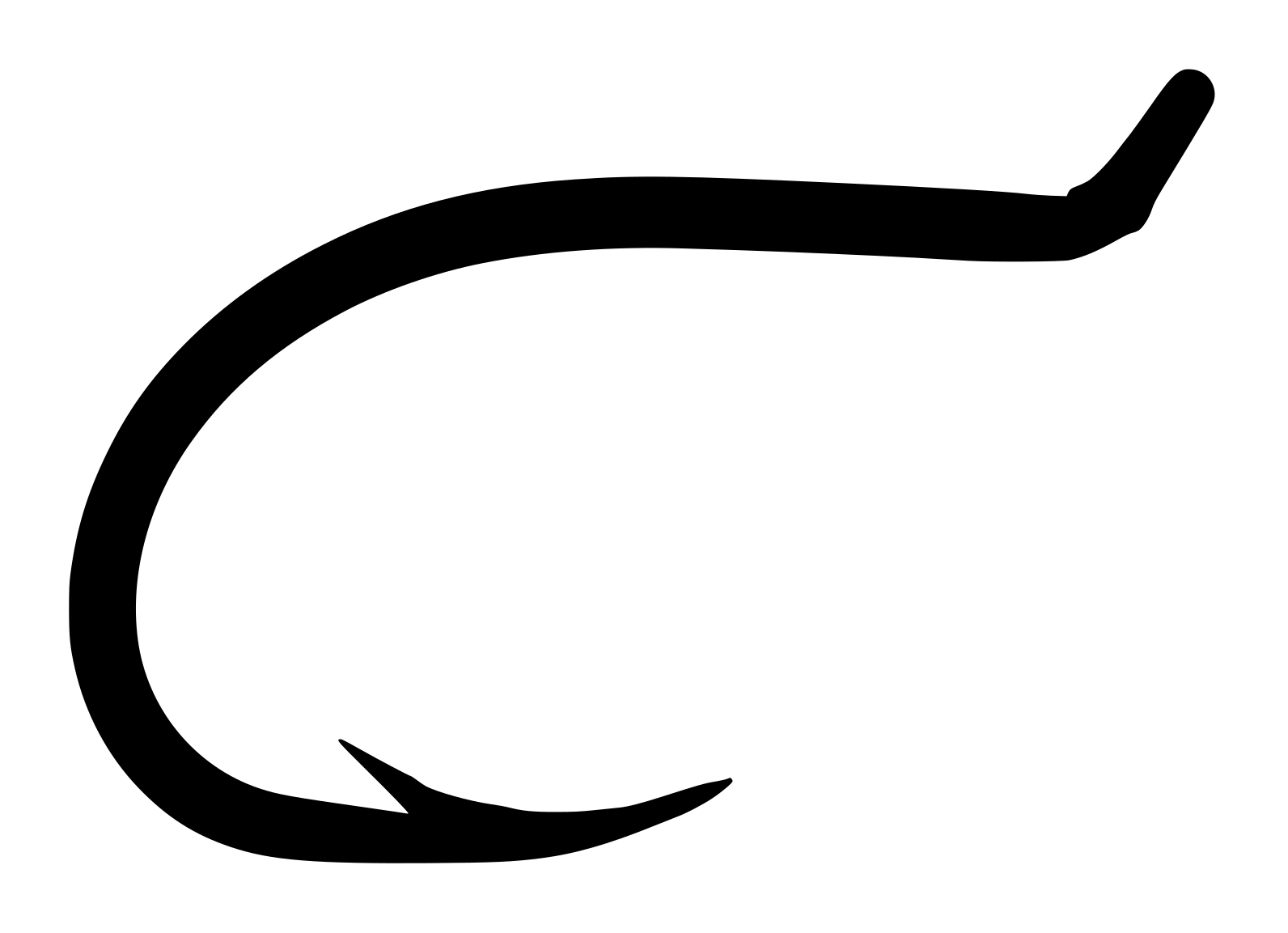
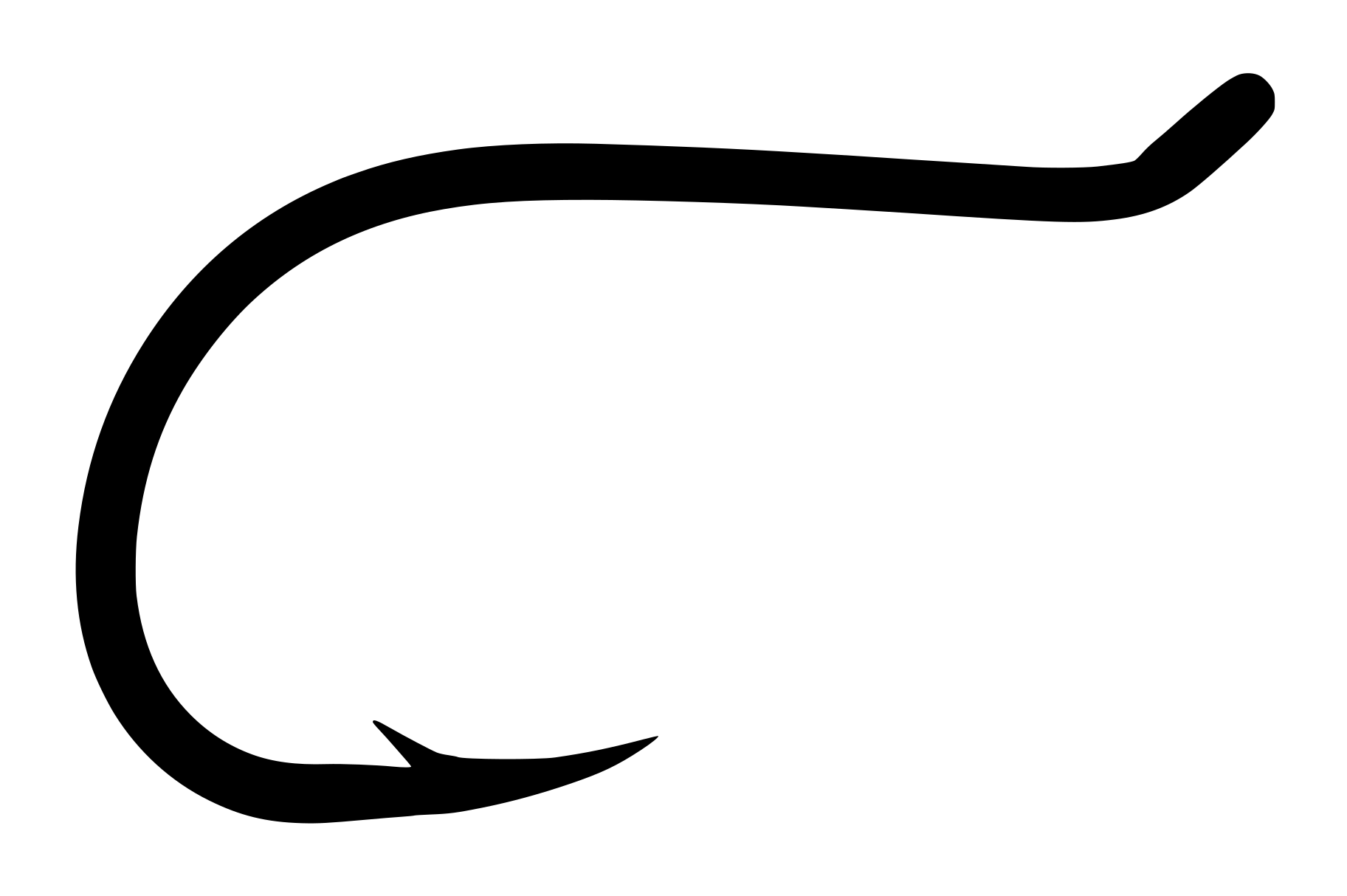
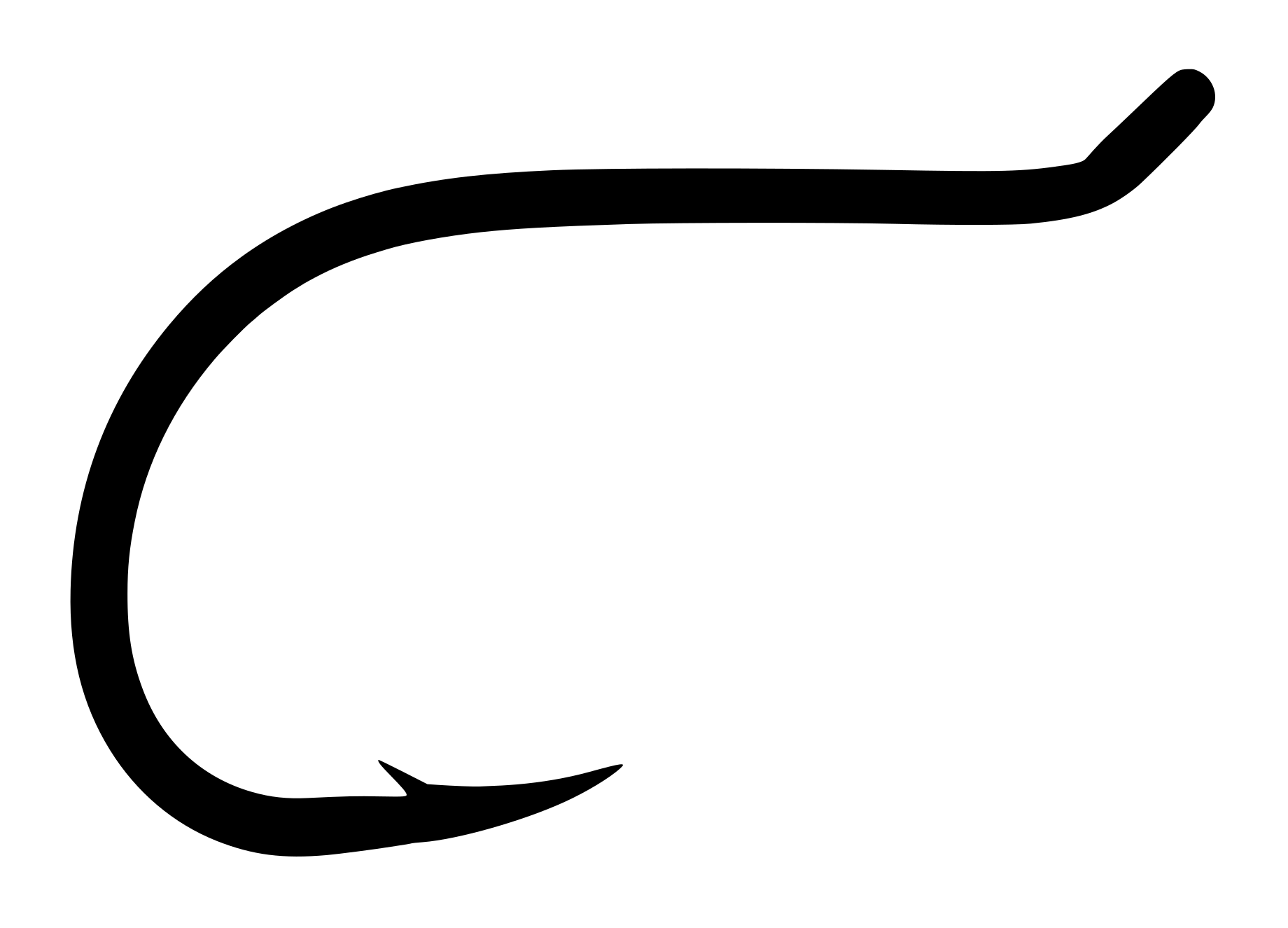
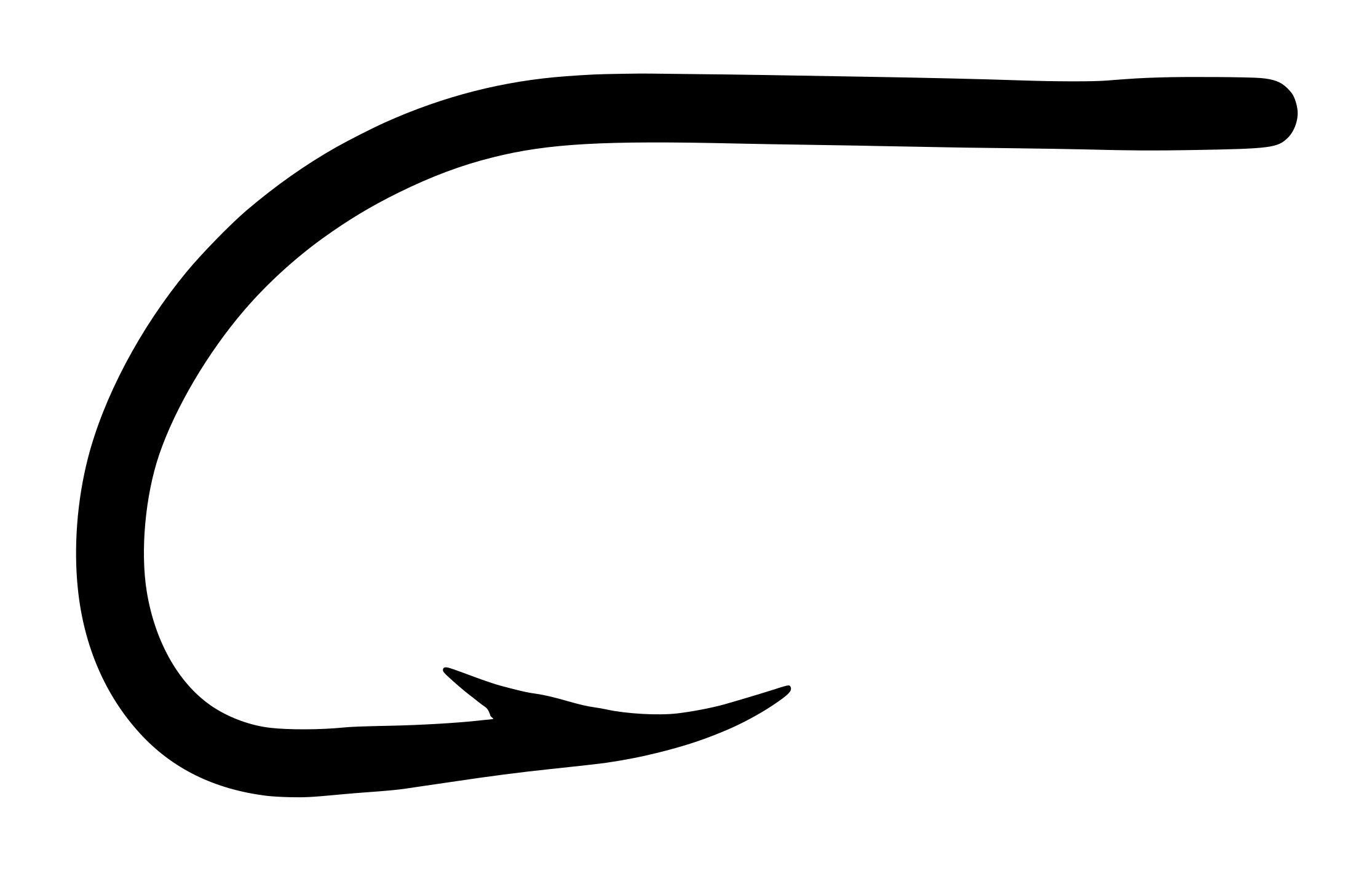
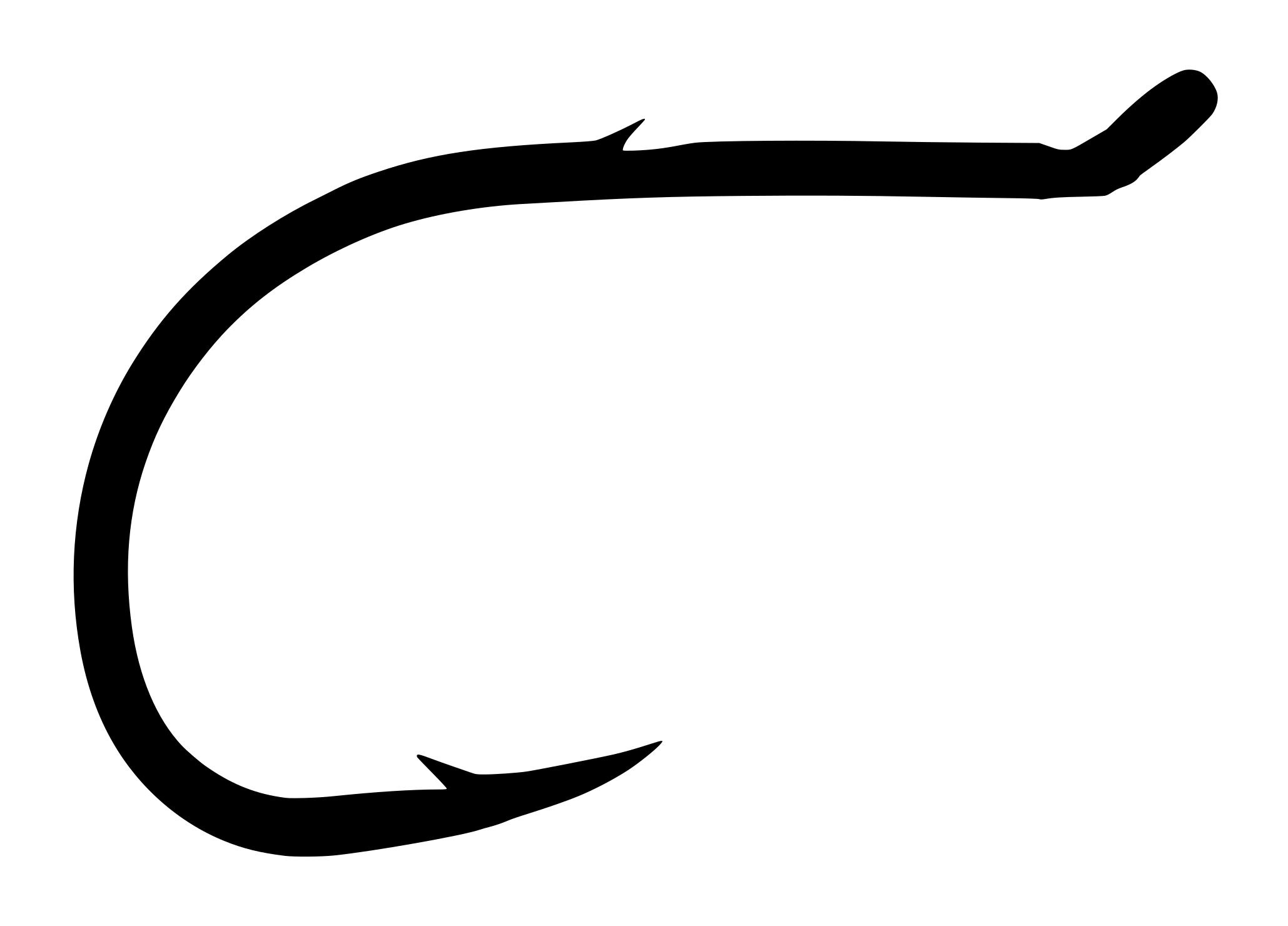
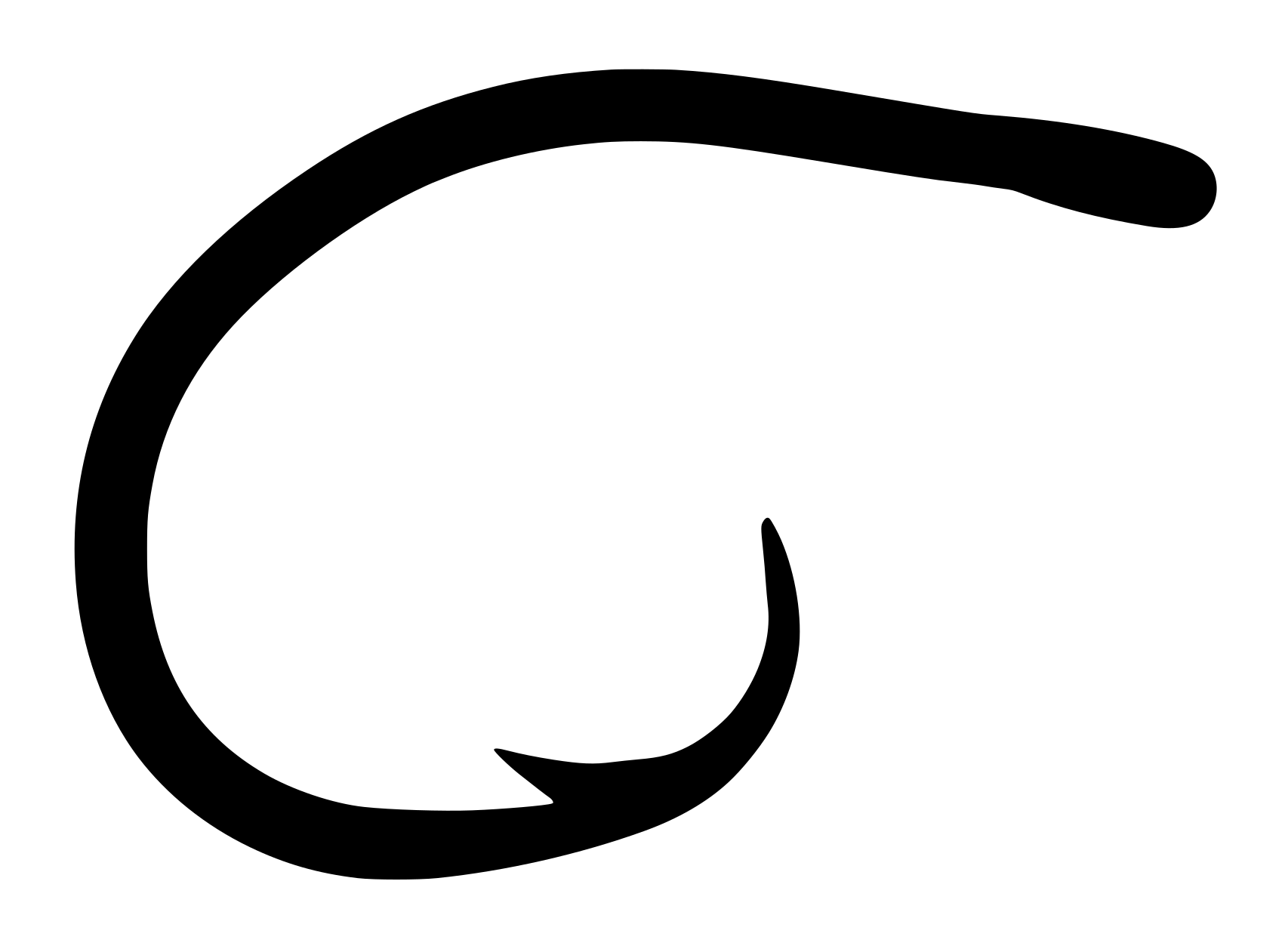
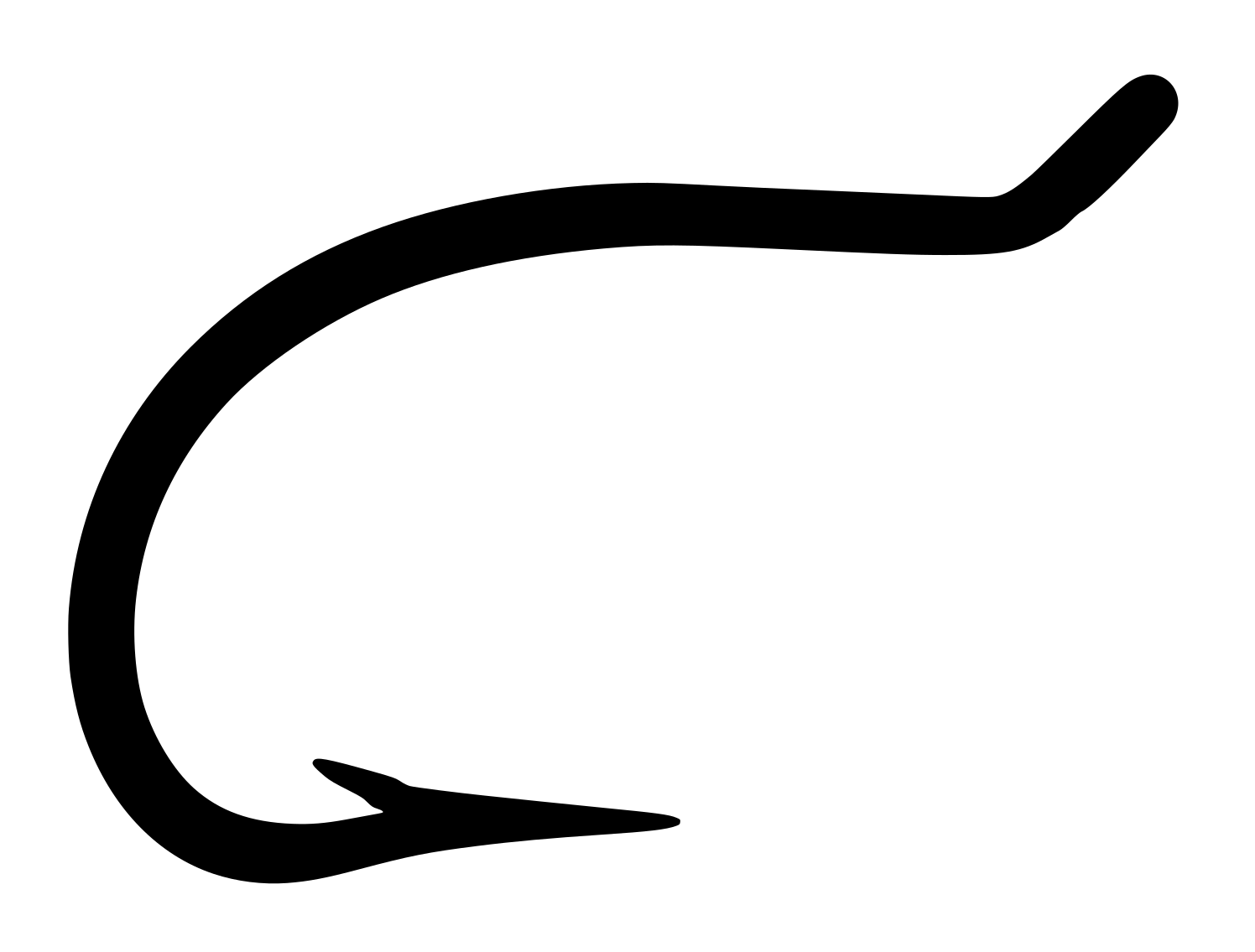
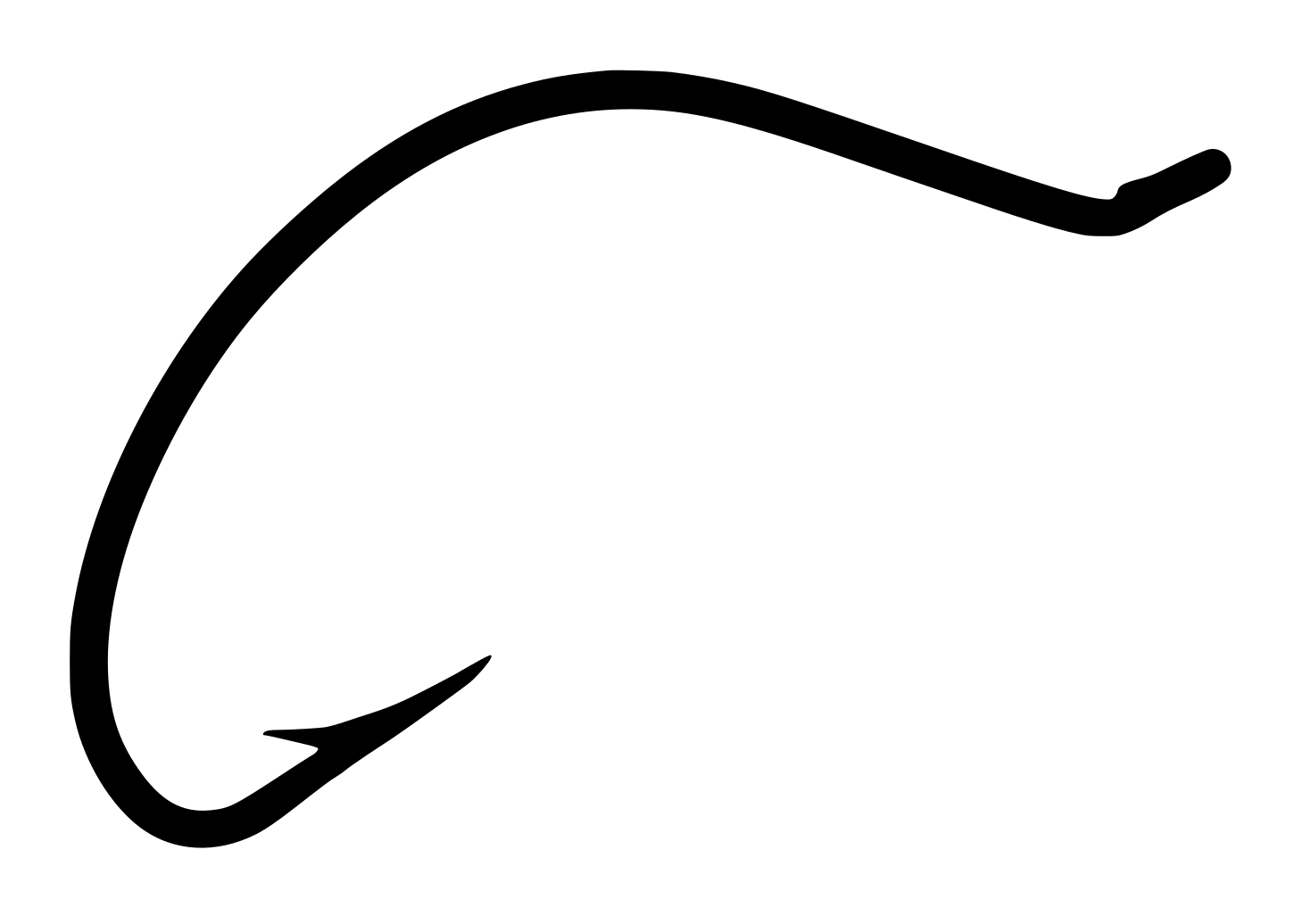
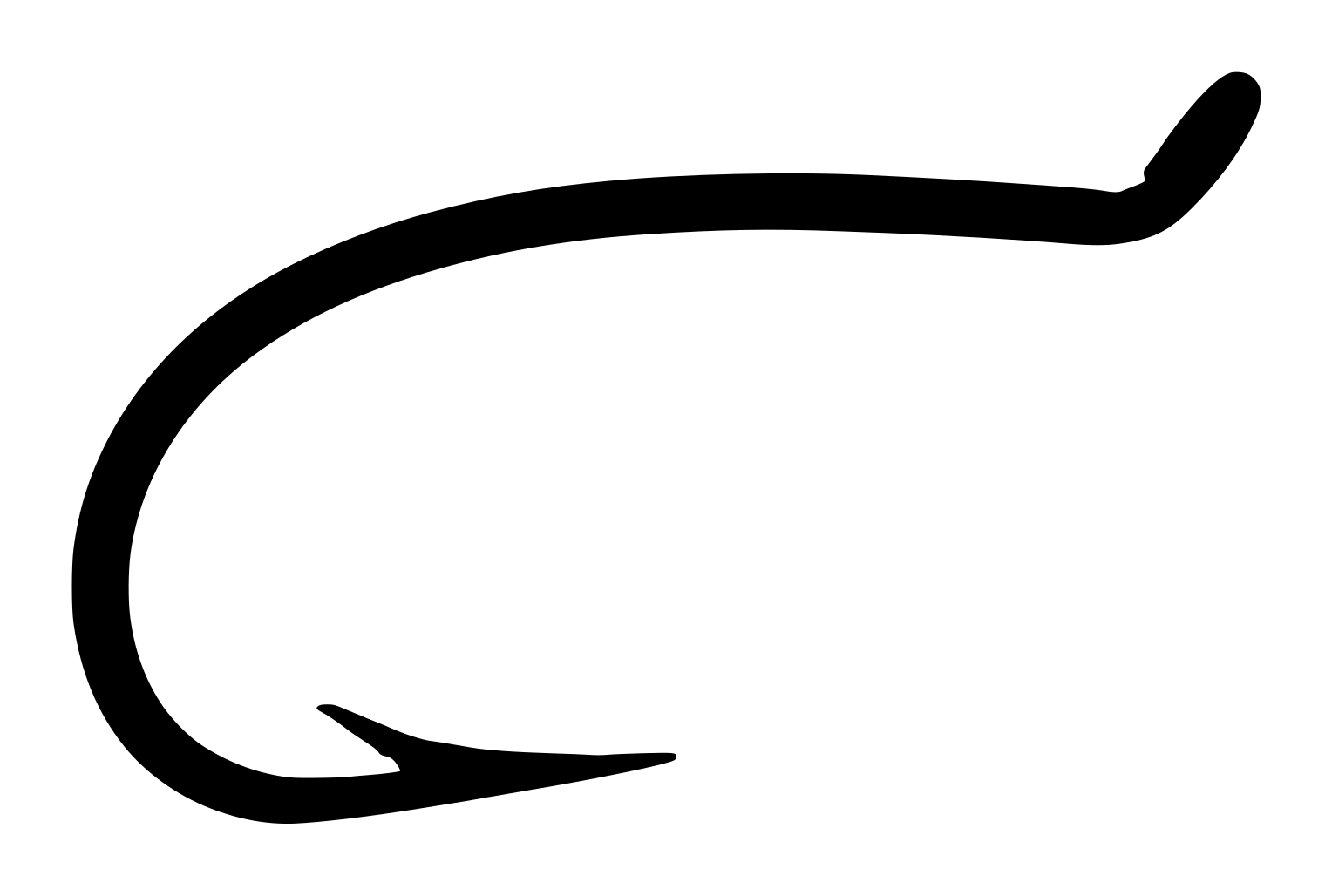
O. Mustad & Son Special O’Shaughnessy, model code 94181, size 3. Upturned ball eye, short shank, standard wire, wide gap, reversed beak point, nickelplated finish. Originally packed in manufacturer box (100 hooks). V
The O’Shaughnessy bend is characterized by a deep, pronounced curve with an angular bend entry — the classic profile for sea trout, salmon, and baited rigs through the mid-20th century. This example, designated “Special,” denotes Mustad’s unforgd construction and upturned eye orientation, distinguishing it from forged or looped-eye variants in the broader O’Shaughnessy line. V
Nickelplating, cool silver-grey tone, applied factory-finish per specification. Wire is standard gauge, round profile, suitable for medium-weight live and dead bait application. The short shank and wide gap geometry gives good holding proportion for natural minnows, ragworms, and soft baits in estuarine and coastal waters. P
Packaging evidence dates to ca. 1945-1965: no barcode, letterpress print on cream stock, kraft tape edge reinforcement, pencil stock notation. The box itself is rarer than cardstock or envelope packaging and commands a significant rarity premium. This specimen represents the standard commercial packaging and production volume of Mustad’s long-established Oslo factory. VI
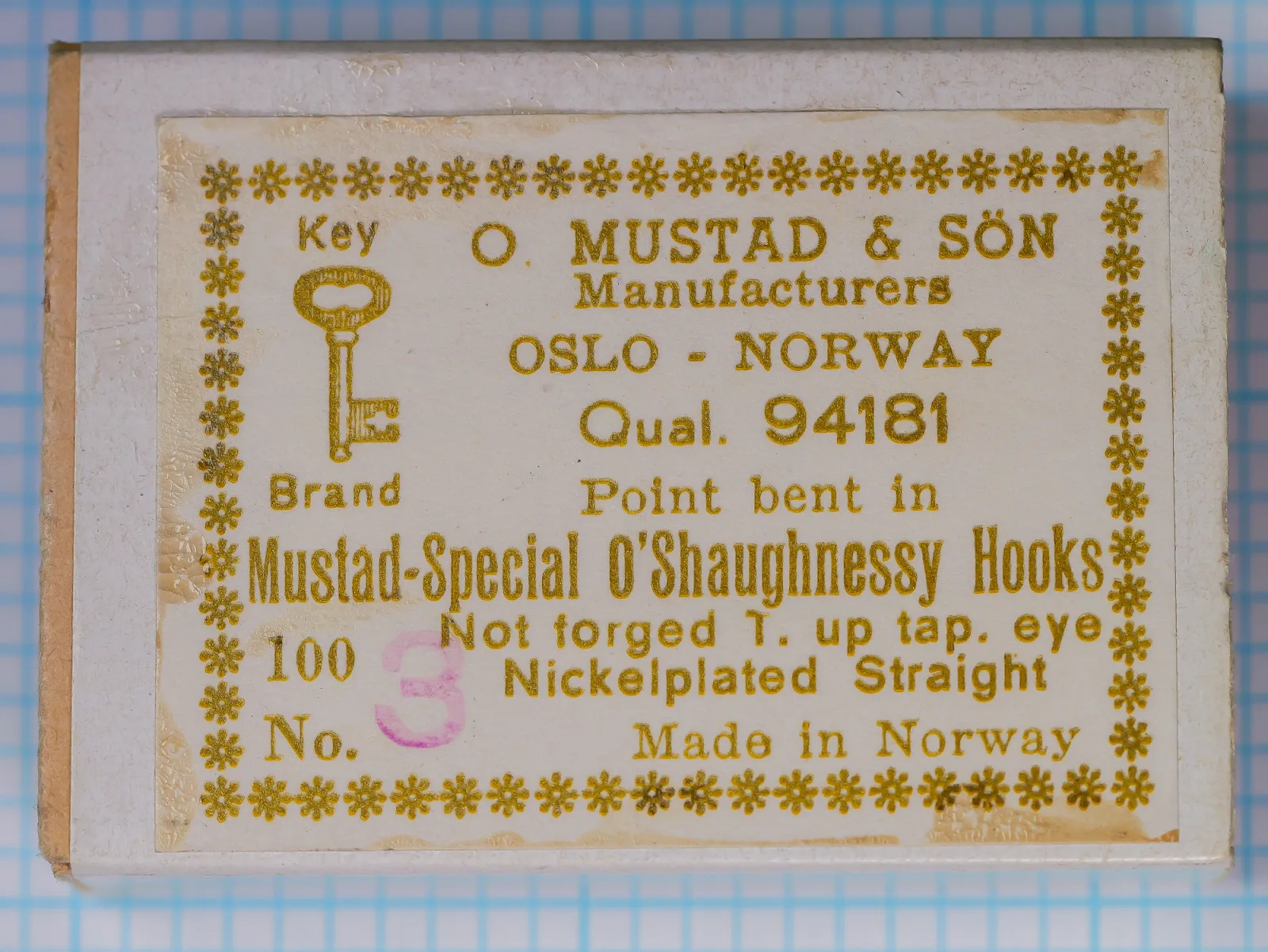
Front panel of the manufacturer box label printed in gold letterpress, showing model code 94181, hook name, and specifications: unforgd, upturned eye, nickelplate finish.
Photographic record
3 cataloged imagesSelect any record to load it above.
3 images shown
Mustad 94181 Special O’Shaughnessy Box LabelFront panel of the manufacturer box label printed in gold letterpress, showing model code 94181, hook name, and specifications: unforgd, upturned eye, nickelplate finish.Open originalMustad 94181 O’Shaughnessy Hook Size 3 — Side ViewSide-on view of the hook showing the deep O'Shaughnessy bend curve and the sharp reversed point in profile. Nickelplate finish displays cool silver-grey tone characteristic of electroplated nickel.Open originalMustad 94181 O’Shaughnessy Hook Size 3 — Eye and Profile ViewFront-face view showing the upturned ball eye at approximately 60 degrees off the shank axis, the short shank length, and the wide gap proportions. Hook is overlaid on grid for dimensional verification (overall length 0.72 inches, gap width 0.35 inches).Open original
Technical profile
Turned Up Ball Eye | O'Shaughnessy | Short| Standard Wire | Beak | Nickelled
Eye
Ball Eye, Turned UpBall eye is uniformly round, wire end butted to shank body with minimal scar. Upturned orientation at approximately 60 degrees off shank axis, consistent with sea trout tradition and allowing for gut-loop snelling or direct knot attachment. No visible deformation or corrosion. P
Wire
Standard, Round
Shank
Short (1X–2X Short) — Plain
Bend
O'Shaughnessy, Wide gapO'Shaughnessy bend exhibits the characteristic angular entry transitioning into deep, rounded lower curvature. The offset is reversed (point deflected rightward when viewed from eye looking down shank), a defining feature of the beak-reversed geometry. Bend is symmetrical and well-set, with no visible crimp or wire set distortion. Gap width is proportionally wide relative to shank length, increasing hook-hold margin on natural baits. P
Point
Beak / Reversed (incurving)Barb is present, short and closely cut. Positioned just above the inner curve transition. Angle sweeps backward in line with the point taper — standard mid-century barb geometry, not pronounced or exaggerated. Barb is small enough not to impede penetration on soft-mouthed fish. P
Finish
Nickelled / Nickel-Plated — Confirmed (stated on packaging)Nickelplated finish displays cool silver-grey metallic tone throughout, characteristic of electroplated nickel rather than tinning or polishing. Coating is uniform with no visible patina or oxidation spots on specimen examined. Finish color temperature is distinctly cooler than bronze and lacks any blue-grey oxide tone, confirming nickelplate over bluing. PV
Hook specimen shows no corrosion, pitting, or bend distortion. Nickelplate is intact with full metallic sheen. Box lid remains structurally sound with original kraft tape edge binding. Card stock shows moderate age toning (cream-to-tan transition) and surface creasing consistent with storage in a tackle box or cupboard. No water damage or insect damage visible. All 100 hooks presumed present (not opened for individual count verification). Overall excellent storage condition befitting a stored unopened manufacturer box. P
The reversed beak point (offset rightward, standard for O’Shaughnessy) creates a direct inward angle from the barb to the needle point without intermediate curve. This geometry offers two functional advantages: the point enters baits without deflection (important for soft-mouths and natural finfish), and the offset geometry self-rotates the hook into the fish’s jaw under line tension.
Standard wire gauge preserves strength for live-bait casting while keeping the hook light enough for dead-bait drift work and uptide casting. The short shank (1X–2X Short) reduces shank length relative to gap width, increasing gap penetration relative to overall hook footprint — valuable when tying small-to-medium baits or when fishing faster-moving water where bait compression is minimal.
Nickelplating provides three benefits: mirror-bright appearance increases visibility in turbid water; electroplated nickel resists salt-water corrosion longer than bronzed (oxidized) steel; and the cool metallic reflectivity does not impart color preference bias (unlike warm-toned bronzed finishes). The upturned eye accommodates both traditional gut-loop snelling and modern mono knots, allowing either pre-rigged snelled configurations or direct line-to-hook tying.
Size & scale lab
Known manufactured size range:
Size 3 (documented)
This pattern was made in sizes Size 3 (documented). We have measurement for size 3. Know the others? Submit calipered measurements and we'll review and add them. Thank you!
Historical context
mustad
O. Mustad & Son, established 1832 in Gjøvik, Norway, became the world’s largest industrial hook manufacturer. The company built its reputation on mechanized production and consistent quality at scale, flooding global markets with fish hooks at competitive prices that displaced many hand-forging traditions. By the early 20th century, Mustad’s output exceeded all English Redditch makers combined.
The Oslo (later Gjøvik) factory operated continuously through two world wars, achieving remarkable production volumes. Mustad supplied wholesale distributors, mail-order catalogs, and tackle shops across North America, the UK, and British Commonwealth territories. The company’s “Special” line designated unforgd hooks hand-tied or factory-finished with particular attention to eye and point geometry — positioned as a premium variant within the broader mass-production catalog.
Mustad’s dominance in the mid-20th century came not from technical innovation but from systematic quality control, extensive model range, and reliable logistics. The Special O’Shaughnessy 94181 represents this strategy: a proven bend family, standardized short-shank platform, and simple nickelplate finish applied to 100-hook boxes distributed to tackle dealers nationwide. V
Series History
The O’Shaughnessy bend traces to 19th-century Irish and Scottish sea-trout traditions. The shape — angular upper curve, deep lower belly, reversed point offset — proved effective for both live minnow work and bait casting in estuarine conditions. Multiple manufacturers (Redditch, Irish, and Norwegian makers) produced O’Shaughnessy variants; Mustad’s industrial version standardized the geometry for mass market.
The “Special” designation on Mustad packaging indicated unforgd (not forged flat/wider) construction, preserving the round wire profile. The model 94181 size 3 with upturned eye was catalogued continuously from the 1940s into the 1970s, positioned for sea-trout bait work and compatible with the traditional gut-loop snelling method or direct mono knots. Variant models in the O’Shaughnessy line included forged versions, looped-eye options, and size ranges from 2 to 8.
The nickelplate finish was Mustad’s standard for medium-weight seawater and bait hooks from the 1930s onward, offering superior salt-water corrosion resistance compared to bronzed steel. This model remained in the Mustad catalog through the 1960s; later O’Shaughnessy variants shifted to forged construction and inline eyes reflecting changing fishing preferences.
Era and Packaging Dating
No barcode present on box or label — strong indicator of pre-1974 manufacture (barcodes introduced in US retail ca. 1973–1974). Letterpress print method (not offset) on cream-stock box is consistent with 1940s–1960s packaging technology; offset printing gradually displaced letterpress during the 1950s–1960s but coexisted. Kraft tape edge binding, single-ply cardboard construction, and hand-written pencil notation ("100") are typical of wartime–postwar rationing and early-1950s cost controls. Mustad's "Special" line nomenclature and upturned-eye sea-trout configuration were current in catalogs issued 1945–1970. Pink rubber stamp mark (partially visible) may be a factory date code; unable to confirm exact year without reference to Mustad's archival stamp patterns. Overall evidence supports mid-20th century (1945–1965) with no features suggesting later manufacture. Conservative dating to c. 1950 (midpoint) is reasonable; upper boundary 1965 allows for extended catalog life without overestimating production span.
The Ghost of the Gut Loop
The upturned eye on sea-trout hooks originated not from fishing advantage but from knot-tying practicality. Before crimped sleeves and modern loop-knots became standard, anglers used the traditional "gut loop" — a 2-inch loop of heavy nylon or gut threaded through the eye and knotted to the main leader. An upturned eye allowed the loop to hang freely below the hook, preventing the leader from fouling on the barb. Mustad's "Special" upturned O'Shaughnessies were designed for this 1950s–1960s rig style and remained catalogued unchanged for three decades afterward, even as direct mono-knot tying became universal. Many tyers and bait fishermen still prefer upturned eyes out of habit, decades after the gut loop disappeared from practice.
Design lineage and influence
The O’Shaughnessy bend originated in 19th-century Dublin and Belfast with unnamed tackle makers responding to Irish sea-trout demands. The deep-bellied, reversed-point profile appeared in multiple Redditch catalogs from 1880–1920 (Allcock, Bartleet, Sealey) under various proprietary names. Mustad’s “O’Shaughnessy” line (model codes in the 94180–94189 range) integrated the bend into a rationalized product platform: unforgd (94181), forged (94182), and specialized variants available across sizes 2–10.
Competing designs in the bait-hook category included the Sproat (softer, rounder belly), the Limerick (angular, more acute bend entry), and the Kirby (lateral offset rather than reversed). By the 1950s, O’Shaughnessy dominated the UK and Irish sea-trout market, with Mustad’s version becoming the default choice in tackle shops and mail-order catalogs. Modern equivalents (post-1980) include the Mustad 34007 (forged O’Shaughnessy), various Japanese salt-water O’Shaughnessies (Daiichi, Tiemco), and generic “sea-trout specials” in tackle-shop own-label ranges.
Best matchRelated by Attribute
Computed automatically from catalog data — updated as new hooks are added.
Matches: Shank, Gap, Eye Orient., Point, Finish +4 moreDiffers: Bend: O'Shaughnessy vs Round / Kendal; Wire: Standard vs Fine (1X Fine); Eye: Ball Eye vs Tapered Eye +1 more
Matches: Shank, Gap, Eye Orient., Point, Finish +4 moreDiffers: Bend: O'Shaughnessy vs Round / Kendal; Wire: Standard vs Fine (1X Fine); Eye: Ball Eye vs Tapered Eye +1 more
Matches: Bend, Shank, Gap, Eye, Point +4 moreDiffers: Wire: Standard vs Heavy (1X Heavy); Eye Orient.: Turned Up vs Straight / Inline; Application: Sea Trout, Bait vs Bait, Saltwater +1 more
Matches: Bend, Wire, Eye, Forging, Shank Feat. +1 moreDiffers: Shank: Short (1X–2X Short) vs Standard; Gap: Wide vs Standard; Eye Orient.: Turned Up vs Straight / Inline +3 more
Matches: Shank, Gap, Eye Orient., Point, Finish +3 moreDiffers: Bend: O'Shaughnessy vs Round / Kendal; Wire: Standard vs Fine (1X Fine); Eye: Ball Eye vs Tapered Eye +2 more
The Special O’Shaughnessy 94181 was engineered for live and dead bait fishing in estuarine and coastal salt water, specifically for sea trout (brown trout migratory form), finnock (sea-run juvenile trout), and opportunistic Atlantic salmon parr in tidal rivers. The short shank and wide gap allowed natural minnows (sand eels, silver eels, small whitebait) to be rigged tail-first, with the bait lip hooked just beneath the upper jaw. The reversed beak point rotated into the fish’s hard palate under strike tension. The upturned eye accommodated traditional gut-loop snelling, the dominant rig method for bait hooks in the 1950s–1960s.
Secondary Applications
Bass (largemouth) on live shiners and minnows in salt marshes and tidal impoundments. Pike on dead roach or herring in estuarine shallows. Saltwater flats fish (permit, tarpon) on live pilchard or mullet, though the hook's size and gap make it marginal for large gamefish by modern standards.
Collector notes
Rated 4.5/10. Moderately uncommon. The manufacturer box (vs loose hooks or card packaging) elevates scarcity significantly — Mustad boxes of this era are rarer than bulk card or envelope packaging and command a 2–4× premium over equivalent loose hooks. Collector demand is steady among sea-trout specialists, vintage bait-fishing historians, and Mustad archive enthusiasts. Size 3 in this upturned-eye configuration is less frequently encountered than sizes 4–6. Original complete count (100 hooks) and excellent storage condition enhance value. Primary limiting factors: Mustad's industrial production volumes mean even scarce variants are never truly rare; collector demand outside specialist circles (sea-trout, UK/Ireland fishing history) remains modest; and the bait-hook category attracts less trophy collecting attention than salmon or fly-tying patterns.
Reference value
$12 – $35 USD estimate
Packaging condition
Good — moderate wear, legibleRecorded specimen
Packaging format
GW-B-MUSTAD-94181Catalog code
What Makes This Hook Collectible: The Special O’Shaughnessy 94181 occupies a narrow niche: it represents mid-20th century Mustad’s deliberate positioning of unforgd hooks as a premium variant, distinct from the company’s mass-market forged models. The upturned eye and reversed point are signatures of a specific fishing tradition (gut-loop snelling for sea trout) that persisted from the 1940s through the 1970s. Packaging as a complete manufacturer box (rather than loose hooks or cardstock) is genuinely rare — most Mustad distribution went through commercial card sets or bulk dealer lots. The absence of barcode and letterpress printing are strong period markers (pre-1974). For specialists in sea-trout tackle history, vintage estuarine fishing, and Mustad’s evolution from craft to industrial production, this hook documents a specific moment in tackle standardization.
Limiting Factors: Mustad’s production volume was industrial-scale. Even a “scarce” model code (94181 vs the forged 94182) was produced in quantities of thousands across the 1945–1965 window. Surviving unopened boxes are uncommon but not rare — they appear on eBay and in dealer stock with reasonable regularity. Collector demand outside specialized sea-trout and British angling circles is limited; bait hooks do not command the same trophy interest as salmon irons or named fly-pattern hooks. The model remained in continuous production from the 1940s into the 1970s, so no artificial scarcity created by short production runs. Condition premium is significant (unopened boxes vs loose corroded specimens), but the absolute price ceiling is modest — this is not a high-value hook category.
Most Desirable Variants: Size 3 (documented here) in original unopened box. Smaller sizes (2) and larger sizes (4–6) were produced in greater volume and are more frequently encountered. Nickelplate finish is more desirable than bronzed variants (superior salt-water appearance and corrosion resistance). Upturned eye is preferred over straight-eye or looped variants. Original box with intact lid, legible printing, and full hook count (100) commands strong premium over opened or partial boxes.
Condition Factors Affecting Value: (1) Box integrity: intact lid, no water damage, legible printing, original kraft tape edge binding. (2) Hook count: 100/100 (sealed or verifiable), 90–99/100 (excellent), below 80/100 (good). (3) Hook condition: bright nickelplate with no corrosion, no bend distortion, barbs intact. (4) Label clarity: gold letterpress printing still visible, no fading or ink loss. (5) Age patina: light cream-to-tan toning acceptable; dark staining or mold growth is destructive. Unopened boxes in fine condition command 2–3× the price of opened boxes with partial counts.
Packaging
Manufacturer box. Rigid cardboard container with separate lid. Front panel printed in gold letterpress on cream stock. Text and decorative border design consistent with ca. 1940s-1960s Mustad packaging. "O. MUSTAD & SON Manufacturers OSLO - NORWAY" printed across top. Model number "Qual. 94181" stated below. Hook description reads "Mustad-Special O'Shaughnessy Hooks" with "Not forged 1. up tap. eye" (indicating unforgd, single upturned eye). "Nickelplated Straight" printed on lower portion. Maker's mark: stylized key logo centered on panel. "100" marked in pencil, likely original stock count. Small pink rubber stamp visible (date code unclear). Box lid intact, showing moderate toning and edge wear consistent with age storage. Edges reinforced with tan kraft tape, original to packaging. No barcode present — strong indicator of pre-1974 manufacture.
Market Value Notes
Low ($12): Good condition — opened box, 85–95 hooks present, light toning, intact label, no corrosion. High ($35): Excellent/Mint condition — sealed or unopened box, full 100-hook count, minimal toning, bright nickelplate, intact kraft binding, label printing legible. Premium factors: unopened/sealed status (add 50–100%), complete hook count (no missing), original manufacturer box (vs card or loose) worth 2–4× equivalent loose hooks, size 3 rarity within the model range, UK/Ireland provenance or documented sea-trout history. Platforms: eBay UK and US (most common sales channel for vintage Mustad boxes), specialist tackle dealers (UK, Ireland, Norway), fishing antique dealers, vintage fishing swap meets/fairs. Confidence: E estimated — limited recent comparable sales data for this specific model in box format. Estimate based on (a) typical Mustad unopened-box pricing in the £8–£20 ($10–$25 USD) range observed 2020–2023, (b) upturned-eye sea-trout specialty adding 20–30% premium, (c) size 3 scarcity bump, (d) box format rarity (2–4× over loose). If loose hooks only (no box): $2–$8. Recommend specialist UK tackledealer or eBay advanced search for comparable closed-auction prices to refine estimate.
Where to Find
eBay UK (primary), eBay US (secondary). Search terms: "Mustad 94181", "O'Shaughnessy box", "Mustad sea trout special". Specialist UK tackle dealers (Harris, Farlows, Sharpes of Aberdeen archival stock). Fishing antique fairs and swap meets in Scotland, England, and Ireland. Mustad distributor clearance lots (rare). Norwegian fishing museums and archival dealers (limited retail availability). Not commonly found in modern US tackle shops — distribution was concentrated in UK/Ireland markets.
Collector's Identification Tips
Confirm the model code 94181 is printed on the box lid and front panel in gold letterpress. Verify the phrase “Not forged 1. up tap. eye” (indicating unforgd and upturned eye). Check for Mustad’s stylized key logo centered on the label. Examine the eye orientation with the hook in profile — upturned eyes angle 45–70 degrees off the shank axis, distinct from straight or turned-down configurations. The reversed point offset is visible from above: point deflects rightward (toward the observer’s right hand) when viewing from the eye end. Nickelplate finish should exhibit cool silver-grey tone, not warm bronze or blue-grey bluing. Absence of barcode on packaging is consistent with manufacture before 1974.
Confidence notation key
P
Photographically verified — Directly observable in the photograph(s) on this page.
V
Verified by documentation — Confirmed by manufacturer catalog, spec sheet, or published reference.
I
Inferred — A logical deduction from observable or documented evidence, not directly stated.
E
Estimated — An approximation based on visual comparison, proportional analysis, or limited data.
S
Speculative — A reasoned hypothesis that cannot be confirmed from available evidence.
Claims with no notation are confirmed by multiple independent sources. All photographs on garrenwood.com are taken on a measurement grid where each square equals 1/10 inch (0.1″ / 2.54 mm).