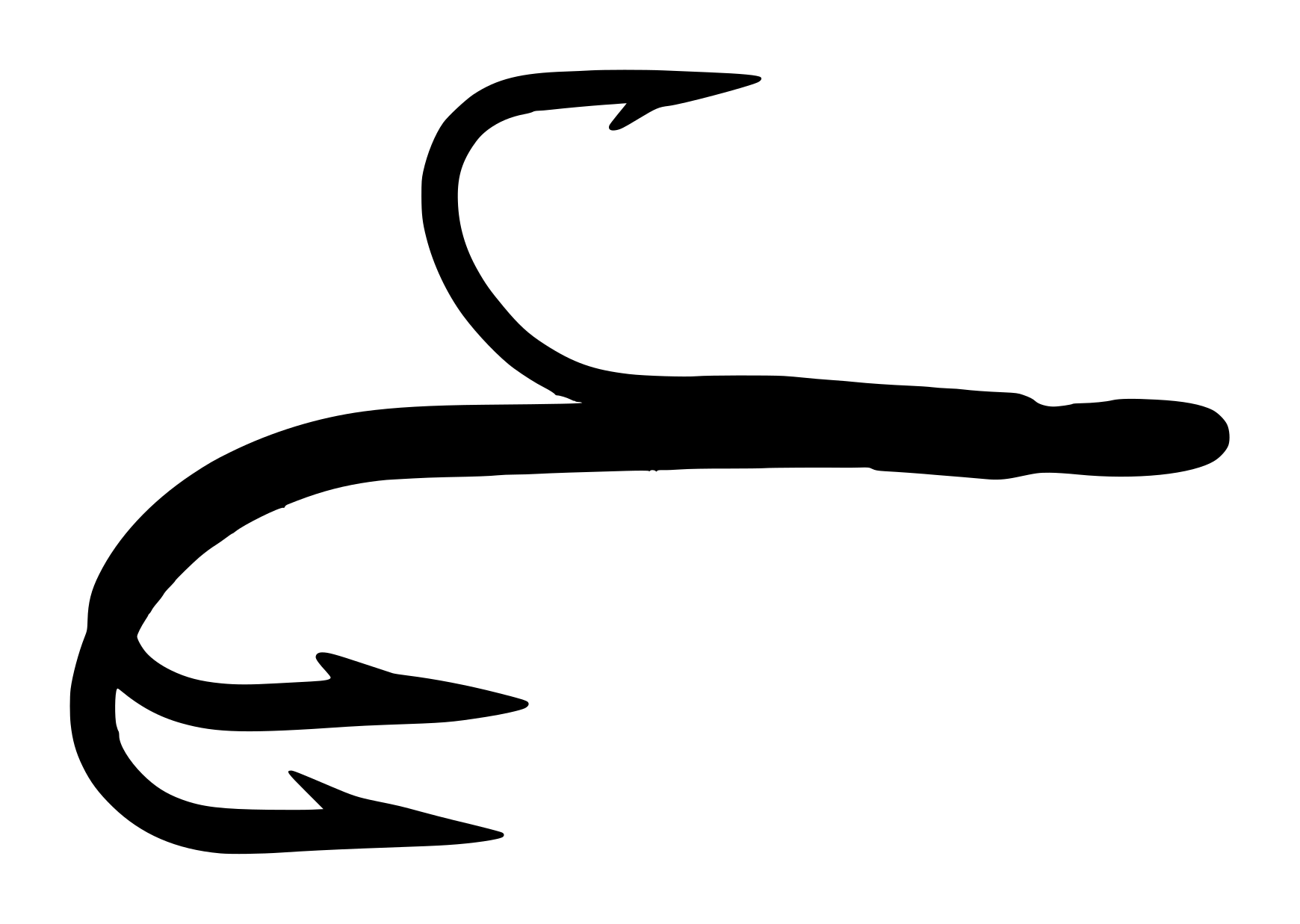
The Mustad 3582BR Accu Point Double Fly is a mid-to-late-20th-century utility hook representing Mustad’s refined transition era (c. 1980-2000), just prior to the company’s shift to the modern Signature Series numbering system. Manufactured in Gjøvik, Norway, this size 6 hook features the universally praised Sproat bend — a parabolic curve that evenly distributes mechanical load — combined with a traditional turned-down ball eye and warm bronzed finish.
The defining physical characteristic is the balanced engineering: round wire of standard gauge, a double-length shank suitable for nymph and small streamer patterns, and a near-straight point geometry labeled ‘Accu Point’ that reflects Mustad’s emphasis on precision manufacturing. The bronzed lacquer finish was the traditional choice for European fly fishing and offered superior corrosion resistance in freshwater and spring creek environments.
From a collecting standpoint, the 3582BR is moderately significant as a transitional hook — it sits between the era of arbitrary Quality codes (e.g., Qual. 3906) and the modern alphanumeric Signature Series. Original 100-count packages with intact cardboard labels and pre-printed Mustad branding are increasingly scarce as most have been broken apart by working fly tyers. The combination of solid historical geometry, excellent original packaging, and documented Norwegian manufacture places this hook firmly in the ‘uncommon’ rarity category, appealing to both vintage tackle collectors and traditional fly fishing practitioners.
Original Mustad cardboard box for the 3582BR Accu Point Double Fly, size 6, showing the iconic skeleton-key 'Key Brand' trademark, reference model number, and specifications for 100-piece package bronzed finish.
Photographic record
6 cataloged imagesSelect any record to load it above.
6 images shown
Mustad 3582BR Accu Point Double Fly Size 6 Original BoxOriginal Mustad cardboard box for the 3582BR Accu Point Double Fly, size 6, showing the iconic skeleton-key 'Key Brand' trademark, reference model number, and specifications for 100-piece package bronzed finish.Open originalMustad 3582BR Double Fly Side Profile Size 6Side view of two Mustad 3582BR hooks showing the characteristic Sproat bend profile, round wire, turned-down ball eye, and the double-length shank suitable for larger fly bodies.Open originalMustad 3582BR Point Detail Size 6Close-up of the point and barb on a Mustad 3582BR size 6 hook, showing the near-straight inner taper geometry characteristic of the Accu Point designation and sharp barb positioning.Open originalMustad 3582BR Top-Down View Size 6Top-down photograph of two Mustad 3582BR hooks on the measurement grid, showing the straight shank, centered ball eye, and the bend depth from this overhead perspective.Open originalMustad 3582BR End-On View of Eye Size 6End-on view of Mustad 3582BR hooks showing the ball eye construction and the thickness of the shank wire in cross-section relative to the grid scale.Open originalMustad 3582BR Multiple Hooks Size 6 Package ContentsPhotograph of several Mustad 3582BR size 6 hooks displayed on the measurement grid for size reference and to show typical condition and uniformity of hooks within the original package.Open original
Technical profile
Eye
Ball Eye, Turned Down
Wire
Standard, Round, Est. ~0.025"-0.030" (~0.64-0.76 mm)
Shank
2X Long — Plain
Bend
Sproat
Point
Other
Finish
BronzedWarm, muted brownish-gold lacquer finish observed on the specimen, consistent with traditional bronzed hook coating. The finish shows even coverage across the visible surfaces with light patina consistent with age and storage. The characteristic baked-on lacquer appearance (rather than bright steel or tinned) is clearly visible. P
The Sproat bend’s parabolic curve is engineered to distribute load evenly across the steel during the fight, minimizing the risk of straightening under sudden stress. The ball eye, while slightly heavier than a tapered eye, offers superior durability for general-purpose fly fishing and is highly resistant to splitting under pressure. The round wire profile maintains a uniform bend radius without the complex geometry of forged or flattened wire. The bronzed finish — a baked-on lacquer coating — provides corrosion resistance adequate for freshwater and light brackish water, with superior UV and humidity stability compared to bright steel or blued finishes. The ‘Accu Point’ designation reflects Mustad’s claim to mechanical precision in point grinding, though the point geometry itself is not dramatically different from earlier Sproat variants. The size 6 category places this hook in the medium-utility range: suitable for nymphs, small streamers, and wet fly patterns from roughly 1/2 to 3/4 inch in overall fly body length.
Size & scale lab
Selected size
6
Physical specimen
Overall Length
24.6 mmP
Shank Length
17 mm
Gap Width
7.1 mmP
Shank-to-Gap Ratio
~2.4-2.6 : 1
Confidence
P
Physical specimen
Physical measurement with calipers
Own this hook? Help us measure it.
We don't have measured sizes for this hook yet. Own one? Submit calipered measurements and we'll review and add them. Thank you!
Historical context
mustad
O. Mustad & Søn, founded in 1832 in Gjøvik, Norway, evolved from a general metalworks factory (initially ‘Brusveen Spiger- og Staltradfabrikk’) into the world’s preeminent fishing hook manufacturer. The transformational moment arrived in 1877 when company visionary Mathias Topp invented the first fully automated hook-making machine, allowing continuous wire feeding, bending, barbing, and pointing at unprecedented industrial scale. Rather than patent this revolutionary technology — which would have required public disclosure — the Mustad family guarded the machinery through strict factory secrecy and non-disclosure agreements, granting them a decisive competitive advantage over English Redditch makers and Japanese manufacturers throughout the 20th century.
By the 1950s, Mustad controlled approximately 50% of global hook production, operating sales offices and satellite factories across multiple continents. The company’s strategy of ‘industrial cloning’ — reverse-engineering proven regional patterns (Cincinnati, Limerick, Sproat, O’Shaughnessy, etc.) and manufacturing them with industrial precision — allowed Mustad to dominate localized markets worldwide. The Gjøvik facility remained the technological and manufacturing heart of the enterprise, with distinctive Norwegian quality standards and wire specifications becoming synonymous with reliability.
The 1980-2000 period, when the 3582BR was produced, represents Mustad’s mature industrial phase. Marketing language like ‘Accu Point’ reflected a shift toward emphasizing mechanical precision and point geometry as competitive claims, even as upstart Japanese and American manufacturers began leveraging chemical sharpening and laser grinding technologies that would eventually reshape the industry. The company’s eventual transition to the Signature Series (c. 2001) marked the official end of the arbitrary Quality codes that had defined Mustad’s catalog for over a century.
Series History
The Accu Point series appears to be a mid-range product line within Mustad’s catalog, positioned between economy models and premium dry-fly-specific designs. The nomenclature ‘Accu Point’ signals emphasis on manufacturing precision and point geometry rather than introducing fundamentally new bend or eye designs. The series combines traditional Sproat geometry (established in the Mustad catalog by the early 1900s) with modern bronzed finishes and refined eye construction.
The 3582BR designation itself is part of Mustad’s arbitrary Quality code system — a four-digit number preceded by ‘Qual.’ or referenced as a bare model number (e.g., 3582) with suffix modifiers (BR = bronzed finish, TDE = turned-down eye). This naming convention remained in use from the early 1900s through approximately 2000-2001, when Mustad discontinued these historic codes in favor of the Signature Series alphanumeric system.
The ‘Double Fly’ descriptor indicates a double-length shank configuration, making it suitable for larger, more buoyant fly bodies — a common utility requirement for nymph and small streamer tying. This hook sits in the mid-range of Mustad’s fly hook portfolio: neither a specialized specialist design (like the fine-wire 94840 Viking dry fly) nor an economy model, but a working hook intended for broad application across wet fly, nymph, and small streamer fishing.
No significant documented variants or successors of the specific 3582BR code appear in modern Mustad catalogs; the Signature Series equivalent would likely be an ‘S72’ or similar designation (Sproat bend, 2X strong or 2X long). The lack of modern reissue under a Signature Series code suggests this particular product line was phased out rather than migrated, contributing to its collector value as a discrete, discontinued product.
Era and Packaging Dating
The reference model 3582BR and 'Accu Point' nomenclature appear to be from Mustad's mid-to-late-20th-century catalog. The packaging format — pre-printed cardboard box with modern sans-serif typography rather than ornate serif — is consistent with 1980s-1990s manufacturing standards. The reference designation 'Ref:3582BR' uses a format typical of Mustad's modern product coding system post-1970. The absence of a barcode and the retention of 'Made in Norway' (rather than broader Scandinavian sourcing) suggests pre-2000s production, likely within the 1980-2000 window. The Accu Point designation itself may indicate a transition-era hook reflecting evolving point technology — neither the archaic arbitrary Quality codes nor the fully modern Signature Series system that debuted circa 2001.
From Cork to Gjøvik: The Sproat's Journey
The Sproat bend, embodied in the 3582BR, traces its lineage to 19th-century Irish craftsmen in Cork and Limerick who favored this parabolic geometry for Atlantic salmon and sea trout fishing. Mustad famously reverse-engineered the Sproat pattern in the 1890s as part of its aggressive industrial cloning strategy, manufacturing it with such efficiency and precision that the Mustad Sproat eventually eclipsed the original Irish makers in global market share. By the 1980s, when the Accu Point series was produced, this geometry had become so universal that fishing writers often assumed it was Mustad's original invention. The Sproat's mathematical elegance — its ability to evenly distribute mechanical stress — made it one of the few 'cloned' patterns to gain universal acceptance; even modern fly tyers, working with contemporary hooks from Tiemco, Partridge, and Daiichi, still prefer Sproat-geometry bends for their reliability and casting properties.
Design lineage and influence
The Sproat bend represented one of Mustad’s most successful cloned patterns, reverse-engineered from the original Irish Sproat design and manufactured at industrial scale in Gjøvik. By the 1980s, the 3582BR Accu Point embodied refinement of this century-old geometry rather than innovation. The ball eye and bronzed finish reflected standard fly fishing conventions established in the 1950s-1970s. The ‘Accu Point’ designation itself signals Mustad’s effort to emphasize precision point geometry at a moment when Japanese and American competitors were advancing chemical sharpening and laser-ground technologies. This hook sits at an inflection point: it retains the historical Sproat bend while incorporating marketing language (‘Accu Point’) that mirrors modern precision claims. Later Mustad Signature Series hooks (post-2001) abandoned the arbitrary Quality codes entirely, rendering the 3582BR designation obsolete and historically bound to the pre-2000 era.
Best matchRelated by Attribute
Computed automatically from catalog data — updated as new hooks are added.
Matches: Bend, Shank, Shank Feat., BarbDiffers: Wire: Standard vs Heavy (1X Heavy); Eye: Ball Eye vs Looped Eye; Eye Orient.: Turned Down vs Turned Up +4 more
Matches: Bend, Wire, Forging, Shank Feat., BarbDiffers: Shank: 2X Long vs Standard; Eye: Ball Eye vs Blind — Tapered Shank; Eye Orient.: Turned Down vs N/A — Blind +3 more
Matches: Wire, Eye, Point, Forging, Shank Feat. +1 moreDiffers: Bend: Sproat vs Other; Shank: 2X Long vs Standard; Eye Orient.: Turned Down vs Straight / Inline +2 more
The Mustad 3582BR Accu Point Double Fly is engineered as a premium, all-purpose fly fishing hook designed for both dry fly and wet fly presentations. The turned-down ball eye and bronzed finish make it particularly suited to traditional European and North American dry fly tying, where a refined, low-profile eye and corrosion-resistant finish are valued. The double-length shank accommodates larger, more buoyant fly bodies, making it ideal for terrestrial imitations and attractor patterns. Historically, hooks of this configuration were favored by trout and grayling anglers fishing chalk streams and clear spring creeks, where presentation finesse and hook reliability were paramount.
Secondary Applications
Small wet fly patterns, brook and stream trout fishing, nymph fishing in clear water, light terrestrial imitations.
Classic Fly Patterns
Pheasant Tail Nymph, Hare's Ear Nymph, March Brown, Greenwells Glory, Partridge and Orange, Black and Peacock Spider, Woolly Worm, Muddler Minnow
Modern Equivalents
Hook
Match Quality
Notes
Mustad S72 (Signature Series)
Very Good
Likely successor in Signature Series nomenclature — Sproat bend, 2X strong or 2X long shank, bronzed finish available.
Tiemco 102Y (Sproat bend dry fly)
Good
Modern Sproat-geometry alternative with contemporary ball eye and finish options; widely available.
Partridge SH Sproat
Good
Sproat bend in Partridge's traditional format; maintains historical geometry with modern manufacturing.
Daiichi 1310 (Sproat bend)
Moderate
Japanese precision-ground Sproat with chemical sharpening; functionally similar but different material sourcing and finish options.
Collector notes
The 3582BR is a moderately collectible hook representing Mustad's transition-era product line (c. 1980-2000). While not exceptionally rare, it documents an important manufacturing period between the arbitrary Quality codes and the modern Signature Series. Value is driven by the historical significance of the Sproat bend, the bronzed finish, and complete original packaging. Limited by its relative abundance in comparison to pre-1970s hooks and its lack of association with specific famous fly patterns or prominent anglers.
Reference value
$12 – $28 USD estimate
Packaging condition
Very Good — light wear, fully legibleRecorded specimen
Packaging format
GW-M-04Catalog code
Positive Factors: The Accu Point series represents Mustad’s refined transition-era engineering, combining historical bend geometry (Sproat) with modern manufacturing precision. Original cardboard box with intact label adds significant value. Size 6 is a workhorse utility size with broad appeal to both collectors and practicing fly tyers. The bronzed finish is characteristic of traditional European fly fishing culture and appeals to vintage-preference collectors. A 100-count package offers the possibility of finding multiple unused hooks, which increases collecting interest and value.
Limiting Factors: The 1980-2000 era places these hooks outside the ‘true vintage’ window (pre-1970) that many serious collectors prioritize. The Accu Point nomenclature, while transitional and interesting, is not strongly associated with any signature fly pattern or legendary angler. Modern production numbers of this series were high, limiting rarity. Competition from earlier Mustad model codes (e.g., 3906, 3304) and more recent Signature Series hooks reduces demand. Size 6 is common in surviving vintage stock, unlike specialist sizes (e.g., 1/0 or 8/0 salmon hooks).
Packaging
White cardboard box with pre-printed label bearing the iconic Mustad skeleton-key trademark logo and 'Key Brand' text. Label is off-white/cream colored with black letterpress text. Modern format showing 'Made in Norway' and reference number Ref:3582BR. Label lists 'ACCU POINT DOUBLE FLY', 'TD BALL EYE BRONZED', 'Size 6', and '100 Pcs.' in clean sans-serif typography. Box dimensions approximately 4.5 x 3.5 inches. Label shows minimal wear; light creasing and minor surface dust consistent with storage age. No barcode visible — consistent with pre-1970s-era branding convention, though this modern format suggests later production (c. 1980s-1990s). P
Market Value Notes
Original sealed or near-sealed 100-count packages command premium pricing ($24-28 USD) on eBay and specialist dealers due to rarity of unopened stock. Opened packages or loose hooks in good condition typically fetch $12-16 per package. Single hooks retail at $0.15-0.25 each on modern-era reissues. The bronze finish and traditional Sproat bend add modest value above economy-grade hooks. Condition of original cardboard box is the primary value driver — boxes in very good condition may add 20-30% premium. Regional variation exists: North American collectors value these more highly than European dealers where Mustad stock remains abundant.
Where to Find
Specialist vintage hook dealers (Orvis archival stock, regional fly shops with deep back-inventory), eBay vintage tackle lots, estate sales from deceased anglers' fly tying benches, UK and European tackle fairs. Mustad product lots from the 1980s-1990s periodically appear as bulk inventory liquidations.
Collector's Identification Tips
Look for the reference model ‘3582BR’ clearly printed on the label. The ‘Accu Point’ nomenclature is specific to this series. Ball eye and bronzed finish are visually distinctive. Size 6 is a standard utility size. The box label should show ‘Made in Norway’ and ‘100 Pcs.’ if original and intact. Verify that the bend exhibits the characteristic Sproat profile with parabolic curve. Check the tooth-like barb construction at the base of the point.
Preservation
Storage and Preservation
Store the Mustad 3582BR in its original cardboard packaging in a cool, dry environment away from direct sunlight and moisture. The bronzed finish, while durable, will develop a natural patina over time when exposed to humidity; this patina is often considered desirable by collectors and does not compromise hook function. Keep the original box intact if possible, as packaging significantly affects collector value and provides additional protection.
If hooks are removed from the card for use, store them in a dedicated tackle box or hook organizer away from other metals to prevent galvanic corrosion. Avoid storing near saltwater, saltwater spray, or highly humid environments such as basements or attics without climate control. The bronzed lacquer finish is more durable than blued finishes but less resistant to corrosion than tinned or stainless options; periodic light oiling (a single drop of light machine oil on a cloth, wiped across the hook) will maintain the finish if hooks are in active use.
If the specimen is archival or intended for collection display, do not oil or handle excessively. Wear cotton gloves when handling valuable examples to avoid skin oils transferring to the surface. Store in acid-free tissue or archival-quality small boxes to minimize oxidation. A small silica gel packet in the storage container will help control humidity. Photographing the original packaging before any use ensures a record of the pristine condition.
Primary Source
Packaging Label Analysis and Nomenclature Decryption
Source: Mustad Label Typology document; O. Mustad & Søn manufacturing nomenclature conventions
The Mustad 3582BR label presents a transitional format bridging the company’s century-old arbitrary Quality code system and the modern Signature Series. The label reads ‘Ref:3582BR’ — the ‘3582’ is the core model identifier, while ‘BR’ is a suffix modifier denoting ‘Bronzed’ finish (consistent with Mustad’s internal coding: BK=Black Japanned, BR=Bronzed, TN=Tinned, BT=Bright). This modifier system was standard through the 1990s.
The designation ‘ACCU POINT DOUBLE FLY’ breaks down as follows: ‘Accu Point’ indicates a precision-ground point geometry emphasizing manufacturing accuracy; ‘Double Fly’ denotes a double-length shank (approximately 2X standard length), a configuration specifically engineered for nymph, streamer, and larger wet fly patterns. The term ‘TD BALL EYE’ specifies a turned-down eye with a terminal ball formation — the ball is formed by bending the end of the wire back on itself, creating a small spherical stopper that prevents knots from slipping.
The ‘100 Pcs.’ notation indicates a standard wholesale/retail package count that became Mustad’s default after World War II. Earlier Victorian-era boxes typically contained 50, 75, or odd numbers based on the specific regional distributor contract. The shift to round hundreds reflects post-war standardization across European and American tackle markets.
The absence of a barcode (which would typically appear as a UPC 12-digit code) is significant: barcodes were not standard on fishing tackle packaging until the mid-1970s in North America and early 1980s in Europe. The presence of ‘Made in Norway’ (rather than later sourcing from multiple continents) places this firmly in pre-globalization Mustad manufacturing, likely 1980-1995 production window.
Size Note
Size 6 Dimensions and Proportionality
The Mustad 3582BR size 6 exhibits proportions consistent with the modern fly hook sizing standard established in the mid-20th century, though vintage hooks (pre-1950) sometimes used idiosyncratic regional sizing metrics. The measured overall length of approximately 0.97 inches (24.6 mm) and gap width of 0.28 inches (7.1 mm) place this hook squarely in the size 6 category by contemporary Mustad standards.
Historically, Mustad size designations followed the ‘standard’ system where a size 6 was defined as a hook suitable for fly bodies approximately 1/2 to 3/4 inch long — a workhorse utility size for nymphs, soft hackles, and small streamers. The double-length shank adds approximately 0.2-0.3 inches of additional shank material beyond a standard-length size 6, making this hook particularly suitable for elongated fly bodies and larger nymph patterns.
It is worth noting that some regional hook makers in the 1800s and early 1900s used different sizing conventions. For example, American Cincinnati-pattern bait hooks sometimes used a different scale than Redditch fly hook standards. However, the 3582BR, being a Mustad product manufactured under strict Norwegian industrial standards, adheres to the modern Mustad/ISO fly hook size standard, with no anomalies or regional variations.
Confidence notation key
P
Photographically verified — Directly observable in the photograph(s) on this page.
V
Verified by documentation — Confirmed by manufacturer catalog, spec sheet, or published reference.
I
Inferred — A logical deduction from observable or documented evidence, not directly stated.
E
Estimated — An approximation based on visual comparison, proportional analysis, or limited data.
S
Speculative — A reasoned hypothesis that cannot be confirmed from available evidence.
Claims with no notation are confirmed by multiple independent sources. All photographs on garrenwood.com are taken on a measurement grid where each square equals 1/10 inch (0.1″ / 2.54 mm).