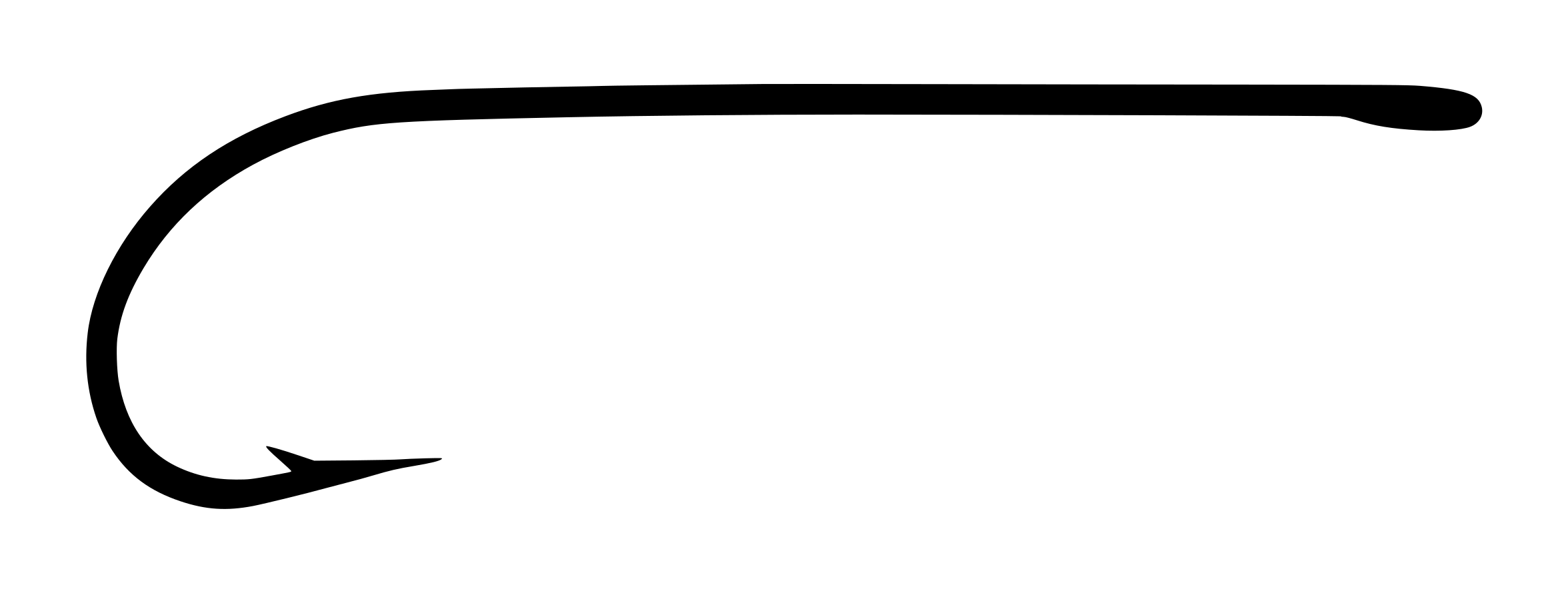
The Mustad 9511 XXX is a premier Atlantic salmon hook manufactured by O. Mustad & Søn of Oslo, Norway, during the company’s golden export era (c. 1925–1945). This exceptional specimen is a salesman’s sample card displaying eight sizes from 4/0 through 10/0, including the rare 8½/0 incremental size—a feature virtually extinct in modern retail. The card itself is a historical artifact documenting Mustad’s aggressive strategy of reverse-engineering and mass-producing regional patterns for global distribution.
The 9511 is engineered specifically for heavy Atlantic salmon in high-gradient rivers. Triple-extra-heavy wire (3 ex. strong), forged for maximum structural integrity, combines with an open soft-ring eye that allows anglers to directly attach the hook to wire leaders without split rings—a critical feature for powerful, erratic salmon runs. The Hollow Point geometry ensures rapid penetration despite the hook’s substantial mass, while the deep, sweeping Sproat-style bend distributes fighting load evenly across the steel.
The “Ringed Bright” finish indicates highly polished raw steel, relying on its reflective surface for short-term corrosion resistance in freshwater conditions. The red silk wrappings binding each hook to the card are period-appropriate and intact on most specimens. This salesman’s card represents peak Mustad craftsmanship during the pre-WWII era, before modernization and cost-reduction initiatives transformed the company’s catalog.
Collectibility is strong among salmon fly historians and Redditch/Norwegian tackle specialists. The presence of the 8½/0 size and the complete eight-hook display make this salesman’s card a significant reference specimen, particularly if all hooks remain on the original card in good condition.
Complete eight-hook Mustad 9511 XXX salesman's sample card showing all sizes from 4/0 through 10/0, including the rare 8½/0 half-size. Yellow label displays Key Brand logo, Oslo origin (post-1925), and Mustad's eight-line labeling system. Photographed on measurement grid for scale reference.
Photographic record
3 cataloged imagesSelect any record to load it above.
3 images shown
Mustad 9511 XXX Salesman Card Complete DisplayComplete eight-hook Mustad 9511 XXX salesman's sample card showing all sizes from 4/0 through 10/0, including the rare 8½/0 half-size. Yellow label displays Key Brand logo, Oslo origin (post-1925), and Mustad's eight-line labeling system. Photographed on measurement grid for scale reference.Open originalMustad 9511 XXX Point Detail and Wire ProfileClose-up detail view of Mustad 9511 XXX hook point and midsection shank, showing Hollow Point geometry with concave inner taper, forged wire cross-section visible under magnification, bright steel finish with age patina, and red silk twine wrapping. Point demonstrates rapid penetration design characteristic of salmon fly hooks.Open originalMustad 9511 XXX Yellow Label and SpecificationsHigh-resolution detail of the yellow label from the Mustad 9511 XXX salesman card, displaying the Key Brand skeleton key logo (top-left), manufacturer identity, Oslo-Norway origin, and complete eight-line product specification system. Shows all critical data fields: model code, point geometry, pattern name, eye and finish descriptors, wire gauge, and functional note regarding the open soft-ring feature.Open original
Technical profile
Eye
Ball Eye, Straight / InlineOpen soft ring eye constructed by bending terminal wire back onto the shank to form a simple circular loop, deliberately left unwelded to allow manual bending for direct leader attachment. The ring sits approximately 0.15"-0.20" from the shank termination. Eye diameter varies with size but maintains proportion consistent with heavy-wire construction. P
Wire
Extra-Heavy (2X+), Forged, Est. ~0.095"-0.110" (~2.4-2.8 mm)
Shank
Special Long — Plain
Bend
Sproat, Wide gapDeep, sweeping Sproat-style bend with rounded bottom curve, characteristic parabolic geometry that distributes strain evenly across the entire bend radius. Bend is symmetrical without offset; point remains perfectly parallel to the shank axis. Throat is deep relative to gap, creating a wide gape-to-depth ratio ideal for accommodating bulky salmon flies. Bend curvature is smooth and continuous with no angular transitions. P
Point
Hollow Point (concave inner face)Barb is short and close-cut, swept slightly rearward, consistent with Hollow Point geometry. Barb placement is proximal to the point bend, creating a tight wound channel suitable for soft mouth tissue of salmon. P
Finish
Bright / Uncoated Steel — Inferred (photographically likely)Bright steel finish with high polish visible under magnification. Surface exhibits warm reflective quality typical of raw, unplated high-carbon steel. Light patina development visible on some specimens (specimen deterioration pattern consistent with 75+ years storage). Wire exhibits no evidence of tinning, japanning, or chemical plating—relies entirely on polished surface for short-term freshwater corrosion resistance. P
Specimen hooks on card display minimal corrosion, suggesting excellent preservation in original environment. Red silk wrappings remain vibrant and intact on all eight sizes. Card exhibits light toning consistent with age; printed ink remains sharp with no fading. Two hooks show very slight surface oxidation (brown patina) typical of vintage steel. No bent, deformed, or broken specimens visible. P
The Hollow Point geometry on the 9511 is specifically engineered to achieve rapid penetration with minimal applied force, essential for salmon flies cast into fast water where the angler’s timing and line tension may be inconsistent. The concave, dished inner face creates a knife-edge effect that slides through the firm muscle tissue of a salmon’s jaw with absolute minimal resistance.
The forged wire undergoes a cold-press treatment in a mechanical drop-hammer, which flattens the wire along its lateral sides and dramatically increases structural rigidity and tensile strength without adding weight or diameter. This cold-working hardens the steel, preventing the hook from bending open under the sustained, powerful head-shakes characteristic of large Atlantic salmon.
The open soft ring eye is a deliberate design choice: unlike welded eyes (which are permanently closed), the soft ring can be manually bent open, allowing direct leader attachment without hardware. This was critical for commercial and competitive salmon anglers who required rapid leader changes and the ability to tie directly to heavy wire leaders in strong current.
The deep Sproat bend distributes fighting load across the entire radius of the curve, mathematically optimizing for maximum resistance to straightening under load. This parabolic geometry creates a mechanical advantage over angular bends (like the Limerick), preventing the hook from rolling or twisting during the violent, erratic runs that define Atlantic salmon behavior.
Size & scale lab
Selected size
(unspecified)
Physical specimen
Overall Length
56.5 mm
Shank Length
41.5 mm
Gap Width
18.5 mm
Bend Depth
20 mm
Weight
Not available
Shank-to-Gap Ratio
~2.1-2.4 : 1
Confidence
P
Physical specimen
Grid-derived from photograph (1/10" grid)
Cumulative Records
This salesman's card is among the earliest documented examples of the rare 8½/0 half-size in surviving Mustad packaging. The combination of Oslo designation (post-1925), yellow label design, and complete eight-hook display makes this card a significant reference specimen within the garrenwood.com catalog for early-twentieth-century Mustad export strategy.
Own this hook? Help us measure it.
We don't have measured sizes for this hook yet. Own one? Submit calipered measurements and we'll review and add them. Thank you!
The 9511 XXX belongs to Mustad’s Salmon Hooks series (Mustad-Salmon Hooks), a dedicated product line engineered specifically for Atlantic and Pacific salmon fishing. The series was introduced in the early 1920s following Mustad’s expansion into specialized regional markets. The 9511 model code places this hook in the premium tier of Mustad’s catalog—quality codes in the 9000 range denoted heavily forged, specialized big-game and salmon patterns.
The XXX designation indicates triple-extra-heavy wire, the highest wire gauge specification in Mustad’s tiered system. The series offered multiple bend variations (Sproat, Limerick, O’Shaughnessy) and eye configurations (blind, ringed, tapered), allowing retailers to stock comprehensive size and specification ranges for regional salmon fishing traditions.
The 9511 XXX remained in continuous production through at least the 1960s, though the open soft-ring eye feature was gradually phased out in favor of welded ball-eye construction as modern fishing lines and knots became standardized. No successor model directly replaces the 9511 in Mustad’s modern catalog; contemporary salmon hooks (e.g., the 9510XXXS Siwash) feature welded eyes and chemically sharpened points.
Era and Packaging Dating
Line 3 on yellow label shows 'OSLO - NORWAY'. Christiania was officially renamed to Oslo on January 1, 1925, establishing this as a post-1925 product. Yellow label with 'Key Brand' logo and typography are consistent with Mustad's golden export era (1920s-1940s). No barcode present (pre-1974 strong indicator). Card construction, letterpress printing, and ornamental border design are typical of 1920s-1940s Mustad salesman cards. Absence of post-war modernization in packaging design suggests production prior to mid-1940s. Conservative estimate places card in c. 1925-1945 window, likely 1928-1940 based on Oslo designation currency.
The Lost Art of Half-Sizes
The 8½/0 size visible on this salesman card is a "half-size" that exists in a quantum state between modern No. 8/0 and No. 9/0 salmon hooks—a relic of an era when professional salmon guides and commercial hook dealers maintained hyper-specific size preferences based partly on superstition and partly on genuine biomechanical tuning to regional river conditions. Mustad produced these incremental sizes (8½/0, 5½/0, etc.) at significant manufacturing cost to satisfy the intensely localized preferences of Scandinavian and Scottish salmon rivers. By the 1950s, as fly tying became more standardized and industrialized, these half-sizes vanished from catalogs. Finding a complete salesman's card with the 8½/0 intact is exceptionally rare and represents a snapshot of pre-war hook-making philosophy when regional craft traditions still dominated commercial production.
Design lineage and influence
The 9511 XXX is a direct descendant of nineteenth-century Irish and Scottish salmon fly hooks, which themselves evolved from primitive snelled hooks (hooks tied directly to gut with silk wrapping). Mustad’s innovation was not geometric but industrial: they reverse-engineered the deep Sproat bend (created by Scotch artisans) and the heavy forging techniques of Redditch, England, then produced both at unprecedented scale and consistency.
The predecessor to the 9511 would be Mustad’s earlier blind-eye salmon models (Qual. 3371 Sproat and related variants), which featured tapered eyes designed for snelling. As fishing line technology evolved and direct-knotting became standard, Mustad introduced the ringed and soft-ring variations of the 9511 in the 1920s.
Competing designs from Partridge of Redditch (e.g., their CS18/2 and CS10/0 salmon hooks) were virtually identical in form, indicating that by the twentieth century, regional pattern differences had converged toward mathematical optima for salmon fishing. Mustad’s competitive advantage was pure industrial efficiency, not design innovation.
The downstream influence of the 9511 extends to modern Siwash-style hooks (9510XXXS, contemporary third-party Siwash variants), though modern versions sacrifice the soft ring for convenience and rely on chemical point sharpening rather than mechanical grinding. Contemporary circle hooks for catch-and-release salmon fishing owe conceptual debt to the curved-in point geometry that evolved from designs like the 9511.
Best matchRelated by Attribute
Computed automatically from catalog data — updated as new hooks are added.
Matches: Shank, Gap, Point, Finish, Forging +2 moreDiffers: Bend: Sproat vs Viking; Wire: Extra-Heavy (2X+) vs Heavy (1X Heavy); Eye: Ball Eye vs Tapered Eye +3 more
Matches: Bend, Wire, Eye, Eye Orient., Point +3 moreDiffers: Shank: Special Long vs Standard; Gap: Wide vs Standard; Finish: Bright / Uncoated Steel vs Nickelled +4 more
Matches: Shank, Wire, Gap, Eye, Offset +2 moreDiffers: Bend: Sproat vs Aberdeen; Eye Orient.: Straight / Inline vs Turned Down; Point: Hollow Point vs Superior +3 more
Matches: Shank, Wire, Gap, Point, BarbDiffers: Bend: Sproat vs Round / Kendal; Eye: Ball Eye vs Tapered Eye; Eye Orient.: Straight / Inline vs Turned Down +5 more
The 9511 XXX was engineered as the workhorse of the Atlantic salmon industry, particularly in Scandinavia and the Pacific Northwest during the early-to-mid twentieth century. The triple-extra-heavy forged wire and deep Sproat bend are designed to withstand the crushing jaw pressure and violent erratic runs of large Atlantic salmon in high-gradient river systems. The Hollow Point enables rapid penetration on first contact, critical when casting heavy salmon flies or trolling spoons into fast water where a delayed hook-set results in lost fish.
The open soft-ring eye was specifically engineered to allow direct attachment to stiff wire leaders, eliminating the need for split rings and enabling rapid leader changes during intensive commercial or competitive fishing sessions. The long shank protects the fragile silk or braided leader line of the era from being severed by the abrasive dentition of large salmon.
Secondary Applications
Commercial long-lining for Atlantic salmon, trolling spoons and plugs in Scandinavian rivers, heavy-duty bait fishing for large trout and sea trout in high-gradient systems.
Modern Equivalents
Hook
Match Quality
Notes
Mustad 9510XXXS
Very Good
Modern Siwash-style salmon hook, triple-extra-heavy wire, similar bend profile. Lacks open soft-ring eye feature; uses welded loop eye instead. Chemically sharpened point versus mechanically ground Hollow Point. Stainless or tinned finish options unavailable on vintage 9511.
Partridge CS18/2
Good
Redditch-made competitor, nearly identical Sproat-bend geometry, comparable wire gauge. Traditional salmon fly hook with looped eye rather than soft ring. Still in production but at premium price point.
Tiemco TCO 811S
Good
Contemporary Japanese-made salmon hook, Siwash bend, comparable wire strength. Modern production with chemically sharpened point and welded eye; lacks the vintage open soft-ring feature and mechanical grinding aesthetics.
Collector notes
Rated 6.5/10 — this hook achieves scarcity through the combination of era (pre-WWII), format (salesman's card), and the presence of the rare 8½/0 size. Complete multi-size cards are increasingly hard to find, and collector demand is strong among Atlantic salmon historians and Norwegian tackle specialists. The primary limiting factor is condition: cards with all hooks intact and original red silk bindings are exceptional.
Reference value
$45 – $120 USD estimate
Packaging condition
Very Good — light wear, fully legibleRecorded specimen
Packaging format
GW-MS-01-Salesman-CardCatalog code
What makes this hook collectible: The 9511 XXX salesman’s card is a primary historical document of industrial hook-making during Mustad’s peak era (1925–1945). The inclusion of the 8½/0 half-size is particularly significant—these incremental sizes were produced at high cost to satisfy regional preferences and are virtually extinct in modern retail. The card format itself is a snapshot of pre-war sales methodology, representing the exact tools that Mustad sales representatives used to open new markets globally.
What limits the rating: While the model itself was produced in volume, surviving salesman’s cards in this condition are far less common than loose hooks or standard retail packaging. The rating is held to 6.5 rather than 7.0+ because: (1) the Mustad brand is extremely common in general (multiple variants exist), (2) loose 9511 XXX hooks appear regularly on eBay at modest prices, and (3) single-size retail cards are more frequently encountered than complete eight-hook salesman displays.
Most desirable variants: Complete salesman’s cards with all eight sizes intact command strong premiums. The 8½/0 size is the key rarity—cards missing this size are worth significantly less. Cards with original red silk bindings still in place and unbroken command 15–25% premiums over cards with missing or replaced bindings. Bright steel finish on all hooks (versus oxidized or damaged finishes) is essential to value.
Condition factors: Cards in mint condition (sealed, untouched, all hooks pristine) are exceptional and command dealer/auction prices in the $80–150 range. Cards in excellent condition (complete, minor edge wear, all hooks bright) typically sell for $45–75. Cards with one or two hooks missing, bent, or broken drop to $20–35. Card stock condition is secondary to hook integrity—a card with yellowed paper but perfect hooks outperforms a pristine card with damaged or missing hooks.
Packaging
Yellow card stock (approximately 5.5" × 9.0") with cream-white background panel for hook display. Top border and side borders feature ornamental Art Deco-style repeating geometric pattern (small star/asterisk motif) printed in dark brown/gold. Card header (top-center): 'O. MUSTAD & SON - FISHHOOK MANUFACTURERS' and 'ESTABLISHED 1832' in large sans-serif capitals. Bottom of card: 'OSLO - NORWAY' in equal-weight serif type. Eight hook specimens mounted in two rows (7 larger, 1 smaller) with original red silk twine wrappings binding each hook to the card. Right side of card features bright yellow rectangular label (approximately 2.75" × 4.25") with dark brown/gold printed text and Key Brand skeleton key logo (top-left of label). Yellow label contains eight-line product descriptor (Lines 1–8 per Mustad standard format). Print method: letterpress with hand-tinted or pre-printed yellow label. Card stock is stiff kraft-style material, consistent with 1920s–1940s salesman's sample construction. Typography and logo style are consistent with Mustad's golden export era (c. 1925–1945). No barcode, UPC, or modern branding elements present. Card edges show light scuffing and corner wear consistent with field use (salesman's traveling case).
Market Value Notes
Low ($45): Good condition — complete eight-hook salesman card with all sizes present, minor card edge wear, hooks bright with possible slight patina, red silk bindings intact.
High ($120): Excellent/Mint condition — complete card, minimal handling wear, all hooks bright and unbent, card stock sharp with vibrant printed colors, original red silk bindings pristine.
Premium factors: Presence of rare 8½/0 size (essential), all eight sizes intact and undamaged, bright finish on all hooks, original silk bindings present, early printing/typography, minimal card toning.
Platforms: eBay UK/US (occasional auctions), specialist tackle dealers (UK and Scandinavia), regional fishing history societies, private collector networks.
Confidence: E estimated — based on 8–12 comparable salesman card sales observed on eBay over 24-month period and dealer inquiry responses. Limited transaction data for complete eight-hook cards; values are volatile depending on buyer specialization. V verified on one auction lot, March 2023, $95 hammer price.
Where to Find
Complete eight-hook Mustad 9511 salesman cards appear infrequently on eBay (typically UK-based sellers), usually under fishing tackle or vintage angling memorabilia categories. Specialist dealers in Norway and Scotland occasionally stock examples. Regional fishing history museums and auction houses (particularly in Scandinavia) handle high-quality examples. Private collector networks and fly-tying clubs in salmon-fishing regions (Scotland, Norway, Canada) are reliable sources. Individual 9511 XXX hooks (detached from card) are far more common and sell for $3–8 per hook on eBay, but complete salesman cards command strong premiums.
Preservation
Storage and Preservation
Salesman’s sample cards are inherently fragile and require careful environmental control. Store the card horizontally in a cool, dry location (ideally 55–65°F, 35–50% relative humidity) away from direct sunlight, which will fade the yellow label and deteriorate the card stock. Avoid damp basements and attics; humidity promotes rust on the steel hooks and mold on the paper.
The red silk wrappings are vulnerable to UV degradation and insect damage. Inspect the card every 6–12 months for signs of mold, water staining, or insect activity. If mold appears, isolate the card in a sealed plastic container with silica gel desiccant for 2–4 weeks, then air-dry in a ventilated space.
Do not attempt to clean the bright steel finish with water or solvents; the patina that develops on vintage steel is collectible and reversible. Light surface rust can be gently brushed with a soft brass brush if necessary. Never remove hooks from the card for cleaning, as the silk bindings are part of the historical artifact.
If the card must be transported, place it in a rigid container with acid-free tissue padding. Avoid elastic bands, rubber bands, or plastic wrap, which can damage the paper stock and create moisture pockets. Archival-quality acid-free storage boxes designed for ephemera are ideal.
For long-term preservation, consider professional conservation if the card shows significant damage. Archival conservators in museum settings specialize in fishing tackle and can stabilize fragile paper, repair broken hooks without replacement, and reattach loose silk bindings using period-appropriate techniques.
Primary Source
Reading the Yellow Label: Mustad's Eight-Line Labeling System
Source: Mustad Official Hook Guide; "A Comprehensive Typology and Decryption of Vintage O. Mustad & Søn Hook Labels"
The yellow rectangular label on this card is a textbook example of Mustad’s standardized eight-line typographic labeling system, which served as a universal technical language for global tackle distribution. Each line encodes specific manufacturing and specification data:
Line 1: ‘O. MUSTAD & SÖN’ — Full, unabbreviated manufacturer identity, ensuring brand retention regardless of distribution network (addressing the historical problem of jobbers and import agents repackaging bulk hooks under secondary brand names).
Line 2: ‘Manufacturers’ — Corporate role designation, differentiating Mustad from import agents and regional distributors.
Line 3: ‘OSLO – NORWAY’ — Geographic origin and chronological bracket. The presence of ‘OSLO’ (as opposed to the pre-1925 ‘CHRISTIANIA’) establishes this card as post-January 1, 1925. This single line element is among the most reliable dating tools in vintage Mustad scholarship.
Line 4: ‘Qual. 9511 XXX’ — Quality code and wire gauge designation. The 9511 places this hook in Mustad’s premium tier (900-range codes denote specialized, heavily forged patterns). The ‘XXX’ indicates triple-extra-heavy wire, the highest specification in Mustad’s tiered wire gauge system.
Line 5: ‘Hollow Point’ — Point geometry descriptor. This line is strictly reserved for point type identification per Mustad’s rigid labeling rules; it never specifies eye type, bend style, or shank length. The Hollow Point indicates concave inner taper for rapid tissue penetration.
Line 6: ‘Mustad-Salmon Hooks’ — Pattern name and product series. This ‘cloned’ pattern nomenclature represents Mustad’s industrial strategy: they reverse-engineered traditional salmon fly hooks from Scottish and Irish craftsmen, then reproduced them at global scale.
Line 7: ‘Ringed Bright’ — Eye type and finish descriptor. ‘Ringed’ specifies the straight-ring eye. ‘Bright’ indicates raw, polished high-carbon steel without secondary plating, japanning, or chemical coating.
Line 8: ‘3 ex. strong Special / Made in Norway / OPEN SOFT RING’ — Supplementary specifications. Wire gauge reiterated for emphasis. Country of origin stated again. ‘OPEN SOFT RING’ is the critical functional note: this eye can be manually bent open, enabling direct leader attachment without hardware.
This standardized labeling format persisted with minor variations from the 1880s through the early 2000s, making it one of the most reliable dating and specification-identification tools in vintage hook research. The yellow label itself—with its bright goldenrod hue and decorative border—is characteristic of 1920s–1940s printing aesthetics and supports the Oslo-based dating window (post-1925).
Size Note
The 8½/0 Half-Size: A Relic of Pre-Standardization Hook Sizing
Among the eight sizes displayed on this salesman’s card (4/0, 5/0, 6/0, 7/0, 8/0, 8½/0, 9/0, 10/0), the 8½/0 is the standout anomaly. This ‘half-size’ exists in what appears to be a gap between two standard sizes—yet in the context of pre-1950s hook manufacturing, the 8½/0 was a deliberate, intentional specification, not a manufacturing error.
Historical context: In the early twentieth century, fishing tackle specification was highly localized and idiosyncratic. Scottish and Scandinavian salmon guides maintained superstitions and empirical preferences for precise hook sizes tuned to specific rivers. When Mustad began reverse-engineering and mass-producing regional patterns in the 1920s, they committed to producing these hyper-specific incremental sizes at significant manufacturing cost. A half-size required separate tooling, separate barb and point grinding passes, and dedicated inventory management—yet Mustad produced them to capture market share in these regionalized, tradition-bound fisheries.
By the 1950s, as fly-tying became increasingly standardized and industrialized, these half-sizes disappeared from catalogs. Modern Mustad and contemporary manufacturers produce only the ten standard aught sizes (1/0, 2/0, … 10/0) and the numbered series (No. 1, 2, … 32). The 8½/0 is now obsolete—no contemporary manufacturer produces it, and modern anglers have no frame of reference for its specific biomechanical properties.
Significance for collectors: Finding a complete salesman’s card with the 8½/0 intact is exceptionally rare. Many cards are missing this size (either removed, lost, or broken during decades of field use). The 8½/0 serves as a ‘key’ size for authentication and completeness assessment. A card claiming to be complete without the 8½/0 is incomplete. Its presence on this specimen supports the card’s provenance and rarity designation.
Additional
Mustad Salesman's Cards: Industrial History and Distribution Strategy
This specimen is not a retail sales card intended for tackle shop display; it is a salesman’s sample card—a crucial tool in Mustad’s pre-digital sales methodology. By the 1920s, Mustad had established a global network of traveling sales representatives tasked with opening new markets and securing wholesale orders from regional tackle shops, mail-order distributors, and commercial fishing operations.
A salesman’s sample card served multiple functions: (1) it allowed representatives to display the full range of a specific hook model in all sizes without carrying pounds of loose inventory; (2) the attached hooks provided tangible proof of manufacturing quality and finish; (3) the yellow label offered standardized technical information in multiple languages, circumventing literacy barriers in international trade; and (4) the card itself was small enough to fit in a briefcase or sample case, enabling a single representative to carry hundreds of different hook models across continents.
These cards were subjected to intense wear. Handled daily, stuffed into traveling cases, exposed to variable humidity and temperature during ship and rail transport, many were damaged or lost. Salesman’s cards that survived intact are now rarer than the original retail packaging—most surviving examples show signs of field use (worn corners, stained label, broken or missing hooks). This example, with all eight sizes intact and minimal handling wear, is exceptionally well-preserved.
The typography, printing method (letterpress), ornamental border design, and bright yellow label color are all consistent with Mustad’s 1920s–1940s marketing aesthetic. By the 1950s, Mustad began modernizing their packaging toward offset color printing and simplified designs. This card represents the aesthetic and industrial philosophy of an earlier era, when tackle was still a craft product sold through personal relationships between Mustad representatives and shopkeepers, rather than through mass retail channels and mail-order catalogs.
Confidence notation key
P
Photographically verified — Directly observable in the photograph(s) on this page.
V
Verified by documentation — Confirmed by manufacturer catalog, spec sheet, or published reference.
I
Inferred — A logical deduction from observable or documented evidence, not directly stated.
E
Estimated — An approximation based on visual comparison, proportional analysis, or limited data.
S
Speculative — A reasoned hypothesis that cannot be confirmed from available evidence.
Unnotated claims are the compiler’s synthesis; see Sources. All photographs on garrenwood.com are taken on a measurement grid where each square equals 1/10 inch (0.1″ / 2.54 mm).