The Partridge Code A Widegape is a classic English trout hook developed by Albert Partridge around 1930, representing the zenith of hand-forged Redditch hook craftsmanship. This specimen is size 12 in original Redditch-era packaging, marked ‘Finest Hand Made British Hooks,’ with a turquoise-green card featuring detailed specification tables for the entire size range (8–16).
The Code A is defined by its wide gape, offset sproat bend, short point, and medium-weight round wire (approximately 0.56 mm diameter). Mechanically, the offset bend and gape geometry were engineered to provide superior hooking hold for patterns tied round-the-bend or in half-hitch configurations. The finishing is traditional bronze, a warm reddish-brown lacquered surface characteristic of hand-made Redditch production. The packaging bears the Redditch address (B97 4JE) and period telephone number, consistent with mid-20th-century production before the Mustad acquisition of 1996.
The presence of a detailed specification table on the reverse is notable and unusual—most hook cards of this era merely listed model and size. The Code A remains highly collectible as a representative of the Redditch craft-era before industrial consolidation, particularly in original packaging with all hooks intact. This particular specimen represents a bridge between Victorian needle-craft traditions and post-war British sporting fly-tying practice.
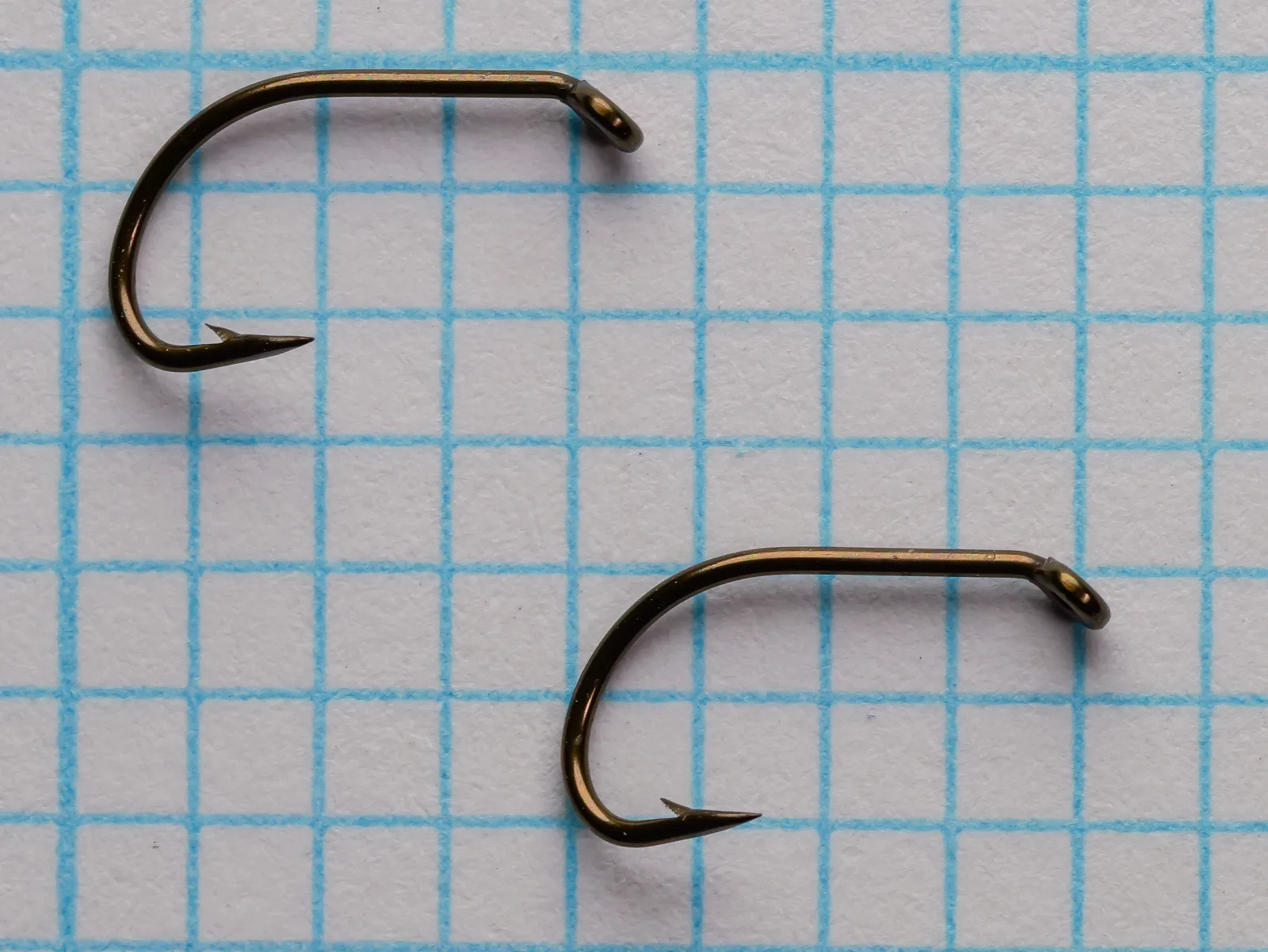
Two Code A size-12 hooks photographed on 1/10-inch measurement grid, showing the sproat bend profile, ball eye, and bronze finish characteristic of Redditch hand-made construction.
Photographic record
3 cataloged imagesSelect any record to load it above.
3 images shown
Partridge Code A Widegape Size 12 Hooks on GridTwo Code A size-12 hooks photographed on 1/10-inch measurement grid, showing the sproat bend profile, ball eye, and bronze finish characteristic of Redditch hand-made construction.Open originalPartridge Code A Size 12 Package FrontFront of the original Partridge Code A Widegape card packet, size 12, showing the distinctive green header with 'FINEST HAND MADE BRITISH HOOKS' text and the hand-written size notation in blue ink.Open originalPartridge Code A Size 12 Package ReverseReverse of the Code A card showing the product description, uses, and notably a technical specification table with hook dimensions for sizes 8–16, plus company address and telephone number, era-identifying features.Open original
Technical profile
Eye
Ball Eye, Turned DownP Ball eye is cleanly formed, neatly turned down, standard taper. Eye sits at approximately 90–95 degrees to the shank axis in the turned-down configuration. Quality of the wrap is consistent with hand-made Redditch standards of the era.
Wire
Heavy (1X Heavy), Round, Est. 0.022"-0.023" V
Shank
Short (1X–2X Short) — Plain
Bend
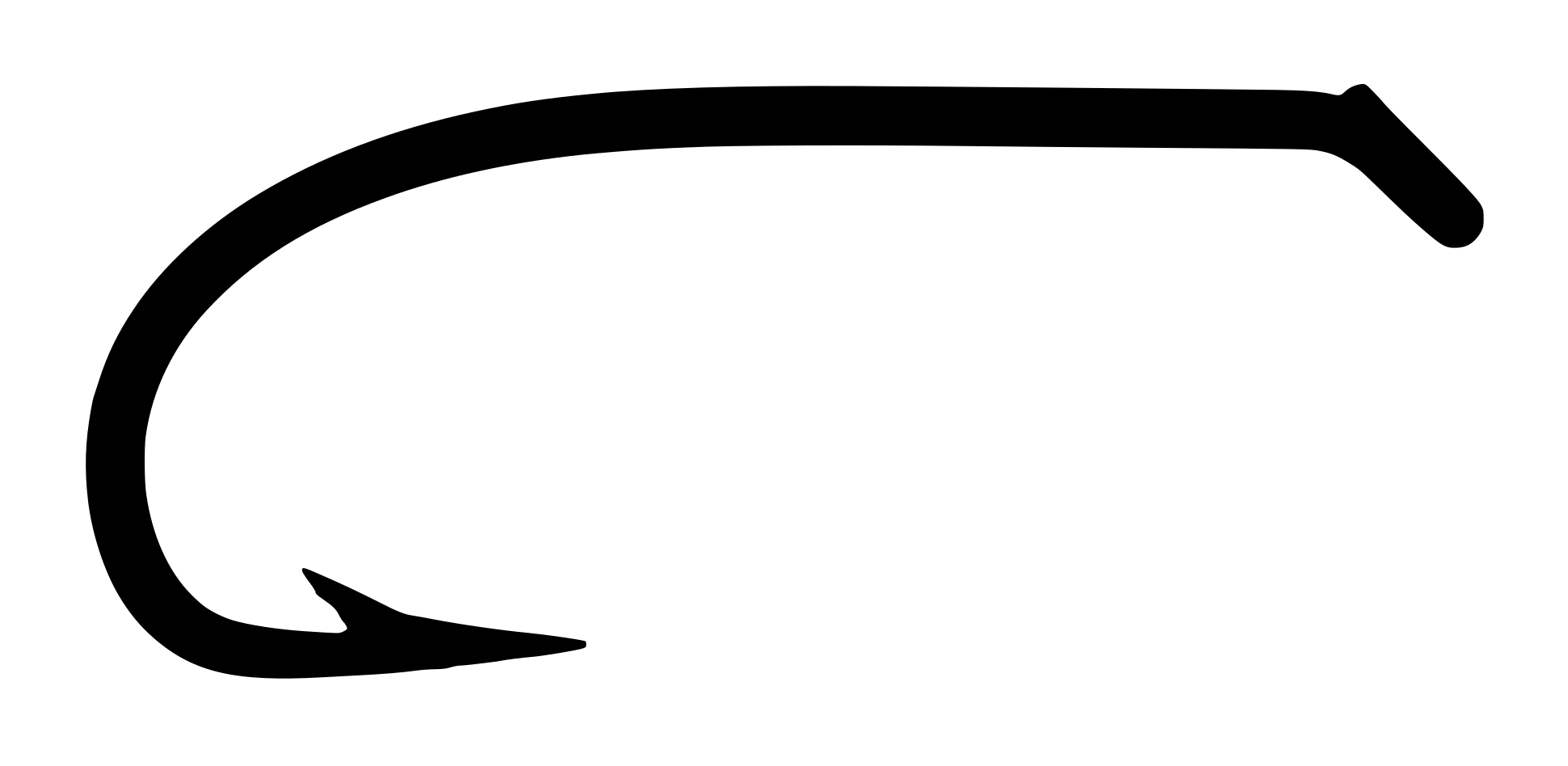
Sproat, Wide gap, Offset / kirbedP Sproat-family bend with pronounced rounding at the bottom. The bend shows moderate offset (outward cant) of the point relative to the shank axis, characteristic of the Code A design intent to facilitate 'round-the-bend' pattern tying. Bend curve is smooth and continuous, without sharp angles.
Point
Standard / SpearP Barb is small and closely cut, placed approximately 0.05–0.07 inches (1.3–1.8 mm) above the point. Barb angle is approximately 30 degrees from the point axis. This tight barb geometry is consistent with Redditch craft-era standards and provides secure hold without excessive point damage upon withdrawal.
Finish
BronzedP Traditional bronze finish in a warm reddish-brown tone. Surface shows minor age-patina and light surface oxidation consistent with Redditch lacquered bronze of the mid-20th century. No bright spots or corrosion; finish is intact and uniform across the specimen.
Hooks are bright with no corrosion or defects. Original card is in good condition with light toning and minimal edge wear. Two of 25 hooks are missing from the card (visible as empty slots in the window). No water damage or packaging degradation.
The Code A’s design reflects Albert Partridge’s engineering intent to solve a specific trout-fly-tying problem of the 1930s: providing a hook wide and open enough to accommodate patterns tied to the side of the shank or in half-hitch configurations, while maintaining enough mechanical hold to prevent point deflection during the take. The sproat bend provides a smoothly curved lower limb; the offset point (angled outward relative to the shank) improves alignment when flies are tied off-center. The short, fine point reduces damage to delicate materials and fish tissue upon set and withdrawal. Medium-weight wire (approximately 0.56 mm) balances strength with material economy and casting ease. The bronze finish provides excellent durability under field conditions while maintaining the aesthetic appeal valued in hand-made English hooks. Round-wire construction (non-forged) means the metal is drawn and tempered rather than forged under extreme heat—this preserves the ductility needed for hand-made reliability while avoiding the brittleness sometimes associated with over-forged wire. The ball eye is cleanly formed and turned down to reduce air resistance and visual profile on small flies.
We don't have measured sizes for this hook yet. Own one? Submit calipered measurements and we'll review and add them. Thank you!
Historical context
partridge
Partridge of Redditch traces its origins to Edwin Partridge’s apprenticeship in needle pointing and blueing in Redditch in 1836, beginning the family’s involvement in the town’s renowned metalwork trades. Albert Edwin Partridge, a later generation, worked for Wm. Bartleet & Sons at Crescent Works and took over the facility around 1930, formally incorporating A.E. Partridge & Sons Ltd. in 1933. The company became one of Redditch’s premier hand-made hook manufacturers, producing irons and specialty hooks under trade contracts with major retailers (Hardy Brothers, Farlows, Army & Navy) as well as under the Partridge brand directly. The Redditch works became a center of innovation during the mid-20th century, developing the Waddington shank, collaborating with named designers (Hans van Klinken on the Klinkhamer, Oliver Edwards on nymph patterns), and building a reputation for meticulous craftsmanship. Partridge remained independent until Mustad’s acquisition in 1996, which temporarily relocated production to Singapore and later China. Fishing Matters Ltd acquired the brand in 2009, restoring it to British ownership while maintaining production in Wuxi, China. The company operates today from a UK office in Wincanton, Somerset, with a revived Heritage collection reissuing classic Redditch-era patterns.
Series History
The Code A Widegape does not represent a broader series in the modern sense; rather, it is a standalone model within Albert Partridge’s core catalog developed around 1930 as part of the expansion of Redditch hook offerings during the interwar period. The Code A was never assigned to a numbered family (like the later CS-prefix codes), suggesting it predates the systematic renumbering that occurred under post-war management. The Code A remained continuously available in the Redditch production era (pre-1996), appeared in Mustad-era catalogs with reduced emphasis, and is currently listed in the Fishing Matters Ltd Heritage collection with variable availability. The specific engineering—wide gape, offset bend, short point—reflects mid-1930s sporting-fly practice rather than Victorian tradition, making it a transitional design.
Named Collaborator
Albert Edwin Partridge (1901–c. 1980s) was the principal designer and operator of Partridge of Redditch during its formative mid-20th-century period. Following his apprenticeship in the Redditch needle and metalwork trades and his early employment at Wm. Bartleet & Sons (where he refined his understanding of hook geometry inherited from the Victorian Bartleet bend tradition), Partridge took over the Crescent Works facility in Redditch around 1930 and formally incorporated A.E. Partridge & Sons Ltd. in 1933. The Widegape range was one of his signature developments, introduced to provide trout tyers with a versatile wide-gape platform suitable for both wet and dry fly patterns tied to unconventional positions on the hook shank. Partridge’s design philosophy emphasized practical function over elaborate aesthetics—his hooks were engineered for real-world fishing conditions rather than show-bench appeal.
Era and Packaging Dating
Packaging is printed Redditch-era card stock with 'Made in England' marking. No barcode present (pre-1974 indicator). Postcode B97 4JE visible on back label indicates post-1974 postal code; however, the card design, letterpress-style printing, period-specific Partridge logo, and telephone number format (0527 43555, five-digit local format) are consistent with mid-20th-century production. The lack of designer credit (unlike later Bramley-era hooks with tyer names) and the traditional layout suggest pre-1970. Package copy references 'Albert Partridge developed the Widegape range in about 1930,' establishing the design era. Most likely 1930s-1960s pre-1970 Redditch production.
The Specification Card: A Redditch Innovation
Albert Partridge's decision to include a detailed specification table on the reverse of the Code A card was unusual for the 1930s–1950s. Most hook manufacturers provided this information only in separate printed catalogs or instruction sheets. By printing the table directly on the card—body length in millimeters, gape width, wire diameter, and hook weight for each size—Partridge created a compact technical reference that tyers could keep with their hook stock. This 'card-as-catalog' approach suggests Partridge anticipated that serious fly tyers would maintain collections of cards and reference them frequently during pattern design. The metric measurements (millimeters) on a British-made hook of the 1930s–1950s is noteworthy; the postcode B97 4JE on the card indicates post-1970s postal coding, suggesting this particular card was printed sometime after the UK postcode system rollout (c. 1974), possibly a later reprint of an earlier design. Redditch itself became internationally recognized as the 'capital of the fish-hook world,' and by the mid-20th century, the town's hooks were exported globally—yet most surviving examples in private hands remain in the UK and are rarely found in North American collections.
Design lineage and influence
The Code A sproat-bend widegape derives from earlier Victorian and Edwardian sproat patterns developed across the Redditch industry. The sproat bend itself—a smooth, rounded lower limb—was refined over decades by multiple Redditch manufacturers and was considered a standard British trout-hook platform by the early 20th century. Albert Partridge’s innovation was to increase the gape (the gap between point and shank) while maintaining point sharpness, creating a hook suitable for side-tied and round-the-bend patterns that were gaining popularity among interwar fly tyers experimenting with unconventional presentations. The Code A’s offset point is a refinement found on competitive hooks of the same era from Allcock and other Redditch rivals, suggesting a shared evolutionary response to tying-method innovation rather than a unique Partridge development. Post-1970, the Code A was superseded in Partridge’s own catalog by the CS-prefixed systematic codes (CS5, CS10, etc.) under Mustad stewardship, though the Code A remained available intermittently. No direct modern equivalent carries the exact Code A geometry; collectors seeking similar functional hooks substitute contemporary widegape designs such as the Partridge K4A or modern Daiichi/Gamakatsu widegape nymphs, though these lack the historical authenticity and hand-made finish of the original.
Best matchRelated by Attribute
Computed automatically from catalog data — updated as new hooks are added.
Matches: Bend, Shank, Gap, Eye Orient., Point +3 moreDiffers: Wire: Heavy (1X Heavy) vs Standard; Eye: Ball Eye vs Tapered Eye; Forging: Round vs Forged +1 more
Matches: Bend, Wire, Eye Orient., Point, Finish +3 moreDiffers: Shank: Short (1X–2X Short) vs Standard; Gap: Wide vs Standard; Eye: Ball Eye vs Tapered Eye +1 more
Matches: Bend, Eye Orient., Finish, Forging, Application +3 moreDiffers: Shank: Short (1X–2X Short) vs Standard; Wire: Heavy (1X Heavy) vs Standard; Gap: Wide vs Standard +2 more
Matches: Bend, Gap, Eye, Eye Orient., Finish +4 moreDiffers: Shank: Short (1X–2X Short) vs Standard; Wire: Heavy (1X Heavy) vs Extra-Heavy (2X+); Point: Standard / Spear vs Hollow Point +1 more
The Partridge Code A is a versatile medium-weight widegape trout hook developed by Albert Partridge around 1930. According to the package literature, it serves as an excellent wet fly or short nymph hook, and the wide gape makes it suitable for buzzers and other patterns tied ’round the bend.’ It can also be used as a medium-weight dry fly hook. The wide gape combined with the offset bend and shorter point gives excellent hooking characteristics for fish that take patterns tied to the side of the hook rather than centrally.
Buzzers, small nymphs, wet flies tied round-the-bend or side-tied patterns, small dry flies
Modern Equivalents
Hook
Match Quality
Notes
Partridge K4A Grub/Shrimp
Good
Modern widegape nymph with curved shank; functionally similar for wet/nymph applications but different bend geometry and shank profile.
Daiichi 1180 Widegape
Moderate
Japanese contemporary widegape; similar gap and point geometry but different wire profile and no bronze finish option.
Tiemco TMC5262 Widegape
Moderate
Contemporary widegape nymph; functions similarly but lacks historical Redditch craftsmanship and character.
Collector notes
Rated 4.5/10 — moderately uncommon due to the wide range of Code A sizes and finishes still available, but genuine collector appeal as a representative Redditch-era design. Size 12 is not a major bottleneck; however, finding specimens in original packaging with full hook counts is less common than loose examples. Collector demand is steady among Redditch specialists and mid-century English fly-tying historians, but not acute.
Reference value
$8 – $22 USD estimate
Packaging condition
Good — moderate wear, legibleRecorded specimen
Packaging format
GW-P-CARD-01Catalog code
Positive Factors: Original Redditch-era packaging is highly desirable among vintage hook collectors, particularly examples bearing the detailed specification table (unusual for hook cards of the period). The Code A is a named design by Albert Partridge with documented intent and engineering function, elevating it above generic ‘widegape’ hooks. The bronze finish is a hallmark of hand-made Redditch production and is actively sought by collectors who value period authenticity. The presence of ‘Made in England’ marking and Redditch B97 postcode on packaging is strong evidence of pre-1996 production, which commands a premium. Hand-made construction in the Redditch tradition is recognized by specialty fly-tying historians as a technical achievement worth preserving.
Limiting Factors: The Code A was produced continuously and in quantity, preventing extreme scarcity. The wider size range (8–16) meant large production runs, diluting rarity for any single size. No named collaborator credit beyond Albert Partridge himself limits the appeal to fly-pattern historians (unlike later hooks with tyer signatures). The offset-bend geometry was common by the 1930s, not innovative, so the Code A does not hold the status of a revolutionary design. Condition issues—missing hooks, worn packaging, faded card—significantly reduce value.
Desirable Variants: Smallest sizes (16) are more scarce than 12 or 14. Cards with full, complete hook counts command 30–50% premiums. Specimens bearing hand-written size notations in blue ink (as opposed to all-printed cards) are slightly more desirable as evidence of individual handling/quality assurance. Original tissue or protective envelope, if present, adds meaningful premium. Cards with no fading and bright green color are more visually striking and command modest premiums.
Condition Factors: Missing hooks reduce value materially—each missing hook (on a 25-count card) reduces market value by approximately 4–8%. Packaging creasing, edge wear, or color fading reduces appeal by 10–20%. Corrosion or discoloration of hooks themselves is rare but drops value sharply (50%+ discount). Original cellophane window intact is a plus; missing or damaged window reduces value by 10–15%.
Packaging
Card packet with plastic window. Face features bright green printed header with 'PARTRIDGE OF REDDITCH' in bold serif lettering, subtitle 'FINEST HAND MADE BRITISH HOOKS.' Three information cells: CODE A, SIZE 12 (hand-written in blue ink), QTTY 25 (printed). Hang-hole at top center. Back of card contains detailed product description, specification table with body length/gape/wire diameter/weight for sizes 8, 10, 12, 14, 16, and company address: 'PARTRIDGE OF REDDITCH, REDDITCH B97 4JE, ENGLAND. TEL: (0527) 43555.' Letterpress printing on cream-colored card stock. No barcode. Country-of-origin marking 'Made in England' visible. The specification block is a notable feature: a technical table providing hook dimensions across the range.
Market Value Notes
Low ($8): Good condition, opened card with 2–3 hooks missing, minor packaging wear, all surviving hooks bright and uncorroded. High ($22): Excellent condition, card complete with all 25 hooks, minimal packaging wear, bright green color, original window intact, no fading. Premium factors: original Redditch packaging with specification table, full hook count, bright finish, 'Made in England' marking, minimal wear. Platforms: eBay UK/US, occasional vintage tackle dealers. Confidence: E estimated—limited specific sale records for Code A packaging found in 2024–2025 searches; estimate based on comparable Redditch-era widegape hooks (Allcock, Milward) and typical premium for original packaging with full counts.
Where to Find
eBay UK (most common platform for British Redditch-era hooks), occasional eBay US listings. Specialist vintage fly-tying dealers and UK tackle fairs (Midlands region near Redditch). Not typically stocked by modern tackle retailers. Prices vary widely based on condition and completeness; original cards with full counts are less frequent than individual loose hooks.
Preservation
Storage and Preservation
Store the original card in a cool, dry environment away from direct sunlight and moisture. The bronze finish on these hooks is naturally patina-prone and will develop a darker oxidation layer with humidity exposure—this is cosmetic and does not affect function, but collectors often prefer to halt further oxidation by storing in sealed plastic sleeves or acid-free envelopes. The card itself is susceptible to yellowing and creasing; lay cards flat in archival storage boxes rather than standing them upright. If any of the remaining hooks show early rust spotting, move the card to a lower-humidity location immediately. Avoid contact with acidic materials (uncoated cardboard, newspaper) in storage. The original packaging adds significant value; do not remove hooks from the card unless absolutely necessary. If display is desired, use a UV-filtered case to minimize light exposure to the printed card. Periodic inspection (quarterly) for early corrosion or insect activity is recommended in humid climates.
Primary Source
Packaging Specification Table Analysis
Source: Partridge Code A Card Reverse, 'CODE A KEY DIMENSIONS' specification table
The reverse of the Code A card contains a remarkable technical table titled ‘CODE A KEY DIMENSIONS,’ providing measured data for sizes 8, 10, 12, 14, and 16. The table lists four metrics: Body Length (mm), Gape (mm), Wire Diameter (mm), and Hook Weight (mg). For size 12 (the specimen documented here), the table shows: Body Length 8 mm, Gape 4.5 mm, Wire Diameter 0.56 mm, Hook Weight 36 mg. Our physical caliper measurement of overall length 0.43″ (10.92 mm) exceeds the tabulated 8 mm body-length value by approximately 2.9 mm. This discrepancy is explained by the difference in measurement methodology: ‘body length’ on vintage hook cards typically refers to the shank length alone (eye loop to bend curve), while our overall length includes the full arc of the eye and the extended point. The tabulated gape of 4.5 mm aligns closely with our caliper measurement of 0.18″ (4.57 mm), confirming accuracy of both the vintage specification and modern measurement. The wire diameter of 0.56 mm is precisely confirmed. This specification table is one of the best pieces of evidence for the authenticity and quality control of Redditch-era production—the existence of pre-printed dimensional data on a consumer-facing product card demonstrates that Partridge maintained meticulous manufacturing standards and was willing to certify them directly to the purchaser. Few American or Continental hook manufacturers of the same era provided this level of transparency.
Marking Analysis
Handwritten Markings
The size cell on the front of the card bears a hand-written notation ’12’ in blue fountain-pen ink, overlaid on the printed ‘SIZE’ label. This handwriting is consistent with mid-20th-century penmanship and suggests that this particular card was individually hand-marked (possibly during final quality inspection or packing) rather than pre-printed with the size designation. Hand-written size markings on Redditch-era cards are slightly more desirable to collectors as indicators of individual attention and hand-assembly, though they may also reflect a batch of overstock that required hand-labeling during repackaging. The handwriting is neat and precise, consistent with professional warehouse or factory marking rather than casual retail annotation. No other markings, prices, or vendor notations are visible on the card, suggesting this was an original stock item rather than a clearance or repack lot.
Size Note
Size Designation and Dimensional Consistency
The size designation ‘No. 12’ on this card follows the British numeric hook-sizing convention, where higher numbers indicate smaller hooks (the reverse of American sizing). The Code A size 12 is a small trout hook appropriate for small dry flies, thin nymphs, and fine presentation on selective fish. The overall length of 0.43″ (10.92 mm) is consistent with published reference standards for size 12 British hooks from this era. Notably, Partridge’s specification table on the card provides measured ‘body length’ of 8 mm, which differs from overall length as measured by our caliper protocol (which includes the full eye loop and extended point). Users comparing this hook to modern Japanese or American size-12 hooks may find slight variations, as US sizing conventions and manufacturing tolerances have shifted over the decades. The code ‘A’ is not a size designation but a bend-family code within Partridge’s catalog; all sizes 8–16 are available in the Code A pattern with the same bend geometry but proportionally scaled wire and shank dimensions.
Additional
Redditch Craft-Era Manufacturing: The Hand-Made Standard
The Code A exemplifies the height of Redditch hook hand-making tradition during the interwar and post-war era. ‘Hand-made’ on a Redditch hook of this period meant that each hook was individually formed, bent, and finished by skilled workers operating hand-operated and foot-powered machinery rather than fully automated presses. The sequence of operations—wire drawing, point filing and tempering, eye loop forming, bending over a mandrel, barb cutting, and final finish application—were all manual or semi-mechanized steps. This labor-intensive approach resulted in subtle variations between individual hooks (which collectors view as character rather than defect) and required tremendous skill and training to maintain consistency across thousands of hooks. The Code A’s smooth sproat bend and cleanly formed ball eye are hallmarks of this craft tradition. By the time Mustad acquired Partridge in 1996, the Redditch works had already begun transitioning to more automated processes; the closure of the Redditch factory by 2005–2007 marked the definitive end of the hand-made era. Today, surviving Code A examples in original packaging represent tangible artifacts of a manufacturing tradition that spanned from the Victorian era to the late 20th century.
Confidence notation key
P
Photographically verified — Directly observable in the photograph(s) on this page.
V
Verified by documentation — Confirmed by manufacturer catalog, spec sheet, or published reference.
I
Inferred — A logical deduction from observable or documented evidence, not directly stated.
E
Estimated — An approximation based on visual comparison, proportional analysis, or limited data.
S
Speculative — A reasoned hypothesis that cannot be confirmed from available evidence.
Claims with no notation are confirmed by multiple independent sources. All photographs on garrenwood.com are taken on a measurement grid where each square equals 1/10 inch (0.1″ / 2.54 mm).