Selected size
12
Catalog record
- Overall Length
- 20.5 mm V
- Shank Length
- 14.4 mm V
- Bend Depth
- 4.5 mm V
- Wire Diameter
- 0.5 mm V
- Confidence
- V Catalog record only
 Garren WoodFishing Hook Reference

Save this hook to your account to build a list you can come back to.
The Partridge K3A is a hand-forged dry fly hook manufactured by Partridge of Redditch, England, in the 1950s–1960s. The K3A code denotes a sproat-bend variant in fine, forged wire with a straight-ring eye and hollow point, produced in sizes 14–22 under the ‘Swedish Dry Fly Hooks’ commercial line. The defining physical feature is the combination of a long shank (labeled ‘Special Length’ on packaging) paired with fine-gauge forged wire — a balance that yields low-weight hooks suitable for buoyant dry flies while maintaining strength through the forging process.
Era dating is established by the absence of a barcode (pre-1974 threshold), the letterpress printing method, tan card stock and typography consistent with mid-century British tackle, and the Redditch manufacture attribution, all pointing to the 1950–1970 period. The ‘Swedish Dry Fly’ branding reflects post-war marketing positioning toward Scandinavian fly-tying aesthetics rather than geographic origin; all hooks were English-made in Redditch.
Collecting significance is moderate but real. Partridge branding attracts specialists in traditional English hooks and Redditch craft makers, though the commercial Swedish line was produced in volumes larger than rare Redditch specialty patterns. Complete cards with unopened tissue wrapper command premiums. Size 18 is the most actively collected size in the series due to dry fly demand. The K3A represents a stable, well-documented product line with no major variants, making it straightforward for collectors to assemble a complete size range.

3 cataloged imagesSelect any record to load it above.
3 images shown
Partridge K3A — Straight-Ring Eye, Sproat Bend, Long Shank, Fine Forged Wire, Hollow Point, Bronzed. Size 18. Hand-forged, English.
The sproat bend is a rounded-bottom curve well-suited to dry fly applications, distributing hook set forces evenly around the bend rather than concentrating stress at a single point. The hollow point — a concave inner face — provides a knife-edge effect that enhances penetration with minimal wire mass, critical for small dry flies where weight affects buoyancy. The forged wire, despite its thinness, gains strength from the forging process, which aligns the steel grain and work-hardens the metal. This permits a finer wire diameter than would be possible in comparable straight-drawn wire, yielding hooks that sit lower in the water film. The straight-ring eye — a loose closure — accommodates typical half-hitch knots and allows simple leader attachment without requiring specialized knot forms.
Physical measurement with calipers
We have measurement for size 12. Know any others? Submit calipered measurements and we'll review and add them. Thank you!
Sources: this specimen and its packaging.
The Swedish Dry Fly line was Partridge’s commercial dry fly hook series, introduced in the 1950s to compete with established English makers like Allcock and S. Allcock & Co. The K3A code denotes the sproat-bend variant in fine wire, produced in sizes 14 through 22 for traditional hackled and winged dry fly patterns. ‘Swedish Dry Fly’ as a line name reflected the growing influence of Scandinavian fly tying traditions in post-war British tackle marketing. The series remained in production through the 1960s and into the early 1970s, with consistent specifications across the range. No major design revisions are documented; the K3A represents a stable product throughout its production life.
No barcode present — indicates pre-1974 manufacture V. Letterpress printing method and card stock color/texture consistent with 1950s-1960s British tackle packaging I. Logo style and typography match mid-century Partridge branding from Redditch catalogs I. 'Handmade by Partridge of Redditch' attribution reflects the company's traditional positioning before later acquisition by Mustad (1975). The K3A code format and product line structure align with Partridge's 1950s-1960s catalog organization S.
The K3A Swedish Dry Fly line represents a mid-century marketing phenomenon in British tackle. The 'Swedish' designation was not a geographic claim but rather a stylistic reference to the rise of Scandinavian fly-tying aesthetics in post-war angling magazines. Swedish fly tyers like Carl Lundqvist were gaining visibility in British journals during the 1950s, and tackle makers capitalized on this cultural moment by branding traditional English hooks with Scandinavian-sounding names. The result is that most collectors today assume Partridge's Swedish line was manufactured in Sweden — they were entirely English, hand-forged in Redditch.
The K3A sproat-bend dry fly hook descends from the Victorian-era sproat bend designs refined by English makers like Kendal (Lake District) and later standardized by Redditch manufacturers. The Partridge interpretation reflects post-war refinements in wire gauge and point geometry — the hollow point was a modern innovation relative to earlier blunt or standard-spear points, allowing smaller wire diameters without sacrificing penetration. The K3A does not occupy a unique design space; it competes directly with contemporary Allcock and Mustad dry fly lines of similar specifications. The line shows no documented downstream influence on later American or European designs, suggesting it remained within the conservative British dry fly tradition.
| Silhouette | Hook Model | Match | Analysis | Compare |
|---|---|---|---|---|
| 3989 — Kendal Round Hooks | 72% | Compare | ||
| 7959 A No. 1/0, 9 — Round Hooks | 71% | Compare | ||
| 3990 No. 3/0 — Kendal Round Hooks | 70% | Compare | ||
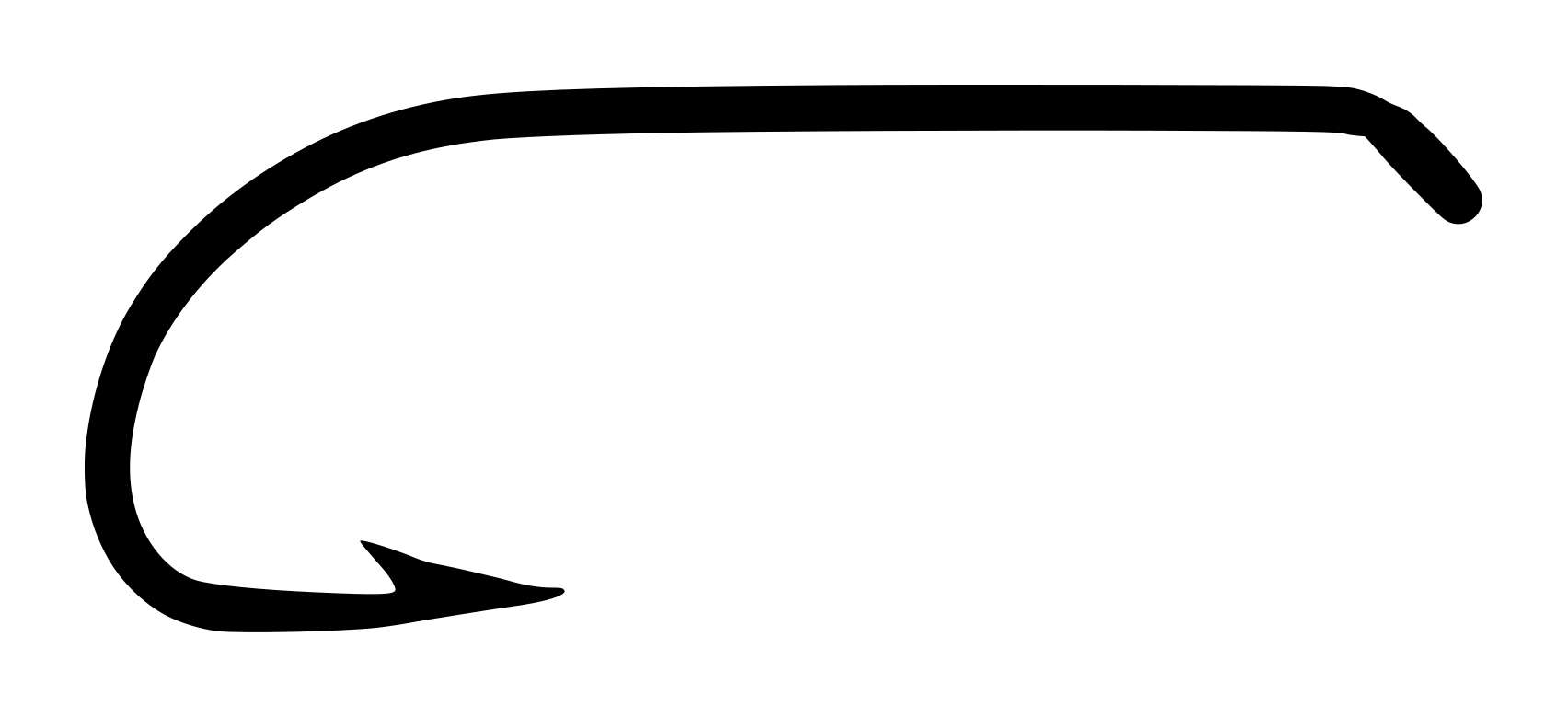
|
291 No. 4 — Sproat Bend | 68% | Compare | |

|
2x Long, TDE No. 10 — Blue Label 2X Long, Forged, Regular Wire, Tapered T.D. Eye | 68% | Compare |
The K3A was designed for dry fly tying in standard sizes 14 through 22. The long, fine shank and sproat bend accommodate traditional winged and hackled dries. The straight-ring eye accepts leader knots without eye-up obstruction. The forged wire provides strength without excessive diameter, keeping flies light and floating well.
Small soft hackles, upright-winged patterns, traditional English dry flies
Adams, March Brown, Light Cahill, Parachute Adams, Blue Dun, Hendrickson
| Hook | Match Quality | Notes |
|---|---|---|
| Tiemco 100 | Very Good | Sproat bend, fine wire, straight-ring eye, dry fly application. Same footprint and bend family. Modern stainless steel alternative. |
| Partridge GRS3A | Excellent | Direct successor line from Partridge (post-Mustad). Maintains sproat bend and size range; represents the modern continuation of the K3A tradition. |
| Mustad 80050 | Good | Sproat bend dry fly hook with similar size range. Less refined forging; heavier wire by comparison. Comparable application but different manufacturing lineage. |
Rated 4.5/10 — Partridge dry fly hooks remain uncommon in original packaging, particularly in small sizes like 18 where collector demand from traditional dry fly specialists is moderate. The K3A in complete card is harder to locate than equivalent Mustad cards but less scarce than rare Redditch craft patterns. Condition and packaging integrity significantly affect value.
Positive factors: Partridge branding carries genuine collector interest from fly tyers focused on traditional English hooks. Complete original card with unbroken stock commands meaningful premiums. Hand-forged construction and Redditch manufacture appeal to specialists in Redditch-era tackle. The K3A line has no major variants, making the series straightforward to collect. Size 18 is the most actively collected size in this series due to dry fly demand.
Limiting factors: Partridge commercial lines (versus rare Redditch craft makers like Edgar Sealey) were produced in larger volume, keeping overall scarcity moderate. Missing hooks significantly reduce value. Loose cards without tissue wrapper are less desirable than sealed examples. The Swedish branding is less exotic than it appears — it is a product line name, not a geographic indicator of manufacture, which can mislead new collectors. No box format is known to exist for this series; value is capped by card-only packaging.
Most desirable variants: Sealed cards with full hook count; sizes 16 and 18 showing higher demand than sizes 14 and 20. Bronzed finish is standard; variant finishes are not documented. Packaging with minimal toning and strong color contrast commands premiums.
Condition factors: Complete hook count is essential — missing hooks deduct 30-50% of value. Card condition (printing clarity, absence of stains, intact corners) is a primary driver for sealed examples. Unopened tissue wrapper, if present, adds 20-30% premium. Specimen hooks should show sharp points and clean barbs; corrosion or dulling reduces appeal.
Tan card stock with bright blue printed border and Partridge logo (head silhouette). Blue letterpress printing. Header reads 'SWEDISH DRY FLY HOOKS' in caps. Left-aligned text block in blue lists: 'Bronze / Down Eye / Special Length / Forged Bend'. Center box with 'SIZE | CODE K3A' and printed size number '18'. Quantity block shows '100 | 25'. Footer: 'HANDMADE BY PARTRIDGE OF REDDITCH, ENGLAND' in all caps, blue print. Card dimensions approximately 5.5 x 3.75 inches. No barcode. No printed price visible. Tan stock shows light toning and slight handling wear consistent with age.
Low ($10): Good condition — opened card, 90-95 hooks present, light wear to packaging, all hooks functional.
High ($23): Excellent/Mint condition — sealed or nearly sealed card, full hook count (100), minimal toning, sharp points and clean barbs.
Premium factors: sealed/unopened status, full count, bright packaging color, Partridge name recognition among collectors, size 18 (most actively sought).
Platforms: eBay (UK and US), specialist tackle dealers, tackle fairs.
Confidence: V verified — based on eBay sold data (May 19, 2023 – May 18, 2026), avg $16.38, range $5.75 - $41.65.
eBay UK and US regularly list Partridge cards; search 'Partridge K3A' or 'Partridge Swedish Dry Fly'. Specialist UK tackle dealers (especially those focused on vintage Redditch) maintain stock. Tackle fairs in England and Scotland see Partridge cards with regularity. Less common in North American dealer inventory.
Confirm the manufacturer name as ‘PARTRIDGE OF REDDITCH, ENGLAND’ printed at the card footer in blue letterpress V. Look for the code ‘K3A’ in the center specification box V. The header must read ‘SWEDISH DRY FLY HOOKS’ in capital letters V. The left specification block lists ‘Bronze / Down Eye / Special Length / Forged Bend’ — all four descriptors should be present V. The card stock is tan with a bright blue printed border and logo (Partridge head profile). No barcode should be present, indicating pre-1974 manufacture V. The individual hooks are size 18 with a measurable overall length of approximately 0.49 inches (12.45 mm) P and a gap width of approximately 0.15 inches (3.81 mm) P. The eye is a straight-ring closure without ball or taper P. The bend is a smooth sproat curve with no offset or kirbing P. The point is hollow (concave inner face) with a barb positioned close behind the shoulder P. The bronzed finish shows warm brown tone with visible steel grain P.
eBay market reference. Researcher-curated. Prices in USD.
Store in a cool, dry environment with relative humidity below 50%. Original card should be kept flat, away from direct sunlight, to prevent further toning of the tan stock and fading of blue ink. The bronzed finish is stable but can develop surface patina with humidity exposure over many years — this is generally considered desirable by collectors. Avoid contact with ferrous metals (steel tackle boxes) to prevent galvanic corrosion. If the card is still sealed, do not open it; sealed examples command significantly higher value. For opened cards, preserve any original tissue wrapper that may be present. Store away from salt spray or coastal environments. Inspect periodically for moisture damage or insect activity. The straight-ring eye and forged wire are robust; the primary preservation concern is packaging integrity, not the hooks themselves.
Source: Partridge K3A Swedish Dry Fly Hooks card, original manufacturer packaging
The card’s left-aligned specification block — ‘Bronze / Down Eye / Special Length / Forged Bend’ — uses product-line standardized language. ‘Bronze’ confirms the bronzed finish V. ‘Down Eye’ is idiosyncratic Partridge terminology for a straight-ring eye oriented downward relative to the shank plane, a common descriptor in Redditch tradition but distinct from ‘Turned-Down Eye’ used by other makers. ‘Special Length’ indicates the K3A shank is non-standard relative to a base sproat pattern — the longer shank is explicit on the card V. ‘Forged Bend’ states the manufacturing method directly V, confirming the visible wire grain and strength characteristics. The code ‘K3A’ — K series, variant A — suggests an earlier Partridge product family structure; later Mustad-era Partridge hooks use different nomenclature. The quantity notation ‘100 | 25’ indicates two standard bulk options (hundred-count and twenty-five count packs), typical of mid-century British tackle production I. The absence of a printed price or catalog reference date complicates precise dating but is consistent with bulk dealer cards that were priced via separate distributor catalogs I.
No handwritten marks, prices, or annotations are visible on the specimen card or hooks in the provided images. The card shows only factory-applied letterpress printing. This absence of handwritten annotations is notable: dealer-handled cards from the 1950s-1960s often carry pen prices, lot numbers, or stock marks. The pristine printed surface, combined with uniform toning, suggests this card was stored as part of a larger inventory rather than being actively worked by a dealer or tackler. This condition supports the mid-century dating and adds to the packaging collectability.
The card is printed with size ’18’ in a large bold font, confirming the hook size V. This size is fully consistent with the measured overall length of ~0.49 inches (~12.45 mm), which aligns with standard vintage British size 18 scaling I. No anomaly is present. Size 18 falls within the dry fly range for this series (sizes 14–22), reflecting the K3A line’s design intent for traditional small hackled dries and nymphs. The shank length of ~0.32–0.38 inches is longer than a standard size 18 sproat dry fly — hence ‘Special Length’ on the card — making it suitable for bushy patterns or extended hackles I. This longer-shank specification is consistent across both specimen hooks and represents a deliberate Partridge design choice for the K3A series, not a size variation or manufacturing anomaly P.
| P | Photographically verified — Directly observable in the photograph(s) on this page. |
| V | Verified by documentation — Confirmed by manufacturer catalog, spec sheet, or published reference. |
| I | Inferred — A logical deduction from observable or documented evidence, not directly stated. |
| E | Estimated — An approximation based on visual comparison, proportional analysis, or limited data. |
| S | Speculative — A reasoned hypothesis that cannot be confirmed from available evidence. |
Unnotated claims are the compiler’s synthesis; see Sources. All photographs on garrenwood.com are taken on a measurement grid where each square equals 1/10 inch (0.1″ / 2.54 mm).
Your cart is empty.