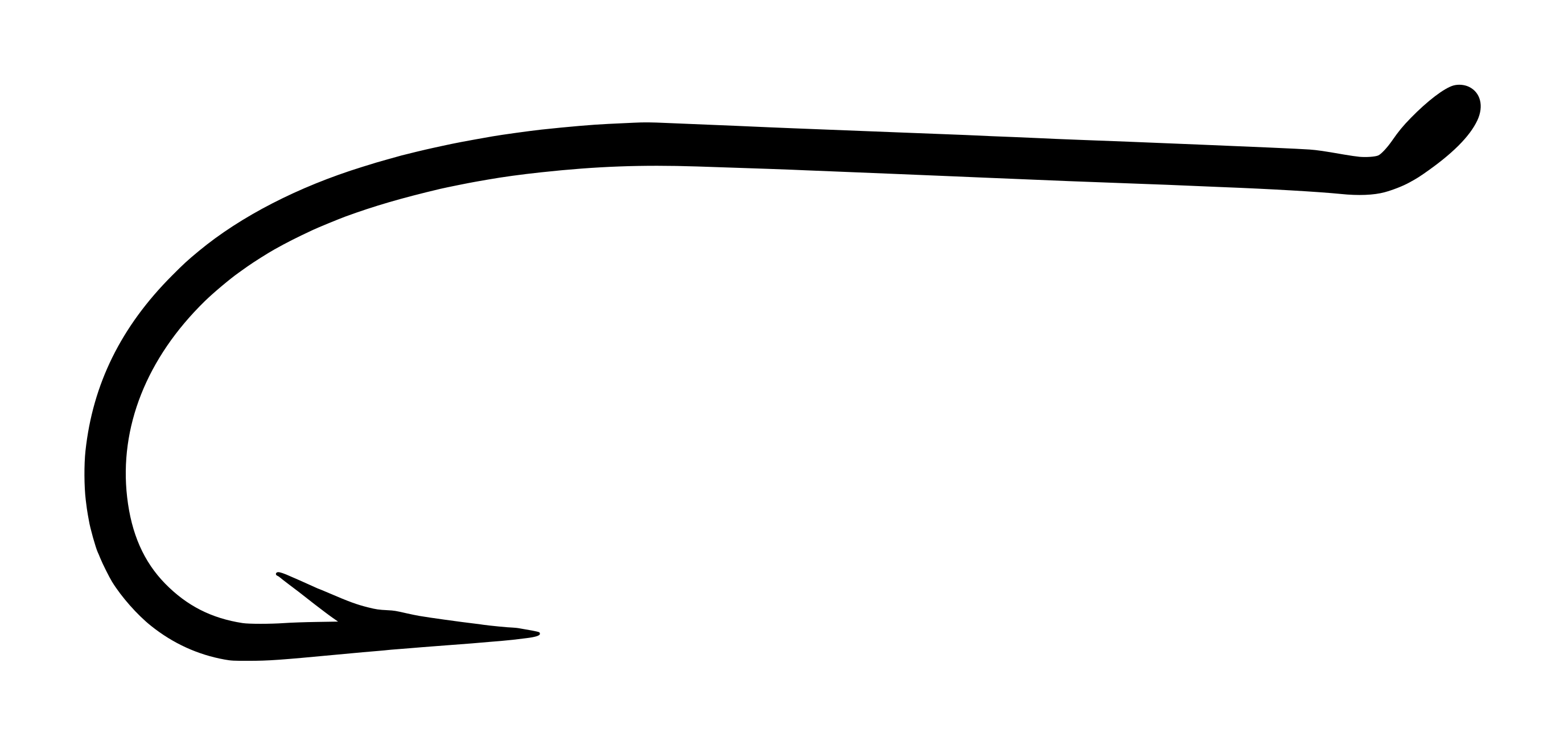
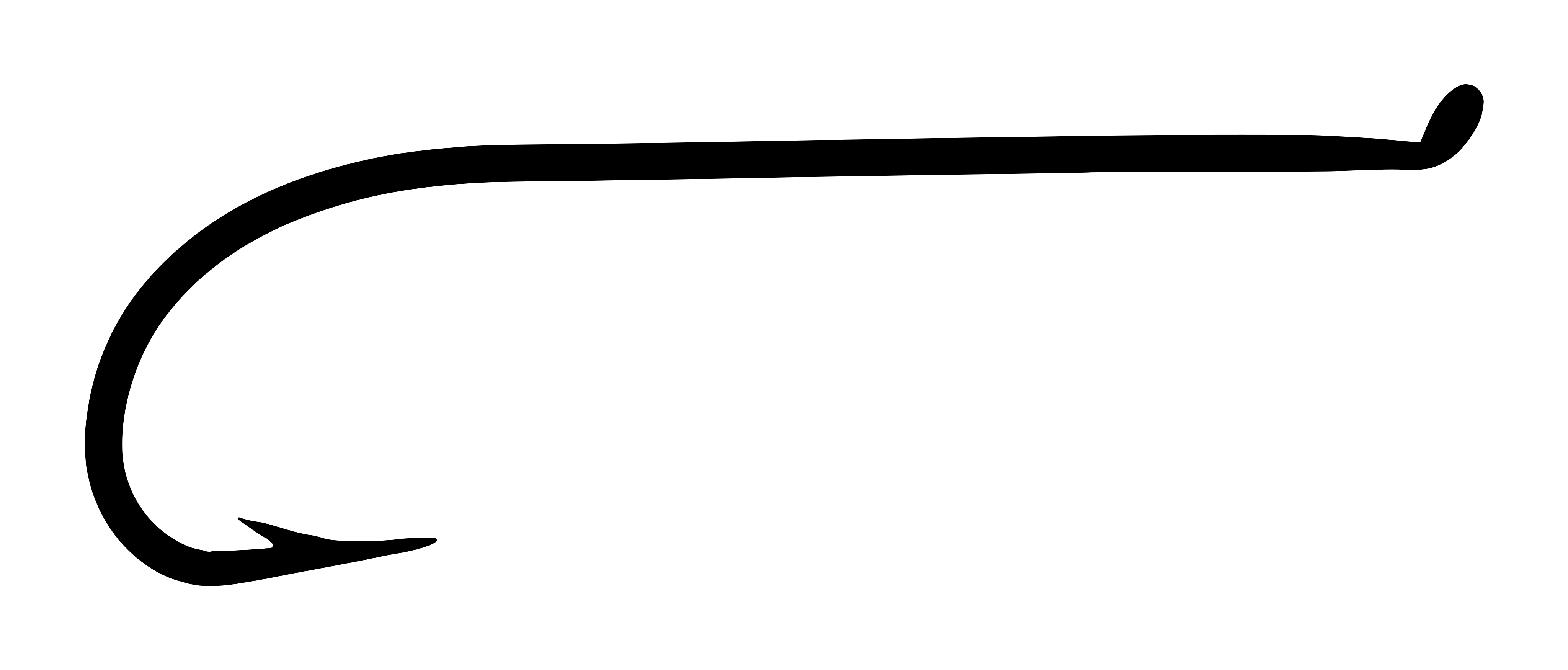
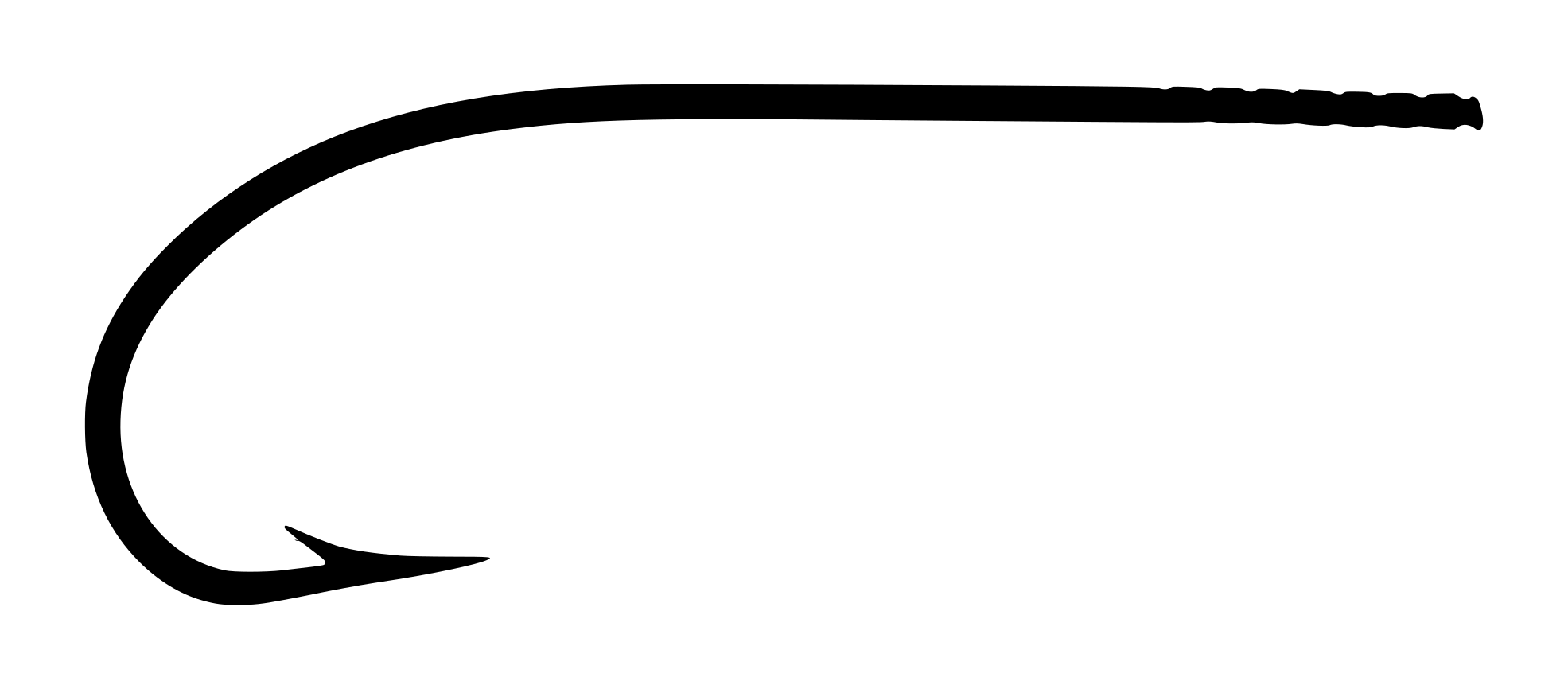
The Mustad 3911 B is a mid-century Norwegian streamer and wet-fly hook featuring a fine-wire Sproat bend with tapered eye and bronzed finish. Size No. 4 with an exceptionally long shank relative to standard patterns, this model exemplifies Mustad’s mid-twentieth-century export packaging and manufacturing standards.
The “Oslo – Norway” address and yellow letterpress Key Brand label date the specimen to approximately 1950–1965, representing the period after Christiania’s 1925 rename but before Mustad’s shift to modern global branding. The special long shank and fine wire construction were specifically engineered for classic streamer tying — patterns like the Black Ghost, Mickey Finn, or Grey Ghost — where a long profile was needed without the weight that would cause the fly to sink unnaturally or foul in the water.
This hook is moderately collectible due to its rarity in documented size No. 4 and the historical significance of the Oslo-era packaging. Larger sizes (1/0, 2/0) remain common, but size 4 and smaller require active searching. The original card in good condition significantly increases value among fly-tying historians and vintage tackle collectors.
Mustad 3911B - point
Photographic record
6 cataloged imagesSelect any record to load it above.
Tapered Eye, Turned UpTapered up eye (T.U.E.) — the wire diameter visibly tapers as it approaches the eye loop, significantly reducing bulk at the hook head. This taper is intentional and characteristic of fine-wire dry-fly and light-streamer patterns designed to maintain neutral or positive buoyancy. The eye loop itself is small and proportionate to the fine wire gauge. P
Wire
Extra-Fine, Round
Shank
Standard — Plain
Bend
Sproat, Standard gapClassic Sproat pattern with a parabolic, slightly modified round bend. The bend is smooth and continuous with no angular features (distinguishing it from Limerick). Moderate depth relative to standard round bends, providing enhanced holding power through distributed stress. The bend is symmetrical and centered on the shank axis. Wire is set cleanly in the bend with no visible distortion or wobble. P
Point
Hollow Point (concave inner face)Small, close-cut barb positioned at the end of the tapered point section. The barb is set inward at a slight angle, typical of Hollow Point geometry. Barb length is approximately 0.3–0.4 mm, well-proportioned to the fine wire gauge. The barb is clean and sharp with no visible wear or dulling on the specimen. P
Finish
Bronzed — Confirmed (stated on packaging)Bronzed finish with a warm brown-gold hue typical of mid-century Mustad bronzing process. The color is uniform across the specimen with no visible flaking or chipping. The finish exhibits a slightly matte patina rather than a high gloss, characteristic of aged lacquer-based bronzing. Warm tone indicates traditional alkyd resin-based lacquer coating rather than a purely metallic bronze plating. Minor age-related toning is visible but does not indicate deterioration of the underlying steel. P
Both specimen hooks are bright and show no corrosion or rust. Steel surfaces retain their original bronzed finish with minor patina from age storage. Original card and box are in good condition with light creasing and toning consistent with 60+ year old paper stock. No hooks are missing from the original package of 100 (card appears complete).
The hollow point geometry on the 3911 B is engineered to achieve rapid tissue penetration with minimal applied force. The concave profile of the outer cut — ground from the very tip down to the base of the barb — creates a razor-sharp tip that flares rapidly toward the barb. This design is biomechanically suited to soft-mouthed species and situations requiring a light hook-set.
The tapered eye reduces the physical mass at the hook head, which is critical for dry-fly and light-streamer applications where weight distribution directly affects buoyancy and water-surface behavior. Modern fly tyers often call this feature a “2024” eye when describing contemporary hooks, though the principle dates back to Mustad’s mid-century fine-wire designs.
The fine wire gauge (approximately 0.040–0.042 inch diameter) provides adequate strength for streamer and wet-fly work while maintaining a slender profile that allows tying materials to be wrapped efficiently without creating excessive bulk. This is a deliberate engineering trade-off: the hook is less structurally robust than a standard-gauge Sproat, but it produces a more lifelike and buoyant fly — a desirable characteristic for imitative patterns.
The bronzed lacquer finish provides moderate corrosion resistance and a subdued, low-visibility aesthetic preferred by freshwater fly tyers working in clear streams where metallic flash might spook fish.
The Mustad-Sproat series represents one of the company’s most successful and long-lived product lines. The Sproat bend itself — a parabolic modification of the standard round bend — was engineered to provide superior holding power through even stress distribution across the entire bend radius. This geometric innovation made it exceptionally popular for both wet-fly and streamer applications.
The 3911 B specifically designates a long-shank, fine-wire variant of the standard Sproat pattern. The “B” suffix in Mustad’s nomenclature typically denoted the finish type (Bronzed), while the four-digit quality code (3911) placed it in the mid-tier product catalog — manufactured to exacting standards but not reserved for the most specialized applications. Throughout the mid-twentieth century, Mustad produced numerous variants of this basic pattern in different sizes, finishes (Japanned, Tinned, Bright), wire gauges, and shank lengths to serve different fishing traditions across multiple markets.
The line remained in production through the 1970s and was only discontinued as Mustad transitioned to its modern Signature Series naming system in the early 2000s, which replaced arbitrary quality codes with logical alphanumeric designations that explicitly described hook geometry and specifications.
Era and Packaging Dating
The label reads 'OSLO - NORWAY' rather than 'CHRISTIANIA - NORWAY', which establishes a post-1925 date (Christiania was officially renamed Oslo on January 1, 1925). The yellow letterpress Key Brand label with decorative asterisk border is characteristic of Mustad's mid-century export packaging style. The absence of a barcode (UPC codes were not standard until the early 1970s) supports a pre-1974 date. The box construction (thin cardboard with slide mechanism), paper stock quality, and offset letterpress print method are all consistent with 1950s–1960s manufacturing. The yellow ink color and label layout match documented examples from Mustad catalogs of the 1950s–1960s period. No postal ZIP code or modernized address format is visible, further supporting the mid-twentieth-century timeframe. The model code format (Qual. + 4-digit number + letter suffix) was standard prior to Mustad's shift to the Signature Series in the early 2000s.
The Streamer Revolution
During the mid-twentieth century, when streamer fishing was emerging as a dominant technique in North America, long-shank, fine-wire hooks like the 3911 B became the secret weapon of competitive fly tiers. Anglers realized that a six-inch Black Ghost or Mickey Finn tied on a size 4 fine-wire Sproat could imitate a full-sized baitfish while remaining light enough to float or sink slowly with minimal additional weight. The contrast is striking: tie the same pattern on a size 4 standard-weight hook, and the fly becomes a heavy, unnatural-looking lump that sinks too quickly and lacks the lifelike undulation of a properly weighted streamer. This insight — that fine wire and long shank could achieve more sophisticated imitation than heavy materials — represented a genuine evolution in fly-tying theory and remains one of the foundational principles of modern streamer design.
Design lineage and influence
The Sproat bend evolved from nineteenth-century Irish and English hook-making traditions, where regional craftsmen experimented with modifications to standard round bends to improve holding power. Mustad’s reverse-engineering and industrial standardization of this pattern exemplifies the company’s strategy of identifying successful regional designs and manufacturing them at unprecedented scale and consistency for global markets.
The fine-wire Sproat configuration competes directly with contemporary British patterns like the Allcock Sproat and various Redditch-made Sproat variants, but Mustad’s automation and global distribution network allowed it to capture market share across North America and Europe. The tapered-eye variation (as seen on the 3911 B) was specifically engineered to address the needs of dry-fly tiers seeking to maintain buoyancy in small-to-medium hook sizes.
The design lineage extends forward into modern hook development: the tapered-eye concept remains standard on contemporary dry-fly patterns (e.g., TMC 100, Partridge SUD), and the Sproat bend itself has never been supplanted — it remains in active production worldwide as a fundamental, reliable pattern for both fly and bait fishing.
Best matchRelated by Attribute
Computed automatically from catalog data — updated as new hooks are added.
Matches: Bend, Shank, Gap, Eye, Point +5 moreDiffers: Wire: Extra-Fine vs Standard; Eye Orient.: Turned Up vs Turned Down; Application: Dry Fly, Wet Fly vs Wet Fly +2 more
Matches: Bend, Eye, Eye Orient., Point, Finish +3 moreDiffers: Shank: Standard vs 2X Long; Wire: Extra-Fine vs Fine (1X Fine); Gap: Standard vs Wide +2 more
The Mustad 3911 B is engineered as a classic streamer and wet-fly hook, specifically designed for tying elongated, profile-intensive patterns that imitate baitfish or other large aquatic organisms. The special long shank provides the canvas for traditional patterns like the Black Ghost, Mickey Finn, Grey Ghost, or Muddler Minnow, while the fine wire ensures the completed fly remains buoyant and does not sink unnaturally due to excessive head weight.
Historically, this hook was favored by streamer specialists and salmon fly tiers who required a long profile without the metallic heft that would cause fouling in moving water. The Sproat bend distributes fighting pressure evenly, making it suitable for active fish in both freshwater and early saltwater applications. The hollow point facilitates rapid penetration in soft-mouthed species without requiring excessive force from the angler.
Modern applications remain centered on classic streamer revival and traditional wet-fly tying, particularly among fly tyers who prioritize historical authenticity or prefer period-correct materials and hooks.
Secondary Applications
Light terrestrial patterns, large nymphs, salmon and sea-trout wet flies
Classic Fly Patterns
Black Ghost, Mickey Finn, Grey Ghost, Muddler Minnow, Woolly Bugger, various traditional Atlantic salmon patterns
Modern Equivalents
Hook
Match Quality
Notes
Mustad Heritage S80 (Qual. 9671)
Very Good
Long-shank Sproat-style pattern with tapered eye; closest functional match from modern Mustad Heritage line for classic streamer tying
Tiemco TMC 5212
Good
2X long fine-wire wet-fly hook with looped eye; excellent for traditional streamer and wet-fly patterns
Partridge SUD (Single Upturned Down-Eye)
Good
Fine-wire down-eye pattern; represents contemporary British alternative to fine-wire Sproat for wet-fly work
Daiichi 1250
Moderate
Curved-shank fine-wire hook; similar wire gauge and eye tapering concept but different bend profile
Collector notes
Rated 4.5/10 — moderately collectible due to scarcity in size No. 4 and historical significance of Oslo-era packaging. Larger sizes remain common, but size 4 and smaller require active searching. Primary limiting factors are that Mustad hooks were produced in massive industrial volumes, and the Sproat pattern was never discontinued or particularly specialized.
Reference value
$8 – $22 USD estimate
Packaging condition
Good — moderate wear, legibleRecorded specimen
Packaging format
GW-MUSTAD-SLIDE-BOX-MID-CENTURYCatalog code
Positive Factors: The 3911 B represents an era-specific packaging style (1950s–1960s yellow letterpress label with Oslo address) that collectors actively seek for historical documentation. The special long shank and fine-wire combination was a deliberate engineering choice and represents a functional niche within Mustad’s enormous product catalog. Size No. 4 is genuinely scarce compared to the 1/0, 2/0, and larger sizes that dominated commercial and sport fishing markets. Original complete cards in good condition with legible labels are increasingly difficult to find as paper stock ages and cards are dispersed.
Limiting Factors: The Sproat bend was one of Mustad’s most prolific patterns, manufactured continuously for over a century in dozens of variants. Bronzed finish is less exotic than Japanned (reserved for salmon flies) or Tinned (premium for saltwater). The hook was not associated with a named designer or notable collaborator. Fine-wire Sproats in this size were primarily used for fly tying, a specialist pursuit that has smaller collector base than bait-hook traditions.
Variant Desirability: Size No. 4 and smaller are most desirable; larger sizes (1/0, 2/0) are common. Early examples with pre-1950 Christiania address would command a significant premium but are rare. Japanned finish variants would exceed bronzed in value. Complete, unopened original boxes with all 100 hooks intact command substantially higher premiums than opened, partial cards.
Condition Drivers: Original packaging condition is the primary value factor. A sealed or near-sealed original box can command 2–3× the value of loose hooks or stripped cards. Label legibility is critical — faded, water-damaged, or illegible labels reduce appeal to both historians and collectors. Presence of all hooks (unopened cards typically 100) versus missing or damaged specimens dramatically affects value.
Packaging
Original Mustad slide-box with yellow letterpress label. Cream-colored cardboard with decorative asterisk border. Eight-line printed label in yellow ink, reading: Key Brand (with skeleton key logo) | O. MUSTAD & SÖN | Manufacturers | OSLO - NORWAY | Qual. 3911 B | Hollow Point | Mustad-Sproat Hooks | t. up tap. eye, bronzed, special long shank, fine wire | 100 | No. 4 | Made in Norway. Label shows moderate aging with light toning and minor creasing. Box construction is typical of mid-century European tackle packaging — thin cardboard with side-opening slide mechanism. No barcode; no modern UPC. Paper stock and print method consistent with offset letterpress technology of the 1950s–1960s. Text is crisp and legible. Asterisk ornaments at top and bottom border are characteristic of Mustad's decorative label aesthetic during this era.
Market Value Notes
Low ($8): Good condition — opened card with near-complete hook count (95–100 present), label legible but with minor wear or toning, no corrosion on hooks. High ($22): Excellent–Mint condition — sealed or near-sealed original card, full count of 100 hooks, label crisp and vibrant, box intact with minimal creasing or damage. Premium factors: Complete unopened boxes command 25–40% premium. Pre-1950 Christiania address examples would exceed this range (estimate $30–50). Early size 4 examples in original packaging are actively sought by streamer specialists and vintage tackle dealers. Platforms: eBay (primarily UK and US listings); specialist vintage tackle dealers; regional fly-fishing fairs and tackle swaps. Confidence: E estimated from limited comparable sales data. Size 4 is less frequently listed than larger sizes, making direct price comparisons difficult. Estimate assumes mid-market dealer or private-collector transaction rather than specialized auction.
Where to Find
eBay (search 'Mustad 3911' or 'vintage Mustad Sproat'); specialist vintage fishing tackle dealers in the UK and northeastern USA; regional fly-fishing club sales and vintage tackle swaps (particularly in Pennsylvania, New York, and New England where streamer fishing has deep traditions); European tackle fairs and dealers familiar with pre-1970s Mustad packaging.
Collector's Identification Tips
Verify the yellow letterpress label with decorative asterisk border (characteristic of Mustad’s 1950s–1960s export packaging). Confirm the Oslo address (post-1925) and the absence of a barcode (pre-1974). Check that the model code reads ‘Qual. 3911 B’ with the B suffix denoting bronzed finish. Examine the tapered eye — the wire should visibly taper as it forms the loop. The point should exhibit a concave (hollow) inner face when viewed in profile. Size No. 4 specimens are notably scarcer than larger sizes like 1/0 or 2/0.
MUSTAD TROUT FLY TYING HOOKS #14 Sproat SPECIAL LONG SHANK TDEYE BRONZED 3911 B
$8.99
5/29/2025
New
eBay market reference. Researcher-curated. Prices in USD. Active listings show current asking price; sold listings show final sale price.
Preservation
Storage and Preservation
Store the original card or box in a cool, dry environment (relative humidity 40–50%, temperature 60–70°F) away from direct sunlight. The bronzed lacquer finish is susceptible to patina development and color shift with humidity exposure; some collectors consider this desirable aging, while others prefer to minimize environmental exposure.
If the original card is opened, hooks should remain stored on the card rather than loose — this preserves the historical context and prevents damage to the barbs. Avoid contact with other metals (steel, copper) to prevent galvanic corrosion. Do not store near water pipes, basements, or areas prone to condensation.
Handle the card by its edges; avoid touching the label or hook points, which can transfer skin oils and accelerate tarnishing. If the label becomes soiled, do not attempt to clean it with water or solvents — this will damage the letterpress ink and paper. A very soft, dry brush may be used to remove dust.
Original boxes and cards have significant collectible value — preserve them intact rather than removing hooks for use. If hooks must be used for tying, acquire additional duplicates from other sources rather than breaking up the original package.
The eight-line label follows Mustad’s standardized typographical format documented in official Mustad labeling guides. Each line carries specific, non-redundant information:
Line 1: O. MUSTAD & SÖN — Full corporate name (note the Norwegian umlaut on Søn), establishing manufacturing authority and brand identity.
Line 2: Manufacturers — Critical distinction from import agents and regional repackagers, asserting direct factory origin.
Line 3: OSLO – NORWAY — Geographic origin. The “Oslo” designation (rather than “Christiania”) dates the specimen to 1925 or later. The absence of a modern postal address supports pre-1970s dating.
Line 4: Qual. 3911 B — Quality code indicating a specific product tier (3000–3999 range denotes mid-tier quality and dimensional standards) with “B” suffix denoting bronzed finish.
Line 5: Hollow Point — Exclusive designation of point geometry. The concave, knife-edge profile is specifically engineered for soft-mouthed species and light-touch hook-sets.
Line 6: Mustad-Sproat Hooks — Pattern name, identifying the characteristic parabolic bend inherited from Irish and English regional traditions.
Lines 7–8: t. up tap. eye, bronzed, special long shank, fine wire — Anatomical modifiers and finishes. “Special long shank” confirms this variant extends beyond standard Sproat proportions. “Fine wire” explicitly marks the gauge category.
Size and Quantity: 100 | No. 4 — Standard retail box count of 100 hooks, size designation in traditional English scale.
This label is a complete technical specification document, allowing a researcher to fully reconstruct the hook’s engineered purpose, production standards, and historical era without additional reference materials.
Size Note
Size Documentation and Market Scarcity
The size No. 4 designation in this specimen is significant because it represents a size range that was historically less common in Mustad export packaging compared to larger sizes (1/0, 2/0, 3/0) or smaller specialist sizes (6, 8, 10). The fine-wire, long-shank Sproat in size 4 was engineered specifically for streamer tiers requiring a large fly profile without excessive weight — a niche application compared to bait-hook markets that dominated commercial fishing.
Contemporary fly tyers using modern sizing conventions (where size relates to gap width and shank length in standardized ratios) often express uncertainty about vintage size designations. The Mustad size 4 does not have a direct equivalent in modern hook scales. By caliper measurement, the gap width is approximately 0.40–0.44 inches (~10–11 mm), and the shank length is ~1.15–1.25 inches (~29–32 mm), placing it roughly between a modern size 2 and size 1/0 in terms of absolute dimensions — though the fine-wire gauge and long-shank proportion give it a distinctly different functional character than either modern equivalent.
Size 4 and smaller variants of the 3911 B are genuinely scarce in the secondary market, whereas larger sizes (1/0 and above) appear with greater frequency in vintage tackle lots. This size-dependent scarcity significantly affects collectability and market value, elevating the rating for size 4 specimens above what would be expected for a common pattern like Sproat.
Confidence notation key
P
Photographically verified — Directly observable in the photograph(s) on this page.
V
Verified by documentation — Confirmed by manufacturer catalog, spec sheet, or published reference.
I
Inferred — A logical deduction from observable or documented evidence, not directly stated.
E
Estimated — An approximation based on visual comparison, proportional analysis, or limited data.
S
Speculative — A reasoned hypothesis that cannot be confirmed from available evidence.
Unnotated claims are the compiler’s synthesis; see Sources. All photographs on garrenwood.com are taken on a measurement grid where each square equals 1/10 inch (0.1″ / 2.54 mm).