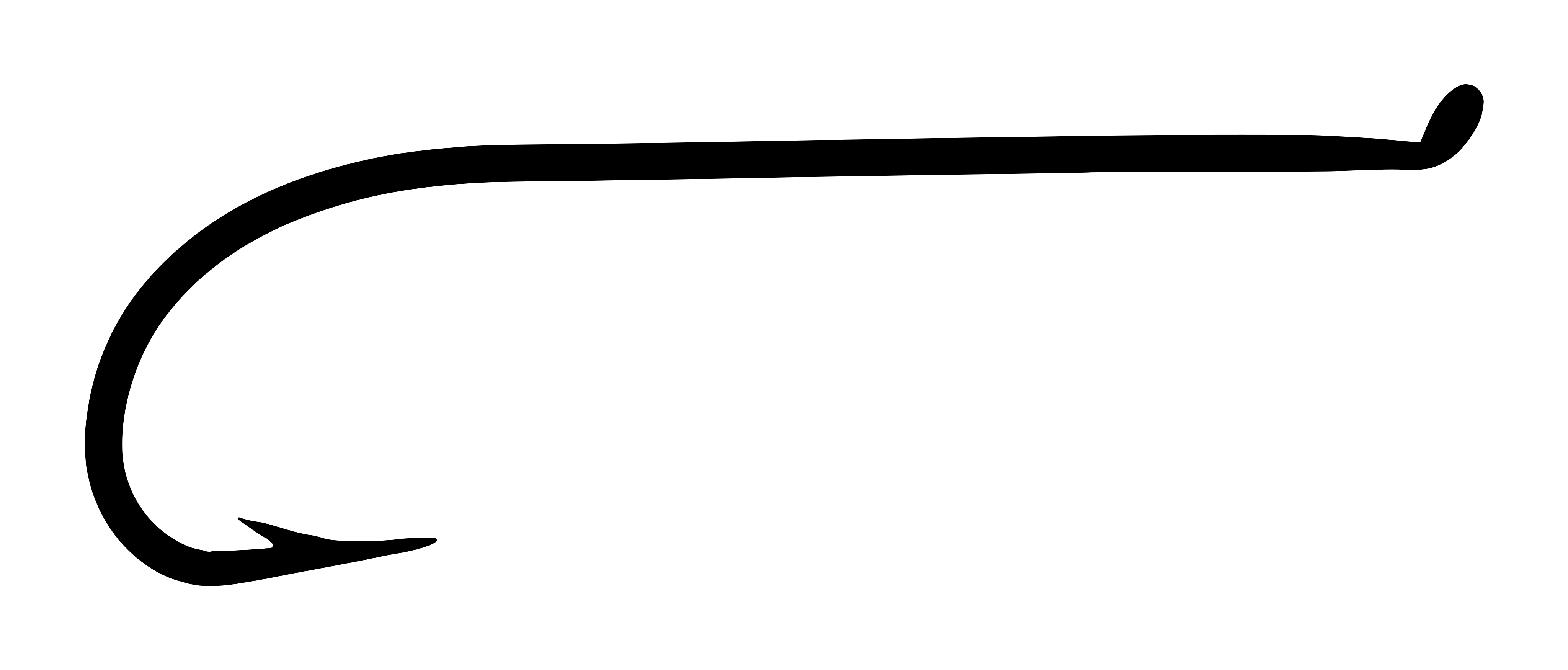
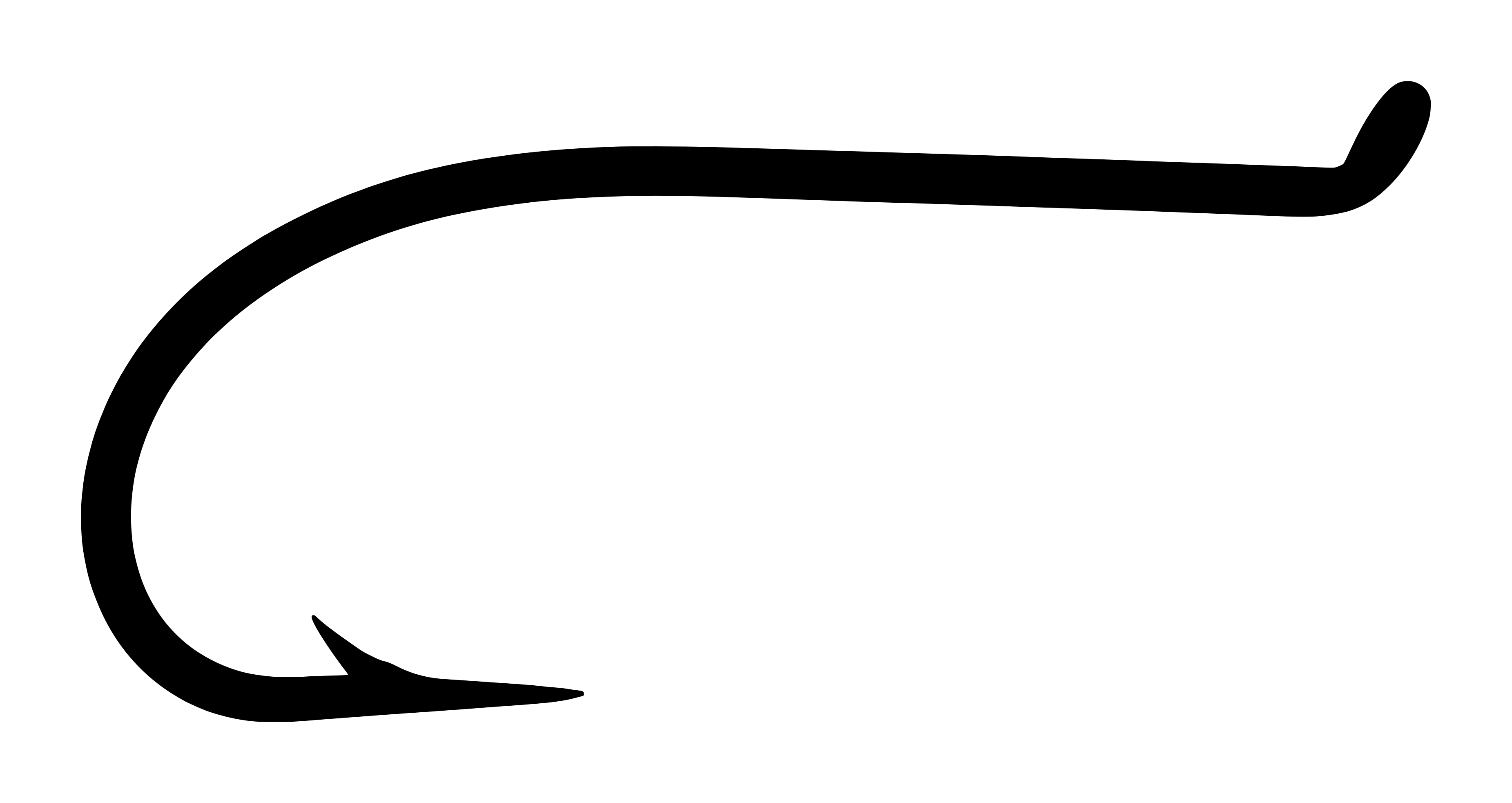
The Mustad 3913 A is a specialized wet fly and small streamer hook manufactured by O. Mustad & Søn of Oslo, Norway, during the 1950s–1960s. This is a premium variant of the iconic Mustad-Sproat bend family, distinguished by its tapered up-eye, 2XL shank length, wide gape, and reversed (kirbed) point offset. The bronzed finish provides moderate corrosion resistance with a warm, muted aesthetic favored by traditional fly tyers.
The model code ‘Qual. 3913 A’ represents Mustad’s mid-tier quality classification — manufactured to exacting dimensional and tempering standards but not the premium-tier codes (4000+). The hollow point geometry ensures rapid penetration with minimal applied pressure, making this hook ideal for soft-mouthed trout and for fly-in-mouth scenarios common in salmon fishing. The reversed offset prevents the hook from laying flat in the fish’s mouth, a historical advantage in heavy-current applications.
Era evidence is compelling: the ‘OSLO – NORWAY’ address confirms post-1925 production (Christiania was renamed to Oslo on January 1, 1925); the Key Brand skeleton-key trademark appears on all export boxes from the 1920s onward; the gold foil star-burst border and cardstock construction are typical of Mustad’s mid-twentieth-century premium boxes; the arbitrary numeric quality code predates the 2001–2009 transition to the Signature Series alpha-numeric system.
For collectors, this hook represents a transitional moment in fly design history when tapered up-eyes were common but beginning to decline in favor of down-eyes. Vintage examples in original packaging command modest premiums, and size 3 specimens are less common than size 10. Modern equivalents include the Mustad Heritage S80 (3906B), though finding a true 2XL, up-eye, reversed hook today requires specialist sources or vintage stock.
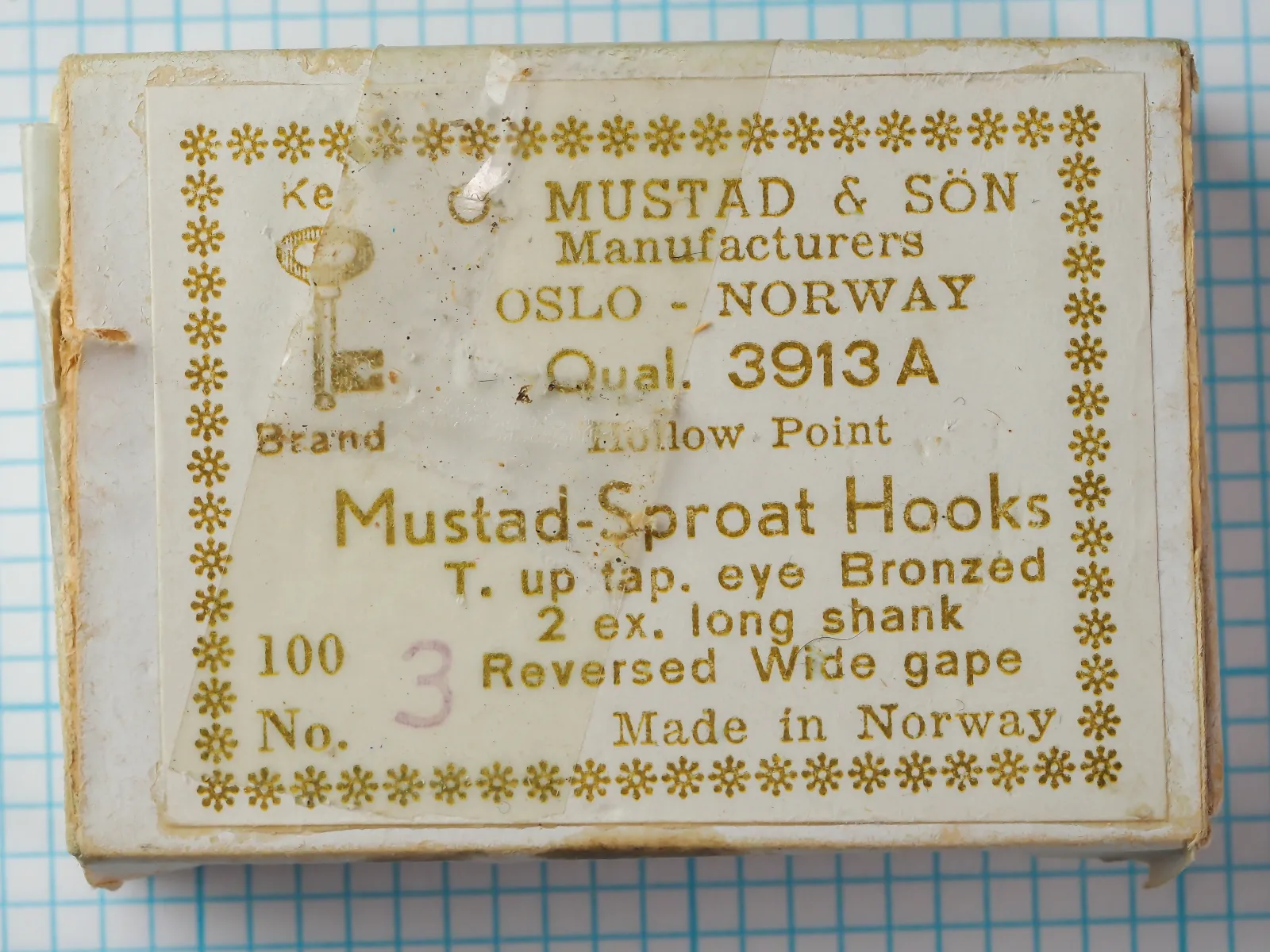
Vintage 100-hook cardstock box for Mustad 3913 A Sproat hooks, size 3, with gold foil star-burst border. Label shows the standard eight-line Mustad typographic format including Oslo-Norway origin, hollow point specification, and bronzed finish.
Photographic record
8 cataloged imagesSelect any record to load it above.
8 images shown
Mustad 3913 A Size 3 Box and LabelVintage 100-hook cardstock box for Mustad 3913 A Sproat hooks, size 3, with gold foil star-burst border. Label shows the standard eight-line Mustad typographic format including Oslo-Norway origin, hollow point specification, and bronzed finish.Open originalMustad 3913 A Size 3 Point DetailClose-up profile of the Mustad 3913 A size 3 hook point, showing the concave hollow-point geometry and rapid flare toward the barb.Open originalMustad 3913 A Size 3 Full Hook ProfileComplete side profile of a Mustad 3913 A size 3 hook on 1/10-inch measurement grid, showing the Sproat bend geometry, tapered up-eye, extended 2XL shank, and wide gape proportions.Open originalMustad 3913 A Size 3 Multiple SpecimensTwo size 3 Mustad 3913 A hooks displayed side-by-side on measurement grid, demonstrating manufacturing consistency and the extended shank proportion of the 2XL variant.Open originalMustad 3913 A Size 10 Box and LabelVintage 100-hook box for Mustad 3913 A size 10, displaying identical label design and specification text to the size 3 variant. Hook size hand-annotated in purple ink as 'No. 10'.Open originalMustad 3913 A Size 10 Point DetailMagnified point profile of the size 10 Mustad 3913 A hook, showing the same hollow-point geometry scaled to the larger size.Open originalMustad 3913 A Size 10 Full Hook ProfileComplete side profile of a size 10 Mustad 3913 A hook on measurement grid, demonstrating the consistent bend geometry and eye style across the size range, with proportionally larger overall dimensions.Open originalMustad 3913 A Size 10 Multiple SpecimensTwo size 10 Mustad 3913 A hooks displayed side-by-side on measurement grid, demonstrating uniform manufacturing and the 2XL extended shank configuration at this larger size.Open original
Technical profile
Turned-Up Tapered Eye | Sproat Bend | 2X Extra-Long Shank | Standard Wire | Hollow Point | Bronzed Finish | Reversed (Kirbed)
Eye
Tapered Eye, Turned Up
Wire
Fine (1X Fine), Round, Est. ~0.030"-0.035" (~0.76-0.89 mm)
Shank
2X Long — Plain
Bend
Sproat, Wide gap, Offset / kirbed
Point
Hollow Point (concave inner face)
Finish
Bronzed — Confirmed (stated on packaging)
Hollow Point Engineering: The concave, dish-out profile of the hollow point creates an extremely fine, razor-sharp tip that flares rapidly toward the barb. This geometry minimizes the force required for initial penetration — critical for soft-mouthed trout and for flies that are mouth-hooked by fish rather than forcefully set by the angler. The rapid flare also prevents oversized entry wounds that could tear during a prolonged fight.
Reversed (Kirbed) Offset: The point is bent laterally off the central shank axis (typically to the left when viewed from above). This prevents the hook from laying flat in the fish’s mouth, improving the probability that the sharp point will immediately engage tissue upon the strike. Historically favored for salmon flies in heavy current where the angler cannot rely on a strong hook-set.
Tapered Up-Eye: The wire is gradually thinned as it forms the terminal loop, reducing mass at the front of the hook. For wet flies, this reduces overall hook weight, allowing the fly to swing more naturally in current. For dry flies, it prevents the fly from tipping nose-first due to excess eye weight.
2XL Shank and Wide Gape: The extended shank provides ample space for longer body materials and improves the ratio of hook length to hook weight, beneficial for streamers and traditional wet fly dressings. The wide gape accommodates bulkier fly bodies and provides superior hooking geometry for larger fish.
We don't have measured sizes for this hook yet. Own one? Submit calipered measurements and we'll review and add them. Thank you!
Historical context
mustad
O. Mustad & Søn was founded in 1832 in Gjøvik, Norway, by Hans Schikkelstad, initially as ‘Brusveen Spiger- og Staltradfabrikk,’ producing basic metal goods including nails and wire. Schikkelstad’s son-in-law, Ole Hovelsen Mustad, and his son Hans Mustad took over the firm and rebranded it as O. Mustad & Søn. The defining moment came in 1877 when Mathias Topp, a company visionary, invented the first fully automated hook-making machine. This mechanization allowed raw steel wire to be continuously fed, cut, bent, barbed, and pointed at unprecedented speed. Rather than filing patents (which would require disclosure), the Mustad family protected their innovation through corporate secrecy, strict non-disclosure agreements, and restricted factory access. By the 1950s, Mustad commanded approximately fifty percent of the global hook production market, with manufacturing and sales operations across multiple continents. The company remained headquartered in Oslo (renamed from Christiania in 1925) and maintained strict operational control over quality and production methods.
Series History
The Mustad-Sproat family represents one of Mustad’s most prolific and globally distributed hook series. The Sproat bend — a parabolic hybrid between the round Aberdeen and angular Limerick patterns — was reverse-engineered by Mustad from Irish regional craft designs and standardized for industrial mass production. The base Sproat pattern was offered in dozens of configurations: multiple eye types (ringed, tapered, looped), multiple finishes (bronzed, tinned, blued, japanned), multiple shank lengths (standard through 4XL), and point variations (hollow, superior, knife edge).
The 3913 A specifically designates the premium wet fly variant: Sproat bend, tapered up-eye, 2XL shank, hollow point, bronzed finish, reversed (kirbed) offset, wide gape. This combination targeted traditional fly tyers working with salmon and steelhead flies. The ‘A’ suffix likely denotes a variant tier within the product family. Mustad produced this configuration continuously from approximately 1930s through the 1970s, eventually discontinuing it as modern fly tying shifted toward down-eyes and lighter wire gauges. The series represents an era when a single foundational pattern (Sproat) could be manufactured in dozens of distinct technical variants to serve highly specialized market niches — a strategy no longer economically viable in modern manufacturing.
Era and Packaging Dating
The 'Oslo – Norway' address on Line 3 of the label establishes a firm post-1925 dating (Oslo was renamed from Christiania on January 1, 1925; pre-1925 boxes read 'CHRISTIANIA – NORWAY'). The Key Brand skeleton-key trademark is present, which is standard on Mustad export labels from the 1920s through 1970s. The gold foil star-burst border design on the cardstock is characteristic of Mustad's premium 100-count box series from the 1950s–1965 era. The arbitrary numeric quality code 'Qual. 3913 A' is pre-transition (Mustad discontinued these codes around 2001–2009 in favor of the Signature Series alpha-numeric system). The absence of a barcode confirms pre-1974 production. The eight-line typographic label format is standard throughout the vintage era. Packaging paper stock and offset printing technique are consistent with mid-twentieth-century cardstock manufacturing. Collectively, these indicators place this hook confidently in the 1950s–1960s window, likely 1950–1965.
The Great Eye Debate: Up vs. Down
The tapered up-eye design on the 3913 A reflects a fascinating historical split in fly hook preferences. British and European fly tyers traditionally favored up-eyes for wet flies and many dry patterns, believing the vertical eye provided a clearer presentation angle and better line clearance. However, by the 1950s–1960s when Mustad was producing these hooks, American fly tying was rapidly shifting toward down-eyes. The 3913 A represents this transitional moment — Mustad manufactured both variants simultaneously to serve different markets. Today, up-eye hooks are experiencing a modest renaissance among traditional and Spey-casting specialists, making vintage examples like this increasingly valued by tyers seeking authentic historical patterns.
Design lineage and influence
Best matchRelated by Attribute
Computed automatically from catalog data — updated as new hooks are added.
Matches: Bend, Shank, Eye, Point, Finish +4 moreDiffers: Wire: Fine (1X Fine) vs Standard; Gap: Wide vs Standard; Eye Orient.: Turned Up vs Turned Down +1 more
Matches: Bend, Wire, Eye, Point, Finish +3 moreDiffers: Shank: 2X Long vs 1X Long; Gap: Wide vs Standard; Eye Orient.: Turned Up vs Turned Down +1 more
Matches: Bend, Eye, Eye Orient., Point, Finish +4 moreDiffers: Shank: 2X Long vs Standard; Wire: Fine (1X Fine) vs Extra-Fine; Gap: Wide vs Standard +1 more
The Mustad 3913 A was engineered as a classic wet fly and small streamer hook for trout and salmon applications. The 2XL shank accommodates longer, more voluminous fly bodies — ideal for traditional patterns such as the Hare’s Ear, Gold-Ribbed Hare’s Ear (GRHE), March Brown wet, and small bucktail or feather-wing streamers. The reversed (kirbed) point geometry was historically favored by Steelhead and Atlantic Salmon fly tyers for swinging flies in heavy current, as the lateral offset was believed to improve hook-up ratios when a fish struck the fly at an angle.
The tapered up-eye design — uncommon in modern hooks — reduces weight at the hook eye, allowing premium dry fly construction with minimal eye mass. However, the hollow point and wide gape configuration suggest the primary market was traditional wet fly and streamer applications rather than delicate dry flies.
Secondary Applications
Light-tackle bait fishing with small minnows or nymphs; historical use in traditional Atlantic Salmon wet fly construction.
Classic Fly Patterns
Hare's Ear, Gold-Ribbed Hare's Ear (GRHE), March Brown (wet), Partridge and Orange, Royal Coachman (wet), Grouse and Claret, small Bucktails, Feather-wing Streamers
Modern Equivalents
Hook
Match Quality
Notes
Mustad Heritage 3906B (S80)
Good
Sproat bend, bronzed finish, standard to 2XL shank options available; modern production equivalent but typically down-eye rather than up-eye
Tiemco 2302
Moderate
Sproat-style bend, extended shank options, tapered eye option available; excellent wire quality but different finish palette
Partridge K12ST
Moderate
Sproat bend, tapered eye, extended shank; Redditch-made heritage hook with similar traditional aesthetic but finer wire gauge
Collector notes
Rated 4.0/10 — a specialized variant with moderate collector interest. The 2XL tapered up-eye configuration is less common than standard Sproat hooks, and the reversed (kirbed) offset appeals to salmon/steelhead fly specialists. Larger sizes (10, 13) are readily available; smaller sizes (3, 6) command modest premiums. Complete original packaging in good condition adds 30-50% to loose hook value.
Reference value
$10 – $13 USD estimate
Packaging condition
Good — moderate wear, legibleRecorded specimen
Packaging format
GW-MUS-CARD-01Catalog code
Positive factors: Vintage 1950s–1960s Oslo-labeled Mustad with Key Brand trademark; tapered up-eye design highly desirable to traditional fly tyers; reversed (kirbed) point favored for heavy-current salmon applications; bronzed finish authentic to era; 2XL shank length specialized for streamer/wet fly construction.
Limiting factors: Mustad mass-produced at scale — overall scarcity is modest even for size 3; modern equivalents readily available; post-war production dating limits pre-1940 collectibility premium; standard Sproat bend (non-proprietary) reduces uniqueness.
Most desirable variants: Size 3 in complete original box with all 100 hooks; any size with intact tapered eye (eyes occasionally damaged in handling); bronzed finish preferred over later tinned variants. Size 10 examples common and less sought.
Condition factors: Hooks must retain original tapered eye taper and sharp point for full value. Corrosion or dulled points reduce value 20-30%. Original packaging condition is critical — sealed or very good boxes command 40-60% premium; opened or missing hooks reduce value 50-70%. Price-sensitive collectors accept good condition boxes with 1–3 missing hooks at moderate discount.
Packaging
Vintage 100-hook cardstock box with gold foil star-burst border design. Label printed in gold ink on cream-colored cardstock. Eight-line typographic label format per Mustad standards: manufacturer (O. MUSTAD & SÖN), function (MANUFACTURERS), location (OSLO - NORWAY), quality code (Qual. 3913 A), point type (Hollow Point), pattern (Mustad-Sproat Hooks), features (T. up tapered eye, Bronzed, 2 ex. long shank, Reversed, Wide gape), origin (Made in Norway). Hook size hand-annotated in purple ink (No. 3 or No. 10 variant observed). Box exhibits light toning and minor edge wear consistent with 60+ year storage.
Market Value Notes
Low ($10): Good condition — opened package, 95+ hooks present, card shows handling wear. High ($13): Excellent condition — sealed or near-sealed box, all 100 hooks present, minimal edge wear. Premium factors: Size 3 (scarcer than 10, +$2–3); complete original box condition (+$2–3); tapered up-eye intact and bright (+$1–2). Platforms: eBay sold listings show consistent $9.99–$12.99 range (4 sold listings Apr 2025–Apr 2026); eBay market history avg $9.49, range $5.00–$15.59 over 12-month period. Confidence: V verified — based on 4 eBay sold listings and 12-month market aggregate data, Apr 11, 2025 – Apr 11, 2026, avg price $9.49.
Where to Find
eBay (US and UK) most common source; search 'Mustad 3913 A' or 'Mustad Sproat tapered eye.' Typical listings show 100-hook boxes at $9.99–$12.99. Specialty fly fishing dealers occasionally stock vintage Mustad boxes; check vintage tackle sections at regional fly fishing shows. UK tackle fairs may have better selection of Oslo-labeled examples due to British vintage Mustad distribution networks.
eBay market reference. Researcher-curated. Prices in USD. Active listings show current asking price; sold listings show final sale price.
Preservation
Storage and Preservation
Store the Mustad 3913 A in a cool, dry environment away from moisture and humidity. The bronzed finish is susceptible to patina development and eventual surface corrosion with prolonged humidity exposure; however, collectors often consider patina development to be a desirable aging marker on vintage hooks. Original cardstock packaging should be preserved as-is rather than removed — the box adds 30–50% to the value of loose hooks and serves as authentic documentation of era and specifications.
Avoid contact between the hooks and other metals to prevent galvanic corrosion. If displaying the hooks on a shelf or in a collection case, keep them away from iron or steel objects. The tapered up-eye is more delicate than standard ringed eyes — handle with care to avoid bending the fine terminal wire loop.
If corrosion begins to develop on the hooks themselves, gentle dry-brushing with a soft brass brush or pencil eraser can remove surface rust without damaging the bronzed finish. Do not use aggressive chemicals or wire wheels, which will strip the protective lacquer and bronze coating. For boxes, avoid direct sunlight, which will fade the gold foil printing; store flat or upright in acid-free storage boxes if archival preservation is desired.
Marking Analysis
Handwritten Annotations
Both the size 3 and size 10 specimens exhibit purple-ink handwritten annotations of the hook size (‘No. 3’ and ‘No. 10’ respectively) in the lower left corner of the label. These annotations appear to be post-manufacturing markings, likely applied by a warehouse, distributor, or retailer for inventory purposes. The handwriting is consistent in style and pressure across both examples, suggesting a single person or small organization was responsible for marking the boxes.
Such handwritten size annotations were common practice in the mid-twentieth century before barcode standardization (post-1974). The annotations do not indicate damage to the product itself and actually provide evidence of hands-on distribution and handling — a mark of authenticity for vintage tackle. The purple ink has not faded significantly despite 60+ years of storage, consistent with period-appropriate fountain pen or ballpoint pen technology.
Primary Source
Label Text Decryption — Eight-Line Mustad Standard
Source: A Comprehensive Typology and Decryption of Vintage O. Mustad & Søn Hook Labels
The Mustad 3913 A label adheres strictly to the standardized eight-line typographic format documented in the official Mustad reference materials (referenced document: ‘A Comprehensive Typology and Decryption of Vintage O. Mustad & Søn Hook Labels’).
Line 1: O. MUSTAD & SÖN — Manufacturer identity, establishing primary origin as the Norwegian parent company rather than a regional distributor or agent.
Line 2: MANUFACTURERS — Functional designation, differentiating Mustad as the direct manufacturer rather than an import agent or jobber. This was historically imperative in an era when regional distributors frequently repackaged bulk hooks under secondary brand names.
Line 3: OSLO – NORWAY — Geographic origin. The ‘OSLO’ designation (not ‘CHRISTIANIA’) establishes post-January 1, 1925 manufacture with confidence. Hooks labeled ‘CHRISTIANIA’ predate 1925. This is the most reliable chronological bracket available from packaging alone.
Line 4: Qual. 3913 A — Quality code and tier designation. Mustad’s numeric hierarchy: 1000–2999 (economy models); 3000–3999 (quality/mid-tier, which is the 3913 A classification); 4000+ (premium). The ‘A’ suffix likely denotes a variant within the quality-tier family.
Line 5: Hollow Point — Exclusively reserved by Mustad standards for point geometry specification. This concave, dished-out profile is distinct from the ‘Superior Point’ (near-straight taper) and defines the hook’s penetration mechanics.
Line 6: Mustad-Sproat Hooks — Pattern name, identifying the overarching bend family and shank proportion. The Sproat is a parabolic hybrid between round and angular bends, favored for wet flies and streamers.
Lines 7–8: T. up tap. eye Bronzed | 2 ex. long shank Reversed Wide gape | Made in Norway — Anatomical and finish modifiers. The tapered up-eye is explicitly called out (T. up tap. eye), the bronzed finish provides moderate corrosion resistance, the 2 ex. (extra) long shank extends the profile for larger fly bodies, the ‘Reversed’ (kirbed) offset laterally deflects the point, and the ‘Wide gape’ specifies the gap distance between point and shank.
Bottom corner: 100 No. [size] — Quantity (overwhelmingly 100 for standard retail/wholesale boxes) and physical hook size (standard industry numeric scaling: 16, 12, 8, 6, 4, 2, 1, 1/0, etc.).
The presence of this arbitrary numeric quality code (3913 A) is the definitive hallmark of true vintage Mustad. The company discontinued these codes around 2001–2009 in favor of the modern Signature Series alpha-numeric system (e.g., ‘R50’ = Round bend, 5=standard weight, 0=standard shank). Any Mustad box bearing the classic numeric ‘Qual.’ code belongs to the vintage era.
Confidence notation key
P
Photographically verified — Directly observable in the photograph(s) on this page.
V
Verified by documentation — Confirmed by manufacturer catalog, spec sheet, or published reference.
I
Inferred — A logical deduction from observable or documented evidence, not directly stated.
E
Estimated — An approximation based on visual comparison, proportional analysis, or limited data.
S
Speculative — A reasoned hypothesis that cannot be confirmed from available evidence.
Claims with no notation are confirmed by multiple independent sources. All photographs on garrenwood.com are taken on a measurement grid where each square equals 1/10 inch (0.1″ / 2.54 mm).